The sublime & awe
Featured Artworks
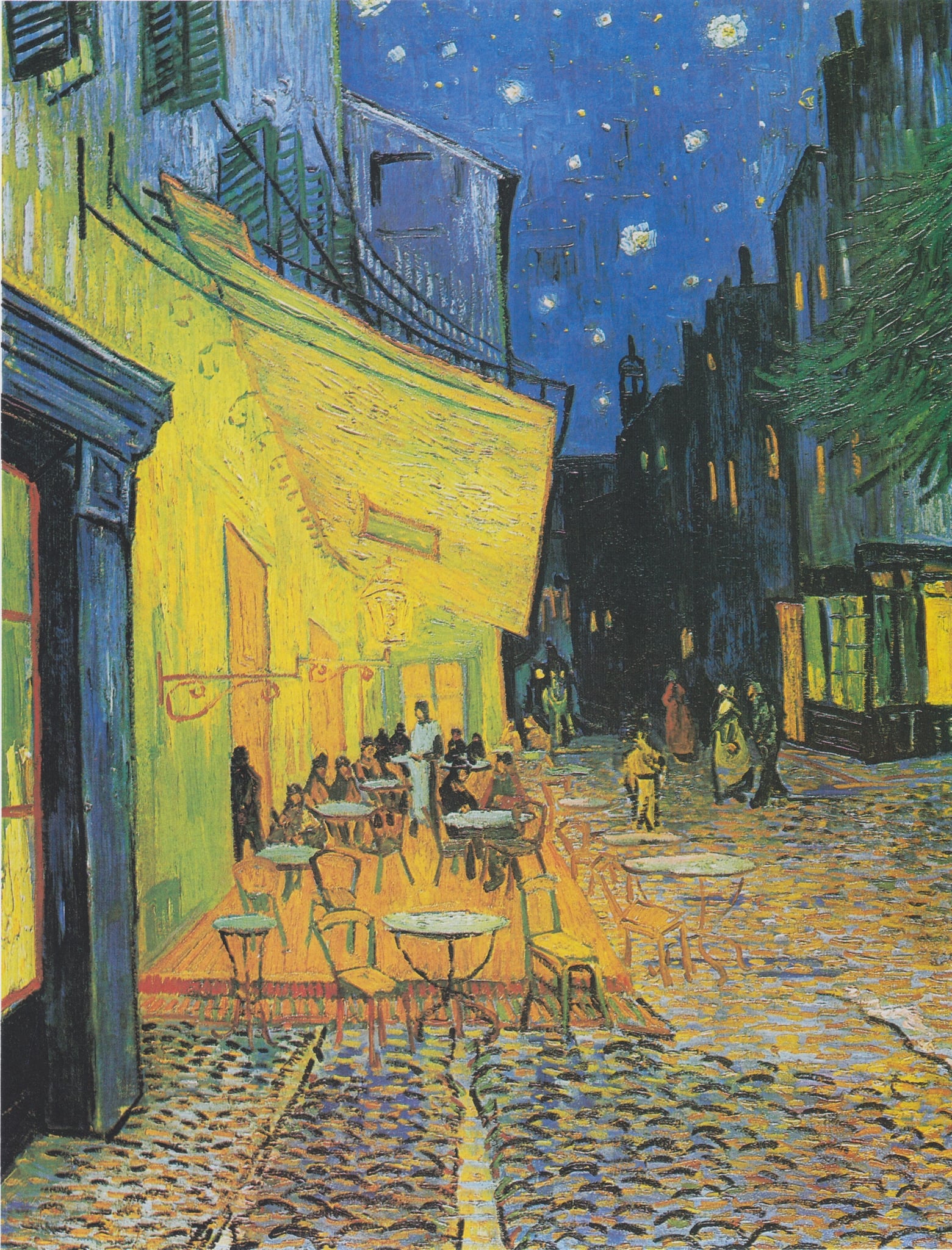
Café Terrace at Night
Vincent van Gogh (1888)
In Café Terrace at Night, Vincent van Gogh turns nocturne into <strong>luminous color</strong>: a gas‑lit terrace glows in yellows and oranges against a deep <strong>ultramarine sky</strong> pricked with stars. By building night “<strong>without black</strong>,” he stages a vivid encounter between human sociability and the vastness overhead <sup>[1]</sup><sup>[2]</sup>.
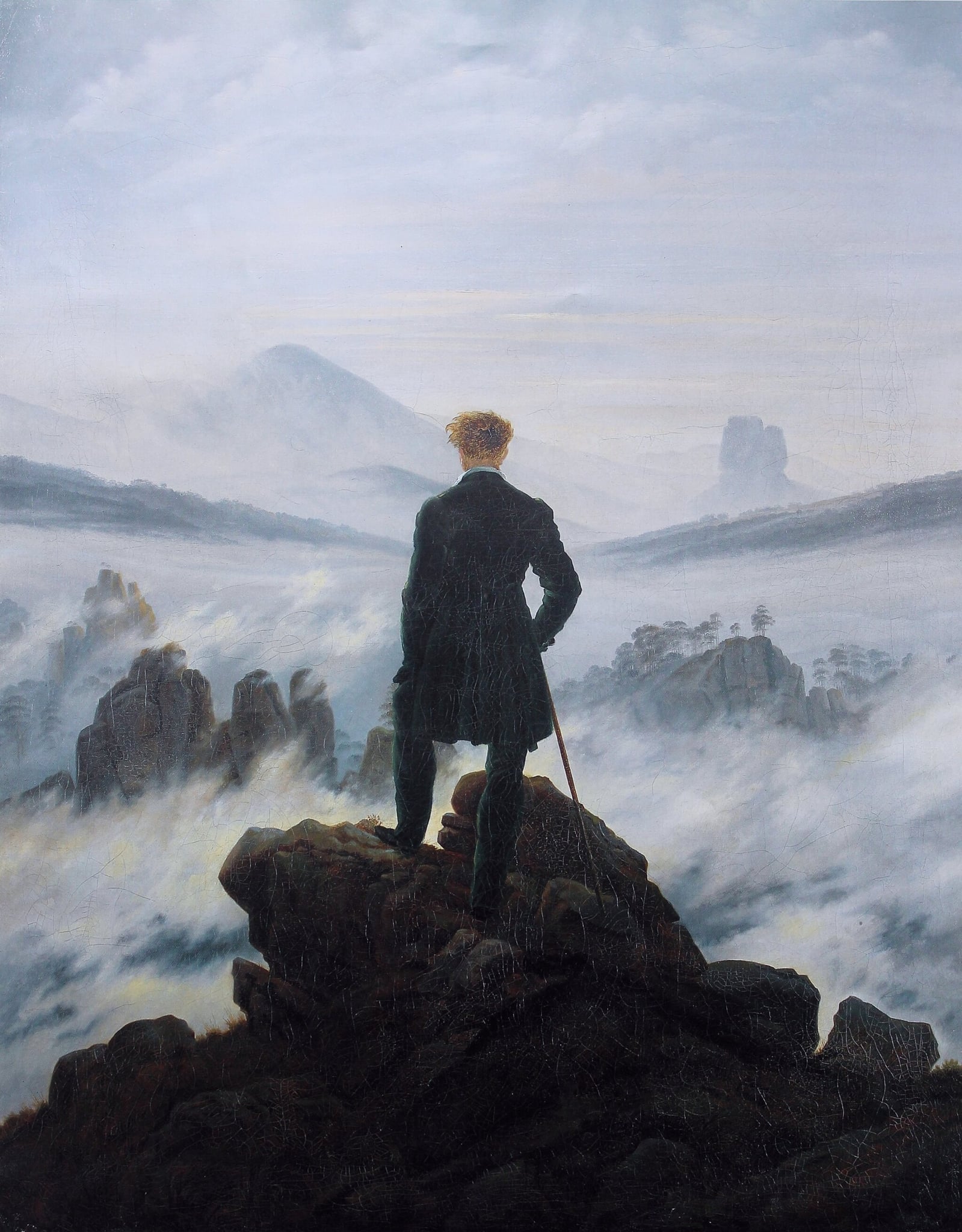
Wanderer above the Sea of Fog
Caspar David Friedrich (ca. 1817)
A solitary figure stands on a jagged crag above a churning <strong>sea of fog</strong>, his back turned in the classic <strong>Rückenfigur</strong> pose. Caspar David Friedrich transforms the landscape into an inner stage where <strong>awe, uncertainty, and resolve</strong> meet at the edge of perception <sup>[3]</sup><sup>[5]</sup>.
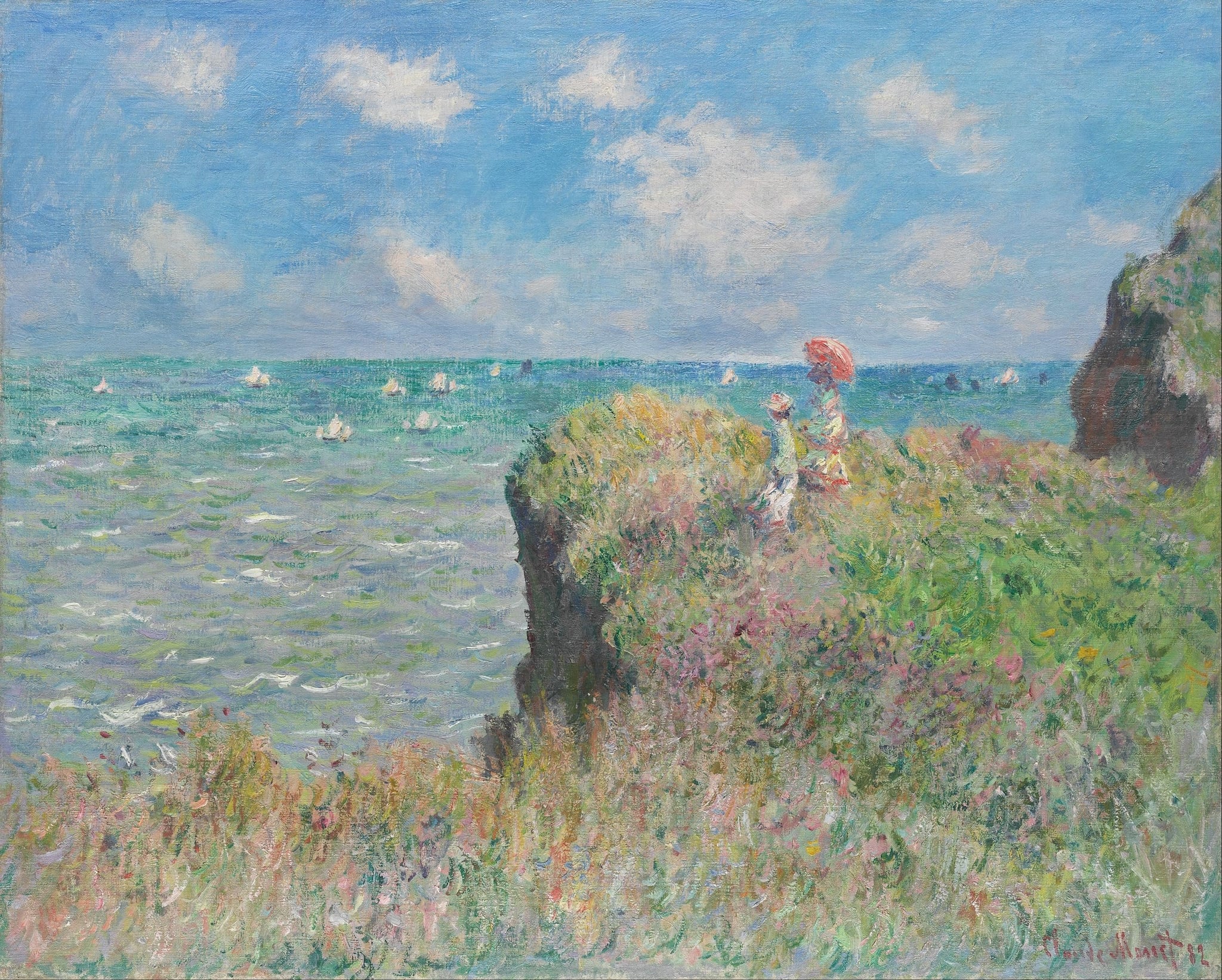
The Cliff Walk at Pourville
Claude Monet (1882)
Claude Monet’s The Cliff Walk at Pourville renders wind, light, and sea as interlocking forces through <strong>shimmering, broken brushwork</strong>. Two small walkers—one beneath a pink parasol—stand near the <strong>precipitous cliff edge</strong>, their presence measuring the vastness of turquoise water and bright sky dotted with white sails. The scene fuses leisure and the <strong>modern sublime</strong>, making perception itself the subject <sup>[1]</sup><sup>[2]</sup>.
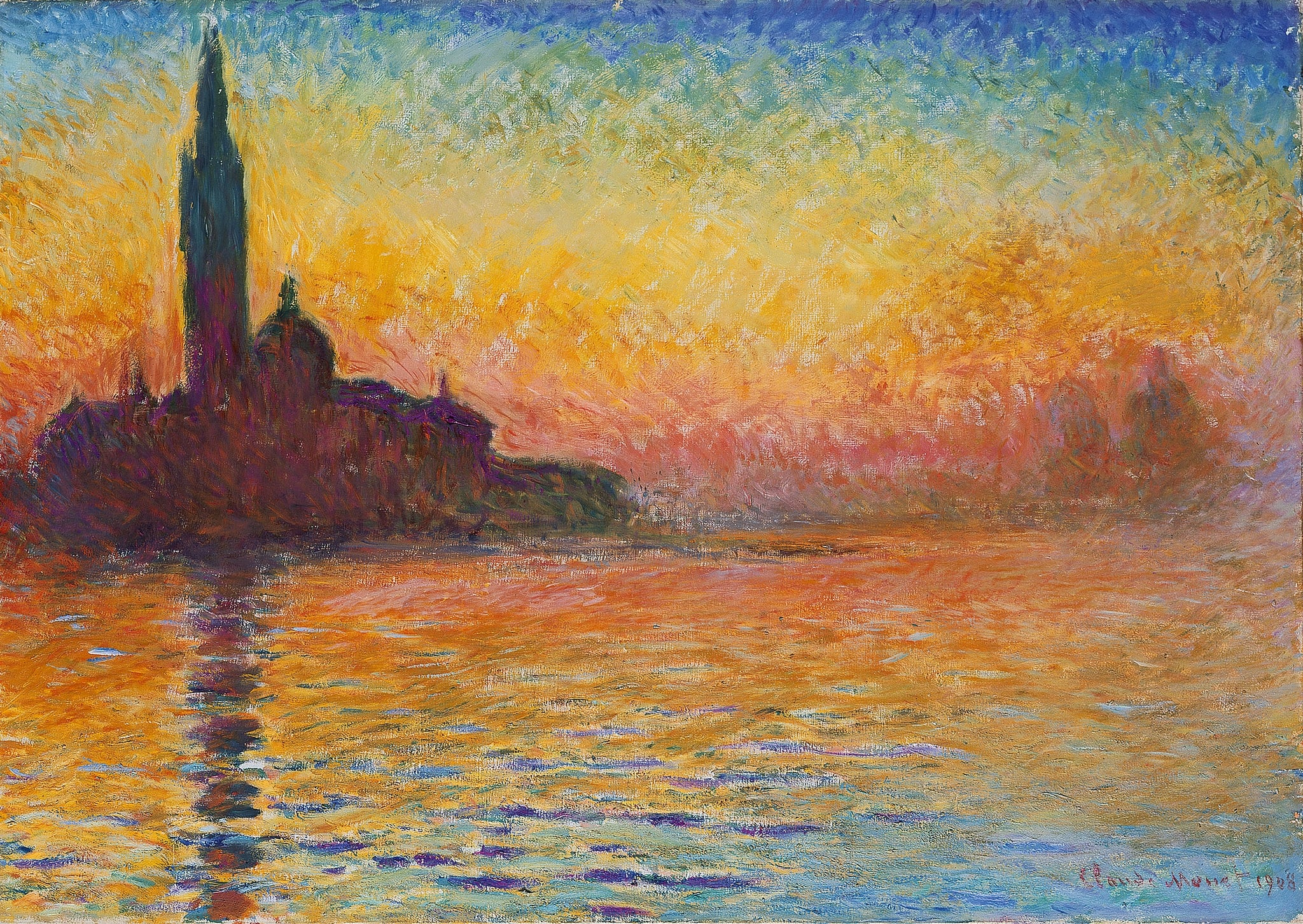
San Giorgio Maggiore at Dusk
Claude Monet (1908–1912)
Claude Monet’s San Giorgio Maggiore at Dusk fuses the Benedictine church’s dark silhouette with a sky flaming from apricot to cobalt, turning architecture into atmosphere. The campanile’s vertical and its wavering reflection anchor a sea of trembling color, staging a meditation on <strong>permanence</strong> and <strong>flux</strong>.
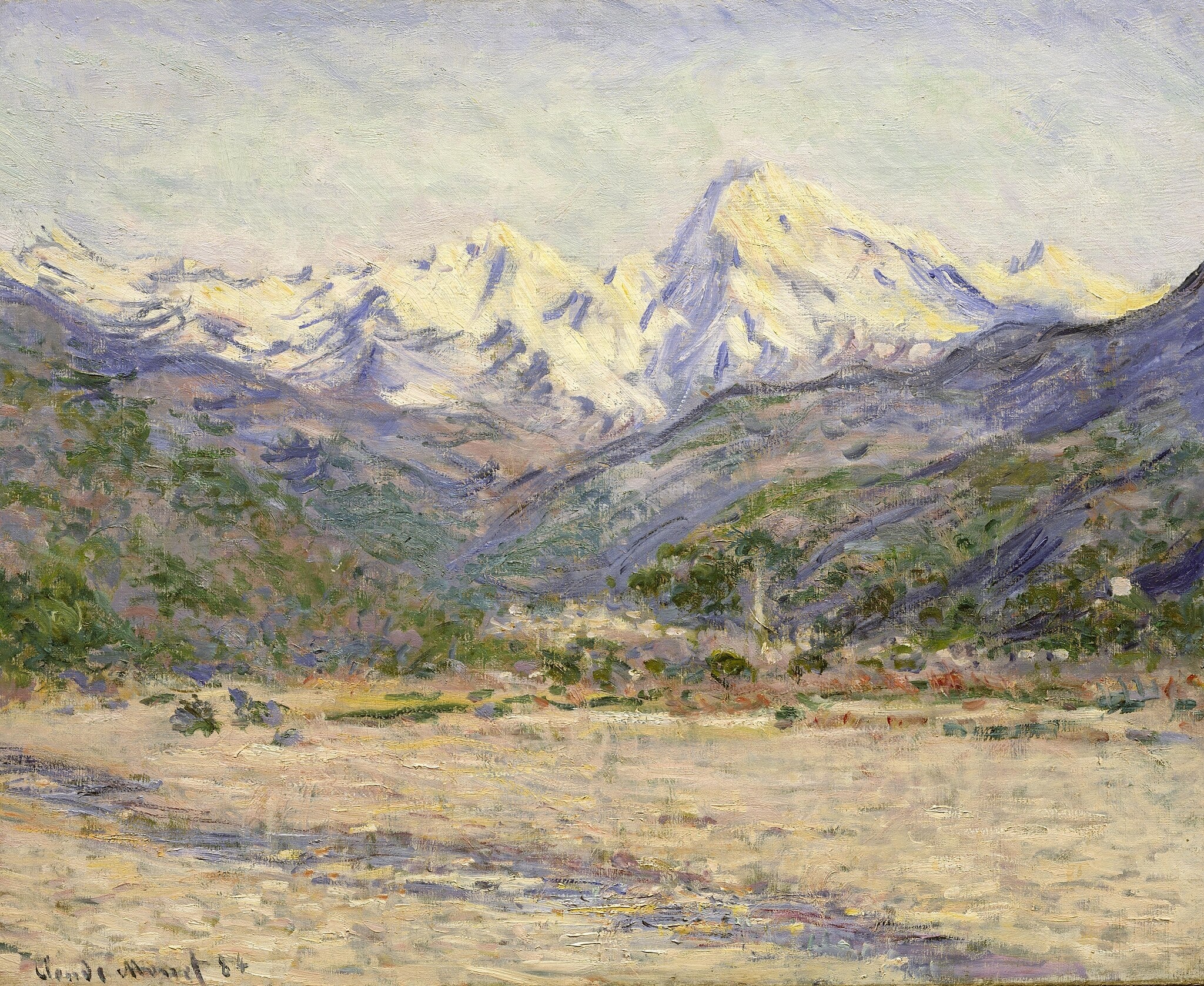
The Valley of the Nervia
Claude Monet (1884)
Claude Monet’s The Valley of the Nervia is a high‑key meditation on <strong>atmosphere as structure</strong>: snow‑lit Maritime Alps rise above a pale, stony riverbed, their mass defined by air and light rather than contour. Through quick, broken strokes of <strong>violet, blue, and lemon</strong>, Monet fuses fleeting afternoon shimmer with the valley’s geologic permanence <sup>[1]</sup><sup>[2]</sup>.
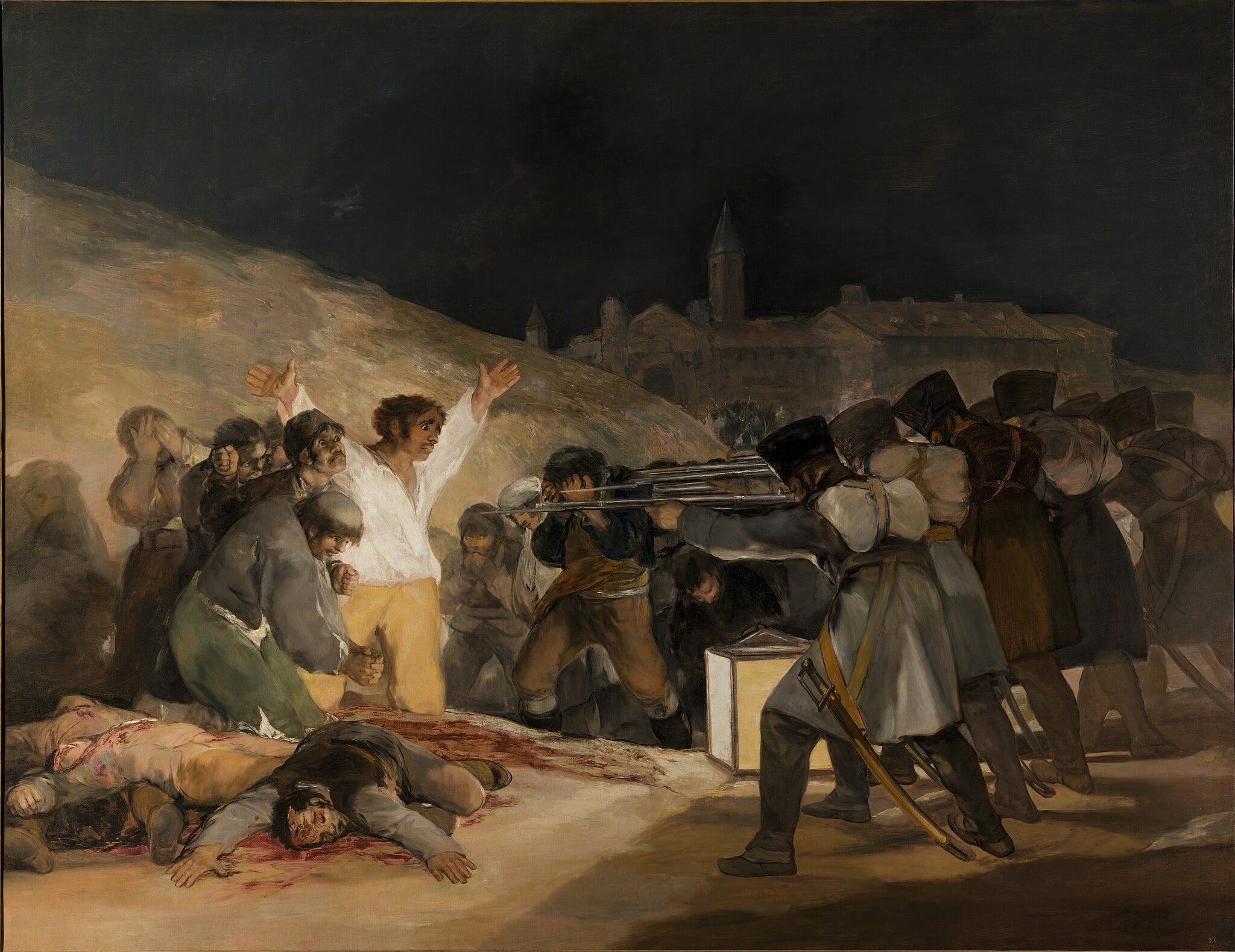
The Third of May 1808
Francisco Goya (1814)
Francisco Goya’s The Third of May 1808 turns a specific reprisal after Madrid’s uprising into a universal indictment of <strong>state violence</strong>. A lantern’s harsh glare isolates a civilian who raises his arms in a <strong>cruciform</strong> gesture as a faceless firing squad executes prisoners, transforming reportage into <strong>modern anti-war testimony</strong> <sup>[1]</sup><sup>[2]</sup>.
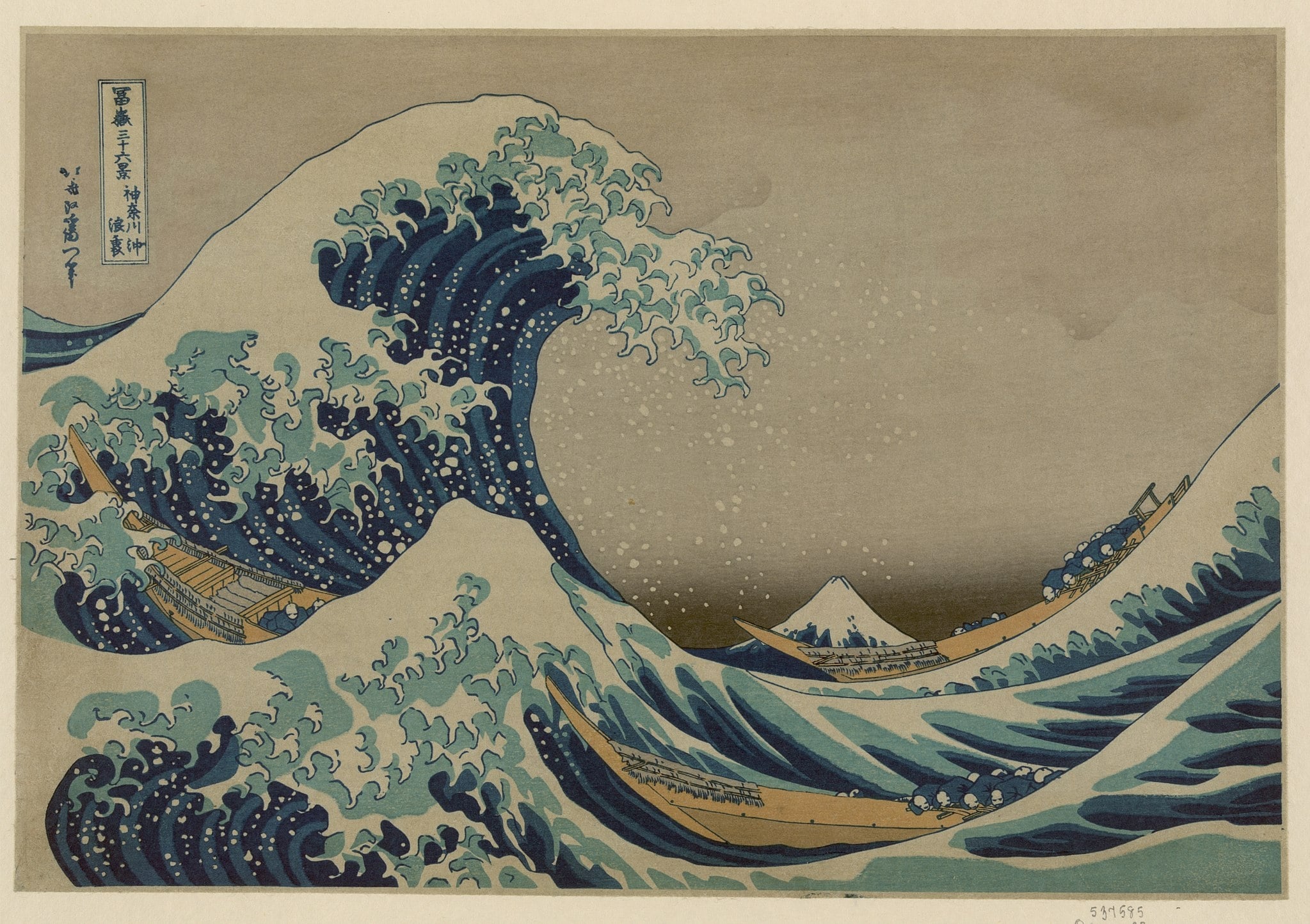
The Great Wave off Kanagawa
Hokusai (ca. 1830–32)
The Great Wave off Kanagawa distills a universal drama: fragile laboring boats face a <strong>towering breaker</strong> while <strong>Mount Fuji</strong> sits small yet immovable. Hokusai wields <strong>Prussian blue</strong> to sculpt depth and cold inevitability, fusing ukiyo‑e elegance with Western perspective to stage nature’s power against human resolve <sup>[1]</sup><sup>[3]</sup>.
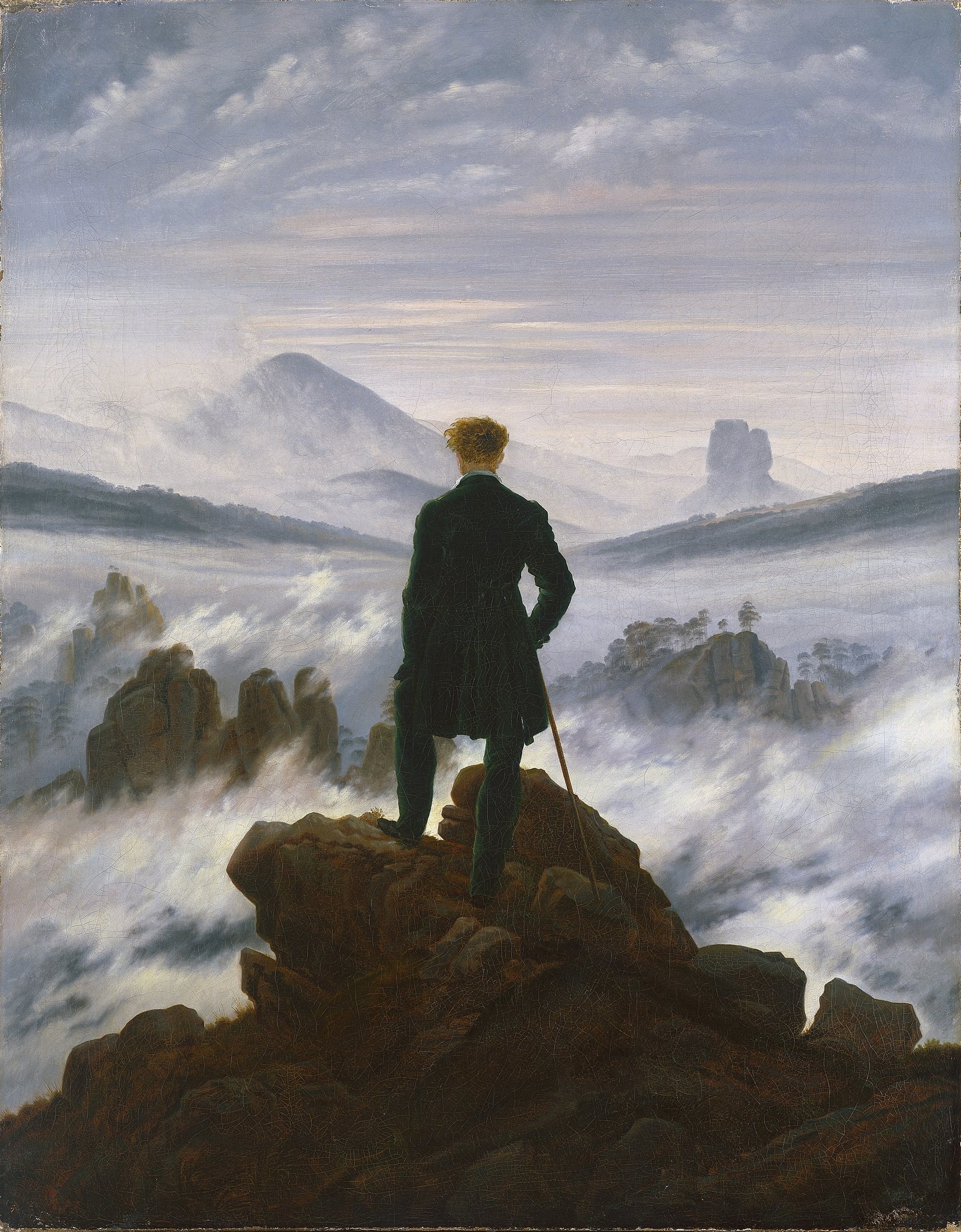
The Wanderer above the Sea of Fog
Caspar David Friedrich (ca. 1817)
Caspar David Friedrich’s The Wanderer above the Sea of Fog distills the Romantic encounter with nature into a single <strong>Rückenfigur</strong> poised on jagged rock above a rolling <strong>sea of mist</strong>. The cool, receding vista and the figure’s still stance convert landscape into an <strong>inner drama of contemplation</strong> and the <strong>sublime</strong> <sup>[1]</sup><sup>[3]</sup>.
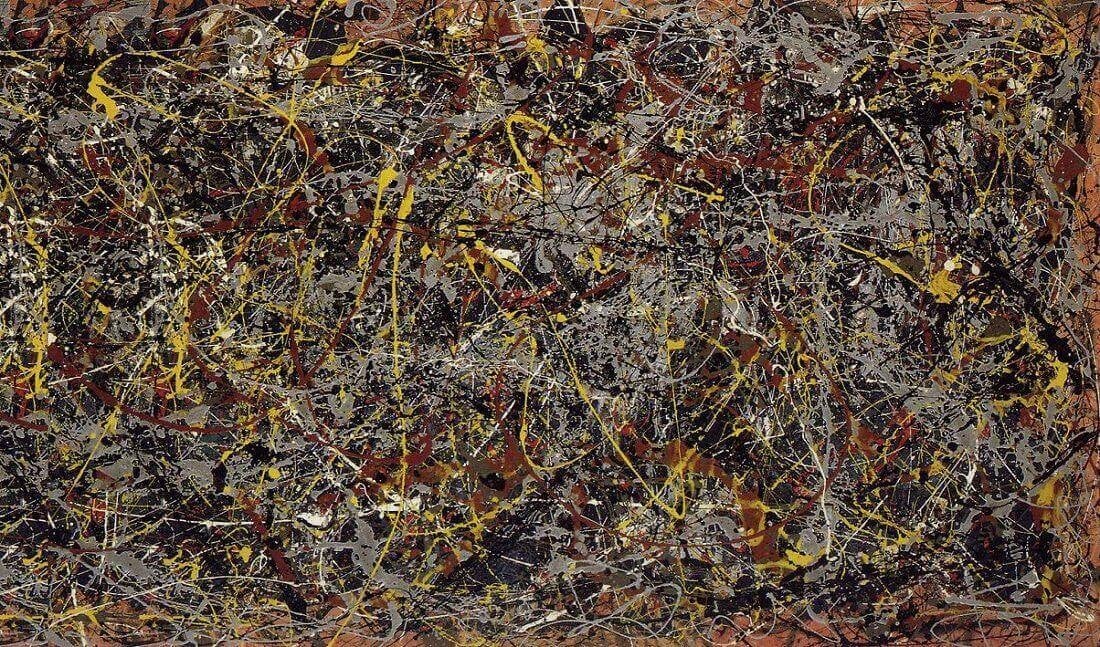
No. 5, 1948
Jackson Pollock (1948)
<strong>No. 5, 1948</strong> is a large, floor‑painted field of poured enamel where tangled skeins of black, gray, umber, and bursts of yellow span the entire support. Its <strong>all‑over</strong> structure rejects a central motif, turning the painting into a record of motion and material behavior. The result is a charged surface that reads as both <strong>image and event</strong> <sup>[1]</sup><sup>[2]</sup><sup>[3]</sup>.
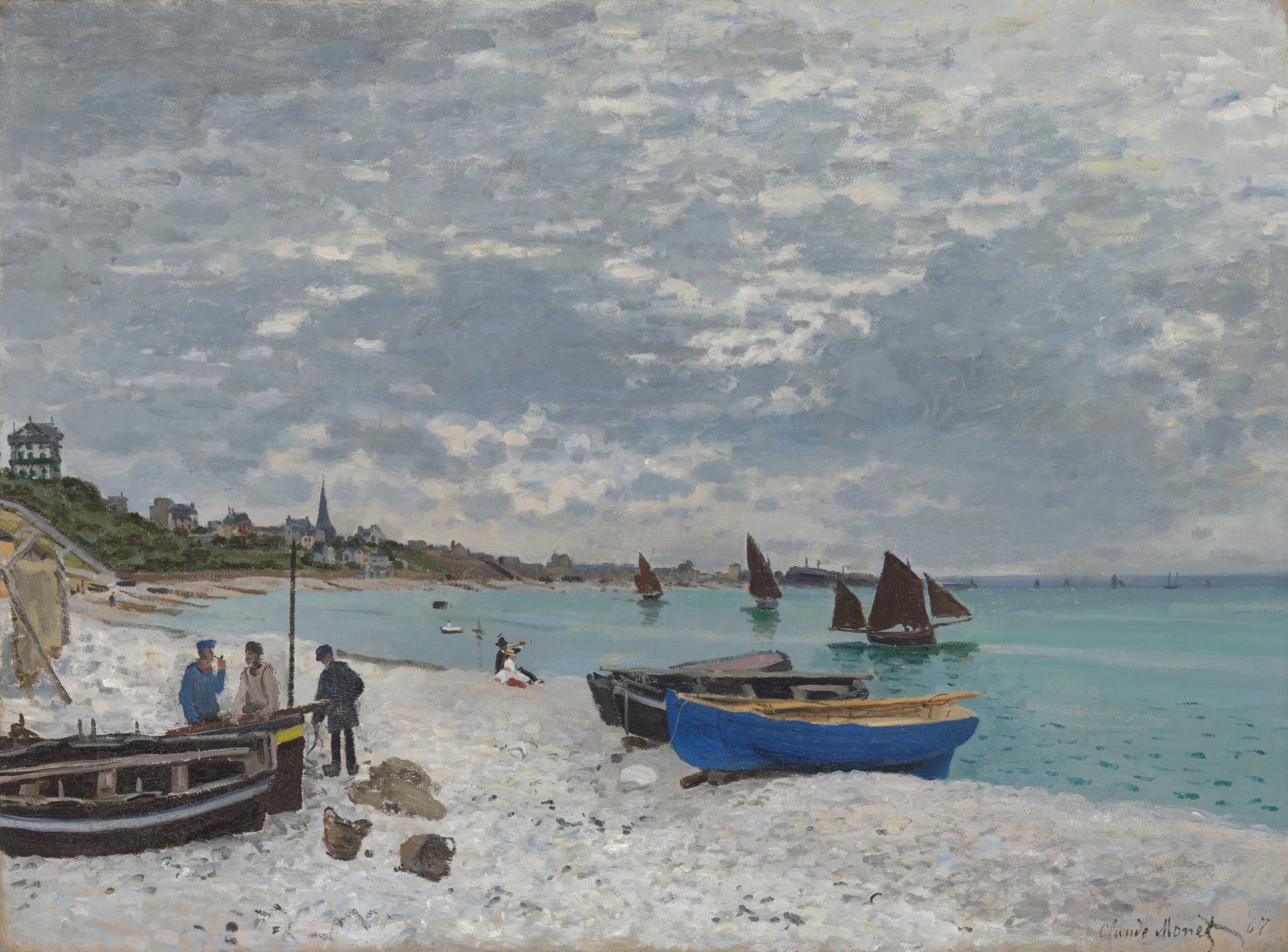
The Beach at Sainte-Adresse
Claude Monet (1867)
In The Beach at Sainte-Adresse, Claude Monet stages a modern shore where <strong>labor and leisure intersect</strong> under a broad, changeable sky. The bright <strong>blue beached boat</strong> and the flotilla of <strong>rust-brown working sails</strong> punctuate a turquoise channel, while a fashionably dressed pair sits mid-beach, spectators to the traffic of the port. Monet’s brisk, broken strokes make the scene feel <strong>caught between tides and weather</strong>, a momentary balance of work, tourism, and atmosphere <sup>[1]</sup><sup>[2]</sup>.
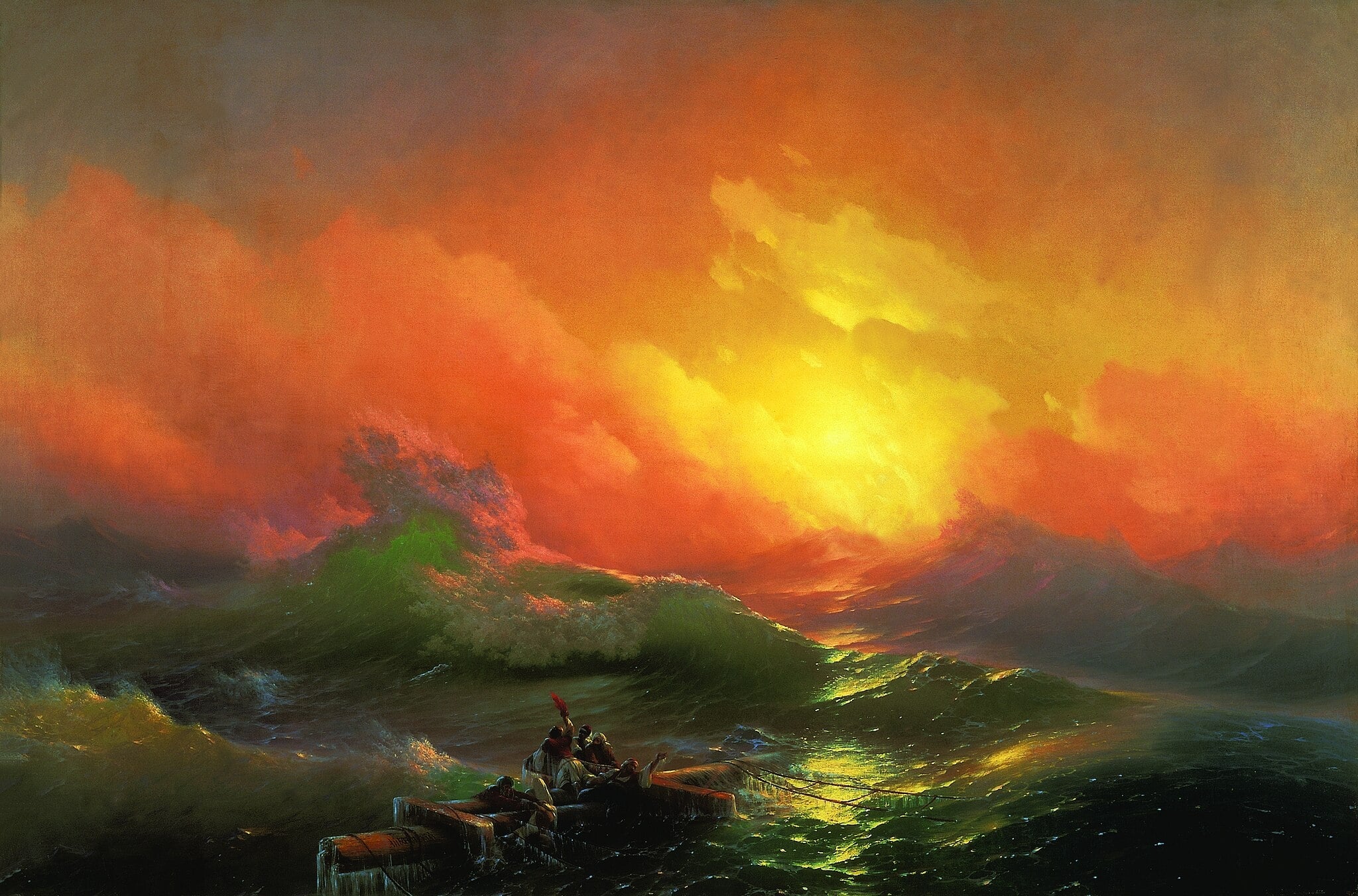
The Ninth Wave
Ivan Aivazovsky (1850)
The Ninth Wave stages a struggle between annihilation and deliverance on a heaving sea, where survivors cling to a cross‑shaped raft under a <strong>molten dawn</strong>. Aivazovsky turns light into a <strong>redemptive force</strong>, cutting a golden path across emerald waves that both threaten and guide the castaways <sup>[1]</sup><sup>[3]</sup>.
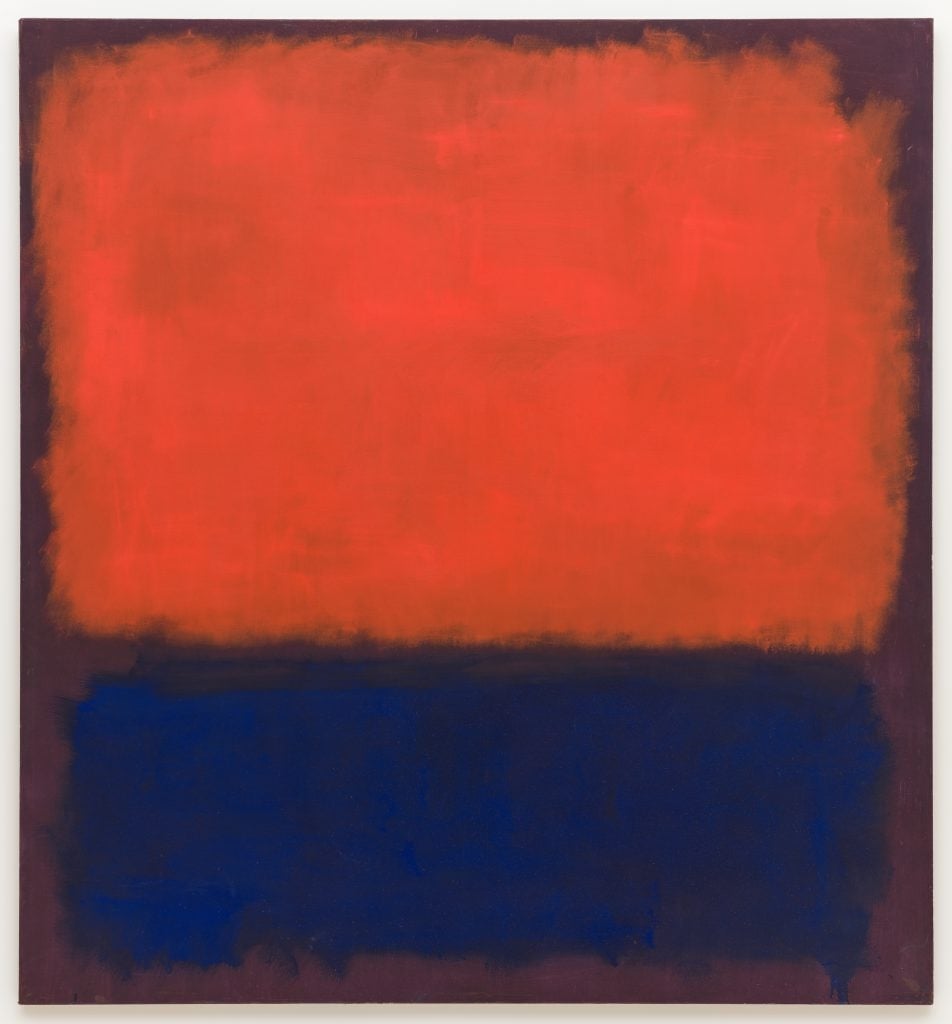
No. 14
Mark Rothko (1960)
In No. 14, 1960, Mark Rothko stages a charged encounter between a vast, <strong>ember-like red-orange</strong> plane and a weighty, <strong>indigo-blue</strong> band that nearly tips into black. The softly frayed borders and faint <strong>plum-violet</strong> surround cause the colors to hover and breathe, converting sheer scale and chroma into felt experience rather than depiction <sup>[1]</sup>.
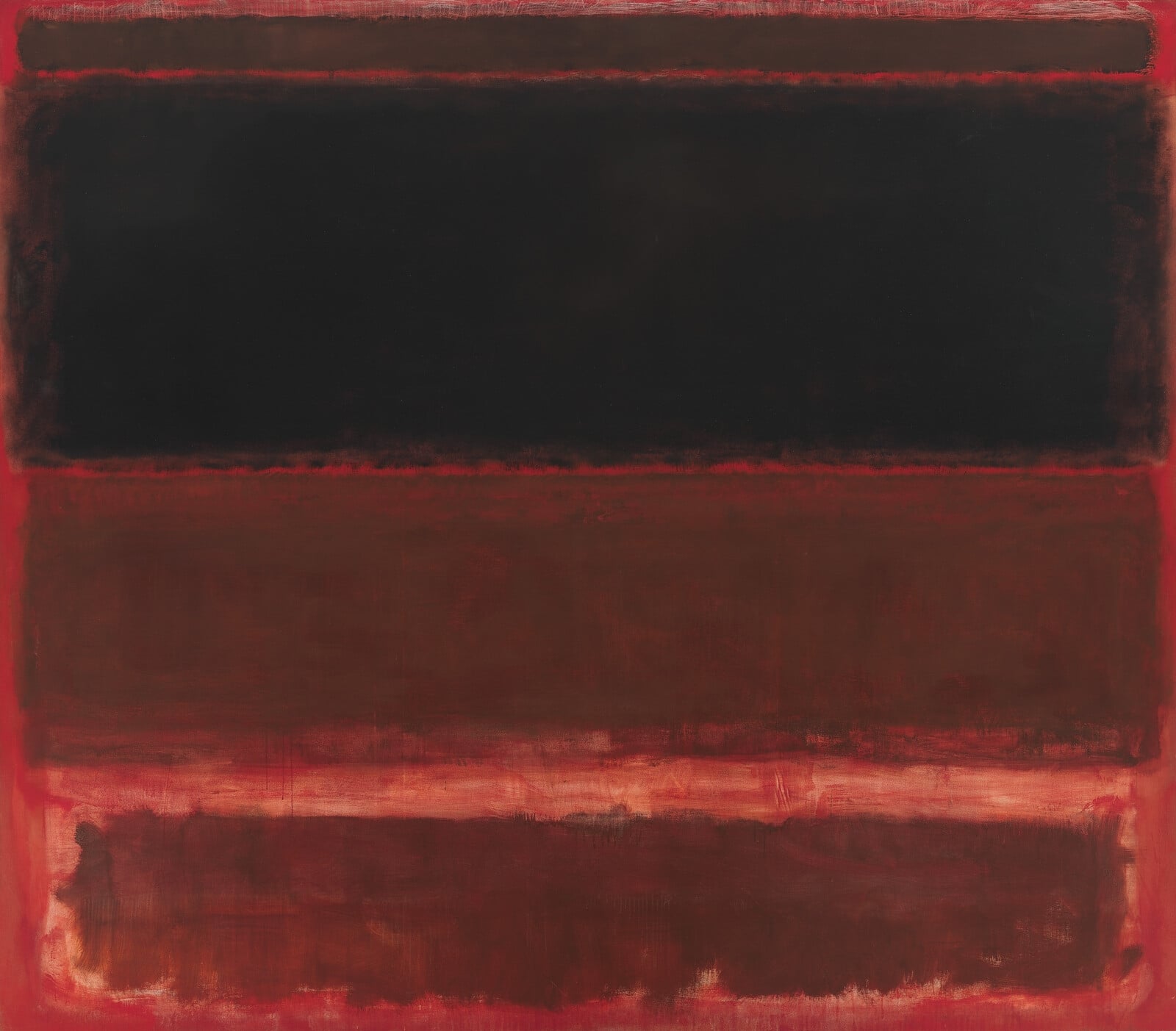
Four Darks in Red
Mark Rothko (1958)
Four Darks in Red stages four hovering bands within a smoldering red field to generate an <strong>immersive, solemn atmosphere</strong>. Thinly layered washes and feathered edges make the dark zones <strong>throb like thresholds</strong>, suspending viewers between weight and glow <sup>[1]</sup><sup>[4]</sup>. Painted in 1958 at monumental scale, it aligns with Rothko’s late‑’50s turn to wine‑dark, enclosing spaces <sup>[1]</sup><sup>[2]</sup>.
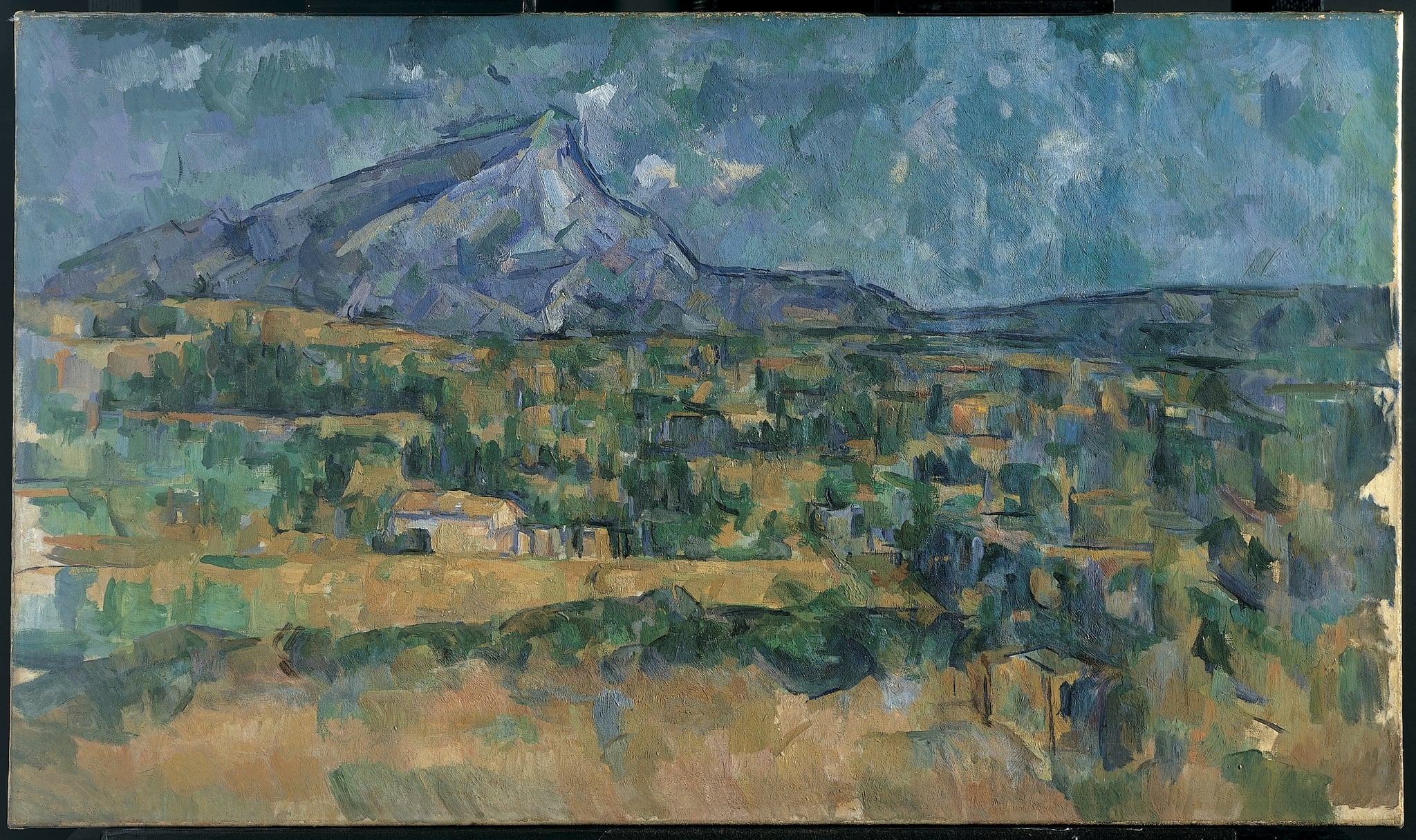
Mont Sainte-Victoire
Paul Cézanne (1902–1906)
Cézanne’s Mont Sainte-Victoire renders the Provençal massif as a constructed order of <strong>planes and color</strong>, not a fleeting impression. Cool blues and violets articulate the mountain’s facets, while <strong>ochres and greens</strong> laminate the fields and blocky houses, binding atmosphere and form into a single structure <sup>[2]</sup><sup>[4]</sup>.
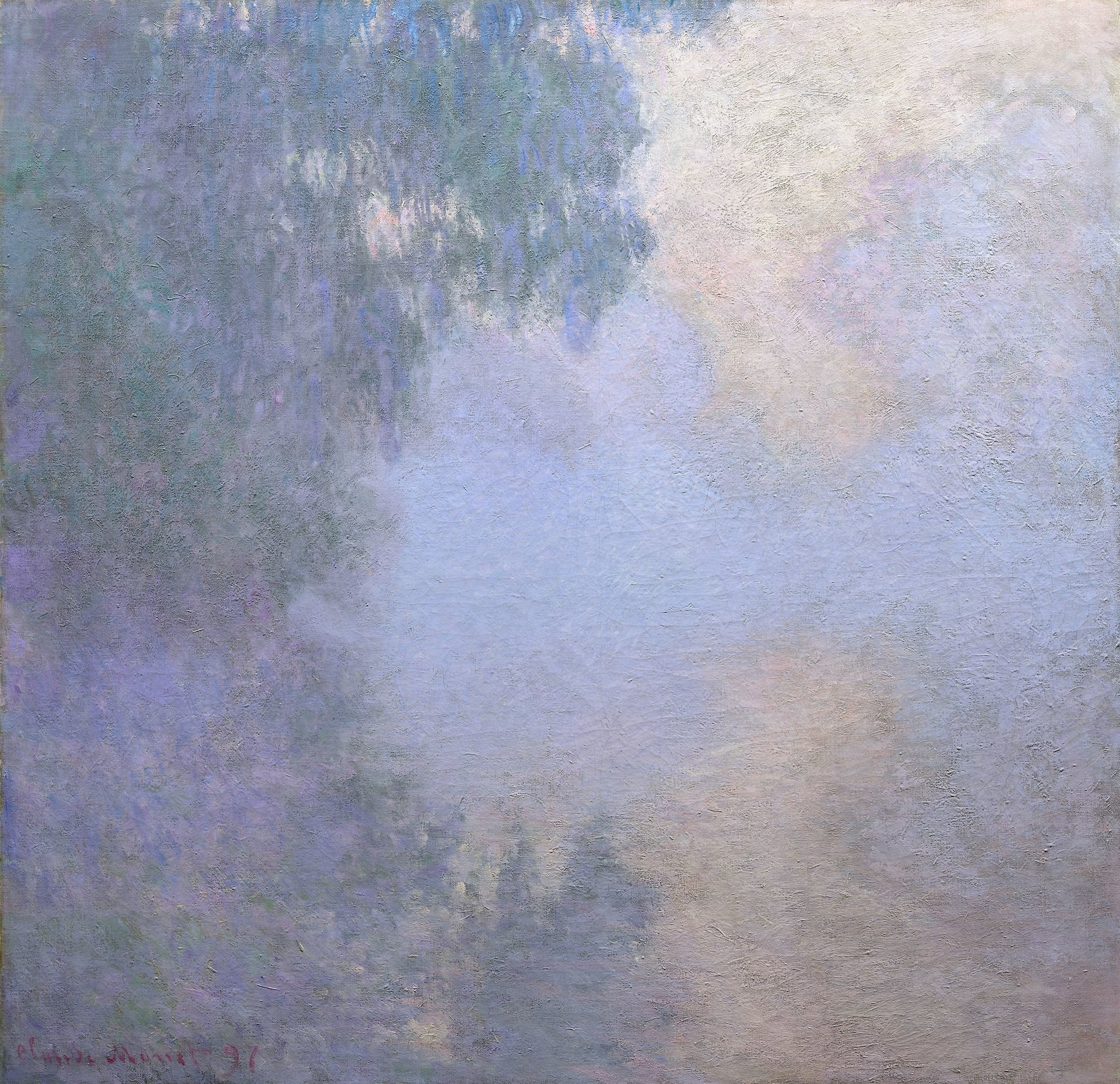
Morning on the Seine (series)
Claude Monet (1897)
Claude Monet’s Morning on the Seine (series) turns dawn into an inquiry about <strong>perception</strong> and <strong>time</strong>. In this canvas, the left bank’s shadowed foliage dissolves into lavender mist while a pale radiance opens at right, fusing sky and water into a single, reflective field <sup>[1]</sup><sup>[2]</sup>.
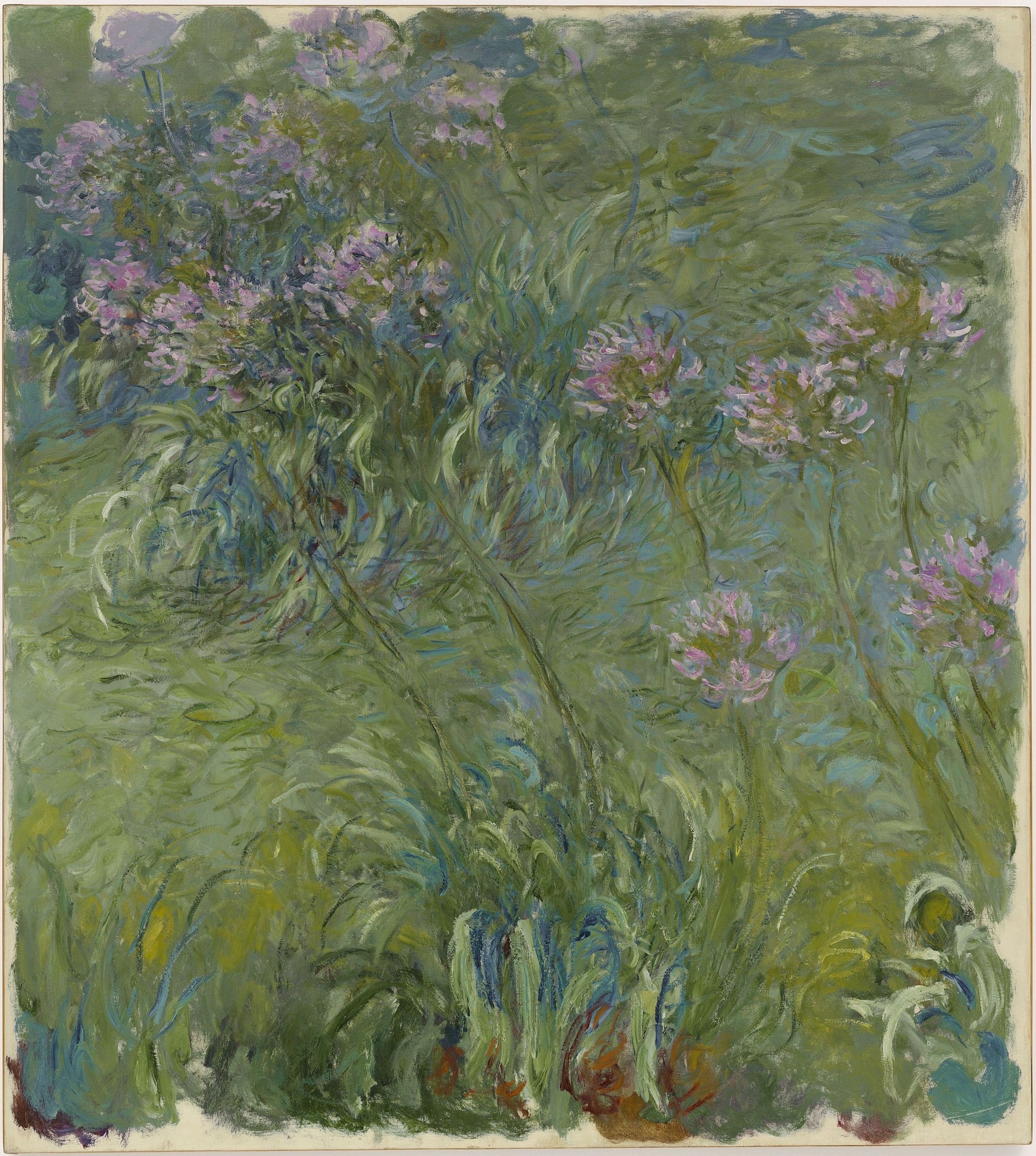
Agapanthus
Claude Monet (c. 1915–1926)
In Agapanthus, Claude Monet turns a close-cropped bed of lilies into a field of <strong>pure movement and light</strong>. Lilac blooms flicker against layered greens, their long, arcing stems written in <strong>calligraphic strokes</strong> that dissolve the line between plant and air.
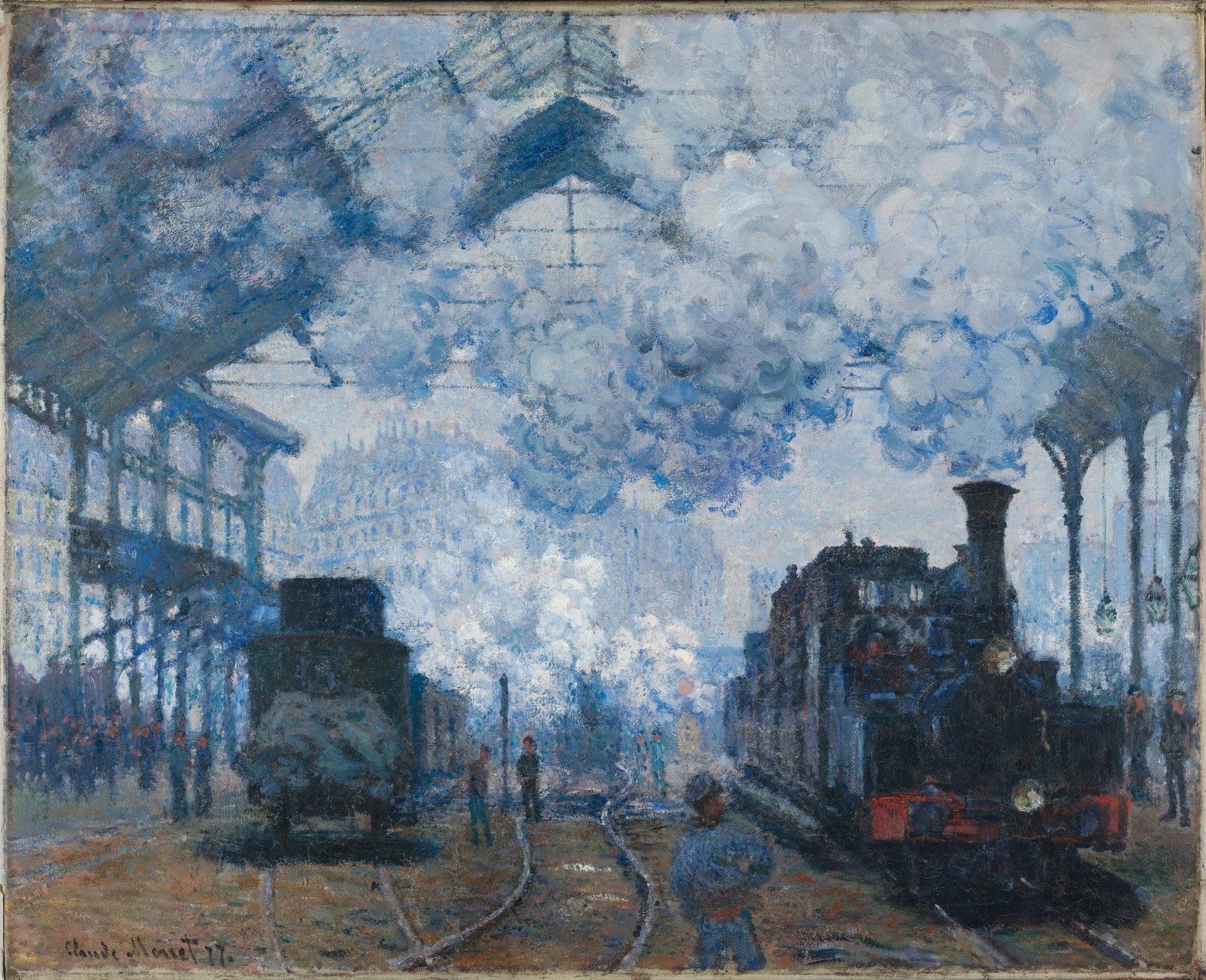
The Gare Saint-Lazare: Arrival of a Train
Claude Monet (1877)
Claude Monet’s The Gare Saint-Lazare: Arrival of a Train plunges viewers into a <strong>vapor-filled nave of iron and glass</strong>, where billowing steam, hot lamps, and converging rails forge a drama of industrial modernity. The right-hand locomotive, its red buffer beam glowing, materializes out of a <strong>blue-gray atmospheric envelope</strong>, turning motion and time into visible substance <sup>[1]</sup><sup>[3]</sup>.
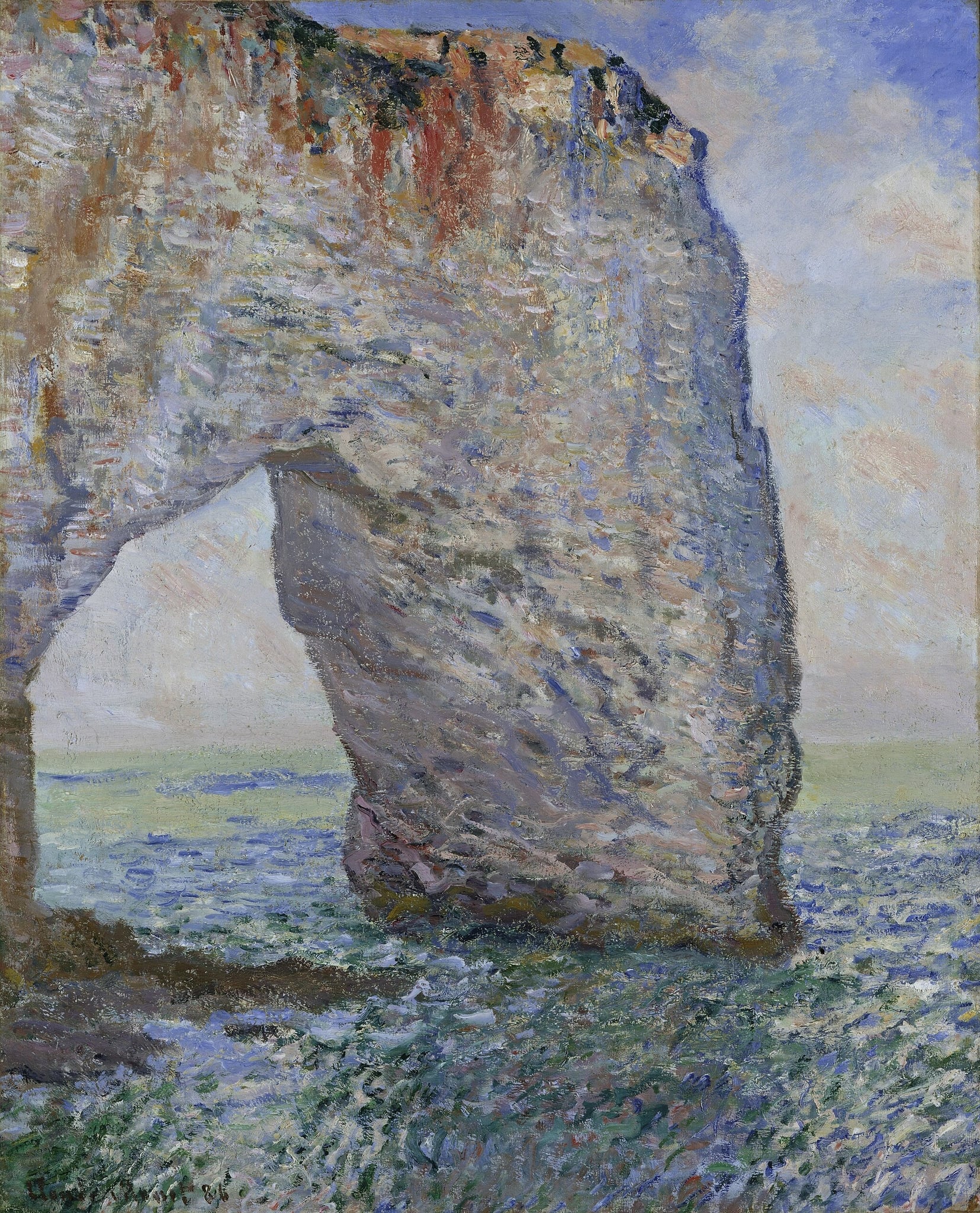
The Manneporte near Étretat
Claude Monet (1886)
Monet’s The Manneporte near Étretat turns the colossal sea arch into a <strong>threshold of light</strong>: rock, sea, and air interlock as shifting color rather than fixed form. Dense lilac–ochre strokes make the cliff feel massive yet <strong>dematerialized</strong> by illumination, while the arch’s opening stages a quiet, glimmering horizon <sup>[1]</sup><sup>[2]</sup>.
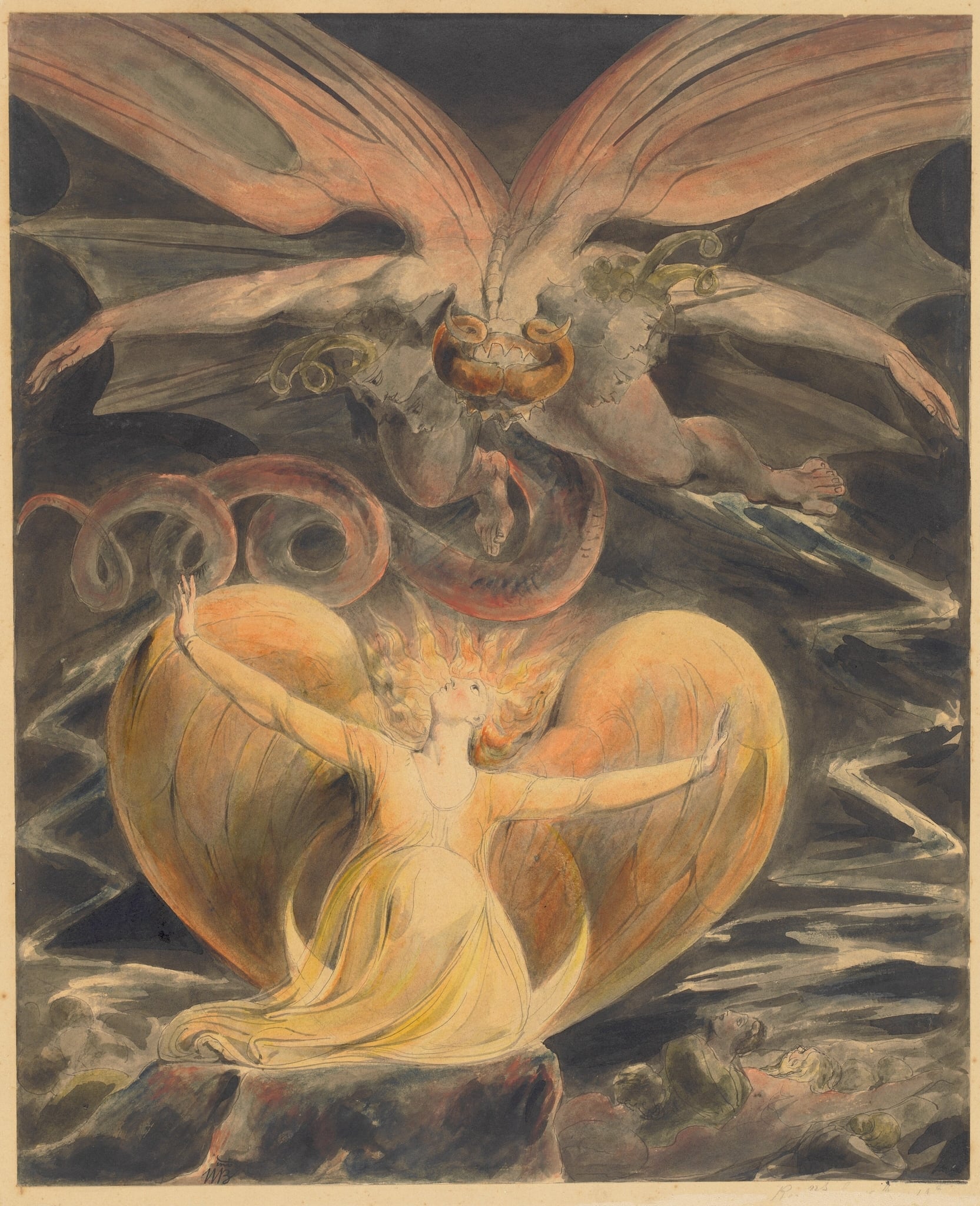
The Great Red Dragon and the Woman Clothed with the Sun
William Blake (c. 1805)
In The Great Red Dragon and the Woman Clothed with the Sun, William Blake pits <strong>radiant innocence</strong> against <strong>predatory tyranny</strong>. A bat‑winged dragon with ramlike horns plunges from a stormed sky as the woman, haloed in light with great golden, heart‑shaped wings, lifts open palms to meet the assault. Blake’s high‑contrast watercolor turns the tableau into a visionary contest of <strong>light versus darkness</strong> <sup>[1]</sup>.
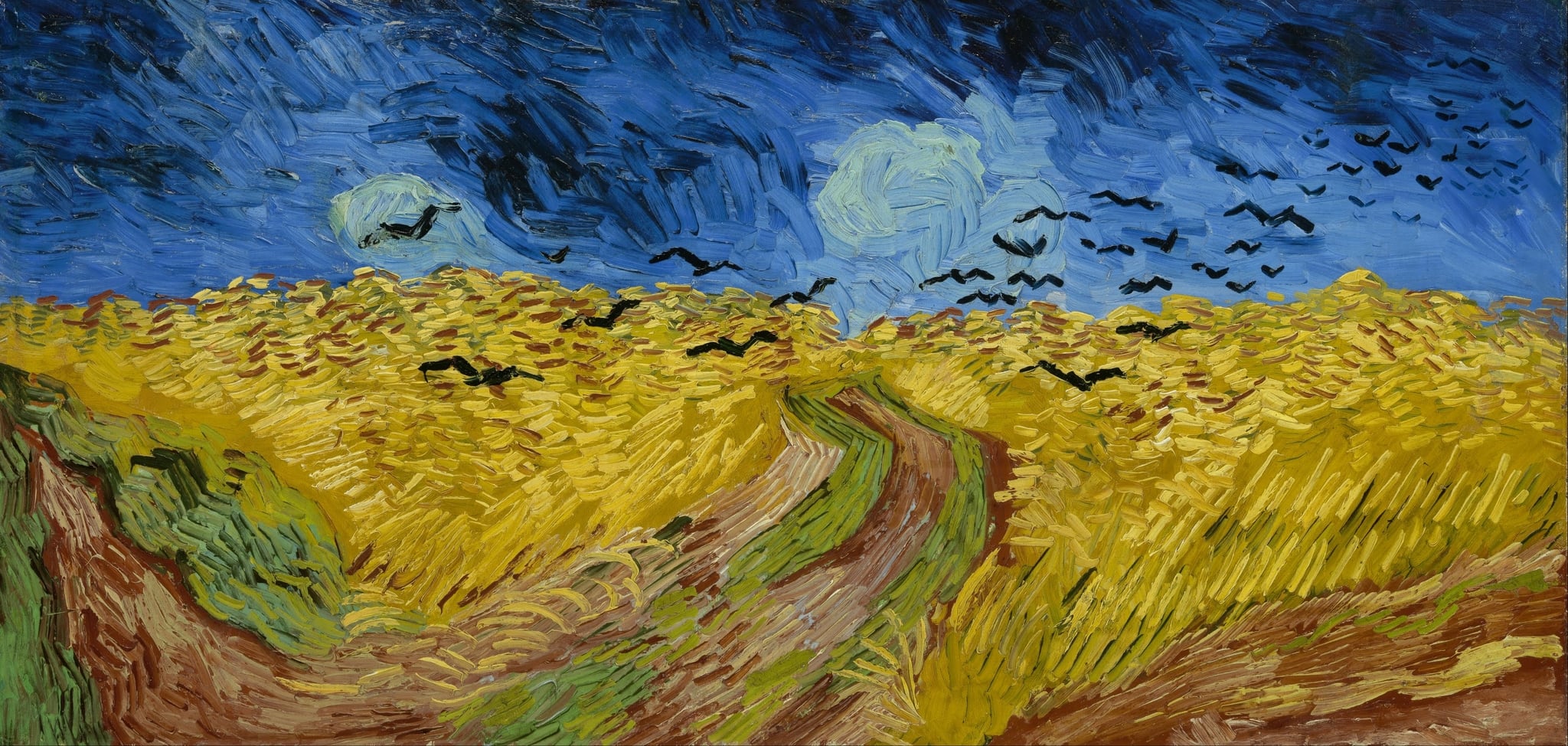
Wheatfield with Crows
Vincent van Gogh (1890)
A panoramic wheatfield splits around a rutted track under a storm-charged sky while black crows rush toward us. Van Gogh drives complementary blues and yellows into collision, fusing <strong>nature’s vitality</strong> with <strong>inner turbulence</strong>.
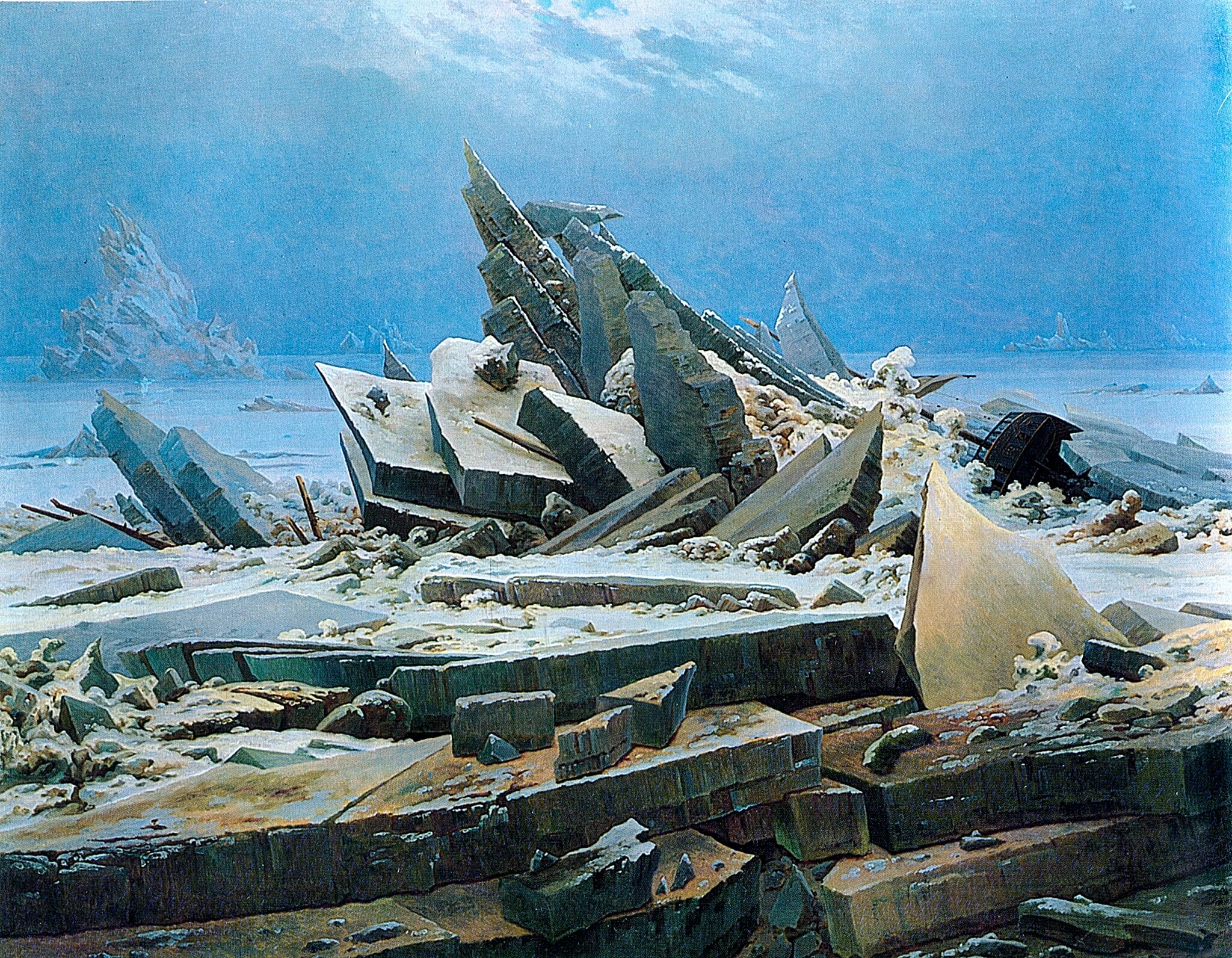
The Sea of Ice
Caspar David Friedrich (1823–1824)
Caspar David Friedrich’s The Sea of Ice turns nature into a <strong>frozen architecture</strong> that crushes a ship and, with it, human pretension. The painting stages the <strong>Romantic sublime</strong> as both awe and negation, replacing heroic conquest with the stark finality of ice and silence <sup>[1]</sup><sup>[3]</sup>.
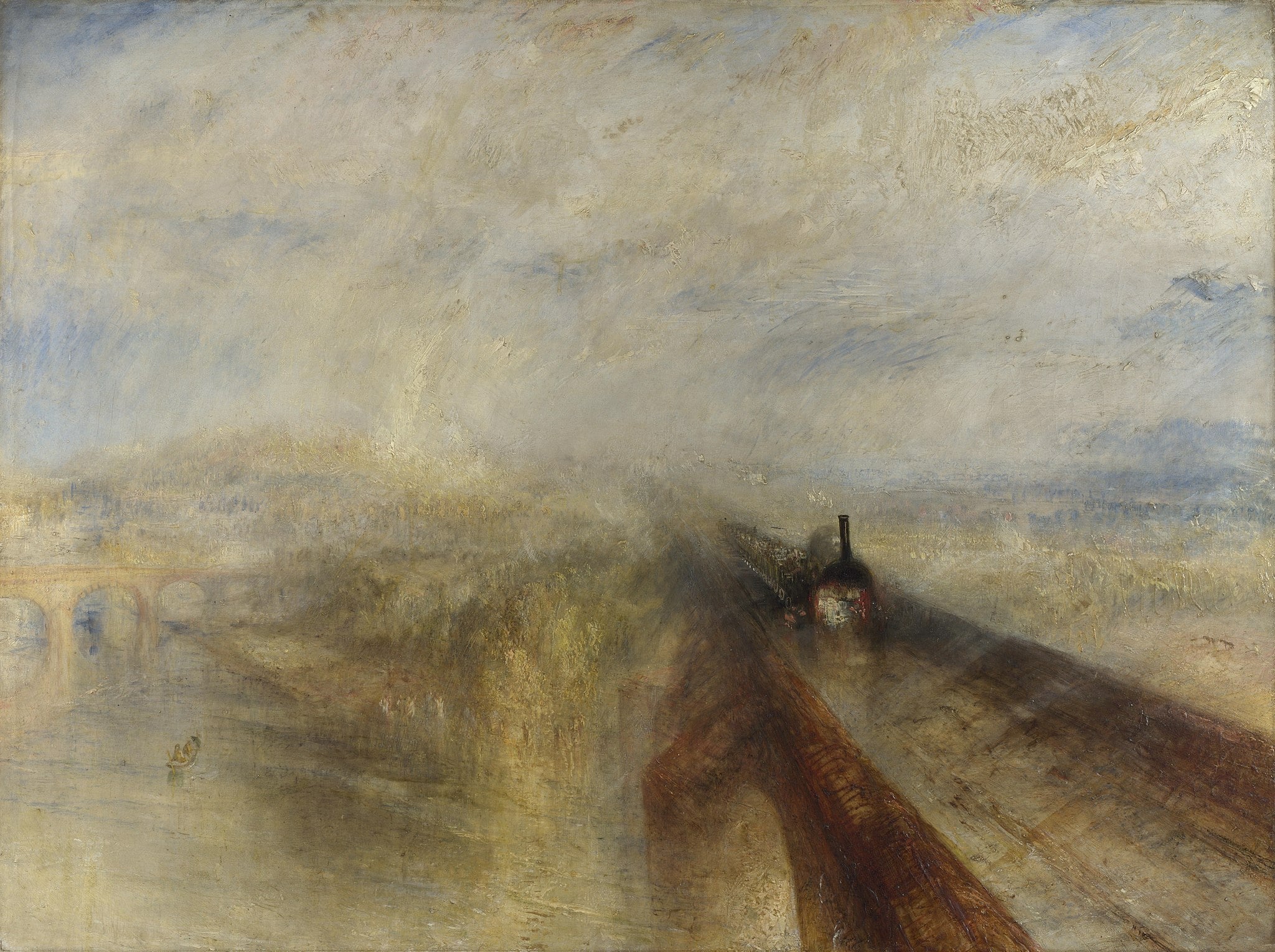
Rain, Steam and Speed
J. M. W. Turner (1844)
In Rain, Steam and Speed, J. M. W. Turner fuses weather and industry into a single onrushing vision, as a dark locomotive thrusts along the diagonal of Brunel’s Maidenhead Railway Bridge through veils of rain and light. The blurred fields, river, and town dissolve into a charged atmosphere where <strong>rain</strong>, <strong>steam</strong>, and <strong>speed</strong> become the true subjects. Counter-motifs—a small boat beneath pale arches and a near-invisible hare ahead of the train—stage a drama between pre‑industrial life and modern velocity <sup>[1]</sup><sup>[2]</sup>.
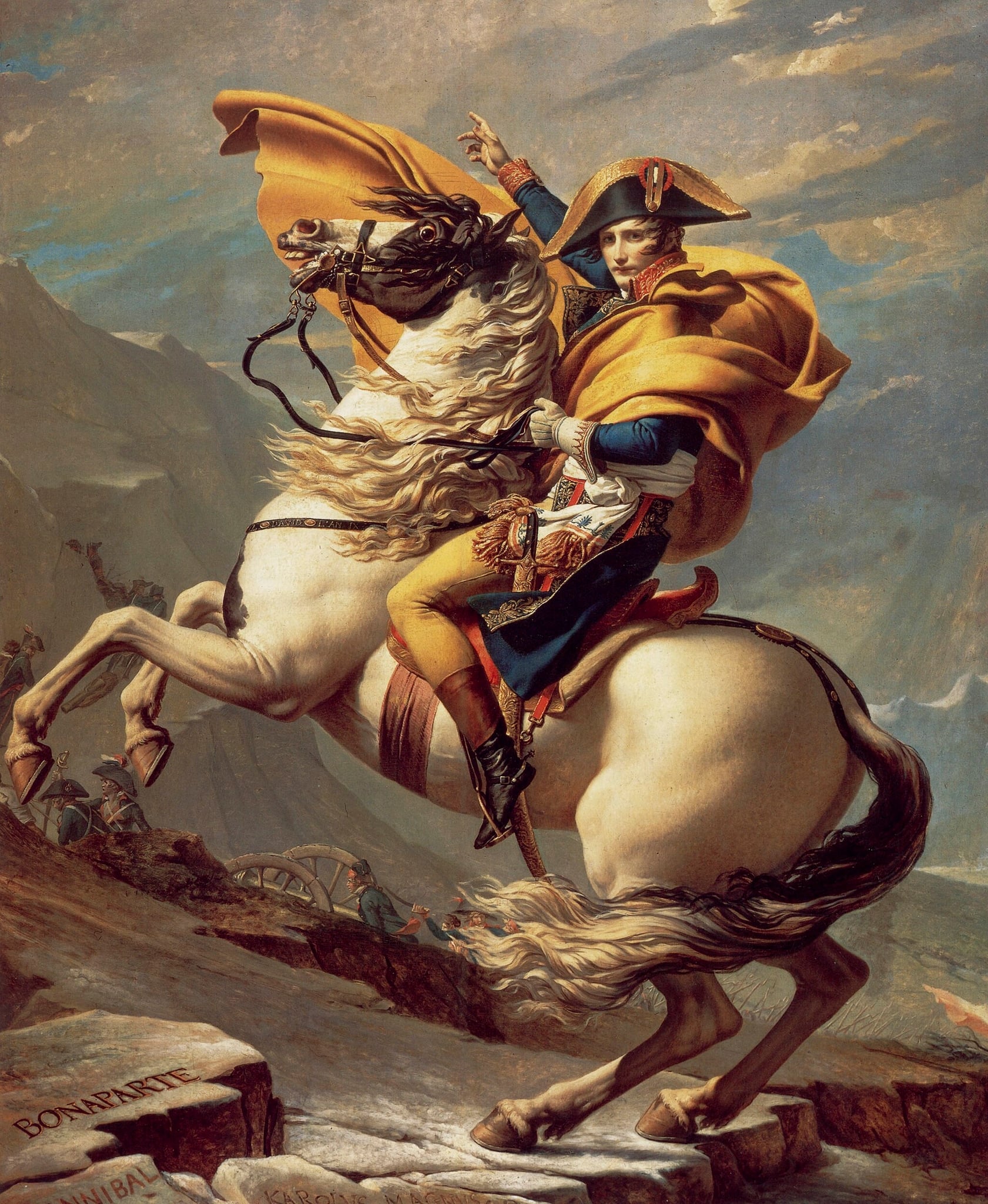
Napoleon Crossing the Alps
Jacques-Louis David (1801–1805 (series of five versions))
Jacques-Louis David turns a difficult Alpine passage into a <strong>myth of command</strong>: a serene leader on a rearing charger, a <strong>billowing golden cloak</strong>, and names cut into stone that bind the crossing to Hannibal and Charlemagne. The painting manufactures <strong>political legitimacy</strong> by fusing modern uniform and classical gravitas into a single, upward-driving image <sup>[1]</sup><sup>[2]</sup><sup>[3]</sup><sup>[4]</sup>.
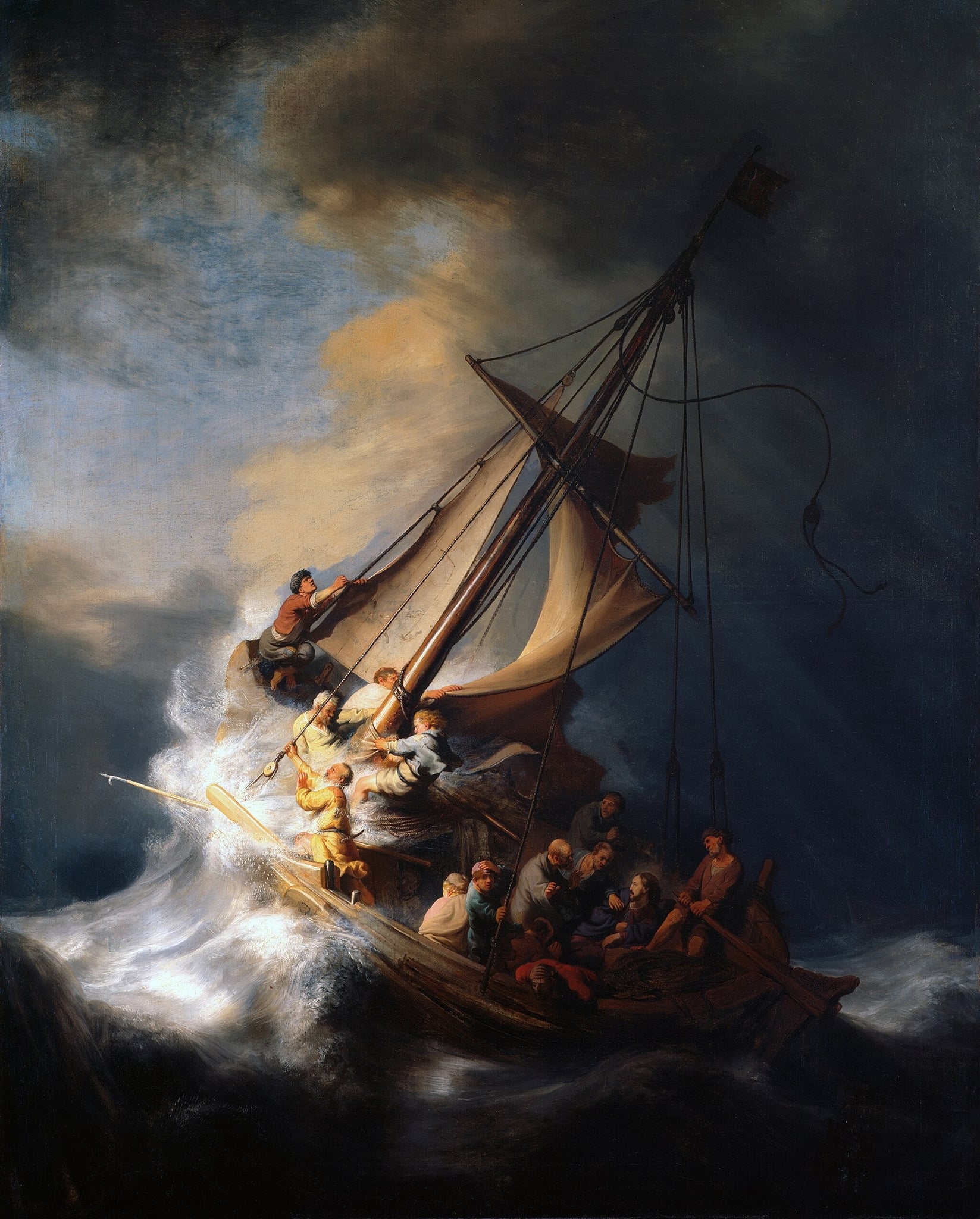
The Storm on the Sea of Galilee
Rembrandt van Rijn (1633)
Rembrandt van Rijn’s The Storm on the Sea of Galilee stages a clash of <strong>human panic</strong> and <strong>divine composure</strong> at the instant before the miracle. A torn mainsail whips across a steeply tilted boat as terrified disciples scramble, while a <strong>serenely lit Christ</strong> anchors a pocket of calm—an image of faith holding within chaos <sup>[1]</sup><sup>[3]</sup>. It is Rembrandt’s only painted seascape, intensifying its dramatic singularity in his oeuvre <sup>[2]</sup>.
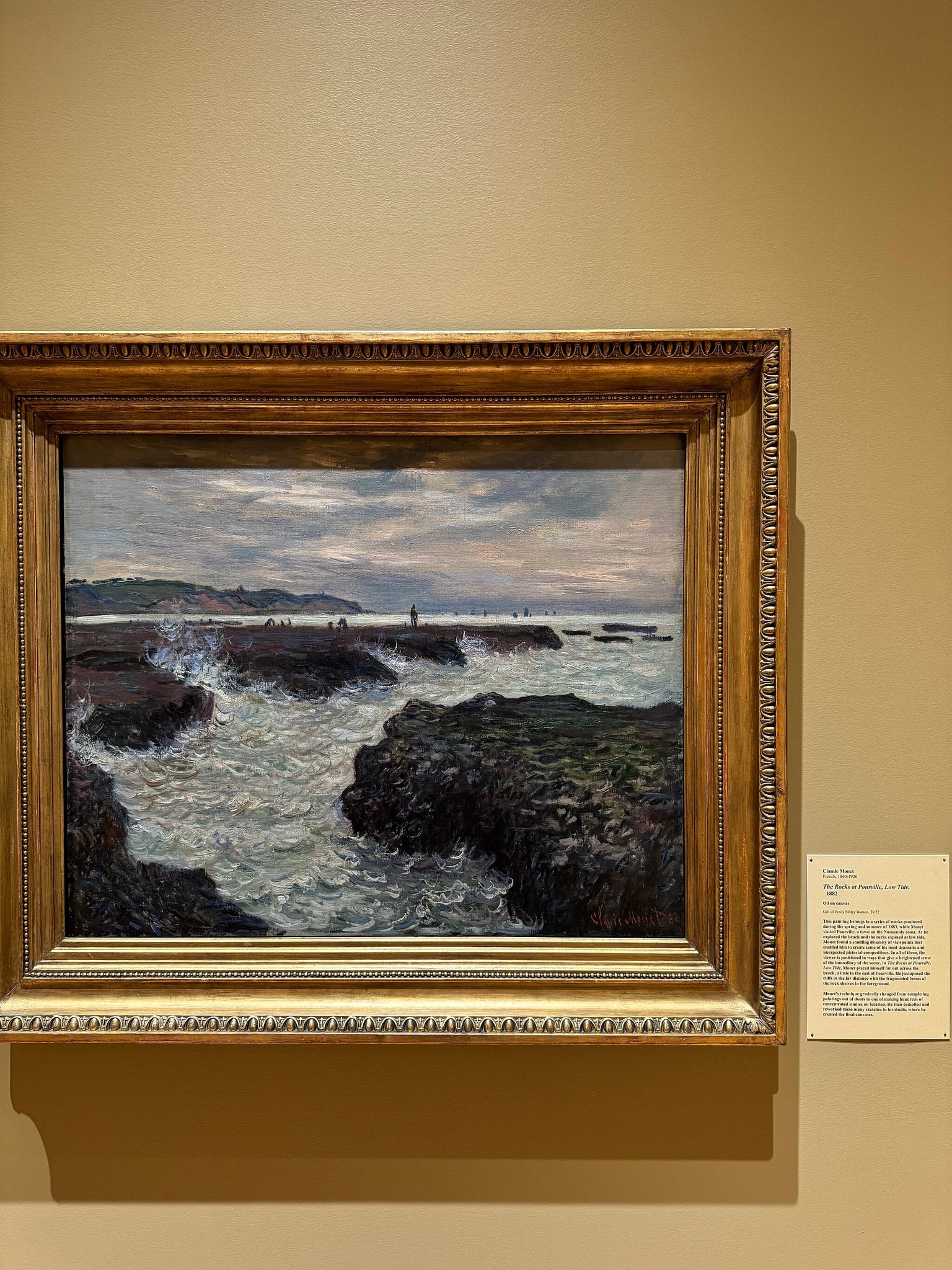
The Rocks at Pourville, Low Tide
Claude Monet (1882)
Claude Monet’s The Rocks at Pourville, Low Tide renders the Normandy foreshore as a meeting of <strong>endurance and flux</strong>—dark, seaweed-laden rocks cleave through <strong>foaming, mobile surf</strong> beneath a cool, <strong>pewter sky</strong>. Tiny silhouettes along the horizon reduce human presence to scale and rhythm, centering nature’s <strong>temporal pulse</strong>.
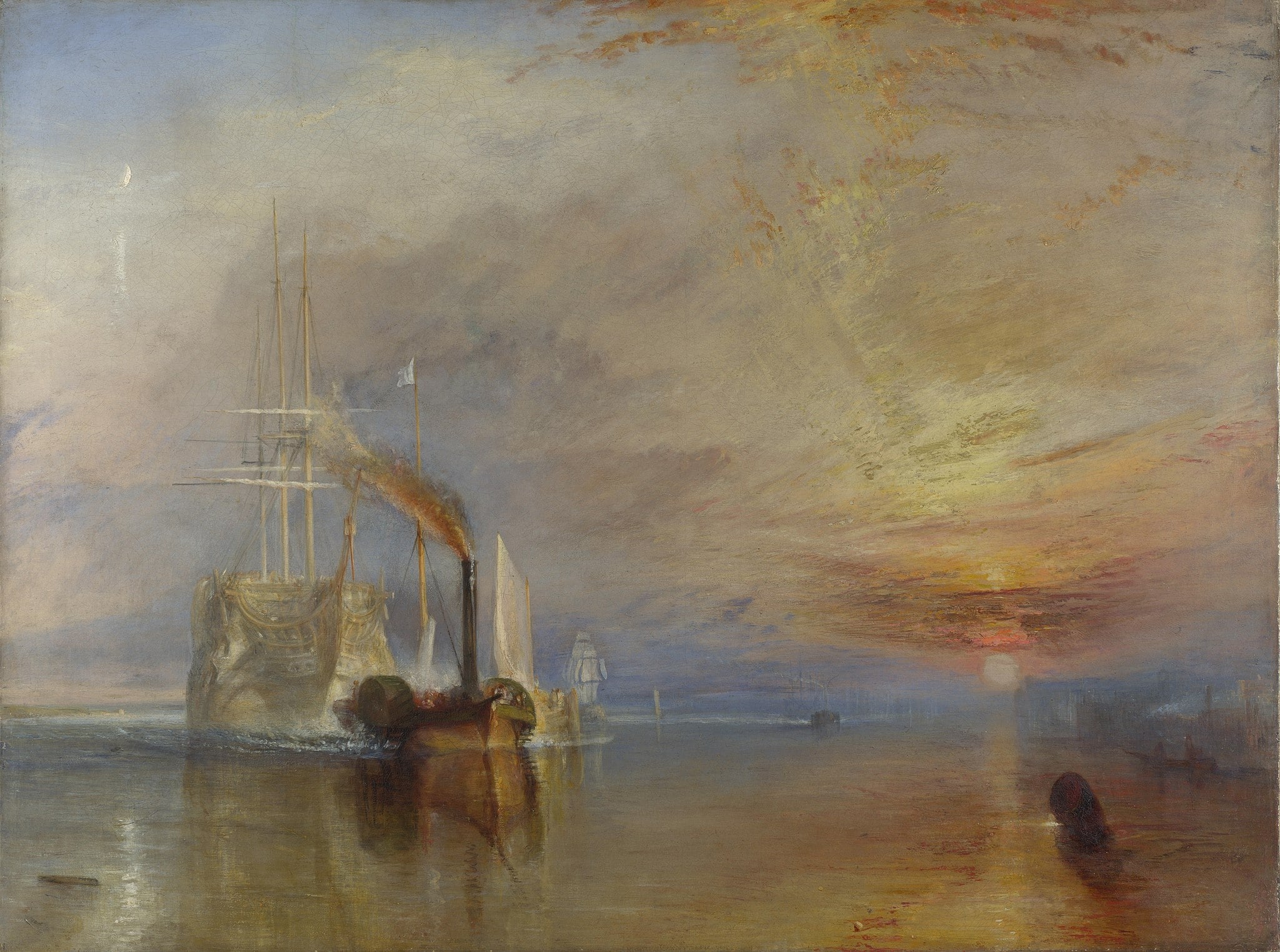
The Fighting Temeraire
J. M. W. Turner (1839)
In The Fighting Temeraire, J. M. W. Turner sets a <strong>ghostly man‑of‑war</strong> against a <strong>sooty steam tug</strong> under a blazing, emblematic sunset. The pale ship’s towering masts and slack rigging read like memory, while the tug’s black smoke cuts through the rigging where a flag once flew, signaling <strong>power passing from sail to steam</strong> <sup>[1]</sup><sup>[2]</sup>. A crescent moon and a humble buoy punctuate a river turned to molten gold, marking both ending and beginning <sup>[3]</sup><sup>[4]</sup>.
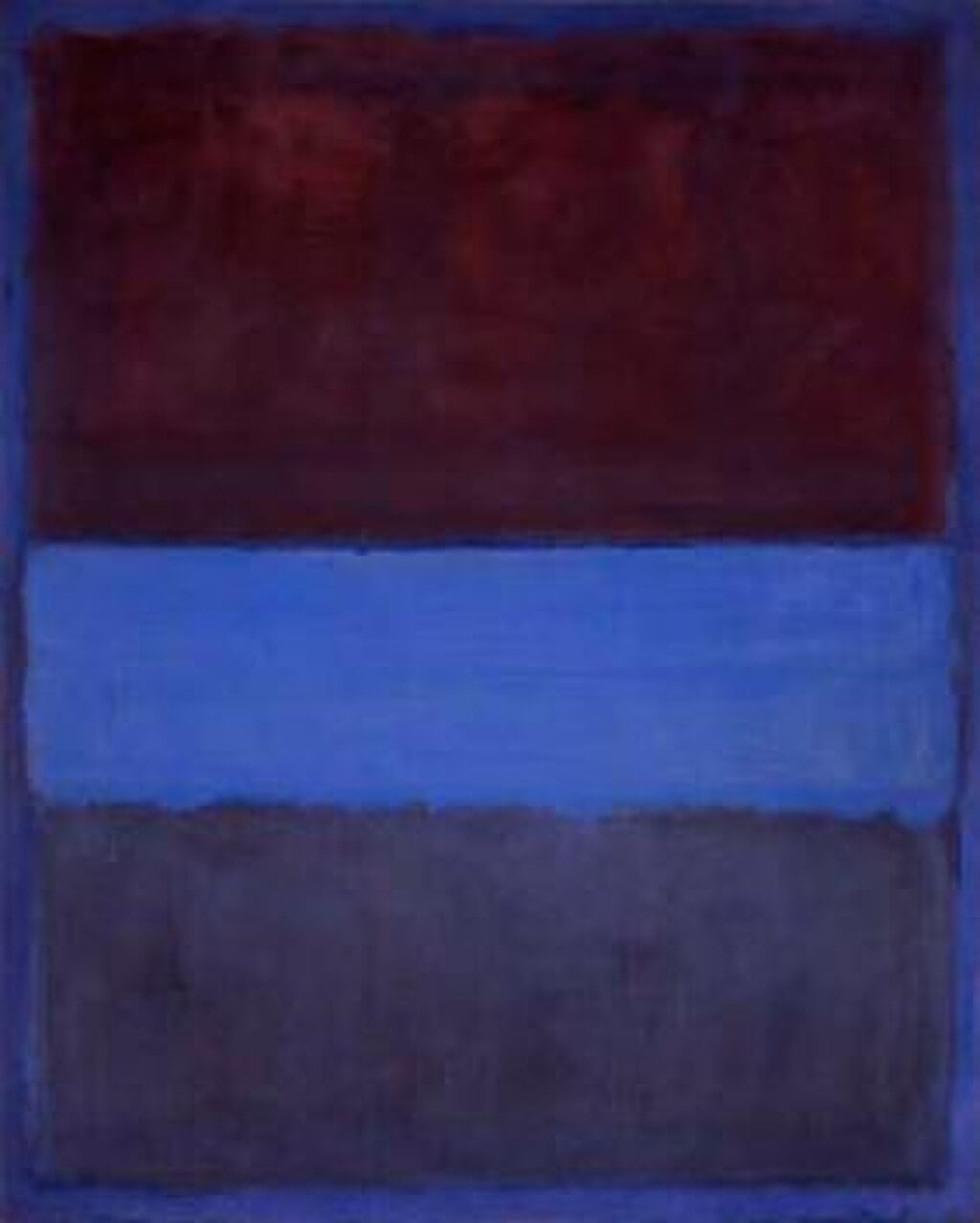
No. 61 (Rust and Blue)
Mark Rothko (1953)
<strong>No. 61 (Rust and Blue)</strong> (1953) stages three hovering color fields—rust, saturated blue, and indigo—within a deep blue perimeter. Through thin, layered oil and feathered borders, Mark Rothko turns color into a felt space where warmth and dusk meet, inviting a contemplative, immersive encounter <sup>[1]</sup><sup>[5]</sup>.
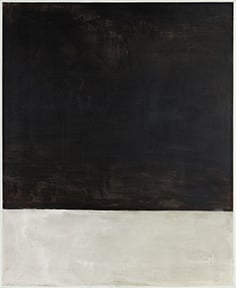
Untitled (Black on Grey)
Mark Rothko (1969–1970)
Mark Rothko’s Untitled (Black on Grey) compresses feeling into two stacked fields: a vast, softly modulated <strong>black</strong> pressing down upon a lower band of <strong>chalky grey</strong>, both ringed by a narrow white border. The blurred seam between them holds a charged <strong>threshold</strong> where descent and persistence meet <sup>[1]</sup><sup>[3]</sup><sup>[4]</sup>.
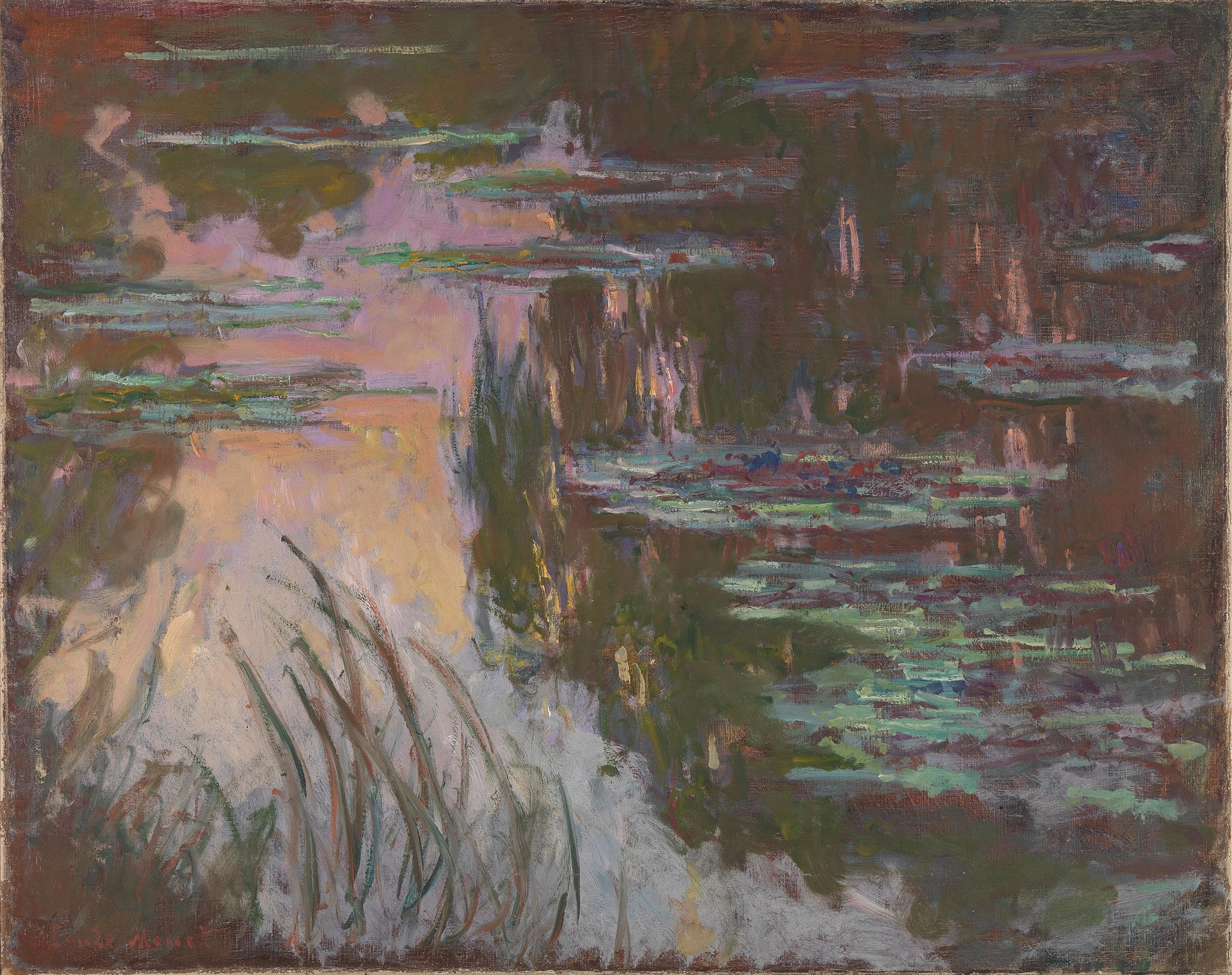
Water-Lilies, Setting Sun
Claude Monet (about 1907)
Claude Monet’s Water-Lilies, Setting Sun turns the Giverny pond into an <strong>immersive field of light</strong> where reflections overtake solid forms. Horizontal lily pads and a <strong>central column of pink-apricot glow</strong> register sunset as a reflection, while dark, vertical willow traces unsettle depth and horizon <sup>[1]</sup>. The result is a vision of <strong>time in flux</strong>, held together by the quiet persistence of the floating lilies.
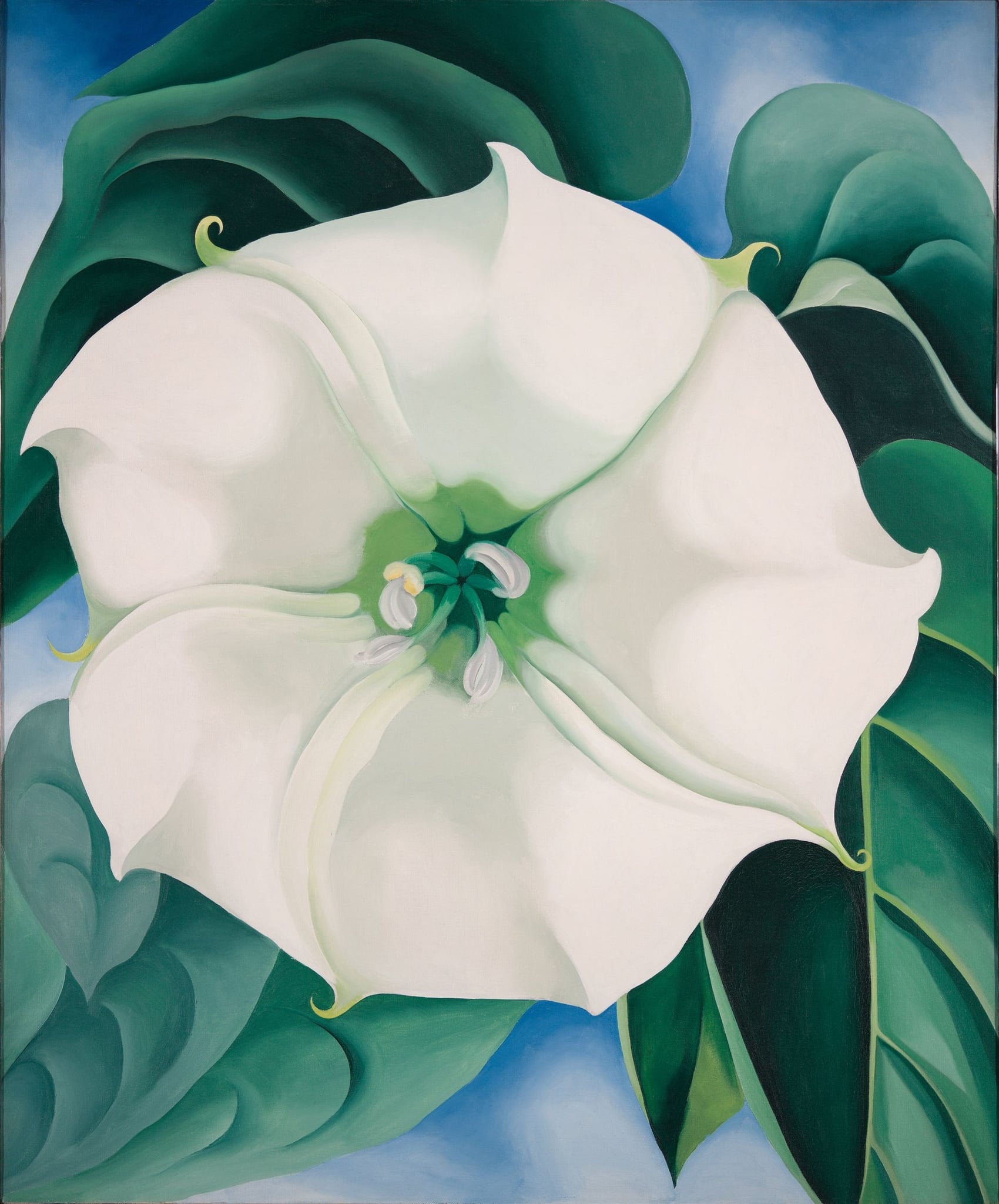
Jimson Weed/White Flower No. 1
Georgia O’Keeffe (1932)
Georgia O’Keeffe’s Jimson Weed/White Flower No. 1 turns a humble roadside blossom into a <strong>monumental icon</strong> of American modernism. The enlarged, close-cropped white trumpet radiates from a cool green throat, set against undulating leaves and a calm blue ground, so the viewer confronts <strong>form, scale, and stillness</strong> rather than botanical detail. Its immaculate bloom, drawn from the poisonous jimson weed, carries a charged tension between <strong>purity and peril</strong>.
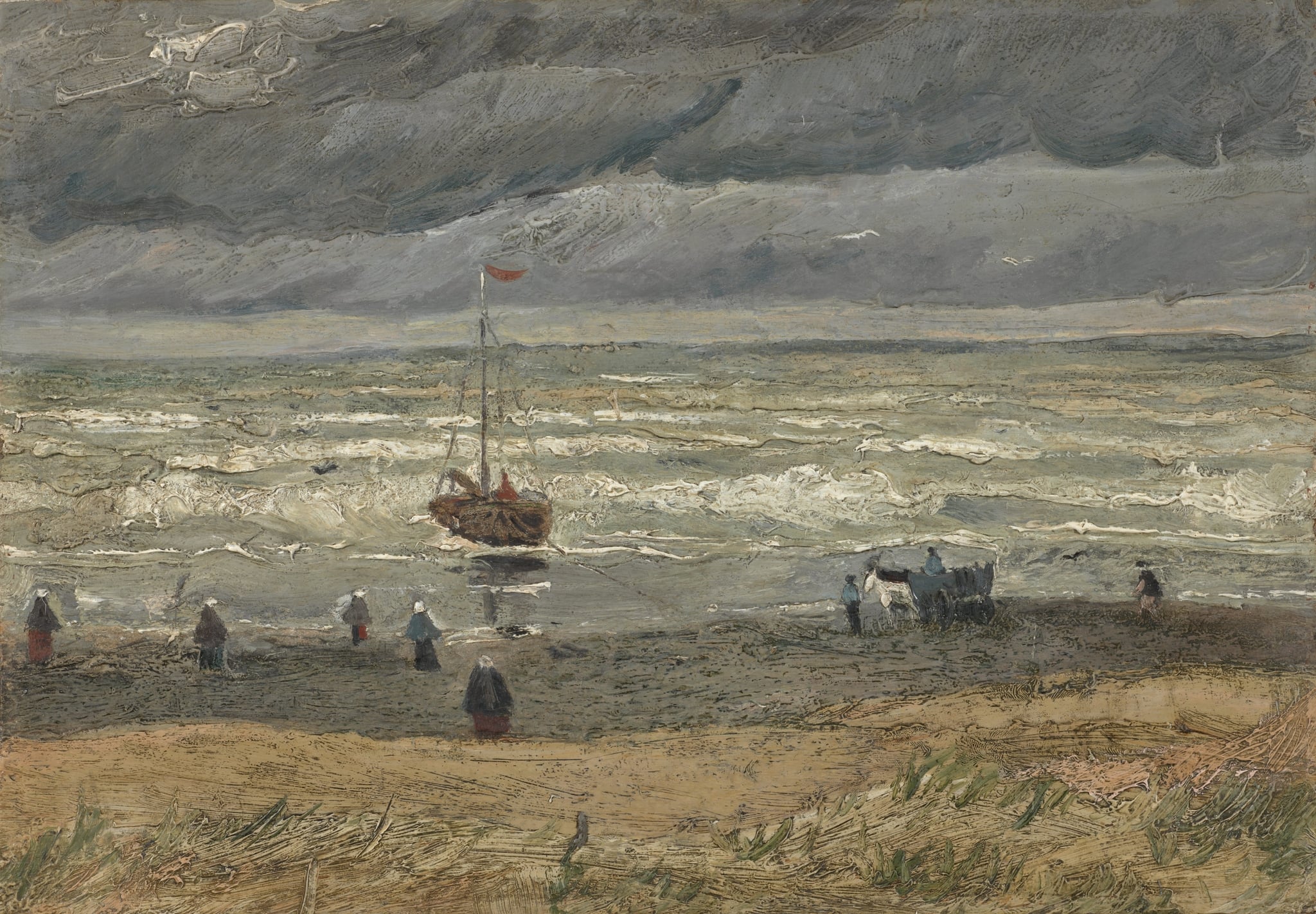
View of the Sea at Scheveningen
Vincent van Gogh (1882)
Under a storm-laden sky, Vincent van Gogh’s <strong>View of the Sea at Scheveningen</strong> pits tiny beach figures, a <strong>horse-and-cart</strong>, and a fishing boat with a <strong>red flag</strong> against the heaving <strong>North Sea</strong>. The quick, dense strokes and even grains of blown <strong>sand embedded in the paint</strong> make the weather itself the subject, fusing observation with immediacy <sup>[2]</sup><sup>[3]</sup>.
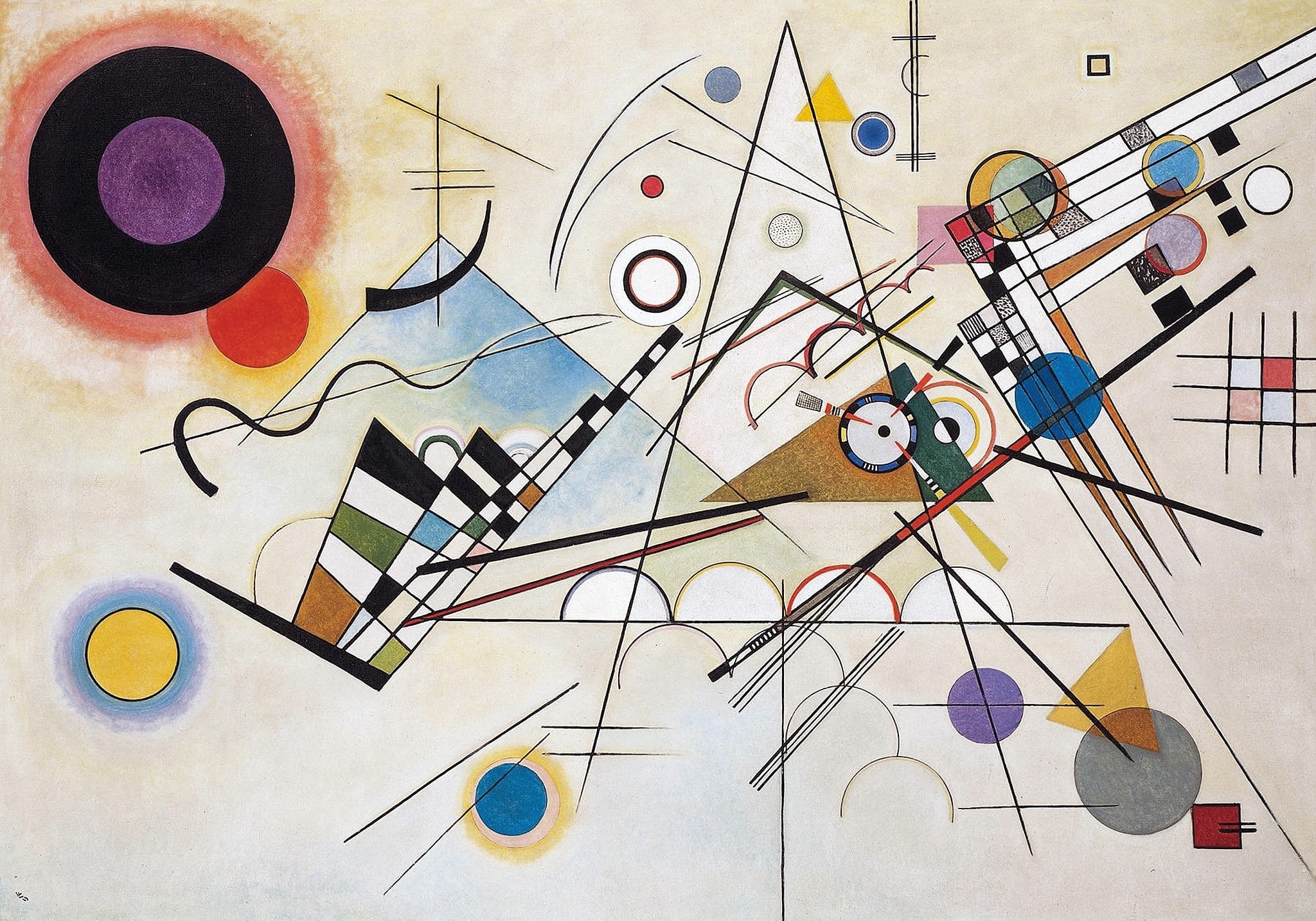
Composition VIII
Wassily Kandinsky (1923)
Composition VIII stages a <strong>musical drama in geometry</strong>: circles, vectors, and triangles surge across a cream field in calibrated counterpoint. A <strong>brooding black circle</strong> at left sets the tonal center while grids, checkerboards, and compass-like dials organize bursts of color and rhythm. The canvas becomes a <strong>score of invisible harmonies</strong>, where pure form conveys feeling.
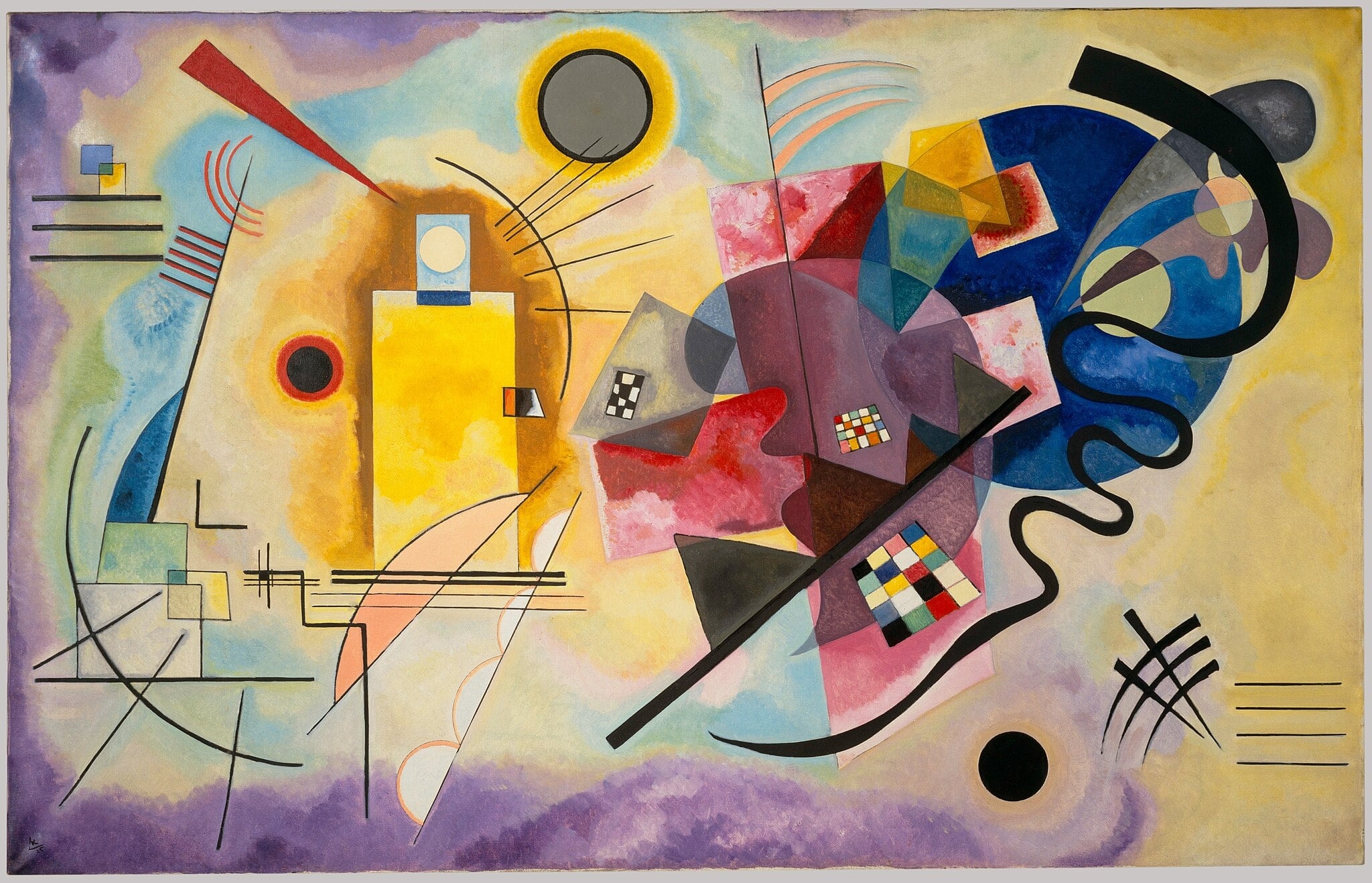
Yellow-Red-Blue
Wassily Kandinsky (1925)
Yellow-Red-Blue stages a collision of <strong>order and impulse</strong> through primary color and geometry. A lucid field of yellow rectangles and orthogonals confronts a vortex of blues, reds, circles, and a serpentine black line, all bound by a commanding black diagonal. The canvas reads like a <strong>spiritual score</strong>, balancing tensions into dynamic equilibrium.
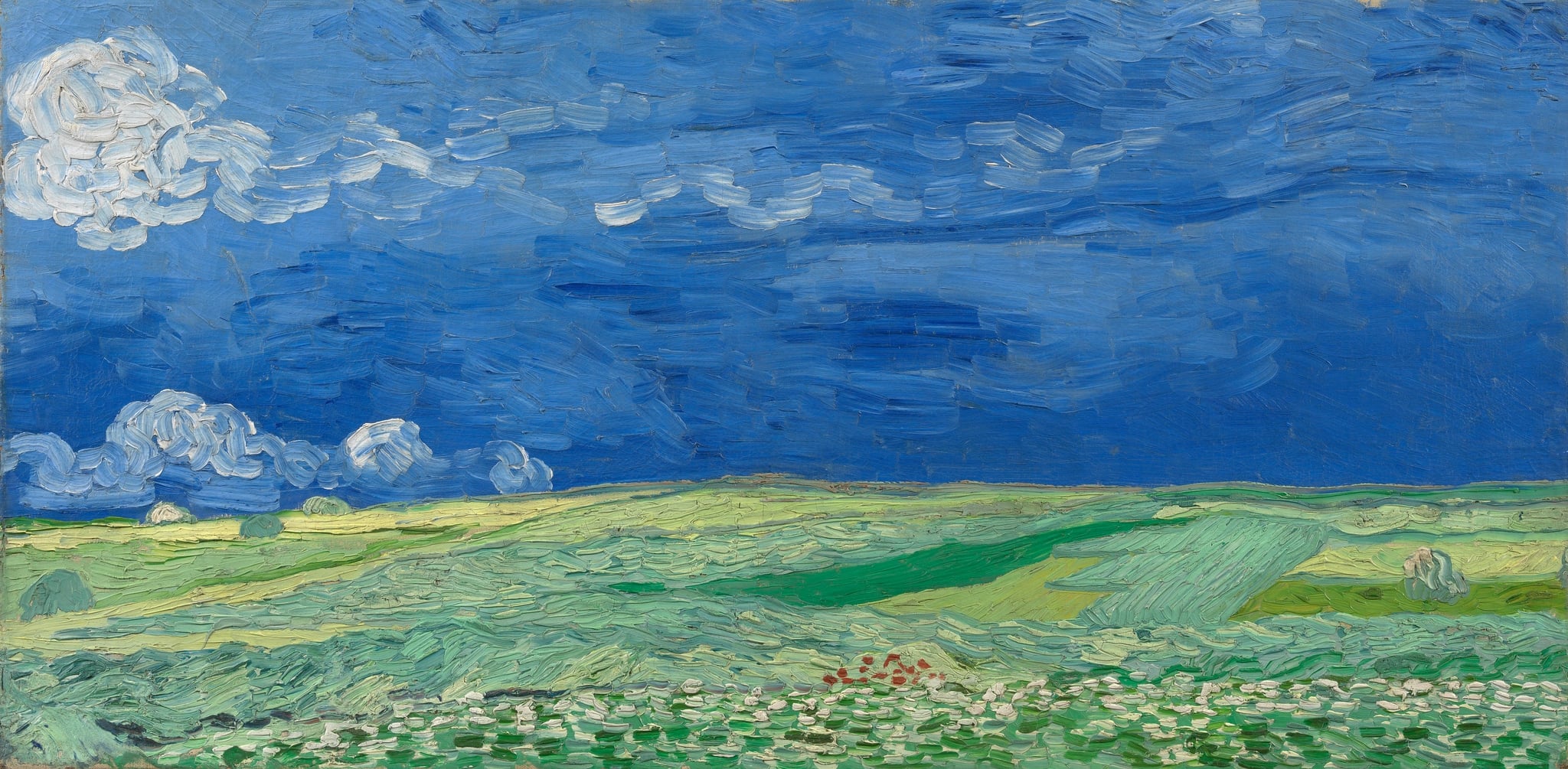
Wheatfield under Thunderclouds
Vincent van Gogh (1890)
A panoramic sweep of land and sky pits a wind‑combed wheatfield against an immense, <strong>thunder‑laden</strong> blue. Van Gogh uses a radically simple two‑band design and dense impasto to stage a confrontation between <strong>turbulence</strong> and <strong>endurance</strong> <sup>[1]</sup><sup>[2]</sup>.
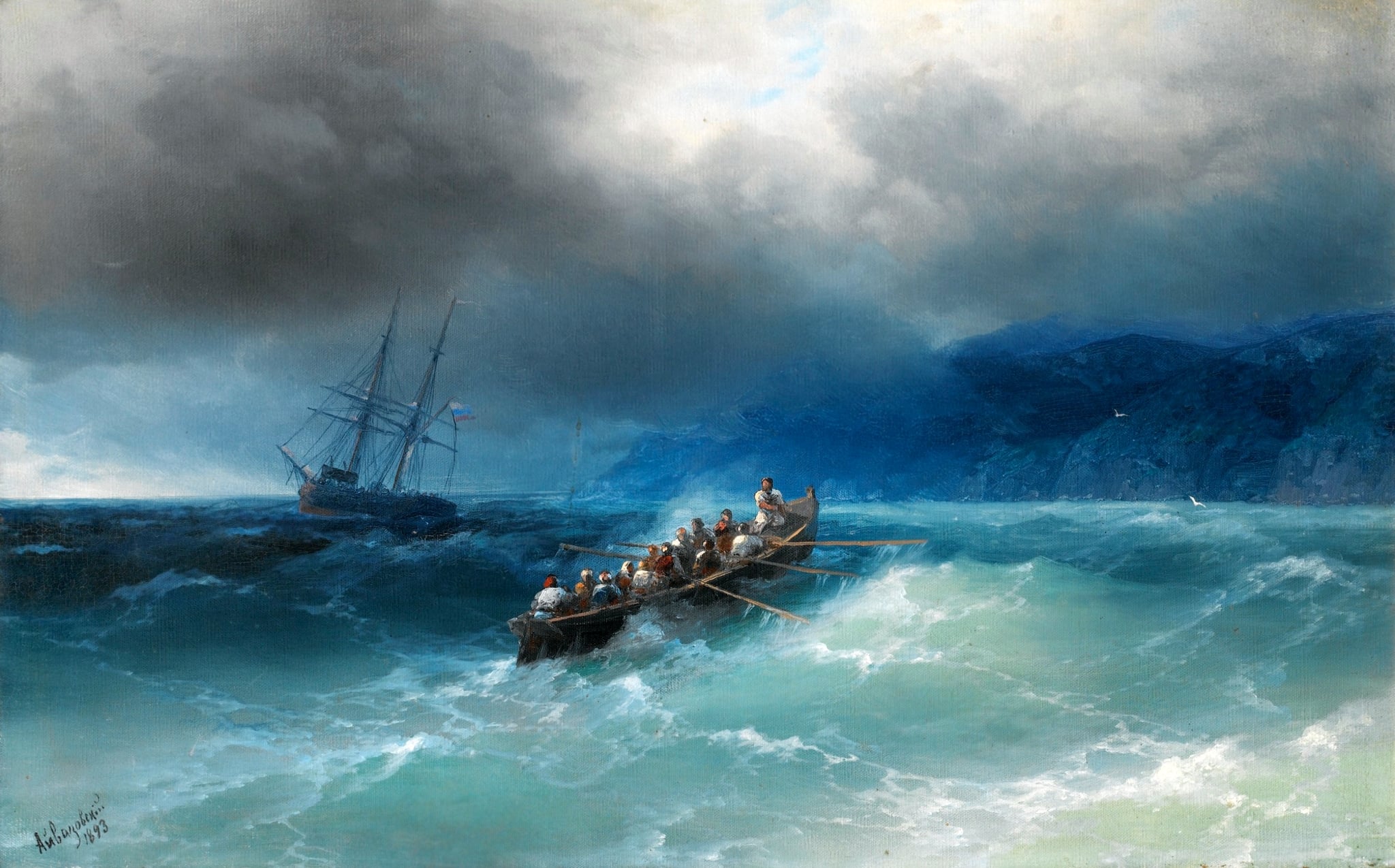
The Storm (Seascape)
Ivan Aivazovsky (1850)
In The Storm (Seascape), Ivan Aivazovsky forges a drama of <strong>human resolve</strong> against the <strong>Sublime sea</strong>. A crowded lifeboat claws up a green-blue swell toward a <strong>break of light</strong>, while a tall-masted ship lists behind and a <strong>rocky coast</strong> looms to the right. The painting crystallizes peril and hope in a single, surging moment.
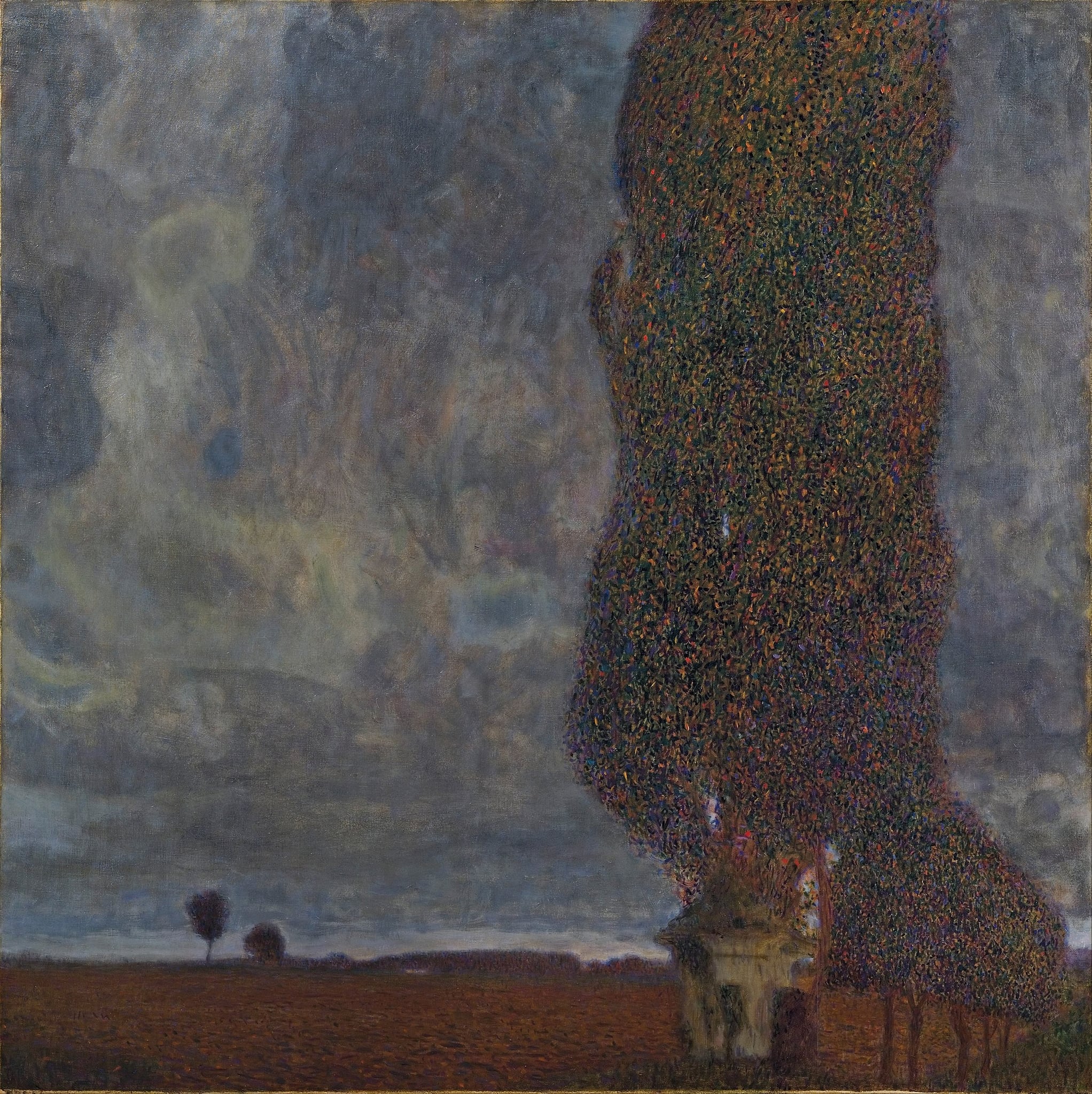
The Large Poplar II (Gathering Storm)
Gustav Klimt (1902/03)
In The Large Poplar II (Gathering Storm), a monumental poplar rises like a <strong>sentinel</strong> at the right edge while a low, rust-toned plain and tiny chapel anchor the horizon. Klimt devotes most of the square canvas to a <strong>charged, near-monochrome sky</strong>, making weather the protagonist and turning the tree’s flecked canopy into a shimmering, ominous <strong>mosaic</strong> <sup>[1]</sup><sup>[2]</sup>.
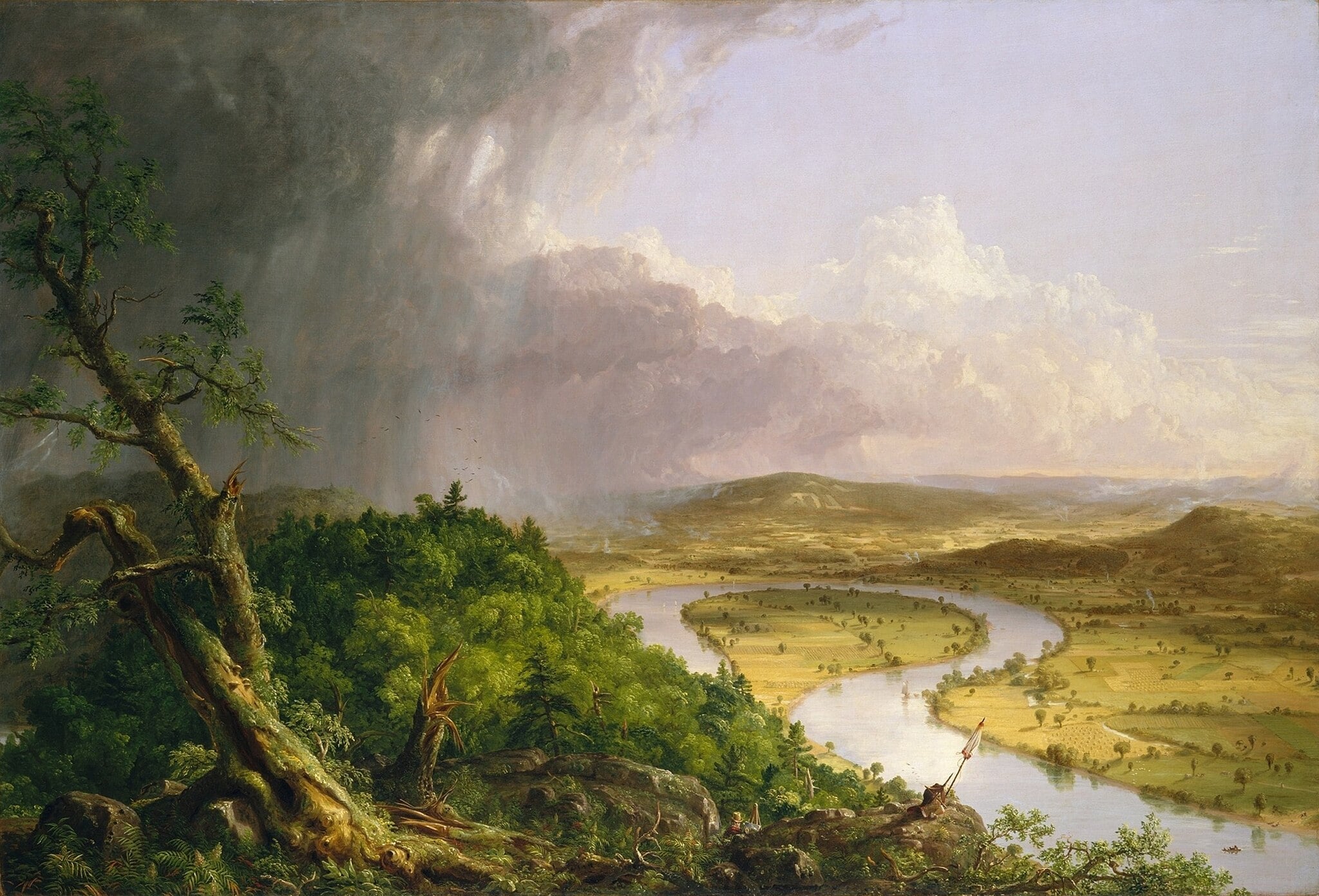
The Oxbow (View from Mount Holyoke)
Thomas Cole (1836)
Thomas Cole’s The Oxbow (View from Mount Holyoke) juxtaposes <strong>storm-lashed wilderness</strong> at left with <strong>sunlit, cultivated farmland</strong> at right, using a panoramic sweep of the Connecticut River’s curve. A tiny figure with an easel—Cole’s self-insertion—stands between realms, turning sight into judgment. The painting frames America’s landscape as both <strong>sublime</strong> and <strong>pastoral</strong>, a place of awe, promise, and warning.
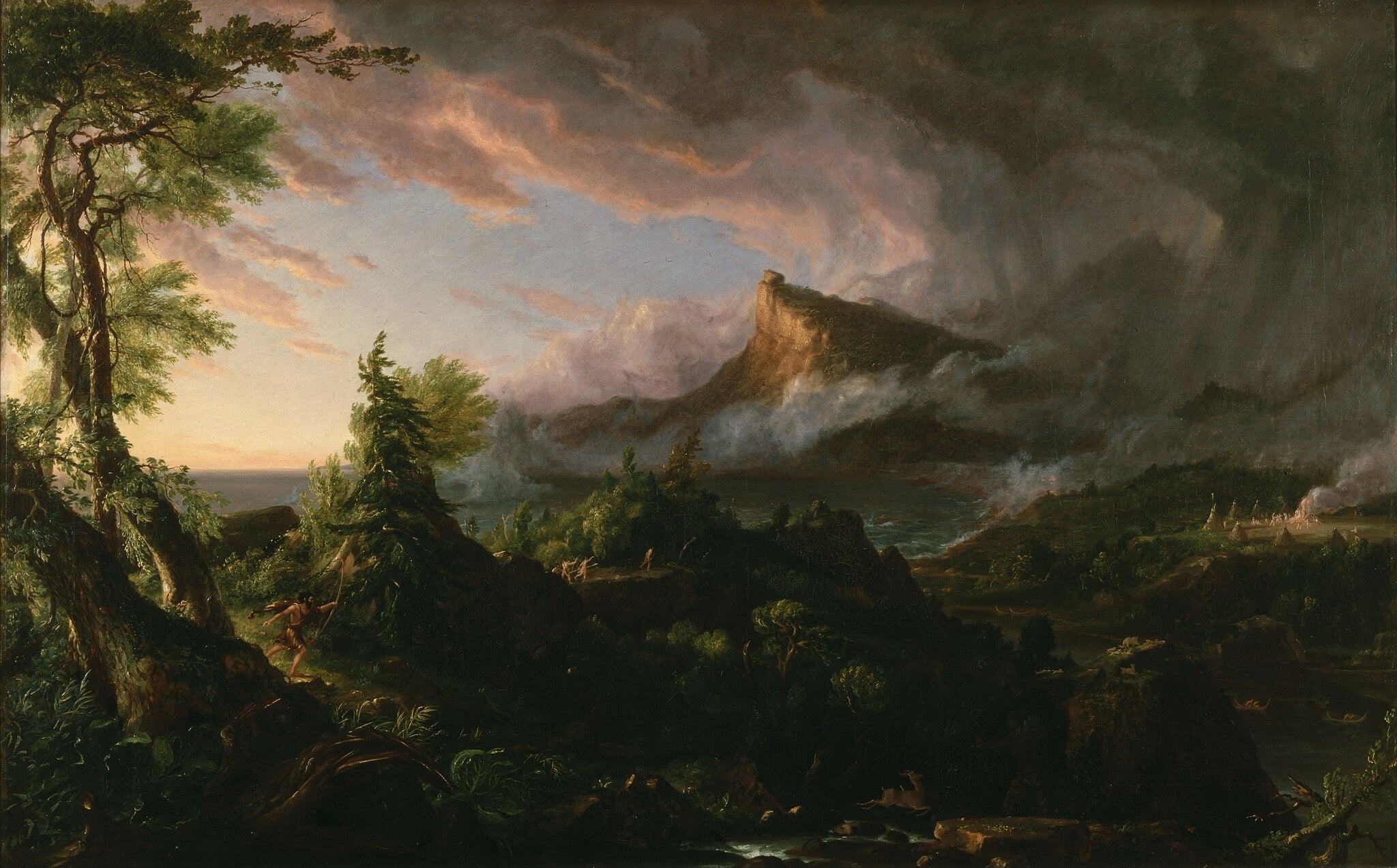
The Course of Empire: The Savage State
Thomas Cole (c. 1834 (series 1834–1836))
Thomas Cole’s The Course of Empire: The Savage State inaugurates his five-part cycle with a landscape ruled by <strong>wildness</strong> and <strong>origin</strong>. Dawn breaks at left as storm clouds rake a flat-topped crag, while a hunter looses an arrow, canoes cut the river, and smoke lifts from skin tents—signals of a society at the threshold of history <sup>[1]</sup><sup>[2]</sup><sup>[3]</sup>.
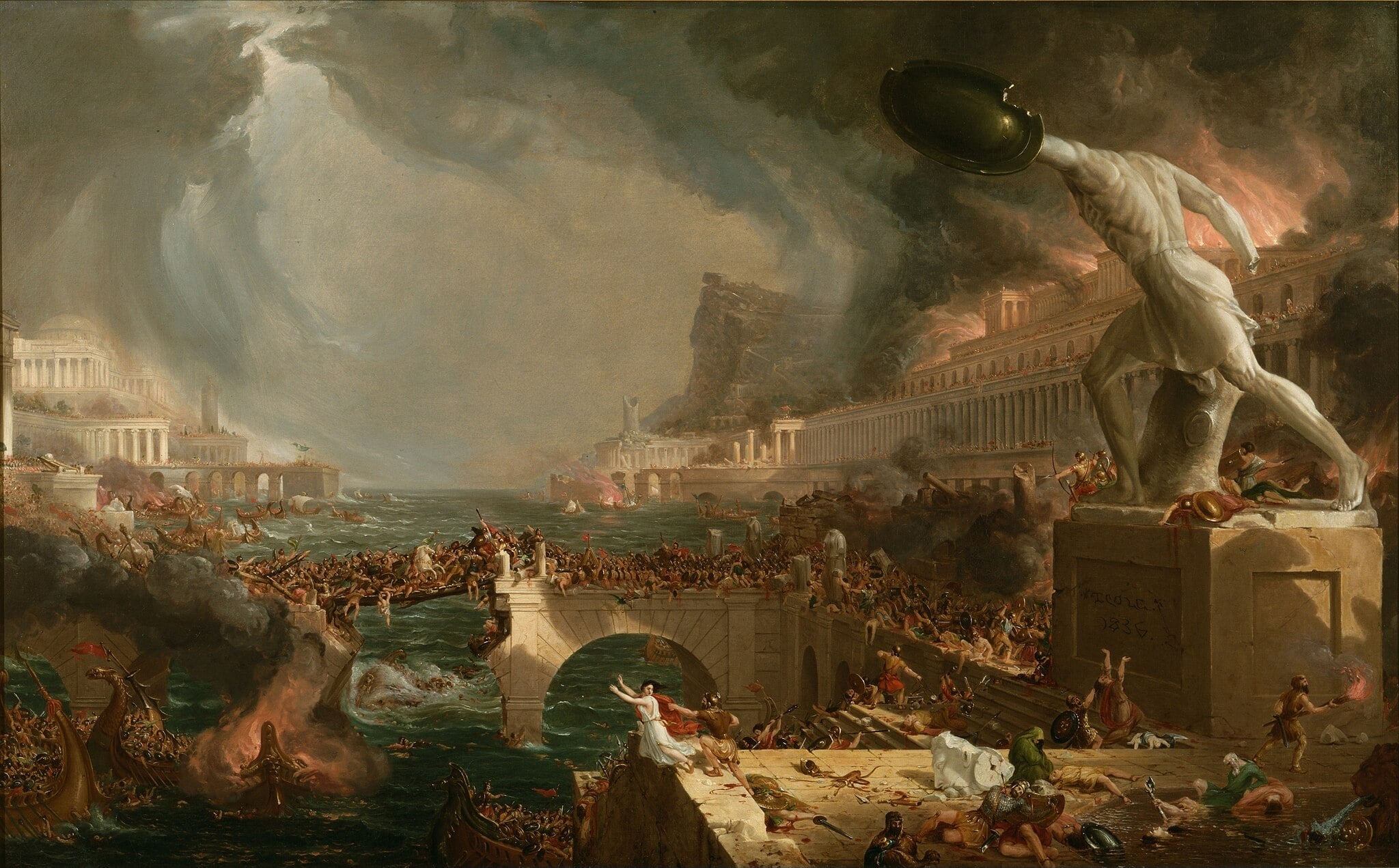
The Course of Empire: Destruction
Thomas Cole (1836)
Thomas Cole’s The Course of Empire: Destruction plunges a once‑ordered classical city into <strong>apocalyptic collapse</strong>. A <strong>collapsing bridge</strong>, <strong>burning colonnades</strong>, and a <strong>headless gladiator statue</strong> preside over panicked crowds and flaming warships, while a fixed mountain crag endures beyond the chaos. The canvas stages <strong>moral retribution</strong>: empire’s luxury curdles into vice and is swept away by combined human and elemental fury <sup>[1]</sup><sup>[2]</sup>.
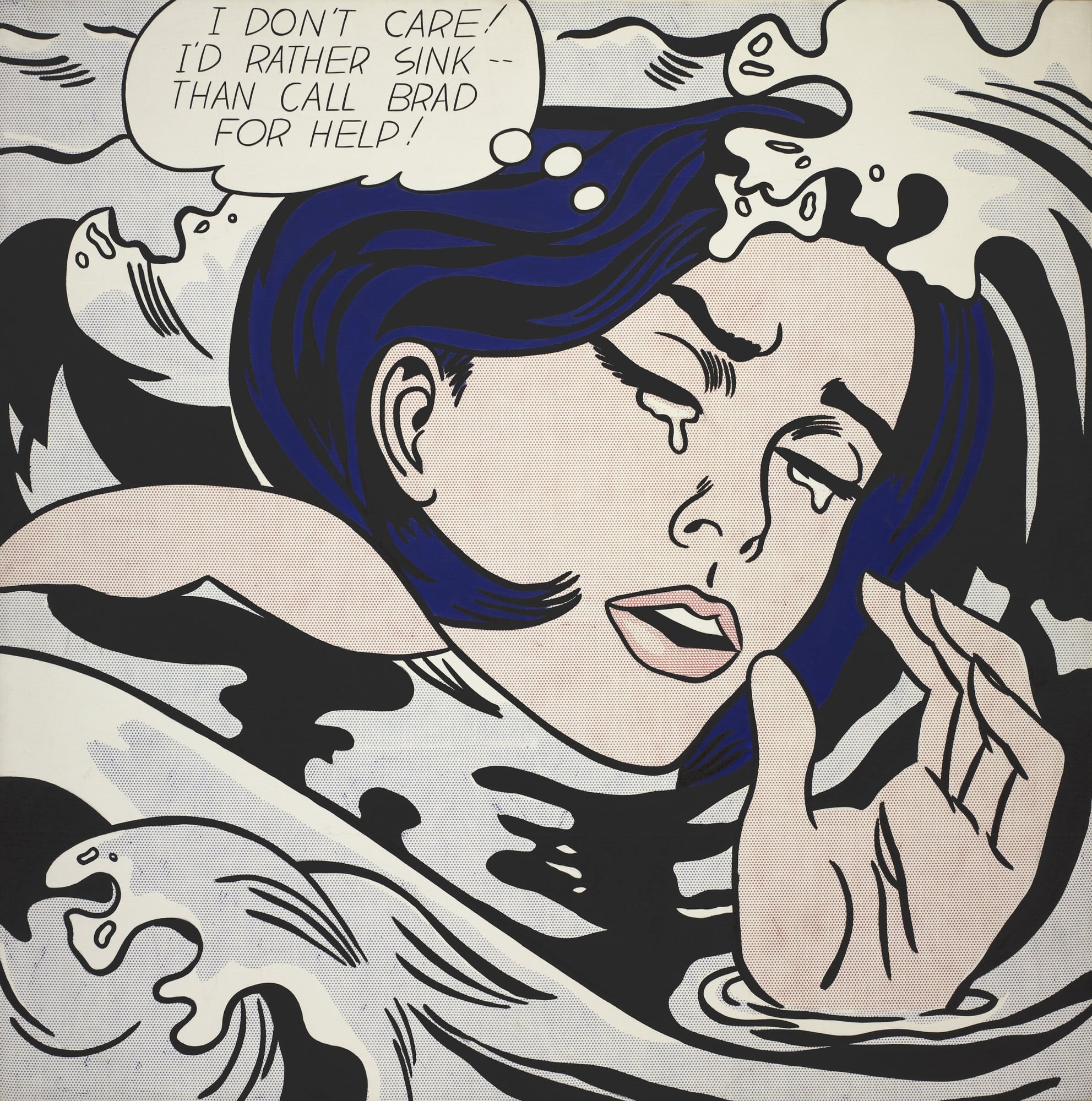
Drowning Girl
Roy Lichtenstein (1963)
<strong>Drowning Girl</strong> converts a romance-comic crisis into a monumental icon of cool, stylized emotion. With tight cropping, <strong>Ben-Day dots</strong>, and heavy black contours, <strong>Roy Lichtenstein</strong> isolates a heroine who declares, "I DON’T CARE! I’D RATHER SINK—THAN CALL BRAD FOR HELP!" The painting turns mass-media melodrama into a distilled language of signs that oscillates between parody and pathos <sup>[1]</sup><sup>[4]</sup>.
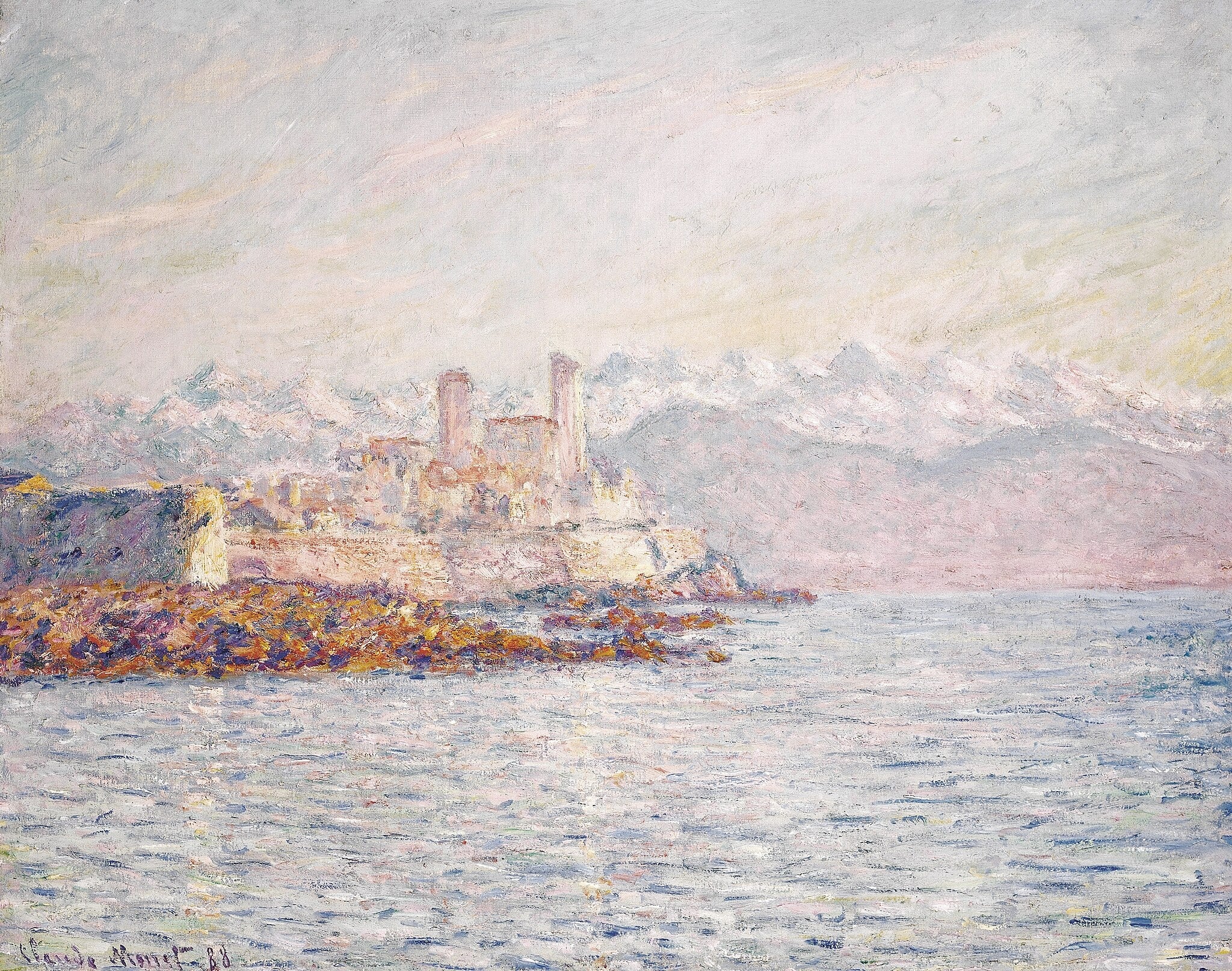
Antibes
Claude Monet (1888)
Monet’s Antibes turns a fortified headland into a <strong>luminous apparition</strong>: towers, ramparts, sea, and Alps dissolve into trembling strokes of lilac, lemon, blue‑green, and rose. By fusing stone and atmosphere, Monet makes the southern light itself the painting’s <strong>true subject</strong> <sup>[1]</sup><sup>[2]</sup>.
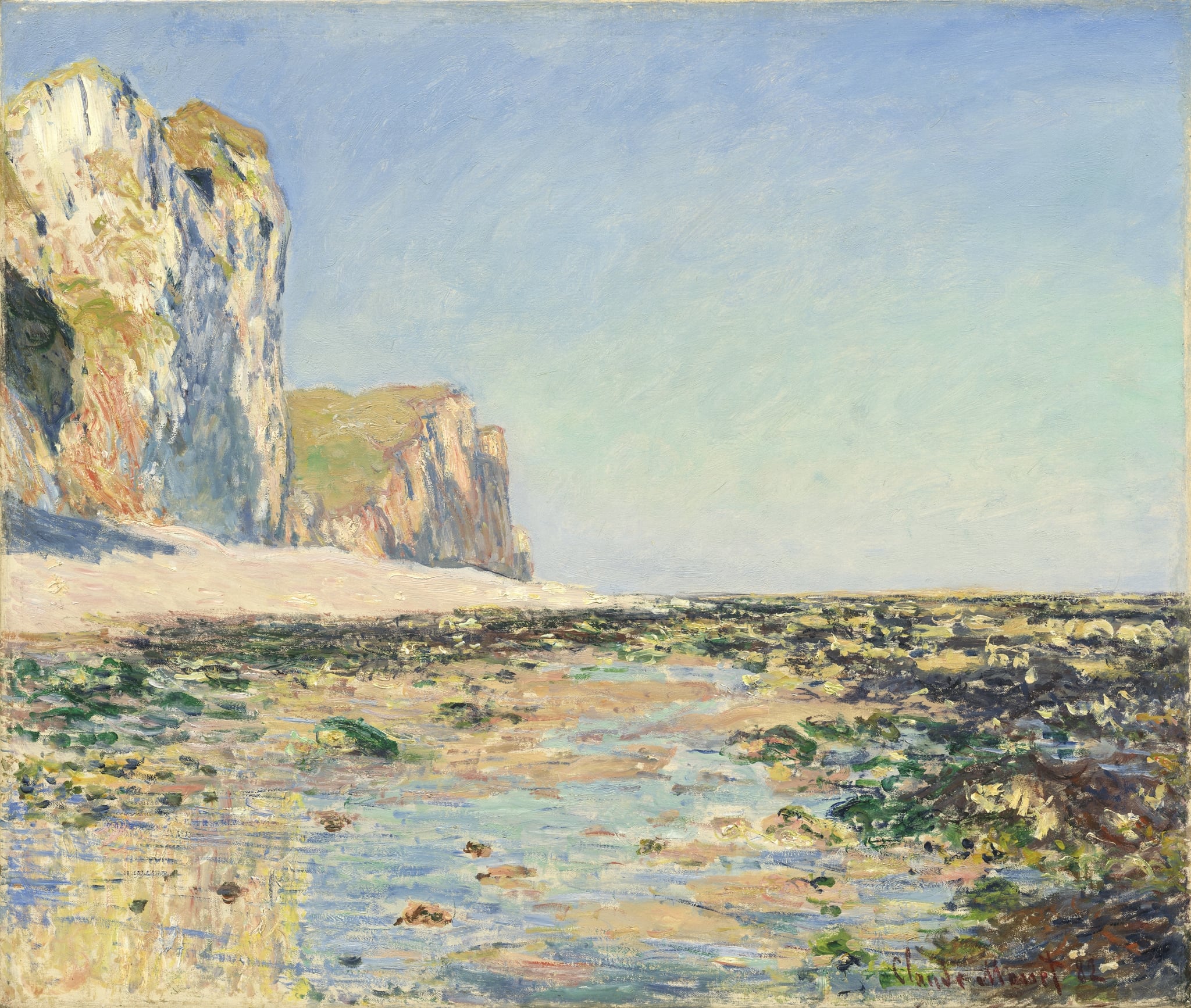
Seashore and Cliffs of Pourville in the Morning
Claude Monet (1882)
Claude Monet’s Seashore and Cliffs of Pourville in the Morning renders Normandy’s coast as a theater for <strong>ephemeral light</strong> and <strong>geologic permanence</strong>. A vast, pale sky and mirror-like tide pools counterbalance the chalk cliffs at left, turning a quiet morning into a statement about <strong>time and renewal</strong>.
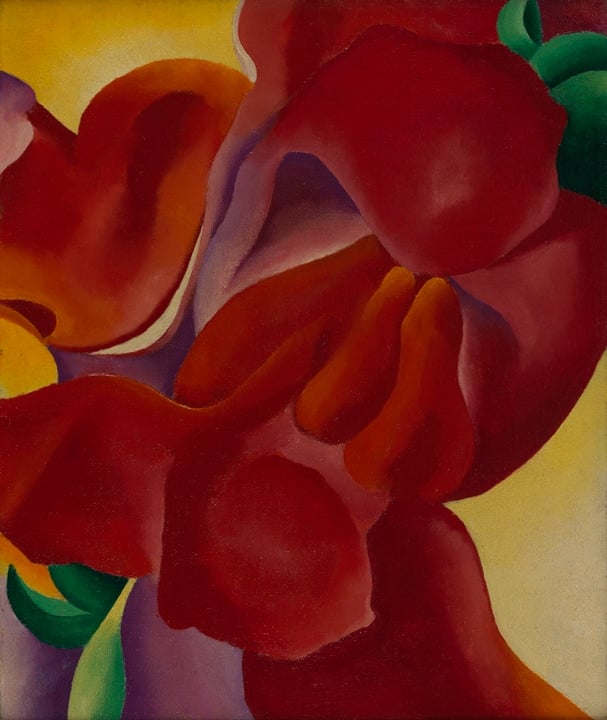
Red Canna
Georgia O’Keeffe (1925–1928)
Georgia O’Keeffe’s Red Canna turns a single bloom into an immersive field of <strong>magnified color and form</strong>. Swelling crimson petals edged with violet ride against a <strong>sunlit yellow</strong> ground, while small <strong>green flickers</strong> punctuate the heat, converting a garden flower into a modern emblem of <strong>vitality and perception</strong> <sup>[1]</sup><sup>[2]</sup>.
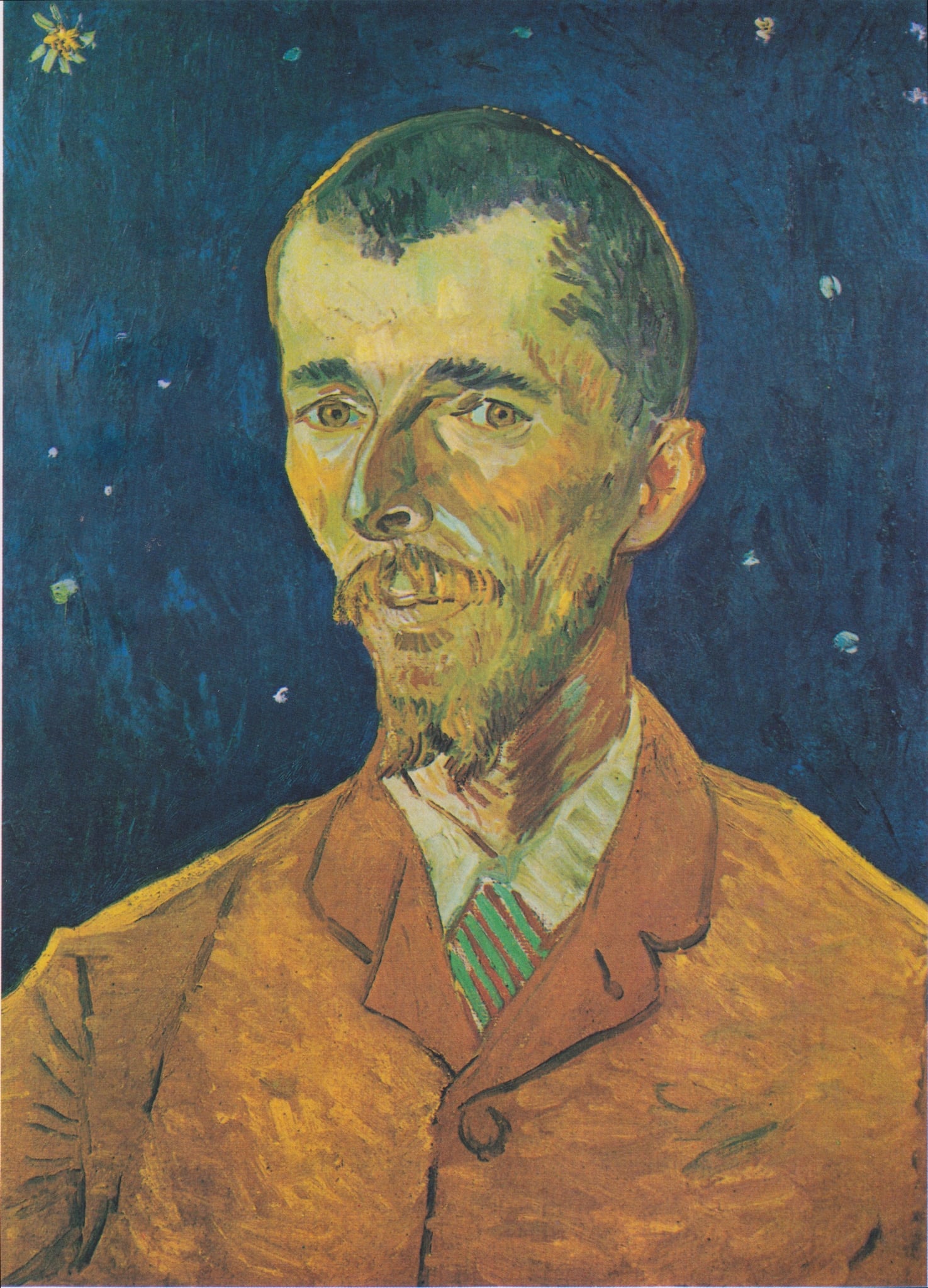
Eugène Boch
Vincent van Gogh (1888)
Vincent van Gogh’s 1888 portrait of <strong>Eugène Boch</strong> turns a friend into a visionary presence: a glowing, ocher head set before an <strong>infinite blue</strong> pricked with stars. The lone bright star at upper left and the cobalt field make the warm face and jacket <strong>vibrate</strong> from the night, declaring art as vocation rather than mere likeness <sup>[1]</sup><sup>[2]</sup>.
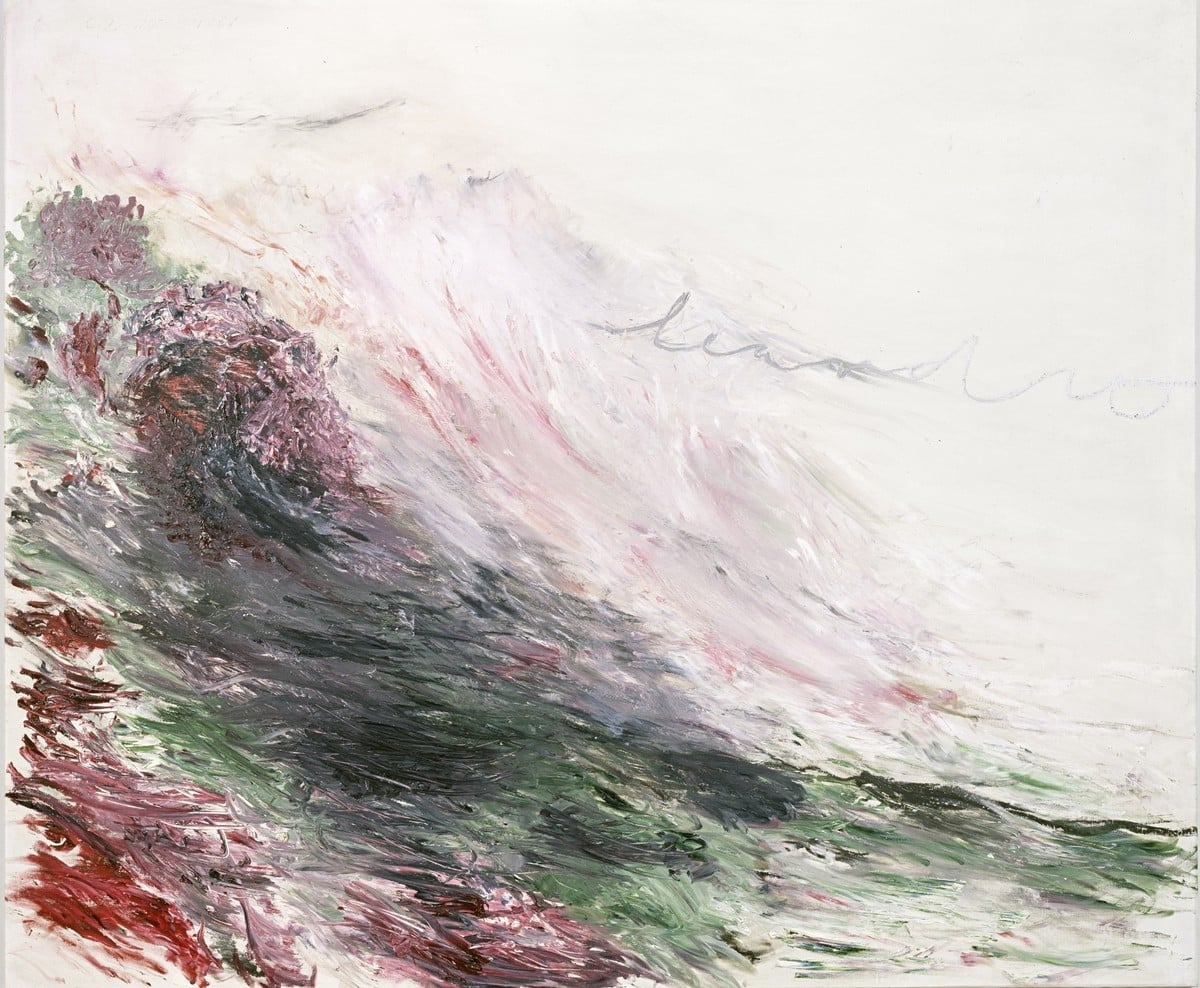
Hero and Leandro
Cy Twombly (1985)
<strong>Hero and Leandro</strong> compresses myth into a single, diagonal surge of paint that fuses sea, storm, and desire. The impasto wave drives from lower left to upper right, while the faint graphite name “leandro” thins into the white ground, turning language into a last breath. Twombly converts Marlowe’s poem and the Greek legend into a <strong>painterly elegy</strong> where gesture stands in for fate <sup>[1]</sup><sup>[2]</sup><sup>[3]</sup>.
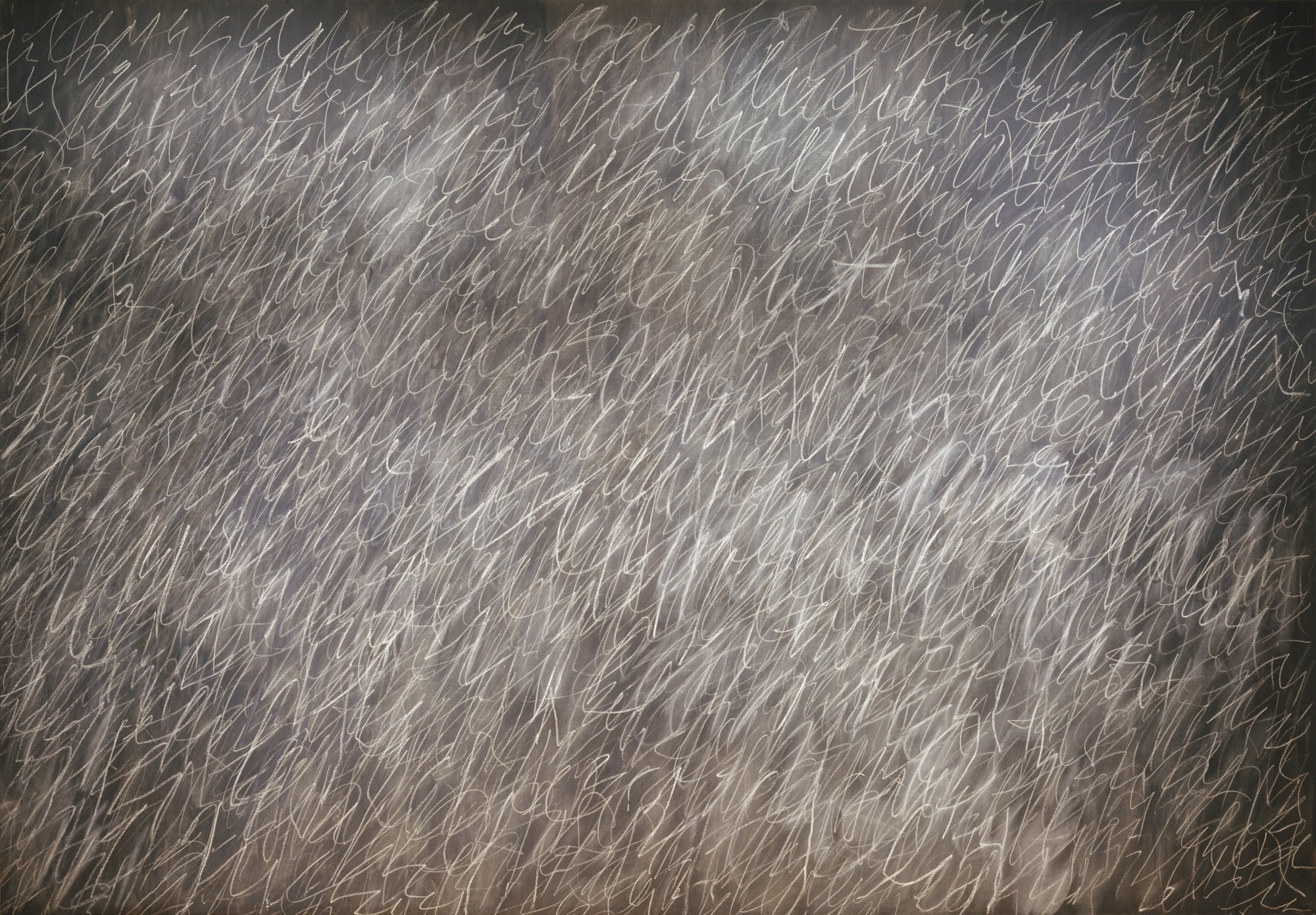
Blackboard
Cy Twombly (1968)
Blackboard stages <strong>writing without words</strong>: looping, chalk‑like lines sweep diagonally across a smoky gray field, rehearsing language as pure rhythm. Twombly turns the schoolroom slate into a <strong>theater of inscription</strong>, where repetition, erasure, and breath register as the true subject <sup>[1]</sup><sup>[2]</sup>.
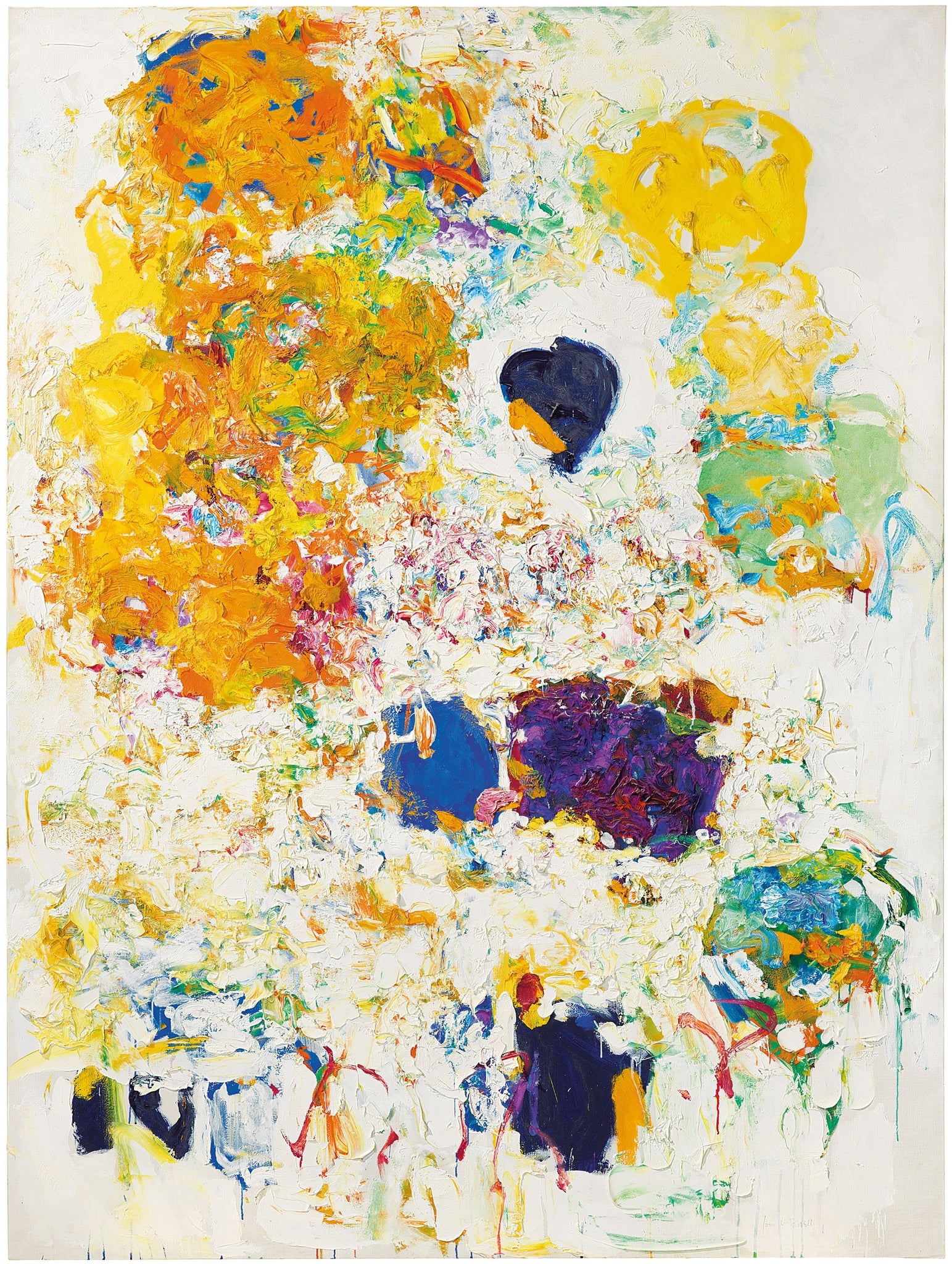
Blueberry
Joan Mitchell (1969)
Joan Mitchell’s Blueberry (1969) stages a <strong>clustering storm of color</strong> within a wide, breathing field of white. Thick blue-violet cores press against ochre and lemon swaths, while scraped light and drips open pockets of air, turning memory into <strong>weathered sensation</strong> <sup>[1]</sup><sup>[3]</sup><sup>[2]</sup>.
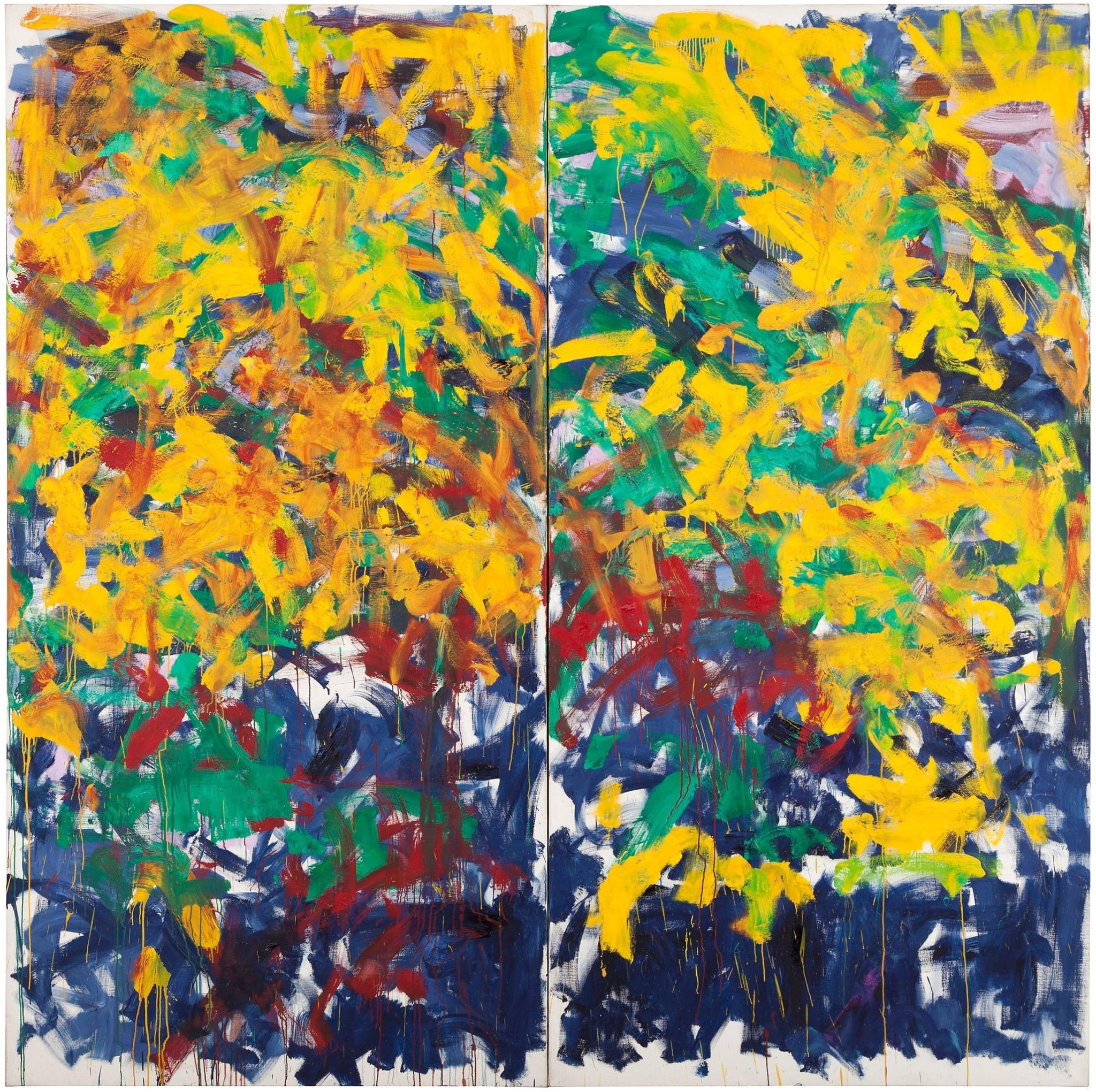
La Grande Vallée VII
Joan Mitchell (1983)
La Grande Vallée VII is a monumental <strong>diptych</strong> in which Joan Mitchell converts a remembered landscape into a charged field of color and motion. Cascades of <strong>blazing yellow</strong>, <strong>leafy green</strong>, and <strong>inky blue</strong> collide across the seam, where drips and slashing strokes keep the surface alive—an arena where <strong>exuberance and elegy</strong> co-exist <sup>[1]</sup><sup>[2]</sup>.
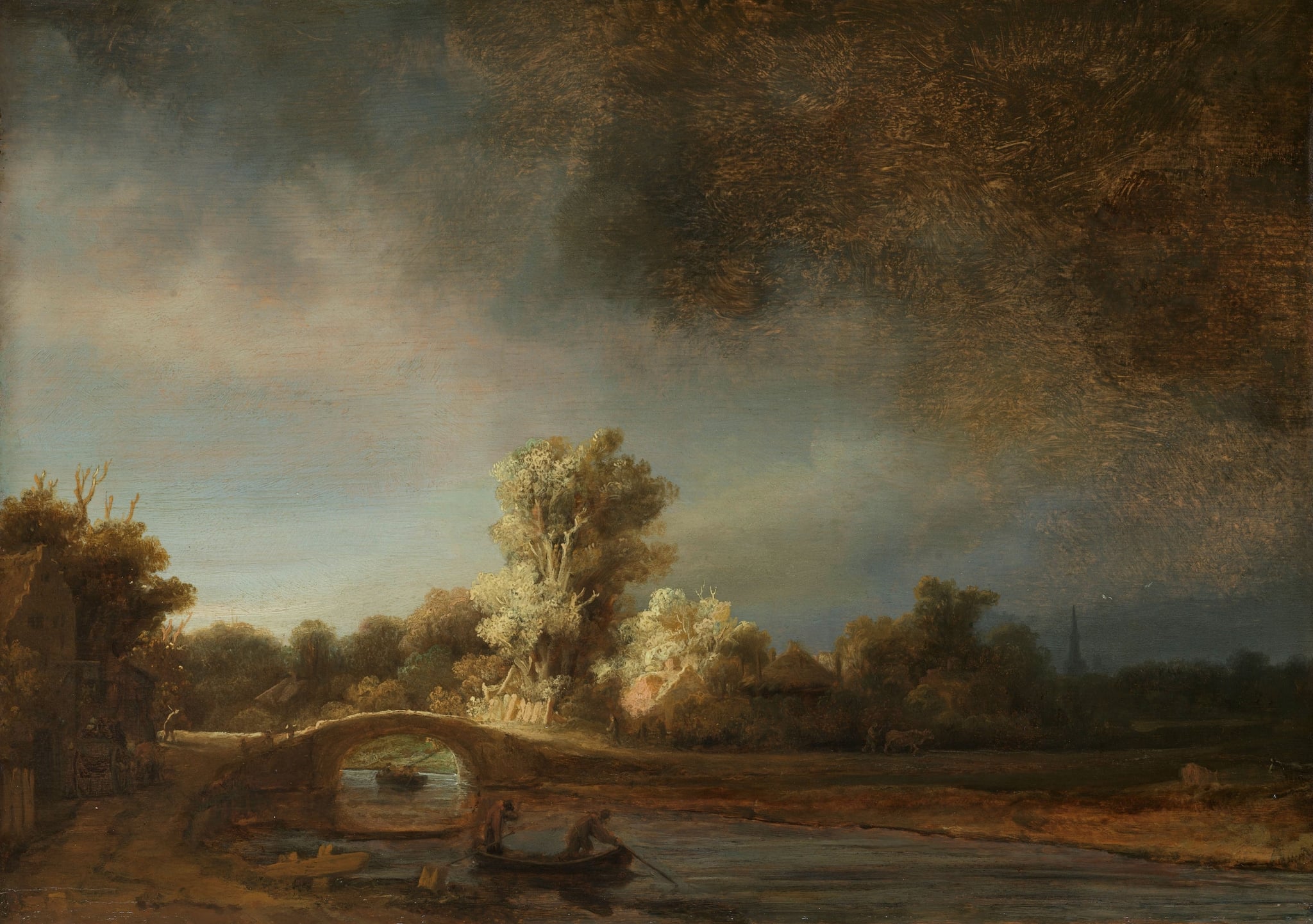
Landscape with a Stone Bridge
Rembrandt van Rijn (late 1630s (c. 1637–1638))
Under a storm-laden sky, a sudden shaft of light isolates the low <strong>stone bridge</strong> and a cluster of <strong>silvery trees</strong>, while tiny boats, a rutted track, a cottage, grazing animals, and a far <strong>church spire</strong> register human presence. Rembrandt van Rijn turns an everyday crossing into a scene of <strong>passage and providence</strong>, where transience moves beneath the endurance of stone and sky <sup>[1]</sup><sup>[2]</sup>.