The Wanderer above the Sea of Fog
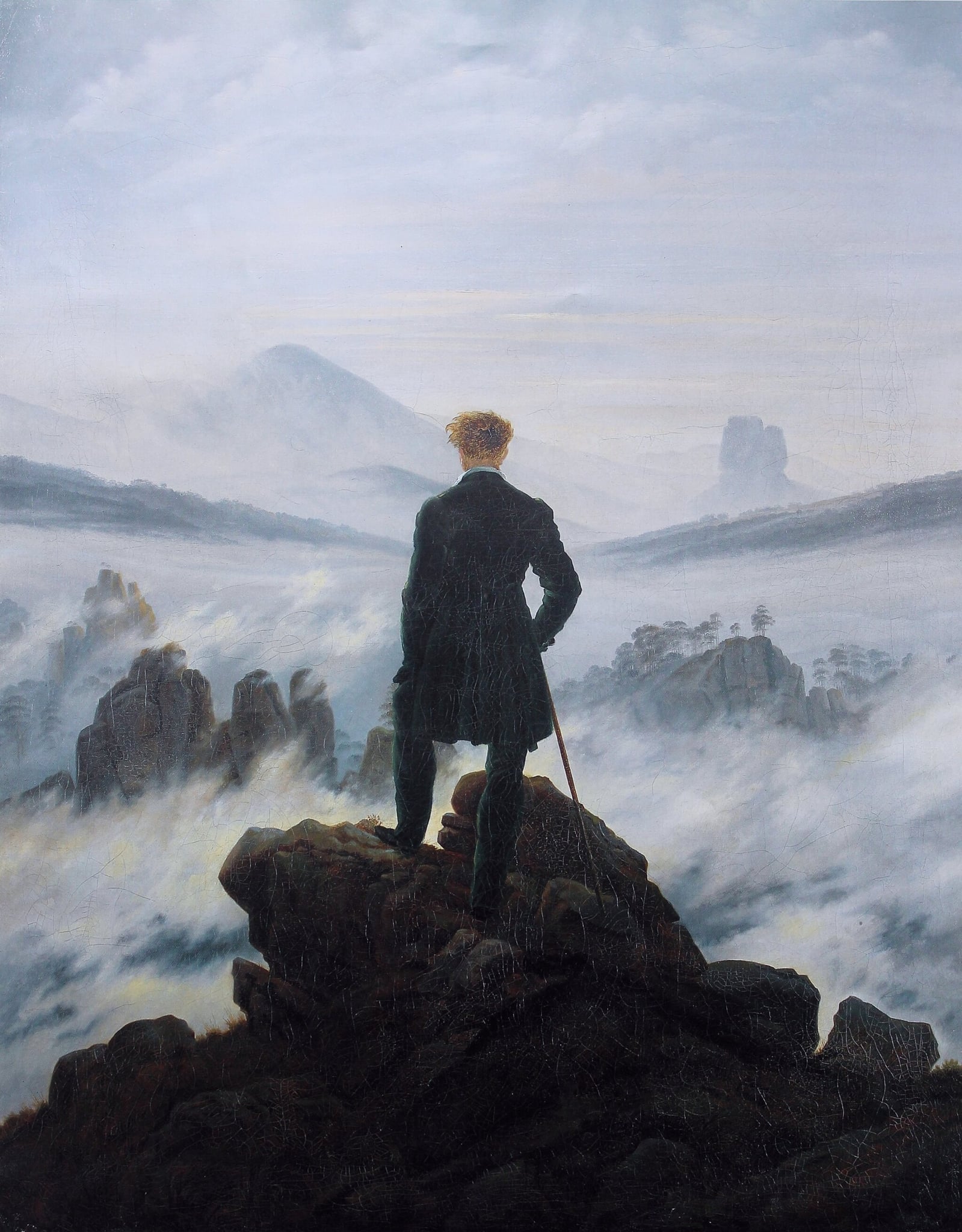
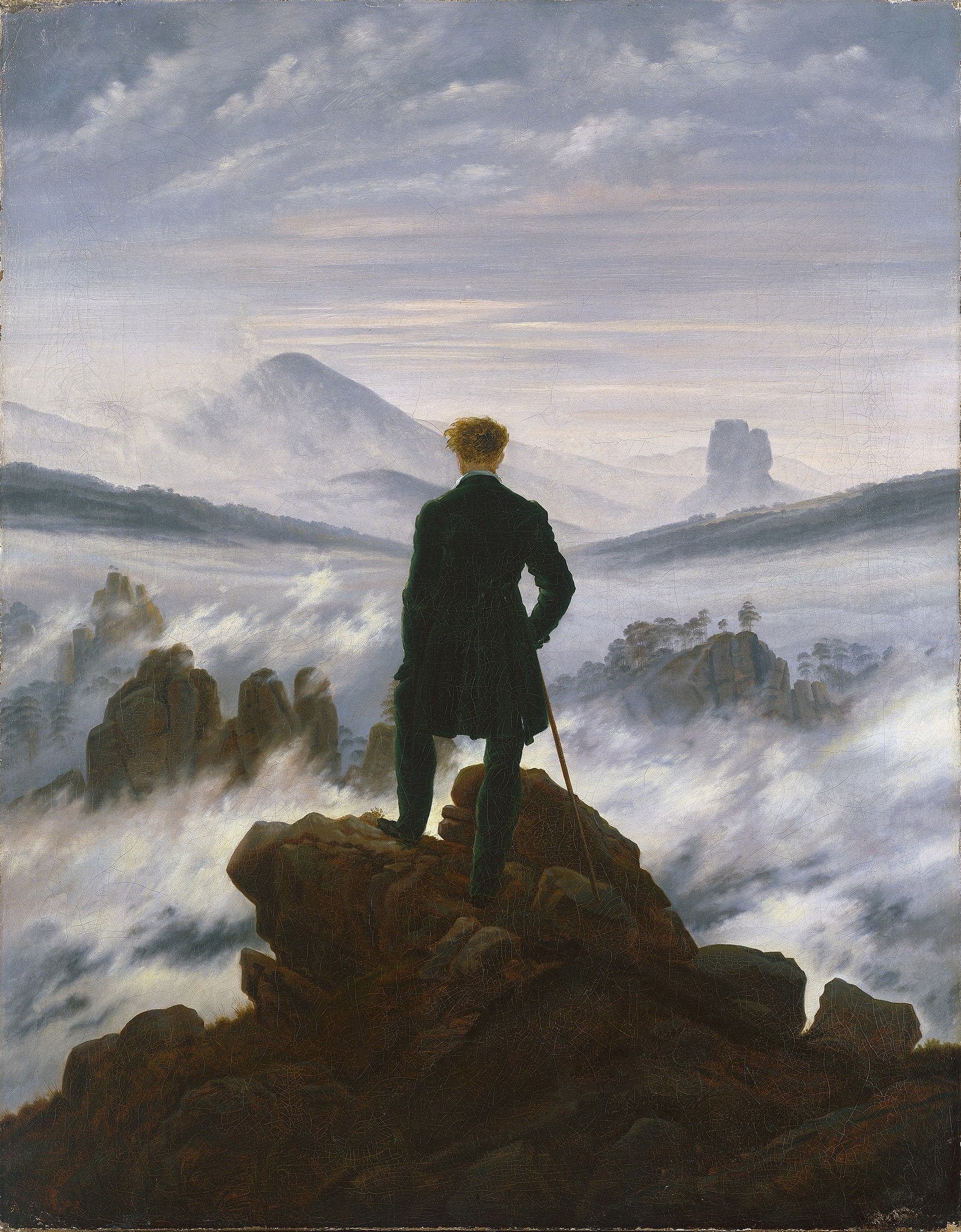
Caspar David Friedrich’s The Wanderer above the Sea of Fog distills the Romantic encounter with nature into a single Rückenfigur poised on jagged rock above a rolling sea of mist. The cool, receding vista and the figure’s still stance convert landscape into an inner drama of contemplation and the sublime [1][3].
Fast Facts
- Year
- ca. 1817
- Medium
- Oil on canvas
- Dimensions
- 94.8 × 74.8 cm
- Location
- Hamburger Kunsthalle, Hamburg
Click on any numbered symbol to learn more about its meaning
Meaning & Symbolism
Friedrich stages a decisive encounter between firmness and flux. The wanderer’s boots grip a dark, angular pedestal while his walking stick descends along a clean diagonal; these anchors oppose the heaving vapor that drowns the valleys below. Islands of rock push up through the whiteness, and distant cones and mesas soften into bluish silhouettes. The figure’s green coat reads as modern, worldly attire rather than pastoral costume; yet his wind-stirred hair and still posture suggest a moment of spiritual suspension. The composition funnels us through him: the back-figure—the paradigmatic Rückenfigur—withholds facial psychology so that attitude and view carry the drama. We look over his shoulder into an airy corridor of layered ridges and a high horizon, a deliberately receding architecture of space that seems to expand as we gaze. This is not a transcribed viewpoint but an assembled one; Friedrich built it in the studio from separate studies to craft an ideal panorama, placing the rock underfoot (drawn near the Kaiserkrone) where it can function both physically and symbolically as a threshold between the solid and the indeterminate 2.
That threshold is the painting’s moral stage. The hard promontory stands for what can be known and stood upon; the fog stands for what must be imagined and faced. By choosing mist—a medium that reveals by veiling—Friedrich aligns vision with faith and doubt rather than with survey and mastery. The wanderer’s elevated perch promises control, but the view denies it: the ground beneath is swallowed, paths are obscured, and all direction resolves into vapor. This dialectic—vantage without certainty—is Friedrich’s particular formulation of the sublime, closer to an ethical testing of the self than to spectacle. The work thus embodies a Protestant-inflected inwardness: revelation arrives not as an external sign but as a heightened consciousness forged in exposure to nature’s magnitude 34. The effect depends on specific visual decisions: a restrained palette of greys and cold greens; a cloud-deck whose horizontal striations steady the eye even as the lower fog churns; and a pyramidal figural silhouette that stabilizes the center while the world around smears into ambiguity. The result is a picture about looking that also critiques looking—offering height without overview, detail without foothold.
Equally modern is Friedrich’s refusal of a single, closed meaning. The scene hints at history—post‑Napoleonic Germany, emergent national landscapes—but withholds emblematic clarity; the coat could signal civic modernity or forester’s work, yet remains purposefully undecidable 23. Identity debates (self-portrait or sitter) ultimately miss the point, because the figure is constructed to be anyone who occupies that ledge. In this way, The Wanderer above the Sea of Fog models spectatorship itself: to see is to project, to assemble fragments into a whole, just as the painter assembled disparate motifs into a fictive totality. That is why The Wanderer above the Sea of Fog is important: it invents a visual syntax for modern subjectivity—steadfast and searching at once—and demonstrates how painting can stage philosophy, turning the interval between rock and vapor into an image of the thinking self 124.
Explore Deeper with AI
Ask questions about The Wanderer above the Sea of Fog
Popular questions:
Powered by AI • Get instant insights about this artwork
💬 Ask questions about this artwork!
Interpretations
Formal Analysis
Friedrich engineers a pictorial architecture of depth: a pyramidal figure locks the center while transverse cloud-bands stabilize the horizon against the churn of the sea of fog. The composition funnels attention through the Rückenfigur into a corridor of receding ridges, a carefully staged alternation of dark foreground, misty middle distance, and cool blue far distance. This is not reportage but a Kompositlandschaft: the rock pedestal derives from a drawing made at the Kaiserkrone on June 3, 1813, then re-sited to become a hinge between solidity and vapor. The controlled palette—cold greens, greys, attenuated blues—suppresses local color to heighten tonal orchestration and spiritual overtones. Everything functions to hold the viewer in a poised oscillation: grounded by angular stone and staff, yet suspended over an abyss of indeterminate light 125.
Source: Hamburger Kunsthalle; Friedrich 250 portal
Medium Reflexivity (Art about Looking)
The picture is a lesson in spectatorship. By turning the viewer into a Rückenfigur, Friedrich externalizes inward vision: we "borrow" the wanderer’s standpoint yet receive height without overview. The assembled panorama acknowledges artifice and, in doing so, critiques the promise of mastery usually implied by high vantage. Joseph Leo Koerner argues that Friedrich makes perception itself the subject: landscape becomes the stage where seeing unfolds as thought, and the work "thinks" about how images mediate the world. Thus the painting is both mimesis and inquiry, an image that makes its own constructedness palpable to question what knowledge pictures can provide 24.
Source: Joseph Leo Koerner; Friedrich 250 portal
Religious/Spiritual Reading
Rather than spectacular terror, the sublime here is an ethical encounter shaped by Lutheran inwardness: the fog "reveals by veiling," aligning vision with faith and doubt. In this Protestant poetics, revelation is not a miracle-event but the sharpening of conscience and humility before creation’s magnitude. The figure is motionless, hair stirred—suspended between action and contemplation—as if prayerfully testing the soul against an uncertain horizon. Koerner’s account of Friedrich’s landscapes as meditations on subjectivity, along with Britannica’s emphasis on the painter’s Lutheran spirituality, supports reading the work as a devotional image without iconography—a quiet sermon in weather and stone 34.
Source: Joseph Leo Koerner; Encyclopaedia Britannica
Political/National Context
Painted in post‑Napoleonic Germany, the canvas mobilizes a recognizably German topography while leaving political meaning undecided. The green coat can read as fashionable urban wear, a forester’s livery, or a nod to Altdeutsch taste; such cues tempt nationalist readings, yet Friedrich withholds emblematic closure. The Friedrich 250 portal stresses deliberate ambiguity; Britannica notes unresolved debates about the figure’s identity and political coding. In this light, the work participates in early 19th‑century nation-imagining through landscape, yet models a modern politics of indeterminacy—a refusal to convert nature into propaganda, even as it resonates with collective aspirations 23.
Source: Friedrich 250 (Hamburger Kunsthalle portal); Encyclopaedia Britannica
Reception and Afterlives
The Wanderer’s afterlife charts shifting modern values. Friedrich’s reputation waned late in his life, the image later canonized as an icon of German Romanticism and, problematically, appropriated by the Nazis—evidence of how open forms can be ideologically co-opted. Post‑1970s scholarship reframed the painting as a universal inquiry into perception and selfhood rather than a nationalist emblem. Its circulation in museums and culture underscores the work’s pliability: a portable allegory of modern subjectivity as steadfast yet searching. This reception history is not incidental; it confirms the painting’s structural openness—its resistance to a single message—as central to its enduring power 35.
Source: Encyclopaedia Britannica; The Metropolitan Museum of Art
Related Themes
About Caspar David Friedrich
Caspar David Friedrich (1774–1840) was the leading painter of German Romanticism, known for meditative landscapes that fuse spiritual reflection with rigorous construction. Trained in Copenhagen and based in Dresden, he often synthesized field studies into studio-made visions that prioritize inward meaning over topographic accuracy [3].
View all works by Caspar David Friedrich →