Mont Sainte-Victoire

by Paul Cézanne

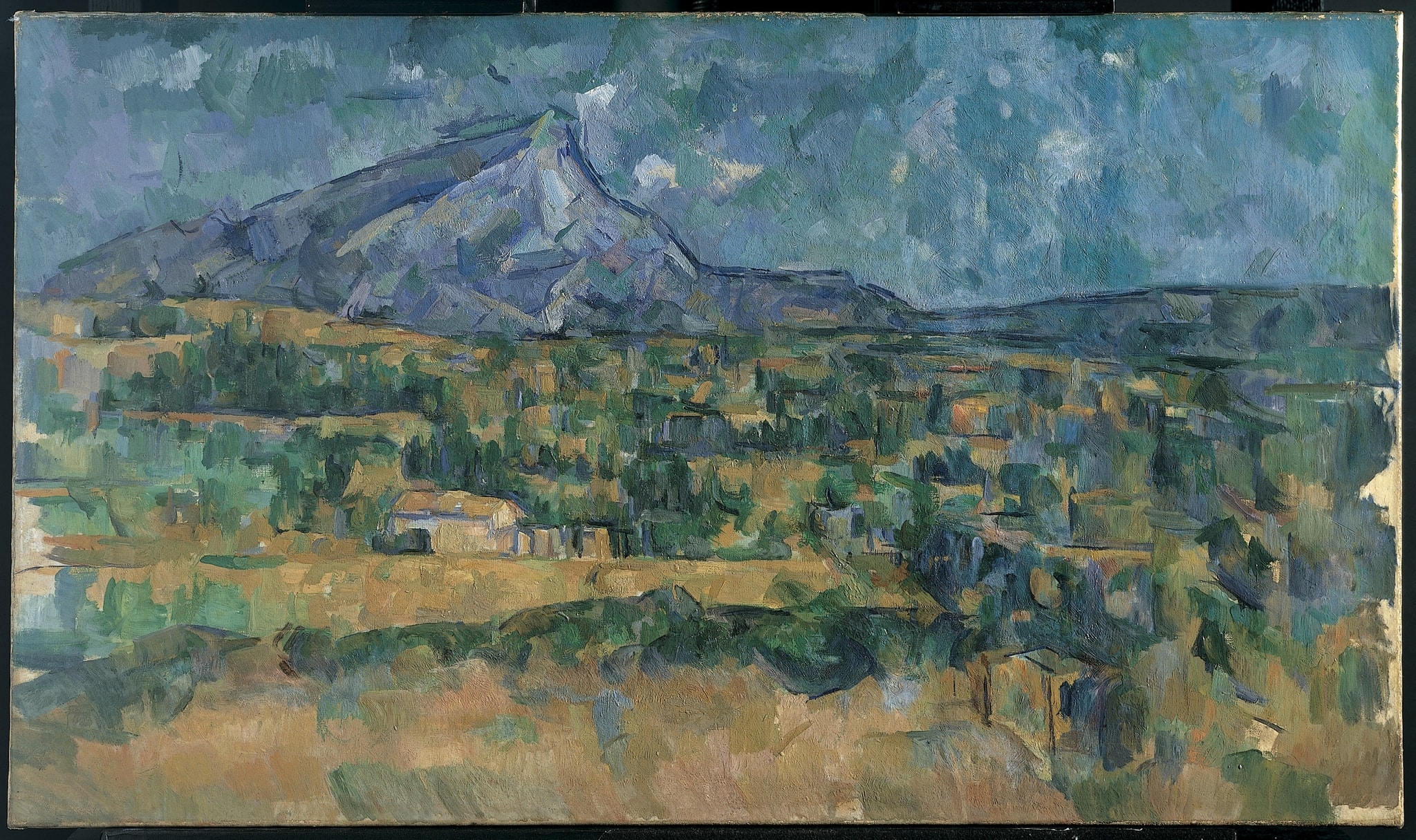
Cézanne’s Mont Sainte-Victoire renders the Provençal massif as a constructed order of planes and color, not a fleeting impression. Cool blues and violets articulate the mountain’s facets, while ochres and greens laminate the fields and blocky houses, binding atmosphere and form into a single structure [2][4].

Fast Facts

Year
1902–1906
Medium
Oil on canvas
Dimensions
57.2 × 97.2 cm (approx.)
Location
The Metropolitan Museum of Art, New York
Mont Sainte-Victoire by Paul Cézanne (1902–1906) featuring Mont Sainte‑Victoire summit, Structural sky, Tessellated fields, Blocky houses

Click on any numbered symbol to learn more about its meaning

Meaning & Symbolism

Cézanne treats Mont Sainte‑Victoire as a principle rather than a vista. The mountain’s left‑leaning summit is built from interlocking strokes of cool blue‑violets and slate greens that declare each plane’s orientation. These facets are not shadows cast over a hollow; they press outward, describing a convex, light‑filled volume that stabilizes the entire field 45. Across the middle ground, the fields break into ochre and green tesserae; the houses, reduced to pale, rectilinear blocks, sit like keystones in a masonry of brushstrokes. The sky refuses to recede into neutrality. Its broken, blue‑gray strokes echo the mountain’s angles, so air becomes a structural medium, not a backdrop. Space unfolds through calibrated warm–cool modulation—warmer ochres advance, cooler blues withdraw—so depth is achieved by color logic and the stacking of planes rather than by linear perspective 4. This constructive procedure recasts landscape as an act of thinking. The absence of a framing pine and of the Arc‑valley viaduct concentrates attention on the massif’s central authority—a late Les Lauves hallmark—while the broad, panoramic format lets rhythms propagate laterally across the canvas 23. Foreground greens are blocked in with heavier, larger patches, then taper into smaller, quicker facets in the middle distance, a measurable deceleration that convinces the eye without resorting to theatrical diagonals. The few human signs—a roofline here, a path implied by a run of ochre there—register as volumes among volumes, not narrative incidents. By subordinating anecdote to construction, Cézanne converts Provence into a universal schema: nature rendered as enduring, analyzable order. This is why Mont Sainte‑Victoire is important. It realizes Cézanne’s oft‑quoted ambition to make of Impressionism something “solid and durable,” exchanging momentary sparkle for perceptual structure 4. The faceting of forms, the equivalence of mountain and sky as interlocking planes, and the refusal to privilege contour over color anticipate the analytic procedures of Braque and Picasso; museum scholarship consistently frames these Sainte‑Victoire canvases as a crucible of proto‑Cubist thinking 45. At the same time, the painting remains intensely particular: the violet bite of limestone, the sun‑bleached ochres, the quilt of vineyards. In the tension between the mountain’s permanence and the flicker of sensation—the visible stitches of touch—Cézanne stages a modern pact between seeing and building. The picture does not record a moment; it constructs nature so that it can be known, held, and measured without losing its living vibration 24.

Explore Deeper with AI

Ask questions about Mont Sainte-Victoire

Popular questions:

Powered by AI • Get instant insights about this artwork

💬 Ask questions about this artwork!

Interpretations

Historical Context: Vantage, Viaduct, and the Classical Modern

Cézanne’s Sainte‑Victoire cycle moves from Bellevue views—often with the Arc‑valley viaduct—to the high Les Lauves prospect after 1902, where the mountain’s mass dominates. The Met reads the viaduct as a modern aqueduct, yoking contemporary infrastructure to Poussin‑like classical order 1. The card’s painting (a late Les Lauves‑type summary) pointedly notes the “absence of a framing pine and of the Arc‑valley viaduct,” a decision that filters out anecdote and speed to concentrate on permanence and construction. Seen against the chronology of sites, this omission is historical as much as formal: it registers how Cézanne’s late project trades modern bustle for a timeless schema built from planar adjacencies, a stance that resonated with the first Cubists even as it remained rooted in the specific topography of Aix 123.

Source: The Metropolitan Museum of Art; Nelson-Atkins Museum of Art

Formal Analysis: Watercolor Logic Inside the Oils

Late Sainte‑Victoire watercolors reveal Cézanne’s reserve—leaving paper bare as active light—and transparent, cool washes that let the mountain “hover.” This aqueous method, documented in MoMA’s works on paper, feeds back into the oils’ broken planes and calibrated warm–cool shifts 6. Scholars of the late work note Cézanne’s realization that the massif’s illumination is convex, not concave—a recognition that encourages outward‑pushing facets and airy intervals between strokes 7. In the oils, passages of unmodeled canvas and lightly scumbled strokes operate like watercolor reserves, making air a constructive agent. The result is a hybrid procedure: oil behaves with watercolor’s economy, stabilizing volume through temperature contrasts while preserving optical breath and the sensation of light permeating stone 267.

Source: MoMA; 1977 MoMA scholarship (via Christie’s summary)

Symbolic Reading: Civilization Threaded Through Nature

Across the series, the railway viaduct functions as a modern sign threaded into a classicalized landscape. The Met notes its analogy to a Roman aqueduct, aligning industrial modernity with enduring civic order 1. Even when the viaduct is absent, the painting sustains that symbolism by other means: houses as pale, rectilinear keystones and fields as tesserae model a civil, measured relationship between human making and geologic time. This is not nostalgia; it is a vision of Provence as a constructed harmony, where culture neither overwhelms nor retreats from nature but joins its geometry. By turning infrastructure into compositional logic, Cézanne suggests that the truly modern is not speed but structure—an ethics of building that makes the landscape legible and durable 125.

Source: The Metropolitan Museum of Art; National Gallery of Art

Method & Influence: From Perceptual Structure to Proto‑Cubism

Cézanne’s Sainte‑Victoire becomes a laboratory of planar construction: color modulates depth, and angled facets articulate orientation without theatrical perspective. The Met’s Heilbrunn essay places this procedure at the hinge between Impressionism and Cubism, emphasizing its impact on Braque and Picasso 2. DIA scholarship (Keyes; via object record) and Machotka’s site analyses argue that Cézanne creates pictorial equivalents rather than transcriptions, substituting measured planes for anecdote 4. The result is a transferable grammar—mountain, sky, and village treated as interlocking volumes—that later painters could extend to bottles and guitars. Sainte‑Victoire thus reads as a proto‑analytic landscape: a system for seeing the world as stackable, investigable planes, where contour yields to chromatic architecture 24.

Source: Met Heilbrunn Timeline; Detroit Institute of Arts (Keyes; Machotka)

Phenomenology of Looking: Measured Time in Brush and Field

The painting “measures” distance through a deceleration of strokes—large, weighted greens up front, tapering into quick facets—so the eye advances by tactile increments, not vanishing‑point decree. This distributes time across the surface: each facet reads like a unit of attention laid down in sequence. NGA and Nelson‑Atkins entries on series variants underscore the steadying role of the Les Lauves prospect, which let Cézanne return to the same motif and recalibrate intervals day after day 35. The viewer’s experience mirrors the painter’s: stepwise construction of space through warm–cool negotiation, where even the sky’s strokes have orientation. Perception is not instantaneous; it’s built—and the painting trains us to feel that build in our own looking 235.

Source: National Gallery of Art; Nelson-Atkins Museum of Art; Met Heilbrunn Timeline

Related Themes

About Paul Cézanne

Paul Cézanne (1839–1906) pursued a solid, durable pictorial order that shaped later modernism. In the 1890s in Provence, he developed series like Mont Sainte‑Victoire, the Bathers, and The Card Players, refining forms into stable masses and chromatic structures that influenced Cubism [1][5].
View all works by Paul Cézanne

More by Paul Cézanne

The Card Players by Paul Cézanne | Equilibrium and Form by Paul Cézanne

The Card Players by Paul Cézanne | Equilibrium and Form

Paul Cézanne

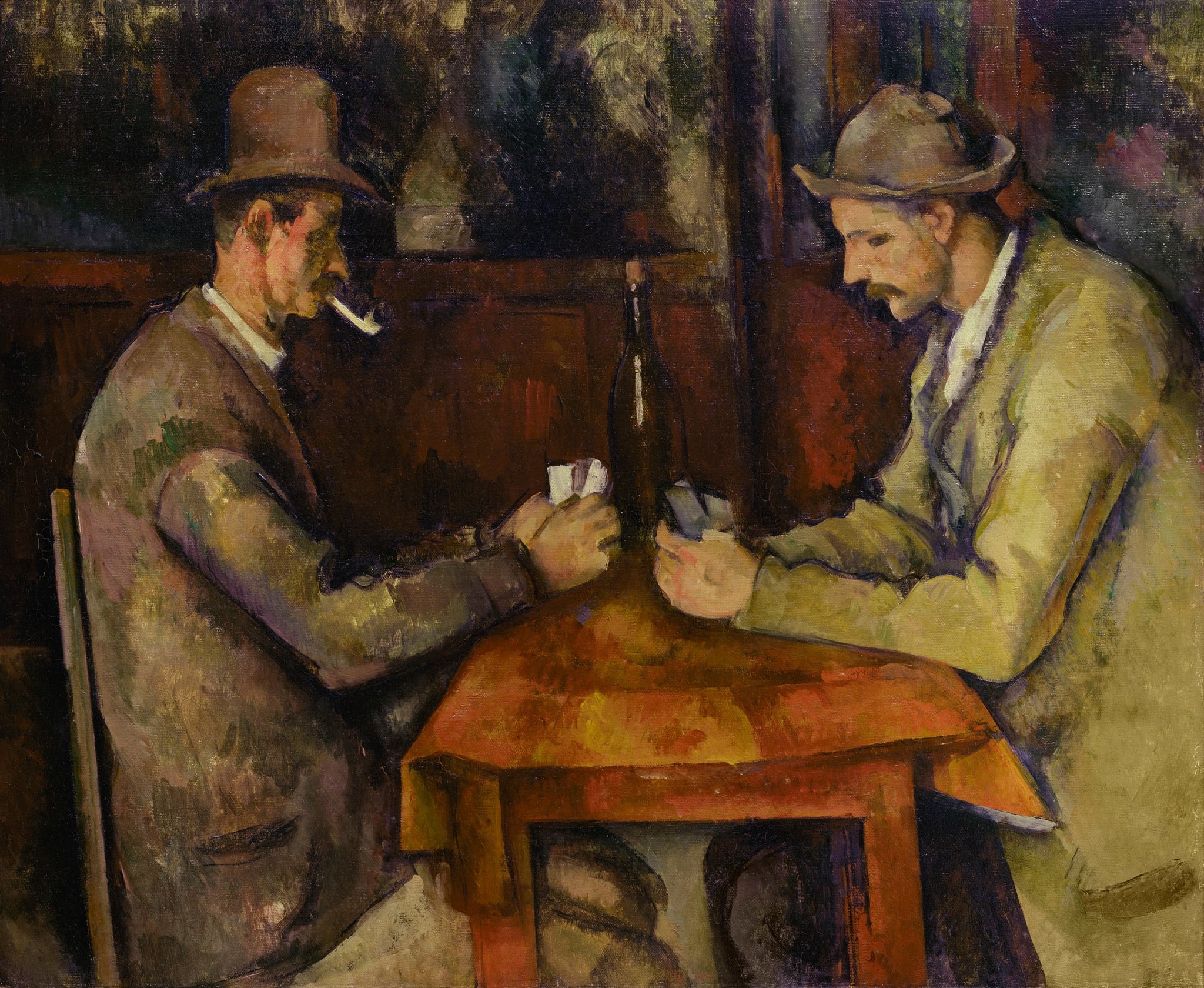
In The Card Players, Paul Cézanne turns a rural café game into a study of <strong>equilibrium</strong> and <strong>monumentality</strong>. Two hated peasants lean inward across an orange-brown table while a dark bottle stands upright between them, acting as a calm, vertical <strong>axis</strong> that stabilizes their mirrored focus <sup>[2]</sup><sup>[3]</sup>.

Bathers by Paul Cézanne: Geometry of the Modern Nude by Paul Cézanne

Bathers by Paul Cézanne: Geometry of the Modern Nude

Paul Cézanne

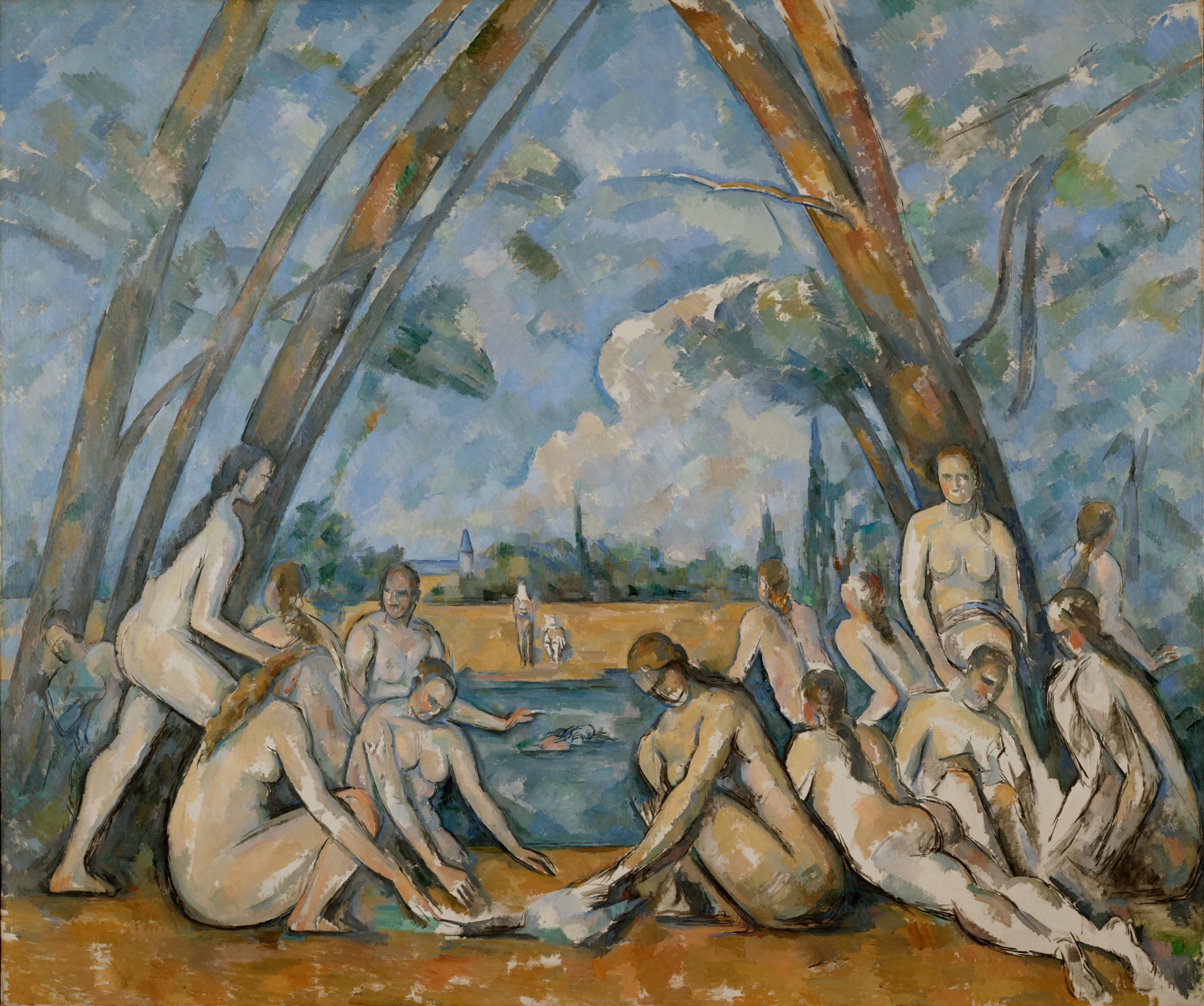
In Bathers, Paul Cézanne arranges a circle of generalized nudes beneath arching trees that meet like a <strong>natural vault</strong>, staging bathing as a timeless rite rather than a specific story. His <strong>constructive brushwork</strong> fuses bodies, water, and sky into one geometric order, balancing cool blues with warm ochres. The scene proposes a measured <strong>harmony between figure and landscape</strong>, a culmination of Cézanne’s search for enduring structure <sup>[1]</sup><sup>[2]</sup>.

The House of the Hanged Man by Paul Cézanne

The House of the Hanged Man

Paul Cézanne (1873)

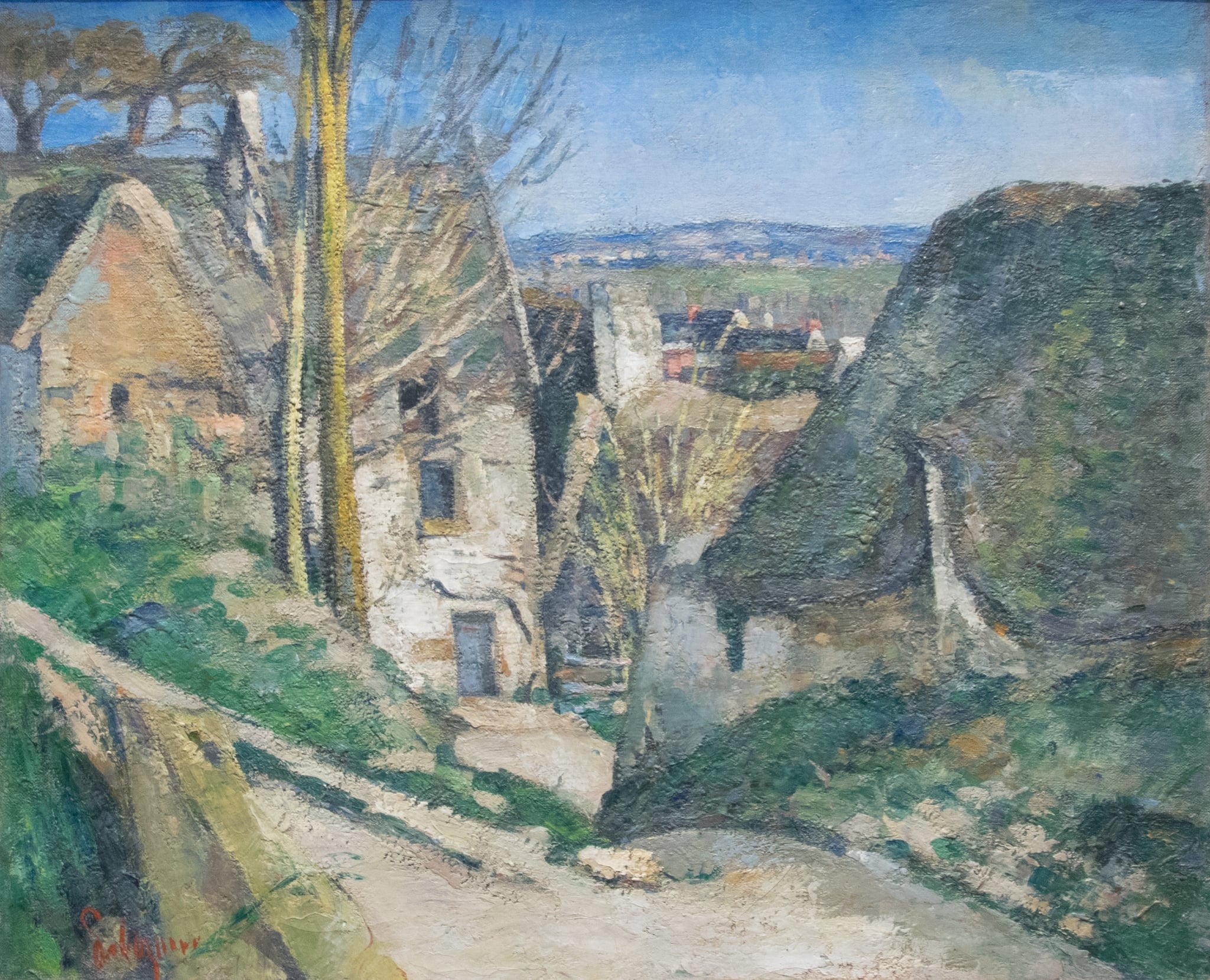
Paul Cézanne’s The House of the Hanged Man turns a modest Auvers-sur-Oise lane into a scene of <strong>engineered unease</strong> and <strong>structural reflection</strong>. Jagged roofs, laddered trees, and a steep path funnel into a narrow, shadowed V that withholds a center, making absence the work’s gravitational force. Cool greens and slate blues, set in blocky, masoned strokes, build a world that feels both solid and precarious.

The Basket of Apples by Paul Cézanne

The Basket of Apples

Paul Cézanne (c. 1893)

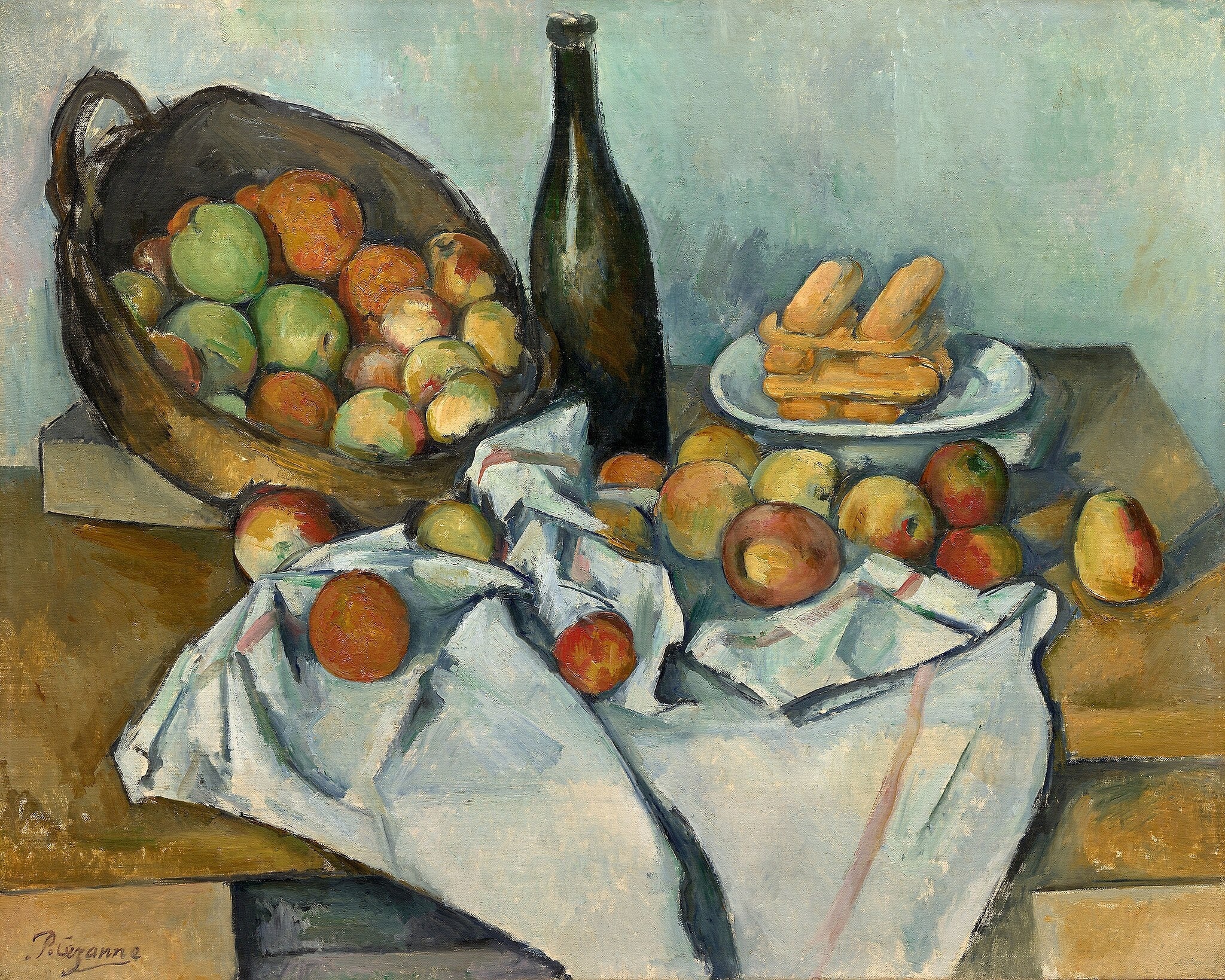
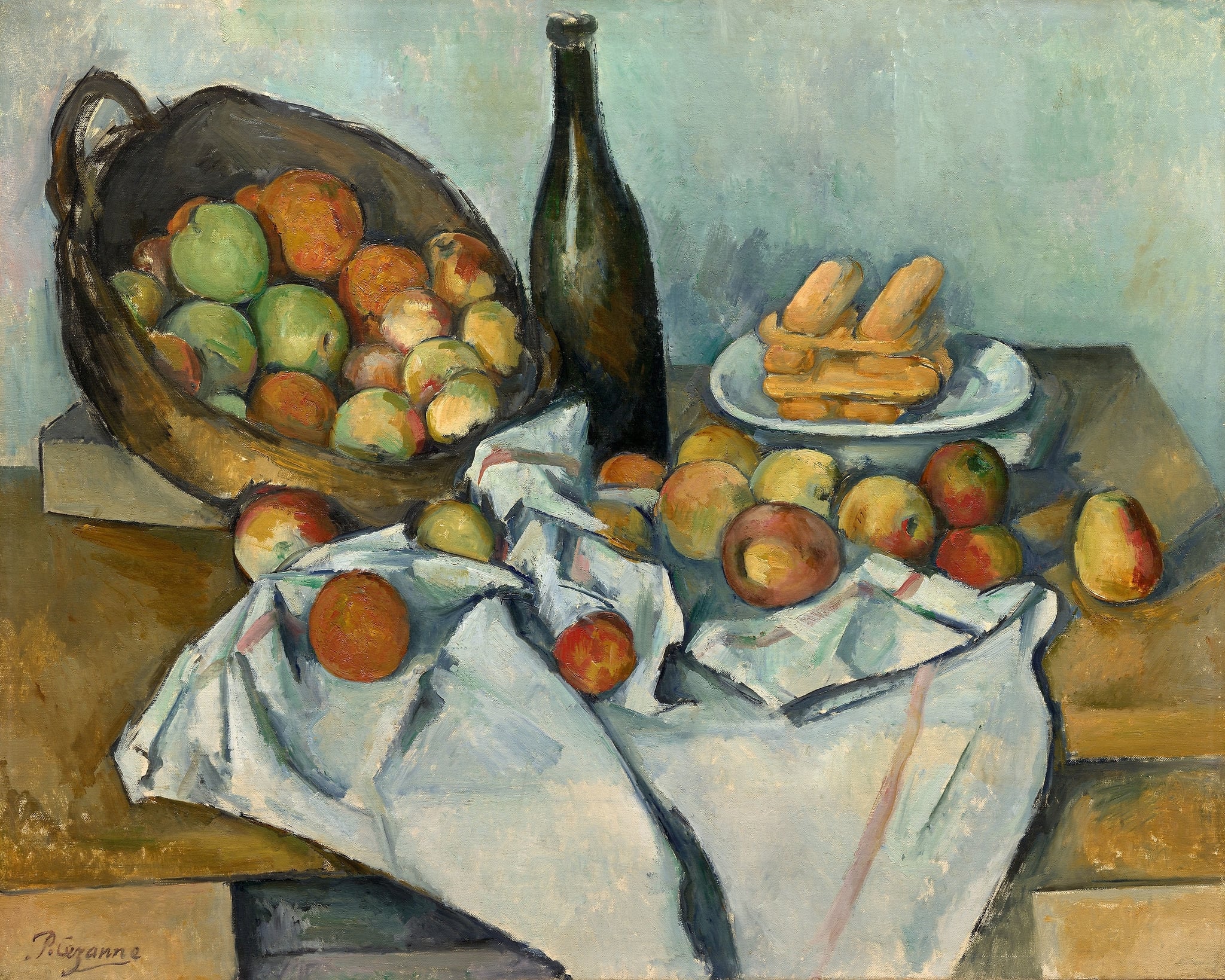
Paul Cézanne’s The Basket of Apples stages a quiet drama of <strong>balance and perception</strong>. A tilted basket spills apples across a <strong>rumpled white cloth</strong> toward a <strong>dark vertical bottle</strong> and a plate of <strong>biscuits</strong>, while the tabletop’s edges refuse to align—an intentional play of <strong>multiple viewpoints</strong> <sup>[1]</sup><sup>[2]</sup><sup>[3]</sup>.

Still Life with Apples and Oranges by Paul Cézanne

Still Life with Apples and Oranges

Paul Cézanne (c. 1899)

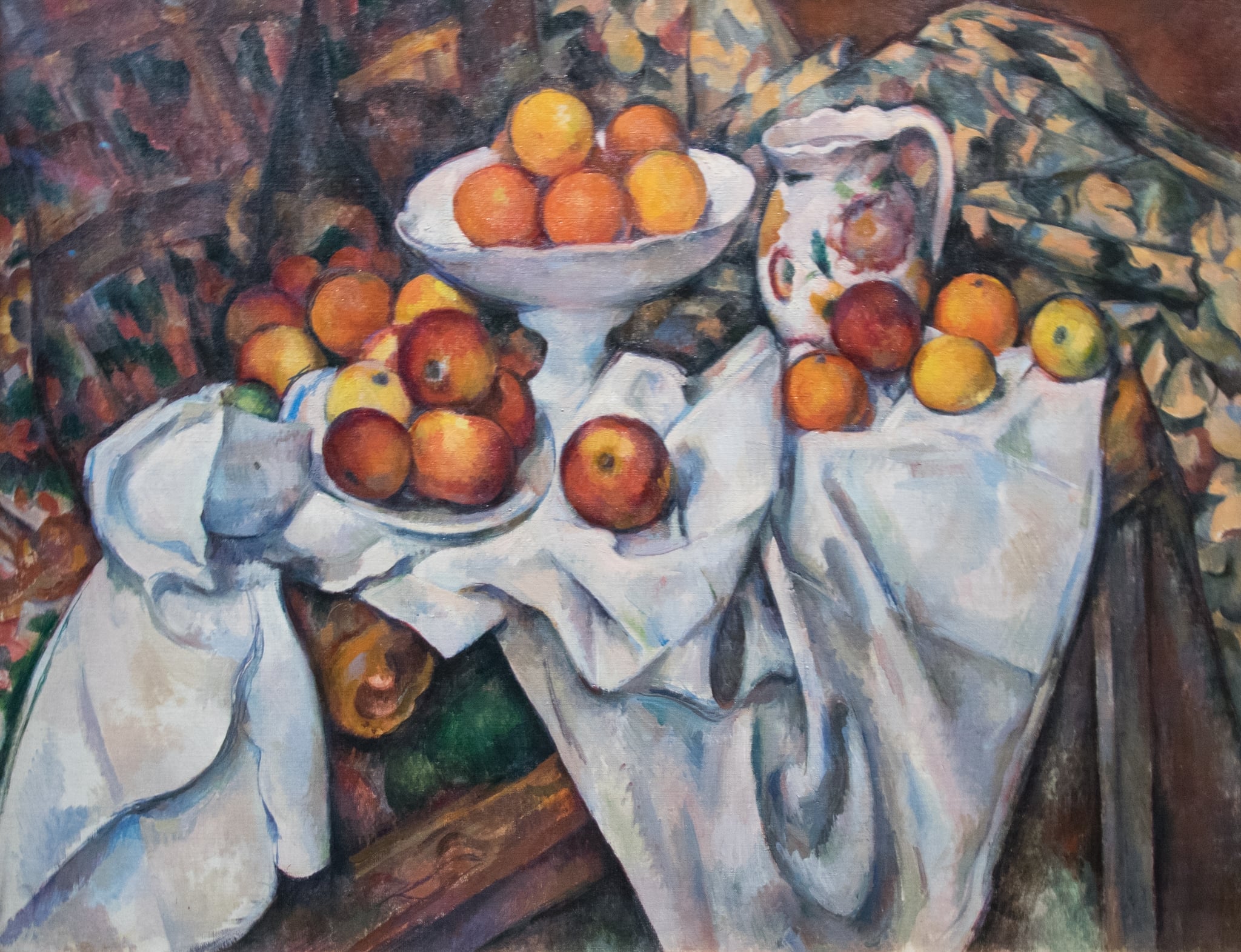
Paul Cézanne’s Still Life with Apples and Oranges builds a quietly monumental world from domestic things. A tilting table, a heaped white compote, a flowered jug, and cascading cloths turn fruit into <strong>durable forms</strong> stabilized by <strong>color relationships</strong> rather than single‑point perspective <sup>[1]</sup><sup>[2]</sup>. The result is a still life that feels both solid and subtly <strong>unstable</strong>, a meditation on how we construct vision.
Madame Cézanne in a Red Armchair by Paul Cézanne

Madame Cézanne in a Red Armchair

Paul Cézanne (about 1877)

Paul Cézanne’s Madame Cézanne in a Red Armchair (about 1877) turns a domestic sit into a study of <strong>color-built structure</strong> and <strong>compressed space</strong>. Cool blue-greens of dress and skin lock against the saturated <strong>crimson armchair</strong>, converting likeness into an inquiry about how painting makes stability visible <sup>[1]</sup><sup>[3]</sup>.