The Basket of Apples

by Paul Cézanne

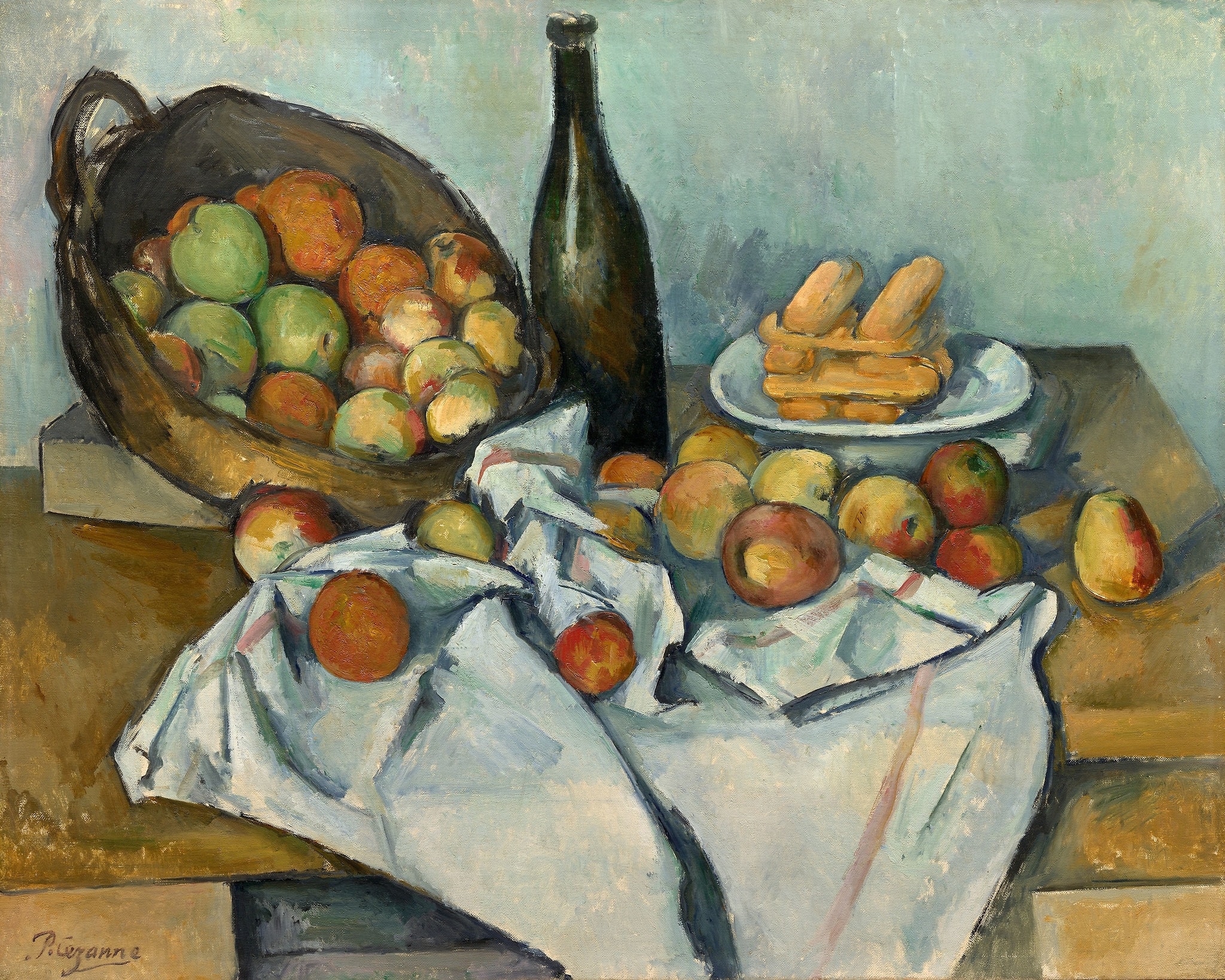
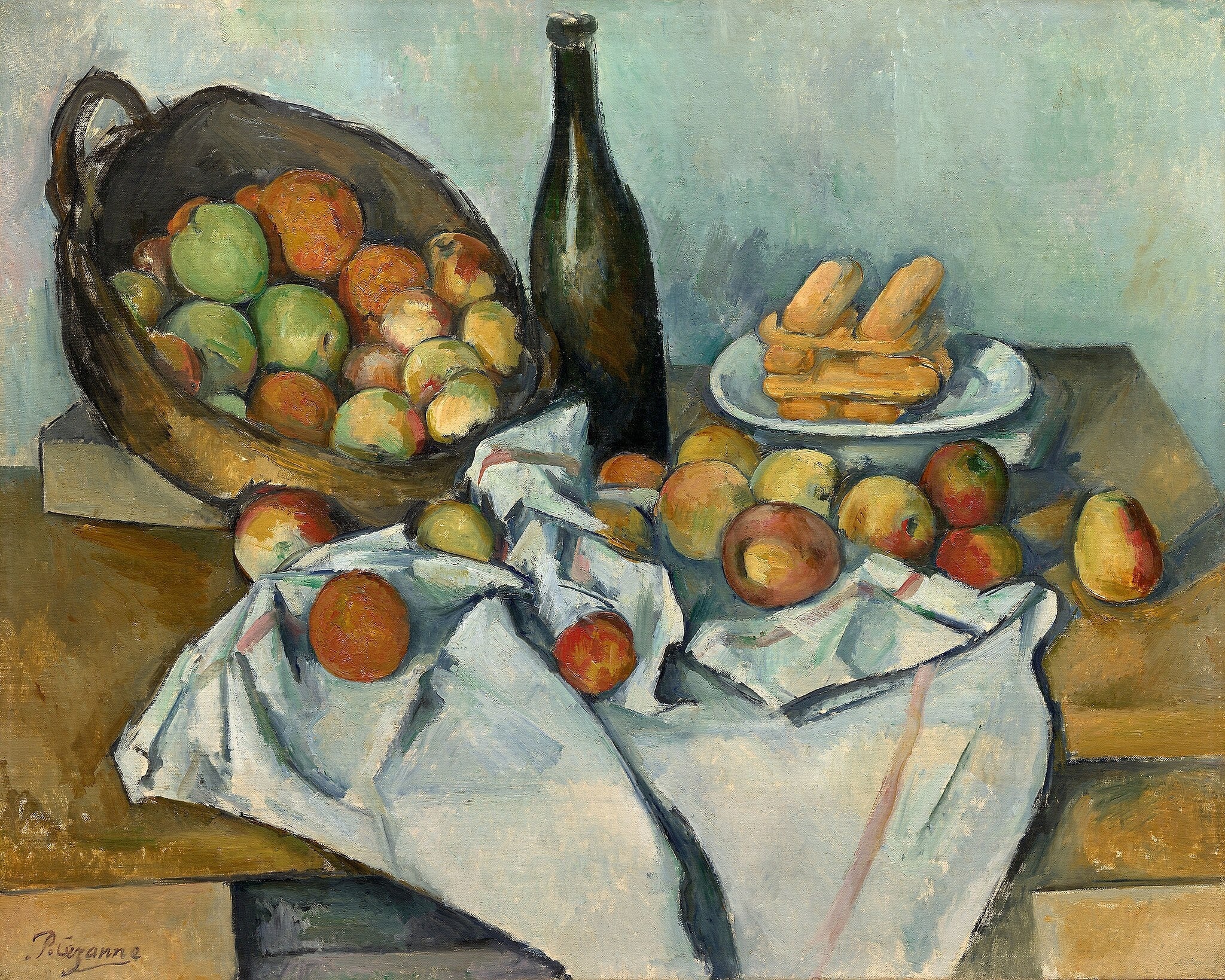
Paul Cézanne’s The Basket of Apples stages a quiet drama of balance and perception. A tilted basket spills apples across a rumpled white cloth toward a dark vertical bottle and a plate of biscuits, while the tabletop’s edges refuse to align—an intentional play of multiple viewpoints [1][2][3].

Fast Facts

Year
c. 1893
Medium
Oil on canvas
Dimensions
65 × 80 cm
Location
Art Institute of Chicago, Chicago
The Basket of Apples by Paul Cézanne (c. 1893) featuring Tilted basket, Apples, Rumpled white cloth (with red stripe), Dark vertical bottle

Click on any numbered symbol to learn more about its meaning

Meaning & Symbolism

Cézanne organizes the still life as a deliberate puzzle of viewpoints. The front and back edges of the tabletop fail to meet; the right-hand slab angles up as if seen from above, while the left projects forward in a frontal slice. The bottle stands as a dark vertical anchor, yet its base does not sit squarely on the plane beneath it. The plate of biscuits reads from two positions at once—its rim and the pastries are drawn as if the eye has shifted slightly between side view and a higher vantage. Even the woven basket is forced forward, its mouth tilting so the apples tumble toward us across the cloth. Technical analysis shows these "misalignments" were not mistakes: the skewed edge and leaning bottle appear in the underdrawing, proving Cézanne composed the instability on purpose 2. In this counter-classical construction, he replaces a single, rational grid with a montage of lookings, turning the still life into a record of time and attention rather than a camera-like instant 3. Within this structure, Cézanne builds solidity through color. The apples’ roundness comes from faceted patches—cool greens, ochers, and rusty reds—that swell and recede to model volume without relying on academic chiaroscuro. The rumpled white cloth, streaked with a faint red stripe, is not mere drapery; its peaks and folds create a rolling terrain of planes that echo the apples’ curves while pushing against the hard edges of table and plate. This is the painter’s often-cited pursuit of a “harmony parallel to nature,” where cylinders, spheres, and cones underwrite what we see without dissolving the objects into abstraction 6. The result is a paradox: the fruit feel as solid as sculpture, yet the space that holds them flickers between incompatible views. That tension embodies the meaning of The Basket of Apples: vision is constructed, cumulative, and negotiated between what we know and what we see 3. Cézanne’s staging also balances human order and natural abundance. The upright bottle and arranged biscuits symbolize habit and routine, while the spill of apples suggests a world that exceeds containment. But the painting refuses easy symbolism; museums emphasize that fruit, for Cézanne, is a durable vehicle for slow looking—forms that withstand long sittings as color and structure are tested 4. By fixing instability into the composition, he proposes a new pictorial contract: truth in painting arises from reconciling multiple, sequential perceptions on a flat surface. This is why The Basket of Apples is important. Its orchestrated distortions and color-built volumes became a touchstone for artists who would fracture and reassemble form—Picasso and Braque above all—after Cézanne’s rising recognition around the 1895 Vollard exhibition 15. The painting stands not as a rejection of reality but as a more exacting account of it: a still life that shows how meaning is made when the eye moves, compares, and composes.

Explore Deeper with AI

Ask questions about The Basket of Apples

Popular questions:

Powered by AI • Get instant insights about this artwork

💬 Ask questions about this artwork!

Interpretations

Technical/Conservation Lens

Infrared and close conservation study show that the skewed tabletop and leaning bottle were drafted from the outset, not accidents. Cézanne’s underdrawing maps the very instabilities we see, and his layered, faceted touches—especially in the apples—build volume through constructive strokes rather than academic chiaroscuro. The rumpled white cloth acts like a relief surface of planes, pressing against hard edges to articulate spatial tensions. This evidence clarifies method: Cézanne composes a deliberate disjunction of viewpoints, then knits them with color-modulated form. The result is a picture that reads as solid and stable locally while remaining structurally heterogeneous globally—a key to its modernity 21.

Source: Art Institute of Chicago

Perception vs. Photography

Rather than a “camera-like instant,” the still life proposes vision as a temporal montage: the plate, basket, and table are legible from subtly different vantage points, as if the eye has moved and compared over time. Smarthistory frames this as a purposeful undoing of Renaissance unity in favor of assembled perception, a response to photography’s single exposure and the 19th‑century appetite for immediacy. What appears inconsistent is in fact a phenomenology of looking: the painting retains the objects’ identity while acknowledging that truth is cumulative, sequential, and comparative—a thesis that will underpin Cubism’s analytic procedures 36.

Source: Smarthistory; The New Yorker

Color-Structure Doctrine

Cézanne’s oft-cited pursuit of a “harmony parallel to nature” manifests here through cylinders, spheres, and cones implied by color planes. Apples swell via cool-to-warm modulations—greens, ochers, rusty reds—so that volume is constructed chromatically, not shaded illusionistically. This is not abstraction for its own sake: the fruit remain palpably “there,” even as their solidity derives from rhythmic patches rather than cast shadow. The cloth’s crests echo the apples’ curvature, setting up a counterpoint of planes that stabilizes the composition amid multiple viewpoints. The doctrine is rigorous and empirical, testing how color can bear the weight of structure without severing ties to observed nature 61.

Source: The New Yorker; Art Institute of Chicago

Lineage and Influence

The picture’s orchestrated distortions—misaligned edges, tilted basket, compound viewpoints—were catalytic for early 20th‑century artists. After Cézanne’s 1895 Vollard exhibition consolidated his reputation, painters such as Picasso and Braque absorbed his lesson: form could be analyzed and recomposed without abandoning subject matter. Museums track a direct line from these still lifes to Proto‑Cubism’s fractured planes and Fauvism’s color assertiveness. In this genealogy, The Basket of Apples appears not as a rejection of reality but as a method for rendering experience—an approach that redefined pictorial construction in the avant‑garde 513.

Source: The Metropolitan Museum of Art; Art Institute of Chicago; Smarthistory

Anti‑Vanitas Still Life

Traditional European still lifes often stage fruit as vanitas—signs of ripeness and rot, moralizing on transience. Here, major museums stress a different contract: fruit are durable, cooperative sitters for extended, analytic looking. The painting “refuses easy symbolism,” prioritizing how perception is built through repeated comparison of planes and colors. If mortality lingers as a historical echo of the genre, Cézanne brackets it to pursue structure and attention. The apples’ firmness and the cloth’s architecture argue for persistence, not decay—still life as a site where seeing is systematized rather than sermonized 471.

Source: National Gallery of Art; Art Institute of Chicago; The Metropolitan Museum of Art

Related Themes

About Paul Cézanne

Paul Cézanne (1839–1906) pursued a solid, durable pictorial order that shaped later modernism. In the 1890s in Provence, he developed series like Mont Sainte‑Victoire, the Bathers, and The Card Players, refining forms into stable masses and chromatic structures that influenced Cubism [1][5].
View all works by Paul Cézanne

More by Paul Cézanne

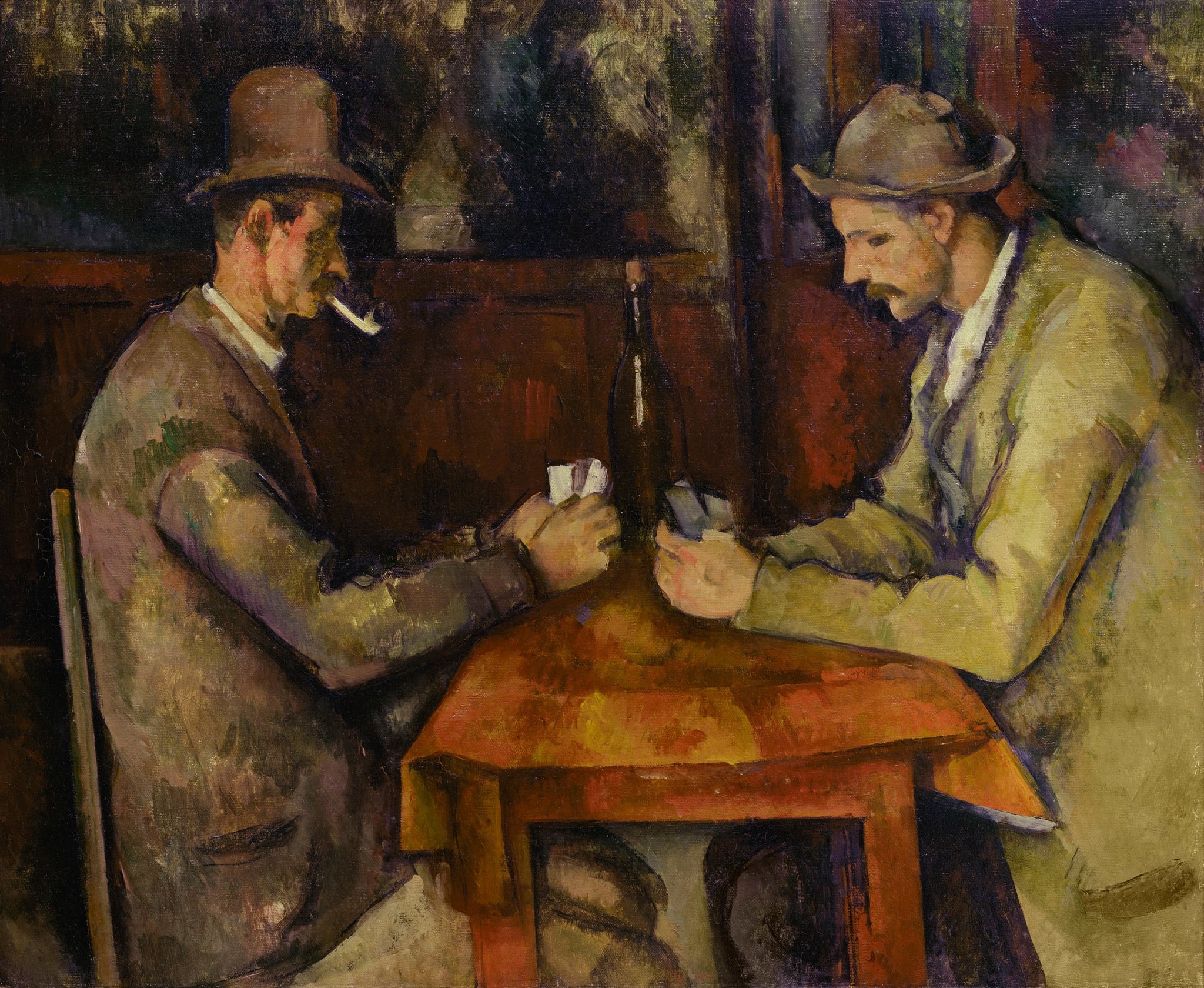
The Card Players by Paul Cézanne | Equilibrium and Form by Paul Cézanne

The Card Players by Paul Cézanne | Equilibrium and Form

Paul Cézanne

In The Card Players, Paul Cézanne turns a rural café game into a study of <strong>equilibrium</strong> and <strong>monumentality</strong>. Two hated peasants lean inward across an orange-brown table while a dark bottle stands upright between them, acting as a calm, vertical <strong>axis</strong> that stabilizes their mirrored focus <sup>[2]</sup><sup>[3]</sup>.

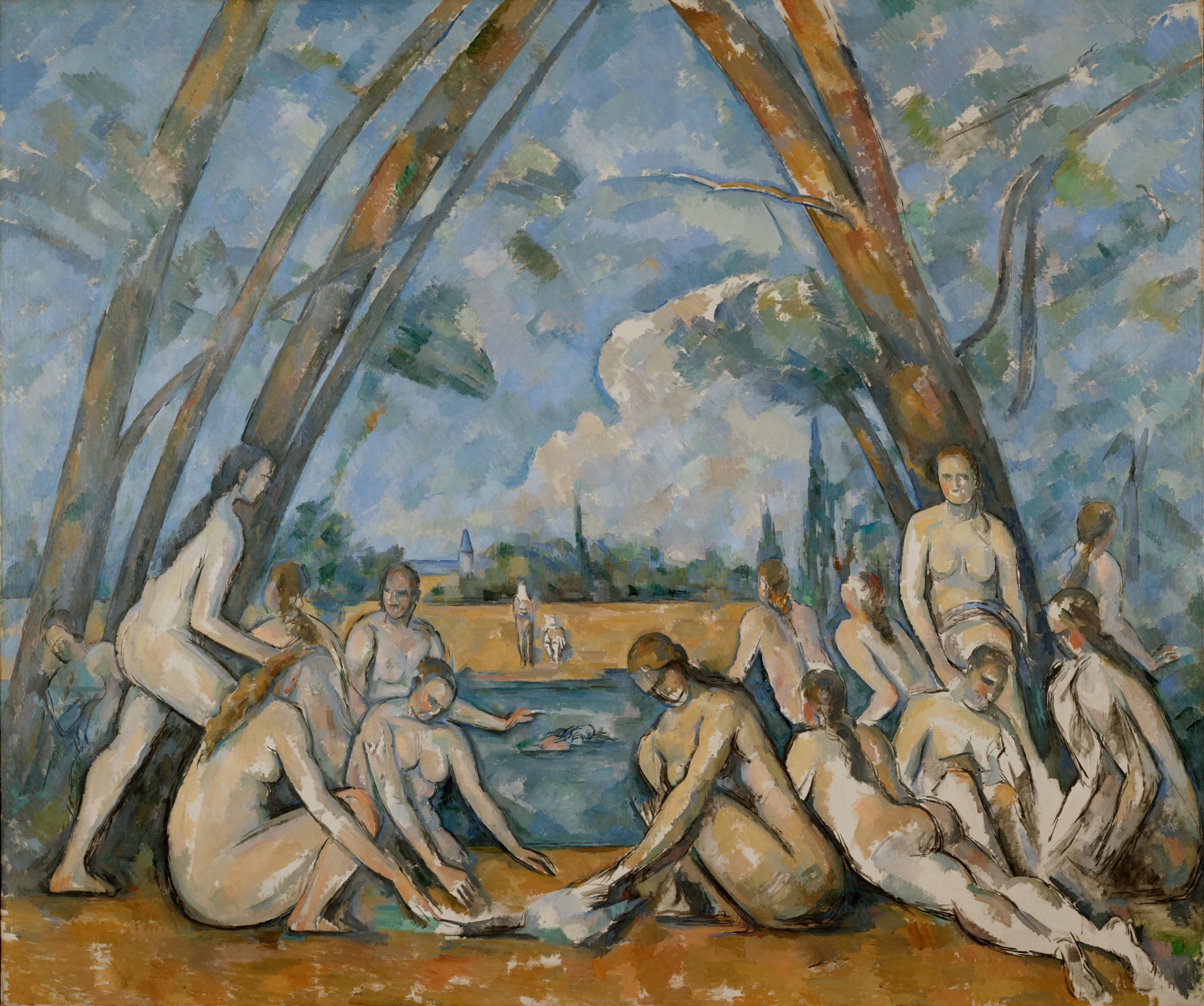
Bathers by Paul Cézanne: Geometry of the Modern Nude by Paul Cézanne

Bathers by Paul Cézanne: Geometry of the Modern Nude

Paul Cézanne

In Bathers, Paul Cézanne arranges a circle of generalized nudes beneath arching trees that meet like a <strong>natural vault</strong>, staging bathing as a timeless rite rather than a specific story. His <strong>constructive brushwork</strong> fuses bodies, water, and sky into one geometric order, balancing cool blues with warm ochres. The scene proposes a measured <strong>harmony between figure and landscape</strong>, a culmination of Cézanne’s search for enduring structure <sup>[1]</sup><sup>[2]</sup>.

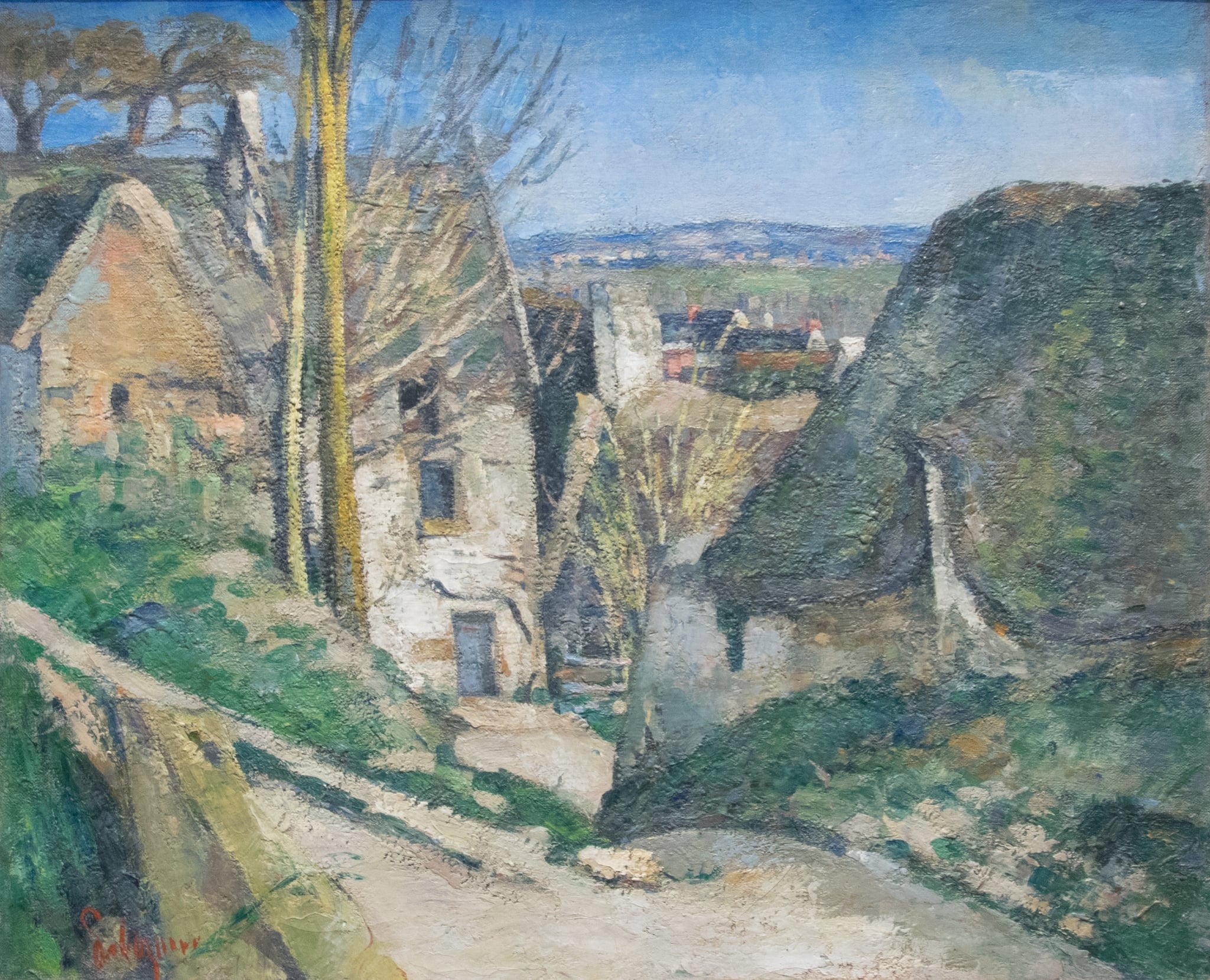
The House of the Hanged Man by Paul Cézanne

The House of the Hanged Man

Paul Cézanne (1873)

Paul Cézanne’s The House of the Hanged Man turns a modest Auvers-sur-Oise lane into a scene of <strong>engineered unease</strong> and <strong>structural reflection</strong>. Jagged roofs, laddered trees, and a steep path funnel into a narrow, shadowed V that withholds a center, making absence the work’s gravitational force. Cool greens and slate blues, set in blocky, masoned strokes, build a world that feels both solid and precarious.

Still Life with Apples and Oranges by Paul Cézanne

Still Life with Apples and Oranges

Paul Cézanne (c. 1899)

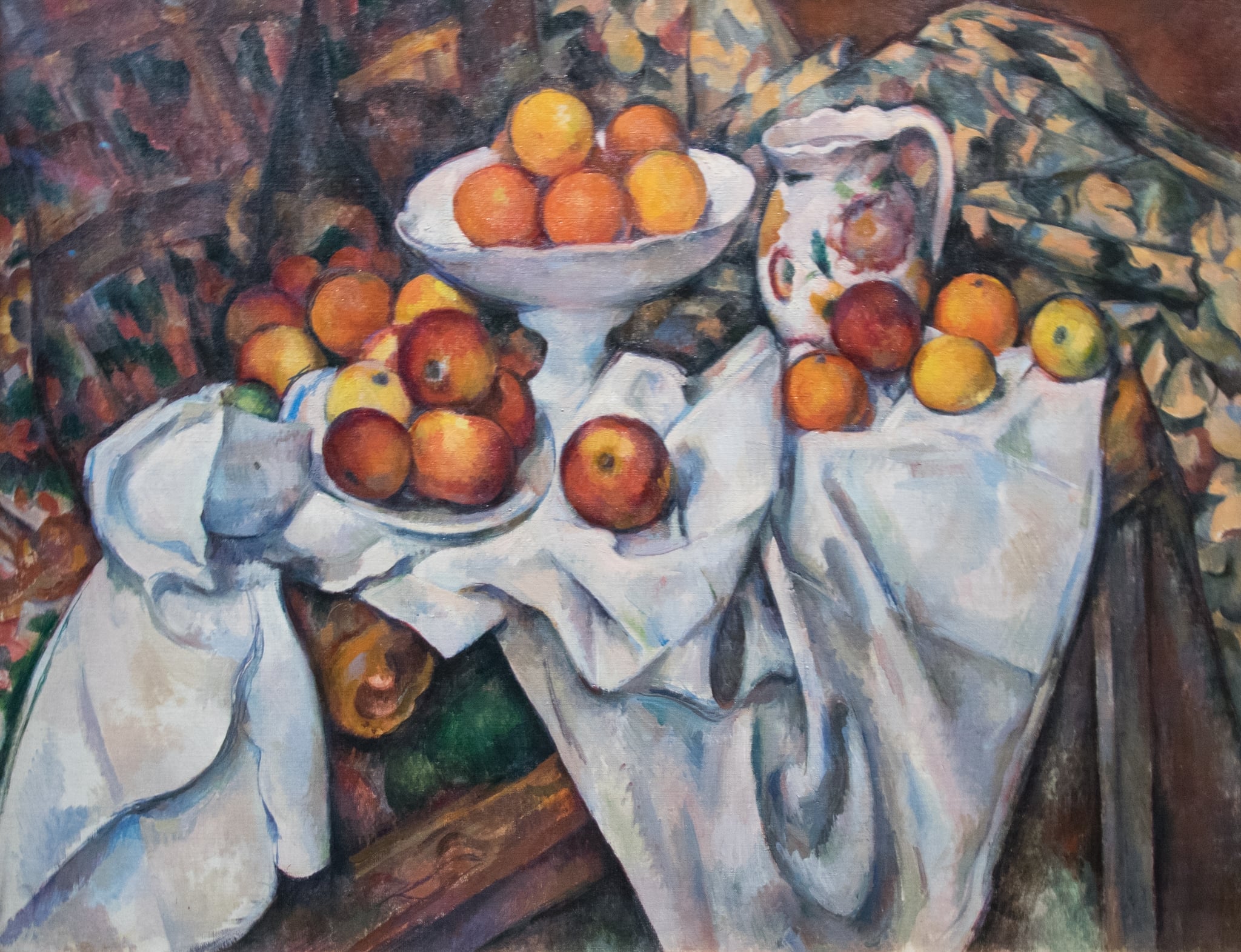
Paul Cézanne’s Still Life with Apples and Oranges builds a quietly monumental world from domestic things. A tilting table, a heaped white compote, a flowered jug, and cascading cloths turn fruit into <strong>durable forms</strong> stabilized by <strong>color relationships</strong> rather than single‑point perspective <sup>[1]</sup><sup>[2]</sup>. The result is a still life that feels both solid and subtly <strong>unstable</strong>, a meditation on how we construct vision.
Mont Sainte-Victoire by Paul Cézanne

Mont Sainte-Victoire

Paul Cézanne (1902–1906)

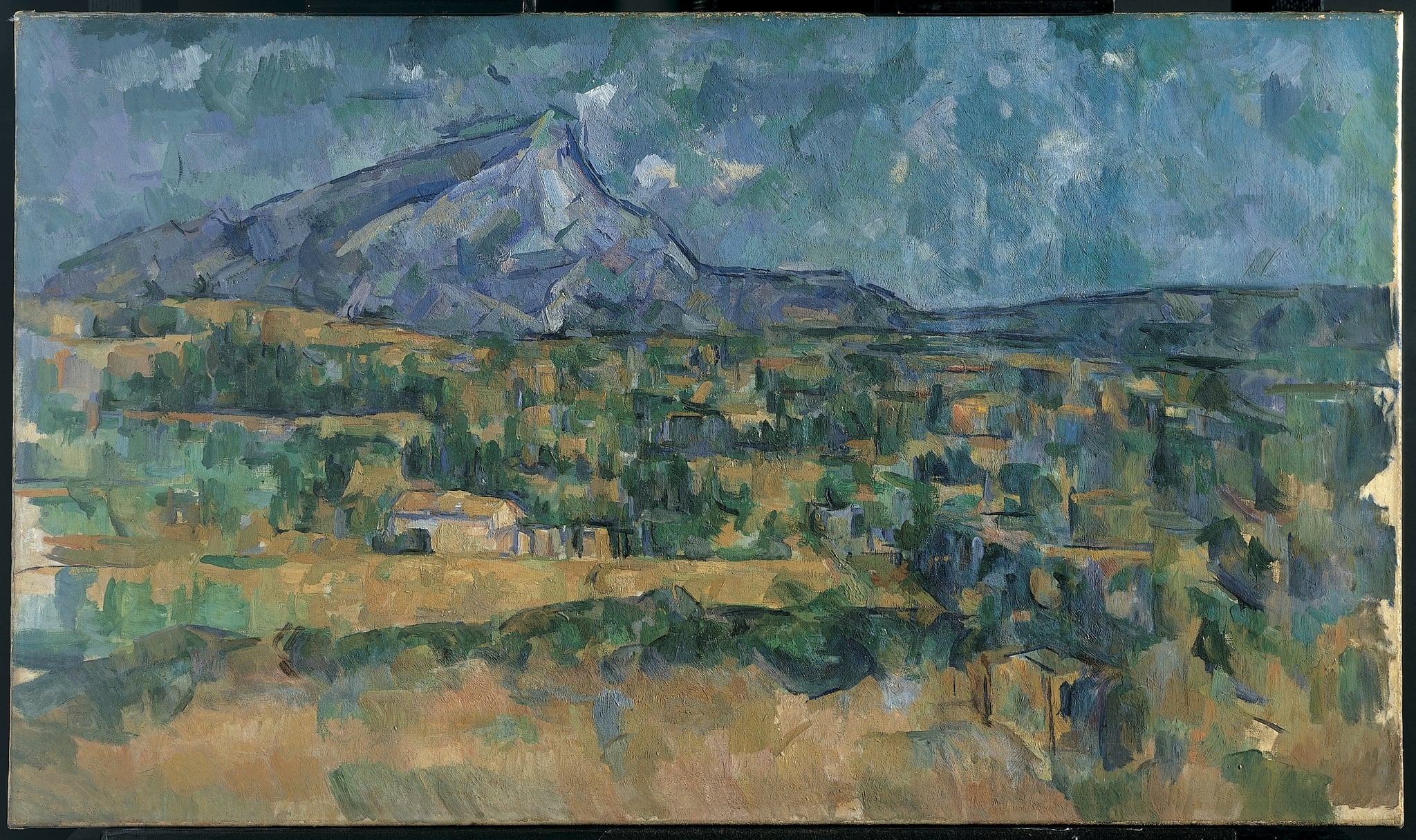
Cézanne’s Mont Sainte-Victoire renders the Provençal massif as a constructed order of <strong>planes and color</strong>, not a fleeting impression. Cool blues and violets articulate the mountain’s facets, while <strong>ochres and greens</strong> laminate the fields and blocky houses, binding atmosphere and form into a single structure <sup>[2]</sup><sup>[4]</sup>.
Madame Cézanne in a Red Armchair by Paul Cézanne

Madame Cézanne in a Red Armchair

Paul Cézanne (about 1877)

Paul Cézanne’s Madame Cézanne in a Red Armchair (about 1877) turns a domestic sit into a study of <strong>color-built structure</strong> and <strong>compressed space</strong>. Cool blue-greens of dress and skin lock against the saturated <strong>crimson armchair</strong>, converting likeness into an inquiry about how painting makes stability visible <sup>[1]</sup><sup>[3]</sup>.