Madame Cézanne in a Red Armchair

by Paul Cézanne

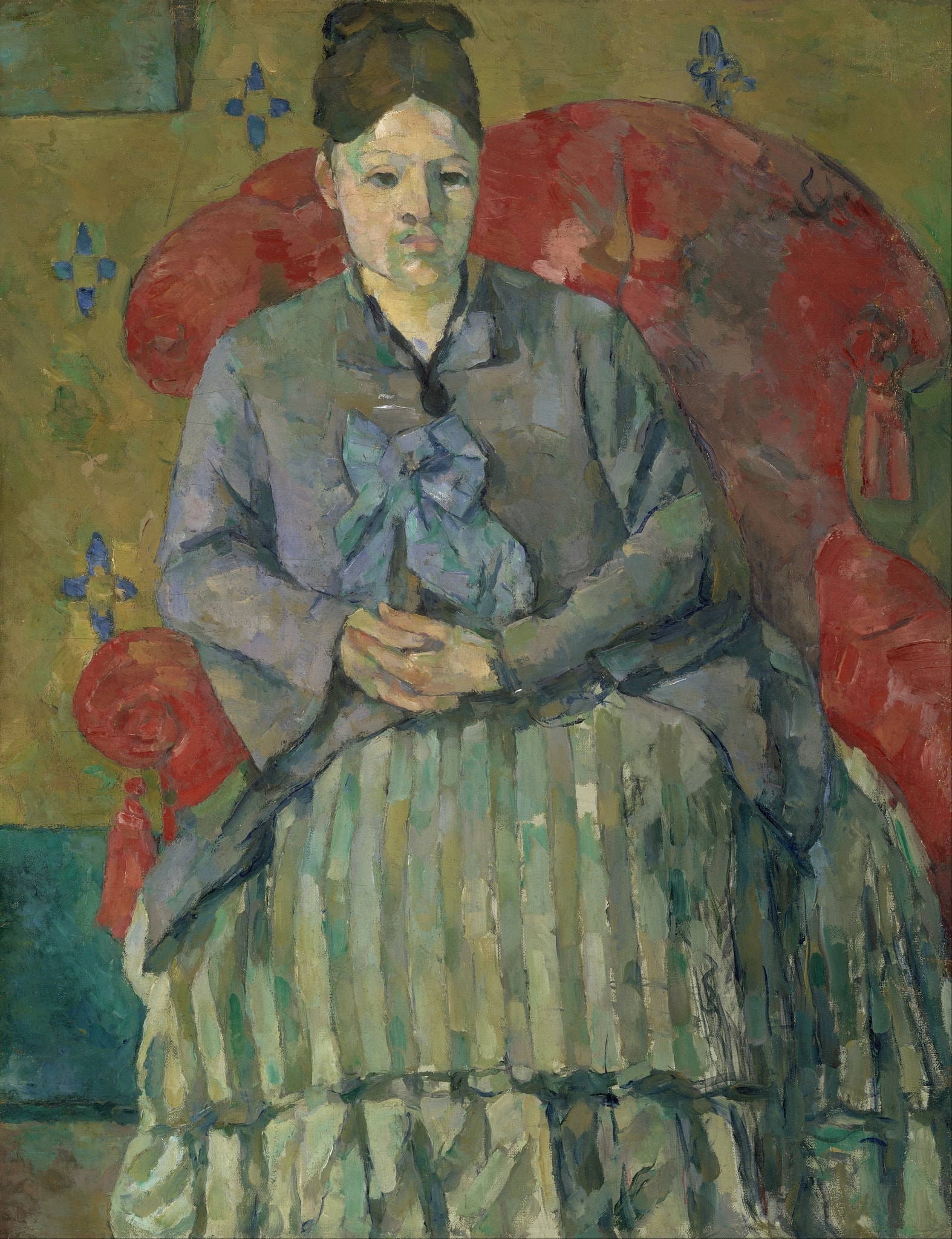
Paul Cézanne’s Madame Cézanne in a Red Armchair (about 1877) turns a domestic sit into a study of color-built structure and compressed space. Cool blue-greens of dress and skin lock against the saturated crimson armchair, converting likeness into an inquiry about how painting makes stability visible [1][3].

Fast Facts

Year
about 1877
Medium
Oil on canvas
Dimensions
72.4 × 55.9 cm
Location
Museum of Fine Arts, Boston
Madame Cézanne in a Red Armchair by Paul Cézanne (about 1877) featuring Crimson Armchair, Blue‑green Dress and Bow, Clasped Hands, Cobalt Wallpaper Florets

Click on any numbered symbol to learn more about its meaning

Meaning & Symbolism

Cézanne stages a clear confrontation between warm and cool masses and lets that confrontation carry meaning. The chair’s enveloping red—cushions, rounded back, tassels—presses forward as a single, pulsing unit; the sitter’s jacket, bow, and striped skirt assemble as tempered blue‑greens and grays. The two systems meet at the clasped hands and at the cheek and jaw, where small, faceted strokes knit temperature shifts into volume. The wallpaper’s cobalt florets echo the jacket’s blue while resisting spatial recession, and the tilted baseboard tightens the interior so the figure reads as a built object—an architectural presence—rather than a fleeting likeness 135. Rilke’s eyewitness account of this very painting captured the effect succinctly: each patch “knows” the others; the cinnabar tassel on the left retunes the whole red mass. Treating those accents as structural pivots rather than ornaments, Cézanne keeps “reality in equilibrium,” an equilibrium we perceive as poise and interiority 5. This poise is not psychology pasted onto a portrait; it is the byproduct of procedure. The sitter’s “blank” face and straight posture are stabilized by the constructive brushstroke—short, blocky touches that accumulate into planes across forehead, cheeks, sleeves, and skirt. The refusal of illusionistic finish is programmatic: folds resolve into bands; flesh becomes calibrated temperatures; the armchair becomes a chromatic engine rather than furniture. By compressing space and standardizing touch, Cézanne neutralizes anecdote and domestic sentiment. The work announces a priority: painting is a system for testing relations. That priority, forged in the mid‑to‑late 1870s under the influence of Pissarro and pursued across the serial portraits of Hortense, helped convert portraiture from biography into an arena for modernist problems—how to build volume with color, how to balance surface and depth, how to let perception harden into structure 34. This is why Madame Cézanne in a Red Armchair is important: it demonstrates, early and decisively, the method that would underwrite Cézanne’s later still lifes and landscapes and, through them, the structural ambitions of twentieth‑century painting 34.

Explore Deeper with AI

Ask questions about Madame Cézanne in a Red Armchair

Popular questions:

Powered by AI • Get instant insights about this artwork

💬 Ask questions about this artwork!

Interpretations

Reception and Legacy

Rilke’s encounter with this very picture helped canonize Cézanne’s color as a system that keeps “reality in equilibrium,” shaping early modernist discourse on structure and perception. Within the series, later variants (e.g., the Met’s Red Dress, 1888–90) amplify these concerns—harder contours, tauter interiors—showing how the Red Armchair’s procedure became a template for still lifes and landscapes that followed. The portrait thus stands at a hinge: a domestic session transformed into a program for twentieth‑century painting, from analytic construction to the Cubists’ interest in planar scaffolds 453.

Source: R. M. Rilke, Letters on Cézanne; The Metropolitan Museum of Art

Seriality and Collaboration

Rather than a one‑off likeness, this canvas is one node in a two‑decade practice of painting Hortense, which The Met reframed as collaboration rather than mere availability. Serial repetition allowed Cézanne to recalibrate pose, costume, and interior so that each session isolated a different pictorial variable—temperature, contour, or planar tilt—without resetting the whole experiment. In this early armchair version, Hortense’s immobility isn’t psychological flatness; it’s the steady condition under which color relations can be tested and compared across the series. The Met catalog argues that such seriality transforms “Madame Cézanne” from biographical subject to methodological partner, anchoring a modernist understanding of portraiture as procedure rather than story 23.

Source: The Metropolitan Museum of Art — “Madame Cézanne” (catalog)

Ornament Refunctioned: From Decor to Structure

Cézanne turns décor into load‑bearing elements. The wallpaper’s cobalt florets, the tassel soaked in cinnabar, and the red upholstery act not as embellishment but as structural hinges that tune the entire composition. Rilke’s 1907 account—“each patch knows the others”—captures how these accents recalibrate the red mass and hold warm–cool equilibrium, making the room read as a shallow, gridded field rather than deep bourgeois comfort. In this lens, the so‑called “decorative” becomes the very mechanism by which surface and volume interlock, anticipating later modernist suspicion of ornament as mere surplus by demonstrating its architectural agency within the picture 41.

Source: R. M. Rilke, Letters on Cézanne; Museum of Fine Arts, Boston

Technique as Meaning

The portrait’s reserve is a function of procedure. The constructive brushstroke—short, faceted touches—aggregates into planes that model cheeks, sleeves, and the striped skirt without resorting to finish. This method stems from Cézanne’s 1870s pivot (under Pissarro’s influence) toward building volume with modulated color rather than chiaroscuro. In Red Armchair, temperature shifts—cool jacket, warm chair—do the volumetric work, while compressed depth and a tilted baseboard stabilize the figure as an architectural presence. Technique here is not a vehicle for narrative; it is the narrative, a self‑conscious demonstration of how color makes form in the modern picture 31.

Source: The Metropolitan Museum of Art — Heilbrunn Timeline Essay

Domestic Space as a Modernist Stage

The painting empties the bourgeois interior of anecdote to make room for formal drama. The armchair, baseboard, and patterned wall form a shallow, pressurized box that refuses deep recession; the sitter’s stillness becomes a stabilizer for chromatic conflict rather than a cue for biography. MFA texts emphasize the “compressed view,” which, combined with standardized touch, converts home décor into a controlled laboratory for testing surface–depth balance. Domesticity isn’t sentimental content but a chosen armature—portable, repeatable, and variable—suited to serial experiment and crucial to Cézanne’s maturation in the late 1870s 123.

Source: Museum of Fine Arts, Boston; The Metropolitan Museum of Art

Related Themes

About Paul Cézanne

Paul Cézanne (1839–1906) pursued a solid, durable pictorial order that shaped later modernism. In the 1890s in Provence, he developed series like Mont Sainte‑Victoire, the Bathers, and The Card Players, refining forms into stable masses and chromatic structures that influenced Cubism [1][5].
View all works by Paul Cézanne

More by Paul Cézanne

The Card Players by Paul Cézanne | Equilibrium and Form by Paul Cézanne

The Card Players by Paul Cézanne | Equilibrium and Form

Paul Cézanne

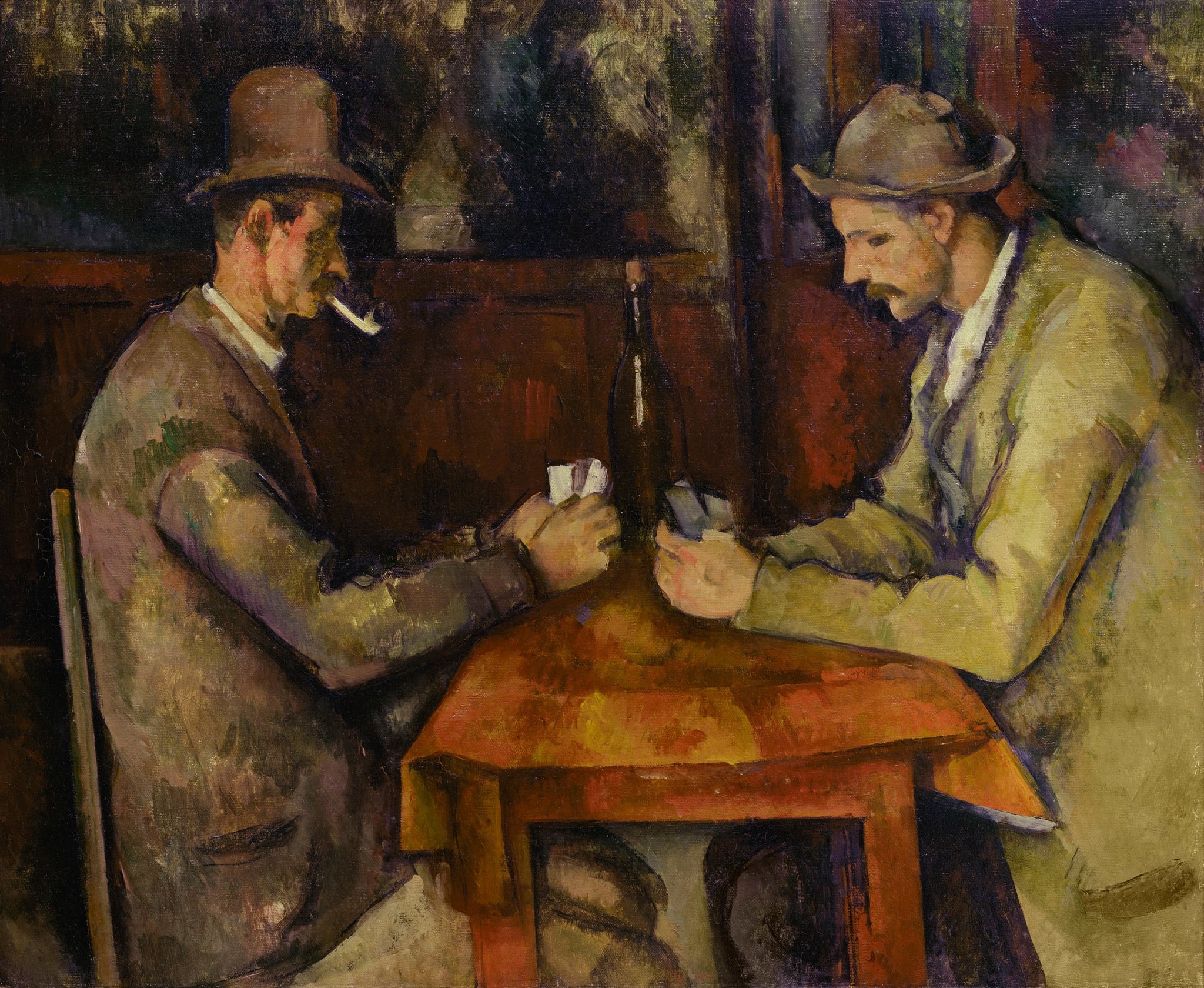
In The Card Players, Paul Cézanne turns a rural café game into a study of <strong>equilibrium</strong> and <strong>monumentality</strong>. Two hated peasants lean inward across an orange-brown table while a dark bottle stands upright between them, acting as a calm, vertical <strong>axis</strong> that stabilizes their mirrored focus <sup>[2]</sup><sup>[3]</sup>.

Bathers by Paul Cézanne: Geometry of the Modern Nude by Paul Cézanne

Bathers by Paul Cézanne: Geometry of the Modern Nude

Paul Cézanne

In Bathers, Paul Cézanne arranges a circle of generalized nudes beneath arching trees that meet like a <strong>natural vault</strong>, staging bathing as a timeless rite rather than a specific story. His <strong>constructive brushwork</strong> fuses bodies, water, and sky into one geometric order, balancing cool blues with warm ochres. The scene proposes a measured <strong>harmony between figure and landscape</strong>, a culmination of Cézanne’s search for enduring structure <sup>[1]</sup><sup>[2]</sup>.

The House of the Hanged Man by Paul Cézanne

The House of the Hanged Man

Paul Cézanne (1873)

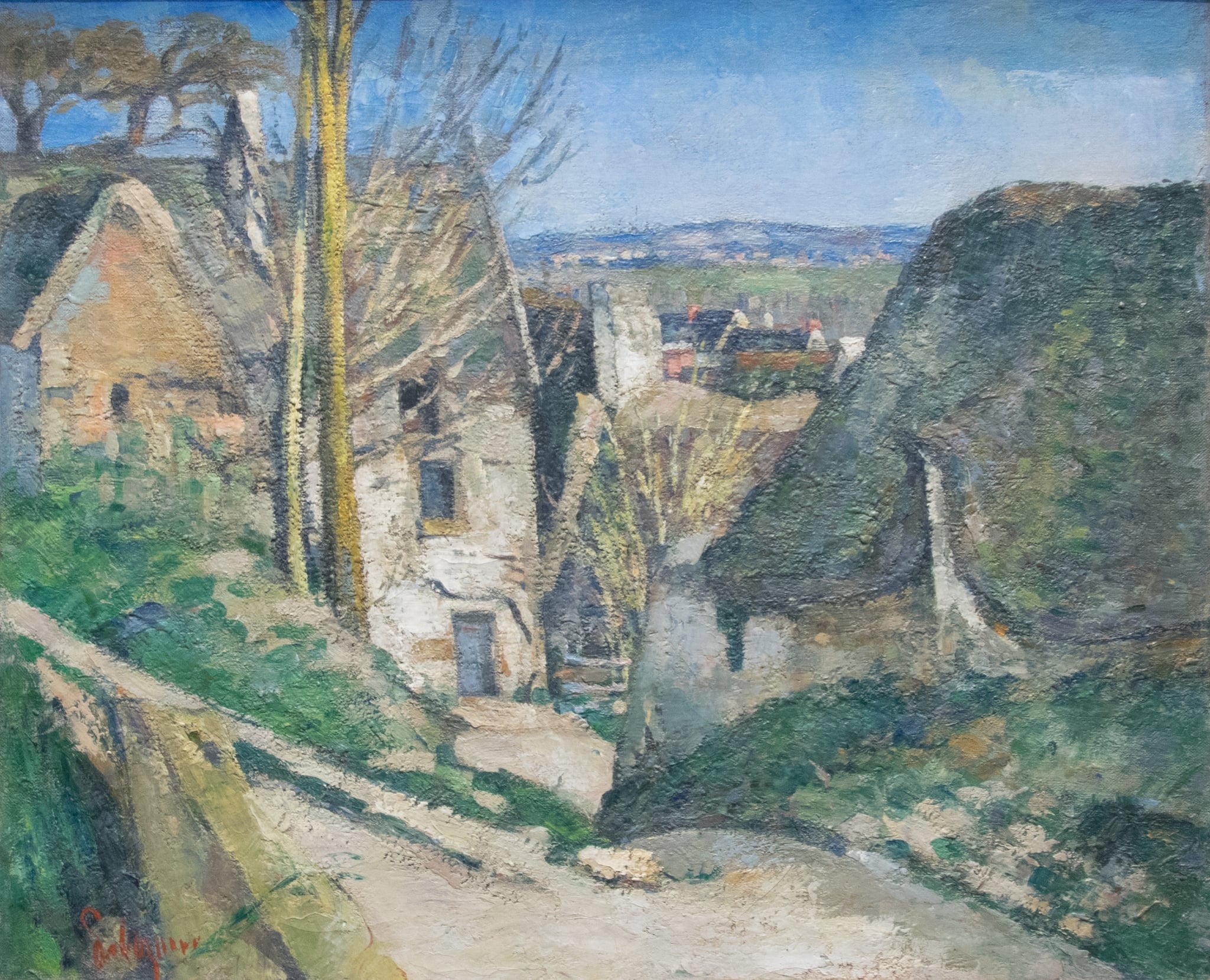
Paul Cézanne’s The House of the Hanged Man turns a modest Auvers-sur-Oise lane into a scene of <strong>engineered unease</strong> and <strong>structural reflection</strong>. Jagged roofs, laddered trees, and a steep path funnel into a narrow, shadowed V that withholds a center, making absence the work’s gravitational force. Cool greens and slate blues, set in blocky, masoned strokes, build a world that feels both solid and precarious.

The Basket of Apples by Paul Cézanne

The Basket of Apples

Paul Cézanne (c. 1893)

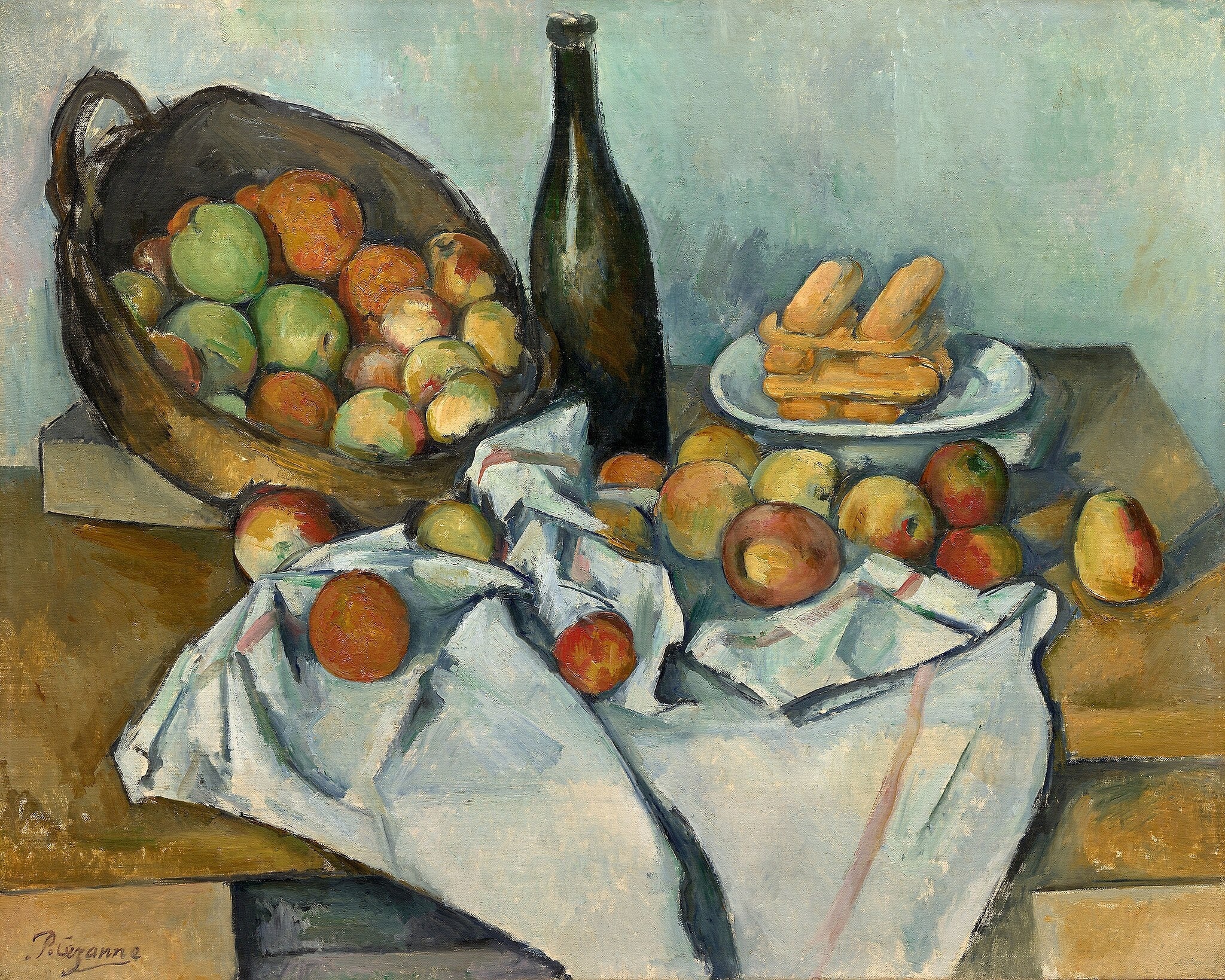
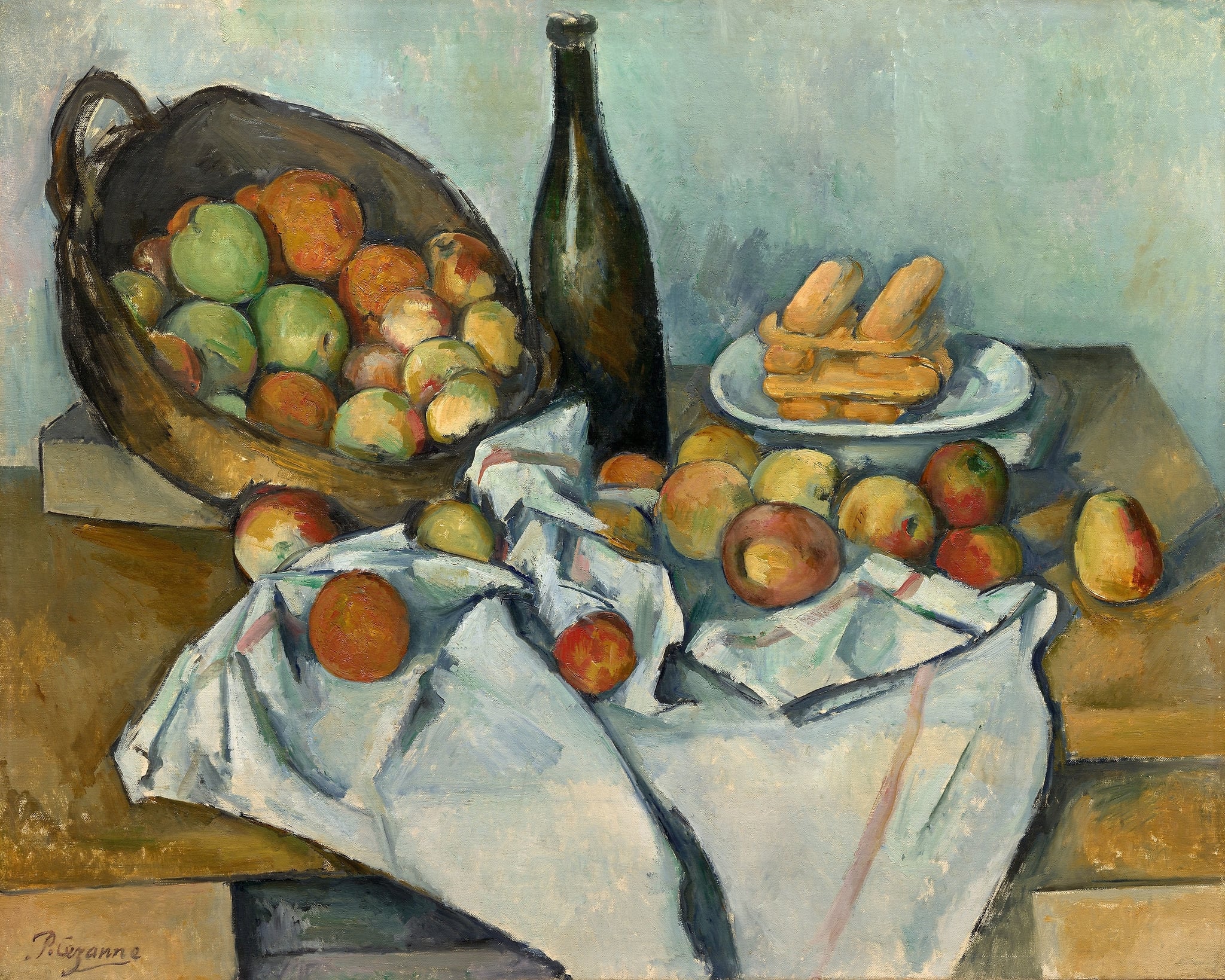
Paul Cézanne’s The Basket of Apples stages a quiet drama of <strong>balance and perception</strong>. A tilted basket spills apples across a <strong>rumpled white cloth</strong> toward a <strong>dark vertical bottle</strong> and a plate of <strong>biscuits</strong>, while the tabletop’s edges refuse to align—an intentional play of <strong>multiple viewpoints</strong> <sup>[1]</sup><sup>[2]</sup><sup>[3]</sup>.

Still Life with Apples and Oranges by Paul Cézanne

Still Life with Apples and Oranges

Paul Cézanne (c. 1899)

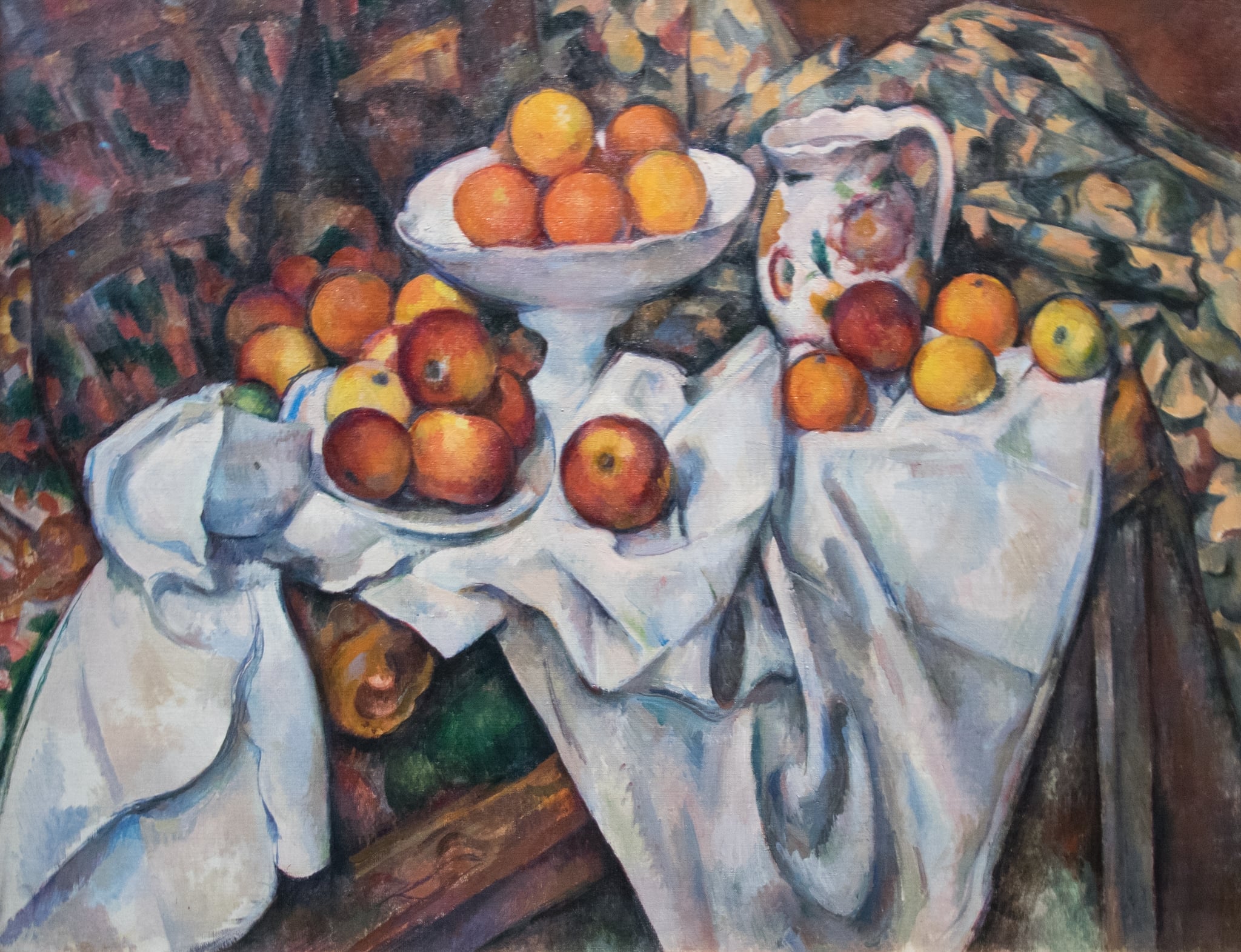
Paul Cézanne’s Still Life with Apples and Oranges builds a quietly monumental world from domestic things. A tilting table, a heaped white compote, a flowered jug, and cascading cloths turn fruit into <strong>durable forms</strong> stabilized by <strong>color relationships</strong> rather than single‑point perspective <sup>[1]</sup><sup>[2]</sup>. The result is a still life that feels both solid and subtly <strong>unstable</strong>, a meditation on how we construct vision.
Mont Sainte-Victoire by Paul Cézanne

Mont Sainte-Victoire

Paul Cézanne (1902–1906)

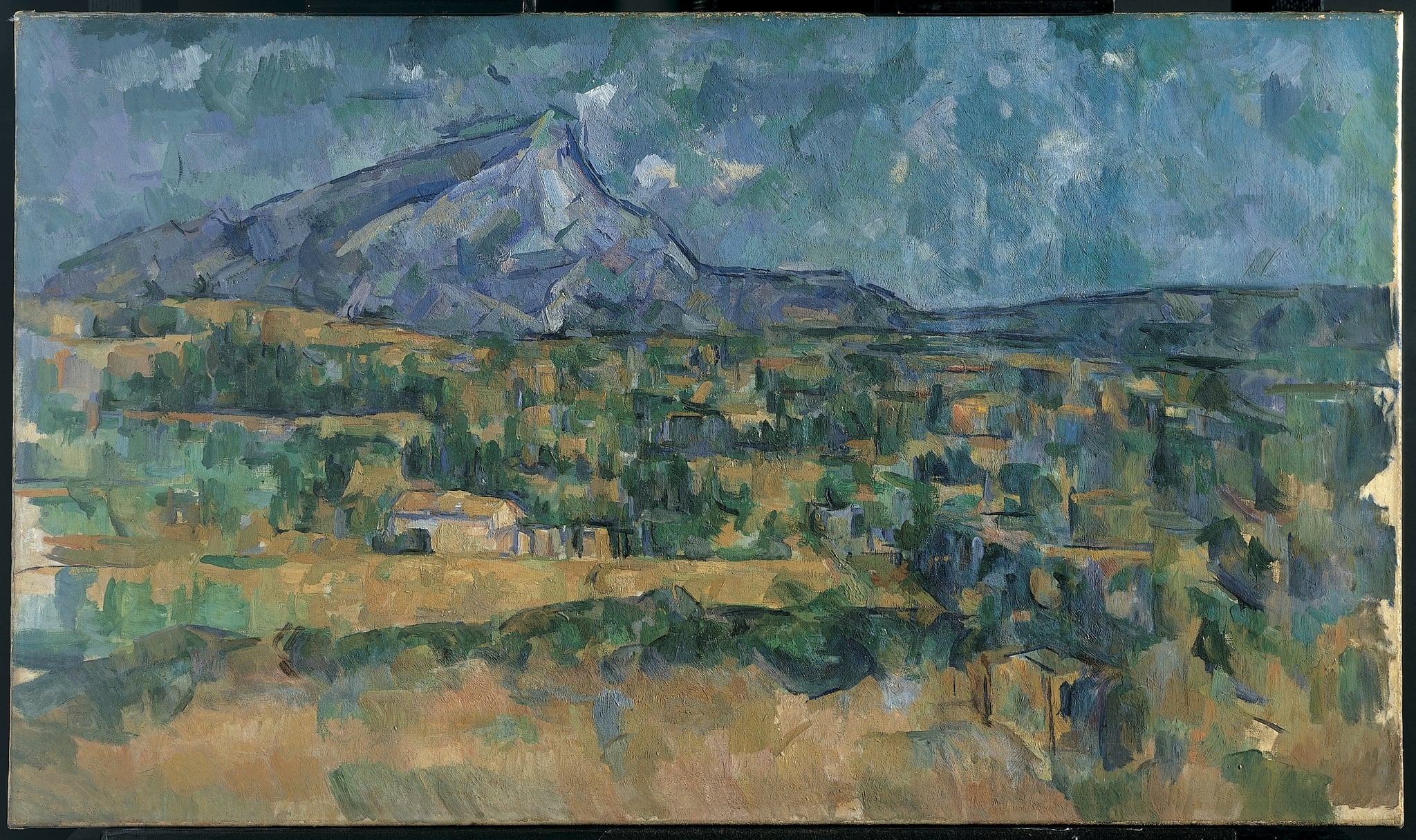
Cézanne’s Mont Sainte-Victoire renders the Provençal massif as a constructed order of <strong>planes and color</strong>, not a fleeting impression. Cool blues and violets articulate the mountain’s facets, while <strong>ochres and greens</strong> laminate the fields and blocky houses, binding atmosphere and form into a single structure <sup>[2]</sup><sup>[4]</sup>.