Still Life with Apples and Oranges

by Paul Cézanne

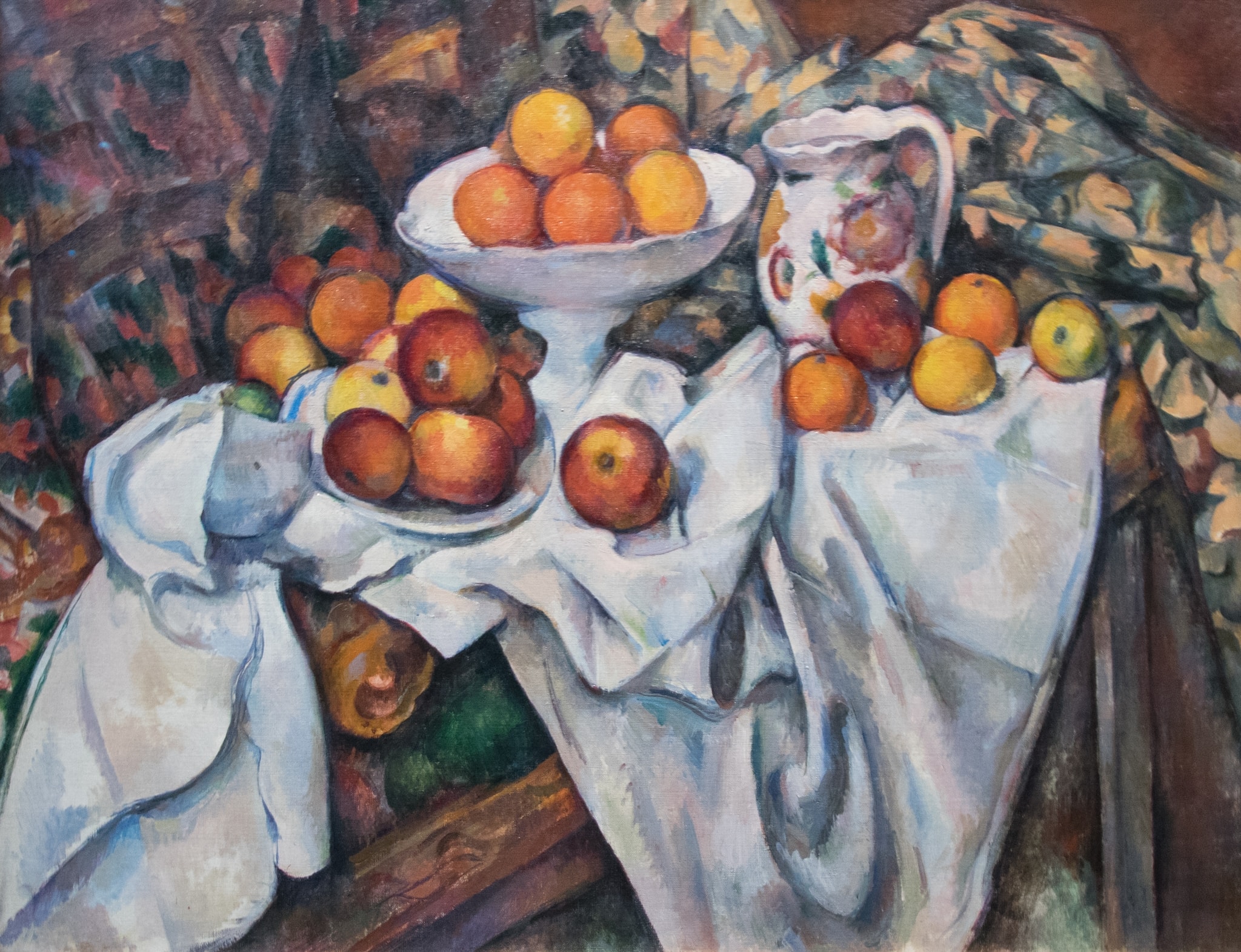
Paul Cézanne’s Still Life with Apples and Oranges builds a quietly monumental world from domestic things. A tilting table, a heaped white compote, a flowered jug, and cascading cloths turn fruit into durable forms stabilized by color relationships rather than single‑point perspective [1][2]. The result is a still life that feels both solid and subtly unstable, a meditation on how we construct vision.

Fast Facts

Year
c. 1899
Medium
Oil on canvas
Dimensions
74.0 × 93.0 cm
Location
Musée d’Orsay, Paris
Still Life with Apples and Oranges by Paul Cézanne (c. 1899) featuring Apples, Oranges, White Drapery/Cloths, Footed Compote (Bowl)

Click on any numbered symbol to learn more about its meaning

Meaning & Symbolism

Cézanne constructs solidity through color, not contour. The apples and oranges read as weighted spheres because their reds and oranges are cross‑stitched with cool violets and blues, and the whites of the tablecloth are anything but white—veins of rose, blue, and yellow articulate each fold into a sequence of planes. These color‑planes, laid in with his constructive brushstroke, model volume while refusing theatrical light-and-shadow; form emerges from measured chromatic differences rather than from a single source of illumination 23. In the image, the compote brims with oranges that press forward, the front lip of the dish slightly overhanging the ambiguous edge of the table. At left, a plate of apples sits on cloth that droops like a cliff, while at right the flowered jug wedges fruit against a high, angular fold. Each component—plate, compote, jug, drapery—acts as a mediator between spheres and planes, allowing Cézanne to test how curves, edges, and colors bind a picture together 15. Spatial stability is continually challenged. The front edge of the table kinks; the two white cloth masses are pitched at different angles; the patterned tapestry behind “closes” depth, flattening the rear space even as the foreground objects insist on weight 1. These dislocations are not mistakes but methods: like his near‑contemporary Basket of Apples, the shifting viewpoints register the way perception accumulates over time—the eye climbs the cloth, circles the fruit, tilts to see into the bowl—then compresses those sequential sightings into a single frame 3. The result is a poised instability that T. J. Clark reads as a modern feeling: the fruit are emphatically there, yet their world is slightly uncanny, held together by relations rather than by certainty 6. In this canvas, that feeling is sharpened by the forward‑leaning compote and the cloth’s avalanche, which together suggest abundance always on the verge of slipping. Cézanne’s staging is deliberate and serial. The flowered jug, footed compote, and printed fabrics recur across a cluster of late‑1890s still lifes, shuffled to probe new balances; here, the jug echoes the oranges’ warm notes in its floral motif and bridges the fruit to the patterned backdrop, reconciling nature (spherical fruit) and culture (ornament and textile) within one chromatic system 17. The apples and oranges—often a byword for difference—coexist as a calibrated spectrum of temperatures, from the cool‑bloomed reds of apples to the hot cadmiums of oranges, demonstrating harmony through difference rather than symbol through code 25. If Flemish still lifes haunt the setup—the heavy drapery that arrests depth, the piled abundance—Cézanne empties allegory of moralizing and replaces it with process: the studio becomes a testing ground where fruit “sit” for long durations so relations can be built and rebuilt 18. That procedure, seeking the “something solid and durable” beyond Impressionism’s shimmer, is the painting’s true subject—and its bequest to 20th‑century art 24.

Explore Deeper with AI

Ask questions about Still Life with Apples and Oranges

Popular questions:

Powered by AI • Get instant insights about this artwork

💬 Ask questions about this artwork!

Interpretations

Formal Analysis: Constructive Color and Engineered Instability

Rather than cast forms with chiaroscuro, Cézanne uses constructive brushstrokes and calibrated warm–cool shifts to build mass: apples and oranges become weighted by sutures of blues and violets against cadmium warms. The tabletop’s kink and the compotier’s forward lean are not errors but composed disjunctions that register multiple glances fused into one field. Technical studies of The Basket of Apples show deliberately misaligned edges and color-modeled fruit—methods directly echoed here, where the cloth’s “white” is a prism of rose, blue, and yellow, faceting the drapery into planes. The effect is a poised instability in which structure comes from chromatic relations, not single-point perspective or theatrical light 235.

Source: Art Institute of Chicago; The Met

Historical Context: Flemish Echoes Without Allegory

The heavy drapery that “closes” depth, abundant fruit, and ornamental ware signal a conscious dialogue with 17th‑century Flemish still lifes. Yet Cézanne strips the genre’s vanitas codes of moralizing content. The Orsay notes that this canvas belongs to a late‑1890s group staged with the same props and a drape that halts recession; but instead of skulls, hourglasses, or extinguished candles, we find duration as practice—fruit and fabrics that sit for long sessions so relations can be built and rebuilt. Allegory is recast as method; time is not symbolized but embodied in iterative arrangement and repainting, converting abundance from a warning about vanity into a laboratory of looking 18.

Source: Musée d’Orsay; Getty (Carol Armstrong)

Studio Practice & Medium Reflexivity: Props as Actors

Cézanne’s flowered pitcher, compotier, and printed cloth recur across late still lifes as repeatable actors—stable variables in experiments with balance, curvature, and chromatic mediation. Getty scholarship stresses how these studio objects enabled extended, revisable sittings, letting relations be tested over weeks. In this canvas, the jug bridges oranges to the tapestry by echoing their warm notes, while the compotier stages gravitational pressure against the table’s edge. Such choices make the work self‑reflexive: it is art about the procedures of art, displaying how composition is built from constraints, serial rearrangement, and the disciplined craft of the constructive stroke 18.

Source: Getty Research Institute (Carol Armstrong); Musée d’Orsay

Modernity & Perception: The Uncanny of the Ordinary

T. J. Clark argues that Cézanne’s still lifes conjure a distinctly modern feeling: things are stubbornly present yet slightly estranged. Here, compounded viewpoints—the table’s broken front, disjunct cloth angles, tilted dish—visualize perception as accumulation over time, not a single glance. The result is a world held together by relations rather than certainty, aligning with Clark’s claim that Cézanne’s apples make contradiction visible: solidity vs. doubt, nearness vs. instability. Post‑1895, after the Vollard exhibition, Cézanne intensifies such experiments, seeking something “solid and durable” from Impressionism while acknowledging the fractured temporality of modern seeing 246.

Source: T. J. Clark; Britannica

Legacy & Influence: From Apples to Cubism

By constructing volume through color‑planes and tolerating spatial disjunctions, Cézanne offered a toolkit that would catalyze Cubism and Fauvism. The Met and Britannica chart how his mature still lifes abandon single‑point perspective in favor of sequential viewpoints and modular brushstrokes, turning forms into interlocking facets. Picasso’s oft‑quoted homage—Cézanne as “the father of us all”—speaks to how such procedures enabled later artists to detach structure from naturalistic depiction. In Apples and Oranges, the tension between planarity and mass models the path from observation to analytic reconstruction, making it a key conduit from Impressionist sensation to 20th‑century abstraction 24.

Source: The Met; Britannica

Related Themes

About Paul Cézanne

Paul Cézanne (1839–1906) pursued a solid, durable pictorial order that shaped later modernism. In the 1890s in Provence, he developed series like Mont Sainte‑Victoire, the Bathers, and The Card Players, refining forms into stable masses and chromatic structures that influenced Cubism [1][5].
View all works by Paul Cézanne

More by Paul Cézanne

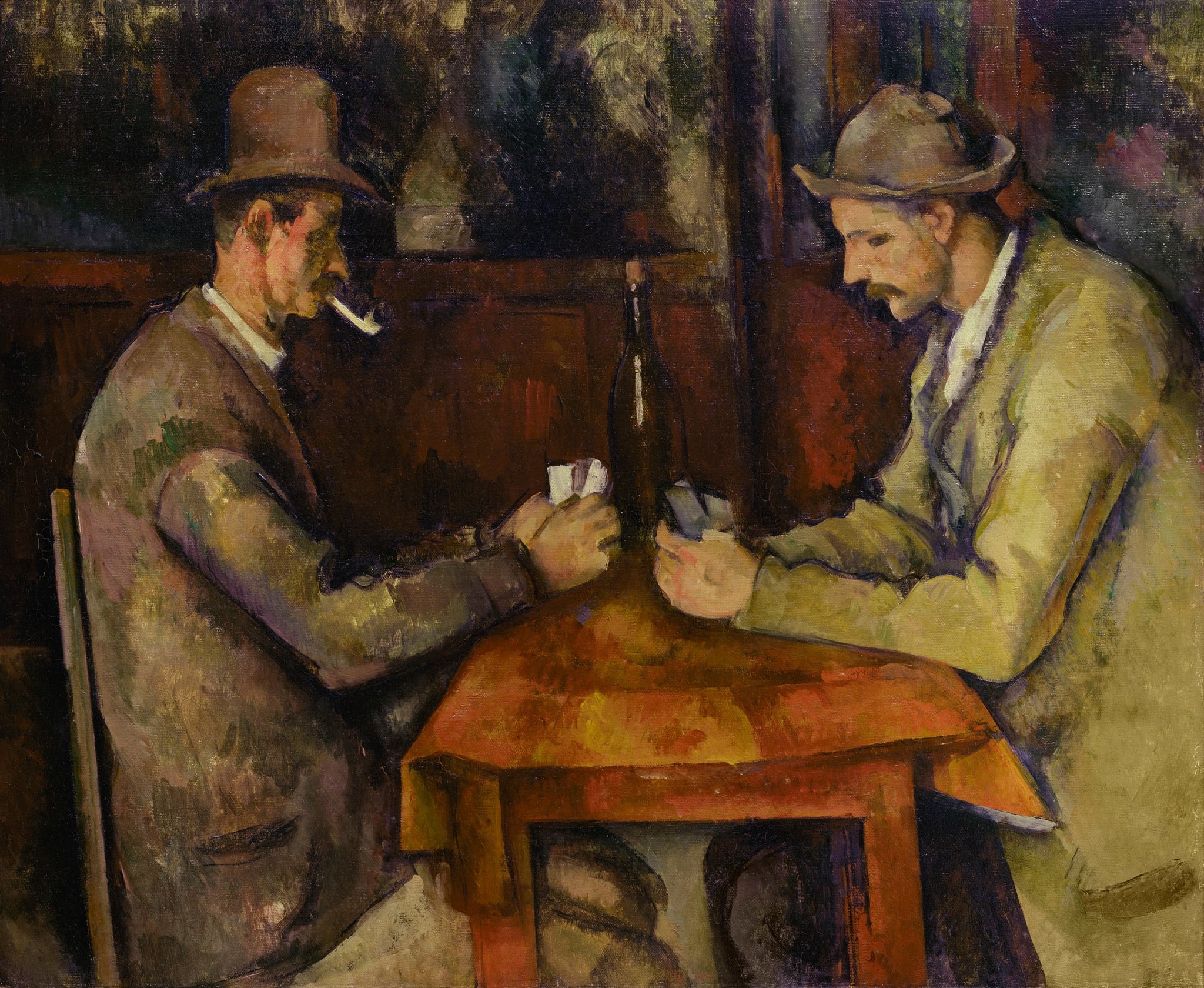
The Card Players by Paul Cézanne | Equilibrium and Form by Paul Cézanne

The Card Players by Paul Cézanne | Equilibrium and Form

Paul Cézanne

In The Card Players, Paul Cézanne turns a rural café game into a study of <strong>equilibrium</strong> and <strong>monumentality</strong>. Two hated peasants lean inward across an orange-brown table while a dark bottle stands upright between them, acting as a calm, vertical <strong>axis</strong> that stabilizes their mirrored focus <sup>[2]</sup><sup>[3]</sup>.
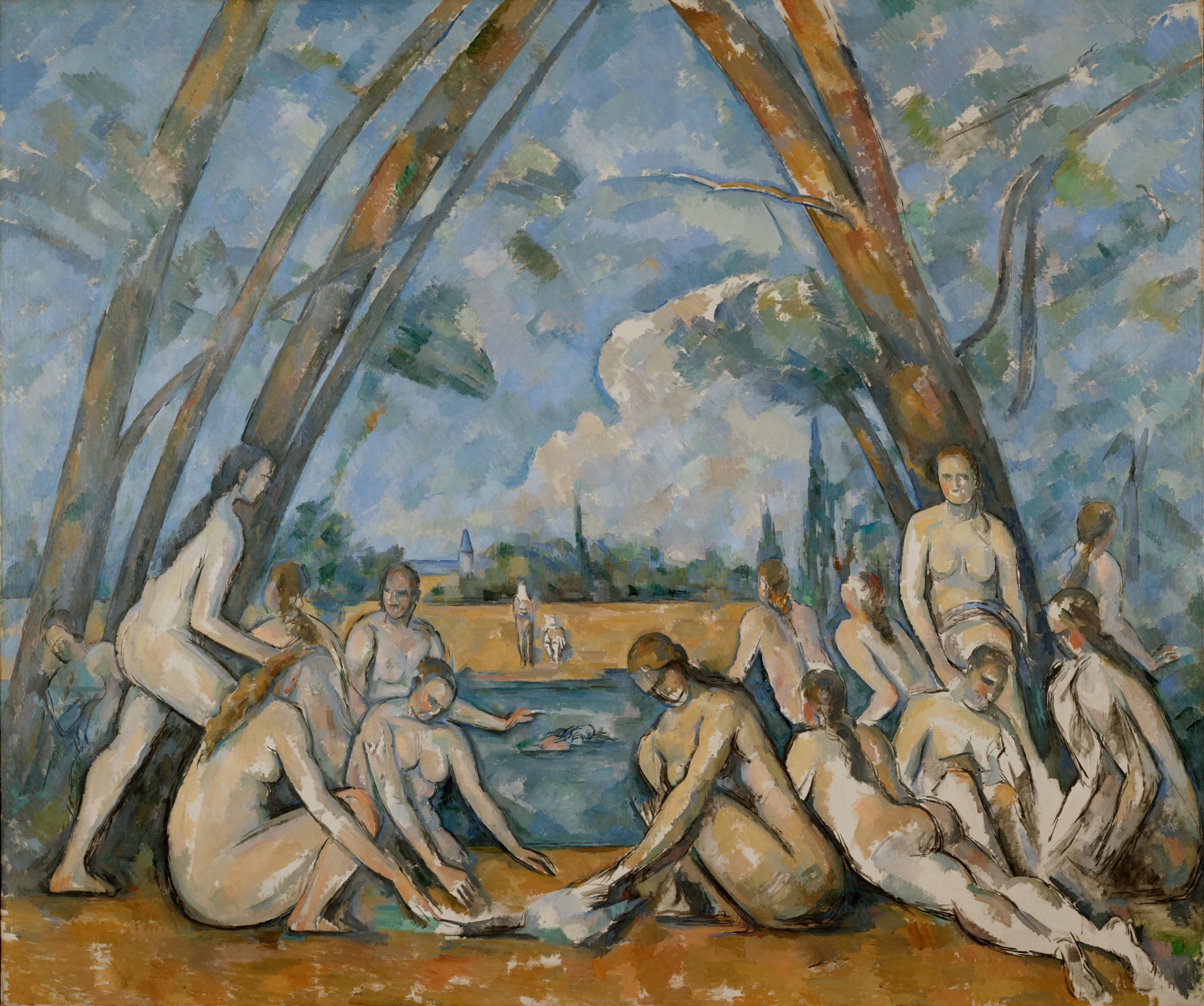
Bathers by Paul Cézanne: Geometry of the Modern Nude by Paul Cézanne

Bathers by Paul Cézanne: Geometry of the Modern Nude

Paul Cézanne

In Bathers, Paul Cézanne arranges a circle of generalized nudes beneath arching trees that meet like a <strong>natural vault</strong>, staging bathing as a timeless rite rather than a specific story. His <strong>constructive brushwork</strong> fuses bodies, water, and sky into one geometric order, balancing cool blues with warm ochres. The scene proposes a measured <strong>harmony between figure and landscape</strong>, a culmination of Cézanne’s search for enduring structure <sup>[1]</sup><sup>[2]</sup>.

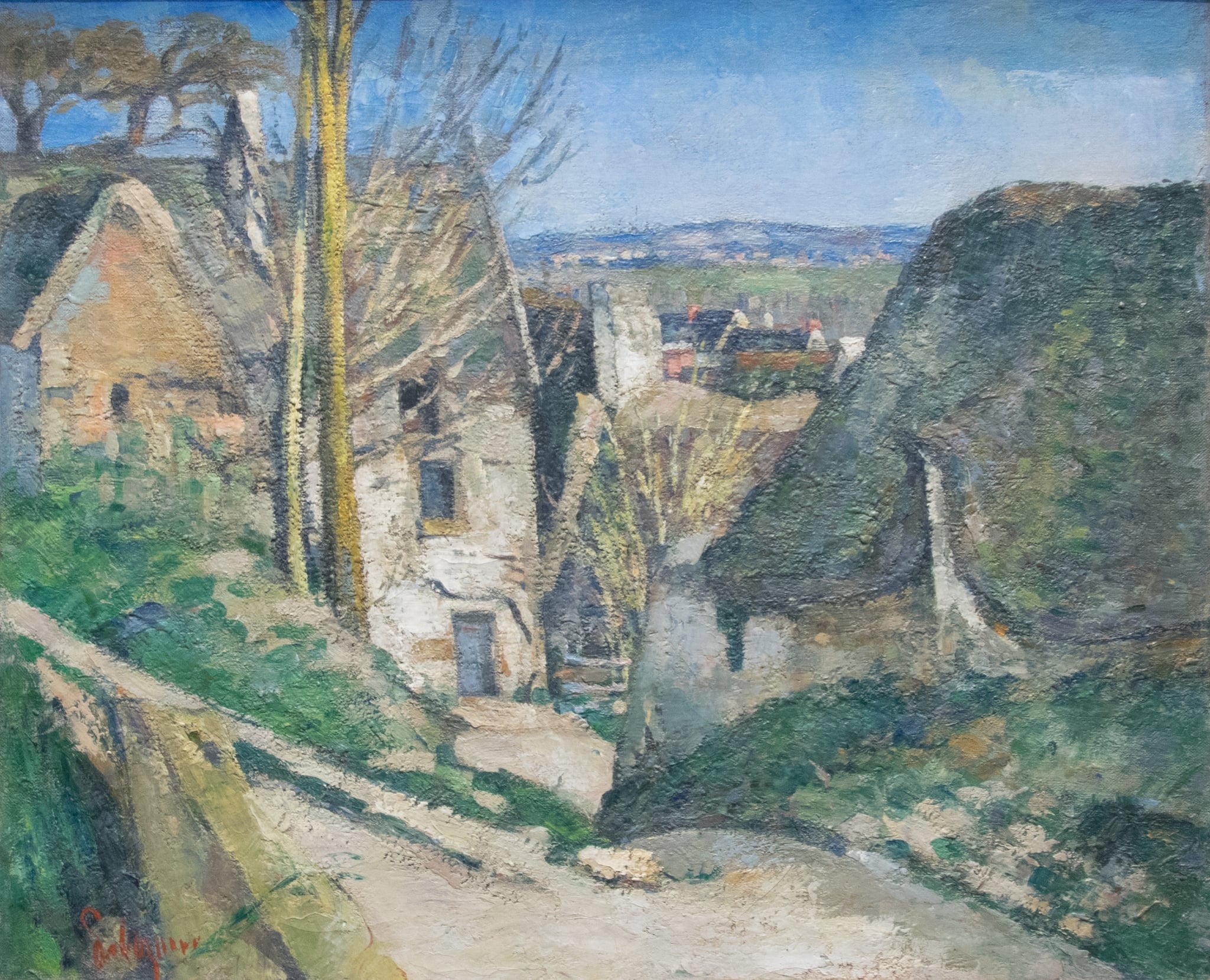
The House of the Hanged Man by Paul Cézanne

The House of the Hanged Man

Paul Cézanne (1873)

Paul Cézanne’s The House of the Hanged Man turns a modest Auvers-sur-Oise lane into a scene of <strong>engineered unease</strong> and <strong>structural reflection</strong>. Jagged roofs, laddered trees, and a steep path funnel into a narrow, shadowed V that withholds a center, making absence the work’s gravitational force. Cool greens and slate blues, set in blocky, masoned strokes, build a world that feels both solid and precarious.

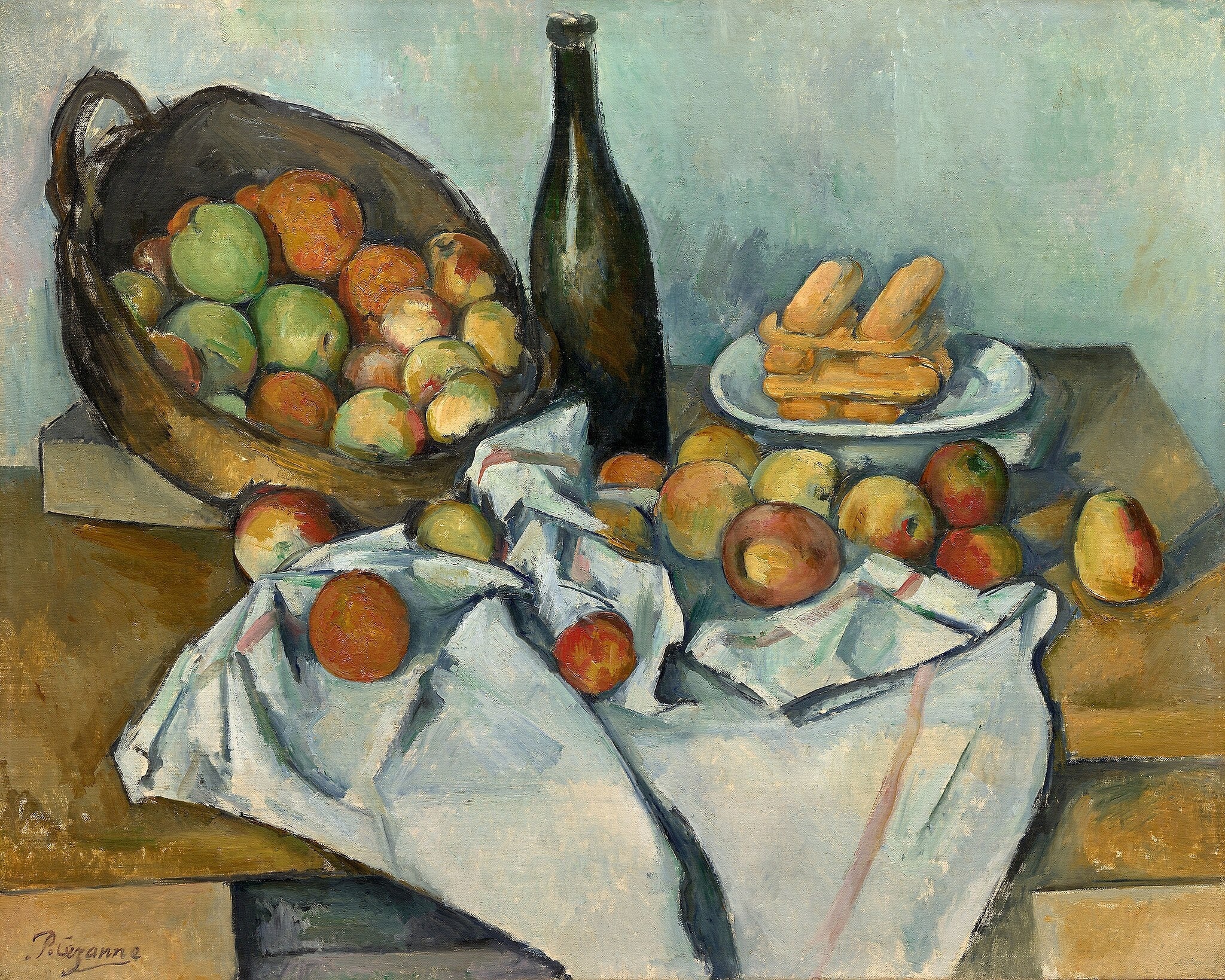
The Basket of Apples by Paul Cézanne

The Basket of Apples

Paul Cézanne (c. 1893)

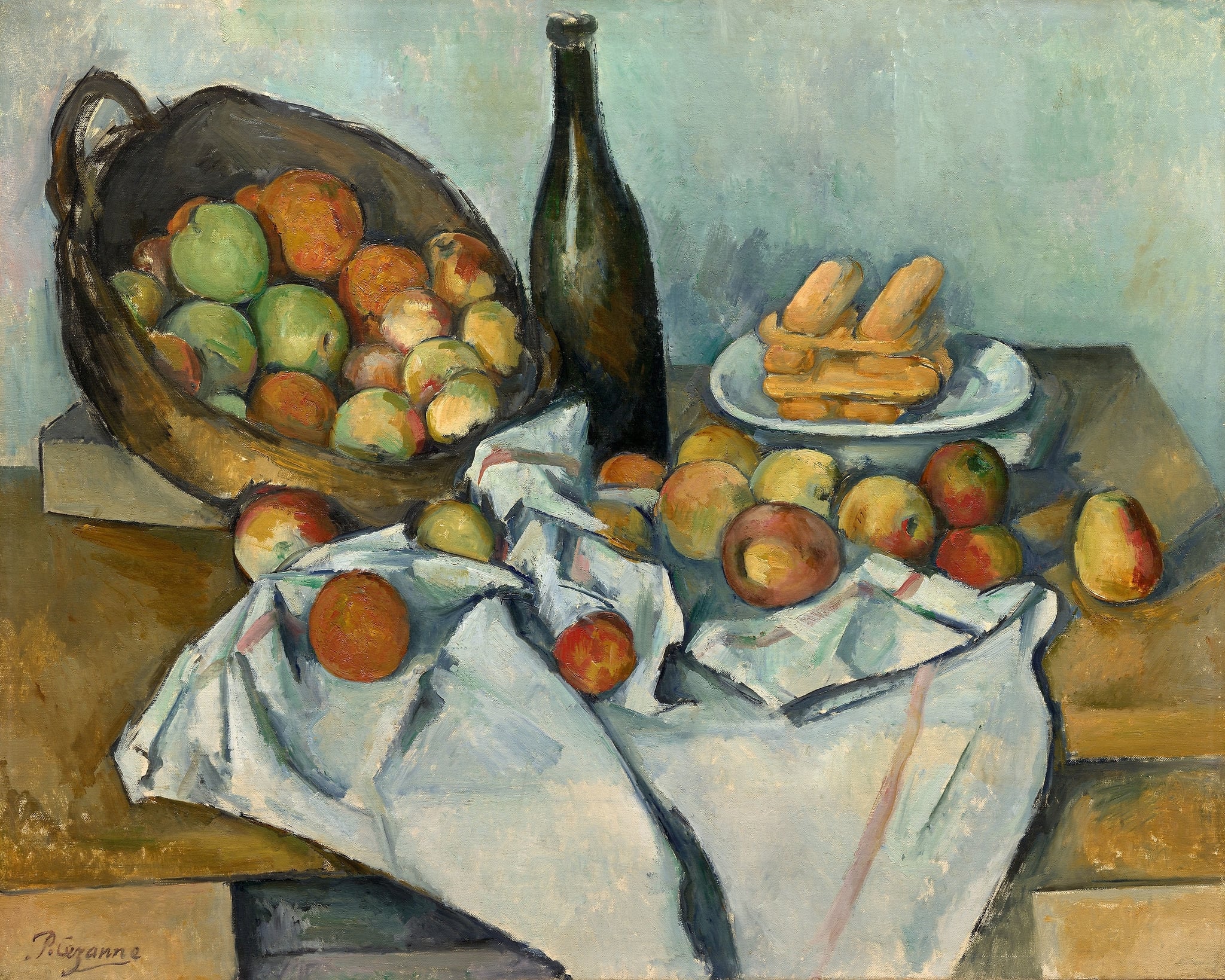
Paul Cézanne’s The Basket of Apples stages a quiet drama of <strong>balance and perception</strong>. A tilted basket spills apples across a <strong>rumpled white cloth</strong> toward a <strong>dark vertical bottle</strong> and a plate of <strong>biscuits</strong>, while the tabletop’s edges refuse to align—an intentional play of <strong>multiple viewpoints</strong> <sup>[1]</sup><sup>[2]</sup><sup>[3]</sup>.

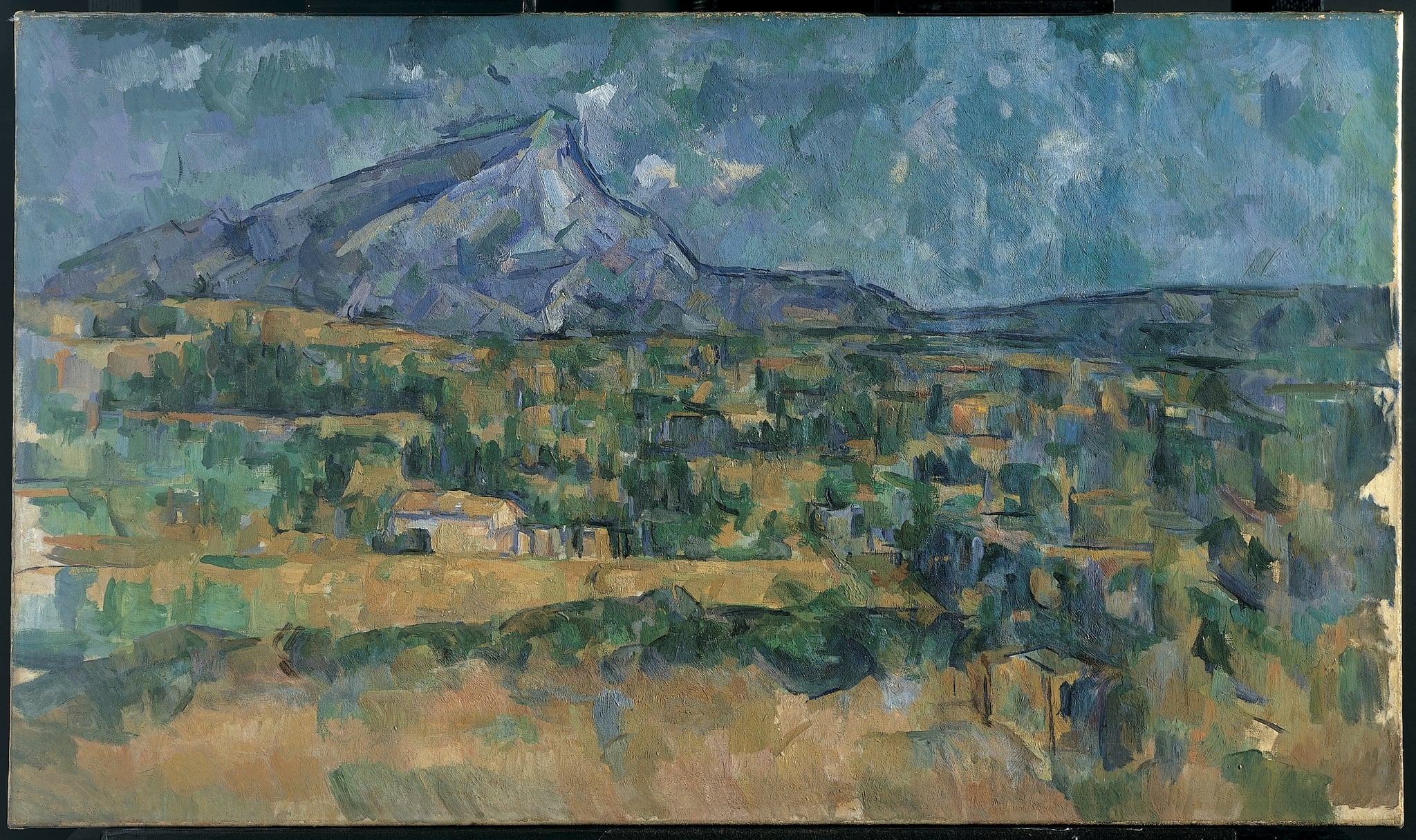
Mont Sainte-Victoire by Paul Cézanne

Mont Sainte-Victoire

Paul Cézanne (1902–1906)

Cézanne’s Mont Sainte-Victoire renders the Provençal massif as a constructed order of <strong>planes and color</strong>, not a fleeting impression. Cool blues and violets articulate the mountain’s facets, while <strong>ochres and greens</strong> laminate the fields and blocky houses, binding atmosphere and form into a single structure <sup>[2]</sup><sup>[4]</sup>.
Madame Cézanne in a Red Armchair by Paul Cézanne

Madame Cézanne in a Red Armchair

Paul Cézanne (about 1877)

Paul Cézanne’s Madame Cézanne in a Red Armchair (about 1877) turns a domestic sit into a study of <strong>color-built structure</strong> and <strong>compressed space</strong>. Cool blue-greens of dress and skin lock against the saturated <strong>crimson armchair</strong>, converting likeness into an inquiry about how painting makes stability visible <sup>[1]</sup><sup>[3]</sup>.