The Fighting Temeraire
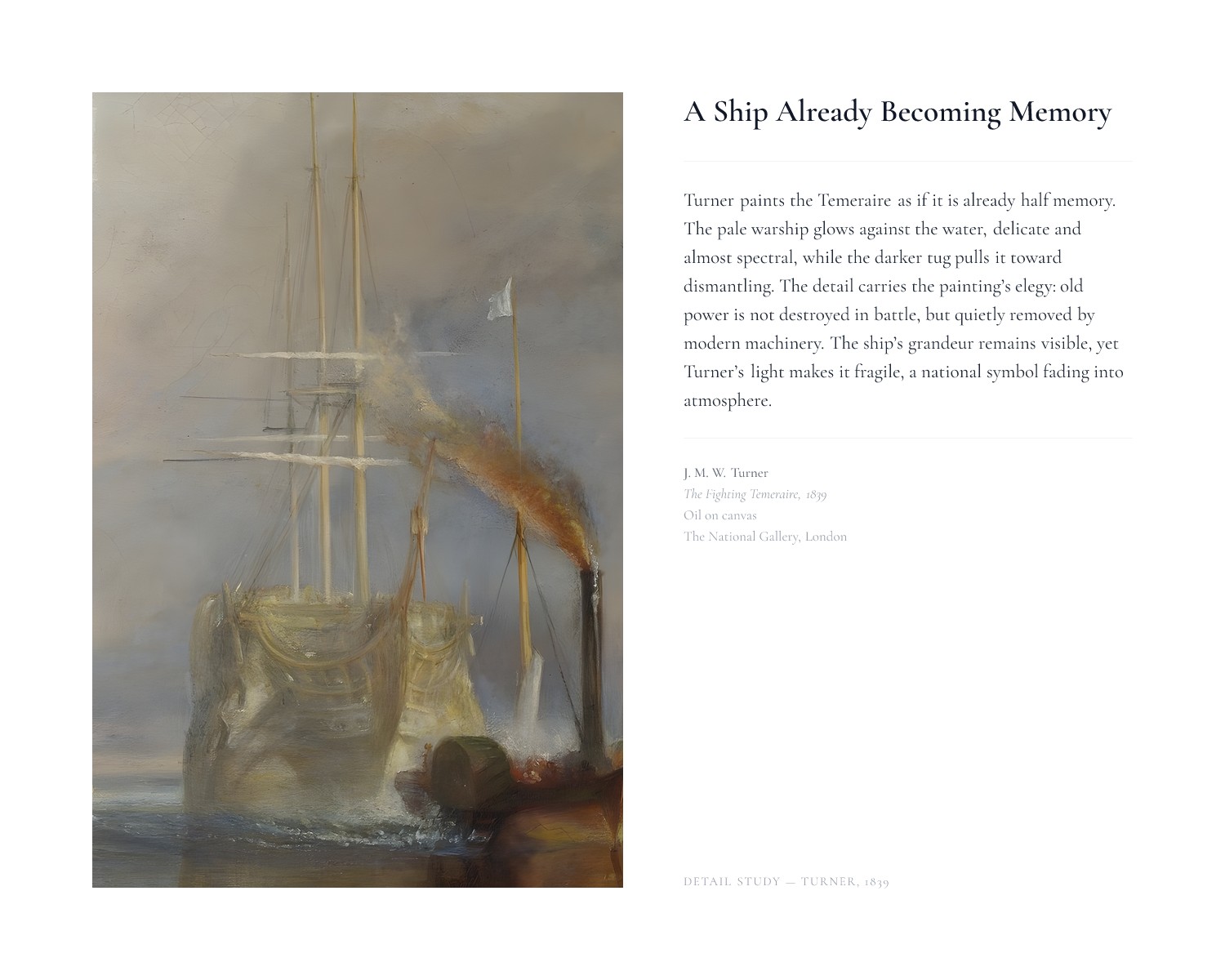
In The Fighting Temeraire, J. M. W. Turner sets a ghostly man‑of‑war against a sooty steam tug under a blazing, emblematic sunset. The pale ship’s towering masts and slack rigging read like memory, while the tug’s black smoke cuts through the rigging where a flag once flew, signaling power passing from sail to steam [1][2]. A crescent moon and a humble buoy punctuate a river turned to molten gold, marking both ending and beginning [3][4].
Fast Facts
- Year
- 1839
- Medium
- Oil on canvas
- Dimensions
- 90.7 × 121.6 cm
- Location
- The National Gallery, London

Click on any numbered symbol to learn more about its meaning
Meaning & Symbolism
Turner constructs the picture around stark oppositions that dramatize a transfer of power. The old warship is rendered in a spectral pallor—its historic black‑and‑yellow livery suppressed—so it appears less like a physical hull than a memory made visible. Its forward gear is telling: under the bowsprit, the broken dolphin striker signifies disabled sail‑power; the jackstaff at the bow—where the Union once flew—is absent, and Turner steers the tug’s smoke straight through that vacancy so that acrid industry occupies the place of national emblems 2. The tug, compressed from the two historical vessels into one emblem, squats dark and low, its funnel exhaling a ribbon that stains the sky; it is useful, unbeautiful, inevitable 2. Across the right half, an invented, molten sunset pours a road of light that the ships are set to cross—Turner’s deliberate east–west inaccuracy turning geography into allegory: day (and the age of sail) is ending as the Temeraire moves toward dissolution 23. At the far left, a small crescent—explicitly read by the National Gallery as a new moon—signals a beginning that answers the sunset’s end, while at lower right a plain buoy anchors all this pageantry to the river’s prosaic shallows, a brisk reminder that life and work go on 34. The surface itself carries meaning: glazes and impasto ignite the sunset so that light becomes subject, staging the final act in a theater of color and atmosphere 2.
Turner also insists that this is not reportage but poetic history. He likely did not witness the tow of 5–6 September 1838; he rebuilt the stripped hulk with full masts to restore dignity and recognizable character, and he reduced two tugs to one for emblematic clarity 12. Exhibited at the Royal Academy in 1839 under its full title—with lines adapted from Campbell’s Ye Mariners of England—the work announces itself as elegy and national meditation rather than a literal scene 23. In that register, specific details sharpen the moral: empty gunports and slackened rigging read like a veteran’s scars; the reflection of the sun forms a path the ships must cross, binding nature’s cycle to human time; in the dusk distance, a thinning forest of masts dissolves into bluish haze, a “countless navy” fading into history 23. Yet Turner refuses mere nostalgia. By thrusting the blunt tug to the composition’s center and driving smoke through the Temeraire’s rigging, he grants modern power a coarse but commanding beauty. Later critics have emphasized this tension—both a lament for lost grandeur and a recognition that steam’s muscle will define the new century 38. This doubleness explains why The Fighting Temeraire is important: it crystallizes a civilizational handover without pretending the past was unblemished or the future purely radiant. The painting’s afterlife—Turner’s own attachment to it (his “darling”), its status as a national favorite, even its appearance on the Bank of England’s £20 note—confirms how completely this image has come to signify Britain thinking about its past, its technologies, and its fate 17. In the end, the pale ship slides toward the sun’s extinguishing disk while the tug beats on, and Turner leaves us in the charged interval between salute and surrender, where glory recedes and work begins.
Explore Deeper with AI
Ask questions about The Fighting Temeraire
Popular questions:
Powered by AI • Get instant insights about this artwork
💬 Ask questions about this artwork!
Interpretations
Formal/Technical Analysis: Light as Subject
Turner makes technique carry meaning: the sunset is built from glazes over impasto, so light reads as a palpable medium rather than mere illumination. Conservation notes confirm unusually intact surface effects, and an x‑radiograph reveals an earlier large sail beneath the current paint layers—evidence of iterative composition in service of symbolism 2. The “eastward” sunset is a deliberate untruth that reroutes geography into allegory, while the tug’s mast/funnel configuration is adjusted to send smoke through the Temeraire’s rigging—a pictorial decision that subordinates engineering to idea 23. In this reading, facture is iconography: paint handling becomes the vehicle by which time, memory, and transition are seen and felt, not just represented 12.
Source: National Gallery (Judy Egerton catalogue)
Industrial Aesthetics: Beauty of the Useful
Against easy nostalgia, Turner grants the tug a “coarse but commanding beauty.” Its squat hull and inky exhaust compose a dark counter‑melody to the aureate sky, asserting an aesthetics of utility as compelling as heroic form 3. Recent curatorial framings emphasize this doubleness: the scene mourns sail’s grandeur yet acknowledges steam’s inevitability and visual power 17. By compressing two historical tugs into one emblematic unit and centering its silhouette, Turner tests Romanticism’s capacity to absorb the Industrial Revolution into the sublime, staging a negotiation between grime and glory rather than a simple elegy 27. The result is not anti‑modern lament but a poised, ambivalent hymn to modernity’s muscle 17.
Source: National Gallery; The Guardian (2024 review)
Nation-Making by Invention
This image crafts a national memory through strategic fictions. The re‑masted hulk restores emblematic dignity; the single tug simplifies a messy event; the sunset, placed “wrong,” converts a tow into ritual passage 23. Exhibited in 1839 with lines from Campbell’s Ye Mariners of England, the painting frames itself as public elegy rather than private view 3. Most pointed is Turner’s substitution of the bow jackstaff with a plume of sooty smoke, installing industry where the Union once flew—an audacious visual thesis about modern Britain’s sovereign sign 2. The work thus operates as patriotic meditation by means of artifice, showing how nations are imagined not by reportage but by images that make history feel true 123.
Source: National Gallery (object page; in‑depth essay; Egerton catalogue)
Work of the River: Class and the Breaking-Up
Beneath the spectacle lies the economy of dismantling. Historically, two steam tugs hired by breaker John Beatson hauled the stripped Temeraire to Rotherhithe; Turner compresses them into one for emblematic force 25. The modest buoy at lower right is a realist anchor, fixing the sublime to working depths where pilots, stokers, and shipbreakers convert past glory into timber and cash 25. This is a river of labor—signals, ropes, and engines—not just of memory. By staging the handover as a routine tow at dusk, Turner reframes epic history as a sequence of jobs done by anonymous workers, making the modern nation legible through its techniques and trades, not only its battles 25.
Source: National Gallery (Egerton); Royal Museums Greenwich
Memento Mori and the Artist’s Late Style
Read as memento mori, the Temeraire’s spectral tonality and the sun’s extinguishing disk align martial fame with human finitude 23. Turner’s possessive attachment—he called it his “darling” and refused to sell—invites a tempered personal allegory: a master of seapieces watching an earlier heroic idiom recede as he presses toward bolder light and atmosphere 16. While evidence for direct self‑identification is circumstantial, the timing within Turner’s career and the painting’s poetic historicism support a meditation on aging and artistic legacy. The new moon opposite the sunset, read by the National Gallery as a beginning, allows the image to hold death and renewal in counterpoise: an ending that seeds another mode of seeing 146.
Source: National Gallery; Britannica
Afterlife and Canon Formation
The Temeraire’s power is amplified by its afterlife. Lauded since 1839, it became a touchstone of British identity—voted the nation’s favorite painting in 2005 and later printed on the Bank of England’s £20 note, paired with Turner’s self‑portrait and his quote about light 89. These reproductions fix the painting as a civic emblem, shaping how publics read the original: not just as maritime scene, but as shorthand for Britain’s self‑reflection on past and progress. Canonization circulates the image into classrooms, galleries, and currency, where its oppositions—steam/sail, dusk/new moon—function as a portable myth of transition, continually refreshed by each new context of display 189.
Source: National Gallery; The Independent; Bank of England (via published design summary)
Related Themes
About J. M. W. Turner
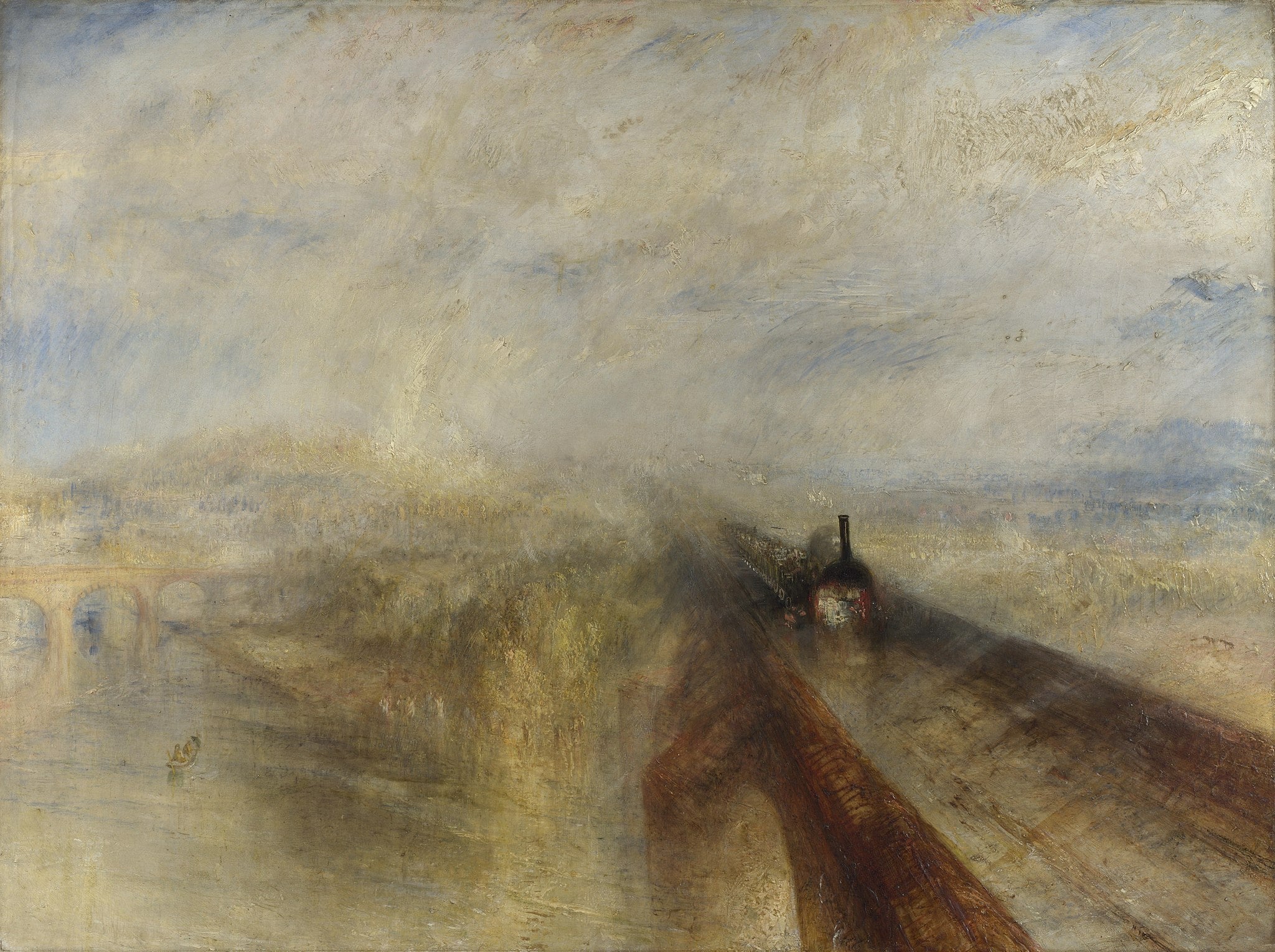
J. M. W. Turner (1775–1851) was the leading English Romantic, famed for radical experiments with light, color, and atmosphere. In the 1830s–40s he turned to steamships and railways, integrating industrial modernity into the sublime. His bequest later transferred much of his studio to the nation, with Rain, Steam and Speed now at the National Gallery [1][5].
View all works by J. M. W. Turner →