Two ways to make weather think
Turner and Constable both make weather the engine of a picture, but for different ends. Turner converts atmosphere and motion into felt force; Constable turns clouds, light, and labor into accountable facts of a locale. Seen together, they map two rigorous, modern answers to what landscape can know.
Comparison frame: How do Turner’s forces and Constable’s facts re-train our eyes—one to feel energy in motion, the other to notice weathered particulars of place?
Quick Comparison
| Topic | J. M. W. Turner | John Constable |
|---|---|---|
| Core aim | Make energy visible—light, storm, steam, speed as experiential force. | Make place legible—weathered particulars, labor, and continuity. |
| Weather method | Vortices, thrusting diagonals, dissolving contours; theatrical warm–cool glare. | Low horizons, capacious skies; cloud structure studied via “skying.” |
| Time sense | Instantaneity and shock: storm fronts, onrushing trains, handover moments. | Diurnal and seasonal rhythm: clouds, fords, and routine work cycles. |
| Modernity | Embraces rail, steam, and industrial smoke within the Romantic sublime. | Selectively omits factories/locomotives to sustain rural order. |
| Compositional engine | Force-first design—centripetal swirls, spear-like perspectives. | Field-first design—distributed incidents under architected skies. |
| Fact vs invention | Declarative poetic license to heighten meaning (e.g., Temeraire’s sunset, single tug). | Studio canvases built from timed, annotated plein-air studies. |
| Britain imagined | Nation as power in transition: sail to steam, speed to empire. | Nation as lived locality: mills, meadows, weather, and work. |
Shared Ground
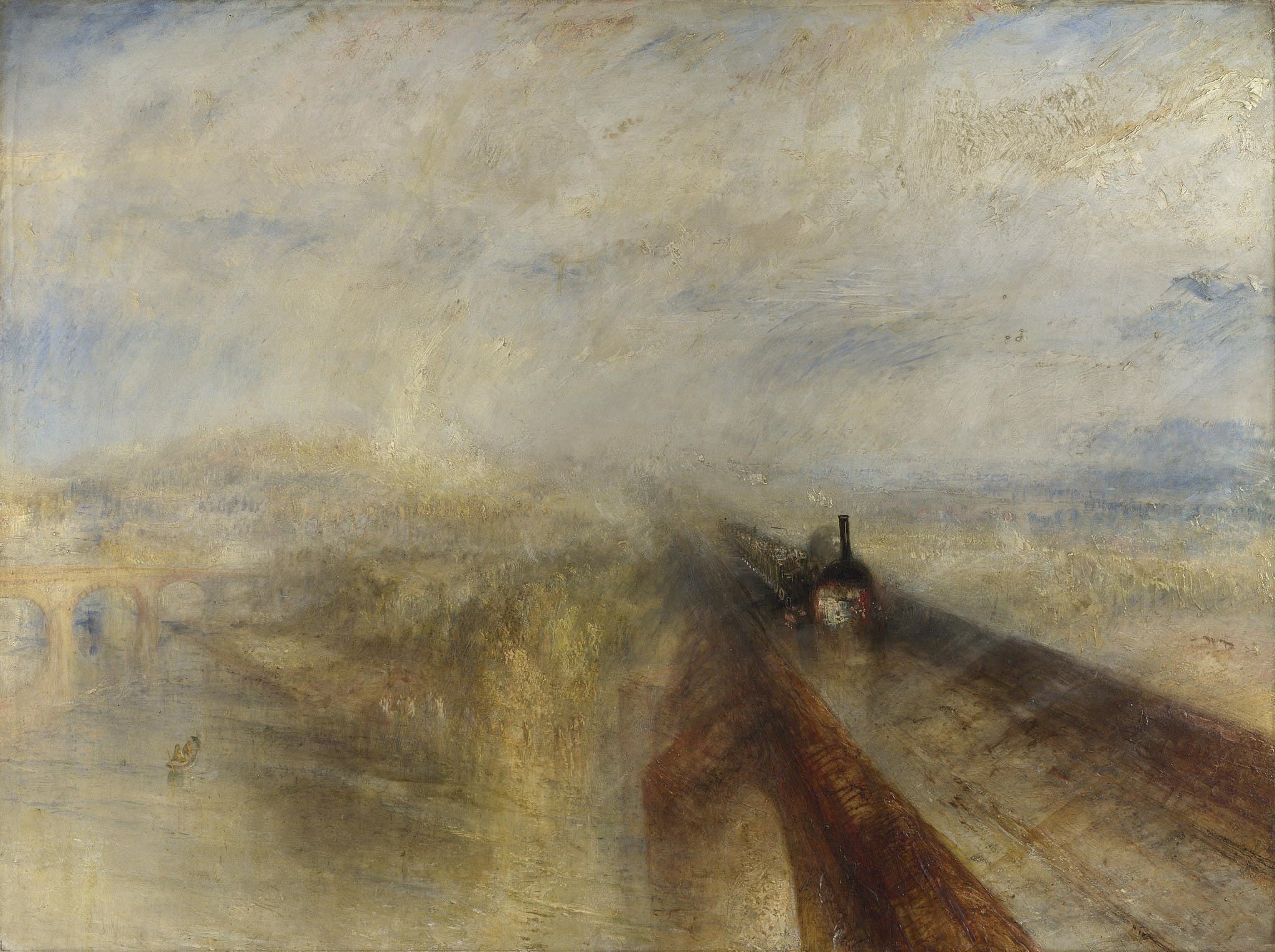
Both painters put weather in charge. In Turner, light, rain, mist, and steam are not backdrops but the picture’s organizing forces; in Constable, the sky is the chief organ of sentiment, its cloud-architecture setting mood and tempo on the ground. Each treats painting as a register of time in landscape. Turner compresses instants—storm vortices, the shock of a locomotive bursting through rain, the slippage from sunset to dusk—into experienced events. Constable accrues duration: his cloud studies log wind direction and hour, and his large studio landscapes absorb those notes so that ordinary crossings and chores feel anchored to diurnal change.
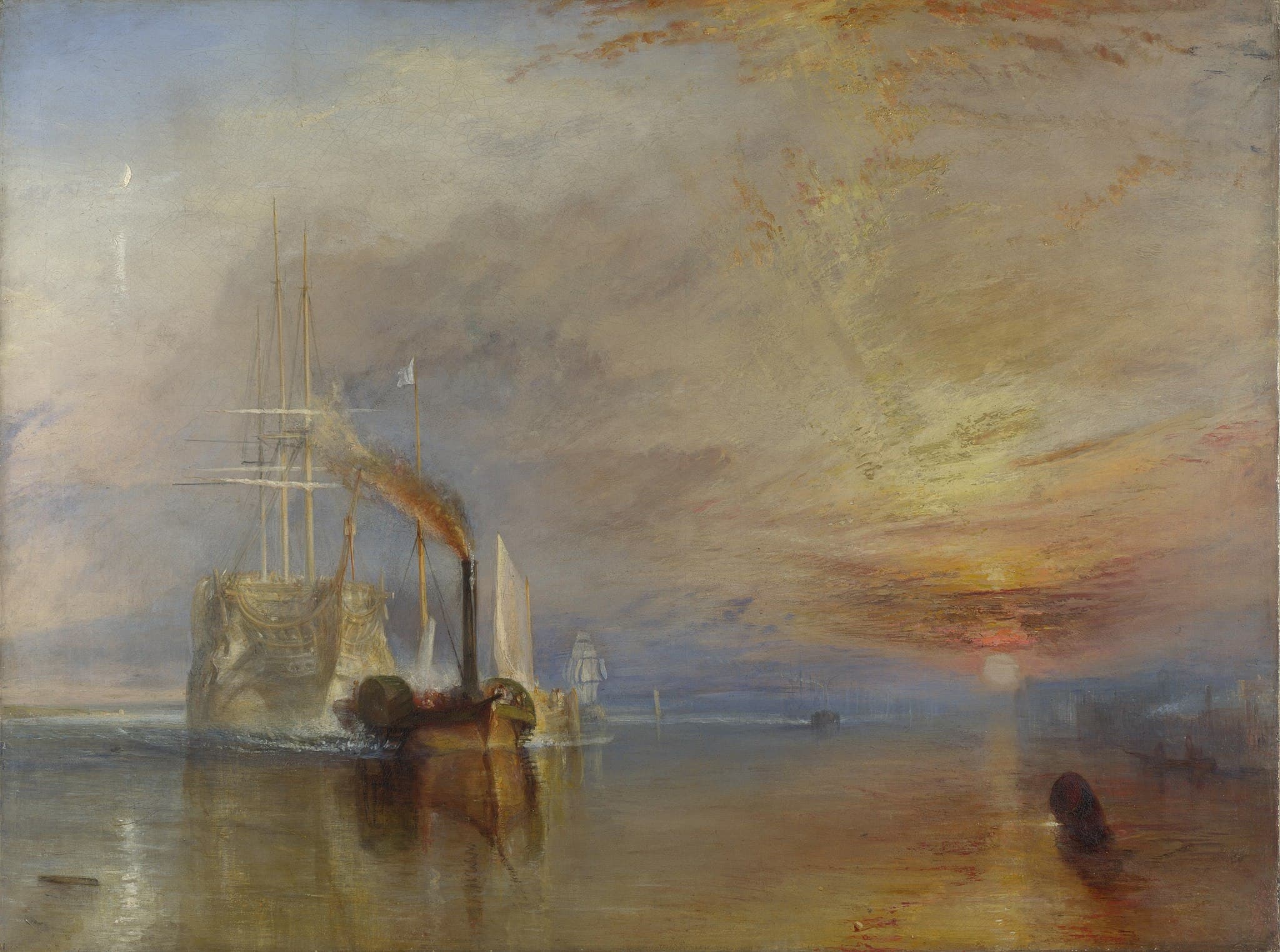
They also use landscape to think about Britain. Turner weaves infrastructure and naval memory into luminous atmospheres: the Great Western Railway on Brunel’s Maidenhead Viaduct, a veteran warship tugged by steam on a river turned to gold. Constable constructs a vernacular England of mills, cottages, and riverside labor observed with steady care, an England that reads as continuous even as industrialization gathers elsewhere. And both balance observation with invention. Turner alters or compresses facts—the Temeraire towed by one tug, smoke threaded through rigging, a symbolic sunset—to concentrate meaning. Constable builds exacting “six-footers” from on-the-spot oil studies and annotated skies while leaving out new factories, a selective clarity that keeps local life coherent. Weather, time, and national self-understanding thus form their shared ground: each turns landscape into a way of knowing.
Decisive Difference
The decisive split is what each asks us to see first. Turner makes us see forces. Topography is subordinated to energies—light, weather, motion, and modern power—often from a vantage inside the event. Rain, Steam and Speed drives a single diagonal vector so hard that space seems to collapse into onrushing velocity; Snow Storm—Steam-Boat off a Harbour’s Mouth spins sea and sky into a vortex that engulfs the viewer. Edges dissolve, forms are lit from within by warm–cool glare, and a few crisp facts (a buoy, puffs of steam, distant masts) keep the sublime anchored. For Turner, truth lies in conveying how power acts on perception: what speed and storm do to seeing.
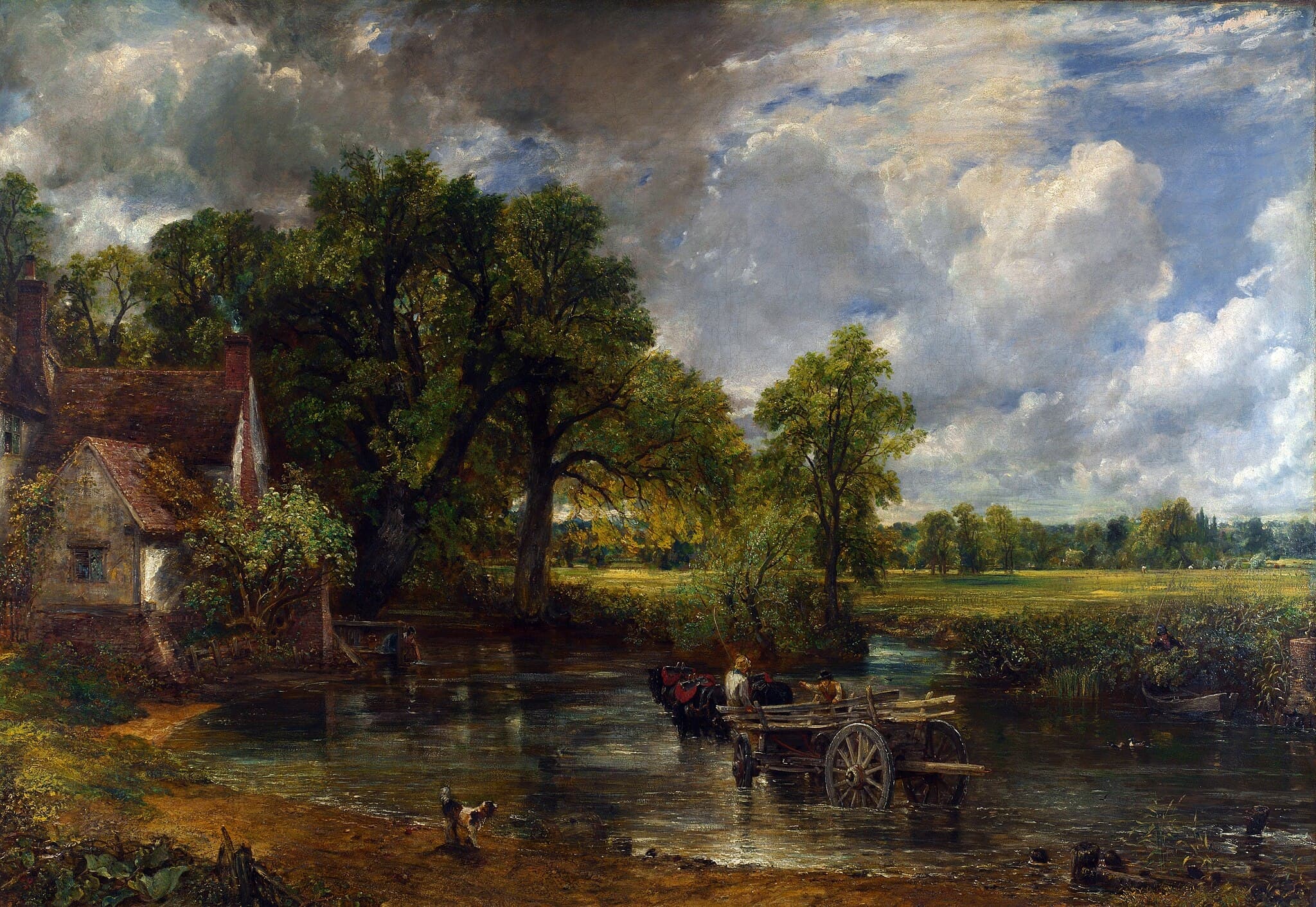
Constable makes us see facts-in-place. His empiricism—“skying” after Luke Howard’s cloud taxonomy, timed notes on light and wind, plein-air oil studies—returns in studio canvases as accountable specificity. The Hay Wain reads as a measured crossing: an empty cart paused mid-ford, tack and reflections observed, work distributed quietly across space. Even when symbolism enters, as in Salisbury Cathedral from the Meadows with its rainbow after storm, the meaning arises from weather set over a knowable locale. Constable’s selectivity—omitting locomotives and chimneys—does not deny modernity so much as frame a continuing rural order. The difference reveals two philosophies of painting: Turner turns experience into event, force-first; Constable turns experience into knowledge, place-first.
Paired Works
Motion vs pause at the water’s edge
Focus question: What does a crossing mean—velocity or continuity?
Rain, Steam and Speed vs The Hay Wain
National icons at a hinge of history
Focus question: How does weather stage historical time?
The Fighting Temeraire vs Salisbury Cathedral from the Meadows
How to paint a storm
Focus question: What counts as truth to nature—immersion or measurement?
Snow Storm—Steam-Boat off a Harbour's Mouth vs Cloud Study: Stormy Sunset
Why This Comparison Matters
Turner and Constable define two durable ways modern painting can be true. Turner insists that art can make us feel forces that exceed ordinary sight—speed, storm, handover moments—by letting weather and light bend space and time. Constable insists that attention to particulars—cloud types, wind, reflections, work—can build public knowledge of a place, a continuity strong enough to carry shared meaning. Their split shaped what followed. The Hay Wain’s reception in Paris in 1824 helped seed French naturalism; Turner’s late storms and rail visions, defended by Ruskin, licensed painters to privilege atmospheric truth over finish. Today, when we read images of climate, infrastructure, or local life, the Turner–Constable problem quietly returns: do we need a felt shock of forces or an accountable record of facts-in-place? Learning to see both—force-first and place-first—equips us to read the world’s changes with more range and precision.
Related Links
Sources
- National Gallery (London) – Turner, Rain, Steam and Speed
- National Gallery (London) – Turner, The Fighting Temeraire
- National Gallery (London) – Constable, The Hay Wain
- National Gallery of Art (Washington) – Constable, Cloud Study: Stormy Sunset
- Encyclopaedia Britannica – Turner, Snow Storm—Steam-Boat off a Harbour’s Mouth
- Ruskin, Modern Painters (Project Gutenberg) – Defense of Turner’s truth to nature
- National Galleries of Scotland – Constable’s Salisbury Cathedral and the rainbow motif
- National Gallery (London) – Room 41 overview (Paris 1824 and Constable’s impact)