The Manneporte near Étretat

by Claude Monet

Monet’s The Manneporte near Étretat turns the colossal sea arch into a threshold of light: rock, sea, and air interlock as shifting color rather than fixed form. Dense lilac–ochre strokes make the cliff feel massive yet dematerialized by illumination, while the arch’s opening stages a quiet, glimmering horizon [1][2].

Fast Facts

Year
1886
Medium
Oil on canvas
Dimensions
81.3 × 65.4 cm
Location
The Metropolitan Museum of Art, New York
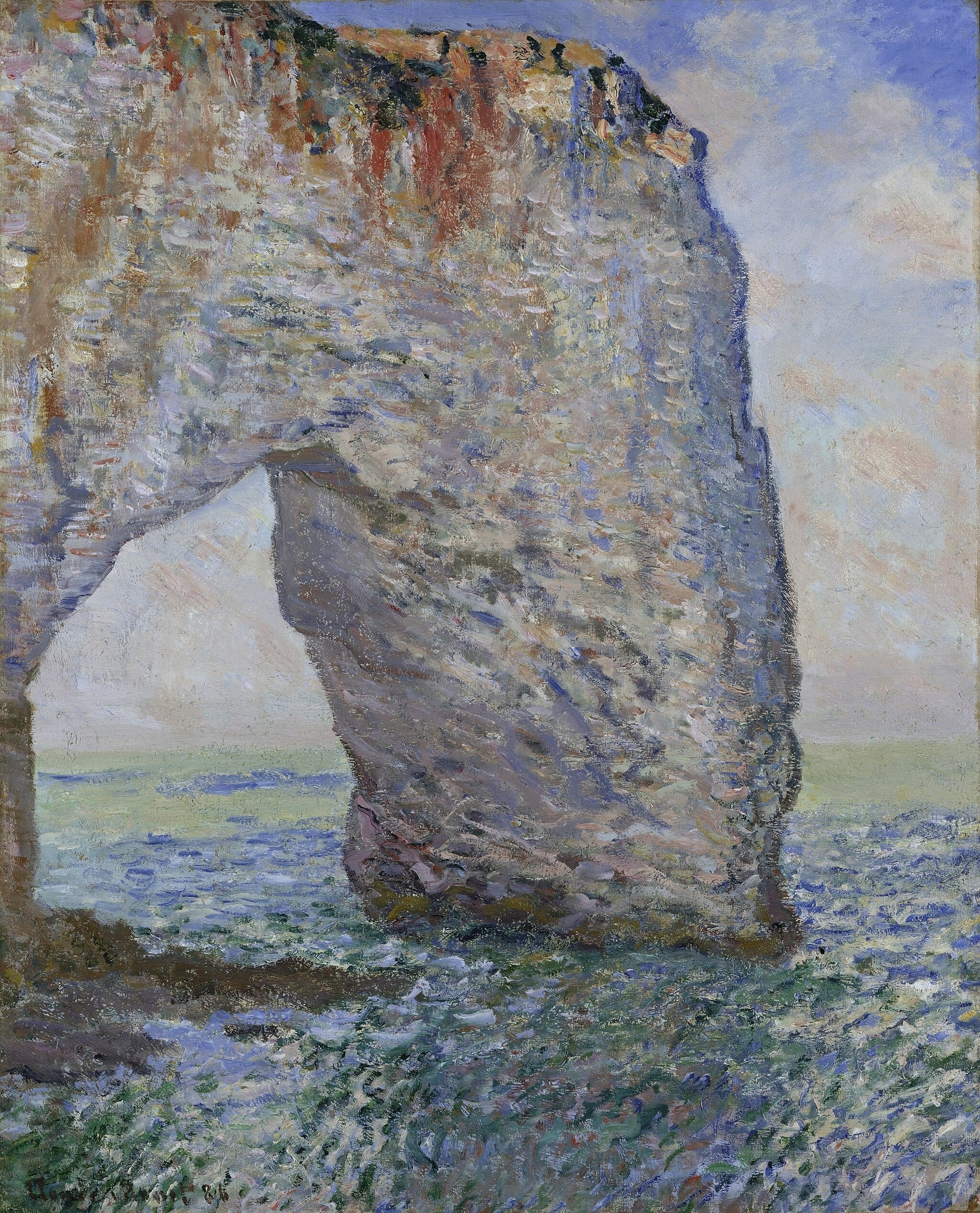
The Manneporte near Étretat by Claude Monet (1886)

Click on any numbered symbol to learn more about its meaning

Meaning & Symbolism

Monet positions the Manneporte as a near-vertical wall that dominates the canvas, thrust so close to us that its base nearly kisses the surf. This deliberate compression rejects a panoramic “sightseeing” view and insists on encounter: the viewer faces the cliff as a living surface. Short, overlapping strokes of lilac, slate, and ochre dissolve the chalk into color-events, so that solidity reads through reflected light rather than contour. The arch’s aperture—pale, almost bleached toward the horizon—becomes a gate that frames the tide’s green-blue shimmer. In this hinge between mass and glimmer, the painting asserts its thesis: permanence is provisional, legible only as it is registered by light 14. The sea is built from flickering touches—cool greens and violets braided with steel blues—that tilt and eddy around the cliff’s foot. Monet’s brushwork makes the water optically active; it is not “depicted” so much as performed. Above, a sky of rose and violet breaths stains the air rather than sealing it, echoing the water’s motion in a lighter key. Across these zones, there are no hard outlines; edges fray into adjacent notes, so that rock, water, and sky exchange hues. The effect is what Met curators call the dematerialization of the motif under sunlight, a process Monet had already begun in earlier Manneporte canvases of 1883 and would carry forward into later serial projects 2. The visual evidence is plain: the cliff’s interior planes are not modeled by shadow conventions; they are tessellated patches—cool to warm, wet to dry—that declare the hour, the weather, the salt in the air. This insistence on temporality grounds why The Manneporte near Étretat is important. The Met notes Monet painted this arched projection six times from this angle across 1883, 1885, and 1886, rotating canvases as light changed—a method famously described by Maupassant 1. Meaning gathers not from iconographic symbols but from the serial comparison that such canvases invite: how one cliff face becomes many under shifting conditions, how one arch rearticulates the sea’s color with each tide. Steven Z. Levine reads this repetition as a modern strategy in which the painting becomes a register of duration, not a fixed emblem 5. Here, that strategy is encoded in the very paint: each mark is a micro-timestamp, and the whole surface is a sediment of moments. At the same time, Monet strips away anecdote—no tourists, no boats—to intensify an elemental confrontation of sea, stone, and air. As Robert Herbert has argued of Monet’s Normandy work, the painter engages a site famous to modern tourism yet empties it of bustle to construct a solitary sublime tuned to perception rather than spectacle 3. The Manneporte reads like a natural cathedral, but its sacredness is optical: the arch’s void fills with brightness; the façade flickers with reflected greens from the tide and rusts from the cliff top. The pitted textures at the base—earthy browns veined with mossy greens—hint at erosion’s pressure, recalling the hazards Monet faced to secure his precarious vantage points along these cliffs 23. Thus the canvas is declarative: nature’s forms endure, but our access to them is momentary and mobile. By refusing the contour and building the cliff from light, Monet makes perception itself the subject. The Manneporte near Étretat stands as a keystone in the move toward his 1890s series—Rouen, haystacks, poplars—where surfaces become theaters for time. In Étretat, the theater is the sea’s edge; the play is the ceaseless exchange between stone and weather; and the script is written in strokes that never quite settle 135.

Explore Deeper with AI

Ask questions about The Manneporte near Étretat

Popular questions:

Powered by AI • Get instant insights about this artwork

💬 Ask questions about this artwork!

Interpretations

Historical Context: Tourism, Withdrawal, and the Modern Sublime

Étretat was a celebrity coastline—mapped in guidebooks and crowded by leisure seekers—yet Monet’s canvas strips away traffic to construct a solitary sublime calibrated to perception rather than spectacle 3. This is not anti-modern escapism but an answer to modern spectatorship: by refusing anecdote (no boats, no promenaders), the painting reframes a tourist icon as a laboratory for looking. Herbert argues Monet’s Normandy campaigns engage tourism’s culture while withdrawing from it to test how scale, weather, and reflective chalk can surpass picturesque viewing and verge on awe 3. The Manneporte becomes an experiential stage where spectatorship itself is rebuilt: less sightseeing, more phenomenological encounter with forces—spray, glare, erosion—registered in flickering strokes.

Source: Robert L. Herbert / Art Institute of Chicago

Seriality and Duration: Meaning Across Canvases

The Met documents six Manneporte canvases "from this angle," spread across 1883, 1885, and 1886, painted in rotating sequence as conditions shifted 1. Steven Z. Levine reads such repetition as a modern tactic: the unit of meaning migrates from a single canvas to the interstices among many, where difference in light and tide composes a register of duration 5. In this key, the 1886 Manneporte is not definitive; it is a temporal node whose tessellated strokes act as micro-time stamps. Maupassant’s eyewitness of Monet swapping canvases as light moved corroborates the work’s durational logic: the arch’s identity is constructed as a comparative process, not an icon fixed in outline 15.

Source: Steven Z. Levine; The Metropolitan Museum of Art

Risk and Vantage: Ecology of the Cliffside View

Monet’s vantage was neither neutral nor safe. On the 1885 campaign he and his gear were swept by a wave—an incident the Met notes in relation to the Étretat works 2. This risk underwrites the painting’s compressed composition: the cliff looms near-vertical, its base nearly at the surf, as if the painter has wedged himself against geology’s edge. Such proximity loads the facture with environmental data—salt, damp, and refracted color—so that the rocky façade is read through light rather than contour. The canvas is thus doubly documentary: it records optical change and the precarious conditions of looking that make such registration possible, a cliffside ecology imprinted in stroke and scale 12.

Source: The Metropolitan Museum of Art (object records for 1883/1886 Étretat canvases)

Architectural Optics: From Sea Gate to Cathedral Façade

Museums and critics have long analogized Monet’s arches to architecture; here the opening functions as a gate, framing a pale horizon and staging luminous passage 14. The cliff face operates like a sculpted façade whose relief is defined by dematerializing light—a logic Monet will radicalize in Rouen Cathedral, where structure is remade by atmosphere. The Manneporte’s ‘nave’ is brightness itself: a void that glows, converting geology into quasi-sacral optics. Rather than symbolic piety, the sacred here is procedural—the world becomes hallowed as its surfaces are rewritten by light-events, an architectural reading that clarifies why later cathedral series feel prefigured on this wind-scoured shore 24.

Source: Musée d’Orsay; The Metropolitan Museum of Art

Optical Performance: Paint Handling as Phenomenology

The sea, Monet writes in paint, is not merely depicted; it is performed through short, braided touches of green, violet, and steel blue that create optical activity at the cliff’s foot 12. Met curators frame this as the dematerialization of the motif: planes refuse academic modeling, becoming chromatic tesserae that declare hour, weather, and moisture content 2. Such facture foregrounds the act of seeing-in-time: edges fray, hues migrate between zones, and solidity emerges from illuminated adjacency rather than contour. The painting thus doubles as a phenomenological study where medium, light, and observer co-produce the image—an experiment in how matter becomes visible as a sequence of color-events.

Source: The Metropolitan Museum of Art

Related Themes

About Claude Monet

Claude Monet (1840–1926) led Impressionism’s pursuit of open-air painting and optical immediacy, especially during his Argenteuil years focused on modern leisure and light. He later developed serial studies of changing conditions, culminating in the Water Lilies cycle [2].
View all works by Claude Monet

More by Claude Monet

La Japonaise (Camille Monet in Japanese Costume) by Claude Monet

La Japonaise (Camille Monet in Japanese Costume)

Claude Monet (1876)

Claude Monet’s La Japonaise (Camille Monet in Japanese Costume) (1876) stages a witty confrontation between <strong>Parisian modernity</strong> and the fashion for <strong>Japonisme</strong>. A fair-skinned model in a blazing red uchikake preens before a wall tiled with uchiwa fans, lifting a <strong>tricolor</strong> hand fan that asserts Frenchness amid the imported decor. The painting turns costume, props, and gaze into a performance about <strong>desire, display, and identity</strong> <sup>[1]</sup><sup>[2]</sup>.

Boating by Claude Monet

Boating

Claude Monet (1887)

Monet’s Boating crystallizes modern leisure as a drama of perception, setting a slim skiff and two pale dresses against a field of dark, mobile water. Bold cropping, a thrusting oar, and the complementary flash of hull and foliage convert a quiet outing into an experiment in <strong>modern vision</strong> and the <strong>materiality of water</strong> <sup>[1]</sup><sup>[2]</sup>.

The Thames below Westminster by Claude Monet

The Thames below Westminster

Claude Monet (about 1871)

Claude Monet’s The Thames below Westminster turns London into <strong>light-made architecture</strong>, where Parliament’s mass dissolves into mist and the river shivers with <strong>industrial motion</strong>. Tugboats, a timber jetty with workers, and the rebuilt Westminster Bridge assert a modern city whose power is felt through atmosphere more than outline <sup>[1]</sup>.

Haystacks Series by Claude Monet | Light, Time & Atmosphere by Claude Monet

Haystacks Series by Claude Monet | Light, Time & Atmosphere

Claude Monet

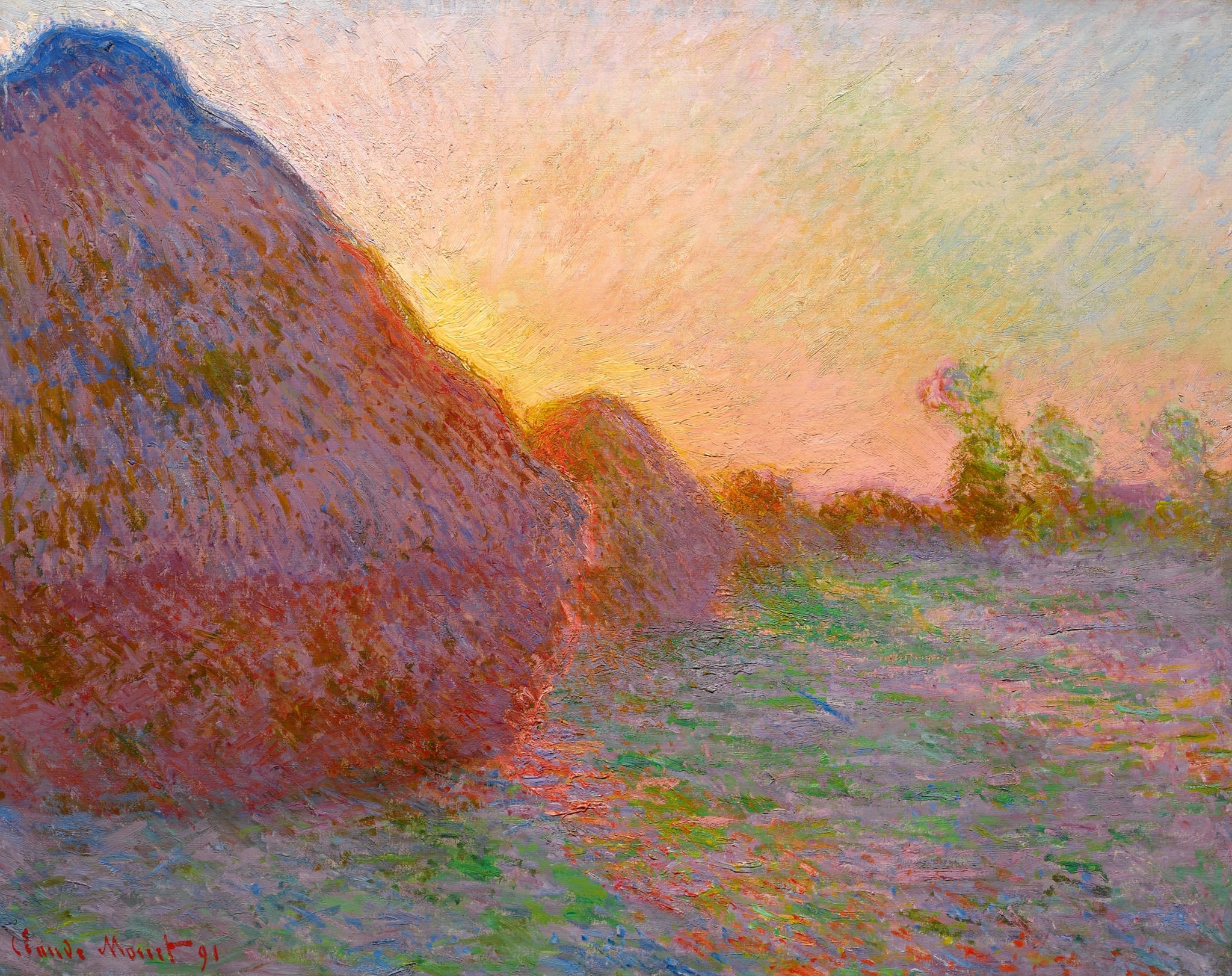
Claude Monet’s <strong>Haystacks Series</strong> transforms a routine rural subject into an inquiry into <strong>light, time, and perception</strong>. In this sunset view, the stacks swell at the left while the sun burns through the gap, making the field shimmer with <strong>apricot, lilac, and blue</strong> vibrations.
Women in the Garden by Claude Monet

Women in the Garden

Claude Monet (1866–1867)

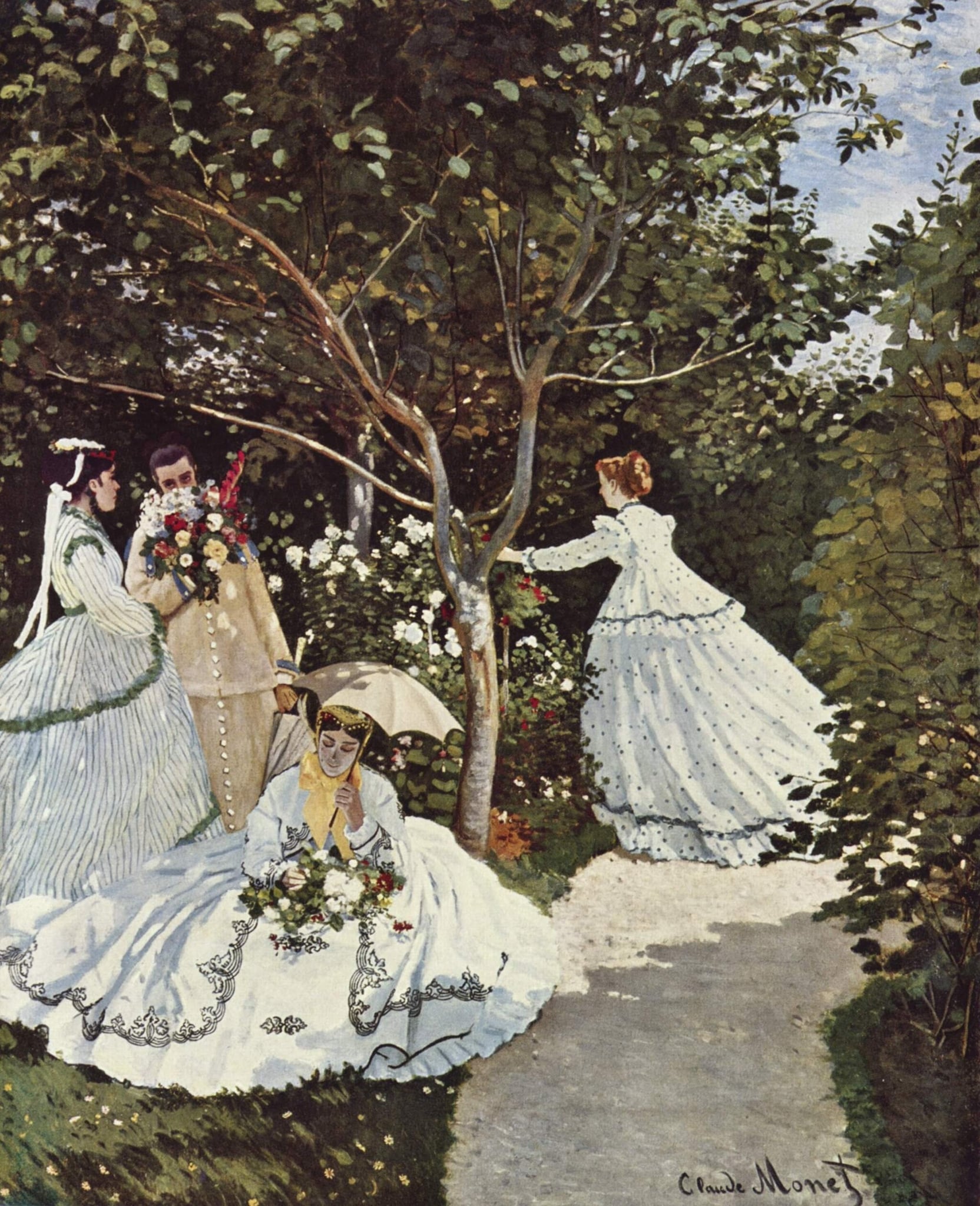
Claude Monet’s Women in the Garden choreographs four figures in a sunlit bower to test how <strong>white dresses</strong> register <strong>dappled light</strong> and shadow. The path, parasol, and clipped flowers frame a modern ritual of leisure while turning fashion into an instrument of <strong>perception</strong>. The scene reads less as portraiture than as a manifesto for painting the <strong>momentary</strong> outdoors <sup>[1]</sup><sup>[3]</sup>.
Impression, Sunrise by Claude Monet

Impression, Sunrise

Claude Monet (1872)

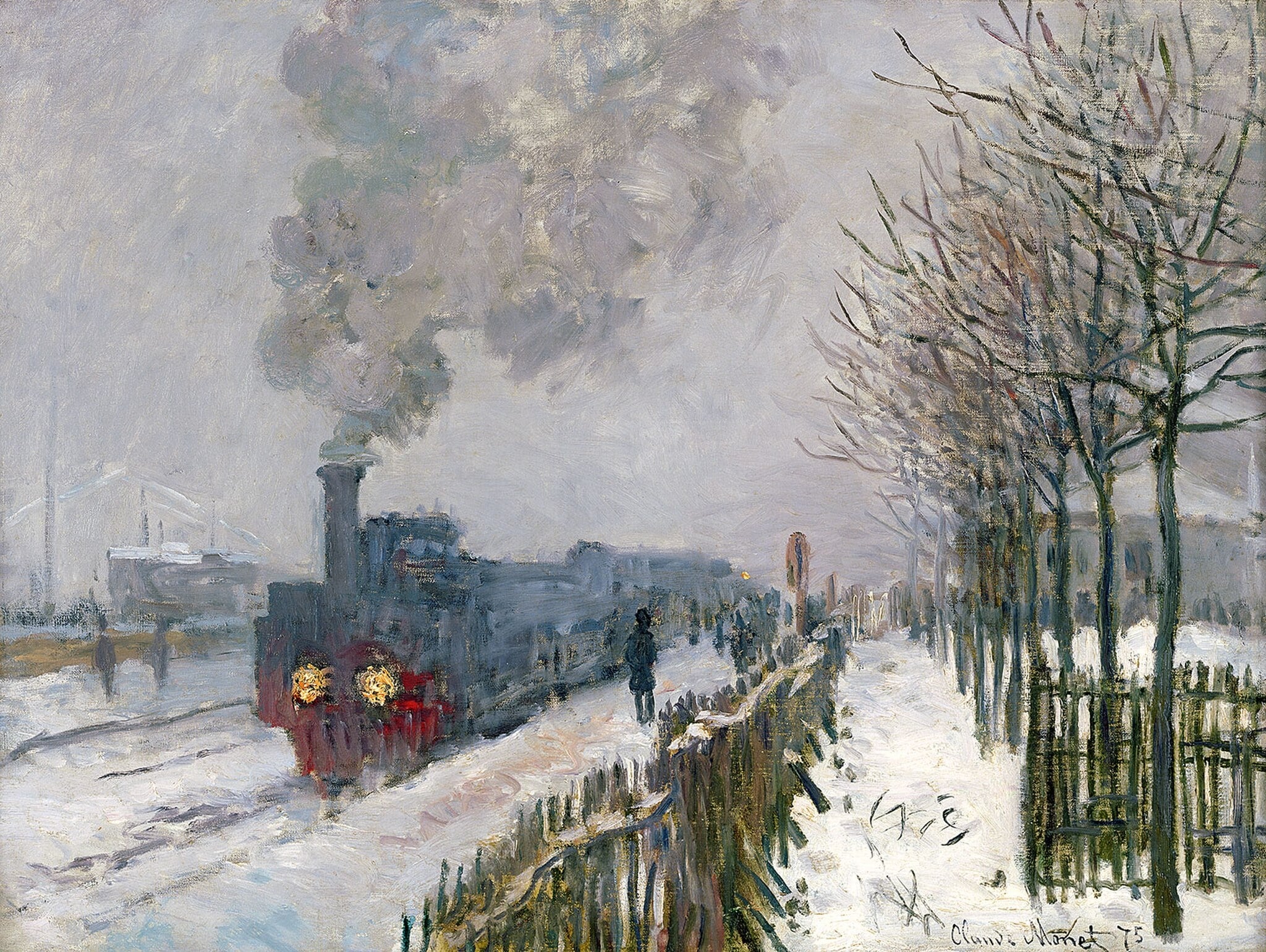
In Impression, Sunrise, Claude Monet turns Le Havre’s fog-bound harbor into an experiment in <strong>immediacy</strong> and <strong>modernity</strong>. Cool blue-greens dissolve cranes, masts, and smoke, while a small skiff cuts the water beneath a blazing, <strong>equiluminant</strong> orange sun whose vertical reflection stitches the scene together <sup>[1]</sup><sup>[3]</sup>. The effect is a poised dawn where industry meets nature, a quiet <strong>awakening</strong> rendered through light rather than line.