The Grand Canal

by Claude Monet

Claude Monet’s The Grand Canal turns Venice into pure atmosphere: the domes of Santa Maria della Salute waver at right while a regiment of pali stands at left, their verticals reverberating in the water. The scene asserts light over architecture, transforming stone into memory and time into color [2][3].
💰

Market Value

$55-70 million

How much is The Grand Canal worth?

Fast Facts

Year
1908
Medium
Oil on canvas
Dimensions
73.7 × 92.4 cm
Location
Fine Arts Museums of San Francisco (Legion of Honor), San Francisco
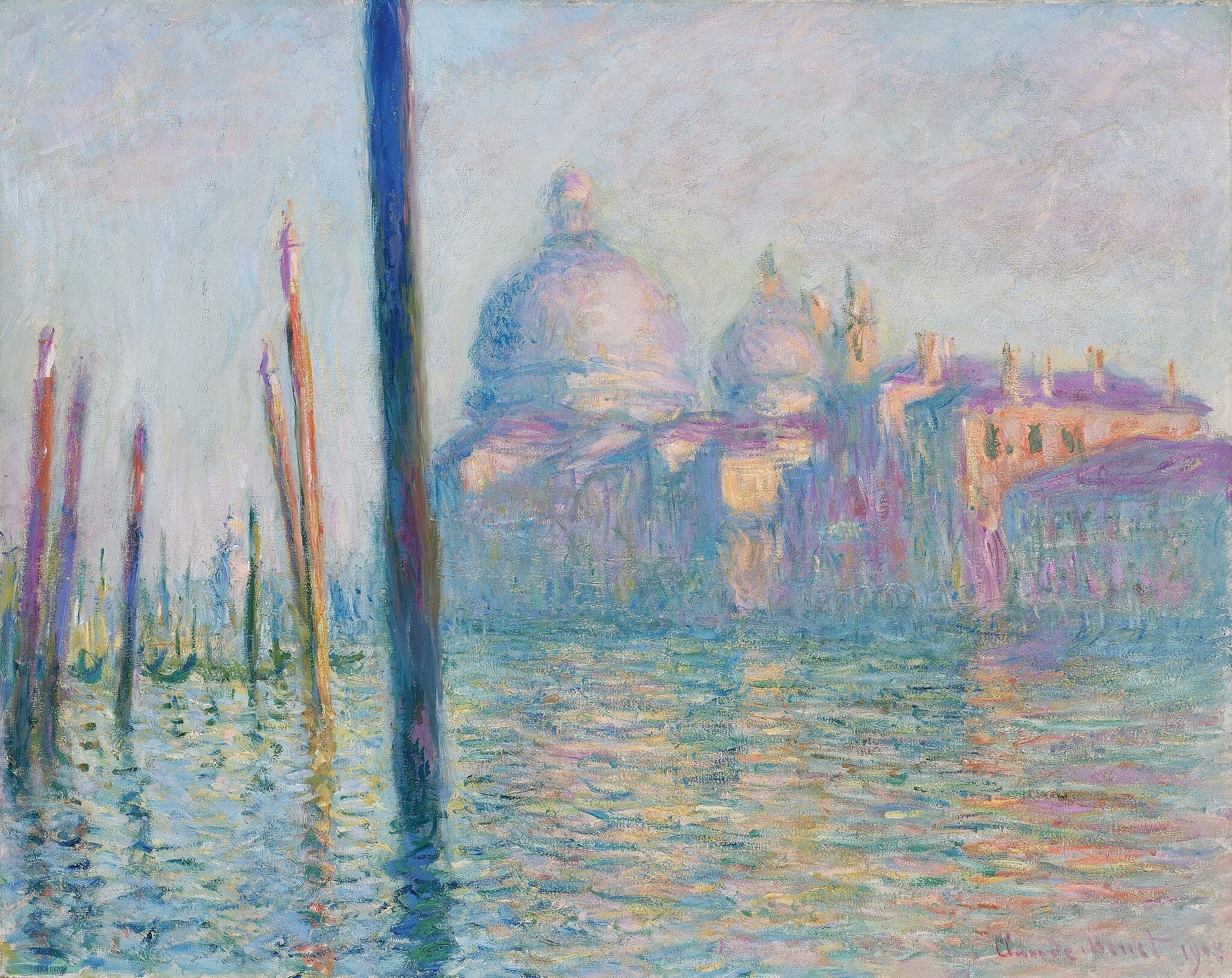
The Grand Canal by Claude Monet (1908)

Click on any numbered symbol to learn more about its meaning

Meaning & Symbolism

Monet composes a dialectic between vertical stake and horizontal shimmer. At left, the striped mooring poles (pali) rise in a measured cadence; one dark blue shaft near center-left cleaves the picture plane, a metronome that calibrates the eye. At right, the basilica of Santa Maria della Salute—a civic ex‑voto for deliverance from plague—dissolves into lavender and aqua, its domes legible yet de-materialized. The water, wrought from short, broken touches of green, pink, and gold, refuses to mirror with clarity; instead it time-stamps the moment through optic vibration. This is not urban inventory but an enveloppe in which air, stone, and water share a single chromatic weather 45. By letting reflection overtake description, Monet asserts that Venice’s identity is not its façades but its mutable light. That stance is programmatic. Painted in 1908 from the Palazzo Barbaro landing and reworked at Giverny before the 1912 Bernheim-Jeune show, the canvas participates in Monet’s serial method: a fixed vantage iterated across hours so that color, not contour, carries meaning 23. Here, the poles function as pictorial “stakes” of continuity—echoes of Venice’s domestic markers—that measure change. Their upright thrust arrests the lateral drift of the canal, staging permanence versus flux as a formal argument. The Salute’s sanctified mass becomes a vision rather than a landmark: faith and civic memory are rendered as haze, acknowledging their persistence yet showing how experience perceives them—through atmosphere, distance, and recollection 46. By privileging sensation, Monet distances himself from Canaletto’s vedute; the city is not mapped but felt, its authority humbled by water’s restless surface 5. The chromatic strategy clinches the meaning. Cool violets and turquoises lay a veil over the entire field; warmer oranges flare along cornices and ripple across the canal, suggesting a late-afternoon interval when light levels and saturations invert solids and voids. Brushwork is deliberately non-descriptive: short, lateral touches in the water break into scale-like tesserae, while the domes receive broader, feathery strokes that let ground tones breathe through. This handling equates reflection with duration—each touch a unit of time. The resulting image is elegiac without narrative: a city symbolized by poles and domes yet encountered as a fleeting encounter, the world briefly becoming light itself. In this, The Grand Canal crystallizes Monet’s late ambition: to relocate meaning from things to their appearances, and to bind civic emblem, sacred history, and private perception into one atmospheric fact 356.

Explore Deeper with AI

Ask questions about The Grand Canal

Popular questions:

Powered by AI • Get instant insights about this artwork

💬 Ask questions about this artwork!

Interpretations

Historical Context

Painted during Monet’s sole Venetian stay (Oct–Dec 1908) and reworked at Giverny, the Grand Canal views were unveiled at Bernheim‑Jeune in 1912 as distilled meditations on light rather than on-site reportage. From the Palazzo Barbaro landing he faced the Salute, a locus classicus of the city’s iconography, but the project’s logic was serial: multiple canvases from a near-fixed vantage, each keyed to a specific hour’s chroma. The resulting ensemble stages Venice as an optical laboratory, where the canal becomes a register of time-of-day rather than a tourist prospect. This bifurcated genesis—open air plus studio—means the final image is a composed memory of weather, not a transcript, aligning the Venice cycle with Rouen, London, and late Giverny procedures 123.

Source: The Met; Museum of Fine Arts, Boston; Museum Barberini

Symbolic Reading

The striped pali at left are more than décor: historically, these poles marked a palazzo’s water entrance and family identity. Monet mobilizes them as visual heraldry and metrical “stakes” that meter the picture’s lateral drift, a civic code turned pictorial scaffolding. Their upright insistence counters the canal’s shimmer, staging a dialectic of continuity versus flux—household markers that persist while water unfixes everything else. In Venice’s urban semiotics, poles once bore colors and lamps; in Monet’s canvas they bear time, calibrating the eye as the day slips. This symbolic repurposing folds local custom into modernist structure, translating urban identity into painterly rhythm 59.

Source: Italoamericano (Venetian pali); Cantiere Daniele Manin (palificazioni)

Formal Analysis (Serial Optics)

Brushwork and palette are functional, not ornamental: short, lateral strokes articulate a vibratory surface where reflection refuses legibility, while broader, feathery touches on the domes admit ground tones, letting form breathe. Across the Grand Canal set, variations in violet-turquoise veils versus orange-gold flares encode shifting atmospheric intervals. This is serial optics in action: color displaces contour as the carrier of meaning; each touch is a unit of duration. The image thereby reenacts perception—unstable, revisable, time-laden—so that Venice materializes as a rhythm of chromatic events rather than a finite architecture, advancing Monet’s late program to relocate significance from things to their appearances 123.

Source: Museum of Fine Arts, Boston; The Met; Museum Barberini

Comparative Lens: Against the Veduta

Set beside Canaletto’s crisp vedute, Monet’s Grand Canal is a polemic: a refusal of cartographic exactitude in favor of atmospheric enveloppe. Where the 18th‑century city portrait inventories façades, Monet fuses air, stone, and water until categories collapse, making reflection the true protagonist. This shift is not merely stylistic but epistemic—what Venice “is” becomes what Venice looks like in a particular light. Market and curatorial essays underscore how the 1908 series consolidates Monet’s long move from topography to phenomenology, recoding a canonical motif as a mutable apparition and aligning Venice with the temporal poetics of Rouen and the Thames 37.

Source: Museum Barberini; Sotheby’s (series overview)

Psychological/Elegiac Reading

Contemporary critics have reframed the Venice cycle as elegiac: the emptied canals and vaporized domes register late-career introspection and approaching loss (Alice died in 1911). Rather than spectacle, the Grand Canal reads as after‑image—a soft‑edged consolidation of sight and memory, where civic grandeur dissolves into melancholic light. Paul Signac’s praise—calling the Venice canvases the “highest manifestation” of Monet’s art—acknowledges this distillation: less cityscape than state of mind. The absence of anecdote, figures, or crisp detail opens a contemplative register where color carries affect, and the Salute’s ex‑voto identity becomes a haze of remembrance more than a monument 68.

Source: Christie’s (letters and reception); Financial Times (2025 review)

Related Themes

About Claude Monet

Claude Monet (1840–1926) led Impressionism’s pursuit of open-air painting and optical immediacy, especially during his Argenteuil years focused on modern leisure and light. He later developed serial studies of changing conditions, culminating in the Water Lilies cycle [2].
View all works by Claude Monet

More by Claude Monet

La Japonaise (Camille Monet in Japanese Costume) by Claude Monet

La Japonaise (Camille Monet in Japanese Costume)

Claude Monet (1876)

Claude Monet’s La Japonaise (Camille Monet in Japanese Costume) (1876) stages a witty confrontation between <strong>Parisian modernity</strong> and the fashion for <strong>Japonisme</strong>. A fair-skinned model in a blazing red uchikake preens before a wall tiled with uchiwa fans, lifting a <strong>tricolor</strong> hand fan that asserts Frenchness amid the imported decor. The painting turns costume, props, and gaze into a performance about <strong>desire, display, and identity</strong> <sup>[1]</sup><sup>[2]</sup>.

Boating by Claude Monet

Boating

Claude Monet (1887)

Monet’s Boating crystallizes modern leisure as a drama of perception, setting a slim skiff and two pale dresses against a field of dark, mobile water. Bold cropping, a thrusting oar, and the complementary flash of hull and foliage convert a quiet outing into an experiment in <strong>modern vision</strong> and the <strong>materiality of water</strong> <sup>[1]</sup><sup>[2]</sup>.

The Thames below Westminster by Claude Monet

The Thames below Westminster

Claude Monet (about 1871)

Claude Monet’s The Thames below Westminster turns London into <strong>light-made architecture</strong>, where Parliament’s mass dissolves into mist and the river shivers with <strong>industrial motion</strong>. Tugboats, a timber jetty with workers, and the rebuilt Westminster Bridge assert a modern city whose power is felt through atmosphere more than outline <sup>[1]</sup>.

Haystacks Series by Claude Monet | Light, Time & Atmosphere by Claude Monet

Haystacks Series by Claude Monet | Light, Time & Atmosphere

Claude Monet

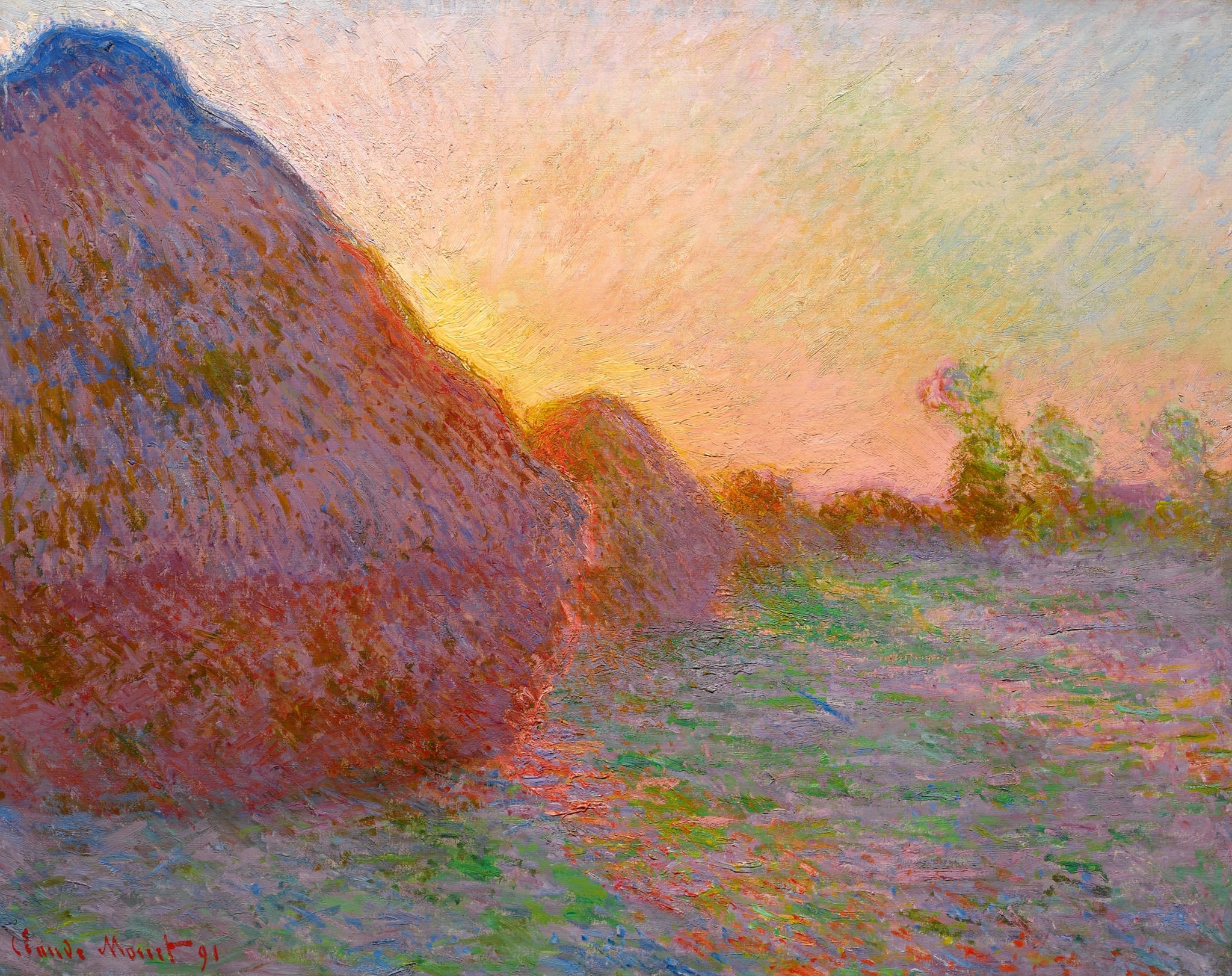
Claude Monet’s <strong>Haystacks Series</strong> transforms a routine rural subject into an inquiry into <strong>light, time, and perception</strong>. In this sunset view, the stacks swell at the left while the sun burns through the gap, making the field shimmer with <strong>apricot, lilac, and blue</strong> vibrations.
Women in the Garden by Claude Monet

Women in the Garden

Claude Monet (1866–1867)

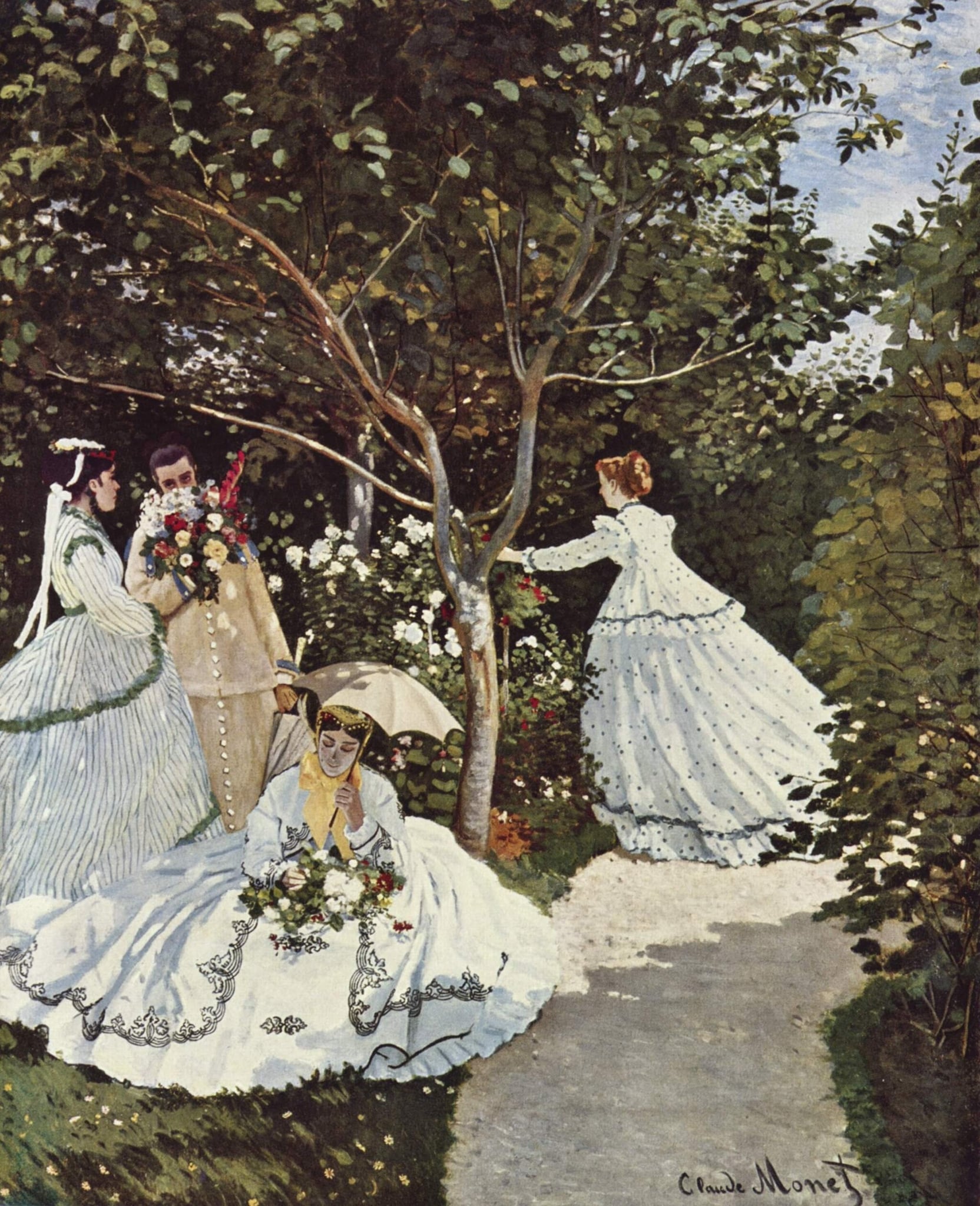
Claude Monet’s Women in the Garden choreographs four figures in a sunlit bower to test how <strong>white dresses</strong> register <strong>dappled light</strong> and shadow. The path, parasol, and clipped flowers frame a modern ritual of leisure while turning fashion into an instrument of <strong>perception</strong>. The scene reads less as portraiture than as a manifesto for painting the <strong>momentary</strong> outdoors <sup>[1]</sup><sup>[3]</sup>.
Impression, Sunrise by Claude Monet

Impression, Sunrise

Claude Monet (1872)

In Impression, Sunrise, Claude Monet turns Le Havre’s fog-bound harbor into an experiment in <strong>immediacy</strong> and <strong>modernity</strong>. Cool blue-greens dissolve cranes, masts, and smoke, while a small skiff cuts the water beneath a blazing, <strong>equiluminant</strong> orange sun whose vertical reflection stitches the scene together <sup>[1]</sup><sup>[3]</sup>. The effect is a poised dawn where industry meets nature, a quiet <strong>awakening</strong> rendered through light rather than line.