The Train in the Snow (The Locomotive)

by Claude Monet

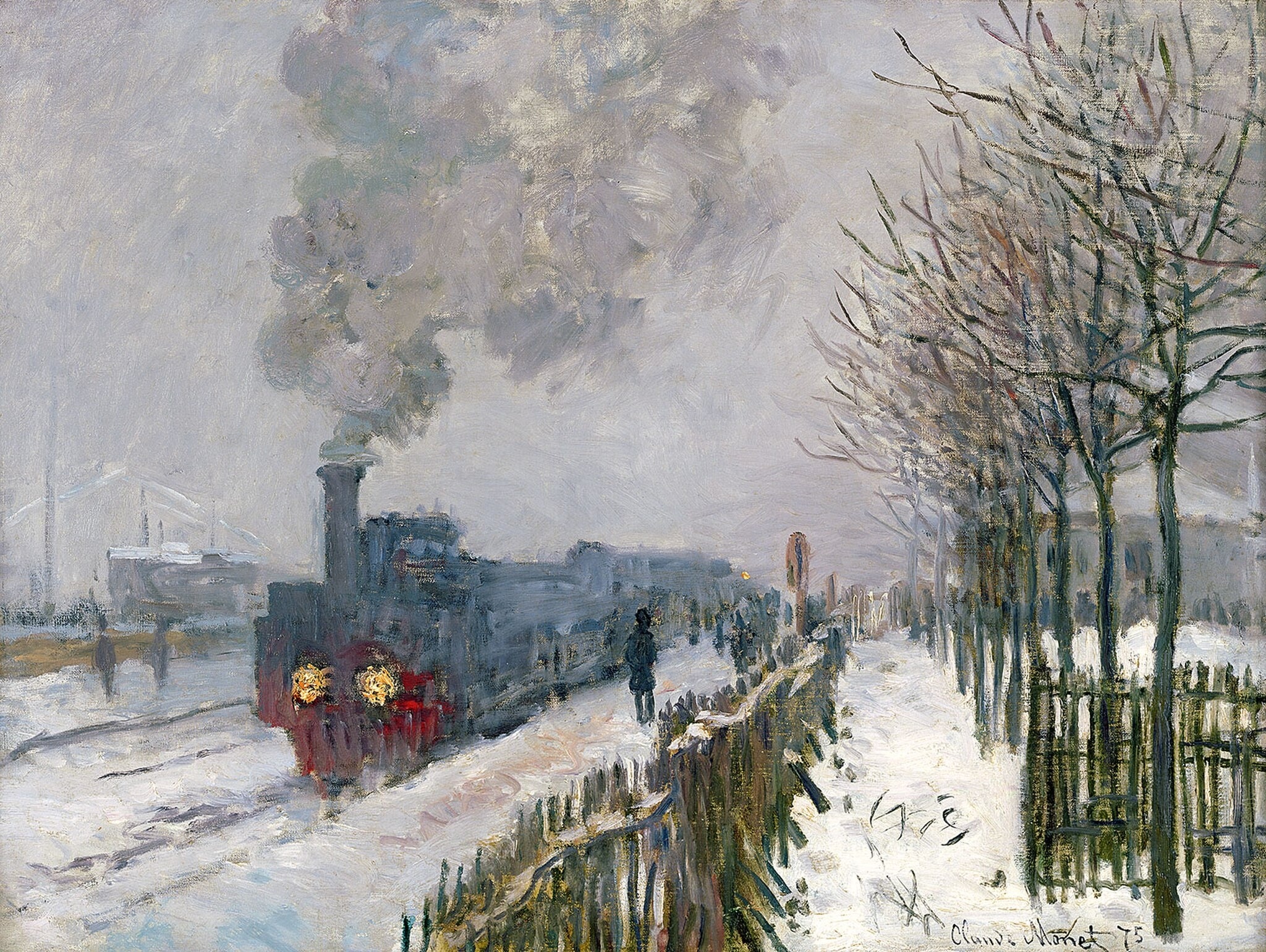
Claude Monet’s The Train in the Snow (The Locomotive) (1875) turns a suburban winter platform into a study of modernity absorbed by atmosphere. The engine’s twin yellow headlights and a smear of red push through a world of greys and violets as steam fuses with the low sky, while the right-hand fence and bare trees drill depth and cadence into the scene [1][4]. Monet fixes not an object but a moment of perception, where industry seems to dematerialize into weather [1][2].

Fast Facts

Year
1875
Medium
Oil on canvas
Dimensions
59 × 78 cm
Location
Musée Marmottan Monet, Paris
The Train in the Snow (The Locomotive) by Claude Monet (1875)

Click on any numbered symbol to learn more about its meaning

Meaning & Symbolism

Monet anchors the composition with three interacting vectors: the train’s dark horizontal mass entering from the left, the serrated fence that cuts diagonally along the right margin, and the vertical cadence of leafless trees. These lines steer the eye toward the cluster of small, shadowed figures mid-distance, who stand as momentary occupants of a space ruled by weather and machinery. The headlights—two punctual yellow discs—and a flare of red at the engine’s face act as signal-colors within a field of greys, violets, and icy blues, concentrating attention and asserting human agency in a muffled world 1. Yet the agency feels provisional. Steam rises as a thick, tonally variegated plume that merges into the low sky, softening platforms and sheds until the man‑made structures lose contour. Scholars have described this as dematerialization: technology persists as atmosphere, its edges surrendered to humidity and cold 12. The result is not a suspense scene of arrival but a proposition about how the modern is perceived—through veils of condensation, in transit, and only ever partially grasped. The right-hand fence and the regimented trees do more than plot perspective. They impose a modern, engineered order on nature while interrupting unimpeded entry into depth, a distinctly contemporary spatial sensation that critics have linked to Monet’s Argenteuil practice 45. Their rhythm counterbalances the train’s lateral push, holding the picture in a taut equilibrium of thrust versus restraint. In that tension, the figures appear vulnerable—dark notes embedded in snow that reflects ambient greys rather than bright whites—so that human presence reads as contingent on the machine and the weather that envelopes it. The snow’s softening power is total: tracks are half-swallowed, footprints fray at the edges, and sound seems absorbed into the damp air. Monet makes climate the principal actor, staging a world where vision itself is slowed and thickened; time is registered as evaporating steam and scumbled brushwork rather than clock or timetable. This is the Impressionist wager transposed to a rail platform: to paint the experience of the new age rather than its diagrams 25. Historically, the canvas belongs to the dense sequence of Argenteuil snows Monet painted in the winter of 1874–75, and it foreshadows the 1877 Gare Saint‑Lazare series where steam becomes spectacle and subject 123. There, as period critics like Zola noted, viewers could almost hear the trains; here, that sonic illusion is inverted into hush—the visual equivalent of a muted engine paused within weather 3. James Rubin and others read Argenteuil’s fences and planted avenues as signs of suburban domestication of industry; Monet accepts those signs but lets snow and vapor reclaim them, folding progress back into landscape 4. Paul Hayes Tucker stresses how converging diagonals imply motion even when halted; the picture therefore holds a latent acceleration, a sense that the train will soon pierce the grey and the figures will scatter 2. By presenting progress as a warm pulse within a cold field, and by letting steam write over the built world, The Train in the Snow (The Locomotive) articulates a modern truth: technology defines the present not by its outlines, but by the atmospheres it creates and the rhythms it imposes on everyday life.

Explore Deeper with AI

Ask questions about The Train in the Snow (The Locomotive)

Popular questions:

Powered by AI • Get instant insights about this artwork

💬 Ask questions about this artwork!

Interpretations

Formal Analysis: Countervailing Vectors and Visual Tempo

Monet’s platform becomes a network of directional forces: the train’s left-to-right mass, the slicing diagonal fence, and the vertical cadence of trees produce a tense equilibrium that holds motion in check. This is not mere perspective plotting; it is a modern spatial syntax that alternates between thrust and arrest, suggesting a halted engine with latent acceleration. The eye’s route is purpose-built—caught, redirected, and slowed by man-made rhythms—so that looking itself becomes a proxy for modern transit. John House underscores how the fence interrupts recession, complicating the viewer’s ingress, while Paul Hayes Tucker notes how converging diagonals preserve the sensation of imminent movement even in stasis. The painting thus translates railway kinesis into optical choreography, converting torque and timetable into pictorial pacing 26.

Source: John House; Paul Hayes Tucker

Suburban Modernity & Social Geography

Set in Argenteuil—a rail-linked suburb that incubated Impressionism—the canvas indexes how industry was domesticated into residential space. James H. Rubin reads the regimented trees and fencing as signs of suburban planning that frame the locomotive within a managed landscape, mediating the gritty apparatus of industry through designed order. Tucker’s Argenteuil studies further situate Monet’s winter scenes within a social fabric where commuting, station stops, and short-haul mobility re-scripted daily life. The clustered figures on the platform become tokens of commuter time, folded into routines of arrival and pause. In this lens, the painting is less a picturesque snow scene than a social map of new peripheries, where work-leisure cycles hinge on the train’s schedule and environmental contingencies—fog, frost, and thaw—continually perturb that schedule 23.

Source: James H. Rubin; National Gallery of Art (Paul Hayes Tucker)

Atmospheric Optics and Signal-Color Punctuation

Within a field of greys, violets, and cold blues, Monet inserts two punctual yellow discs and a flare of red—signal-colors that punctuate and stabilize the viewing field. The Musée Marmottan notes how these accents “lighten and crown” the composition, acting like beacons in a saturated haze. Marianne Delafond emphasizes the chromatic subtlety of the smoke-sky continuum, where tonal gradations knit engine, sheds, and air into a single optical envelope. Against this envelope, the lights function as human-coded signs—indexing control, warning, destination—thereby asserting agency in a world given over to condensation. Color here is semiotic as much as atmospheric: it directs traffic in the picture and aligns perception to the logics of rail signaling, making modernity legible through restrained, high-impact chroma 17.

Source: Musée Marmottan Monet; Marianne Delafond

Phenomenology of Time and the Muted Soundscape

Critics of Monet’s 1877 Saint-Lazare works (Zola among them) claimed one could almost hear the engines; by contrast, The Train in the Snow converts modern noise into hush. Steam becomes a time register—evaporation, diffusion, and drift—replacing clocks with atmospheric duration. Smarthistory’s Saint-Lazare context clarifies how Monet’s rail imagery pivots on the sensorial: not just sight, but implied sound and temperature. The Met’s overview of Monet ties this to Impressionism’s wager to depict immediate experience. Here, winter suppresses clangor; the platform absorbs steps; edges fray. Time is not measured by timetable but by vapor’s decay and the eye’s slowed accommodation to grey. The result is a phenomenological modernity: technology felt as temporal weather rather than spectacle 45.

Source: Smarthistory; The Met (Heilbrunn Timeline of Art History)

Technology as Environment: Dematerialization and Perceptual Truth

Monet renders industry as atmosphere—a locomotive whose forms dissolve into the medium that both reveals and obscures them. The Marmottan stresses the blending of smoke with a low winter sky; House and Tucker frame such handling as a modern truth claim: that technology is apprehended not in clear, classical outline but in ambient effects that recalibrate what counts as convincing depiction. “Dematerialization” names this pivot, where the machine persists as a field condition, rewriting platforms and sheds with moisture and soot. In this reading, mimesis is updated: to be faithful to the present is to paint the interference—steam, glare, cold—through which the present is actually seen, thus edging Impressionism toward the borders of abstraction without severing it from observed life 126.

Source: Musée Marmottan Monet; John House; Paul Hayes Tucker

Related Themes

About Claude Monet

Claude Monet (1840–1926) led Impressionism’s pursuit of open-air painting and optical immediacy, especially during his Argenteuil years focused on modern leisure and light. He later developed serial studies of changing conditions, culminating in the Water Lilies cycle [2].
View all works by Claude Monet

More by Claude Monet

La Japonaise (Camille Monet in Japanese Costume) by Claude Monet

La Japonaise (Camille Monet in Japanese Costume)

Claude Monet (1876)

Claude Monet’s La Japonaise (Camille Monet in Japanese Costume) (1876) stages a witty confrontation between <strong>Parisian modernity</strong> and the fashion for <strong>Japonisme</strong>. A fair-skinned model in a blazing red uchikake preens before a wall tiled with uchiwa fans, lifting a <strong>tricolor</strong> hand fan that asserts Frenchness amid the imported decor. The painting turns costume, props, and gaze into a performance about <strong>desire, display, and identity</strong> <sup>[1]</sup><sup>[2]</sup>.

Boating by Claude Monet

Boating

Claude Monet (1887)

Monet’s Boating crystallizes modern leisure as a drama of perception, setting a slim skiff and two pale dresses against a field of dark, mobile water. Bold cropping, a thrusting oar, and the complementary flash of hull and foliage convert a quiet outing into an experiment in <strong>modern vision</strong> and the <strong>materiality of water</strong> <sup>[1]</sup><sup>[2]</sup>.

The Thames below Westminster by Claude Monet

The Thames below Westminster

Claude Monet (about 1871)

Claude Monet’s The Thames below Westminster turns London into <strong>light-made architecture</strong>, where Parliament’s mass dissolves into mist and the river shivers with <strong>industrial motion</strong>. Tugboats, a timber jetty with workers, and the rebuilt Westminster Bridge assert a modern city whose power is felt through atmosphere more than outline <sup>[1]</sup>.

Haystacks Series by Claude Monet | Light, Time & Atmosphere by Claude Monet

Haystacks Series by Claude Monet | Light, Time & Atmosphere

Claude Monet

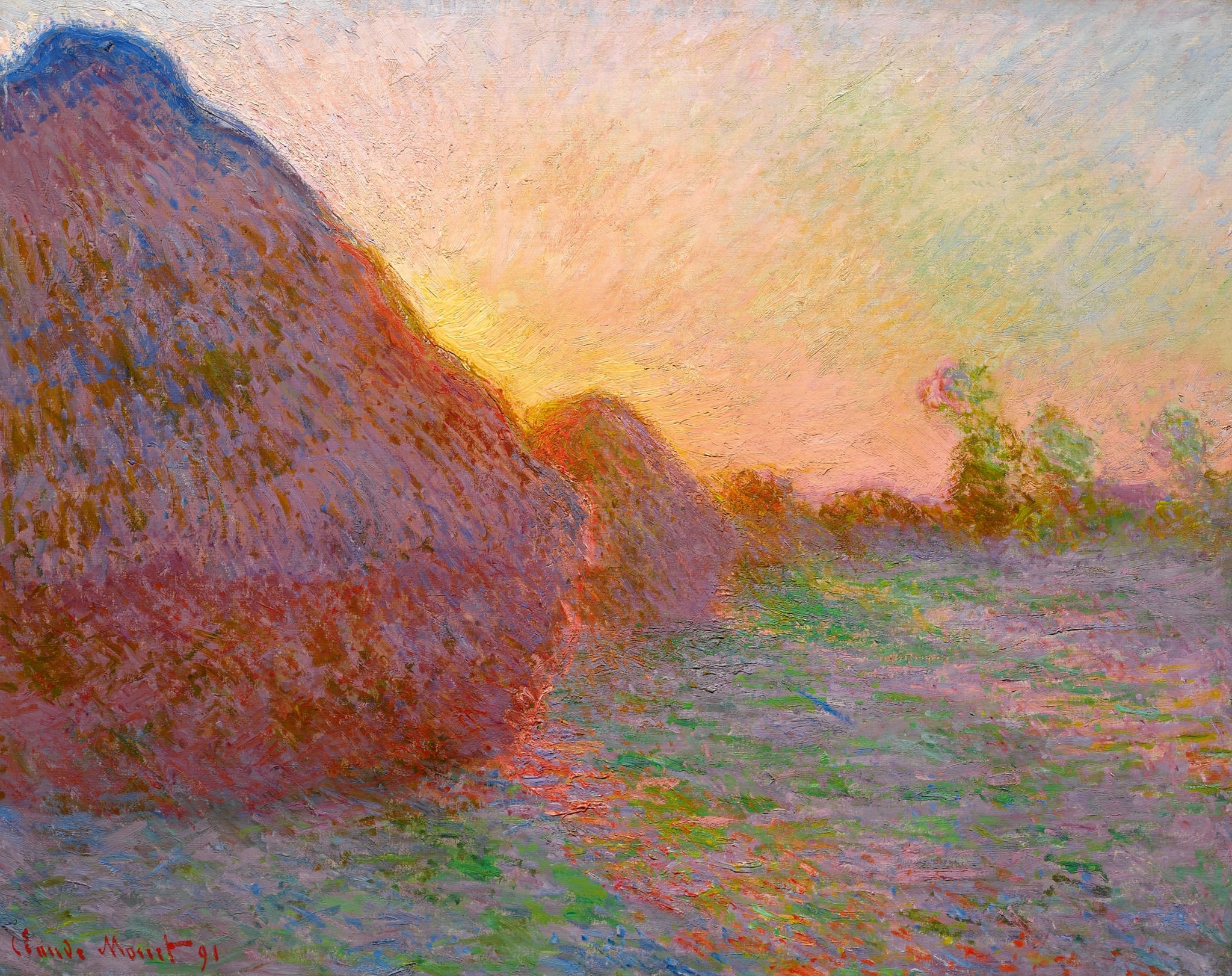
Claude Monet’s <strong>Haystacks Series</strong> transforms a routine rural subject into an inquiry into <strong>light, time, and perception</strong>. In this sunset view, the stacks swell at the left while the sun burns through the gap, making the field shimmer with <strong>apricot, lilac, and blue</strong> vibrations.
Women in the Garden by Claude Monet

Women in the Garden

Claude Monet (1866–1867)

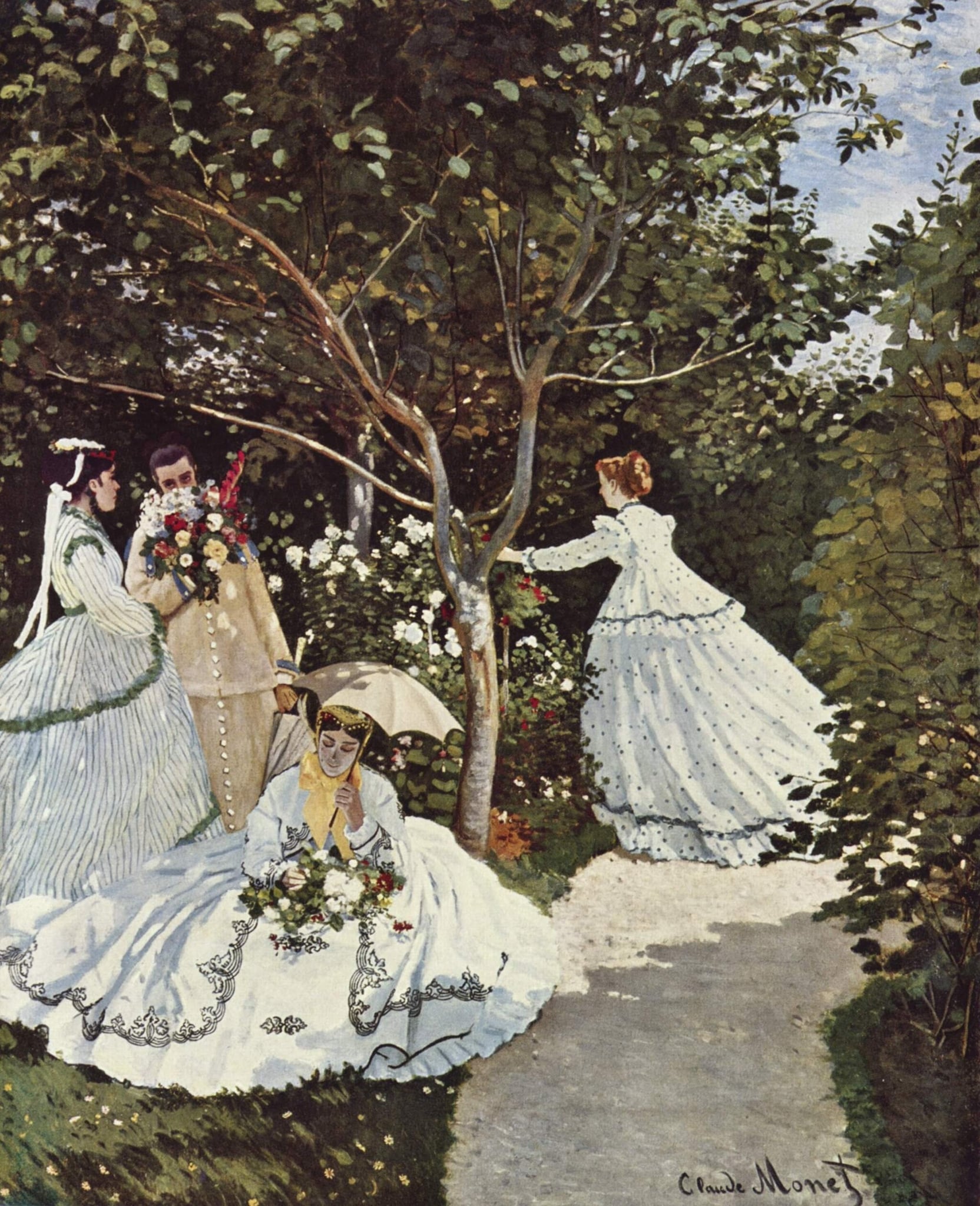
Claude Monet’s Women in the Garden choreographs four figures in a sunlit bower to test how <strong>white dresses</strong> register <strong>dappled light</strong> and shadow. The path, parasol, and clipped flowers frame a modern ritual of leisure while turning fashion into an instrument of <strong>perception</strong>. The scene reads less as portraiture than as a manifesto for painting the <strong>momentary</strong> outdoors <sup>[1]</sup><sup>[3]</sup>.
Impression, Sunrise by Claude Monet

Impression, Sunrise

Claude Monet (1872)

In Impression, Sunrise, Claude Monet turns Le Havre’s fog-bound harbor into an experiment in <strong>immediacy</strong> and <strong>modernity</strong>. Cool blue-greens dissolve cranes, masts, and smoke, while a small skiff cuts the water beneath a blazing, <strong>equiluminant</strong> orange sun whose vertical reflection stitches the scene together <sup>[1]</sup><sup>[3]</sup>. The effect is a poised dawn where industry meets nature, a quiet <strong>awakening</strong> rendered through light rather than line.