How Much Is The Train in the Snow (The Locomotive) Worth?
Last updated: February 26, 2026
Quick Facts
- Insurance Value
- $68.0M (Analyst estimate (replacement value))
- Current Location
- Musée Marmottan Monet
- Methodology
- comparable analysis
Hypothetical fair‑market auction value for Claude Monet’s The Train in the Snow (The Locomotive) (1875) is $40–60 million. The range is supported by closely related 1870s train and snow comparables (Saint‑Lazare canvases around $33m in 2018; Argenteuil railway bridge at $41.5m in 2008) and by recent prime Monet benchmarks in the $35–45m band. As the work is in the Musée Marmottan Monet, this valuation is hypothetical.
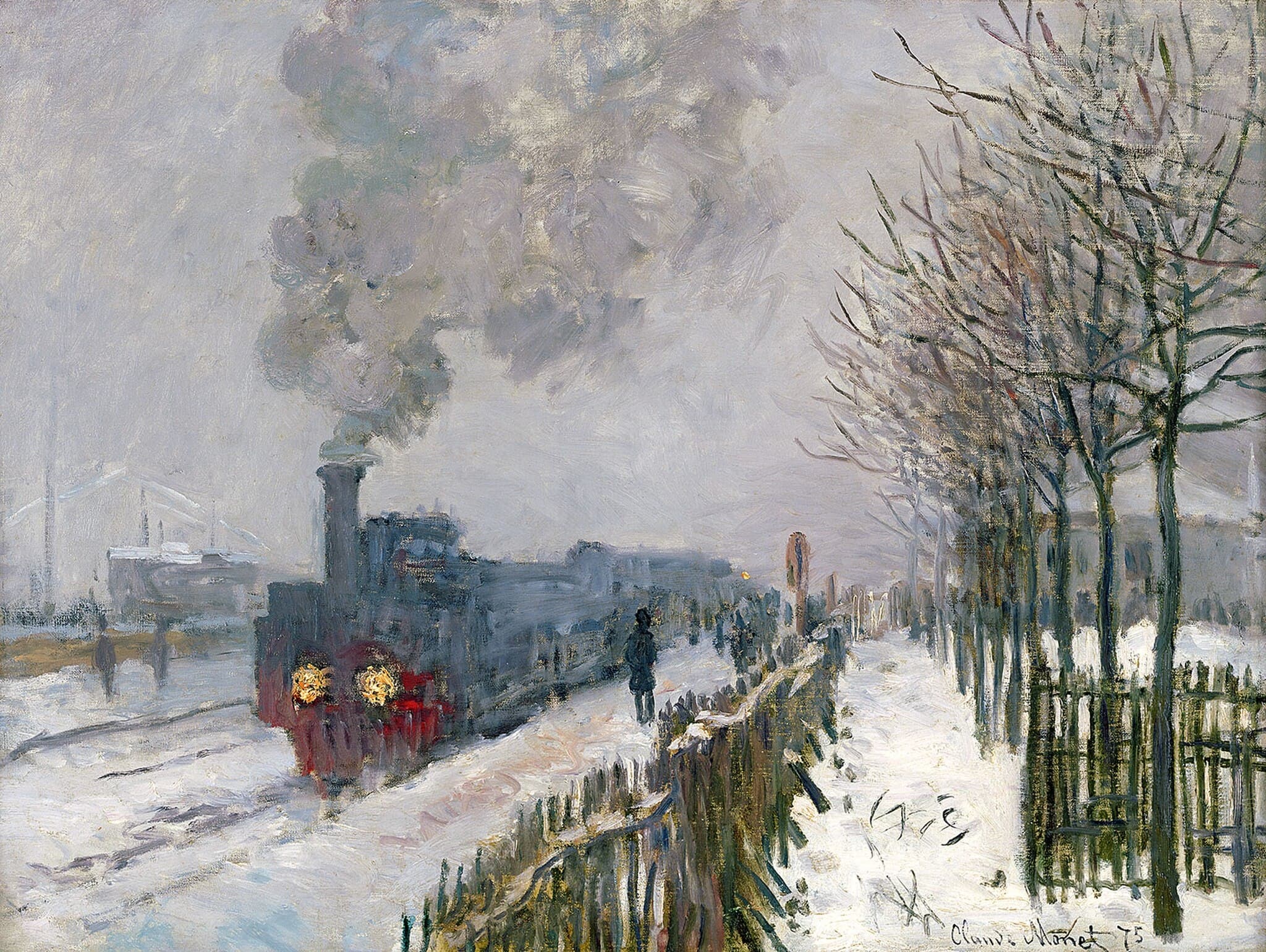
The Train in the Snow (The Locomotive)
Claude Monet, 1875 • Oil on canvas
Read full analysis of The Train in the Snow (The Locomotive) →Valuation Analysis
Work and ownership. Claude Monet’s The Train in the Snow (The Locomotive), 1875, oil on canvas, 59 × 78 cm, signed and dated, belongs to the Musée Marmottan Monet, Paris (inv. 4017). The museum records document a 1940 gift from Eugène and Victorine Donop de Monchy, with prior ownership by Dr. Georges de Bellio by 1876. There is no evidence of a modern-era public auction; earlier transfers appear private. This makes any pricing exercise hypothetical, framed as fair‑market value (FMV) for a theoretical deaccession or insurance benchmarking [1].
Comparables and subject fit. The tightest market anchors are Monet’s 1877 Gare Saint‑Lazare train subjects of similar scale, which realized $32.94m (Christie’s, Rockefeller, May 2018) and ~$32.83m (Christie’s London, June 2018). Adjusted for current conditions, these imply low‑$40m levels today. Train in the Snow, painted in 1875 during the coveted Argenteuil period, fuses a winter effet de neige with a locomotive—an historically resonant “modern life” motif that foreshadows the Saint‑Lazare series. On subject, date, and scale, it should command pricing in line with, or at a premium to, the 2018 Saint‑Lazare benchmarks, all else equal [2][3].
Upper and lower anchors. A key upside precedent is Le Pont du chemin de fer à Argenteuil (1873), another early modern‑life/railway icon, which made $41.48m in 2008; inflation‑adjusted, that suggests potential in the high‑$50m to low‑$60m band for a top setup. Conversely, a prime Argenteuil‑period snow landscape without the train, La Mare, effet de neige (1874–75), carried a $18–25m estimate and reportedly sold near the top of the range in May 2022—helpful as a floor for quality winter subjects. Recent blue‑chip but non‑apex Monet benchmarks, including Peupliers au bord de l’Epte, crépuscule at $42.96m (2025) and Waterloo Bridge, effet de brume at ~US$36.7m (2022), reinforce a mid‑eight‑figure equilibrium for first‑rate works outside the brand‑defining apex series [4][5][6][7].
Market context and conclusion. Monet’s record remains $110.7m for Meules (2019), while late 2023–2024 saw top Nymphéas between ~$65m and $74m—evidence of durable, selective demand for trophies. Against that backdrop, Train in the Snow is an important, museum‑quality 1870s canvas—arguably mid‑to‑upper tier—but a notch below the most iconic series. On a evidence‑weighted basis, a hypothetical FMV of $40–60 million is appropriate. For insurance/replacement, where scarcity and non‑fungibility are emphasized, an indicative figure of roughly $68 million is supportable, subject to current condition, surface quality, and any loan/display constraints [8][9].
Key Valuation Factors
Art Historical Significance
High ImpactPainted in 1875 at Argenteuil, this canvas captures two highly prized aspects of Monet’s oeuvre: the poetic effects of snow and the emblematic modernity of the locomotive. As a precursor to the celebrated 1877 Gare Saint-Lazare series, it bridges Monet’s interest in contemporary life with his atmospheric investigation of light and weather. The subject is historically resonant, anticipating key themes of industrialization and perception that define Impressionism’s break with tradition. Its date, period, and subject align with the middle-to-upper tier of Monet’s production, elevating it above many later or repetitive works. The painting’s museum ownership and well-documented early provenance further underscore its scholarly and cultural significance.
Rarity and Subject Desirability
High ImpactSnow scenes from the mid-1870s are actively sought after, and the addition of a locomotive—a motif central to Monet’s modern-life vocabulary—is comparatively scarce. This dual appeal attracts both traditional Impressionist collectors (for the winter light and atmosphere) and connoisseurs of industrial modernity, expanding the competitive buyer pool. Direct comparables in the 1870s train category (Saint-Lazare) have proven resilient around the low–mid eight figures, while snow-only Argenteuil works transact meaningfully lower. By combining snow and train, this canvas likely commands a premium to pure winter landscapes and sits logically alongside the Saint-Lazare works, strengthening its market position relative to more generic landscapes of the decade.
Scale, Quality, and Condition
Medium ImpactAt roughly 59 × 78 cm, the work falls within Monet’s highly liquid, wall-friendly format frequently seen in evening sales. Market sensitivity to surface condition, varnish, lining, and retouching is acute in the current climate; excellent, original surfaces can add millions to outcomes, while visible condition issues may depress bidding. While the Musée Marmottan’s stewardship suggests appropriate care, the absence of a recent, public condition report introduces some uncertainty. In a sale scenario, a pristine condition report, strong color saturation, and fresh presentation could push the work toward the top of the range; any structural compromises or uneven restoration would argue for the mid-to-low end.
Provenance and Institutional Standing
Medium_high ImpactEarly ownership by Dr. Georges de Bellio—a noted supporter of the Impressionists—confers distinguished provenance. The 1940 gift to the Musée Marmottan Monet and continuous museum ownership for over eight decades add scholarly pedigree and exhibition credibility. These factors enhance desirability and reduce transactional risk. However, institutional ownership also signals that the picture is not a natural market candidate; any valuation is therefore hypothetical. If deaccessioned with standard due diligence, the prestigious chain of title and museum literature/exhibition history would be powerful marketing assets. Absent such a scenario, these factors primarily inform insurance and comparative analyses rather than immediate liquidity.
Sale History
The Train in the Snow (The Locomotive) has never been sold at public auction. It has been held by Musée Marmottan Monet.
Claude Monet's Market
Claude Monet remains the most liquid and globally recognized name in Impressionism, with an enduring base of U.S., European, and Asian buyers. His auction record stands at $110.7 million for Meules (2019), and late, large-format Water Lilies and other apex series reliably command $45–75 million when quality and freshness are exceptional. Pricing is highly subject-driven: brand-defining series (Haystacks, Water Lilies, Rouen Cathedral, Parliament, Poplars, and top Gare Saint-Lazare) enjoy deep competition, while strong but non-apex works trade in the mid–high eight figures. Guarantees are common at the top end, stabilizing outcomes but capping upside unless supply is extraordinary. Overall, Monet’s market remains a benchmark of blue-chip stability and selectivity.
Current Market Trends
After supply-driven contraction in 2023–2024, late‑2025 marquee auctions indicated a selective rebound, with strength concentrated at the top end and for works with best-in-class quality, provenance, and scale. Blue-chip historical material remains favored, though buyers are highly discriminating and condition-sensitive, and guarantees continue to shape pricing dynamics. Within this context, prime Monets outside the absolute apex series have clustered in the mid‑eight figures, while true trophies sustain $60m–$100m+ potential. Monet’s 2026 centenary and continued institutional programming support visibility, but results will remain dependent on quality, freshness, and how well a sale is staged (venue, estimate discipline, and guarantee structure).
Study print
Study this painting as a print
Pair the full artwork with a museum-style study sheet focused on one meaningful detail.
Sources
- Musée Marmottan Monet — Object record: Le Train dans la neige. La locomotive (1875)
- Christie’s (Rockefeller) results summary via The Art Wolf — May 8, 2018
- Hyperallergic — London sale report including Monet’s Gare Saint-Lazare result (June 20, 2018)
- CBS News — Monet painting sells for $41.4 million (Le Pont du chemin de fer à Argenteuil), 2008
- Christie’s Press — Monet’s La Mare, effet de neige to lead sale (estimate $18–25m), May 2022
- Christie’s — ‘Walk the auction’ (May 2025) with Poplars result $42.96m
- Christie’s — Monet in London (Waterloo Bridge) sale context (June 28, 2022)
- Sotheby’s — Monet’s Meules sells for $110.7m (artist record), May 14, 2019
- The Art Newspaper — Sotheby’s New York 2024: Monet Nymphéas sells for $65.5m