How Much Is Boat Lying at Low Tide Worth?
Last updated: May 19, 2026
Quick Facts
- Insurance Value
- $19.0M (Assistant estimate (comparable-analysis cushion above fair market value))
- Methodology
- comparable analysis
Boat Lying at Low Tide (1881) is a mature-period Monet seascape of solid mid-scale (82 x 60 cm), fully catalogued (Wildenstein 644) and extensively exhibited from top institutions. Based on tightly matched early‑1880s comparables and Monet’s current market depth, a fair auction range today is $12–16 million, with an insurance/replacement value of $19 million.
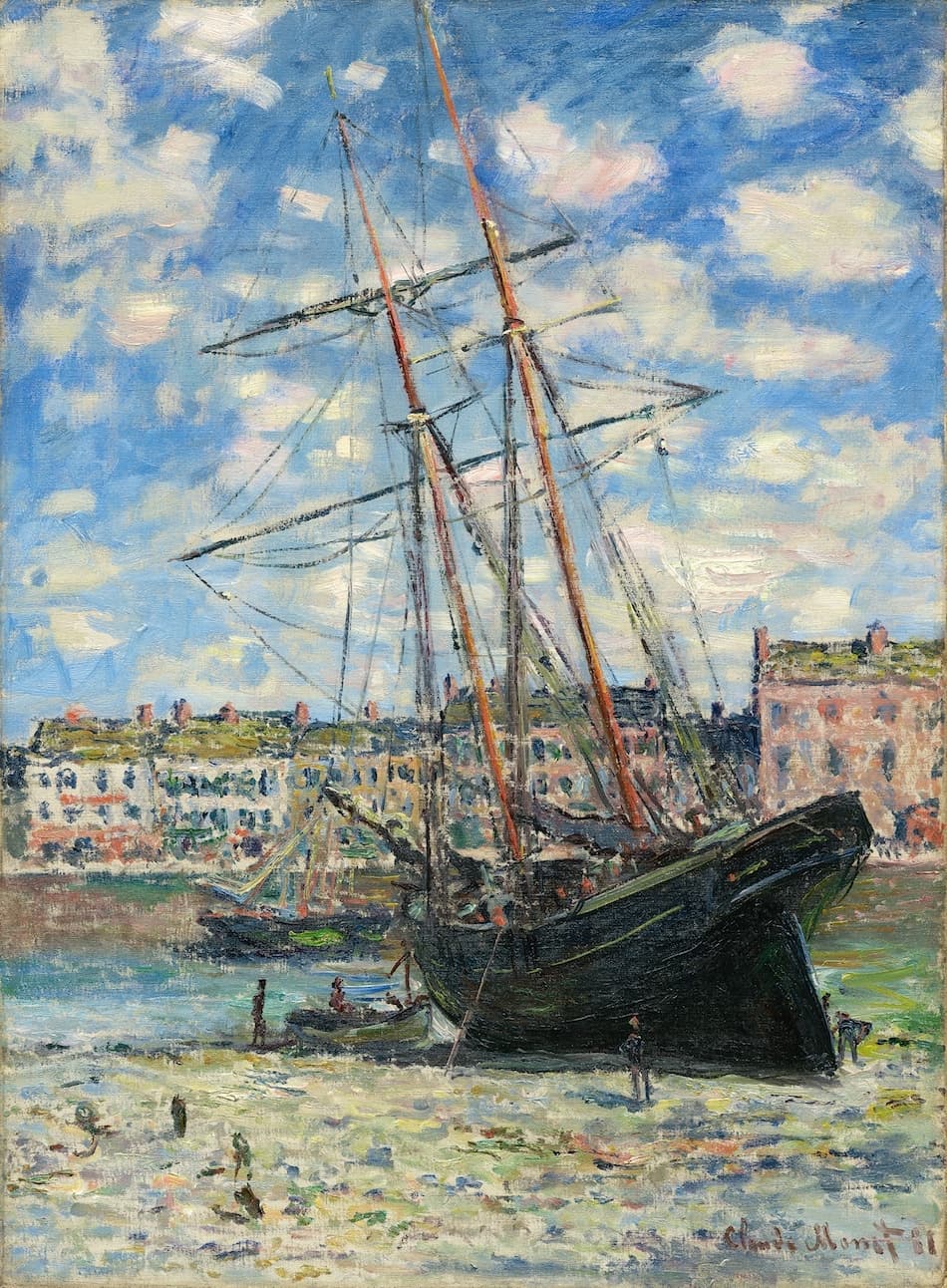
Boat Lying at Low Tide
Claude Monet, 1881 • Oil on canvas
Read full analysis of Boat Lying at Low Tide →Valuation Analysis
Work identification and standing. Boat Lying at Low Tide (1881, oil on canvas, 82 x 60 cm) is held by the Tokyo Fuji Art Museum and is fully documented in the Wildenstein catalogue raisonné (no. 644). Scholarship pairs it with the Art Institute of Chicago’s 1881 Fécamp low‑tide canvas, underlining its place within Monet’s Normandy coastal investigations of the early 1880s and reinforcing its art‑historical anchoring and literature presence [1][7].
Method and comparables. The estimate is derived from recent sales of non‑series but mature, high‑quality Monets around 1880–1905. In April 2026, Sotheby’s Paris set a French‑market record for Monet with Vétheuil, effet du matin (1901) at €10.2m (≈$12m), while the same sale included the early‑1880s Les Îles de Port‑Villez (1883) at €6.45m (≈$7.6m). These two results bracket pricing for attractive, non‑trophy Monets of comparable maturity and format and confirm that mid‑scale, well‑presented works sit solidly in the single‑ to low‑eight‑figure range [6]. Given TFAM’s painting’s scale, its robust provenance/exhibition record, and its clear literature trail, a low‑to‑mid‑teens outcome in a marquee Evening sale is appropriate.
Positioning versus hallmark series. Monet’s most coveted series command materially higher levels: Poplars from 1891 fetched $30.78m at Sotheby’s New York in 2023 [5], while late Nymphéas and London Parliament works continue to achieve $70m‑plus (e.g., Water Lilies at $74.01m in 2023; Parliament at $75.96m in 2022) [3][4]. The artist’s standing remains underpinned by the $110.7m record for Meules (Haystacks) set in 2019 [2]. Against that hierarchy, a finely pitched Normandy low‑tide subject should value well below series trophies, but above “day‑sale” coastal views, aligning with $12–16m for Boat Lying at Low Tide.
Conclusion and key assumptions. On today’s market, Boat Lying at Low Tide would command $12–16 million at auction, reflecting its mature date, desirable mid‑scale, strong literature (Wildenstein 644), and extensive exhibition history with museum stewardship [1]. Replacement/insurance is set at $19 million to reflect typical institutional cushions above fair market value. This valuation presumes sound, sympathetic condition and marketing in a premier venue with full cataloguing; any material condition impairment or suboptimal sale context would be expected to adjust pricing downward, while pristine condition and competitive guarantees could push the result to the top of the range [2][3][5][6].
Key Valuation Factors
Art Historical Significance
High ImpactPainted in 1881, this canvas belongs to Monet’s mature Impressionist period, when his Normandy campaigns produced some of his most rigorous investigations of light, atmosphere, and maritime life. The low‑tide subject with a beached vessel is a recognized motif within the Fécamp body of work and is explicitly paired in scholarship with the Art Institute of Chicago’s related 1881 composition, underscoring its role in a focused sequence rather than as an isolated image. Its registration in the Wildenstein catalogue raisonné (no. 644) and subsequent scholarly citations consolidate its status. While not a canonical series like Haystacks or Water Lilies, it is a well‑defined, mature seascape that carries clear art‑historical relevance within Monet’s Normandy output.
Provenance, Exhibition & Literature
High ImpactThe Tokyo Fuji Art Museum’s stewardship, the painting’s Wildenstein catalogue entry, and an exhibition history spanning major venues materially strengthen market confidence. Its dealer and private‑collection chain, including Durand‑Ruel and established U.S./European ownerships before entering a museum collection, is consistent with high‑quality Monets. Deep literature and frequent exhibition lend visibility and authenticity support, often translating into superior saleroom performance. In a category where fresh, well‑documented works attract premium bidding, this canvas’s provenance and track record would be a decisive positive, positioning it in the upper tier of non‑series, early‑1880s Monets.
Subject, Scale, and Aesthetics
Medium ImpactAt 82 x 60 cm, the work has an attractive, display‑friendly mid‑scale. The single boat at low tide is a respected but mid‑tier Monet subject: less prized than Poplars, Rouen Cathedral, Meules, or late Nymphéas, yet far more desirable than small, sketch‑like coastal studies. Value will be led by coloristic strength, atmospheric effect, and finish—traits that carry a premium in Monet’s market. Within the early‑1880s coastal corpus, this composition’s clarity and completeness, combined with the mid‑scale, place it above day‑sale material and into the Evening‑sale band where outcomes in the low‑to‑mid teens are well supported by recent comparables.
Condition & Conservation
Medium ImpactCondition is a key price governor in Monet’s market. Sound, sympathetically conserved surfaces with minimal retouching support strong competition, whereas aggressive cleanings, extensive overpaint, or structural issues (e.g., heavy lining or cupping) can quickly compress value. Museum stewardship typically correlates with careful care, but buyers still demand current technicals (UV, raking light, conservation notes). The present valuation assumes solid condition commensurate with institutional standards; confirmation of an excellent state of preservation would justify the top of the range, while any notable restoration would temper expectations toward the lower end.
Sale History
Boat Lying at Low Tide has never been sold at public auction.
Claude Monet's Market
Claude Monet remains among the most liquid and globally coveted blue‑chip artists. His auction record stands at $110.7 million for Meules (Haystacks) at Sotheby’s New York in 2019, and major works in hallmark series continue to command $70 million–plus, including a Water Lilies at $74.01 million in 2023 and a London Parliament view at $75.96 million in 2022. Strong, fresh‑to‑market series paintings regularly achieve $30–50 million, as evidenced by Poplars at $30.78 million in 2023. This depth of demand anchors pricing for non‑series but mature works, which can range from the high single‑digits into the low‑to‑mid teens depending on subject, scale, condition, and exhibition/literature strength. Collectors prize clear provenance and museum‑level presentation in this segment. [2][3][4][5]
Comparable Sales
Soleil couchant, temps brumeux, Pourville
Claude Monet
Directly comparable Normandy coastal subject (1882), same mature period and seascape focus; a strong market datapoint for non‑series coastal views near Fécamp/Pourville.
$5.1M
2022, Christie's New York (Day Sale)
~$5.7M adjusted
Les Îles de Port‑Villez
Claude Monet
Same artist and near‑neighbor period (1883). While a Seine view rather than the Channel coast, it is an early‑1880s landscape of comparable maturity and market tier.
$7.6M
2026, Sotheby's Paris
~$7.4M adjusted
Vétheuil, effet du matin
Claude Monet
Blue‑chip Monet landscape (1901) that anchors pricing for non‑series but highly desirable subjects; useful to bracket upper‑mid pricing versus 1881 coastal works.
$12.0M
2026, Sotheby's Paris
~$11.8M adjusted
Le Parc Monceau
Claude Monet
Late‑1870s mature Monet of similar market tier (non‑series, mid‑scale, strong name recognition). While not coastal, it benchmarks pricing for attractive, non‑trophy Monets.
$9.0M
2026, Christie's London
~$8.8M adjusted
Peupliers au bord de l’Epte, temps couvert
Claude Monet
Major Monet series (Poplars, 1891). Not subject‑matched, but provides an upper anchor for highly coveted series works versus single Normandy coastal views.
$30.8M
2023, Sotheby's New York
~$32.6M adjusted
Current Market Trends
The Impressionist/Post‑Impressionist market has recalibrated since 2024 yet remains a relative safe haven versus more volatile segments, with blue‑chip masters like Monet continuing to attract deep bidding. Recent marquee seasons show a two‑speed dynamic: masterpiece‑grade, well‑documented works are highly competitive, while secondary examples face more scrutiny. Monet’s segment benefits from ongoing institutional programming and the 2026 centenary spotlight, which sustain visibility and buyer confidence. Within this context, mid‑scale, mature‑period Monets with strong literature and exhibition histories are transacting in the low‑eight‑figure band, with outcomes driven by condition, venue, and guarantee structures.
Study print
Study this painting as a print
Pair the full artwork with a museum-style study sheet focused on one meaningful detail.
Sources
- Tokyo Fuji Art Museum – Boat Lying at Low Tide (Wildenstein 644)
- Sotheby’s – Monet’s Meules achieves $110.7m (artist record), May 14, 2019
- Christie’s – 20th Century Evening Sale Results, Nov 9, 2023 (Water Lilies $74,010,000)
- Christie’s – Spring Marquee Week Results, May 12, 2022 (Parliament $75,960,000)
- Sotheby’s – New York Sales, November 2023 Results (Poplars $30,783,000)
- Le Figaro – Un tableau de Claude Monet vendu 10,2 M€ en France (Sotheby’s Paris, Apr 16, 2026)
- Art Institute of Chicago – Online Monet catalogue: Fécamp low‑tide pairing