How Much Is Seashore and Cliffs of Pourville in the Morning Worth?
Last updated: May 19, 2026
Quick Facts
- Insurance Value
- $24.0M (Assistant estimate based on comparable sales and replacement-cost buffer)
- Methodology
- comparable analysis
Hypothetical fair‑market value for Monet’s Seashore and Cliffs of Pourville in the Morning (1882) is $12–20 million. The range is anchored by directly comparable 1882 Pourville canvases at $5.1m (2022) and $8.23m (2014), plus stronger 1880s coastal benchmarks up to ~$14m in 2024, adjusted for this work’s scale, subject, provenance, and extensive exhibition history.
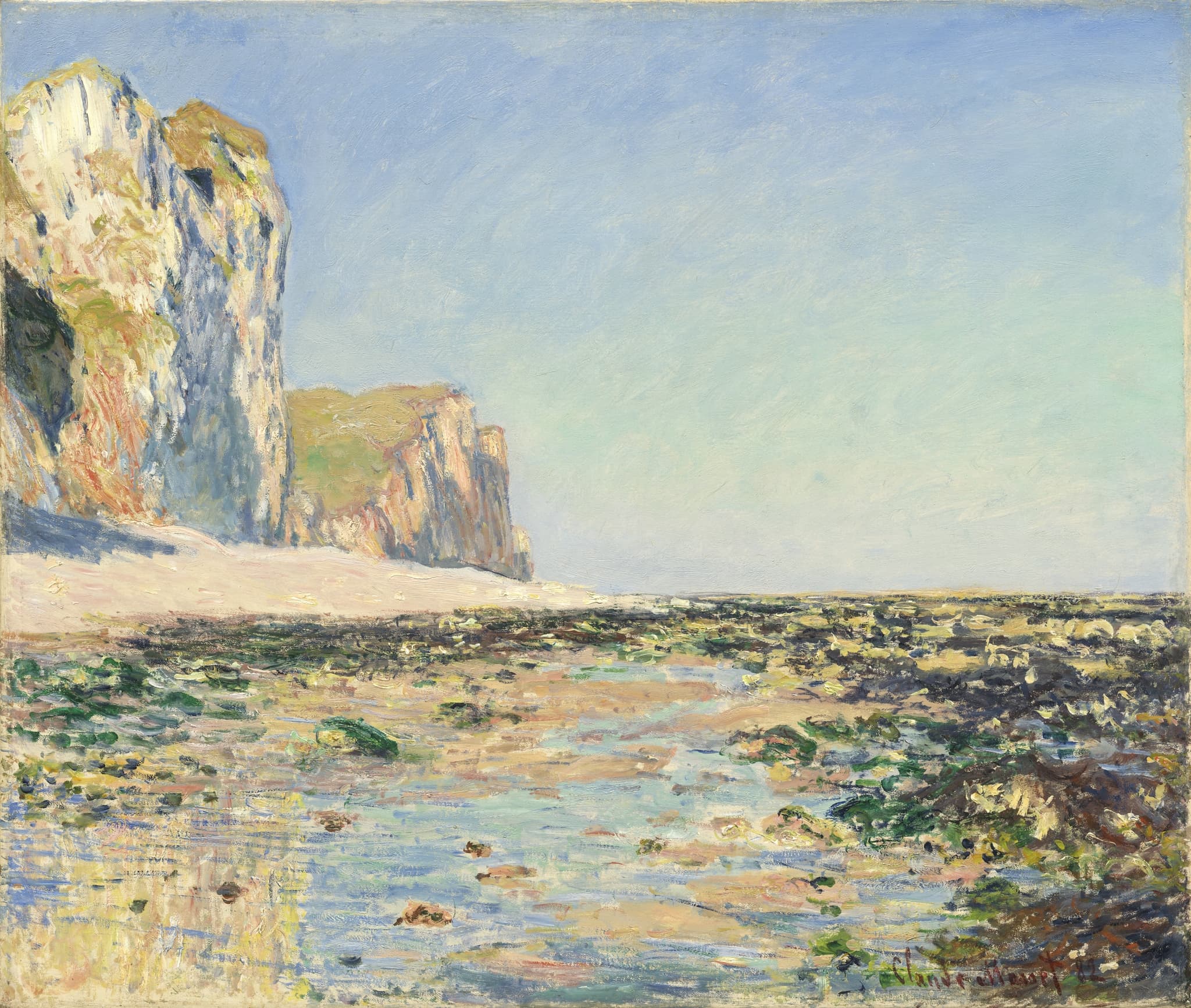
Seashore and Cliffs of Pourville in the Morning
Claude Monet, 1882 • Oil on canvas
Read full analysis of Seashore and Cliffs of Pourville in the Morning →Valuation Analysis
Work identified: Claude Monet, Seashore and Cliffs of Pourville in the Morning, 1882, oil on canvas, 59 × 71 cm (Wildenstein no. W787). The painting is in the Tokyo Fuji Art Museum (TFAM), with a robust provenance (including Durand‑Ruel and Arthur Tooth & Sons) and a strong exhibition record. It is museum‑held and not on the market; the following estimate is a hypothetical fair‑market value based on current comps and Monet demand [1].
Comparable sales and price logic: Two closely related 1882 Pourville works anchor the low and mid bands of value: Sur la falaise à Pourville sold for $8.23m at Sotheby’s New York (2014) [4], and Soleil couchant, temps brumeux, Pourville achieved $5.1m in a Christie’s New York Day Sale (2022) [3]. Broader late‑1880s coastal benchmarks—such as Antibes vue de la Salis (1888) at $14.1m (Sotheby’s, 2024)—demonstrate what vibrant, mid‑size seascapes by Monet can command when color and composition sing in a marquee context [5]. Together, these comparables support a low‑to‑mid‑teens valuation for a well‑composed 1882 Pourville canvas of this size and quality.
Position within Monet’s market: Monet is an ultra‑blue‑chip name with a deep, global collector base; the artist’s auction record is $110.7m for Meules (Haystacks) set at Sotheby’s in 2019 [2]. The market consistently pays a premium for series‑defining icons (Water Lilies, Grainstacks, Rouen Cathedrals, Poplars, Parliament), while strong but non‑serial coastal works from the early 1880s trade in a lower—yet still substantial—band. This Pourville picture is a respected, early‑mature subject with broad appeal, but it is not one of Monet’s brand‑defining series; accordingly, its pricing should sit materially below the $40–75m realm seen for the top tier.
Work‑specific positives/considerations: The painting’s 59 × 71 cm format is a desirable mid size; the morning light effect, luminous atmosphere, and Normandy cliffline motif are highly collectible. The provenance (Durand‑Ruel; Tooth; Hon. Hanning Philipps) and extensive exhibition history add confidence and liquidity, and TFAM’s documentation (including the W‑number) strengthens marketability [1]. As a museum‑held work, transactional scarcity may confer pricing power in a hypothetical sale, though condition, surface quality, and presentation would be scrutinized closely.
Conclusion: Considering direct 1882 Pourville comps ($5.1m–$8.23m), stronger late‑1880s coastal results (~$14.1m), and the subject/scale/provenance strengths of this canvas, a fair‑market range of $12–20 million is appropriate today. At the upper end, prime condition, fresh access to market, and marquee evening placement could be catalysts. For insurance, an agreed value of about $24 million is warranted to reflect replacement risk, fees, and scarcity.
Key Valuation Factors
Art Historical Significance
High ImpactPainted in 1882 during Monet’s Pourville campaign on the Normandy coast, this canvas belongs to the artist’s early‑mature period, when he refined his investigation of light, atmosphere, and coastal geology. The Pourville group is a cohesive, sought‑after body of work with strong institutional resonance; key examples reside in major museums and appear regularly in scholarly literature and exhibitions. This painting’s morning‑light effect and framing of cliffs and shore exemplify the lyrical, observational qualities prized in Monet’s 1880s seascapes. Its inclusion in the Wildenstein catalogue raisonné (W787) and its documented museum exhibitions further underpin its art‑historical weight and enhance its desirability to connoisseur buyers and institutions.
Subject and Composition Quality
Medium ImpactNormandy cliff and seascape motifs are broadly appealing, recognizable, and quintessentially Monet—yet they are priced below the market’s apex series. Within the Pourville subset, works with clear focal rhythms (cliff profiles, surf movement), luminous color, and a balanced horizon perform best. This composition’s morning effect, coastal light, and mid‑distance vantage align well with successful comparables. However, it does not belong to Monet’s brand‑defining serial subjects (Haystacks, Rouen, Nymphéas, Poplars, Parliament), which limits its ceiling relative to the marquee tier. The result is strong mid‑tier positioning with wide bidder appeal and solid liquidity.
Provenance and Exhibition History
High ImpactA provenance chain including Durand‑Ruel (Monet’s principal dealer), Arthur Tooth & Sons (a key London dealer), and the Hon. Hanning Philipps provides excellent market pedigree. The Tokyo Fuji Art Museum’s stewardship and the picture’s extensive exhibition record across Europe, the US, and Japan deliver third‑party validation, literature presence, and visibility—factors that meaningfully de‑risk a transaction and can add premium at auction or in private sales. Museum‑held status also implies stricter curatorial standards and documentation. In a hypothetical release, this history would strengthen buyer confidence, support aggressive evening‑sale placement, and justify pricing toward the upper half of the range, assuming strong condition.
Market Liquidity and Comparables
Medium ImpactDirectly comparable 1882 Pourville canvases have realized $5.1m (Christie’s Day Sale, 2022) and $8.23m (Sotheby’s Evening Sale, 2014), while a vibrant late‑1880s coastal work reached ~$14.1m in 2024, indicating a realistic corridor for high‑quality mid‑size seascapes by Monet. The artist’s overall market is deep and global, with exceptional demand for top series. Against that backdrop, a Pourville morning seascape with solid scale, pedigree, and exhibition history should clear into the low‑to‑mid teens under normal conditions, with upside toward $20m if presentation, condition, and sale context are optimized.
Sale History
Seashore and Cliffs of Pourville in the Morning has never been sold at public auction.
Claude Monet's Market
Claude Monet is a cornerstone of the global blue‑chip market. His all‑time auction record stands at $110.7 million for Meules (Haystacks) achieved at Sotheby’s in 2019. Demand is deepest for his brand‑defining series—Water Lilies, Grainstacks, Rouen Cathedrals, Poplars, and Parliament—which regularly command multi‑tens of millions in premier New York evening sales. Outside these apex series, strong landscapes and seascapes from the 1880s–1890s remain highly liquid, typically trading from the high single digits to the mid‑teens (and higher when color, scale, provenance, and condition excel). Robust global bidding, including significant participation from US and Asian collectors, supports consistent absorption of high‑quality works.
Comparable Sales
Sur la falaise à Pourville
Claude Monet
Same artist; same 1882 Pourville cliffs campaign; mid-size oil seascape from the exact period and subject family.
$8.2M
2014, Sotheby's New York
~$11.2M adjusted
Soleil couchant, temps brumeux, Pourville
Claude Monet
Same artist; same site (Pourville) and year (1882); closely related coastal motif; useful direct comp even though offered in a Day Sale.
$5.1M
2022, Christie's New York
~$5.6M adjusted
Antibes vue de la Salis
Claude Monet
Same artist; coastal Mediterranean landscape from the late 1880s; strong coloristic appeal and similar mid-size oil format—good benchmark for 1880s seascapes.
$14.1M
2024, Sotheby's New York
~$14.5M adjusted
Route près de Giverny
Claude Monet
Same artist; mid‑1880s landscape in a comparable scale; while inland rather than coastal, it serves as a market check for high‑quality 1880s Monets outside the top serial series.
$9.0M
2024, Christie's New York
~$9.3M adjusted
Les Îles de Port‑Villez
Claude Monet
Same artist; very close in date (1883) and scale; river landscape from the same early‑mature period—helps bracket pricing for strong but non‑serial 1880s Monets.
$7.0M
2026, Sotheby's Paris
~$6.9M adjusted
Current Market Trends
Impressionist and Post‑Impressionist works have benefited from a flight to quality, with seasoned collectors favoring time‑tested names over speculative ultra‑contemporary. Monet sits at the center of this demand, with trophy‑level series drawing persistent competition and well‑composed 1880s coastal or landscape pictures achieving solid, if tiered, pricing. Guarantees and irrevocable bids remain prevalent in marquee sales, helping place top material while keeping estimates disciplined. In this environment, non‑serial but compelling Monets in good condition are clearing in the low‑to‑mid eight figures, with upside driven by freshness to market, notable provenance, and strong color/light dynamics.
Study print
Study this painting as a print
Pair the full artwork with a museum-style study sheet focused on one meaningful detail.
Sources
- Tokyo Fuji Art Museum – Collection entry for Seashore and Cliffs of Pourville in the Morning (1882)
- Sotheby’s – Monet’s Meules sells for $110.7m (artist record), May 14, 2019
- Christie’s – Spring Marquee Week 2022 results (includes $5.1m Pourville work)
- Artdaily – Sotheby’s Impressionist & Modern Evening Sale achieves $219m; includes Monet Pourville at $8.23m (2014)
- The Art Newspaper – Sotheby’s Modern Evening Sale (May 16, 2024) highlights; Monet results including Antibes ($14.1m) and Meules à Giverny ($34.8m)