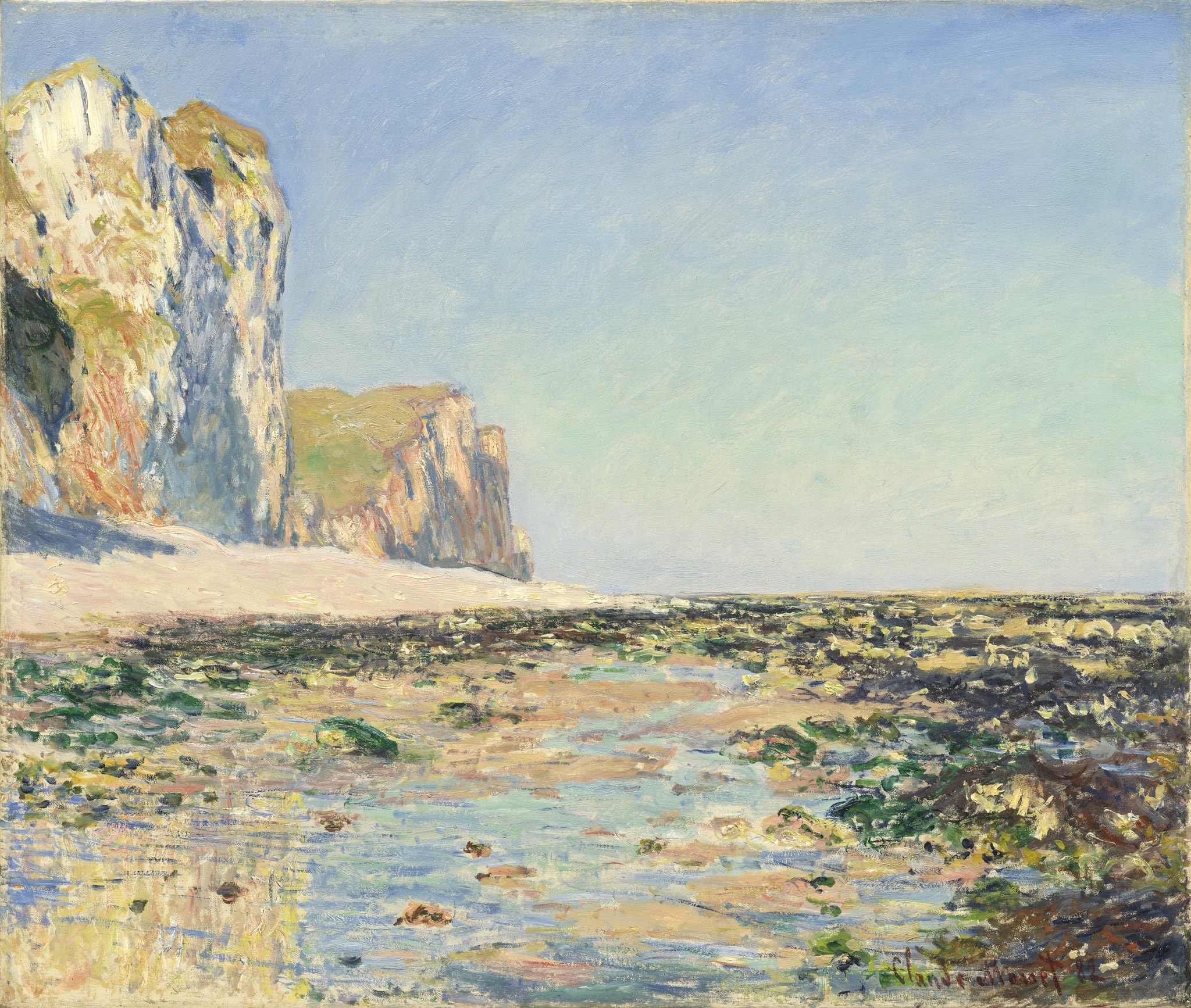
Seashore and Cliffs of Pourville in the Morning

by Claude Monet

Claude Monet’s Seashore and Cliffs of Pourville in the Morning renders Normandy’s coast as a theater for ephemeral light and geologic permanence. A vast, pale sky and mirror-like tide pools counterbalance the chalk cliffs at left, turning a quiet morning into a statement about time and renewal.

Study Print Studio

Create a personal study print

Build a companion study sheet around the part of this painting that speaks to you most. Choose a detail, shape an interpretation, and walk away with something personal and display-worthy.

Fast Facts

Year
1882
Medium
Oil on canvas
Dimensions
59.0 × 71.0 cm
Location
Tokyo Fuji Art Museum, Hachiōji (Tokyo)
See all Claude Monet paintings in Tokyo
Seashore and Cliffs of Pourville in the Morning by Claude Monet (1882) featuring Chalk Cliffs, Morning Sky, Tide Pools as Mirrors, Exposed Seaweed and Rock Ledges (Low Tide)

Click on any numbered symbol to learn more about its meaning

Meaning & Symbolism

Monet organizes the picture around a decisive asymmetry: the chalk cliffs stack vertically along the left edge while the right two-thirds open into a sky of pearly blue. That sky, not the cliff, governs the color system; it cools the entire canvas and repeats itself in the tide pools, where blue washes mingle with ochres, rose, and sea-green weed. The brushwork is quick and additive, laying down broken, lateral strokes that read as ripples and reflective skins. By placing the horizon low enough to grant the sky dominion and by letting the pools mirror its tonality, Monet asserts that what moves—the day’s light—is more pictorially consequential than what stands, the rock mass. This is not topography; it is a proposition about nature’s temporality, made legible through paint handling and composition 23. The cliffs themselves resist monumentality in a traditional sense. Though solid, their faces dissolve into lavender, rust, and chalky whites that shift with ambient glare; their cast shadow slips diagonally across the sand, a reminder that even stone submits to solar time. In contrast, the open right flank breathes—no boats, no promenaders—just the long, weedy ledges exposed by low tide and scattered stones catching highlights. That subtraction is purposeful. Monet’s Channel campaign trims the seaside of tourist anecdote to stage atmosphere as subject, converting the shore into a laboratory where tide marks, pools, and wind become the plot points 14. In this canvas, morning acts as a structural device: cool values, high clarity, and faint, transparent clouds produce a sensation of beginning—the coast as a daily reset. The painting’s meaning, then, is renewal achieved through the oscillation of permanence and flux; its argument is that vision itself is dynamic, contingent on hour and weather 34. This work also exemplifies the spatial experiments Monet pursued at Pourville in 1882. The slanted shoreline that races from lower left to mid-distance and the expansive blank of sky create a modern sense of breadth and immediacy, inviting the viewer to occupy the wet foreshore rather than a picturesque overlook. Such decisions belong to a serial logic: Monet tests horizons, vantage points, and meteorological states across multiple canvases to measure how motif behaves under changing conditions 2. Here, the repeated blue of sky and pools forms a visual cadence; the dark weed belts provide counterpoint; the cliff’s verticals punctuate the rhythm. The result is a landscape purified to its essentials—light, air, water, rock—through which Monet advances Impressionism’s claim that painting can register the present tense of seeing. That is why Seashore and Cliffs of Pourville in the Morning is important: it codifies a method that would lead directly to the great series of the 1890s and, ultimately, to the immersive late water lilies, all grounded in this coastal proof that time can be painted 235.

Explore Deeper with AI

Ask questions about Seashore and Cliffs of Pourville in the Morning

Popular questions:

Powered by AI • Get instant insights about this artwork

💬 Ask questions about this artwork!

Interpretations

Historical Context: Fieldwork on the Channel

Monet’s Pourville campaign was a season of embedded fieldwork: he lodged beside the surf—“the waves beat at the foot of the house”—and painted directly into shifting winds, tides, and glare, converting the coast into a working laboratory of change 5. The 1882 sojourn aligns with his broader Channel investigations bridging late‑Seine motifs and the coastal seriality of the early 1880s. This picture’s morning condition and low‑tide ledges are not anecdotal scenery but evidence-gathering of moments that recur yet never repeat, a logic he would later scale into his systematic series. Exhibition and sale through Durand‑Ruel (1899–1914) show how this observational rigor was also calibrated for the modern market, where repeat views of a motif could demonstrate range, method, and control over volatile nature 12.

Source: Cleveland Museum of Art; Tokyo Fuji Art Museum; Art Institute of Chicago

Seriality and the Problem of Time

Rather than produce a single definitive “view,” Monet treats Pourville as a set of variables—horizon, tide, wind, cloud—tested across multiple canvases. In this work, the repeated blues of sky and pools act as a temporal refrain, while weed-dark bars syncopate the rhythm, a serial strategy that externalizes time as pattern and interval 2. Robert L. Herbert locates this in Monet’s broader Channel practice: a move from subject stability to condition variability, where geology serves as a constant against which weather writes its permutations 3. The canvas thus operates as one data point in a time-based suite, anticipating the 1890s series by demonstrating how painterly iteration can model continuity and difference without narrative—a modern solution to picturing duration on a static support 23.

Source: Art Institute of Chicago; Robert L. Herbert

Spatial Modernity: Horizon Mechanics and Scale

The low-set horizon and sky-dominant field create an architecture of air, granting atmosphere compositional sovereignty. This is not a picturesque promontory but a foreshore vantage that immerses the viewer in wet, reflective ground—an embodied spatial tactic AIC identifies across Monet’s 1882 coastal works 2. The asymmetry (cliff compressed at left; aerated sweep at right) breaks classical balance to produce breadth and immediacy, what MoMA calls the modern drama of cliff against sea/sky 4. Monet’s horizon isn’t a boundary but a regulator: it meters value ranges, organizes chromatic cooling, and turns the sky into a light engine whose output repeats in the tide pools below. Space here is temporalized—the farther the gaze travels, the more it measures atmosphere rather than distance 24.

Source: Art Institute of Chicago; MoMA

Anti‑Anecdote Aesthetics and the Politics of Leisure

In a coast increasingly shaped by tourism, Monet’s strategic subtractions—no promenaders, signage, or resort bustle—constitute an aesthetic position. Herbert notes how the Channel pictures negotiate modern leisure by withholding its spectacle, purifying landscape to elemental processes 3. That choice reframes the beach from a social stage to an observational site, where low-tide weed belts and reflected sky serve as protagonists. The result resists the era’s postcard modernity: instead of picturesque amenities, we get a calibrated study of exposure and retreat, morning clarity and marine stain. This is a politics of looking as much as of leisure—Monet curates what counts as modern experience on the coast, shifting value from consumption (the resort) to attention (the motif under changing conditions) 31.

Source: Robert L. Herbert; Tokyo Fuji Art Museum

Material Language: Stroke, Color, and Optical Truth

Monet’s short, additive strokes refuse local color in favor of optical mixtures that let atmosphere colonize matter—chalk becomes lavender, sand turns rose-blue, weed reads as chromatic near-black. TFAM underscores this rejection of fixed hues as central to recording “ever-changing aspects of nature” 1. The touch is laterally oriented where water films the ground, producing a skin of reflections; on the cliff, strokes fracture into faceted planes that accept sky-borne light. MoMA’s account of related Pourville works highlights this cliff/sky confrontation, which here is resolved materially: brushwork itself becomes a barometer, translating glare, moisture, and distance into texture and temperature 4. The painting thus makes a claim about truth—not topographic, but perceptual—secured through pigment behavior on the surface 14.

Source: Tokyo Fuji Art Museum; MoMA

Related Themes

About Claude Monet

Claude Monet (1840–1926) led Impressionism’s pursuit of open-air painting and optical immediacy, especially during his Argenteuil years focused on modern leisure and light. He later developed serial studies of changing conditions, culminating in the Water Lilies cycle [2].
View all works by Claude Monet

More by Claude Monet

Haystacks Series by Claude Monet | Light, Time & Atmosphere by Claude Monet

Haystacks Series by Claude Monet | Light, Time & Atmosphere

Claude Monet

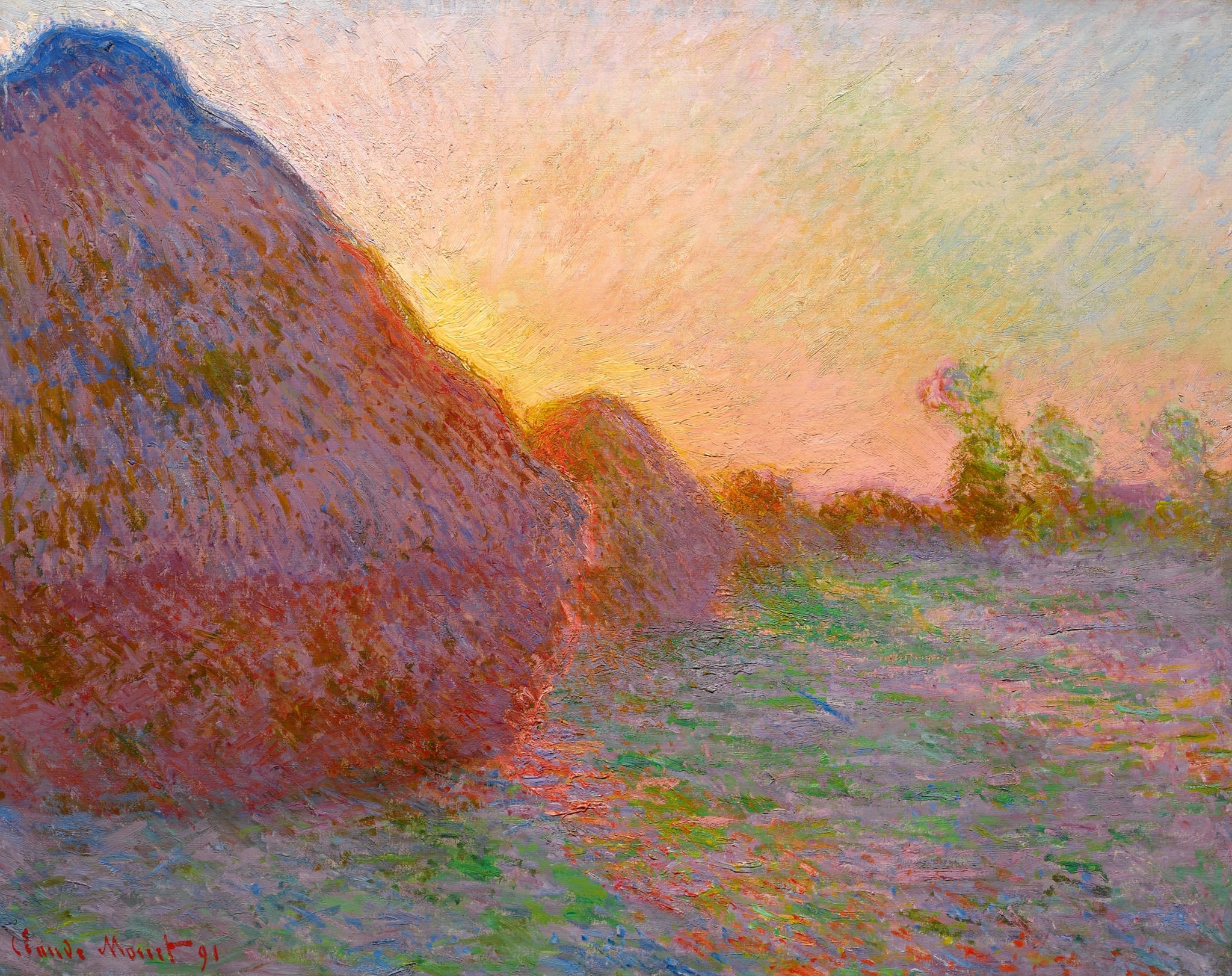
Claude Monet’s <strong>Haystacks Series</strong> transforms a routine rural subject into an inquiry into <strong>light, time, and perception</strong>. In this sunset view, the stacks swell at the left while the sun burns through the gap, making the field shimmer with <strong>apricot, lilac, and blue</strong> vibrations.
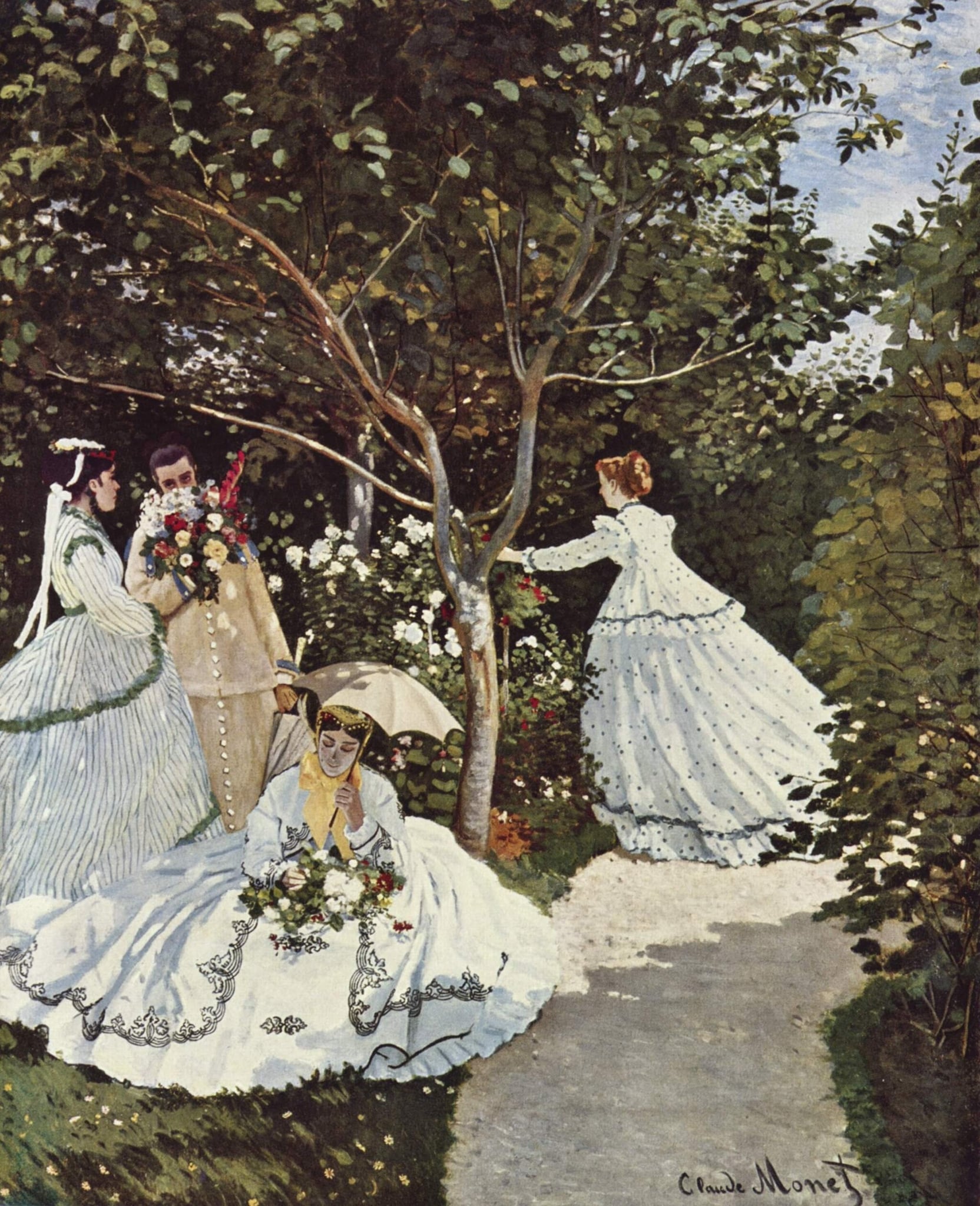
Women in the Garden by Claude Monet

Women in the Garden

Claude Monet (1866–1867)

Claude Monet’s Women in the Garden choreographs four figures in a sunlit bower to test how <strong>white dresses</strong> register <strong>dappled light</strong> and shadow. The path, parasol, and clipped flowers frame a modern ritual of leisure while turning fashion into an instrument of <strong>perception</strong>. The scene reads less as portraiture than as a manifesto for painting the <strong>momentary</strong> outdoors <sup>[1]</sup><sup>[3]</sup>.
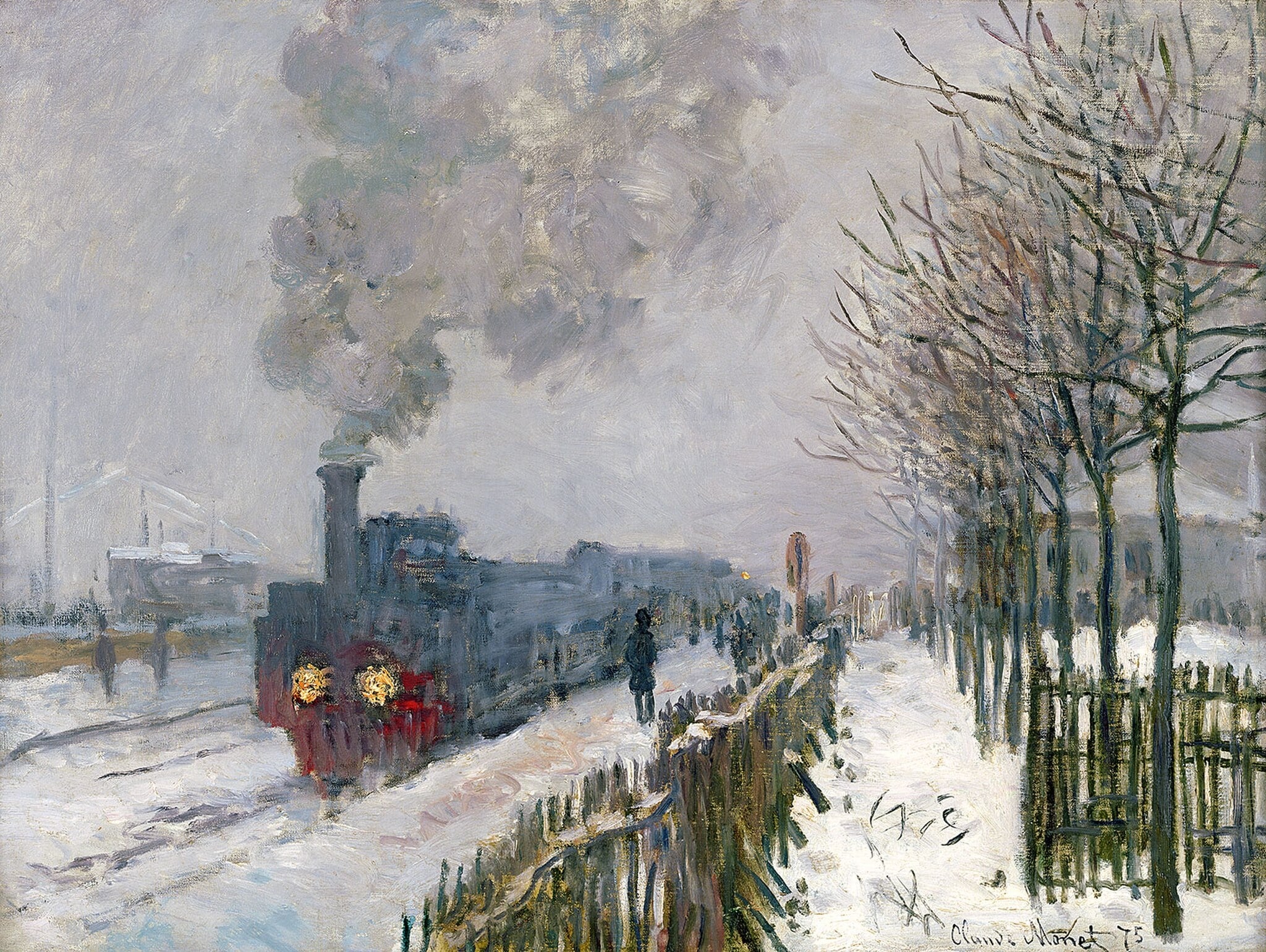
The Train in the Snow (The Locomotive) by Claude Monet

The Train in the Snow (The Locomotive)

Claude Monet (1875)

Claude Monet’s The Train in the Snow (The Locomotive) (1875) turns a suburban winter platform into a study of <strong>modernity absorbed by atmosphere</strong>. The engine’s twin yellow headlights and a smear of red push through a world of greys and violets as steam fuses with the low sky, while the right-hand fence and bare trees drill depth and cadence into the scene <sup>[1]</sup><sup>[4]</sup>. Monet fixes not an object but a <strong>moment of perception</strong>, where industry seems to dematerialize into weather <sup>[1]</sup><sup>[2]</sup>.
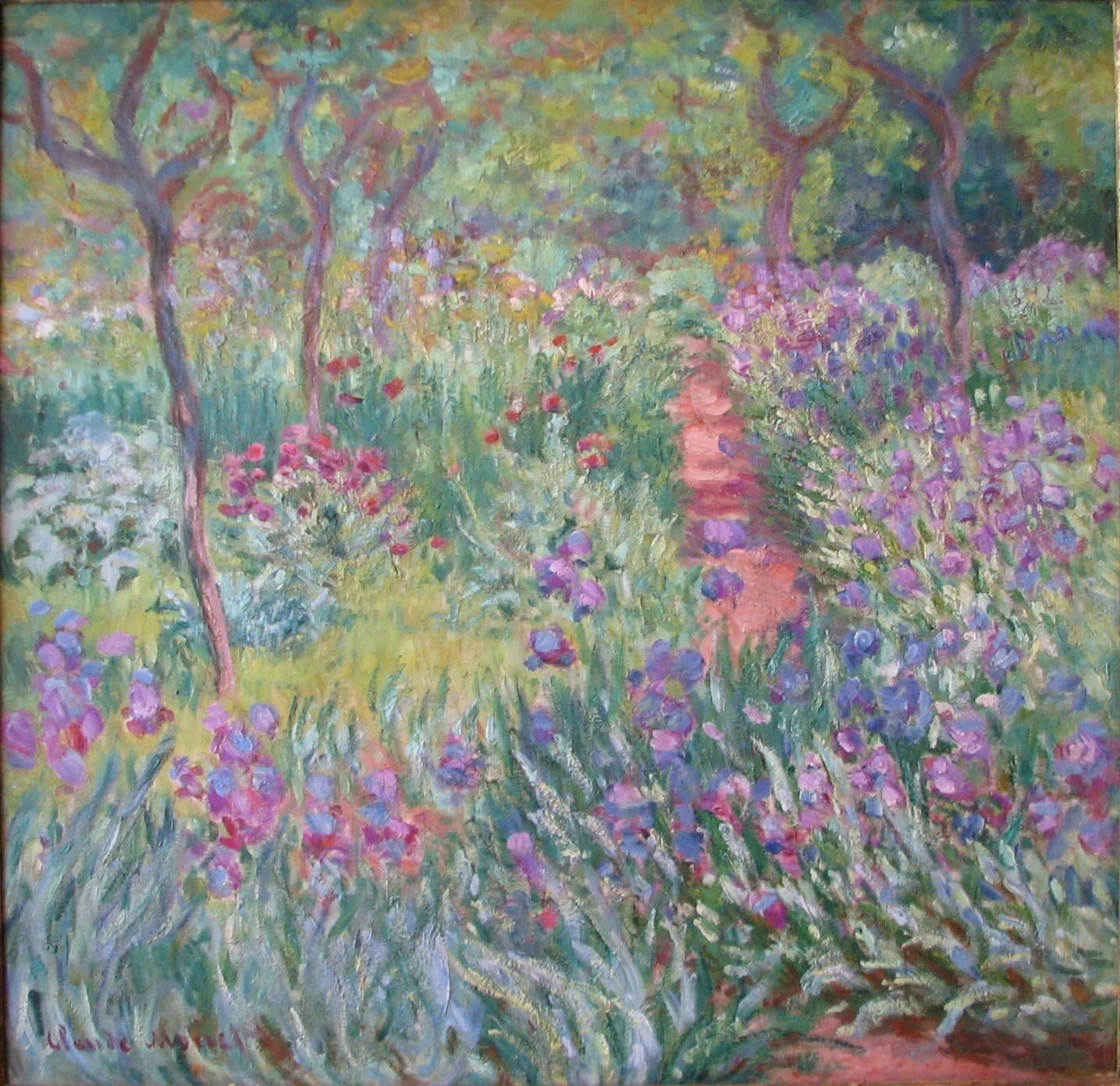
The Artist's Garden at Giverny by Claude Monet

The Artist's Garden at Giverny

Claude Monet (1900)

In The Artist's Garden at Giverny, Claude Monet turns his cultivated Clos Normand into a field of living color, where bands of violet <strong>irises</strong> surge toward a narrow, rose‑colored path. Broken, flickering strokes let greens, purples, and pinks mix optically so that light seems to tremble across the scene, while lilac‑toned tree trunks rhythmically guide the gaze inward <sup>[1]</sup><sup>[3]</sup>.
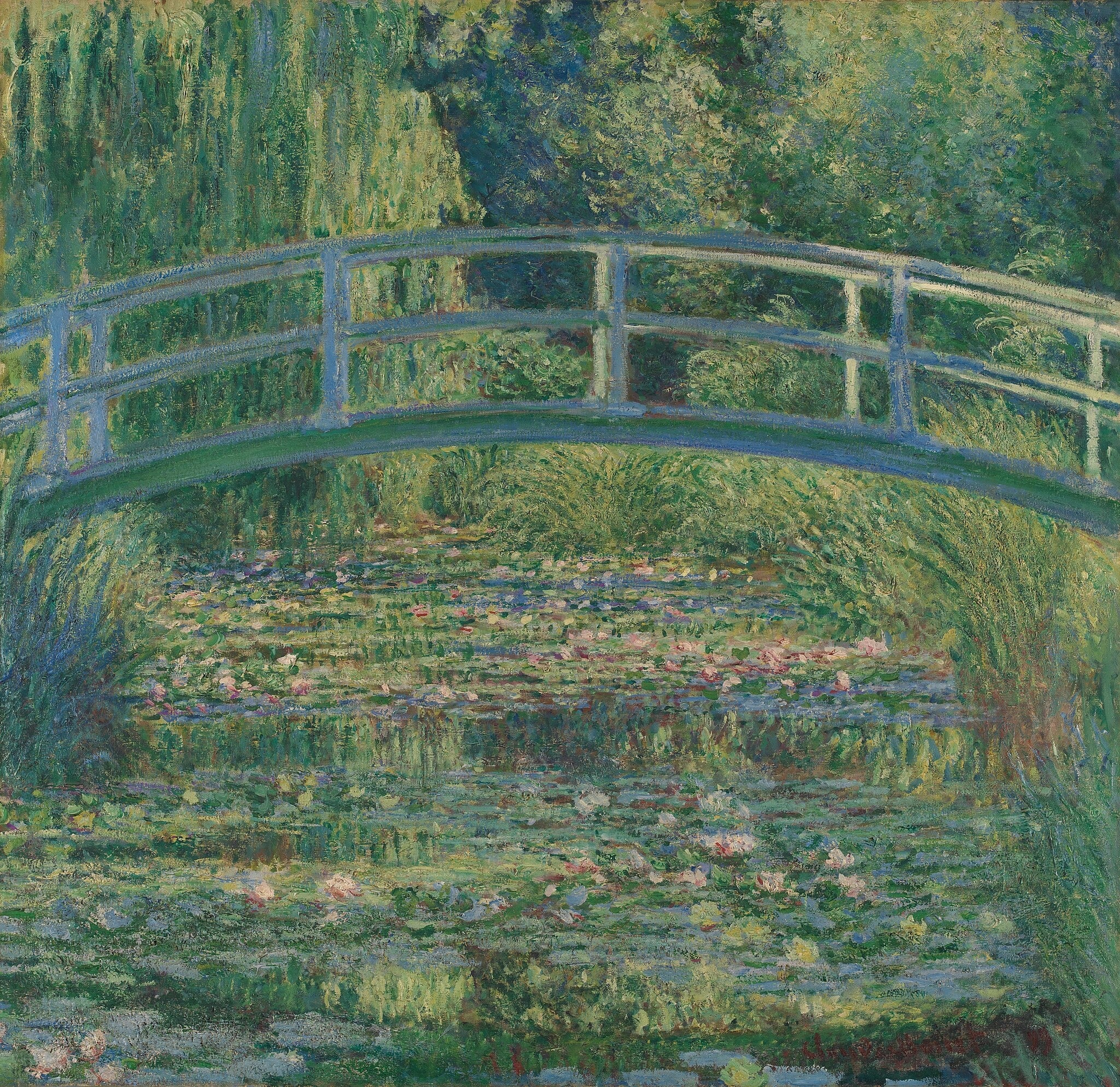
Water Lilies by Claude Monet

Water Lilies

Claude Monet (1899)

<strong>Water Lilies</strong> centers on an arched <strong>Japanese bridge</strong> suspended over a pond where lilies and rippling reflections fuse into a single, vibrating surface. Monet turns the scene into a study of <strong>perception-in-flux</strong>, letting water, foliage, and light dissolve hard edges into atmospheric continuity <sup>[1]</sup><sup>[3]</sup>.
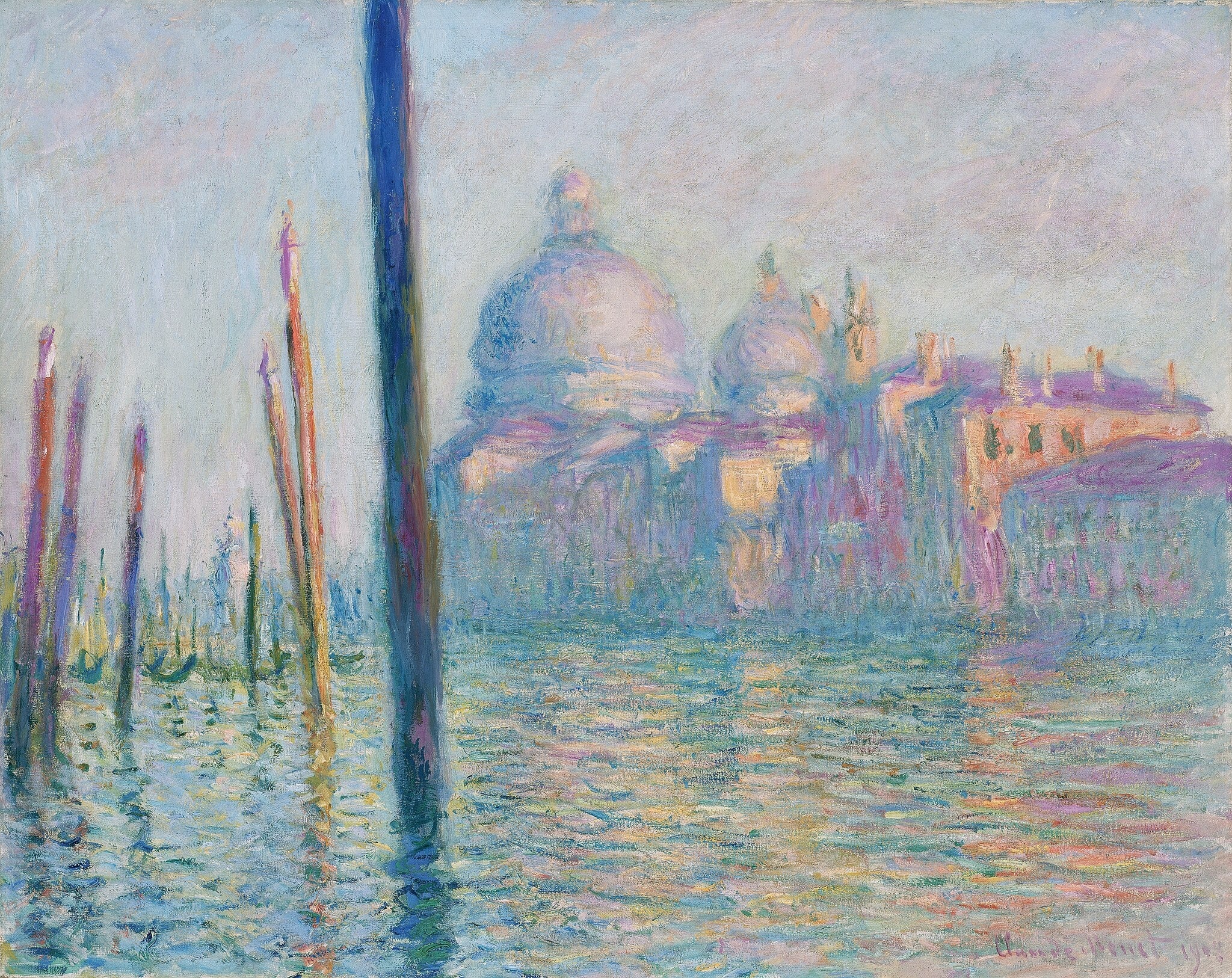
The Grand Canal by Claude Monet

The Grand Canal

Claude Monet (1908)

Claude Monet’s The Grand Canal turns Venice into <strong>pure atmosphere</strong>: the domes of Santa Maria della Salute waver at right while a regiment of <strong>pali</strong> stands at left, their verticals reverberating in the water. The scene asserts <strong>light over architecture</strong>, transforming stone into memory and time into color <sup>[2]</sup><sup>[3]</sup>.