Boat Lying at Low Tide

by Claude Monet

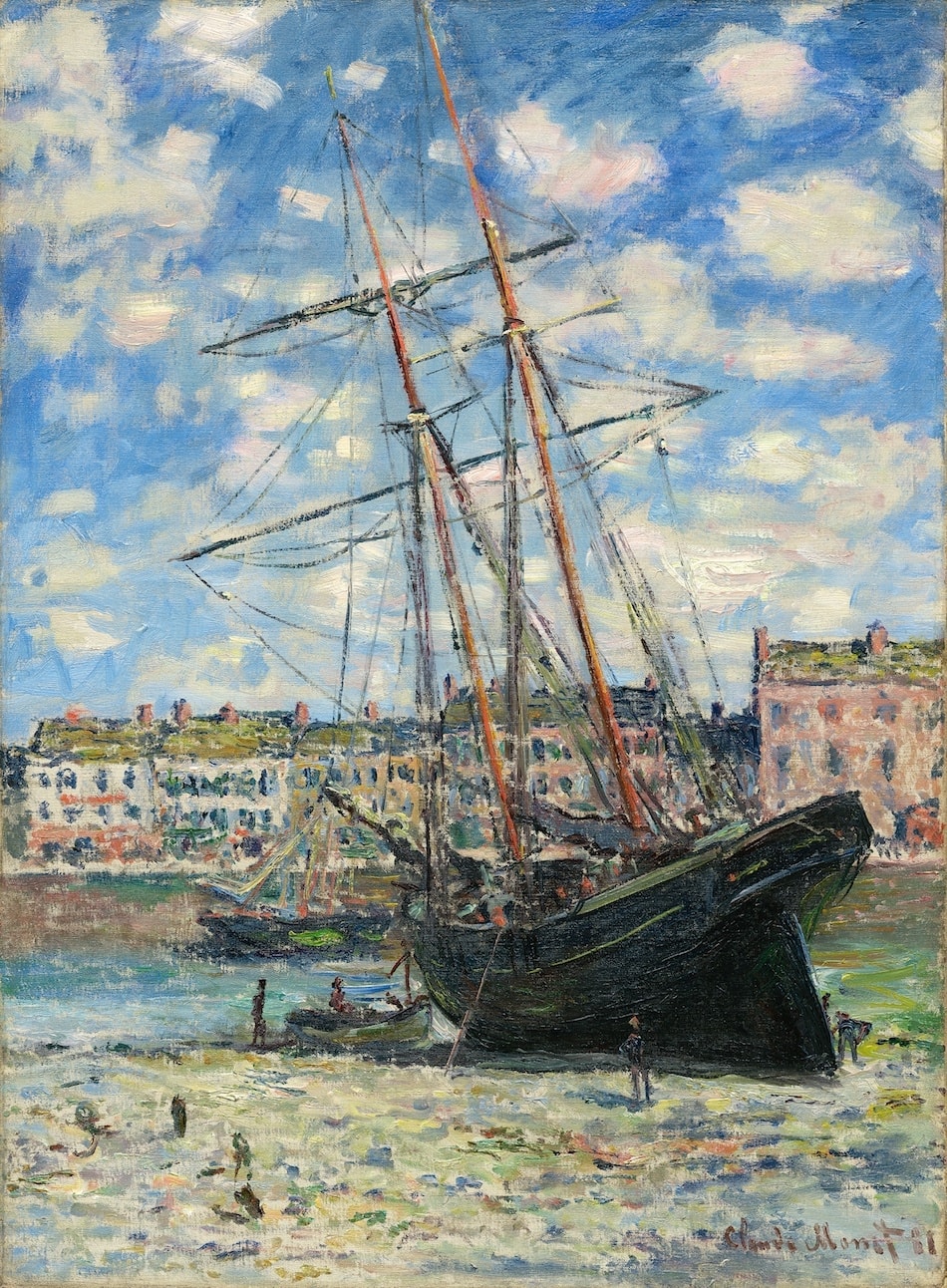
Claude Monet’s Boat Lying at Low Tide stages a moment of suspension between work and weather: a dark hull settles on the glittering strand as masts and rigging cut a lattice through a light‑soaked sky. The grounded vessel faces a town flickering in pinks, blues, and creams, so that atmosphere—not the boat—emerges as the true protagonist of change [1][2].
💰

Market Value

$12-16 million

How much is Boat Lying at Low Tide worth?

Study Print Studio

Create a personal study print

Build a companion study sheet around the part of this painting that speaks to you most. Choose a detail, shape an interpretation, and walk away with something personal and display-worthy.

Fast Facts

Year
1881
Medium
Oil on canvas
Dimensions
82.0 × 60.0 cm
Location
Tokyo Fuji Art Museum, Tokyo
See all Claude Monet paintings in Tokyo
Boat Lying at Low Tide by Claude Monet (1881) featuring Exposed keel and grounded hull, Masts and rigging diagonals, Low‑tide strand with seaweed and shells, Workers and skiff

Click on any numbered symbol to learn more about its meaning

Meaning & Symbolism

Monet anchors the composition in a striking contradiction: the ship’s exposed keel and careened hull—forms normally concealed underwater—press visibly into the strand while three ocher‑tipped masts rake across a sky knit by fast, rectangular clouds. Those diagonals torque against the harbor’s long horizontal band, producing a dynamic tension between mass and buoyancy. The rigging’s wiry lines, likely plotted in light underdrawing before paint, read as calligraphy that both stabilizes and unsettles the silhouette 2. At the bow, small figures stand shin‑deep and tend a skiff; along the waterline others work with poles. Their scale and gestures assert that the tide’s withdrawal is not an ending but an interval of maintenance—scraping, caulking, resetting—before the sea lifts the boat again 2. In the foreground, flecks of green and ocher suggest seaweed and shell, registering the littoral zone as a field of living time rather than inert terrain. Across the basin, the town shimmers in mosaic touches of pink, blue, and creamy white, a chromatic counterweight that frames maritime labor within communal life. Monet’s handling makes atmosphere the engine of meaning. Wet‑into‑wet strokes leave seams and glimpses of ground that keep the surface in perceptual motion, as if the picture’s materiality breathed with the changing weather 2. This sensation of flux converts a traditional stranded‑boat motif—long used for moralizing allegory—into a rigorously modern statement about cycles, contingency, and operational downtime in a working port 25. Even the title’s French root, “échoué,” shades the scene with ambiguity: “beached/stranded,” but also “failed,” a nuance Monet counters with evidence of purposeful activity at the hull. Rather than catastrophe, the picture insists on renewal through pause. The diagonals of the spars and the subtle thrust of the prow imply latent motion; the next tide already haunts the composition’s geometry. The sky’s broken passages and the harbor’s flicker of windows are not backdrop but temporal markers, each stroke a unit of passing light. Historically, the canvas belongs to Monet’s spring 1881 return to the Normandy coast—centered on Fécamp—where he produced a sequence of low‑tide boat images from closely related vantage points, one now in Chicago and this one in Tokyo 12. Curators note that the Tokyo Fuji version makes the keel’s exposure unusually emphatic, intensifying the picture’s meditation on time and tide 2. Read with Robert Herbert’s account of Normandy’s shifting economies—working fisheries, new tourism, modern spectatorship—the painting registers coastal modernity without anecdote: labor cycles, harbor architecture, and atmospheric volatility are fused by optical notation 4. Within Monet’s career arc, this is a hinge between his earlier realistic seaports and the later serial method; its brisk facture, calibrated diagonals, and observational precision anticipate the cathedral and haystack campaigns by modeling how a single motif can stage recurring conditions of light and activity 26. Boat Lying at Low Tide is thus not a picturesque pause but a thesis: that modern life is rhythmed by forces—tide, weather, work shifts—best understood through the tempo of looking, and that painting’s own procedures can embody those cycles as convincingly as the tide lifts a grounded hull 24.

Explore Deeper with AI

Ask questions about Boat Lying at Low Tide

Popular questions:

Powered by AI • Get instant insights about this artwork

💬 Ask questions about this artwork!

Interpretations

Technical Art History: Process and Planning

Monet’s spontaneity rides on premeditation. Technical study of the sister canvas shows light underdrawing for rigging and rapid, open wet‑into‑wet passages that leave “glimpses of ground,” keeping air and motion active across the surface 1. Evidence that Monet reoriented a support mid‑process in the related work clarifies how he engineered diagonals to torque against harbor horizontals—an optical structure echoed here in Tokyo. The result is a surface that stages flux materially: seams, scumbles, and liquid joins perform the weather, not merely depict it. This method lets the painting track a temporal workflow—lay‑in, revision, and final accents—analogous to the crew’s scraping and caulking at low tide. Technique and subject both pivot on intervals where intervention is possible 1.

Source: Art Institute of Chicago

Socioeconomic Modernity: Work Rhythms at the Shore

Read through Robert Herbert’s lens on Normandy, the picture encodes a working port’s labor cycles in tandem with emergent tourism and modern spectatorship 3. The beached hull isn’t calamity; it’s scheduled operational downtime that synchronizes human labor with tidal logistics. Across the basin, the patchwork town—pink, blue, cream—supplies a civic counterweight, implying service networks, markets, and onlookers folded into maritime productivity 1. Monet strips anecdote but preserves infrastructure and tempo: boats, basin, skyline as a system of throughput. In 1881 Fécamp, fisheries and leisure economies entwined; Monet’s optical notation records that entanglement without moralizing, making maintenance and waiting legible as productive modern time 13.

Source: Robert L. Herbert; Art Institute of Chicago

Semantics of the Title: From Stranding to Renewal

The French “échoué” shades the subject with the specter of failure—beached, stranded, even “aborted” 1. Monet counters this semantic drag by staging purposeful activity at the keel and waterline: figures with poles, a skiff tended at the bow, a hull prepared for relaunch. Title and image thus generate a dialectic between catastrophe and craft, where maintenance reframes stranding as productive pause. The compositional hints of latent motion—the raking masts, the prow’s thrust—further argue against finality. Rather than allegory of ruin (familiar from Romantic and Dutch precedents), Monet offers an anti‑allegory of procedure, in which work and weather windows transform a negative condition into preparatory time 1.

Source: Art Institute of Chicago

Comparative Iconography: Unmoralizing the Beached Boat

Beached vessels long served painters as moral emblems—vanitas, shipwreck, the wages of hubris. Museum labels for related works still note how immobilized boats can signify endeavor checked by nature 5. Monet reroutes that tradition: he empties the scene of melodrama and substitutes task‑based gestures, optical flicker, and infrastructural context. The exposed keel—a potentially tragic sign—becomes a diagnostic cross‑section inviting repair. His “calligraphic” rigging organizes space without narrativizing fate. In place of parable, we get a procedural image where the littoral is a workshop and cloud‑light the timekeeper. Thus, inherited symbolism is neither quoted nor denied but operationalized into a modern, non‑moralizing register 15.

Source: Art Institute of Chicago; Seattle Art Museum

Medium Reflexivity: Painting as a Tide Clock

Monet makes atmosphere the engine of meaning: strokes knit and unknit like passing fronts, each mark a unit of time. The town’s shimmer and the sky’s broken passages are “not backdrop but temporal markers,” aligning pictorial procedure with tidal rhythm 1. In this sense the work anticipates Monet’s serial method, where a motif becomes a metronome for changing conditions. Here, downtime at the keel coincides with painterly pauses and seams, so the canvas functions as a tide clock—registering when interventions can occur and when buoyancy resumes. It’s medium reflexivity without manifesto: the painting demonstrates how its own techniques embody the very cycles (ebb, maintenance, lift) that structure port life in 1881 Fécamp 12.

Source: Art Institute of Chicago; Tokyo Fuji Art Museum

Related Themes

About Claude Monet

Claude Monet (1840–1926) led Impressionism’s pursuit of open-air painting and optical immediacy, especially during his Argenteuil years focused on modern leisure and light. He later developed serial studies of changing conditions, culminating in the Water Lilies cycle [2].
View all works by Claude Monet

More by Claude Monet

Haystacks Series by Claude Monet | Light, Time & Atmosphere by Claude Monet

Haystacks Series by Claude Monet | Light, Time & Atmosphere

Claude Monet

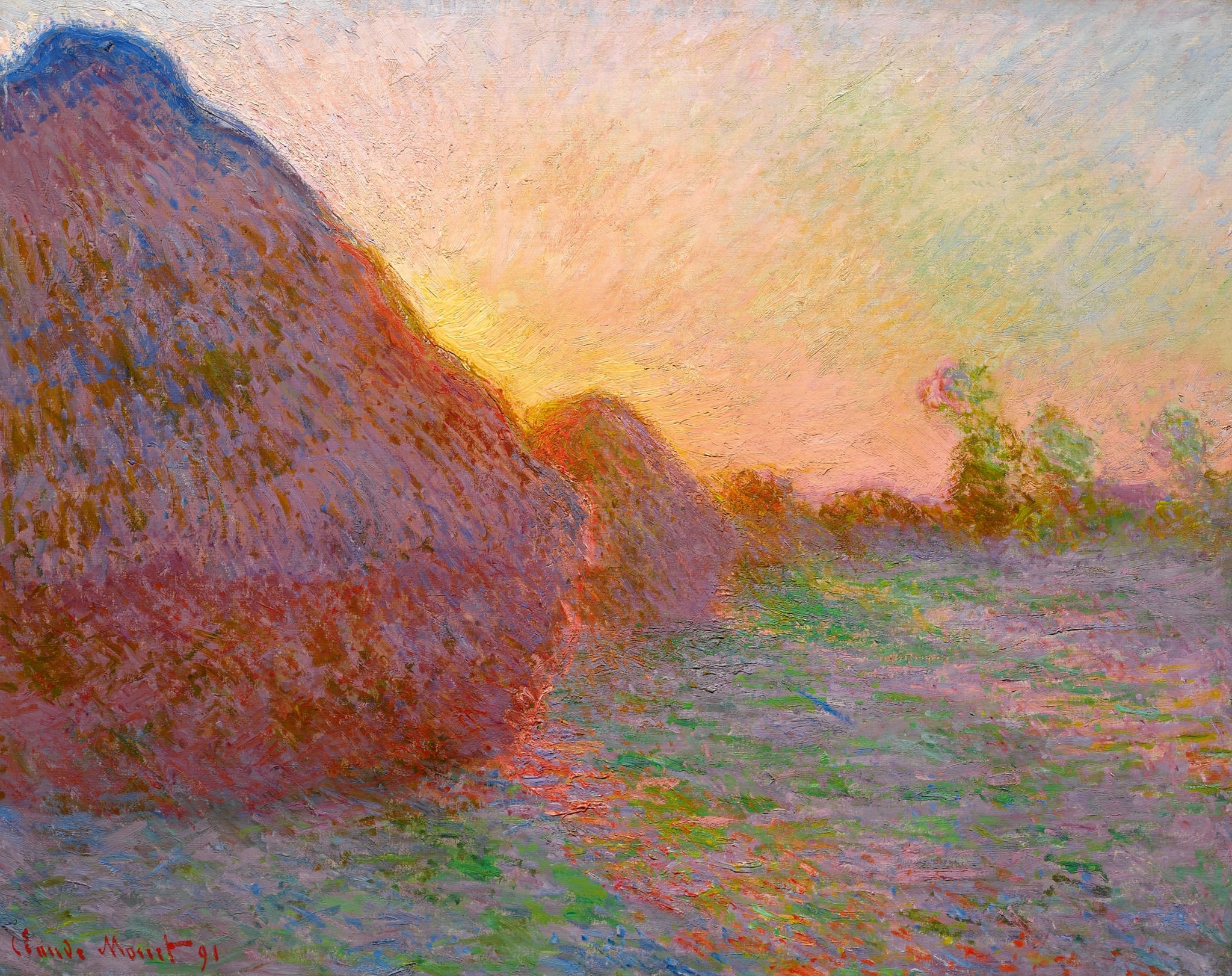
Claude Monet’s <strong>Haystacks Series</strong> transforms a routine rural subject into an inquiry into <strong>light, time, and perception</strong>. In this sunset view, the stacks swell at the left while the sun burns through the gap, making the field shimmer with <strong>apricot, lilac, and blue</strong> vibrations.
Women in the Garden by Claude Monet

Women in the Garden

Claude Monet (1866–1867)

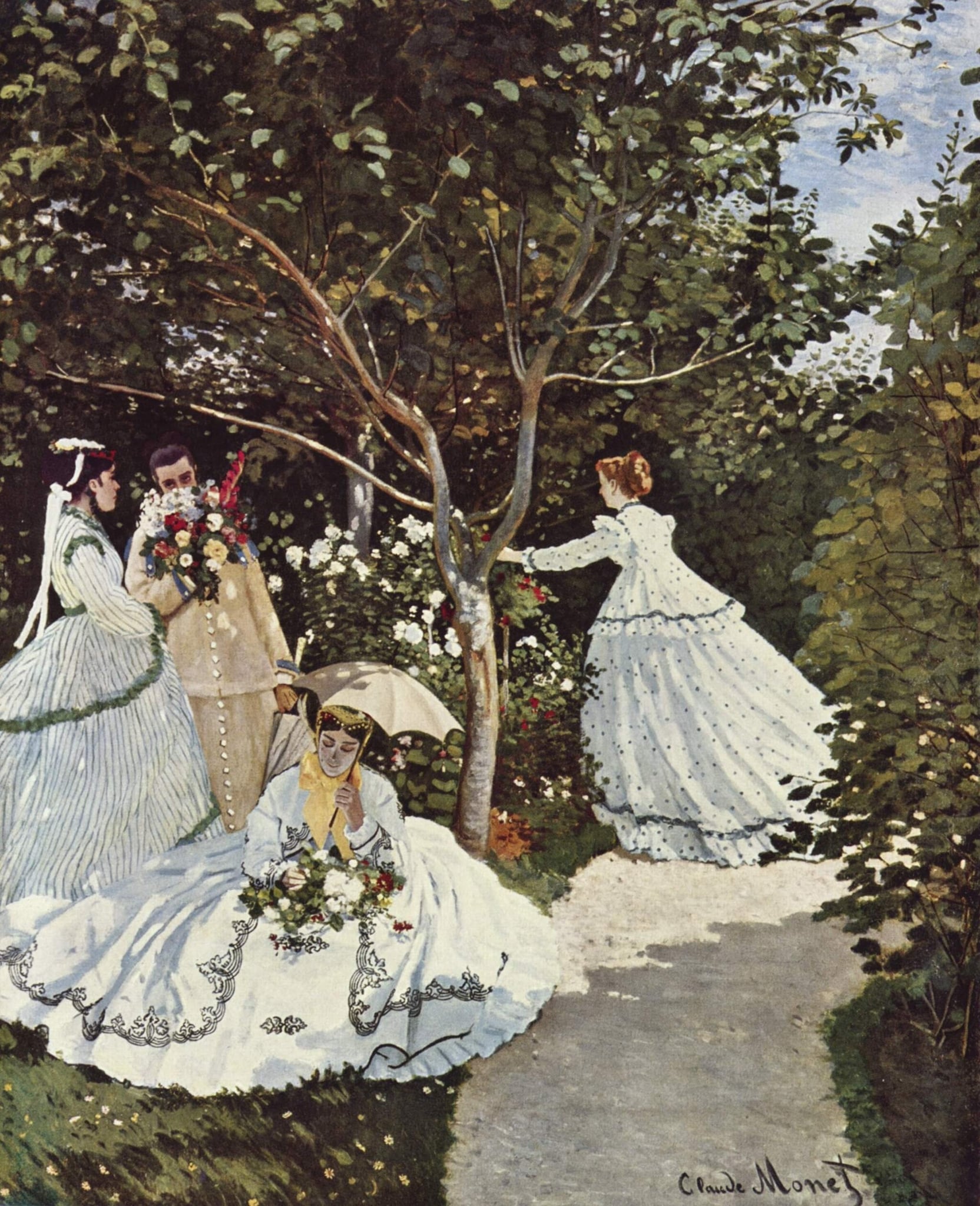
Claude Monet’s Women in the Garden choreographs four figures in a sunlit bower to test how <strong>white dresses</strong> register <strong>dappled light</strong> and shadow. The path, parasol, and clipped flowers frame a modern ritual of leisure while turning fashion into an instrument of <strong>perception</strong>. The scene reads less as portraiture than as a manifesto for painting the <strong>momentary</strong> outdoors <sup>[1]</sup><sup>[3]</sup>.
The Train in the Snow (The Locomotive) by Claude Monet

The Train in the Snow (The Locomotive)

Claude Monet (1875)

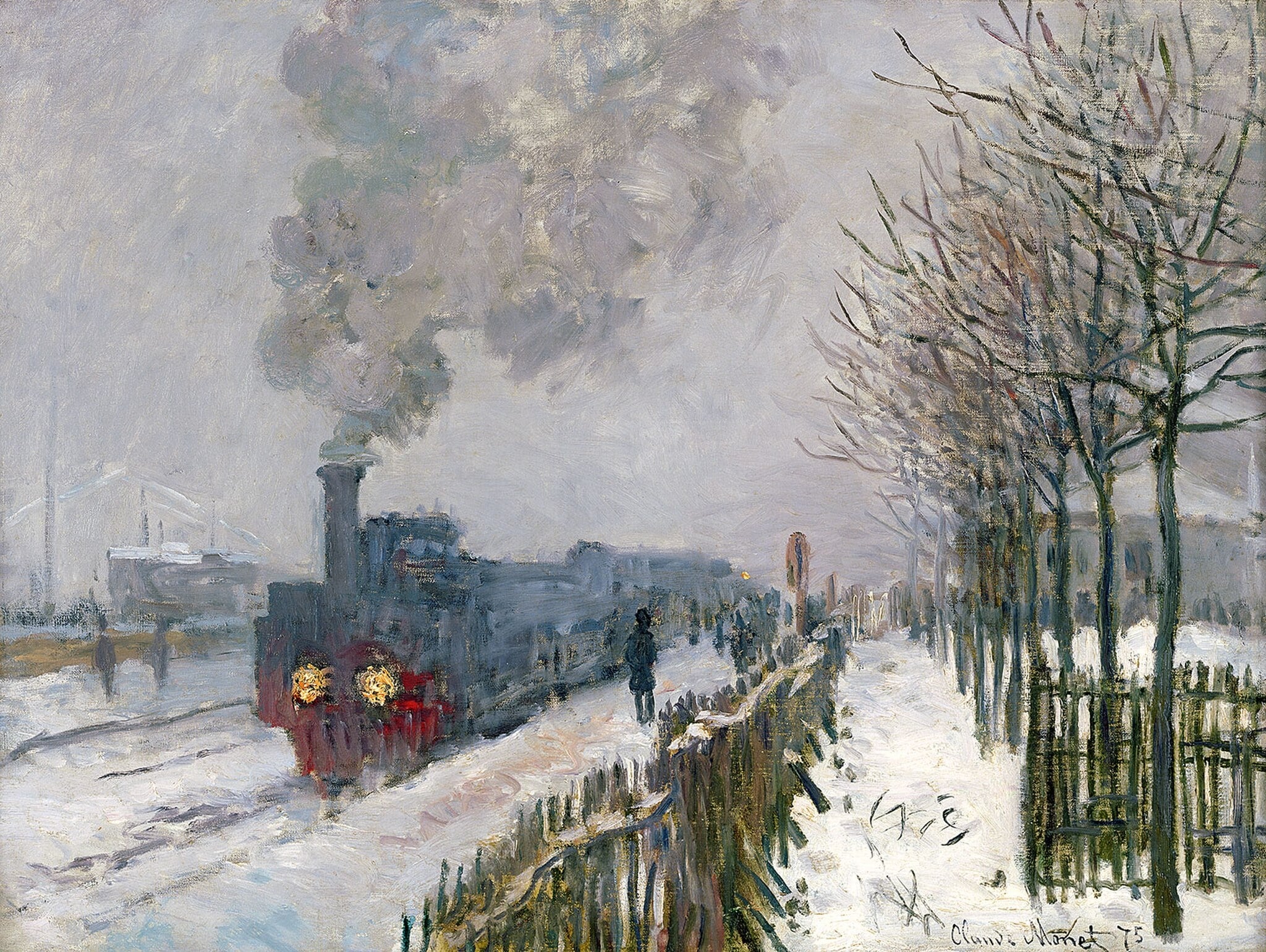
Claude Monet’s The Train in the Snow (The Locomotive) (1875) turns a suburban winter platform into a study of <strong>modernity absorbed by atmosphere</strong>. The engine’s twin yellow headlights and a smear of red push through a world of greys and violets as steam fuses with the low sky, while the right-hand fence and bare trees drill depth and cadence into the scene <sup>[1]</sup><sup>[4]</sup>. Monet fixes not an object but a <strong>moment of perception</strong>, where industry seems to dematerialize into weather <sup>[1]</sup><sup>[2]</sup>.
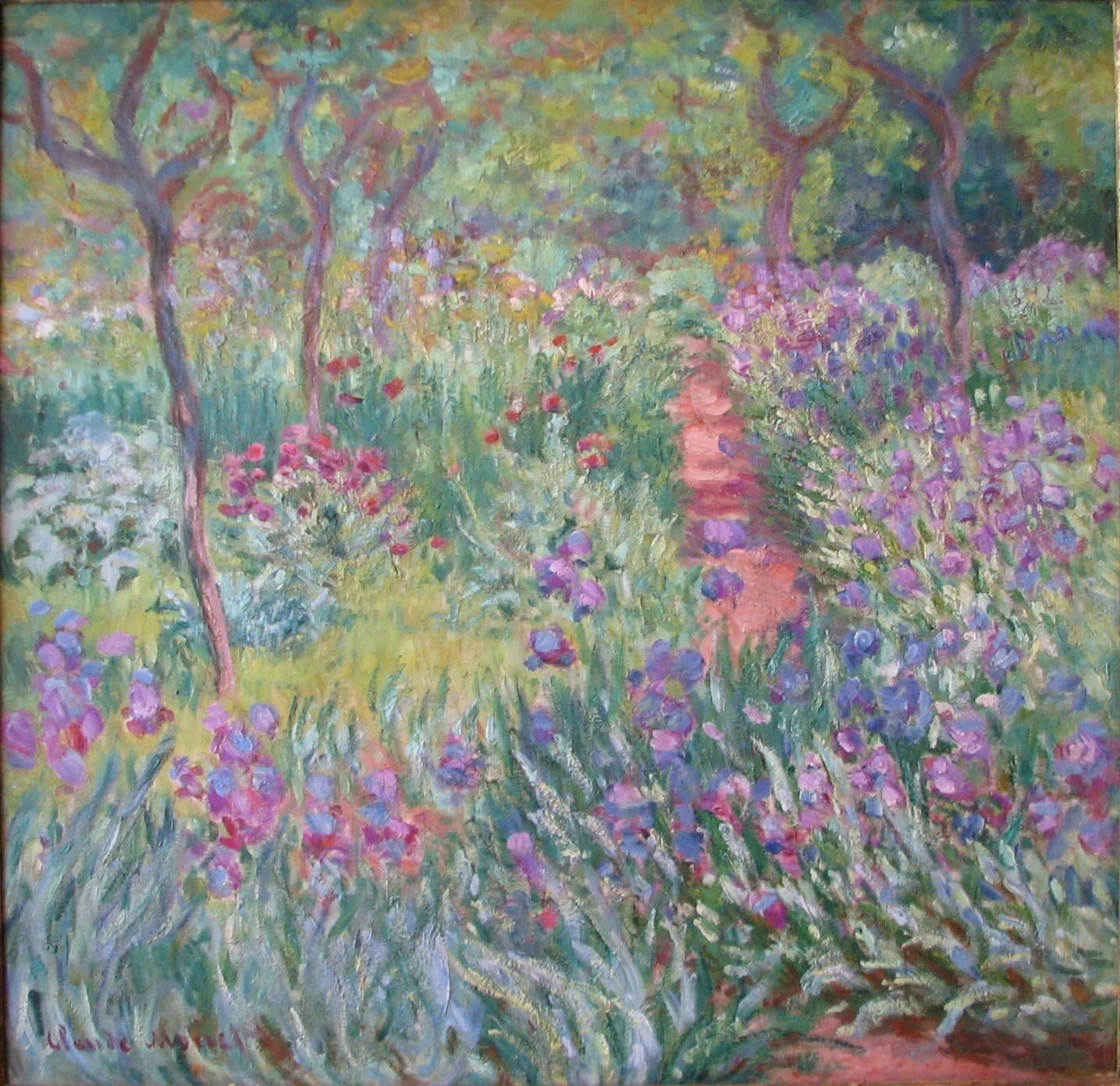
The Artist's Garden at Giverny by Claude Monet

The Artist's Garden at Giverny

Claude Monet (1900)

In The Artist's Garden at Giverny, Claude Monet turns his cultivated Clos Normand into a field of living color, where bands of violet <strong>irises</strong> surge toward a narrow, rose‑colored path. Broken, flickering strokes let greens, purples, and pinks mix optically so that light seems to tremble across the scene, while lilac‑toned tree trunks rhythmically guide the gaze inward <sup>[1]</sup><sup>[3]</sup>.
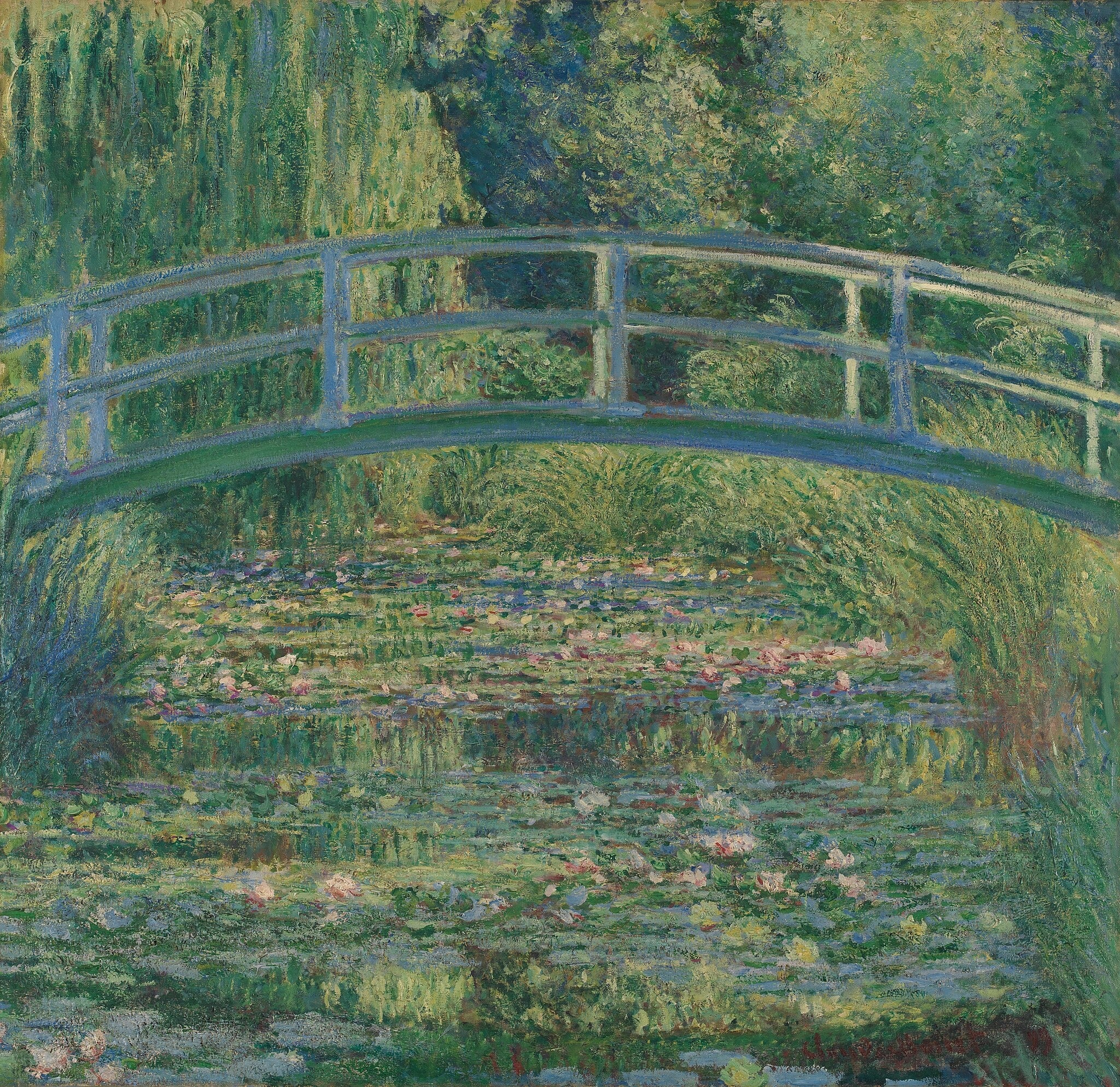
Water Lilies by Claude Monet

Water Lilies

Claude Monet (1899)

<strong>Water Lilies</strong> centers on an arched <strong>Japanese bridge</strong> suspended over a pond where lilies and rippling reflections fuse into a single, vibrating surface. Monet turns the scene into a study of <strong>perception-in-flux</strong>, letting water, foliage, and light dissolve hard edges into atmospheric continuity <sup>[1]</sup><sup>[3]</sup>.
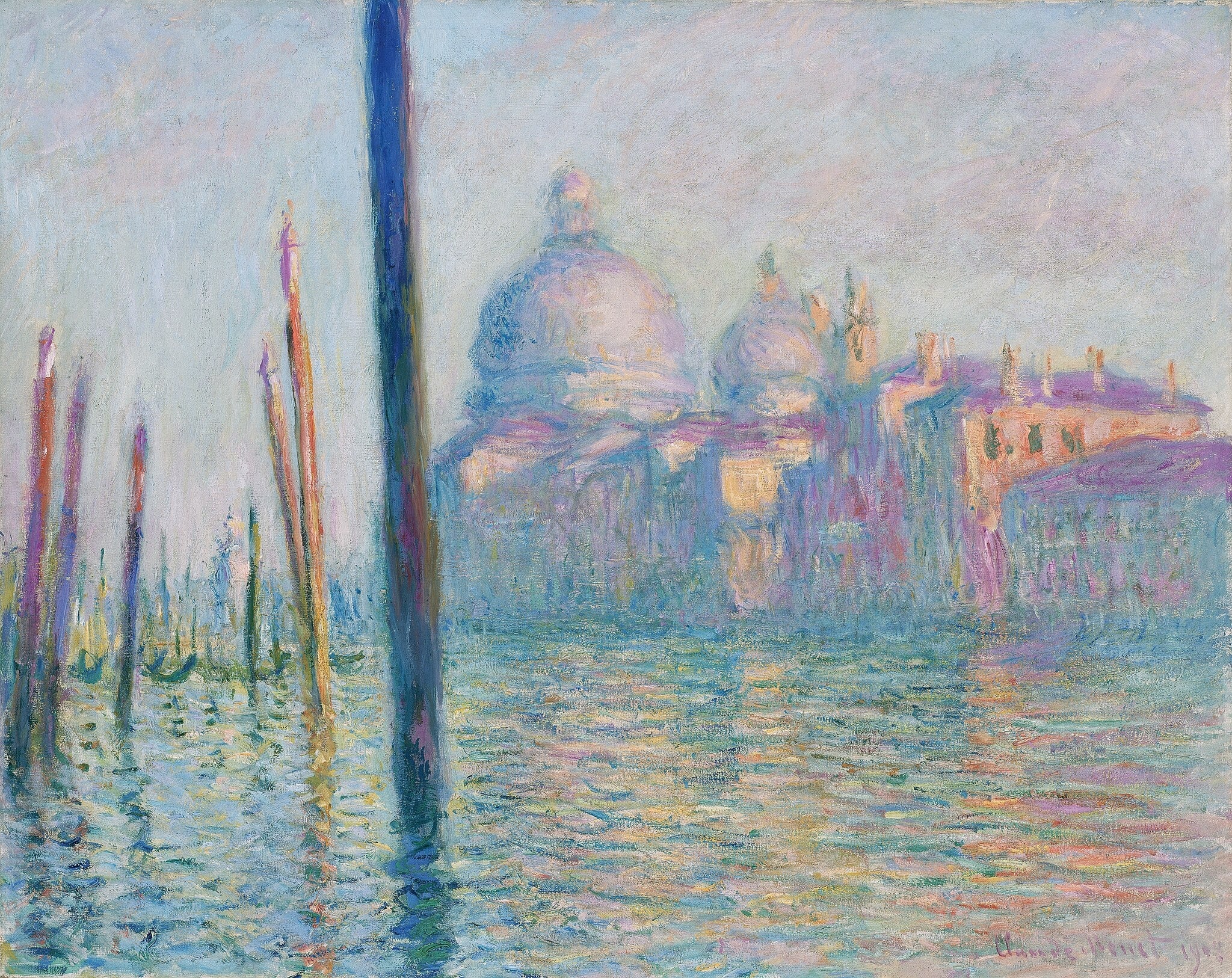
The Grand Canal by Claude Monet

The Grand Canal

Claude Monet (1908)

Claude Monet’s The Grand Canal turns Venice into <strong>pure atmosphere</strong>: the domes of Santa Maria della Salute waver at right while a regiment of <strong>pali</strong> stands at left, their verticals reverberating in the water. The scene asserts <strong>light over architecture</strong>, transforming stone into memory and time into color <sup>[2]</sup><sup>[3]</sup>.