How Much Is The Manneporte near Étretat Worth?
Last updated: February 26, 2026
Quick Facts
- Methodology
- comparable analysis
Hypothetical market value for Claude Monet’s The Manneporte near Étretat (1886, The Met) is estimated at $45–75 million. The range reflects the motif’s importance within Monet’s mature period, strong top-end demand for A‑tier Monets, and extreme scarcity of first-rate Manneporte canvases on the market.
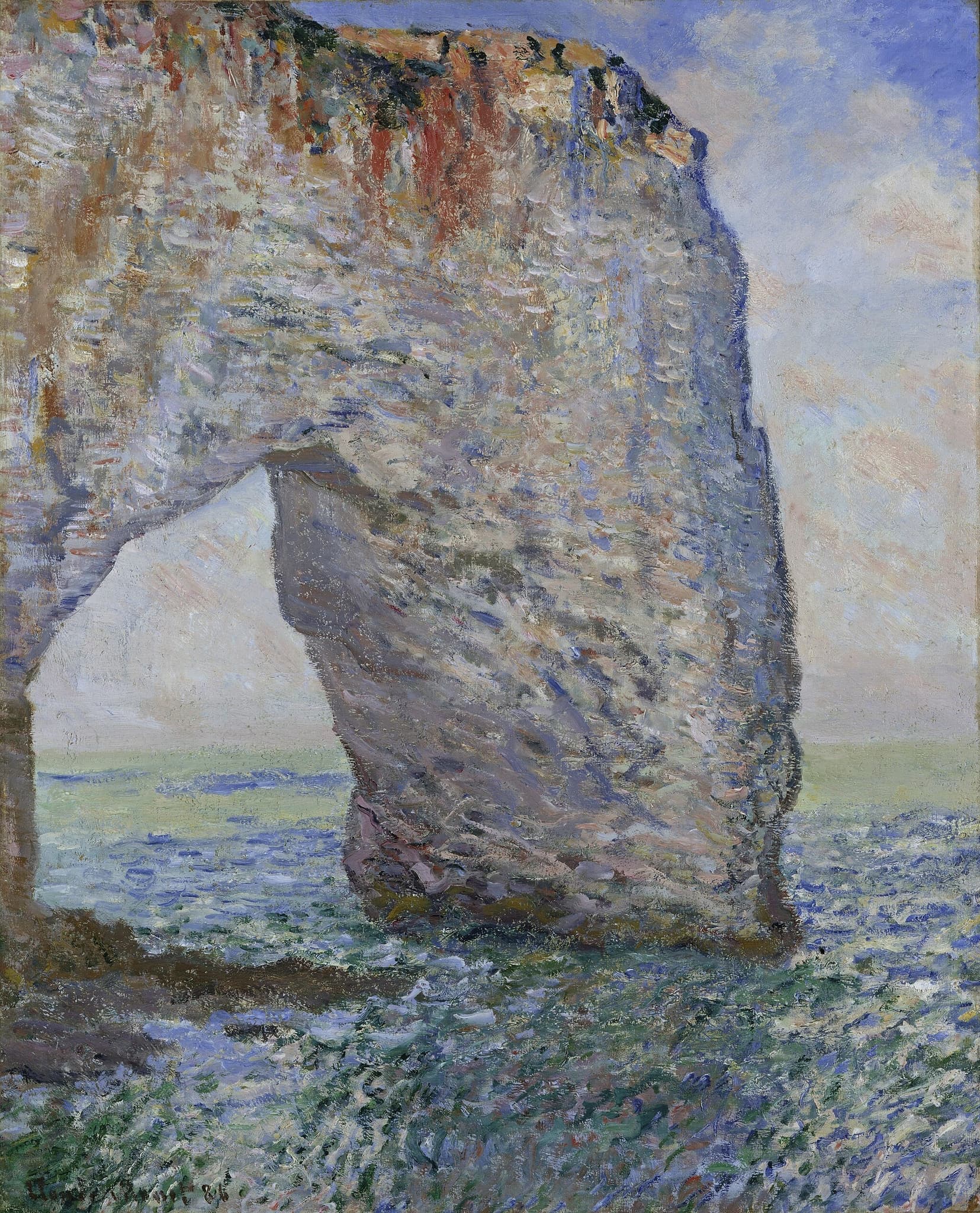
The Manneporte near Étretat
Claude Monet, 1886 • Oil on canvas
Read full analysis of The Manneporte near Étretat →Valuation Analysis
Conclusion: If The Manneporte near Étretat (1886) from The Metropolitan Museum of Art were ever to be deaccessioned and publicly offered, a reasonable auction valuation would be $45–75 million. This work is a prime, mature-period Monet depicting a coveted Normandy subject closely tied to the artist’s evolving serial practice, and its quality and institutional pedigree would command a substantial premium in today’s blue‑chip market [1].
Market anchors: Monet remains among the deepest and most global markets in art. His auction record stands at $110.7 million for Meules (Haystacks) at Sotheby’s in 2019, a benchmark for the very top echelon of the oeuvre [2]. Recent marquee results underscore continued depth at the high end: a late Water Lilies realized $74.01 million at Christie’s in November 2023 [3]; Meules à Giverny (1893) achieved $34.8 million at Sotheby’s in May 2024, reinforcing the $30–40 million floor for strong but non‑record series works [4]; and in 2025 Christie’s set a Poplars series high at $42.96 million, evidencing sustained appetite for A‑category serial subjects [5].
Subject and scarcity: Within Monet’s 1880s Normandy campaigns, Étretat—and specifically the Manneporte arch—is an art‑historically resonant motif that anticipates the artist’s 1890s serial method. Many of the finest Manneporte canvases are in museums (including The Met and Musée d’Orsay), sharply limiting supply of like‑for‑like works and supporting a scarcity premium when significant examples surface [1][6].
Deriving the range: Direct same‑motif comparables rarely appear at auction, so pricing relies on a calibrated blend of series hierarchy and recent top‑end Monet performance. The Manneporte subject sits below Monet’s absolute apex (Haystacks, Rouen Cathedral, late Nymphéas) yet above most secondary coastal views on a desirability curve. Given the demonstrated $40–75 million band for prime series canvases over the last few seasons [3][4][5], a first‑rate, museum‑level Manneporte of substantial size and strong color/impact can credibly sit in the high tens of millions. The proposed $45–75 million bracket positions the work below Monet’s all‑time record while acknowledging its mature date, motif significance, and institutional stature.
Sensitivities and conditions: Final pricing would turn on composition (prominence of the arch and surf), palette, scale (The Met’s canvas is c. 81.3 x 65.4 cm), condition/conservation, literature and exhibition history, and “freshness” to market. Macro liquidity, the presence of third‑party guarantees, and depth of US/European/Asian underbidders would influence the final outcome. As the painting is a Bliss bequest in a leading museum, any valuation is necessarily hypothetical and should be treated as a directional indicator rather than a disposal-ready appraisal [1].
Key Valuation Factors
Art Historical Significance
High ImpactPainted in 1886, this canvas belongs to Monet’s mature Impressionist period and represents the artist’s pivotal Normandy coastal campaign, where he refined a serial approach to changing light and atmosphere. The Manneporte at Étretat is one of Monet’s most emblematic natural monuments and an essential bridge between his mid‑1880s coastal investigations and the celebrated 1890s serial cycles. Its subject matter is instantly recognizable to scholars and the public alike, anchoring the work high on the artist’s internal hierarchy. The painting’s date, motif, and role within Monet’s evolution support strong demand among top collectors and institutions, making art-historical significance a principal driver of value.
Subject Scarcity and Series Demand
High ImpactFirst-rate Manneporte canvases are disproportionately held by major museums (e.g., The Met, Musée d’Orsay), so close substitutes rarely reach the market. This tight supply amplifies competition when a comparable example appears, especially given cross-border demand for iconic, photogenic motifs. The Étretat series sits just below Monet’s absolute apex groups (Haystacks, Rouen Cathedral, late Water Lilies) but is materially more coveted than many earlier or secondary coastal scenes. That positioning—iconic yet scarce—supports a high‑tens‑of‑millions valuation, particularly if the work exhibits strong palette, dramatic surf/sky interplay, and exhibition-ready condition.
Scale, Composition, and Condition
Medium ImpactAt roughly 81.3 x 65.4 cm, The Met’s canvas sits in a highly marketable size class: large enough for wall power yet manageable for private collections. Composition matters—pictures that frame the arch monumentally against energized surf and luminous sky tend to out‑perform quieter variants. Condition, restoration history, and technical integrity (e.g., no significant overpaint, stable support, healthy surface) are decisive price levers at the top end. While The Met’s ownership implies institutional‑level care, a current conservation report would be essential to pin the estimate to the upper end of the range.
Provenance and Exhibition History
Medium ImpactThe painting’s long residence at The Metropolitan Museum of Art, via the Lillie P. Bliss bequest, confers robust provenance and scholarly visibility. Works with deep literature and exhibition track records inspire bidder confidence and can add a premium, especially when paired with a fresh-to-market narrative. If deaccessioned (hypothetically), the pedigree could help secure a third‑party guarantee and strong presale interest. Conversely, stringent deaccession policies or donor restrictions typically limit the likelihood of sale, keeping the valuation theoretical and its market-testing benefits unrealized.
Market Liquidity and Timing
Medium ImpactMonet’s market is among the most liquid in historical art, with marquee works consistently anchoring evening sales. That said, results are cyclical: 2024 saw selectivity at the very top, while late‑2025 marquee weeks signaled renewed strength for blue‑chip Modern masterworks. Realizing the upper half of the range would likely require favorable macro conditions, a broad international buyer pool (including Asia), and strategic sale placement with a well-structured guarantee. In softer windows, consignors may rely on private sale avenues, which can compress competitive tension and nudge outcomes toward the mid‑range.
Sale History
The Manneporte near Étretat has never been sold at public auction.
Claude Monet's Market
Claude Monet is a cornerstone of the global art market and the definitive brand-name of Impressionism. His most coveted series—Haystacks, Rouen Cathedral, late Water Lilies, London/Thames, and Poplars—have produced consistent, high‑visibility results, including the artist’s $110.7 million auction record for Meules (2019). Depth of demand spans the U.S., Europe, and Asia, with major houses routinely deploying guarantees and cross‑category marketing to secure supply and maximize competition. While the very top end can be cyclical, A‑tier Monets have repeatedly realized $40–75 million in recent seasons, and mid‑tier works remain steady provided condition and provenance are strong. Scarcity of trophy‑level canvases, rather than waning demand, is the primary constraint on volume at the high end.
Comparable Sales
Étretat, falaise et Porte d’Amont, grosse mer
Claude Monet
Same artist and Étretat cliffs motif (arch at Porte d’Amont), painted in the early 1880s; similar size class (c. 65 x 81 cm) and period to the Manneporte series.
$4.8M
2015, Sotheby's London
~$6.5M adjusted
Aux Petites‑Dalles
Claude Monet
Normandy coastal cliff subject from 1884—very close in place, period, and coastal theme to Étretat/Manneporte works; helpful for gauging demand for 1880s Normandy seascapes.
$7.7M
2025, Sotheby's London
Falaise des Petites‑Dalles
Claude Monet
Another Normandy cliff/coast scene (1881), close in subject zone and period to Étretat; a recent public benchmark for mid-size coastal Monets.
$3.3M
2025, Christie's New York
Étretat, Falaise d’Aval
Claude Monet
Direct Étretat cliff subject (1885), same site as the Manneporte series; likely smaller/secondary work but useful for long-run price context on the motif.
$747K
2010, Sotheby's New York
~$1.1M adjusted
Peupliers au bord de l’Epte, crépuscule
Claude Monet
Top-tier serial subject (Poplars, 1891) establishing current demand for A‑category Monets in the high tens of millions; frames the likely bracket for an iconic Manneporte.
$43.0M
2025, Christie's New York
Le bassin aux nymphéas (c. 1917–19)
Claude Monet
Late Water Lilies—an apex Monet series—demonstrates the current ceiling for blue‑chip Monets; useful as an upper bound when positioning a prime Manneporte.
$74.0M
2023, Christie's New York
~$78.5M adjusted
Current Market Trends
The Impressionist/Modern category experienced a selective 2024 with fewer trophies released and intensified buyer focus on quality. By late‑2025, marquee sales signaled a rebound in blue‑chip demand, aided by high‑profile records and renewed institutional programming around canonical names. Private sales remained active as consignors sought discretion and price protection, while public auctions leaned on guarantees to underwrite top lots. For Monet specifically, recent results in the $40–75 million range demonstrate durable liquidity for A‑tier subjects, with active participation from Asian and U.S. collectors. Heading into Monet’s 2026 centenary programming, visibility and demand tailwinds should remain supportive for prime works.
Study print
Study this painting as a print
Pair the full artwork with a museum-style study sheet focused on one meaningful detail.
Sources
- The Metropolitan Museum of Art – The Manneporte near Étretat (1886), Accession 31.67.11
- Sotheby’s – Monet’s Meules sells for $110.7m (artist record)
- Christie’s – 20th Century Evening Sale results (Nov 9, 2023) including Monet $74,010,000
- Artnet News – Sotheby’s Modern Evening Sale (May 15, 2024): Monet Meules à Giverny $34.8m
- HENI News – Monet’s Poplars record $42.96m (May 12, 2025)
- Musée d’Orsay – Étretat: La Manneporte, Reflections on the Water (1885) and motif context