Wanderer above the Sea of Fog

by Caspar David Friedrich

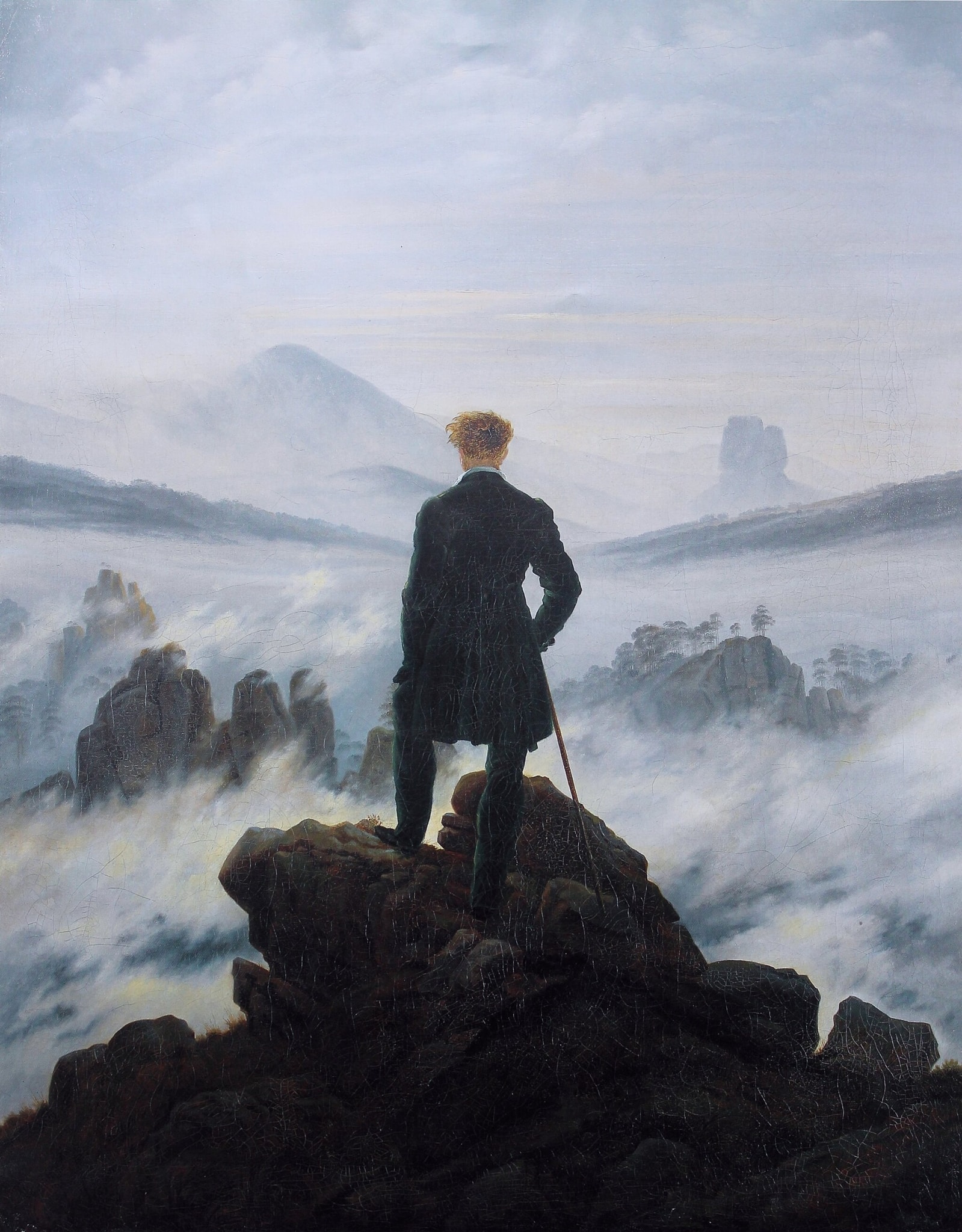
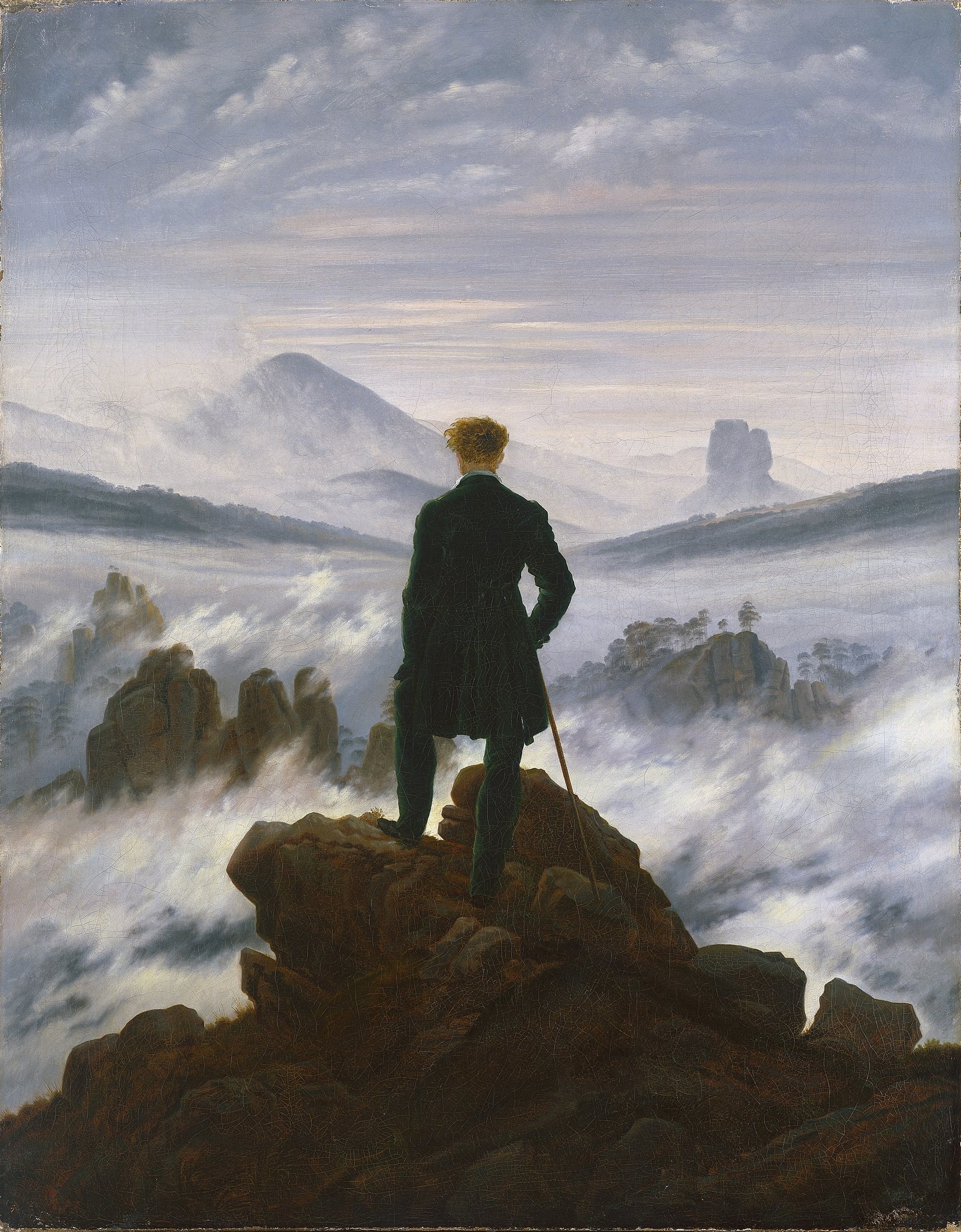
A solitary figure stands on a jagged crag above a churning sea of fog, his back turned in the classic Rückenfigur pose. Caspar David Friedrich transforms the landscape into an inner stage where awe, uncertainty, and resolve meet at the edge of perception [3][5].

Fast Facts

Year
ca. 1817
Medium
Oil on canvas
Dimensions
94.8 × 74.8 cm
Location
Hamburger Kunsthalle, Hamburg
Wanderer above the Sea of Fog by Caspar David Friedrich (ca. 1817) featuring Rückenfigur (back-turned wanderer), Sea of fog, Triangular rock crag, Walking staff

Click on any numbered symbol to learn more about its meaning

Meaning & Symbolism

Friedrich engineers the painting so that seeing—rather than scenery—becomes the drama. The man in the dark green-black coat stands firm on a triangular rock spur, its point rising like a visual fulcrum under his torso. By turning him away, the artist makes him a Rückenfigur, a proxy through whom we step into the view. Our gaze follows his staff downward into the fog and then ascends through the stacked bands of vapor to the pale sky, where horizon and cloud dissolve. In this choreography of sight lines, the landscape operates less as topography and more as a theater of perception: clarity at our feet, obscurity in the middle distance, and a thinning atmosphere that invites metaphysical reach. The fog’s blanketing force—surging between rock-islands and swallowing valleys—performs the Romantic sublime: nature is immense, beautiful, and indifferent, and human comprehension meets its limit at the white, undulant veil 3. Friedrich’s construction is deliberate. Though anchored in studies of the Elbe Sandstone Mountains, the scene is a composite rather than a literal view; the foreground platform adapts a motif he drew on the Kaiserkrone in 1813 35. That engineered synthesis matters: it lets him tune forms to meanings. The vertical format—unusual for landscape—compresses width and amplifies ascent, making the figure’s upright stance rhyme with the skyward vector. The wind teasing his hair and tailcoat animates the pause, suggesting a threshold moment between exertion and insight. Even the color system—cool greys and blue-whites in the distance against the warmer, earthier browns of the crag—creates a gradient from body to spirit, from the tactile to the ethereal. In this calibrated field, the figure’s poise reads as inward steadiness: he does not dominate nature, he endures it, receiving rather than commanding the view. That reception is the painting’s ethical core. The meaning of Wanderer above the Sea of Fog therefore lies in how it binds selfhood to the act of looking. The fog refuses narrative closure—no roads, villages, or destinations resolve the scene—so the traveler’s future remains veiled. Yet the stance declares resolve: one boot set forward, the staff lightly grounded, the body aligned with the rock’s peak. Friedrich thus balances fragility and firmness, positing a modern subject who accepts uncertainty as the medium of insight. The distant peaks, half-absorbed by haze, are not goals to be conquered so much as measurements of scale—registers by which the soul gauges its range. That is why Wanderer above the Sea of Fog is important: it condenses German Romanticism’s wager that spiritual meaning is not beyond the world but within the very limits of perception. Museum and scholarly accounts consistently read the Rückenfigur here as a device that turns the outward view into an inner event, making “vision” the true theme 35. The work’s canonical status—enshrined in major museum holdings and exhibitions—reflects how powerfully this image still articulates the standing question of modern life: how to face a future that is open, obscured, and sublime at once 14.

Explore Deeper with AI

Ask questions about Wanderer above the Sea of Fog

Popular questions:

Powered by AI • Get instant insights about this artwork

💬 Ask questions about this artwork!

Interpretations

Formal Construction: Composite Space as Meaning-Engine

The view is meticulously fabricated: a composite assembled from studies of the Elbe Sandstone Mountains, with the pointed crag adapted from Friedrich’s 1813 sketch at the Kaiserkrone. This invention lets him tune depth and vertical thrust to choreograph attention—from the staff down into vapor, then upward through fog strata to the dissolving horizon. The unusual portrait-vertical compresses lateral spread to intensify ascent; the triangular rock behaves like a visual lever that aligns the body with the sky’s vector. Such calculated artifice displaces topographic truth in favor of a constructed epistemology: clarity near, ambiguity mid-distance, thinning toward the spiritual. The result is landscape as an instrument for thinking, not a window onto a single, nameable site 32.

Source: Caspar David Friedrich 250th-anniversary site; Britannica

Political Semiotics: The Ambiguous Coat

Is the wanderer’s dark green-black coat an Altdeutsche Tracht signaling early-nineteenth-century national sentiment, a Jäger-style hunting garment, or simply bourgeois urban wear? Scholarly debate remains unresolved, and that ambiguity matters: by withholding a stable social code, Friedrich keeps identity porous, directing emphasis back to the act of seeing rather than to a fixed political portrait. Some historians (e.g., Norbert Wolf) connect the cut and color to nationalist currents after 1815; others (e.g., Markus Bertsch) resist such codings, reading the figure as an urbane observer. The uncertainty functions like the fog itself—an interpretive veil that invites projection while refusing closure—underscoring Romanticism’s preference for interior experience over declarative ideology 51.

Source: Synthesis of scholarly debate summarized in Wikipedia; Stiftung Hamburger Kunstsammlungen (essay by Johannes Grave)

Protestant Inwardness: Pilgrimage Without Shrine

The painting reframes pilgrimage as an inward journey. No chapel crowns the peak; instead, the vertical format and the figure’s receptive stance enact a Lutheran-inflected spirituality that privileges inner devotion over outward rite. Wind-lifted hair marks a moment of suspension between exertion and insight—an experiential Sabbath. Recent curatorial frames place Friedrich between empiricism and spiritual yearning, where the fog’s recession analogizes prayer’s uncertain reach. The wanderer stands not as conqueror but as congregant in a natural nave, receiving the world as revelation rather than prey. In this register, “vision” becomes a liturgy of looking, and the mountain a pulpit from which the void speaks in vapor and light 46.

Source: The Met (2025 exhibition framing); The New Yorker (essay on Friedrich’s spirituality and solitude)

Modern Subjectivity: Risk, Resolve, and the Veil of Time

Friedrich stages a modern self who accepts uncertainty as the price of insight. The forward-set boot and lightly grounded staff telegraph resolve, while the fog renders destinations indeterminate. Biographically, Friedrich’s lifelong preoccupation with mortality inflects this stance: the blank middle distance reads as time’s hazard zone, where plans can only be provisional. Rather than heroic domination, the painting proposes ethical poise—selfhood calibrated to limits. This is why the Rückenfigur is pivotal: it folds the viewer into a reflexive circuit where looking equals becoming, and the horizon’s dissolution models how the future is sensed—felt before it is known. The work thus compresses a philosophy of modern life into a single, braced silhouette 26.

Source: Britannica (context and symbolism); The New Yorker (mortality/solitude frame)

Elastic Space: A Proto‑Surreal Precedent

Critics like Wieland Schmied note the painting’s elastic spatial logic—islands of rock float in fog whose scale is hard to anchor, producing a cognitive slippage that anticipates Surrealist ambiguities. The “sea” is a meteorological fact and a metaphoric non-place, at once ground and abyss. Such reversible readings—ledge or promontory? valley or void?—destabilize rational mapping and prime the image for twentieth-century afterlives (think Magritte’s oscillations between sky and stone). Friedrich’s precision of detail paradoxically heightens the dreamlike: the crag is sharply tactile while the world beyond becomes a mutable field where categories melt. The painting thus seeds a lineage in which landscape is less environment than mind-scape, rigorous and hallucinatory at once 5.

Source: Wieland Schmied perspective (as summarized with citations in Wikipedia’s scholarly overview)

Eco-Resonance: Humility as Environmental Ethic

Contemporary curators recast Friedrich’s stance as an early ethic of ecological humility. The figure’s non-instrumental gaze—"receiving rather than commanding the view"—models a posture urgently relevant to climate consciousness: attend first, act after. The fog’s agency, which reconfigures mountains into archipelagos and silences the human footprint, visualizes nature’s indifference to our plans. In this reading, Wanderer is not proto-extractivist conquest but a pedagogy of scale and restraint. The image’s renewed prominence in recent exhibitions aligns with a desire to bind spiritual attention to environmental care, suggesting how Romantic awe might be repurposed as an ethics of planetary neighborliness today 47.

Source: The Met (2025 curatorial frame on spirituality and ecology); Financial Times (contextual reception of Friedrich’s relevance)

Related Themes

About Caspar David Friedrich

Caspar David Friedrich (1774–1840) was the leading painter of German Romanticism, known for meditative landscapes that fuse spiritual reflection with rigorous construction. Trained in Copenhagen and based in Dresden, he often synthesized field studies into studio-made visions that prioritize inward meaning over topographic accuracy [3].
View all works by Caspar David Friedrich

More by Caspar David Friedrich