The Storm on the Sea of Galilee

by Rembrandt van Rijn

Rembrandt van Rijn’s The Storm on the Sea of Galilee stages a clash of human panic and divine composure at the instant before the miracle. A torn mainsail whips across a steeply tilted boat as terrified disciples scramble, while a serenely lit Christ anchors a pocket of calm—an image of faith holding within chaos [1][3]. It is Rembrandt’s only painted seascape, intensifying its dramatic singularity in his oeuvre [2].

Fast Facts

Year
1633
Medium
Oil on canvas
Dimensions
160 × 128 cm (63 × 50 3/8 in.)
Location
Isabella Stewart Gardner Museum, Boston (stolen; whereabouts unknown)
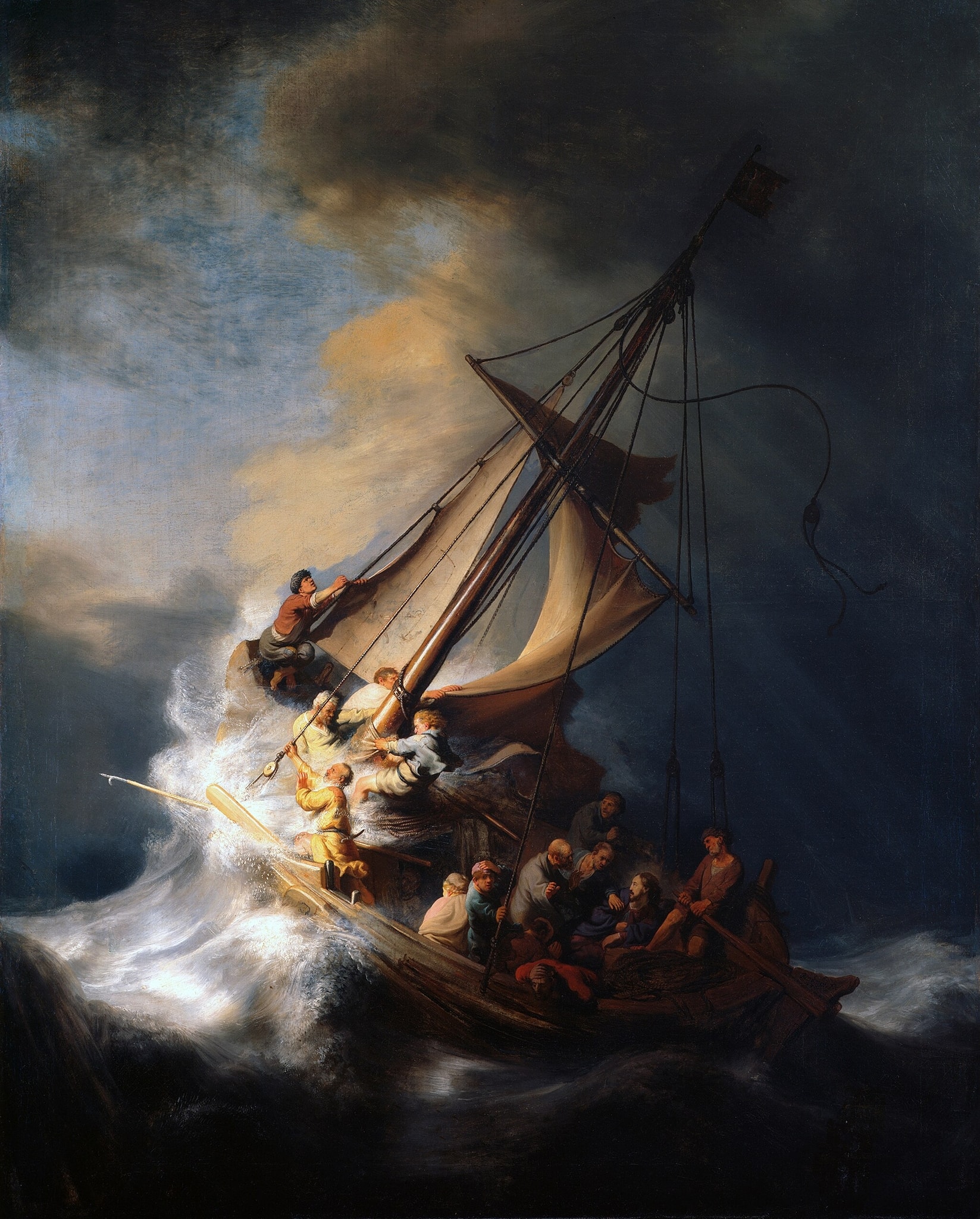
The Storm on the Sea of Galilee by Rembrandt van Rijn (1633) featuring Christ’s calm figure, Torn mainsail and frayed rigging, Raging wave at the bow, Helmsman straining at the rudder

Click on any numbered symbol to learn more about its meaning

Meaning & Symbolism

Rembrandt builds the drama on a pitched diagonal that launches from the foaming wave at lower left, climbs the boat’s bow, and rockets up the mast where torn canvas and whipping stay describe a spiraling, unnatural thrust. Scholars have noted that the nautical details are deliberately heightened, not documentary; the frayed rigging, overstrained spar, and snapping pennant amplify a centripetal chaos that no human seamanship can master 3. At deck level, figures perform a taxonomy of panic: a man retches over the gunwale, others haul futilely at the sheets, and the helmsman braces against a rudder nearly wrenched from his control. One sailor, gripping a rope and steadying his cap, twists to meet our gaze—an insertion that resembles Rembrandt’s own features and functions as a beholder’s gateway; we are conscripted into the crisis, our fear counted among the crew 1. Against this vortex, Christ sits low and slightly right of center, his calm profile and loosely gathered robe forming the composition’s still axis. Rembrandt’s chiaroscuro is not mere description: a troubled beam glances across the sail and storm-spray, skims terrified faces, then softens around Christ’s group, staging a transition from frenzy to quiet resolve—the pedagogy of light itself 13. Crucially, the narrative moment is neither slumber nor command but the threshold between them. By choosing the second when Christ is newly awakened and the question of care—“Teacher, do you not care that we are perishing?”—still hangs in the air, Rembrandt maximizes identification with the disciples’ doubt while preparing the turn to deliverance 3. The boat thus reads as more than a vehicle; it becomes a compact of vulnerable community pitched toward unseen rocks at left, a metaphor for collective peril that early viewers would have recognized from Gospel exegesis and devotional habit 1. The light that grazes several crewmen alongside Christ intimates that grace is already operative within the storm, not merely after it. Formally, the rare vertical format—unusual for marine subjects—funnels force upward while compressing the crew into an intimate theater of expressions typical of Rembrandt’s early Amsterdam style: polished surfaces, saturated color in the yellow and blue garments near the prow, and a dramaturgy of faces that each registers a distinct spiritual state 14. Even the signature, placed on the rudder within the vessel, wittily locates authorship at the point of human control that is failing, underscoring the theme of sovereignty displaced from man to God 2. As a history painting from 1633, early in Rembrandt’s Amsterdam ascent, the work asserts that sacred narrative can be made present—not remote—through sensory immediacy. That claim, realized here with unmatched marine ferocity, explains the painting’s enduring status: it is both a bravura performance of Baroque pictorial rhetoric and a condensed spiritual psychology of crisis and assurance 14. Its later fate—stolen and still missing—has only sharpened the picture’s emblematic power, leaving an empty frame that testifies to absence while the composition itself argues for a calm that exceeds loss 12.

Explore Deeper with AI

Ask questions about The Storm on the Sea of Galilee

Popular questions:

Powered by AI • Get instant insights about this artwork

💬 Ask questions about this artwork!

Interpretations

Formal Genealogy: From de Vos’s Print to Rembrandt’s Vertical Maelstrom

Rembrandt’s rare vertical marine owes a compositional debt to a print engraved by Adriaen Collaert after Maerten de Vos, where a forward‑tilting boat seeds the upsurge he radicalizes. But he intensifies the model’s oblique thrust into a near‑catastrophic axis, packing the hull with differentiated heads and converting print contours into painterly torque—ripped canvas, whipping stay, and a mast that drills the sky. This is not derivative quotation but transformative appropriation: the print’s narrative scaffold becomes a Baroque engine of motion whose vortex is theological as much as optical. The shift from a reproducible engraving to oil’s sensuous surface also heightens immediacy, aligning with Rembrandt’s stated ambition that sacred history be experienced as “present.” 135

Source: ISGM (object essay) and influence studies via Maerten de Vos/Collaert

Expressive Inaccuracy: Nautical ‘Errors’ as Baroque Rhetoric

John Walsh argues that the stressed spar, frayed rigging, and torn sail are deliberately non‑documentary, engineered to produce a rising, centripetal spiral that no real skipper would contrive—and no human hand can master. These distortions function like Baroque hyperbole: exaggeration that clarifies the drama’s moral physics by making the storm legible as disorder itself. In this reading, the boat is a rhetorical instrument—its anatomy bent to visualize the transfer of sovereignty from man’s failing rudder to divine command. The “mistakes” thus operate as sign‑systems, not blunders, turning maritime material into a grammar of spiritual crisis. 31

Source: John Walsh, Notes in the History of Art (1985); ISGM

Market and Medium: Early Amsterdam Bravura as Credo

Painted in 1633 during Rembrandt’s first Amsterdam years, the picture doubles as a manifesto of history painting amid a market dominated by portraiture and genre. The polished surface, saturated blues and yellows, and a crowded theater of physiognomies advertise virtuosity to patrons while asserting that biblical narrative can be made present through sensory force. This commercial and artistic gamble coincides with Rembrandt’s ascent in Hendrick Uylenburgh’s circle, where display pieces signaled capacity for complex commissions. The lone painted seascape in his oeuvre, it compresses genre boundaries—marine, portrait‑like heads, and sacred history—into a single bravura claim about what oil on canvas can do. 124

Source: ISGM; FBI (only seascape); Britannica (First Amsterdam period)

Theology of Light: From Rebuke Imagined to Illumination Felt

Beyond chiaroscuro as atmosphere, the lighting behaves like didactic grace: a troubled beam rakes foam and faces before gentling near Christ, staging a pedagogy from panic to poise. Unlike depictions that show the verbal command, Rembrandt paints the pre‑verbal instant, letting light do anticipatory theology—an anagogic cue that quiet arrives before the word is spoken. This tactic folds exegesis into optics, aligning viewer perception with the disciples’ dawning comprehension. The result is not illustration of a miracle but the felt transition by which fear yields to trust, enacted via tone, edge, and reflected spray rather than speech. 13

Source: ISGM (Zell excerpt); John Walsh

Beholder Inside the Boat: Authorship, Address, and Devotion

The figure who turns outward while gripping a rope has features familiar from Rembrandt’s self‑portraits, functioning as a beholder’s gateway that drafts us into the crew’s count. This device fuses authorship and address: the painter‑witness mediates between sacred past and viewer present, collapsing devotional distance. Compounded by the witty placement of the signature on the rudder, authorship lodges where human control fails—an emblem that redirects mastery to Christ. The effect is catechetical but intimate: spectators are not observers of a tableau but implicated bodies in a listing hull, asked to rehearse the passage from alarm to reliance. 12

Source: ISGM; FBI image/inscription record

Afterlife of an Image: Theft, Absence, and the Work’s Aura

The Gardner heist (1990) displaced the painting into legend; the museum’s empty frame now stages a second drama in which absence performs presence. This unintended coda refracts Rembrandt’s theme—calm exceeding loss—through museological time: a public ritual of looking at what is not there. Law‑enforcement records fix the object as data (dimensions, signature), while the conserved frame functions as memorial reliquary, intensifying attention to the work’s theological claim that assurance can precede recovery. Thus the painting’s cultural meaning expanded after its disappearance, its aura reconstituted by narrative, vigil, and the hope of return. 261

Source: FBI National Stolen Art File; ISGM blog on the frames; ISGM object page

Related Themes

About Rembrandt van Rijn

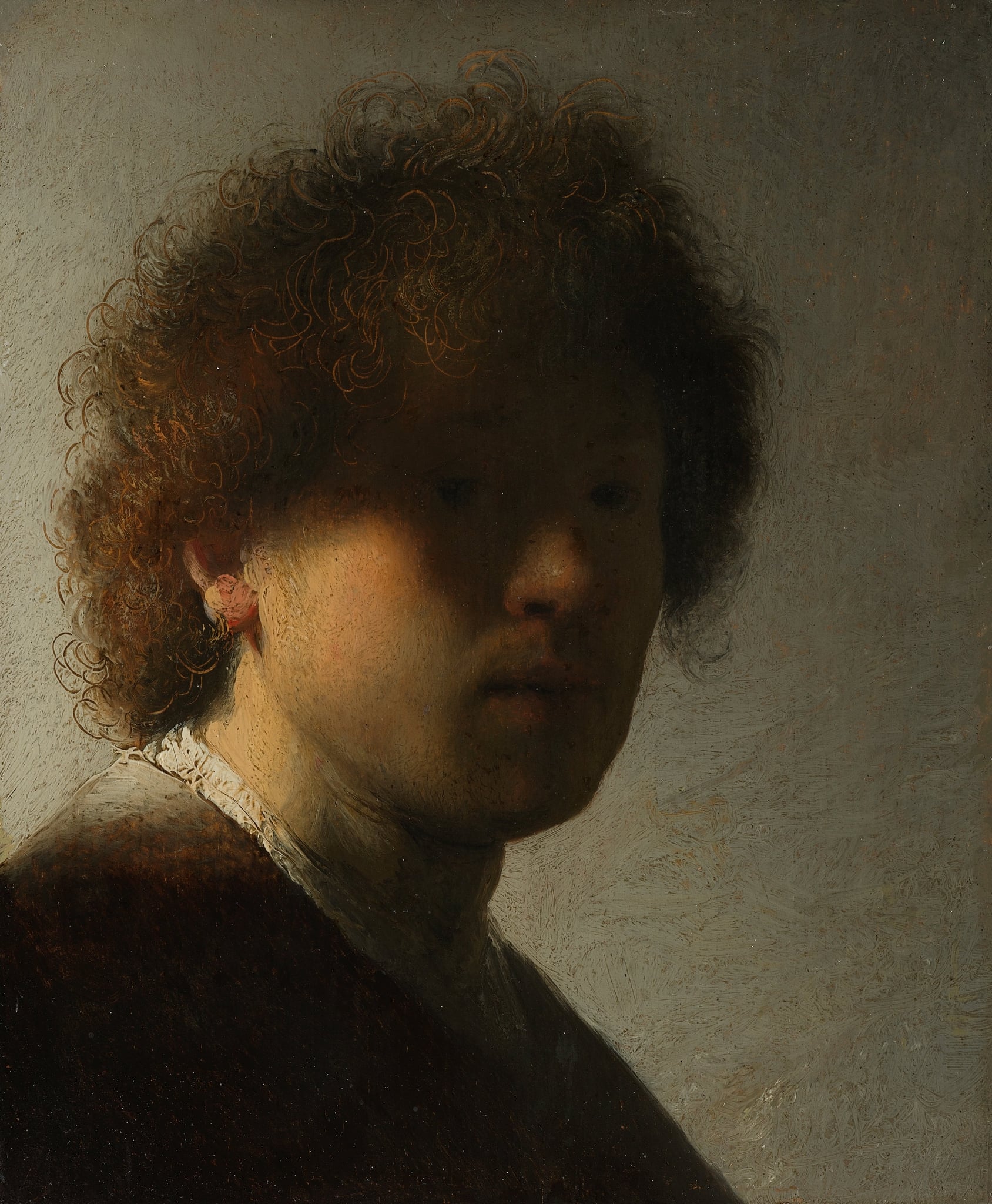
Rembrandt van Rijn (1606–1669) was a leading Dutch Golden Age painter and printmaker whose Amsterdam years (from 1631) produced virtuosic portraits and ambitious history paintings. In the early 1630s he favored polished finishes, saturated color, and theatrical staging—qualities on display in this 1633 canvas. Although prolific, this is his only known painted seascape [2][4].
View all works by Rembrandt van Rijn