The Jewish Bride

by Rembrandt van Rijn

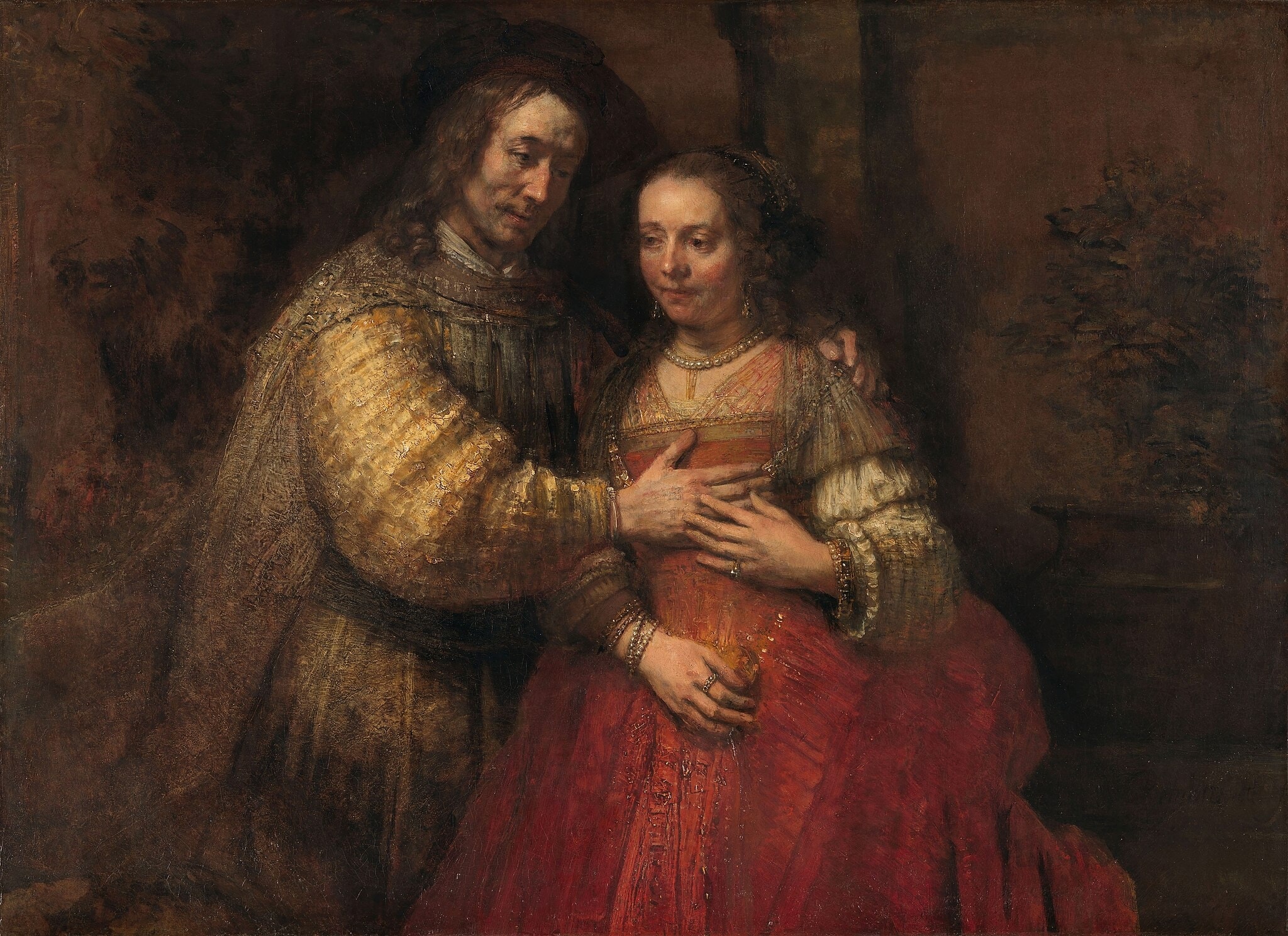
The Jewish Bride by Rembrandt van Rijn stages an intimate covenant: two figures, read today as Isaac and Rebecca, seal their union through touch rather than spectacle. Light concentrates on faces and hands, while the man’s glittering gold sleeve and the woman’s coral-red gown turn paint itself into a metaphor for fidelity and tenderness [1][3]. This late masterpiece embodies Rembrandt’s material eloquence—impasto as feeling—within a hushed, dark setting [1][2].

Fast Facts

Year
c. 1665–1669
Medium
Oil on canvas
Dimensions
121.5 × 166.5 cm
Location
Rijksmuseum, Amsterdam
The Jewish Bride by Rembrandt van Rijn (c. 1665–1669) featuring Interlocked hands over the chest, Gold brocade sleeve, Coral-red gown, Rings and pearls

Click on any numbered symbol to learn more about its meaning

Meaning & Symbolism

Rembrandt van Rijn composes The Jewish Bride as a drama of touch, not pageantry. The figures fill the frame, pressed forward by a nearly abstract brown ground that withholds narrative distraction. The man’s broad right hand spreads across the woman’s chest, splayed but gentle; her right hand rests over his with a measured pressure, while her left hand gathers the lower bodice, just above the abdomen. These three hands create a triangular fulcrum at the painting’s center, declaring consent, modesty, and fidelity in one interlocked sign. Their downcast eyes and closed mouths sustain the vow’s interiority: love here is ethical and sober, not theatrical. This aligns with the dominant identification of the couple as Isaac and Rebecca, whose concealed marriage is discovered by Abimelech—a story that encodes both modest reserve and conjugal tenderness 13. Rembrandt’s late technique makes that ethical meaning palpable. The man’s sleeve is a feat of impasto—thickly troweled, then incised—so that gold brocade seems to crystallize out of light itself. The paint’s ridges catch illumination and release it in flakes, a visual analogue for steadfastness: a protective arm rendered as near-armor, yet softened by warmth 12. By contrast, the woman’s coral-red gown is worked in granular layers and fine strokes, its beaded seams and embroidered panels vibrating under the light. These opposed surfaces—shingled gold versus thready red—embody a dialectic of protection and receptivity. Faces and hands are modeled more softly, their half-tones breathing; Rembrandt withholds detail in the background so that agency (hands) and feeling (faces) become the only readable topography. Light thus functions like a blessing, isolating the covenantal sites of touch and turning paint into sacrament 13. The image refuses anecdote in favor of permanence. No wedding canopy, no crowd, no palace: only paired bodies steadied by gravity and grace. That restraint is a late-Rembrandt hallmark, forged after losses and reversals that intensified his pursuit of inwardness and radical handling of matter 4. Here, technique is meaning: scraped passages, scratches from the brush’s butt, and built-up ridges are not ornament but rhetoric. They slow the eye, asking us to dwell on the vow enacted by hands. The result is what critics have called one of art’s greatest expressions of the tender fusion of spiritual and physical love—a union that transcends any single identity or title 25. Even the painting’s contested nickname, “The Jewish Bride,” becomes a historical footnote to a deeper message: the scene’s true subject is covenant under light. This is why The Jewish Bride is important. It condenses narrative, psychology, and material invention into a single, steady pulse—the pressure of one hand upon another—where paint and promise become indistinguishable 123.

Explore Deeper with AI

Ask questions about The Jewish Bride

Popular questions:

Powered by AI • Get instant insights about this artwork

💬 Ask questions about this artwork!

Interpretations

Iconography and Title History

While the painting is nicknamed “The Jewish Bride,” the Rijksmuseum catalogs it as Isaac and Rebecca, aligning it with Genesis 26, where Abimelech discovers their concealed marriage. The identification is strengthened by a related Rembrandt drawing of the scene and by the picture’s modest, interior gestures that suit a narrative of hidden conjugal status. The now-rejected 19th‑century notion of a Jewish father and daughter at a wedding reflects period bias toward ethnographic reading, not iconographic evidence. Seeing the work as Isaac and Rebecca reframes the touch at the center: it is less ornament than proof of a union kept private—a theologically resonant privacy in Protestant Amsterdam. The title’s evolution, from misreading to scriptural pairing, tracks how modern scholarship prioritizes gesture and narrative congruence over anecdotal labels 12.

Source: Rijksmuseum; Smarthistory

Material Rhetoric (Late Rembrandt Facture)

The painting’s meaning is inseparable from its facture. The man’s sleeve is built with unusually thick impasto, likely palette‑knifed and incised, so that light shards across it like scaled armor; the woman’s gown is rendered in granular strokes that absorb and release light more softly. Rembrandt also scratches into wet paint and allows the ground to remain ambiguous, pushing the eye to hands and faces. This late technique is not flourish but rhetoric: viscosity and resistance slow looking, making us linger over touch as a covenantal act. Critics of “Late Rembrandt” have noted how these tactile surfaces convert costume into character, and light into ethical emphasis rather than spectacle. Material experiment thus functions as a moral technology that articulates protection and tenderness simultaneously 15.

Source: Rijksmuseum; Hyperallergic (Late Rembrandt coverage)

Historiated Portraiture and Role-Play

The couple’s elaborate dress signals the 17th‑century convention of historiated portraiture, where sitters assume biblical personae to inflect likeness with moral meaning. Rembrandt radicalizes the type by suppressing setting and incident, turning role‑play into moral psychology. The result is a paradox: an image that looks like a portrait yet reads like scripture embodied. Rather than court pageantry, Rembrandt offers a concentrated rite of touch that proposes identity as ethical relation, not social station. This approach matches his late practice of foregrounding inner states over recognizable spaces or props. The work thereby demonstrates how Baroque portrait strategies can be quietly subversive, relocating narrative power from external attributes to the performative ethics enacted by hands and gaze 12.

Source: Rijksmuseum; Smarthistory

Gendered Ethics of Touch

The three-hand triad—his splayed right hand on her chest, her right hand covering his, her left at the bodice—constitutes a choreography of consent and modesty legible to a Protestant audience that prized interior virtue. The man’s gilded, armored sleeve connotes protective agency, but its warmth and the woman’s measured pressure recalibrate power into reciprocity. Downcast eyes and closed mouths avert performative desire and instead anchor a conjugal ethic. This reading aligns with the Isaac‑Rebecca narrative (a private marriage made public) and with Rembrandt’s late emphasis on psychological restraint. In this lens, touch is both gendered and equalizing: assertion met by assent, splendor tempered by humility, and intimacy rendered as a mutual vow rather than possession 23.

Source: Smarthistory; National Gallery (London)

Reception and the Modern Eye

From the 19th century onward, the painting’s tactile surfaces captivated artists. Van Gogh famously exalted Rembrandt’s late works, praising their spiritual intensity and the felt presence of paint—an early modern acknowledgment that surface can signify. That response anticipates later modernist values, where materiality and light guide meaning beyond literal narrative. Contemporary exhibitions of Late Rembrandt similarly underscore how scraped passages and impasto restructure viewing time, asking for contemplation rather than story. The Jewish Bride thus becomes a hinge between Baroque inwardness and modern sensibility: a work whose quiet drama of paint models how form can carry ethics, and how love—seen as covenant—can be rendered with matter as eloquently as with words 34.

Source: National Gallery (London); Van Gogh Letters

Related Themes

About Rembrandt van Rijn

Rembrandt van Rijn (1606–1669) was a leading Dutch Golden Age painter and printmaker whose Amsterdam years (from 1631) produced virtuosic portraits and ambitious history paintings. In the early 1630s he favored polished finishes, saturated color, and theatrical staging—qualities on display in this 1633 canvas. Although prolific, this is his only known painted seascape [2][4].
View all works by Rembrandt van Rijn

More by Rembrandt van Rijn
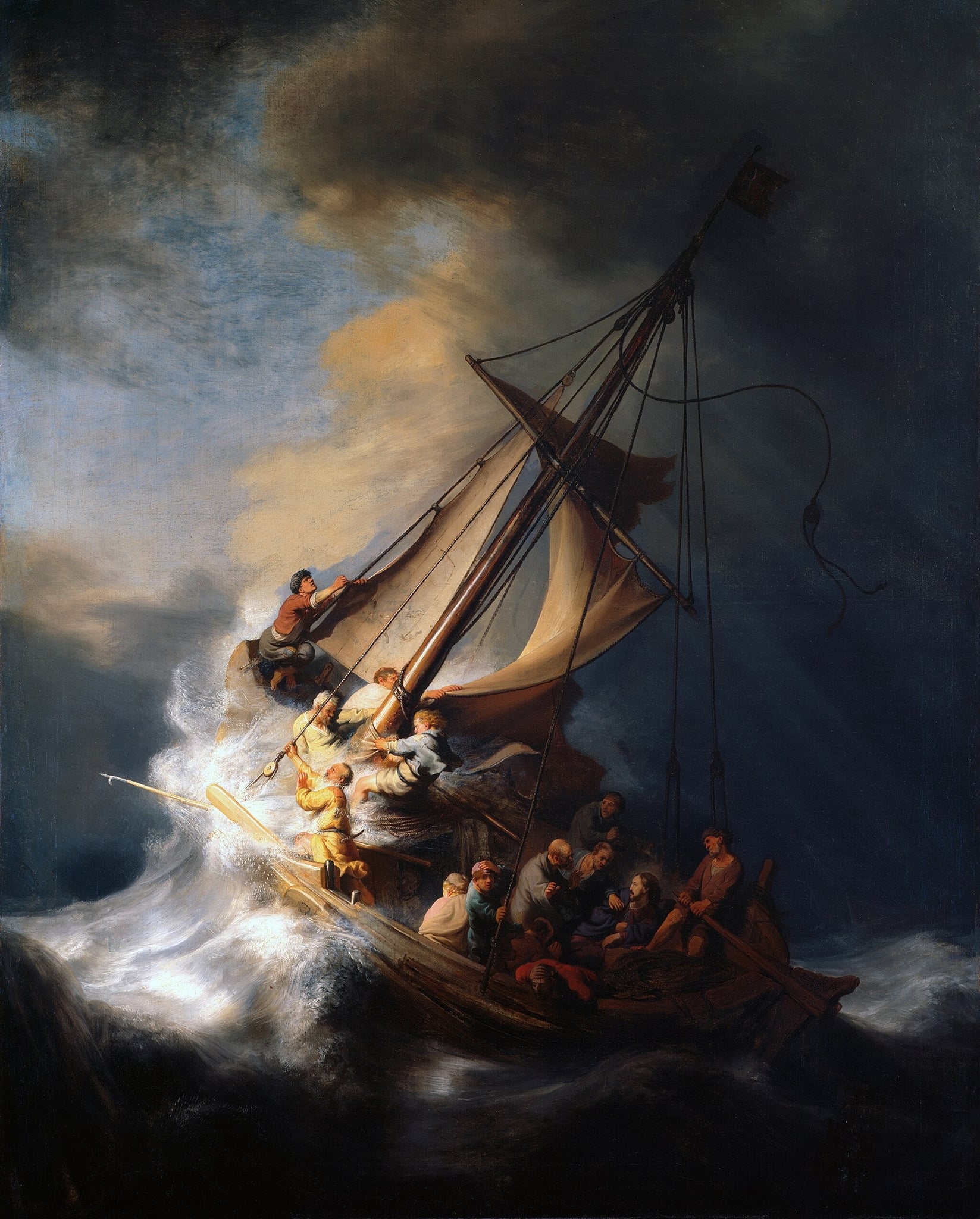
The Storm on the Sea of Galilee by Rembrandt van Rijn

The Storm on the Sea of Galilee

Rembrandt van Rijn (1633)

Rembrandt van Rijn’s The Storm on the Sea of Galilee stages a clash of <strong>human panic</strong> and <strong>divine composure</strong> at the instant before the miracle. A torn mainsail whips across a steeply tilted boat as terrified disciples scramble, while a <strong>serenely lit Christ</strong> anchors a pocket of calm—an image of faith holding within chaos <sup>[1]</sup><sup>[3]</sup>. It is Rembrandt’s only painted seascape, intensifying its dramatic singularity in his oeuvre <sup>[2]</sup>.

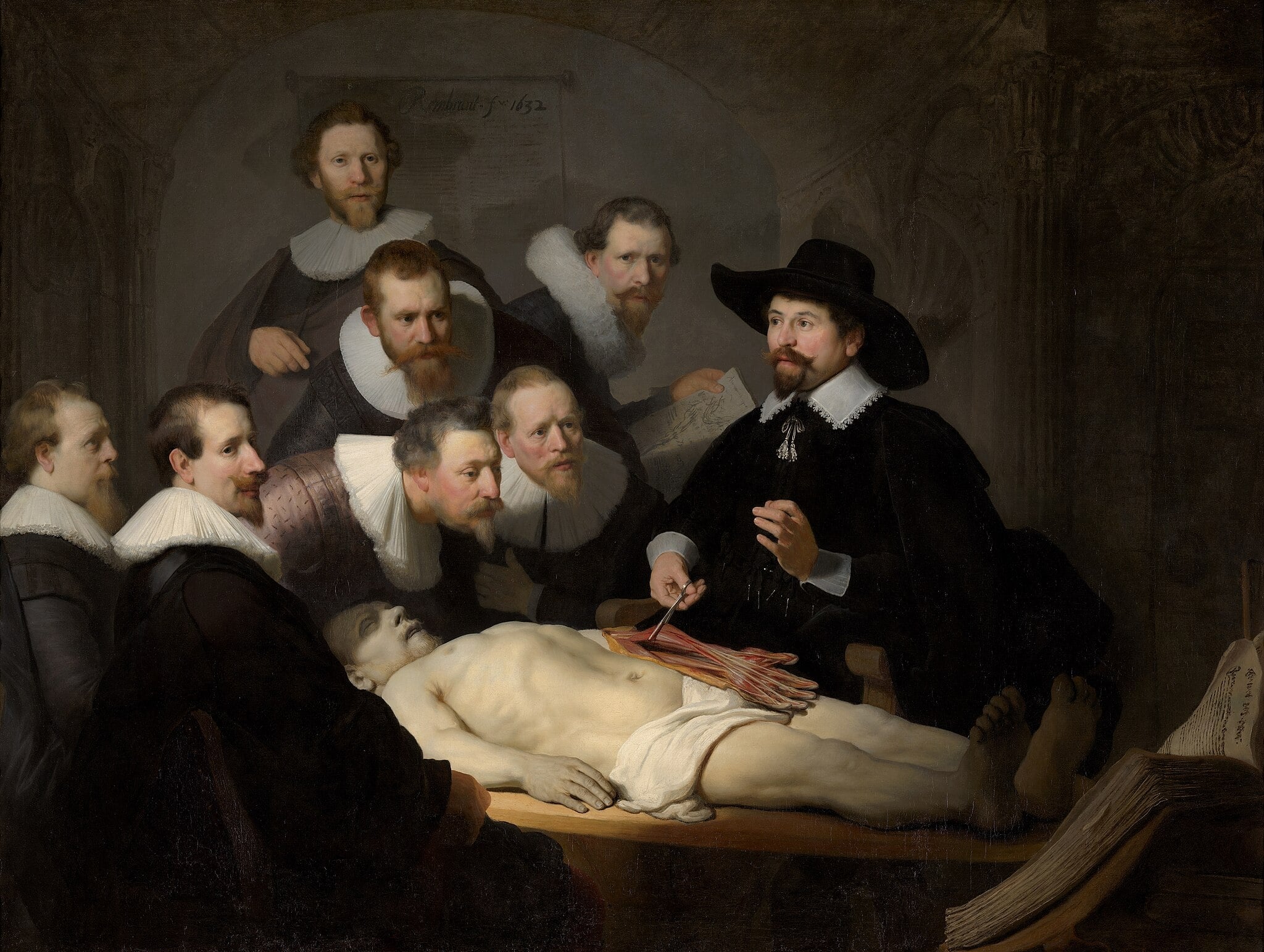
The Anatomy Lesson of Dr. Nicolaes Tulp by Rembrandt van Rijn

The Anatomy Lesson of Dr. Nicolaes Tulp

Rembrandt van Rijn (1632)

Rembrandt van Rijn turns a civic commission into a drama of <strong>knowledge made visible</strong>. A cone of light binds the ruff‑collared surgeons, the pale cadaver, and Dr. Tulp’s forceps as he raises the <strong>forearm tendons</strong> to explain the hand. Book and body face each other across the table, staging the tension—and alliance—between <strong>textual authority</strong> and <strong>empirical observation</strong> <sup>[1]</sup><sup>[2]</sup>.
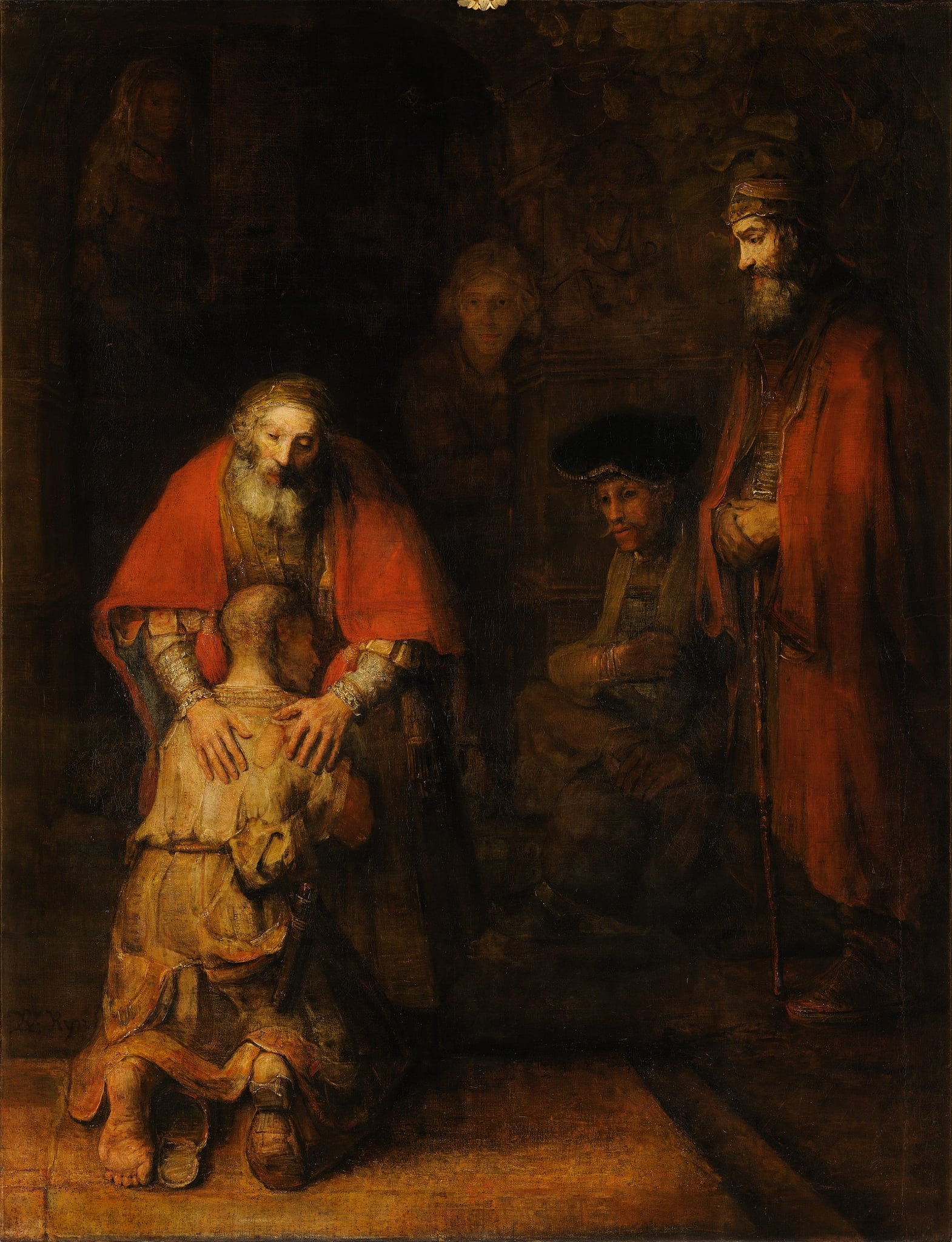
The Return of the Prodigal Son by Rembrandt van Rijn

The Return of the Prodigal Son

Rembrandt van Rijn (c. 1661–1669 (probably completed by 1669))

Rembrandt van Rijn’s The Return of the Prodigal Son is a late-life meditation on <strong>mercy</strong>, <strong>homecoming</strong>, and <strong>restored dignity</strong>. In a hush of dusk-like light, a ragged son kneels into his father’s <strong>embrace</strong>, while an upright elder brother holds back in shadow. The image concentrates meaning in illuminated <strong>faces, hands, and feet</strong>, turning a parable into a timeless human reckoning. <sup>[1]</sup><sup>[2]</sup>