The Return of the Prodigal Son

by Rembrandt van Rijn

Rembrandt van Rijn’s The Return of the Prodigal Son is a late-life meditation on mercy, homecoming, and restored dignity. In a hush of dusk-like light, a ragged son kneels into his father’s embrace, while an upright elder brother holds back in shadow. The image concentrates meaning in illuminated faces, hands, and feet, turning a parable into a timeless human reckoning. [1][2]

Fast Facts

Year
c. 1661–1669 (probably completed by 1669)
Medium
Oil on canvas
Dimensions
262 × 205 cm
Location
The State Hermitage Museum, Saint Petersburg
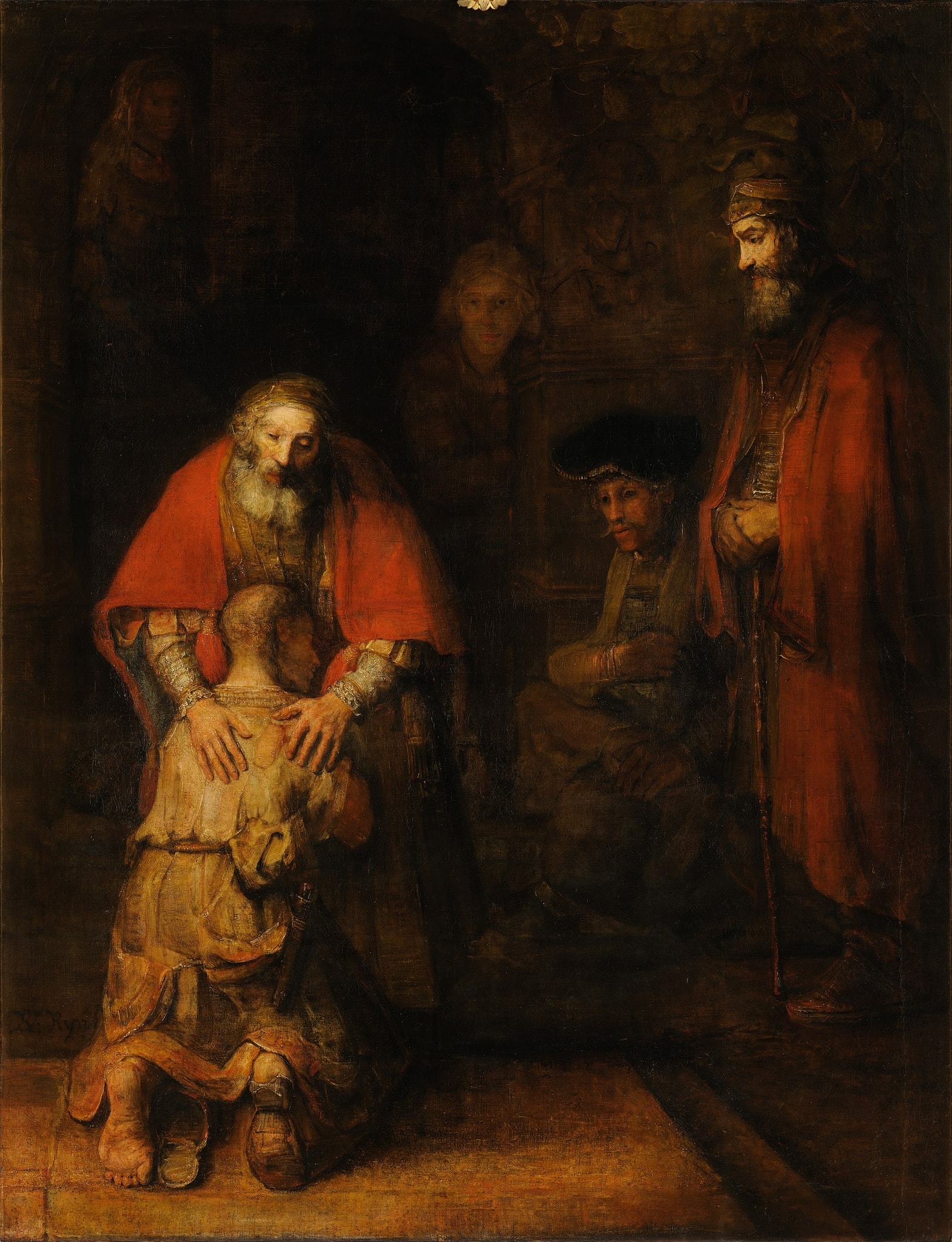
The Return of the Prodigal Son by Rembrandt van Rijn (c. 1661–1669 (probably completed by 1669)) featuring Father’s two distinct hands, Red mantle (father’s cloak), Ruined footwear and bare foot of the son, Shorn head pressed to the father

Click on any numbered symbol to learn more about its meaning

Meaning & Symbolism

Rembrandt compresses the entire parable into one decisive embrace and lets light assign its values. The kneeling son’s shorn head, torn layers of clothing, and ruined footwear—one shoe slipped, the other barely intact—announce total depletion; he is out of resources and arguments. The father stoops in a sheltering arc, his red mantle glowing like a hearth in the gloom, and places two distinct hands upon the boy’s back: one broadly modeled, the other rendered slimmer and gentler. Henri Nouwen famously read this asymmetry as a union of firm justice and tender mercy, an influential reception that has shaped modern understanding of the image, even as it remains interpretive rather than technical fact. The illumination concentrates on faces, hands, and feet—the sites of recognition, blessing, and journey—so that vision, touch, and the trace of the road become the grammar of reconciliation. The scene unfolds at the threshold of a dark interior, a liminal space where exile turns to home and disgrace becomes identity restored. 135 The witnesses deepen the drama’s moral stakes. The elder brother stands apart, upright and self-contained, his red robe echoing but not sharing the father’s warmth. His clasped or contained posture signals withholden empathy and an accounting spirit; he is present but not participating, an embodied objection to gratuity. Seated figures in shadow lean forward with guarded curiosity, not celebration; they measure before they join. Rembrandt refuses spectacle and chooses solemn quiet: there is no feast, music, or motion—only the long duration of acceptance. This restraint belongs to his late style, forged after bankruptcy and grievous losses, when paint thickened, contours softened, and narratives slowed into contemplation. The canvas becomes a workshop for spiritual attention: viewers are trained to notice the father’s downward gaze, the son’s silent press into the chest, and the sandaled foot splayed forward like a period at the end of a sentence. Even small cues—the possible remnant of a dagger at the boy’s side, a relic of birth and squandered status—underscore that nobility returns not by right but by mercy. 246 Chiaroscuro here is not theatrical but declarative. Darkness withdraws everything that competes with the act of blessing; light anoints only what matters. The ground plane in front forms a kind of stage of conscience; the father and son stand on it fully, while the others hover in recess as if their moral positions are still undecided. In this calibrated geometry of nearness and distance, Rembrandt defines the community he believes in: one gathered by compassion rather than performance. The painting thus teaches that reconciliation is both event and disposition—the father’s hands do the work, the son consents to be held, and the elder brother must still decide. The lasting power and importance of The Return of the Prodigal Son arise from this ethical clarity: it visualizes a world in which dignity can be given back, not earned, and it invites viewers to choose whether they will join the embrace or remain in the shadows. 234

Explore Deeper with AI

Ask questions about The Return of the Prodigal Son

Popular questions:

Powered by AI • Get instant insights about this artwork

💬 Ask questions about this artwork!

Interpretations

Formal Analysis: Late-Style Material Devotion

Rembrandt’s late manner turns paint into pastoral action. Thickened impasto, softened contours, and a reduced narrative field create a hush where chiaroscuro becomes declarative rather than theatrical. The light does not dramatize but anoints—selectively blessing faces, hands, and feet while withdrawing distractions into a penumbral penitential. Such economy aligns with late Rembrandt’s move from anecdote to essence, a compression that retools Baroque spectacle into spiritual attention. The broad, absorbent reds and earthened blacks operate like liturgical colors; the surface alternates between scumbled roughness and velvety absorption, so that matter feels worked, weathered, and finally at rest. This is painting as benediction: form and facture conduct mercy to the eye, sustaining a prolonged, reverent beholding 12.

Source: National Gallery, London; National Gallery of Art, Washington

Iconography of Witnesses: Ethics of Spectatorship

The shadowed onlookers are not mere filler; they construct an ethic of looking. Positioned in recess, they embody responses that range from guarded curiosity to judgmental reserve, delaying the communal feast until the community’s conscience matures. Scholarly iconography has noted additional cues—such as a wall relief with a horn-playing figure in related treatments—which tie spectatorship to charity and moral discernment within Northern pictorial tradition. Read this way, the painting rehearses how publics form: not by noise, but by the hard work of measured seeing that must choose mercy before celebration. The main pair stands on a luminous stage of conscience; the rest hover offstage, still negotiating whether they will move from appraisal to participation 3.

Source: University of Michigan dissertation (1983)

Reception History: The ‘Two Hands’ Debate

Henri J. M. Nouwen’s influential meditation reads the father’s unequal hands as a union of firm justice and tender mercy, even hinting at a paternal/maternal polarity. This reading has shaped devotional reception and pastoral teaching, though it is interpretive rather than a conservation-based finding. Its endurance reveals how the work invites theological projection without collapsing into didacticism. Simultaneously, critical tradition (Janson; Rosenberg/Slive; Clark) has canonized the canvas for its solemnity—“a moment stretching into eternity”—underscoring the painting’s power to host layered meanings without forfeiting clarity. The two-hands debate thus marks a key chapter in the painting’s afterlife, where formal ambiguity becomes a catalyst for spiritual self-examination rather than a flaw in description 47.

Source: Henri J. M. Nouwen; Janson; Rosenberg/Slive; Kenneth Clark (via consolidated references)

Socio-Economic Ethics: Restitution Beyond Merit

Visual details—the shorn head, the fallen shoe, the other barely intact—index economic and moral exhaustion. Some commentators note a vestigial dagger hilt at the waist, a relic of squandered status: nobility that travel and folly could not erase. The father’s embrace reinstates rank by gift, not desert, articulating a counter-meritocratic economy where dignity can be given back, not earned. In this light, the elder brother’s distance reads as an audit of fairness: an insistence on proportionality that collides with grace’s asymmetry. Rembrandt converts the parable’s household into a critique of moral accounting, inviting viewers to weigh whether justice without mercy can ever rebuild a human commonwealth 56.

Source: The Christian Century; Camilliani Institute commentary

Spatial Liturgy: From Threshold to Altar

The architecture and floor form a processional theology. The embrace occurs on a clarified ground plane—a “stage of conscience”—as if the threshold of the house had become an altar. Darkness retracts anything extraneous, so that proximity equals conversion: those in light have crossed into participation, those recessed still negotiate their stance. This spatial homily, common to Rembrandt’s late works, recodes Baroque depth as moral distance, guiding the eye from skepticism to assent. The result is a liturgy of return conducted by light, in which composition, not rhetoric, catechizes the beholder into the works of mercy. The canvas thereby functions less as narrative illustration than as a rite of passage enacted before us 17.

Source: National Gallery, London; Web Gallery of Art (Rosenberg/Slive summary)

Temporal Psychology: The Long Now of Mercy

Critics have called this perhaps Rembrandt’s quietest painting, a “moment stretching into eternity.” That stretching is a psychological technology: motion is suspended so the mind can metabolize homecoming. The son’s bowed nape, the father’s downward gaze, and the splayed sandal operate as temporal anchors, slowing the scene to a devotional pace that aligns with the artist’s late-life losses and introspection. Instead of episodic narrative, we get durational presence—a time signature appropriate to reconciliation, which rarely happens at the speed of plot. The painting thus disciplines viewers into the patience that grace requires, transforming beholders from consumers of story into co-witnesses of a conversion unfolding in real time 247.

Source: National Gallery of Art, Washington; Janson and related canonical summaries

Related Themes

About Rembrandt van Rijn

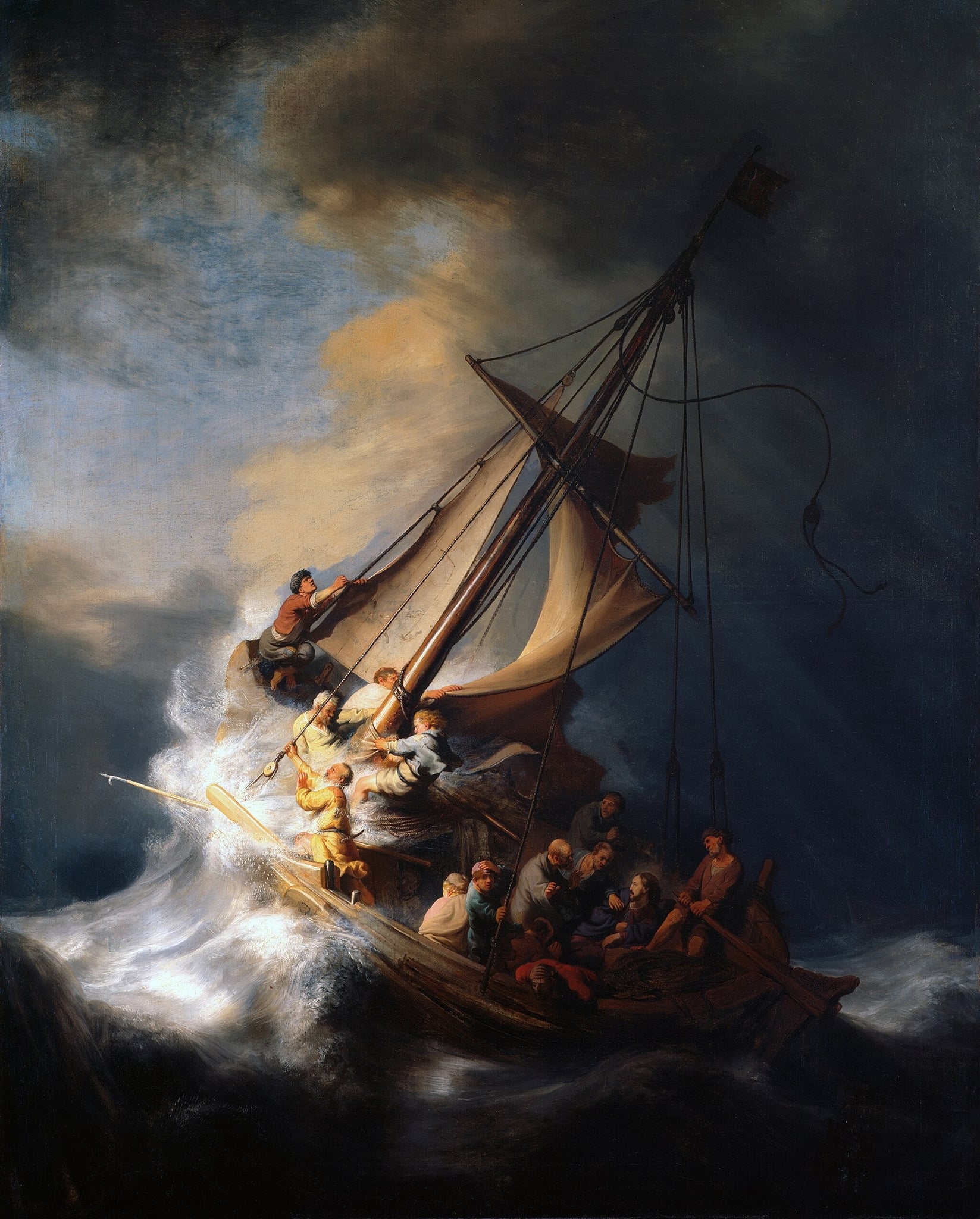
Rembrandt van Rijn (1606–1669) was a leading Dutch Golden Age painter and printmaker whose Amsterdam years (from 1631) produced virtuosic portraits and ambitious history paintings. In the early 1630s he favored polished finishes, saturated color, and theatrical staging—qualities on display in this 1633 canvas. Although prolific, this is his only known painted seascape [2][4].
View all works by Rembrandt van Rijn

More by Rembrandt van Rijn