Rembrandt van Rijn
Biography
Themes in Their Work
Where to See Rembrandt van Rijn's Paintings
Explore Rembrandt van Rijn's works on display in museums around the world.
Compare Rembrandt van Rijn
Most Expensive Rembrandt van Rijn Paintings
Explore ranked valuations of Rembrandt van Rijn's most valuable works →
Featured Artworks
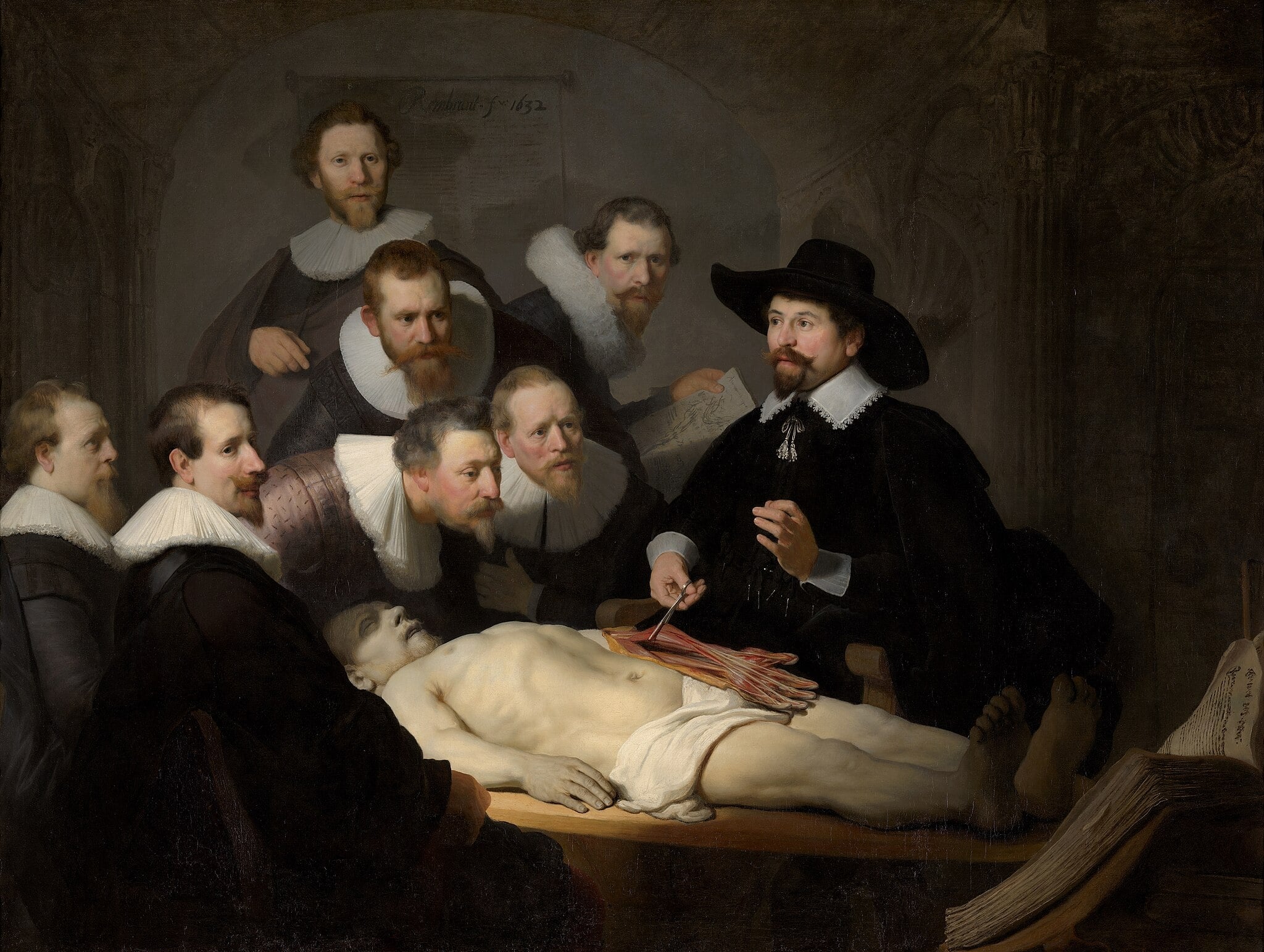
The Anatomy Lesson of Dr. Nicolaes Tulp
Rembrandt van Rijn (1632)
Rembrandt van Rijn turns a civic commission into a drama of <strong>knowledge made visible</strong>. A cone of light binds the ruff‑collared surgeons, the pale cadaver, and Dr. Tulp’s forceps as he raises the <strong>forearm tendons</strong> to explain the hand. Book and body face each other across the table, staging the tension—and alliance—between <strong>textual authority</strong> and <strong>empirical observation</strong> <sup>[1]</sup><sup>[2]</sup>.
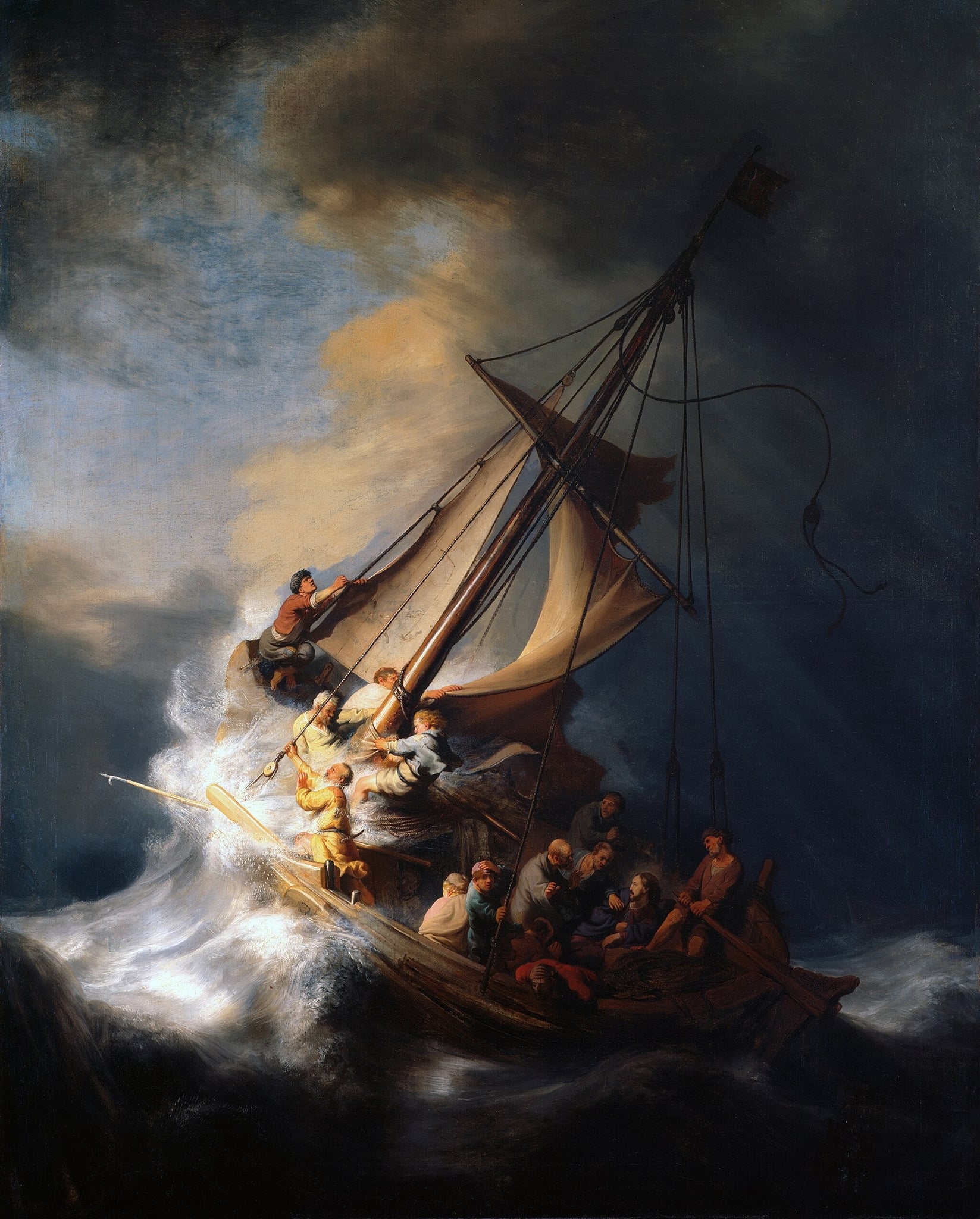
The Storm on the Sea of Galilee
Rembrandt van Rijn (1633)
Rembrandt van Rijn’s The Storm on the Sea of Galilee stages a clash of <strong>human panic</strong> and <strong>divine composure</strong> at the instant before the miracle. A torn mainsail whips across a steeply tilted boat as terrified disciples scramble, while a <strong>serenely lit Christ</strong> anchors a pocket of calm—an image of faith holding within chaos <sup>[1]</sup><sup>[3]</sup>. It is Rembrandt’s only painted seascape, intensifying its dramatic singularity in his oeuvre <sup>[2]</sup>.
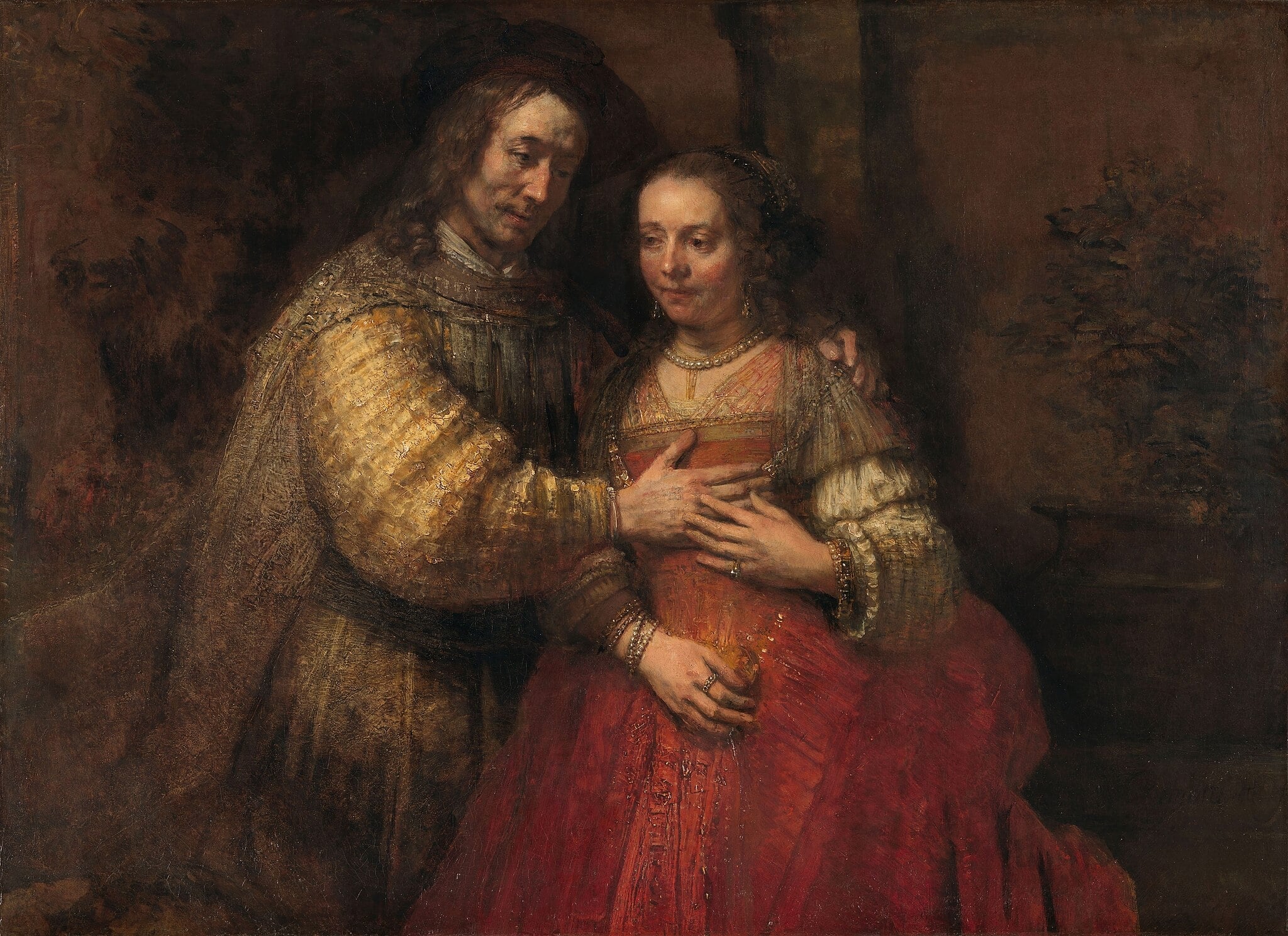
The Jewish Bride
Rembrandt van Rijn (c. 1665–1669)
The Jewish Bride by Rembrandt van Rijn stages an intimate covenant: two figures, read today as <strong>Isaac and Rebecca</strong>, seal their union through touch rather than spectacle. Light concentrates on faces and hands, while the man’s glittering <strong>gold sleeve</strong> and the woman’s <strong>coral-red gown</strong> turn paint itself into a metaphor for fidelity and tenderness <sup>[1]</sup><sup>[3]</sup>. This late masterpiece embodies Rembrandt’s <strong>material eloquence</strong>—impasto as feeling—within a hushed, dark setting <sup>[1]</sup><sup>[2]</sup>.
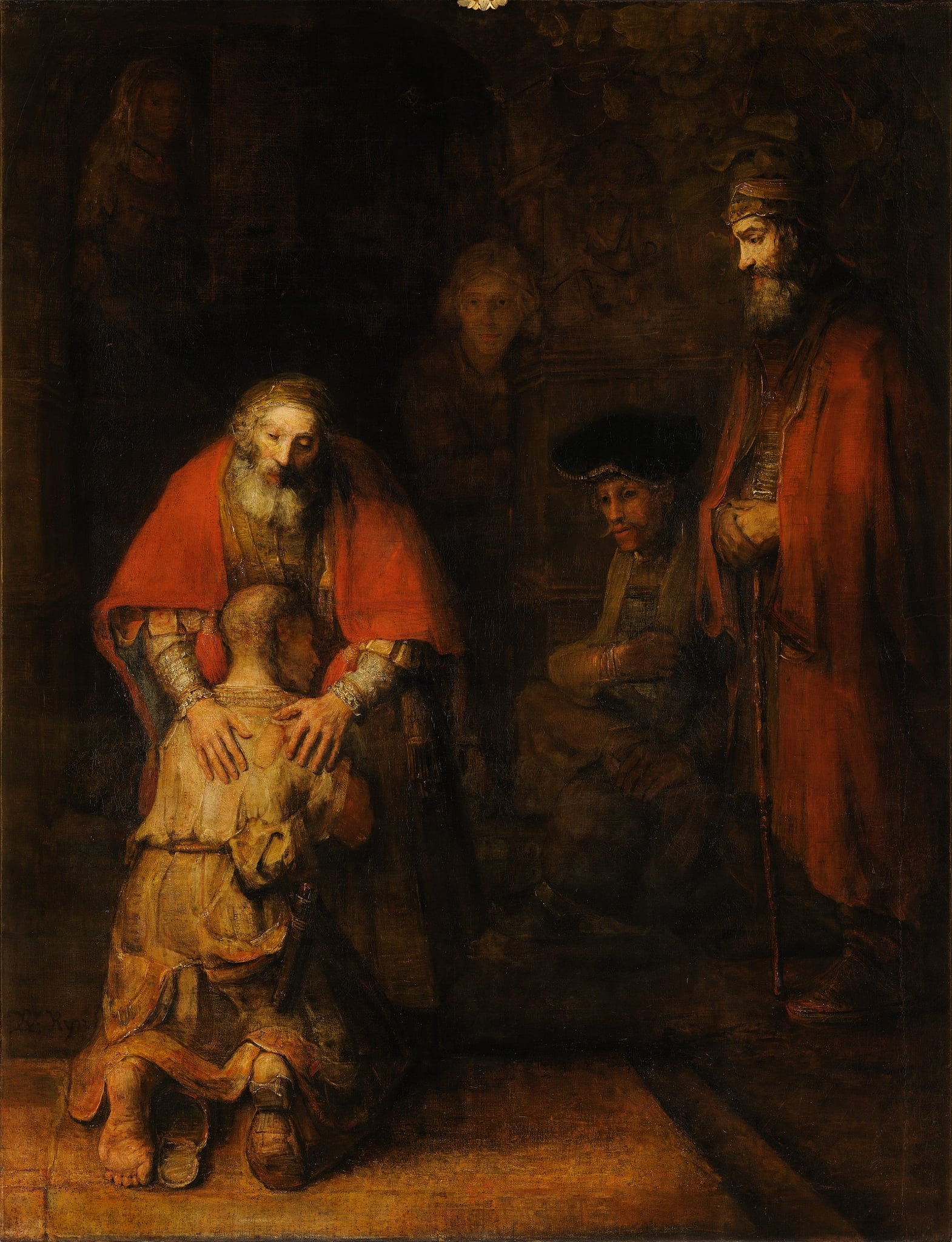
The Return of the Prodigal Son
Rembrandt van Rijn (c. 1661–1669 (probably completed by 1669))
Rembrandt van Rijn’s The Return of the Prodigal Son is a late-life meditation on <strong>mercy</strong>, <strong>homecoming</strong>, and <strong>restored dignity</strong>. In a hush of dusk-like light, a ragged son kneels into his father’s <strong>embrace</strong>, while an upright elder brother holds back in shadow. The image concentrates meaning in illuminated <strong>faces, hands, and feet</strong>, turning a parable into a timeless human reckoning. <sup>[1]</sup><sup>[2]</sup>
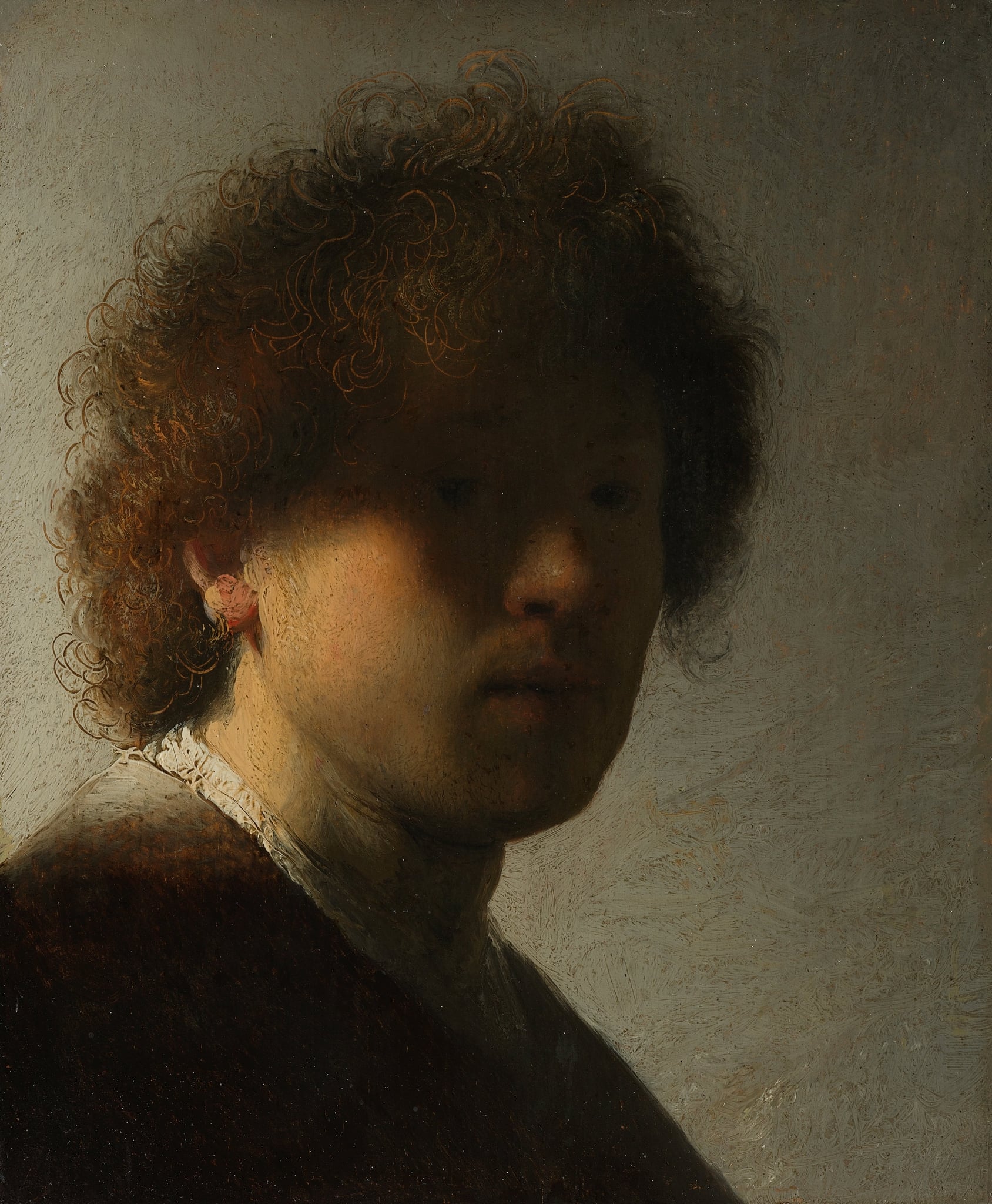
Self-portrait (with tousled hair)
Rembrandt van Rijn (c. 1628)
A young Rembrandt van Rijn tests how <strong>light both reveals and withholds</strong> by letting his face emerge from darkness while his <strong>scratched, backlit curls</strong> flare like a rough halo. The small oak panel makes <strong>process itself the subject</strong>, turning hair, stubble, and a raking highlight into a statement of identity-in-formation <sup>[1]</sup><sup>[5]</sup>.
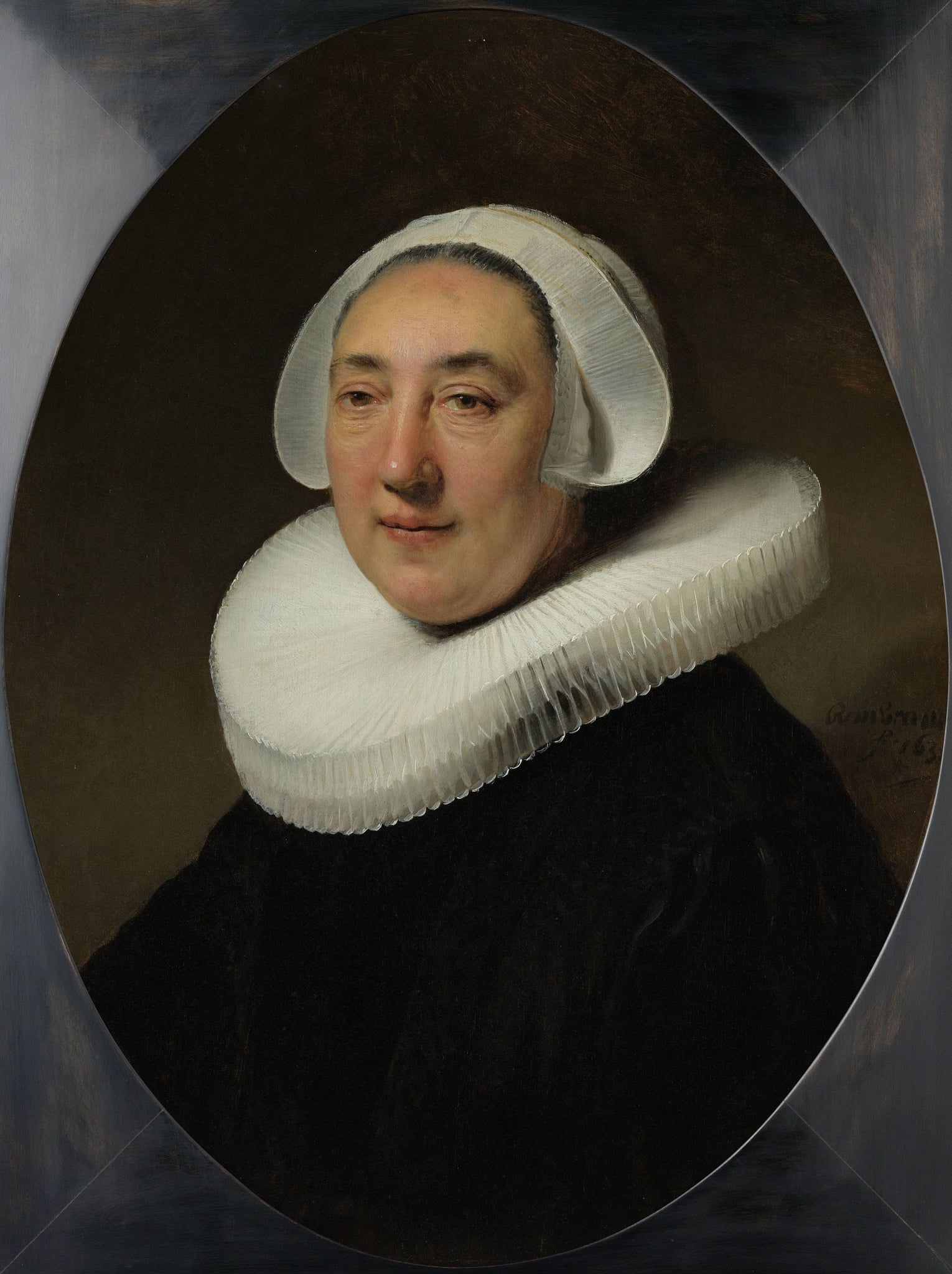
Portrait of Haesje Jacobsdr van Cleyburg
Rembrandt van Rijn (1634)
Rembrandt’s 1634 Portrait of Haesje Jacobsdr van Cleyburg stages a Dutch burgher within a feigned <strong>oval</strong> opening, illuminated by selective <strong>chiaroscuro</strong> that models warm skin against brilliant <strong>millstone ruff</strong> and sober black dress. The painting balances <strong>modesty and status</strong>, making virtue visible while quietly declaring prosperity through immaculate linen and craft <sup>[1]</sup><sup>[4]</sup>.
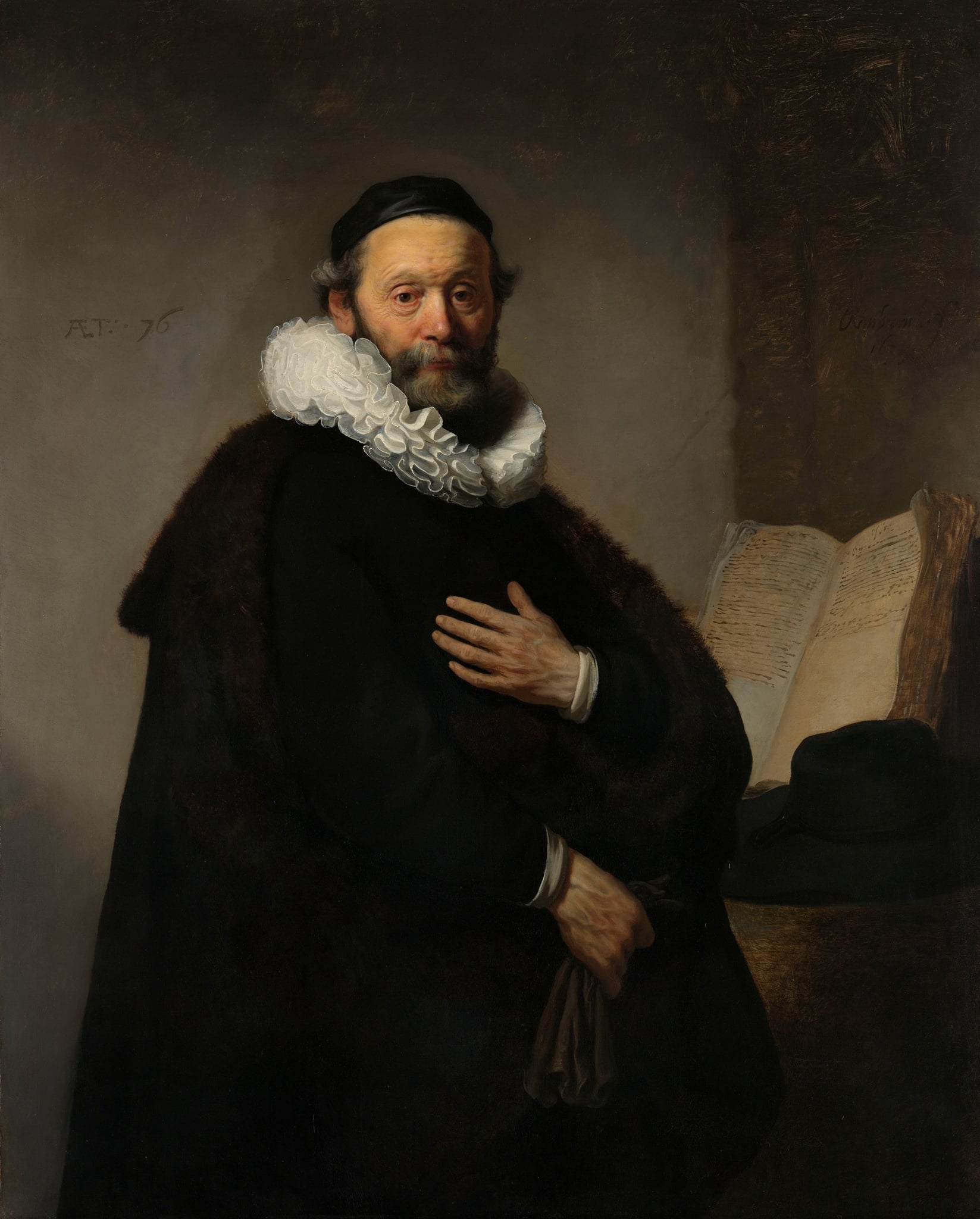
Johannes Wtenbogaert
Rembrandt van Rijn (1633)
Rembrandt van Rijn casts the Remonstrant minister as a study in <strong>moral authority</strong> and <strong>conscience</strong>. A raking light isolates the creased face, cloudlike ruff, and pale hands against the weight of a dark fur-lined cloak, while an open book and a plain hat anchor the scene in <strong>learning</strong> and <strong>humility</strong> <sup>[1]</sup>. The held glove acknowledges worldly status even as the hand to the chest declares inner conviction <sup>[1]</sup><sup>[3]</sup>.
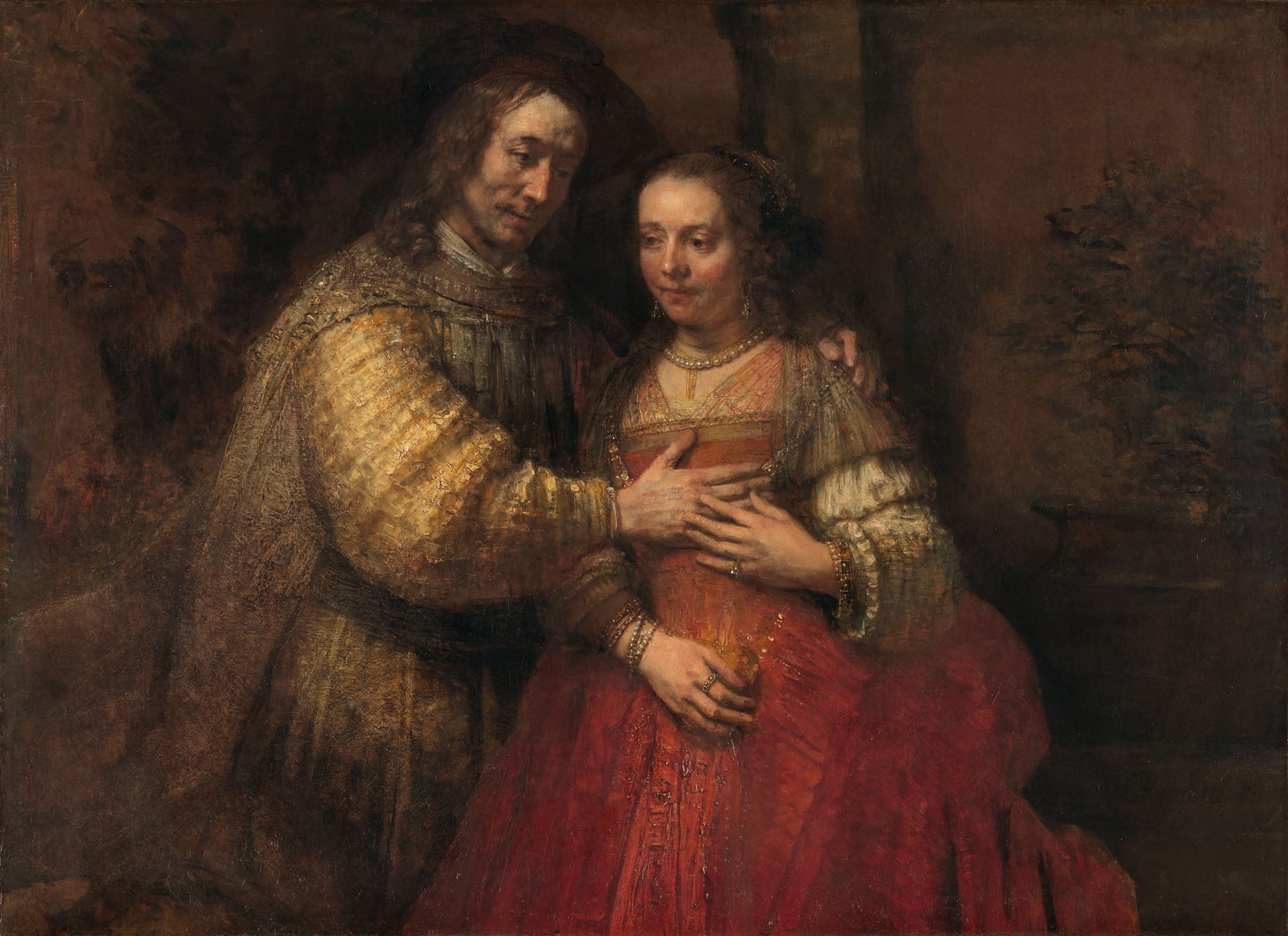
Isaac and Rebecca, Known as ‘The Jewish Bride’
Rembrandt van Rijn (c. 1665–1669)
Rembrandt van Rijn’s Isaac and Rebecca, Known as <strong>‘The Jewish Bride’</strong> crystallizes marriage as a covenant of <strong>love, protection, and consent</strong>. In warm chiaroscuro, the man’s enclosing arm and open right hand meet the woman’s regulating left hand over her chest, while her other hand gathers the glowing red dress. The painting turns a biblical recognition scene into an intimate vow illuminated from within.
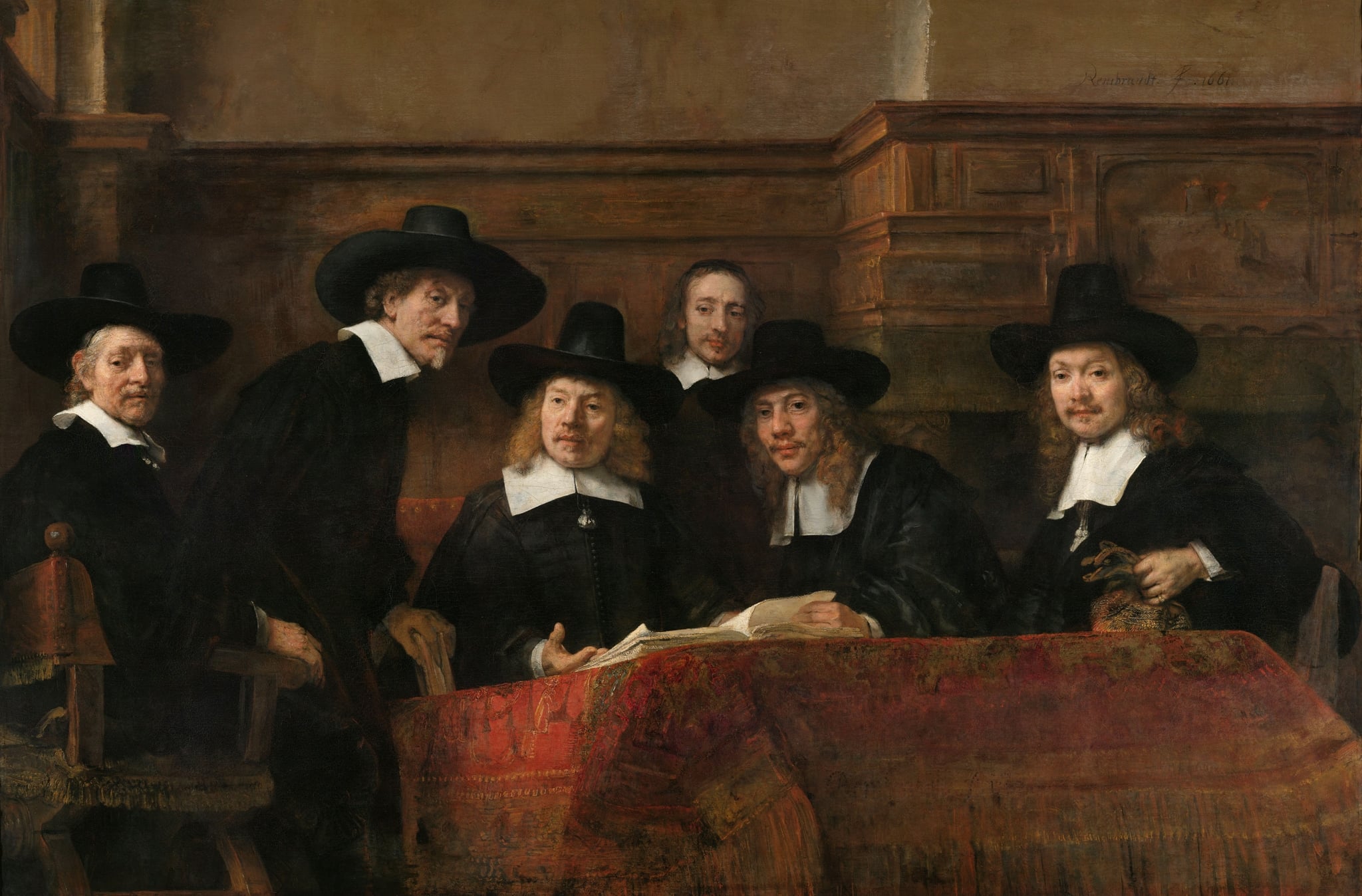
The Sampling Officials of the Amsterdam Drapers’ Guild, Known as ‘The Syndics’
Rembrandt van Rijn (1662)
Rembrandt van Rijn’s The Sampling Officials of the Amsterdam Drapers’ Guild, Known as ‘The Syndics’ (1662) stages a <strong>meeting interrupted</strong>: six guild officials glance up from an open <strong>stalenboek</strong> (sample book) atop a sumptuous <strong>Oriental carpet</strong>, as if a merchant has just entered. The low vantage and unified yet varied poses convert routine inspection into a drama of <strong>civic authority</strong> and <strong>public accountability</strong> <sup>[1]</sup>.
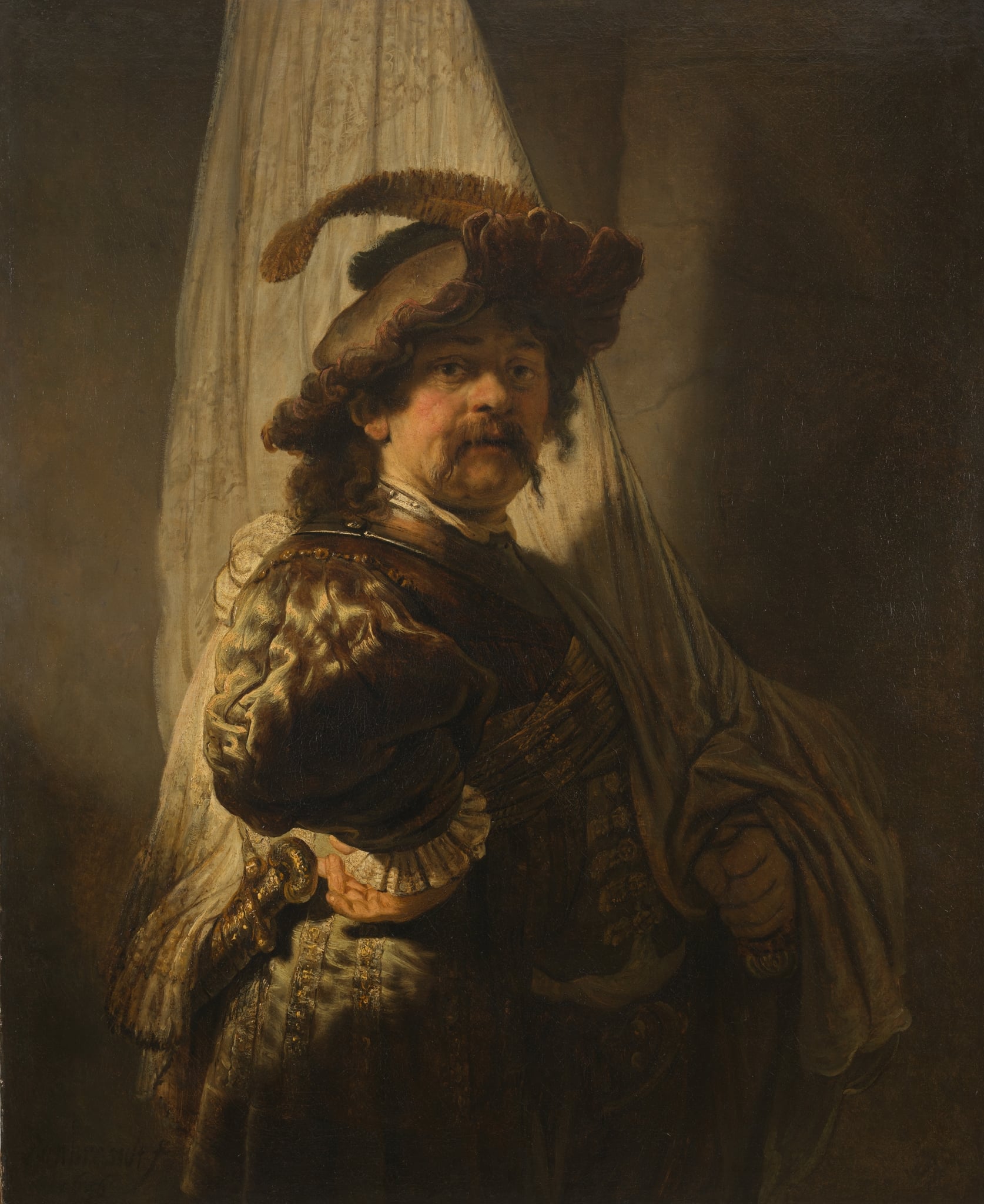
The Standard Bearer
Rembrandt van Rijn (1636)
Rembrandt van Rijn’s The Standard Bearer (1636) thrusts a single figure into a wedge of light, his satin sleeve and metal <strong>gorget</strong> flashing as the pale <strong>standard</strong> billows behind him. The diagonal flag and forward-leaning stance assert <strong>resolve</strong> and <strong>readiness</strong>, while the enveloping shadow and wary gaze convert civic office into a meditation on <strong>honor</strong> and the solitary <strong>weight of leadership</strong> <sup>[1]</sup><sup>[4]</sup>.
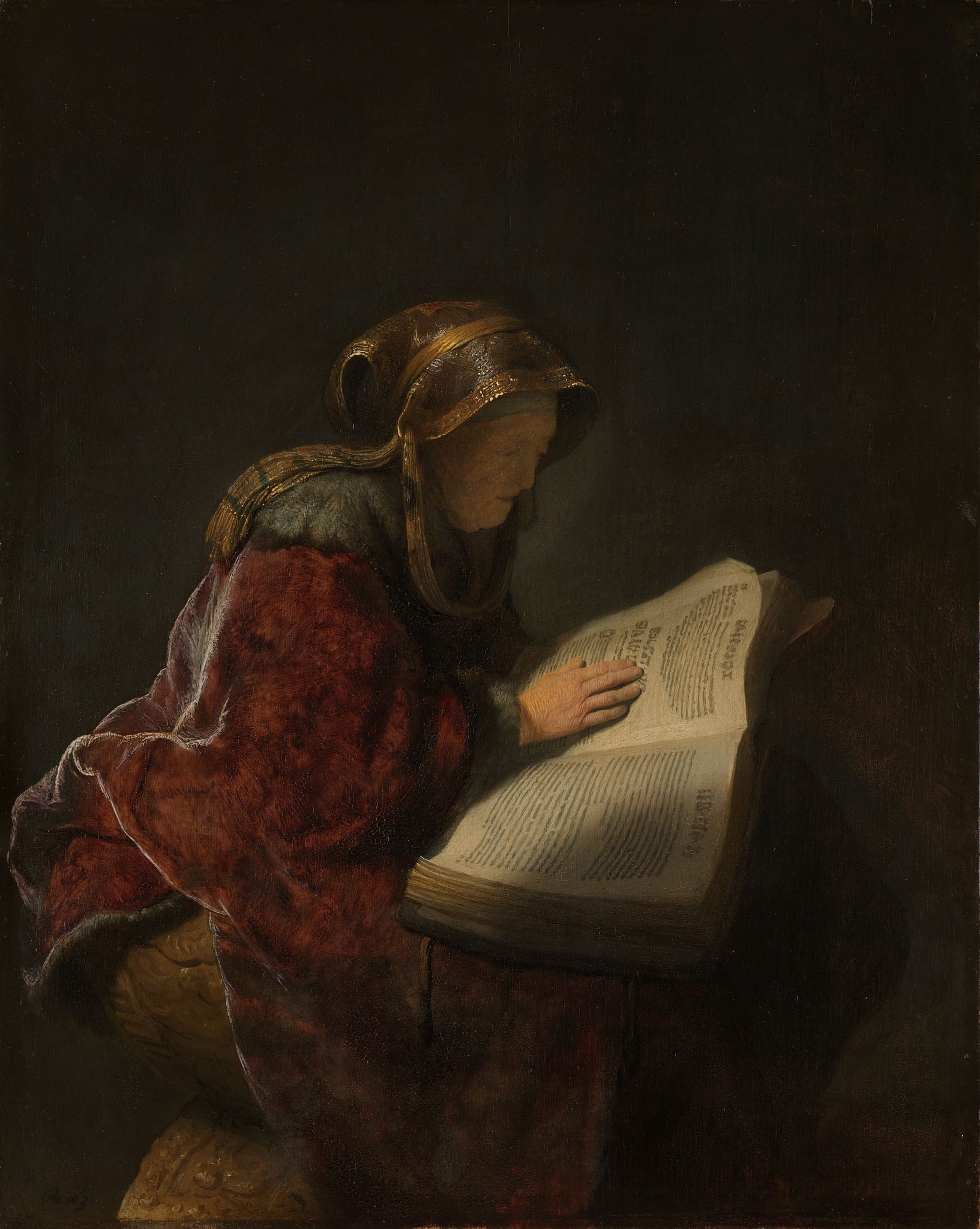
Old Woman Reading, Probably the Prophetess Anna
Rembrandt van Rijn (1631)
A solitary reader bends over a monumental book, its pages and her guiding finger catching the only concentrated light. Rembrandt van Rijn turns this quiet act into a scene of <strong>revelation</strong>, proposing the sitter as <strong>Anna the prophetess</strong>, whose lifelong devotion is embodied in the weight and glow of Scripture <sup>[1]</sup><sup>[4]</sup>.
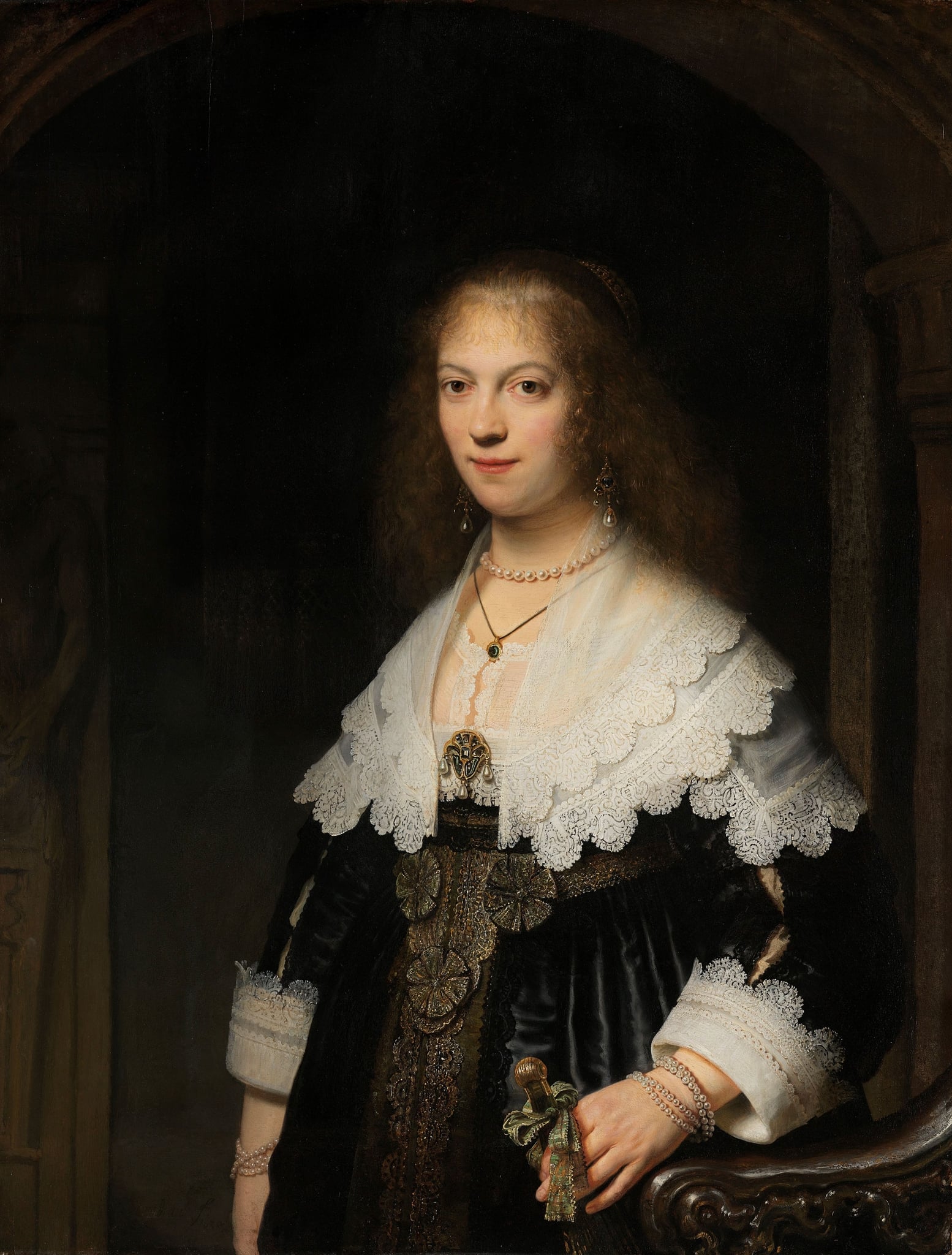
Portrait of a Woman, Probably Maria Trip
Rembrandt van Rijn (1639)
<strong>Portrait of a Woman, Probably Maria Trip</strong> crystallizes Rembrandt’s power to bind status and psyche: a young patrician steps from a dark stone recess into a clarifying beam, her face and hands carrying the drama. Black satin, sculpted lace, and glowing <strong>pearls</strong> register wealth, but the picture’s gravitational center is the sitter’s poised inner life <sup>[1]</sup>.
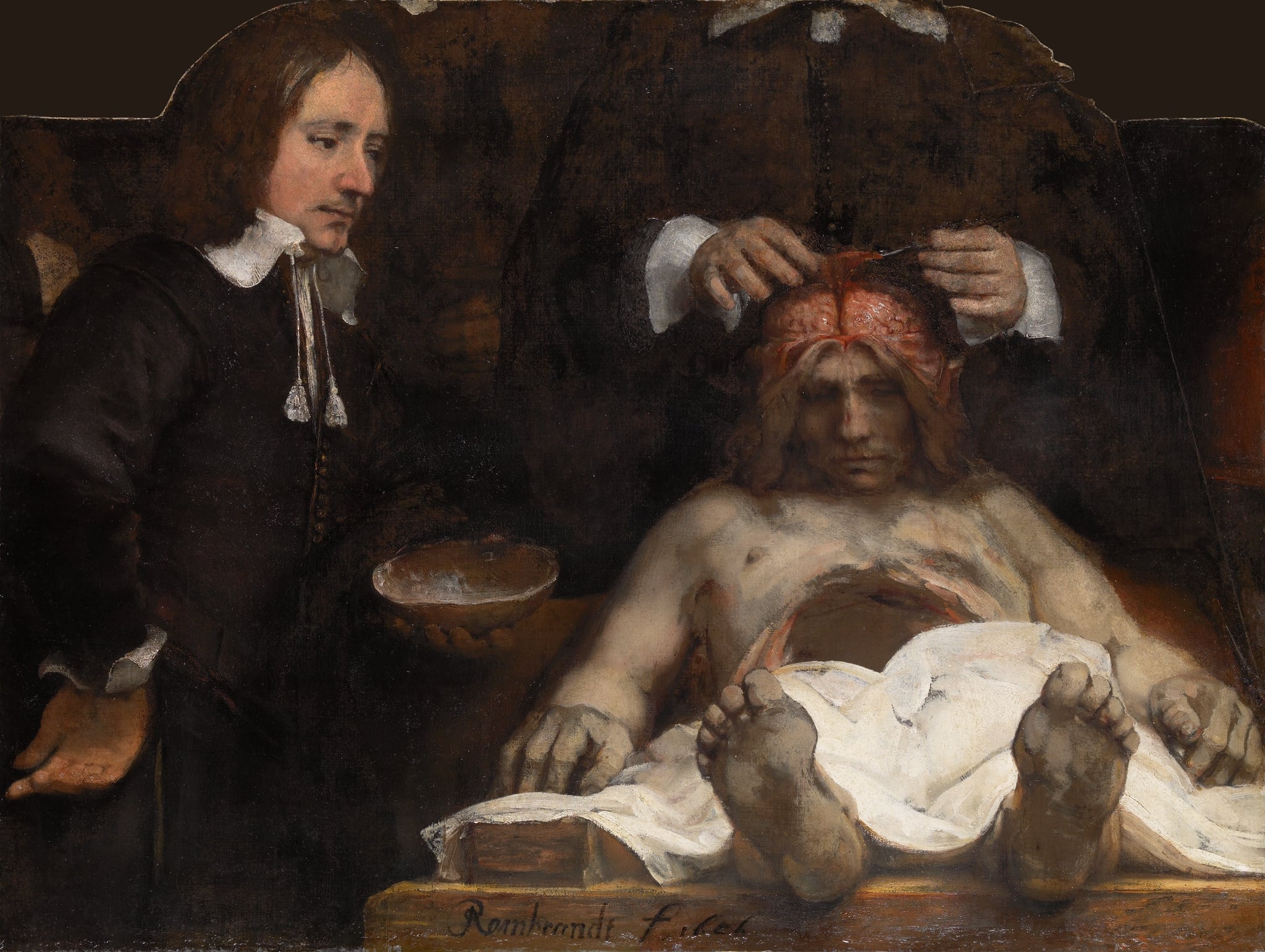
The Anatomy Lesson of Dr. Jan Deijman
Rembrandt van Rijn (1656)
Rembrandt van Rijn’s The Anatomy Lesson of Dr. Jan Deijman (1656) stages a public dissection in which the surgeon exposes the <strong>falx cerebri</strong> while a foreshortened corpse thrusts its feet toward us. The white sheet blazes under Rembrandt’s <strong>chiaroscuro</strong>, making inquiry itself the drama as instruments and cuffs emerge from shadow. What survives—now a fragment—is a riveting meditation on knowledge practiced at the edge of <strong>mortality</strong> <sup>[1]</sup><sup>[3]</sup><sup>[5]</sup>.
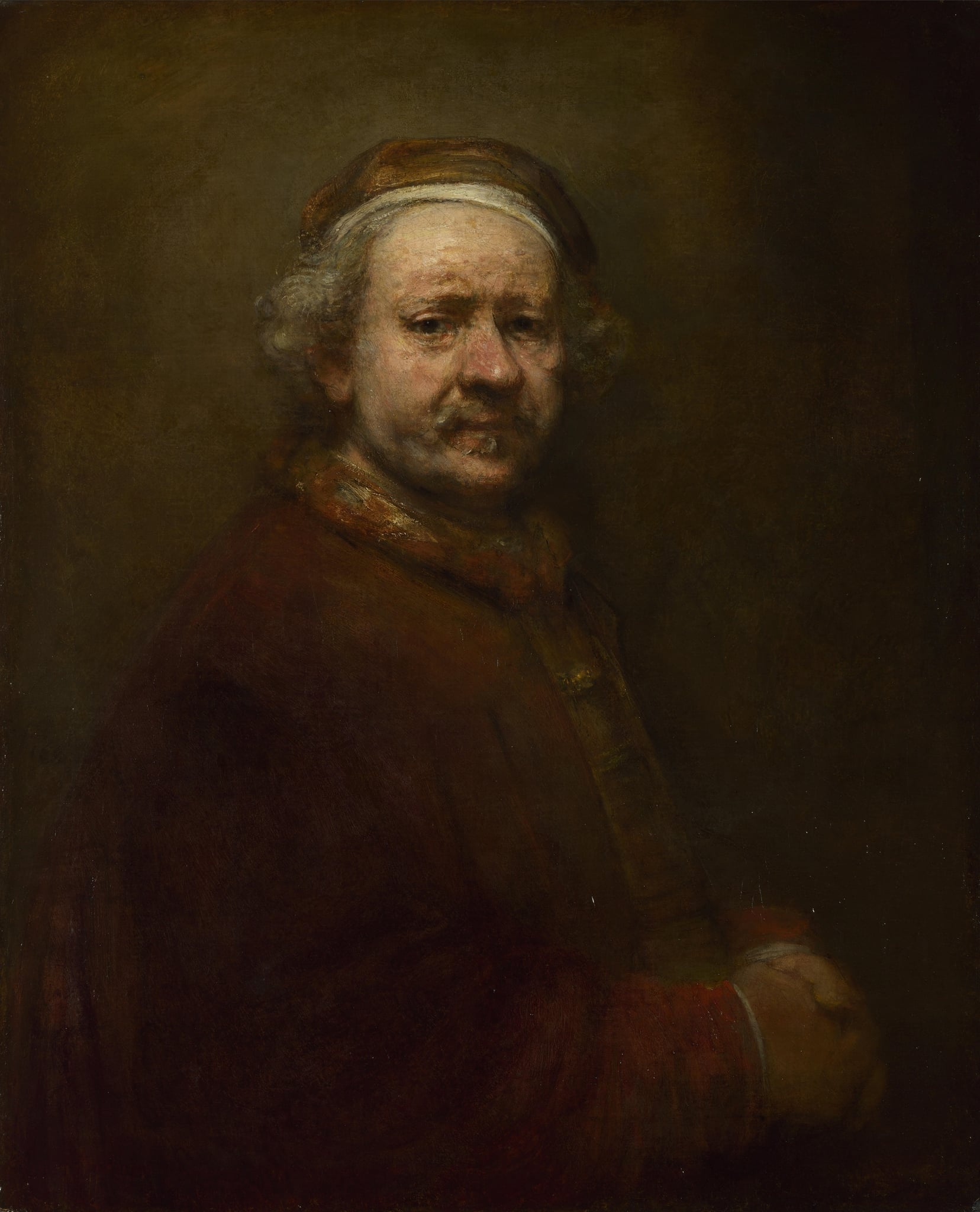
Self Portrait at the Age of 63
Rembrandt van Rijn (1669)
Rembrandt van Rijn’s Self Portrait at the Age of 63 (1669) presents an aged painter held in a warm cone of light against an engulfing dark. Thick, tactile strokes carve the face while the clasped hands retreat into shadow, turning bodily presence into a <strong>meditation on endurance</strong> and the <strong>craft of looking</strong> <sup>[1]</sup><sup>[2]</sup>.

The Woman taken in Adultery
Rembrandt van Rijn (1644)
Rembrandt van Rijn’s The Woman taken in Adultery (1644) stages John 8:3–11 as a tense, ethical <strong>pause</strong> inside a cavernous, gilded sanctuary. A narrow beam of <strong>light</strong> singles out the kneeling woman in white while Christ’s composed figure redirects the crowd from <strong>retribution</strong> toward <strong>mercy</strong> <sup>[1]</sup>.
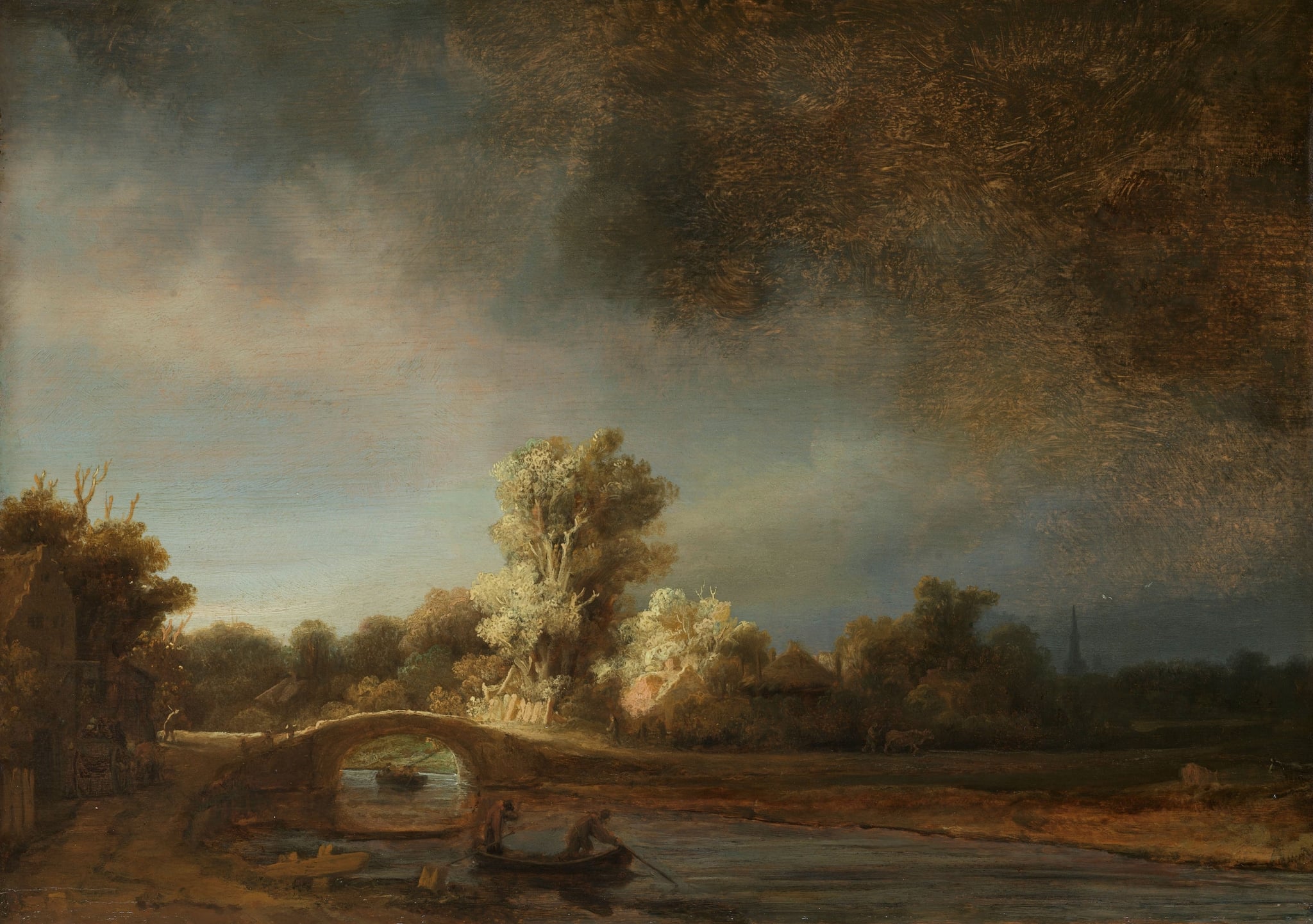
Landscape with a Stone Bridge
Rembrandt van Rijn (late 1630s (c. 1637–1638))
Under a storm-laden sky, a sudden shaft of light isolates the low <strong>stone bridge</strong> and a cluster of <strong>silvery trees</strong>, while tiny boats, a rutted track, a cottage, grazing animals, and a far <strong>church spire</strong> register human presence. Rembrandt van Rijn turns an everyday crossing into a scene of <strong>passage and providence</strong>, where transience moves beneath the endurance of stone and sky <sup>[1]</sup><sup>[2]</sup>.
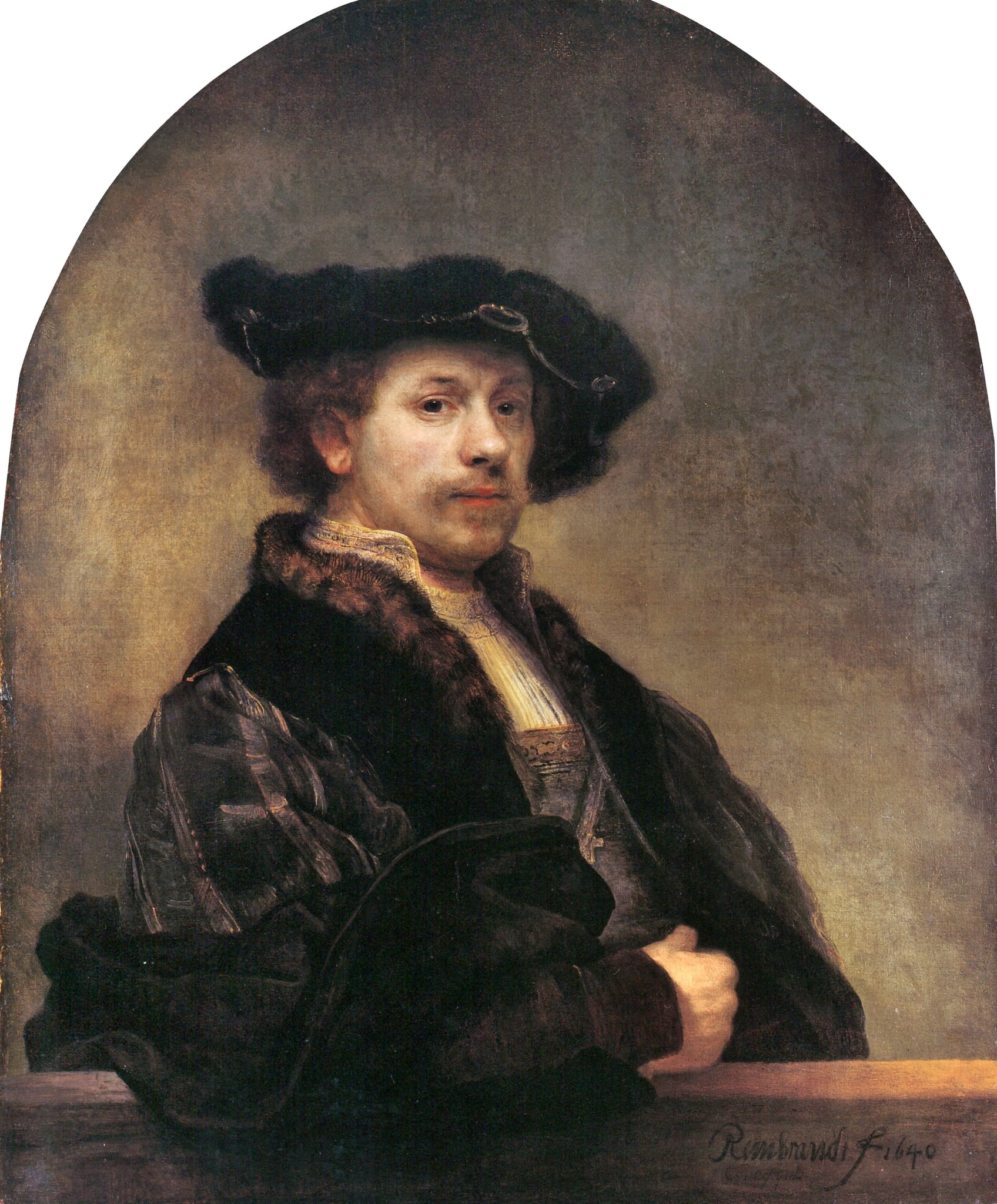
Self Portrait at the Age of 34
Rembrandt van Rijn (1640)
Rembrandt van Rijn’s Self Portrait at the Age of 34 (1640) declares the painter’s authority by adopting the <strong>Renaissance gentleman</strong> pose, bathed in focused <strong>chiaroscuro</strong> and anchored by a projecting stone <strong>parapet</strong>. The sumptuous beret, fur-trimmed mantle, and steady hand assert social rank and artistic lineage while the softly parted lips keep the image searching and human <sup>[1]</sup><sup>[2]</sup>.
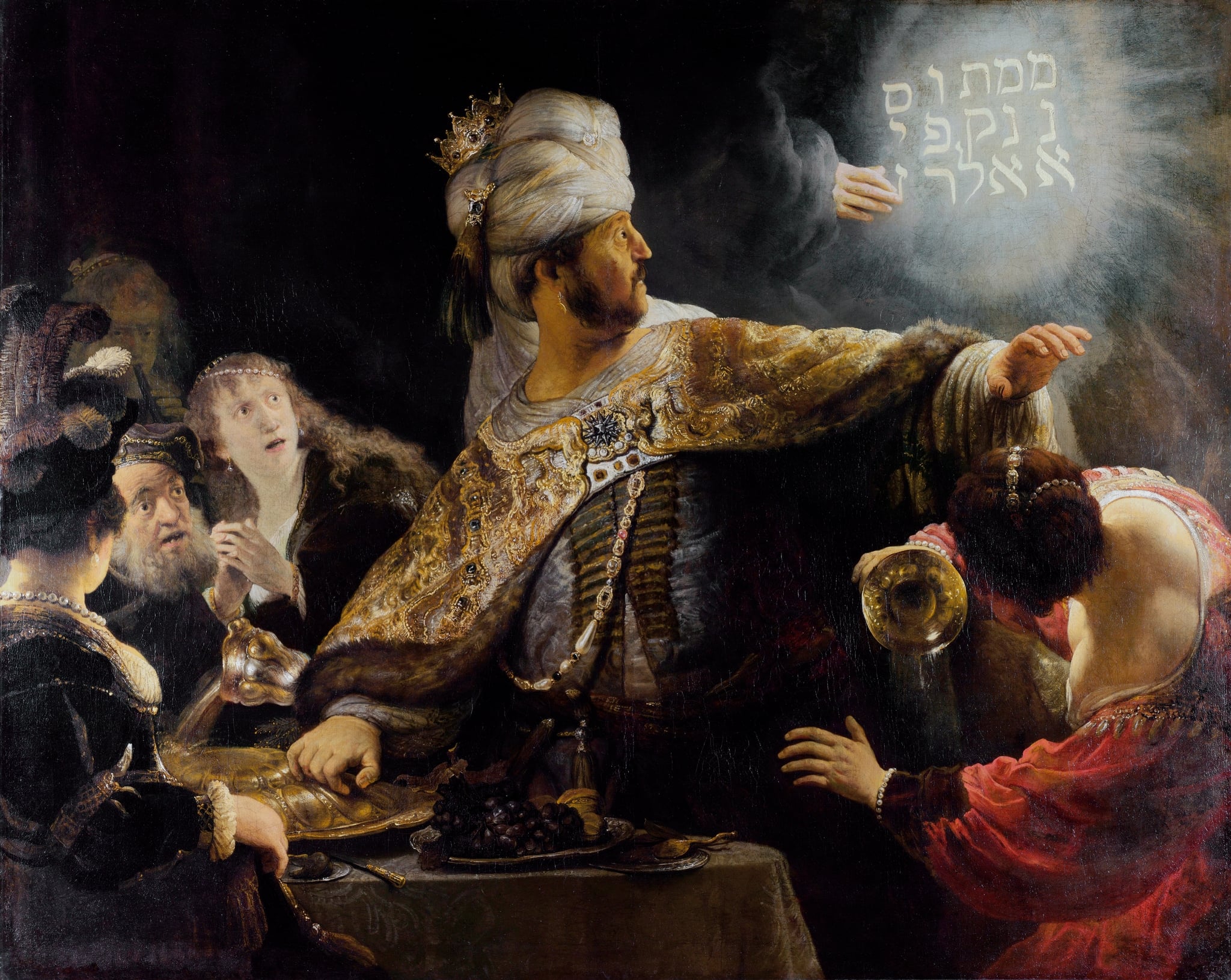
Belshazzar's Feast (study listed separately in some catalogues)
Rembrandt van Rijn (c. 1636–1638)
In Belshazzar's Feast (study listed separately in some catalogues), Rembrandt van Rijn arrests the instant a royal revel is judged by a <strong>supernatural decree</strong>. A radiant hand writes the fateful words while the bejeweled king jerks round, courtiers flinch, and sacred vessels glint—opulence set against <strong>divine judgment</strong> <sup>[1]</sup><sup>[2]</sup>.
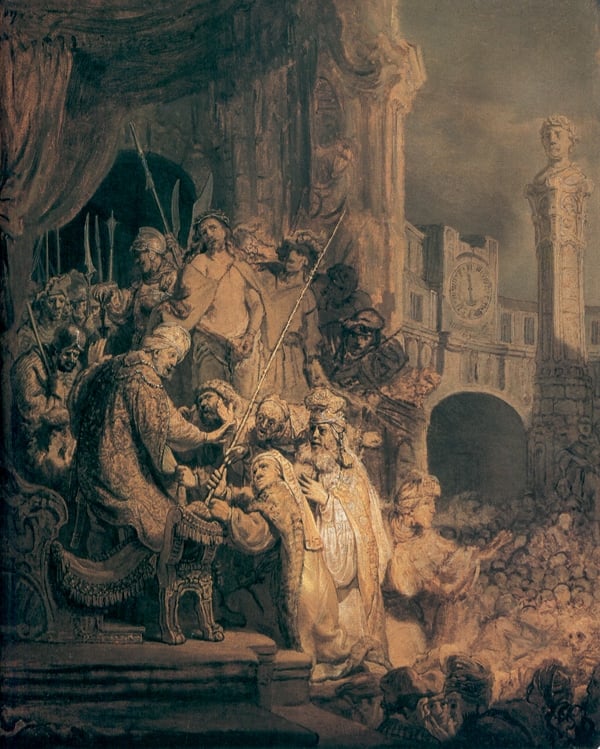
Ecce Homo
Rembrandt van Rijn (1634)
Rembrandt van Rijn’s Ecce Homo turns a Gospel episode into a <strong>public ritual of power</strong>. Under a heavy canopy, Pilate elevates himself above a seething crowd and gestures toward the bound Christ, while civic architecture and antique statuary proclaim <strong>earthly authority</strong> over <strong>innocent suffering</strong> <sup>[1]</sup><sup>[2]</sup>. Light isolates the principals and treats the rest as a turbulent mass, converting a show trial into a meditation on refusal of mercy.
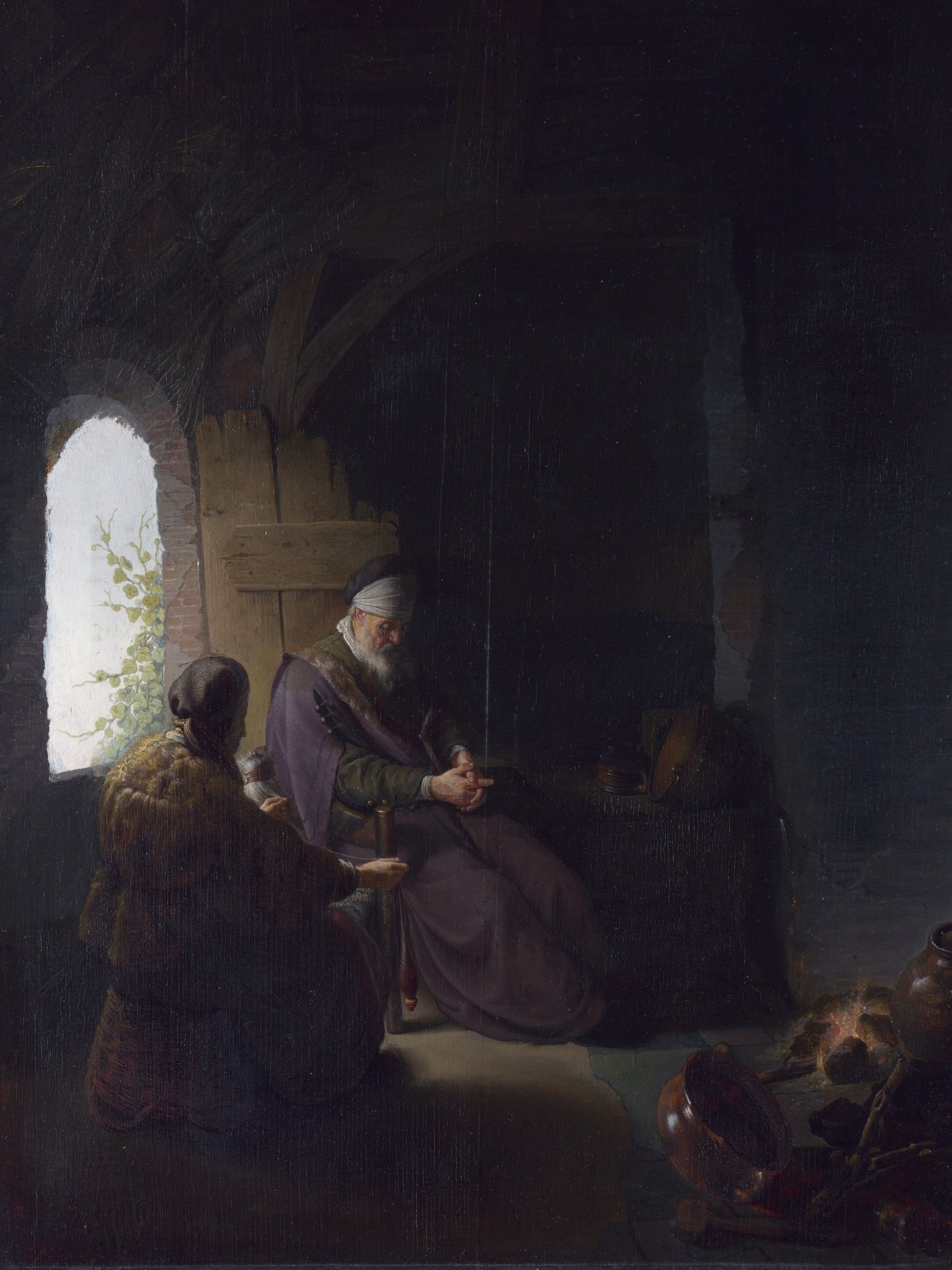
Anna and the Blind Tobit
Rembrandt van Rijn (about 1630)
In Rembrandt van Rijn’s Anna and the Blind Tobit, a cool beam from an unglazed window touches two aging figures while the room recedes into shadow. The painting compresses the Tobit story into a moment of <strong>patient endurance</strong>, where clasped hands, a staff, a smoldering hearth, and ivy at the window do the narrative work of <strong>faith under trial</strong> <sup>[1]</sup>.
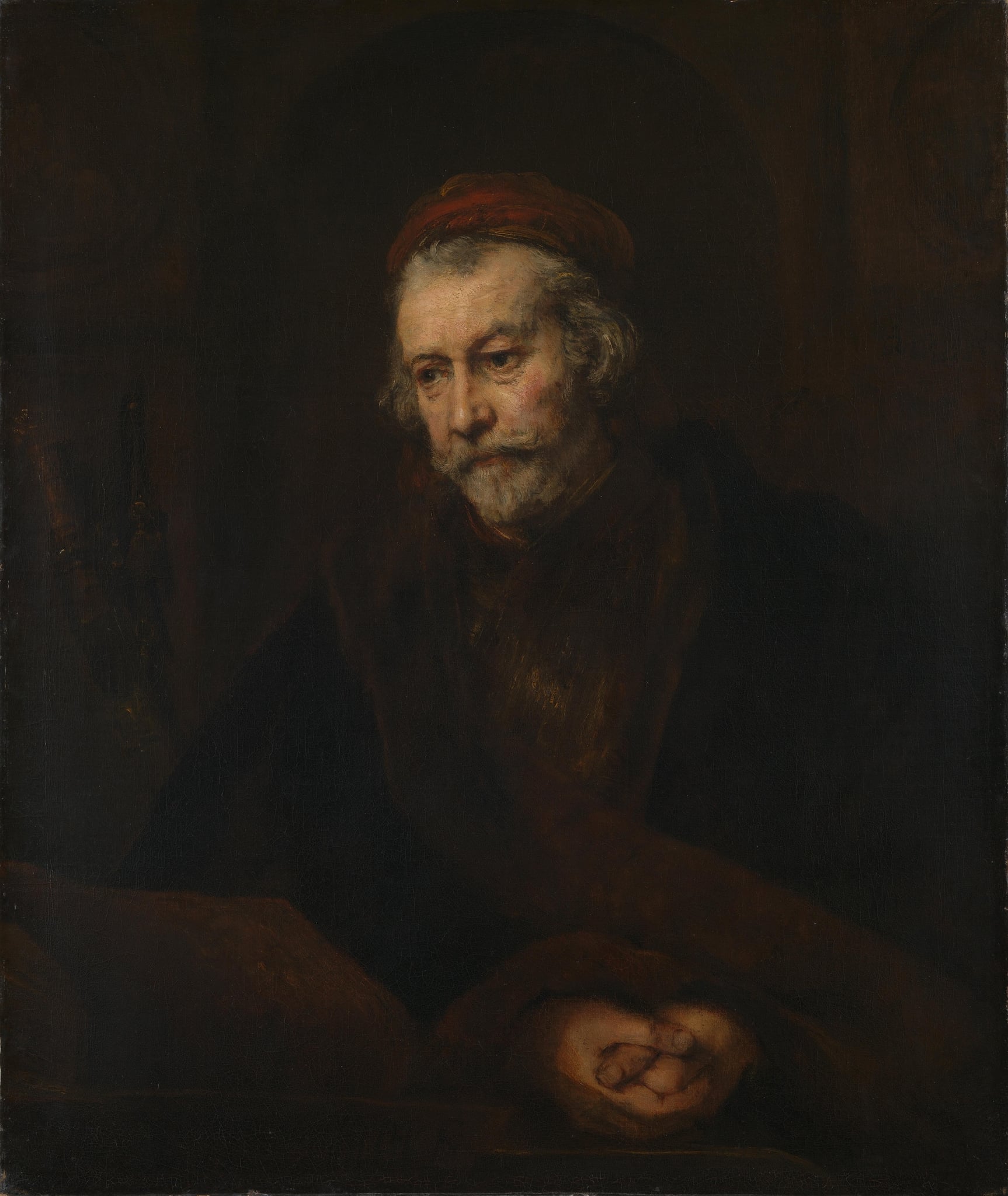
An Elderly Man as Saint Paul
Rembrandt van Rijn (1659 (probably))
Rembrandt’s An Elderly Man as Saint Paul stages a profound meditation on <strong>thought joined to faith</strong>, cupping light around a weathered face and folded hands that hover above a scholar’s book. A veiled <strong>sword</strong> and faint <strong>roundel of the Sacrifice of Isaac</strong> deepen the painting’s argument that conviction, text, and trial cohere in Pauline wisdom <sup>[1]</sup><sup>[2]</sup>.
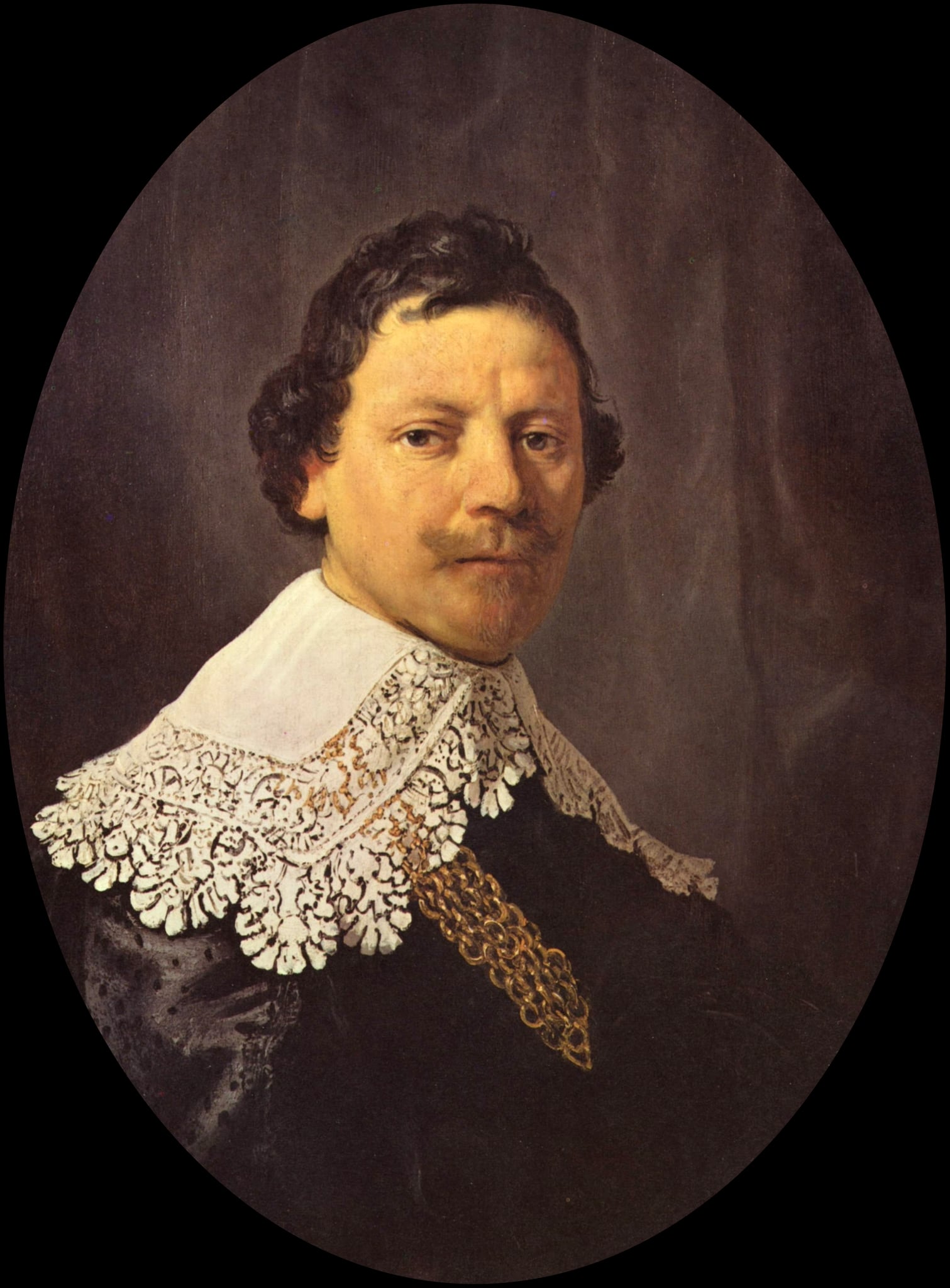
Portrait of Philips Lucasz.
Rembrandt van Rijn (1635)
Rembrandt van Rijn’s Portrait of Philips Lucasz. distills <strong>wealth and restraint</strong> into a poised, three-quarter likeness framed by an oval field. Raking light clarifies the sitter’s steady gaze, the <strong>crisp white lace</strong> and the diagonally falling <strong>gold chain</strong>, while the deep black costume absorbs attention back to character over display <sup>[1]</sup>.
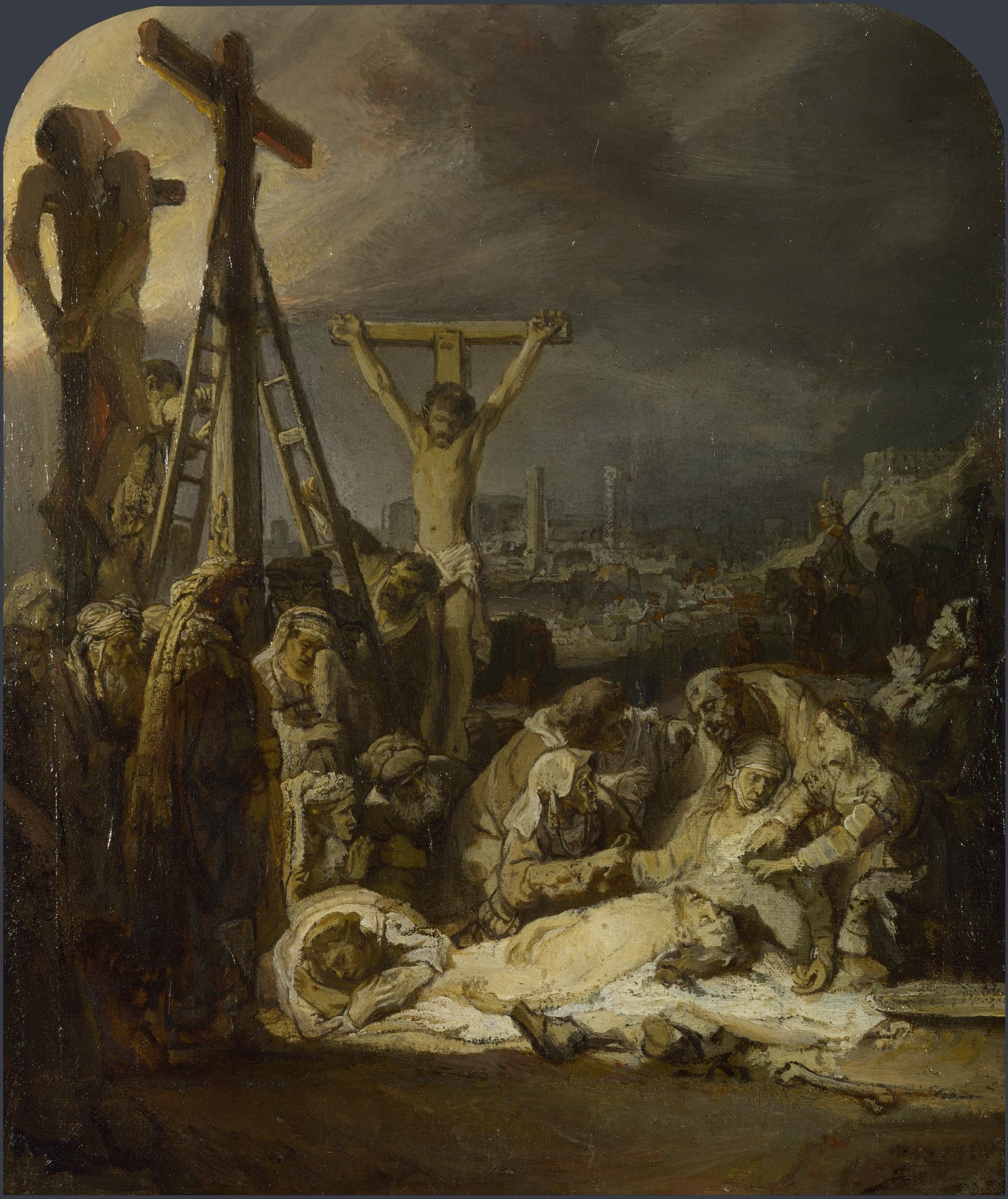
The Lamentation over the Dead Christ
Rembrandt van Rijn (about 1635)
In The Lamentation over the Dead Christ, Rembrandt van Rijn gathers grief and hope into a single <strong>grisaille</strong> blaze of light. Christ’s diagonal, pallid body on a white shroud draws mourners into a tight arc, while ladders, crosses, and the silhouetted thieves still crown the hill under a storming sky <sup>[1]</sup>.
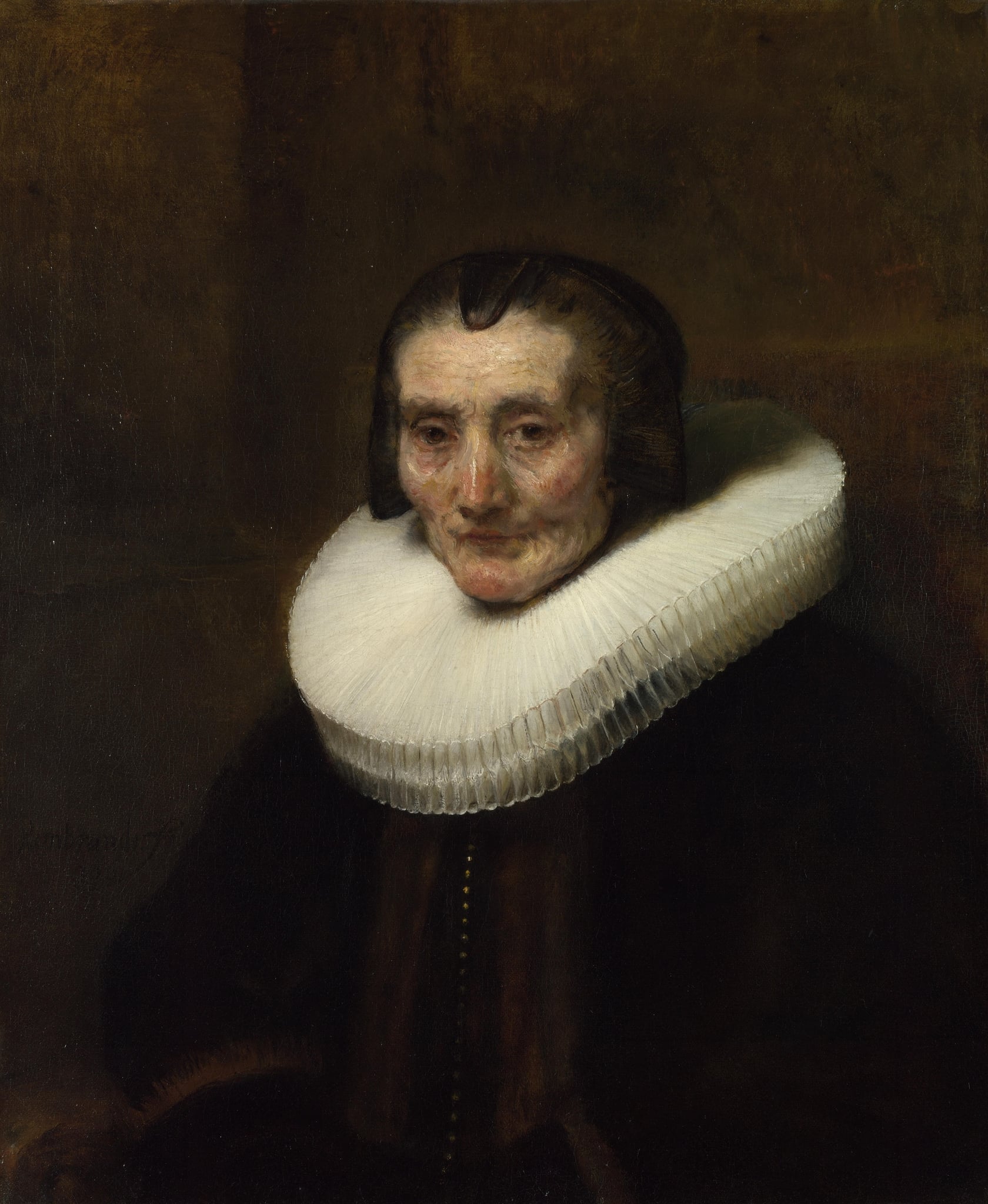
Portrait of Margaretha de Geer, Wife of Jacob Trip
Rembrandt van Rijn (about 1661)
Rembrandt van Rijn’s Portrait of Margaretha de Geer, Wife of Jacob Trip crystallizes late‑style <strong>chiaroscuro</strong> and a fearless study of <strong>age and dignity</strong>. The incandescent <strong>millstone ruff</strong> gathers and emits light against a brown void, while the dark gown and measured posture project wealth disciplined by piety <sup>[1]</sup>.
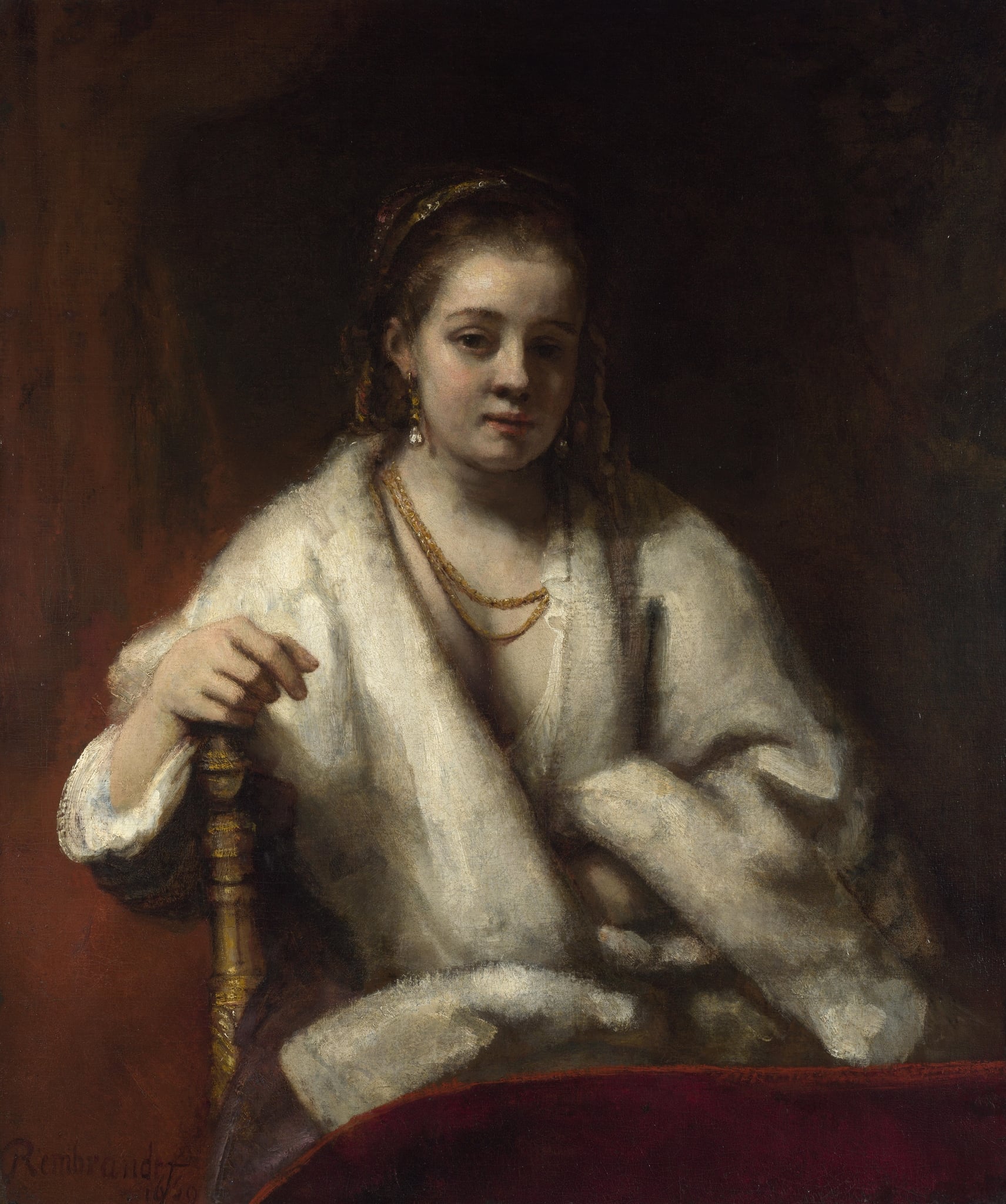
Portrait of Hendrickje Stoffels
Rembrandt van Rijn (c. 1654–1656)
In Portrait of Hendrickje Stoffels, Rembrandt van Rijn stages an intimate encounter in which a young woman leans from darkness into <strong>golden, directional light</strong>, her fur-trimmed wrap and jewelry catching the eye while her expression remains inward-looking. The thick impasto of the robe, the <strong>subtle glint of a gold chain and pearl earring</strong>, and the anchoring <strong>red table edge</strong> fuse touch, time, and tenderness into a single, contemplative presence <sup>[1]</sup>. Painted in the mid‑1650s, the work distills Rembrandt’s late style: psychological depth, restrained palette, and <strong>moral chiaroscuro</strong> <sup>[1]</sup>.
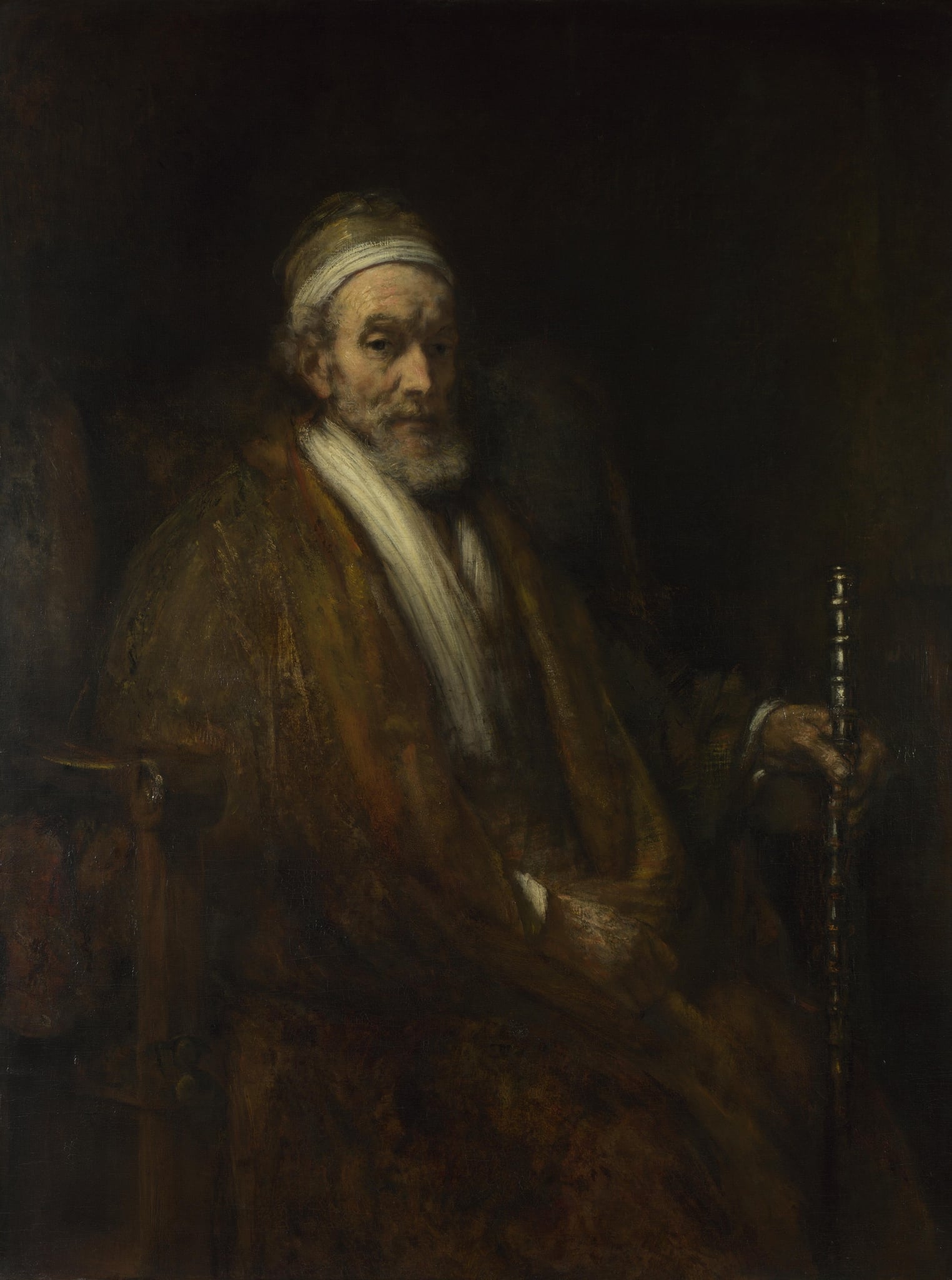
Portrait of Jacob Trip
Rembrandt van Rijn (c. 1661)
In Portrait of Jacob Trip, Rembrandt van Rijn distills worldly rank into <strong>quiet authority</strong> and <strong>moral gravity</strong>. A narrow beam lifts the sitter’s brow, nose, and beard while the rest recedes, so that character—not costume—carries the image <sup>[1]</sup><sup>[2]</sup>. The lightly held, scepter‑like <strong>staff</strong> and tabbaard‑like robe project power tempered by age and introspection <sup>[1]</sup><sup>[5]</sup>.
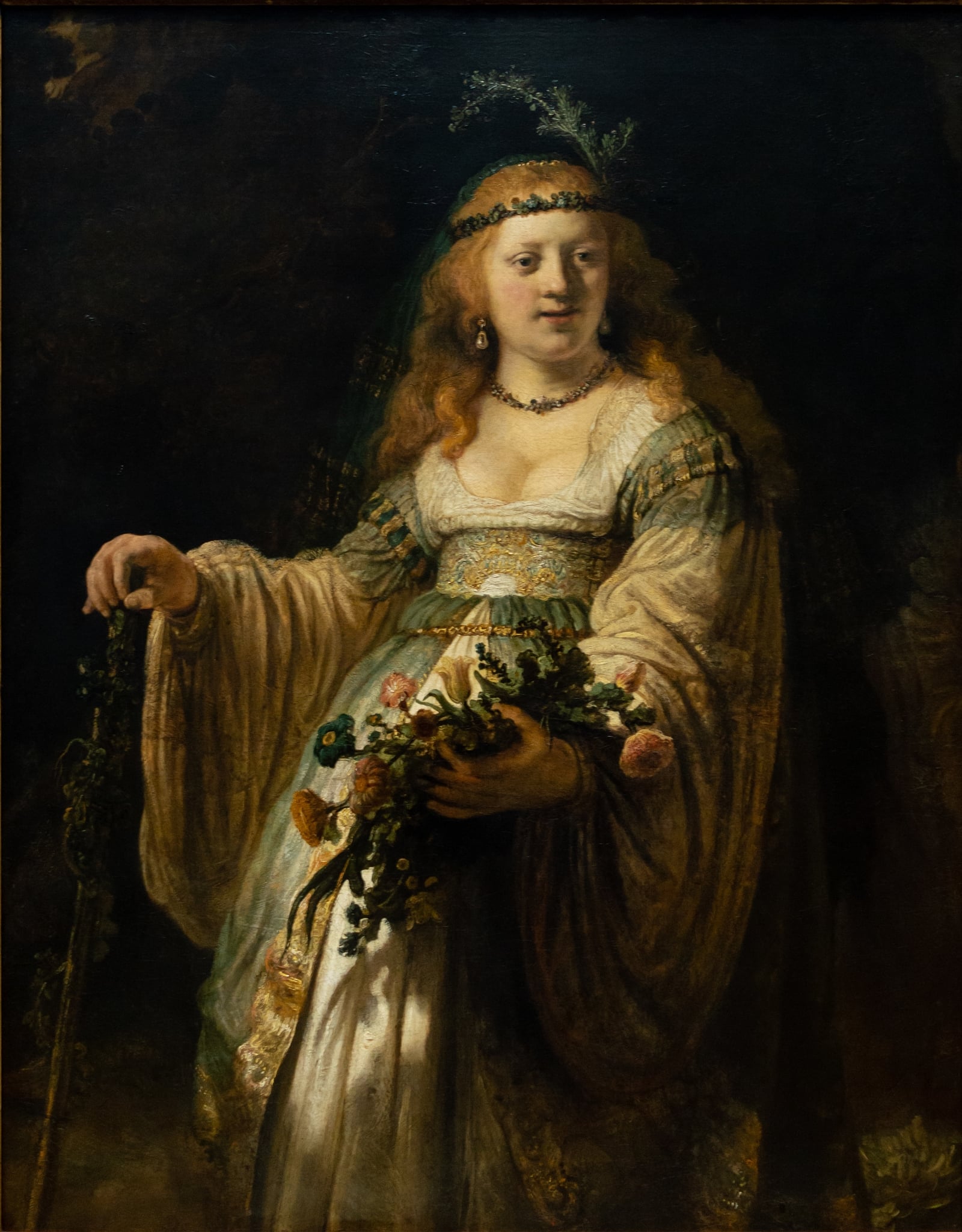
Saskia van Uylenburgh in Arcadian Costume
Rembrandt van Rijn (1635)
Rembrandt van Rijn’s 1635 portrait of his wife, Saskia, appears as a luminous shepherdess in <strong>Arcadian costume</strong>, her face and hands caught in a warm cone of light while the world around her recedes into shadow. The wreath, foliage‑twined staff, and armful of blossoms transform a private likeness into an emblem of <strong>fertility, prosperity, and renewal</strong> <sup>[1]</sup>.
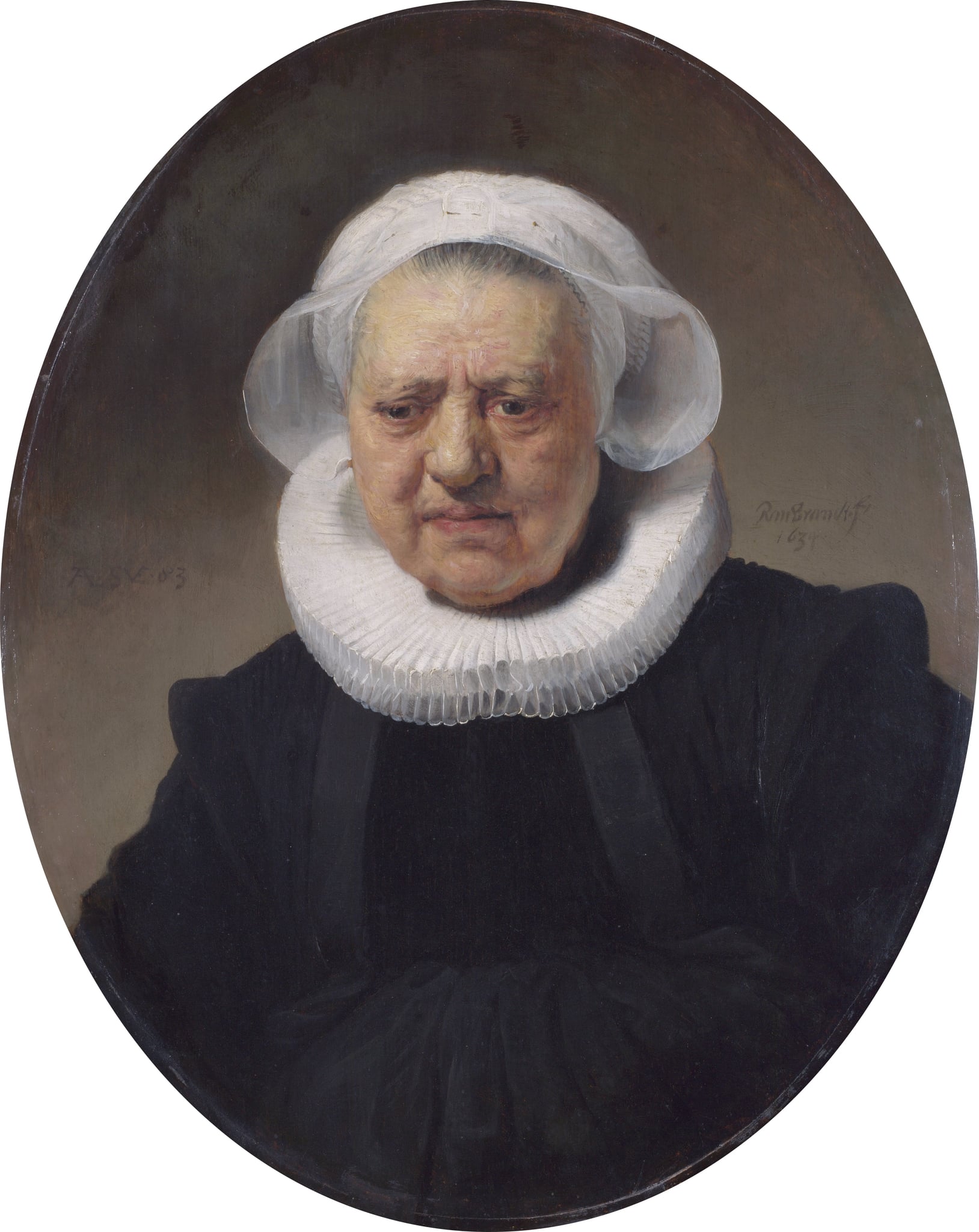
Portrait of Aechje Claesdr.
Rembrandt van Rijn (1634)
Rembrandt van Rijn’s Portrait of Aechje Claesdr. (1634) distills <strong>age, dignity, and moral clarity</strong> into an intimate oval. A black gown and a luminous white ruff and cap concentrate light on her face, where Rembrandt’s tactile strokes honor the <strong>truth of age</strong> without caricature <sup>[1]</sup>.
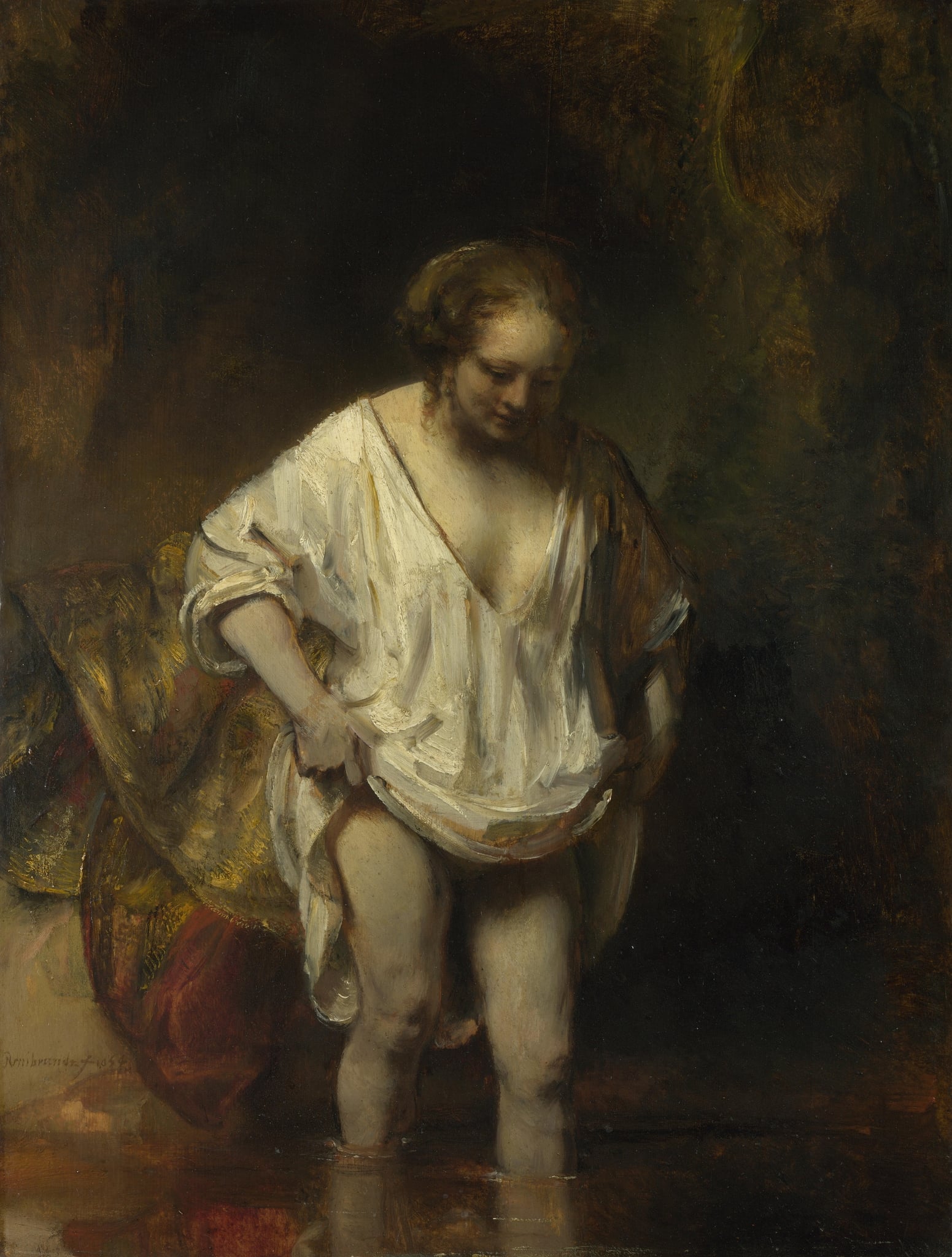
A Woman bathing in a Stream (Hendrickje Stoffels?)
Rembrandt van Rijn (1654)
Rembrandt van Rijn’s A Woman bathing in a Stream (Hendrickje Stoffels?) stages a private act as a public meditation on <strong>vulnerability</strong>, <strong>renewal</strong>, and <strong>empathetic seeing</strong>. The woman gathers her <strong>white shift</strong> as it clings to her, steps into the water, and glows under a warm, directional light against a shadowed bank. The image turns everyday intimacy into a <strong>monumental</strong>, morally inflected moment of presence <sup>[1]</sup><sup>[2]</sup>.
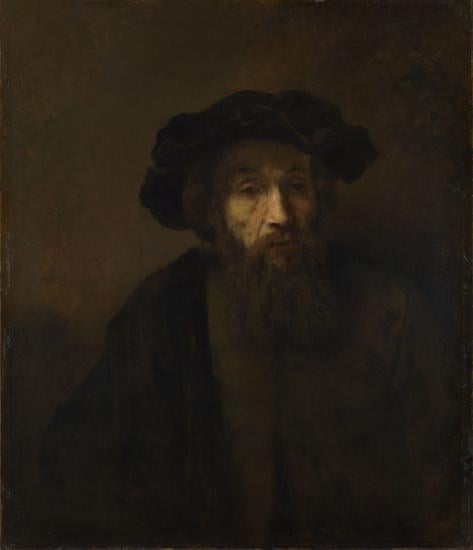
A Bearded Man in a Cap
Rembrandt van Rijn (late 1650s (probably 1657))
<strong>A Bearded Man in a Cap</strong> is a late‑1650s tronie by <strong>Rembrandt van Rijn</strong>, a meditative study where raking light grazes a timeworn face emerging from darkness. With a broad, soft <strong>cap</strong> and square‑cut <strong>beard</strong>, the figure embodies aged contemplation rather than social identity, rendered through Rembrandt’s late <strong>chiaroscuro</strong> and tactile brushwork <sup>[1]</sup>.
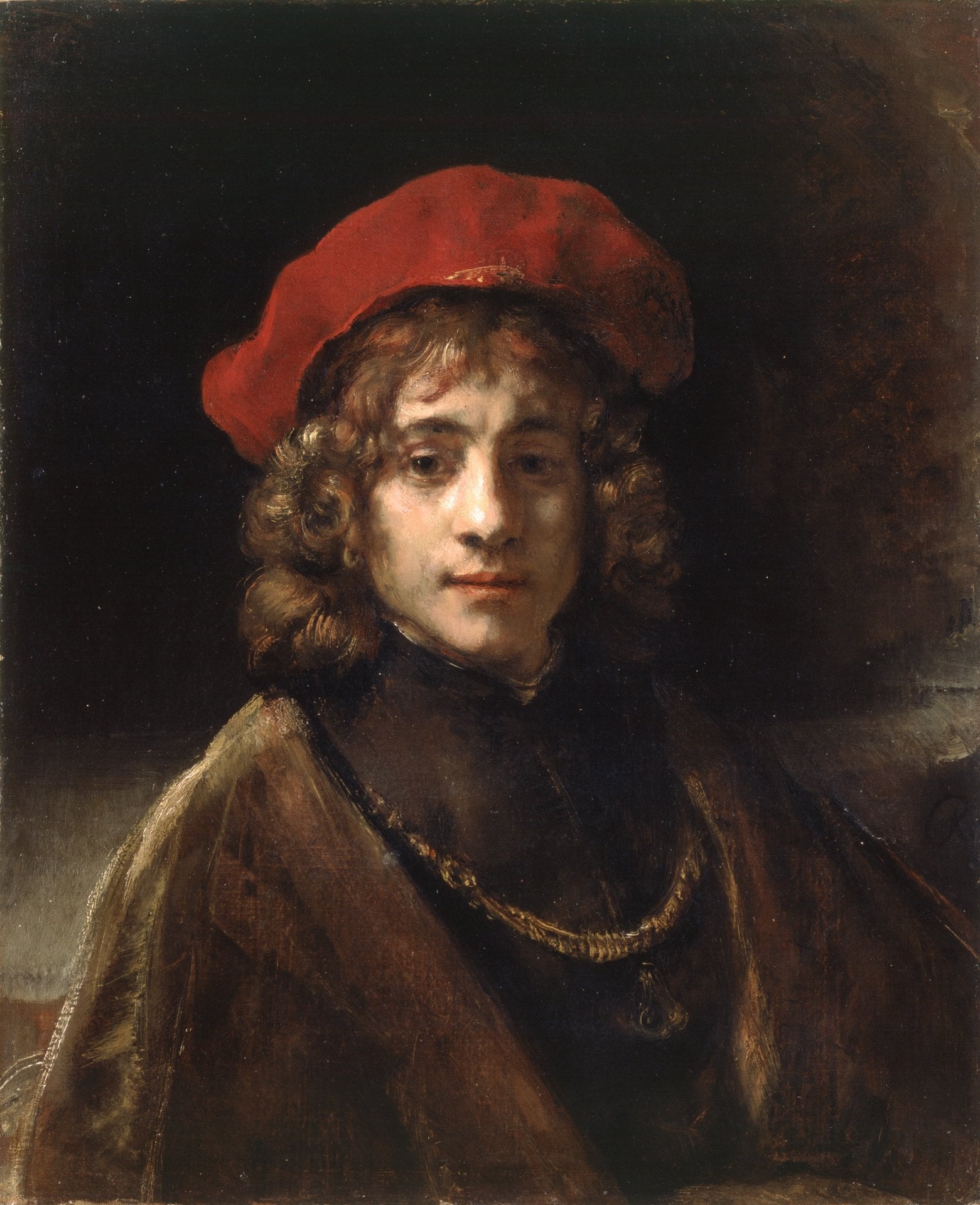
Titus, the Artist's Son
Rembrandt van Rijn (c. 1657)
Rembrandt van Rijn’s Titus, the Artist’s Son is a poised, half-lit study of youth, where <strong>tender chiaroscuro</strong> gathers on the face and crimson cap while the rest dissolves into shadow. The <strong>fancy Venetian costume</strong>, notably the red beret and simple gold chain, elevates a private likeness into a meditation on dignity and becoming <sup>[1]</sup><sup>[2]</sup>.
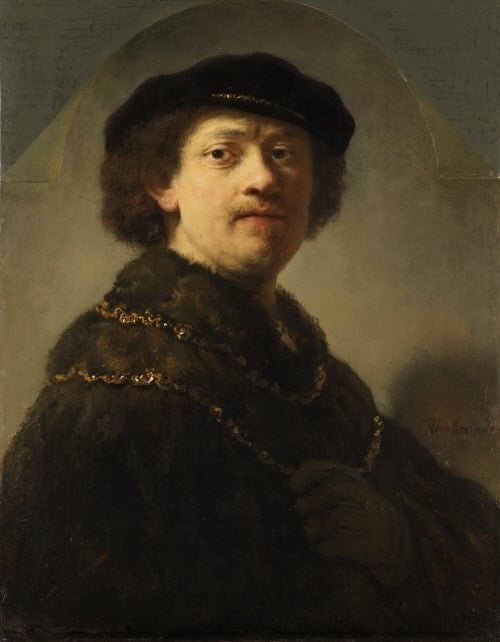
Self-Portrait in a Black Cap
Rembrandt van Rijn (1637)
In Self-Portrait in a Black Cap, Rembrandt van Rijn stages himself in <strong>sumptuous fur</strong>, a <strong>black cap</strong>, and a <strong>glinting gold chain</strong>, then cuts the figure from dusk with incisive light. The steady gaze and slightly parted lips meet the viewer while a <strong>gloved hand lifts the chain</strong>, redirecting status back to the artist’s own hand. Painted c. 1637 in oil on oak, the work now has an <strong>arched top</strong> from a later reshaping of the panel <sup>[1]</sup>.
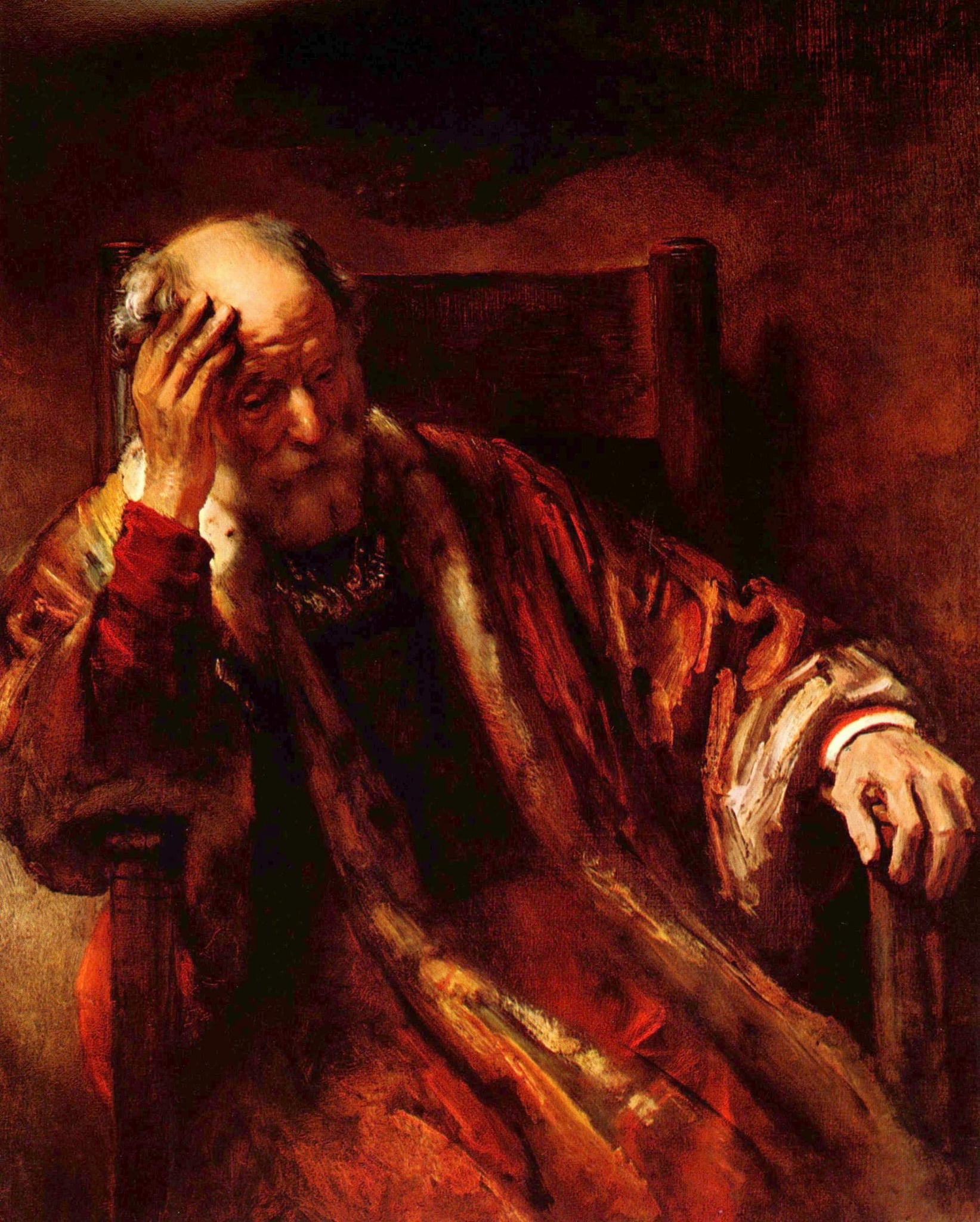
An Old Man in an Armchair
Rembrandt van Rijn (1652 (signed; generally dated 1650s))
An Old Man in an Armchair stages a solitary figure caught between <strong>worldly dignity</strong> and <strong>inner reckoning</strong>. A warm beam isolates the bald head and right hand while the robe dissolves into <strong>rough, animated brushwork</strong>, turning the chair into a site of meditation and time’s weight <sup>[1]</sup>.
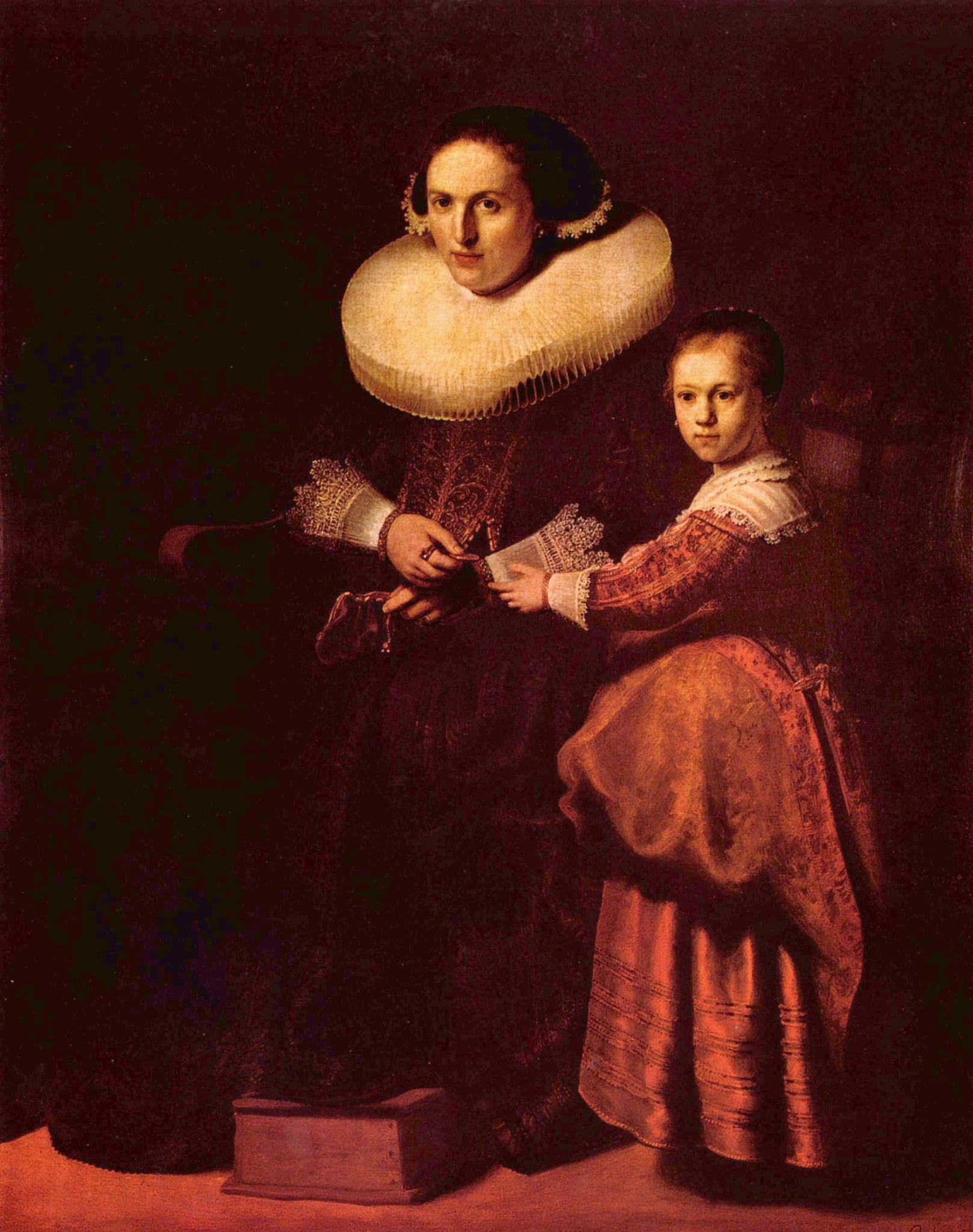
Portraits of Susanna van Collen and her Daughter Anna
Rembrandt van Rijn (c. 1632–33)
A mother and daughter step out of darkness, their faces, hands, and fabrics seized by Rembrandt’s <strong>chiaroscuro</strong>. The mother’s monumental <strong>ruff</strong> and sober black gown declare <strong>prosperity with restraint</strong>, while gloves, a clasped hand, and a book encode civility, lineage, and piety <sup>[1]</sup><sup>[4]</sup><sup>[5]</sup>.