Altar theater vs inward light
Both painters turn light into an argument staged at a crisis point. Rubens builds public, altar‑scale persuasion through surging motion and legible groups; Rembrandt concentrates meaning into faces, hands, and pockets of light that invite slow, private attention. Seeing is trained differently: to be moved together, or to attend and recognize.
Comparison frame: From diagonal drama to tactile hush: how do Rubens and Rembrandt use light and surface to change what painting asks of a viewer?
Quick Comparison
| Topic | Peter Paul Rubens | Rembrandt van Rijn |
|---|---|---|
| Primary address | Public persuasion (church, court, civic display) | Inward recognition (domestic, civic, private) |
| Compositional driver | Motion: sweeping diagonals, interlocked bodies | Concentration: compressed space, withheld background |
| Light’s function | Stage-like illumination that clarifies doctrine at distance | Focused revelation on faces and hands; darkness withholds |
| Surface logic | Fluid glazes and sheen unify continuous action | Late impasto and scored paint slow looking at touch-zones |
| Viewing distance | Designed for 30–60 feet (altarpiece legibility) | Designed for arm’s-length intimacy and time |
| Narrative moment | Crisis as exaltation and communal action | Crisis as testing, recognition, or mercy |
| Patronage ecosystem | Catholic Antwerp; Counter‑Reformation clarity | Dutch Republic; reduced church imagery, market and civic |
| Studio model | Large workshop; oil sketches; tapestry/print networks | Smaller studio; revisions; experimental handling |
Shared Ground
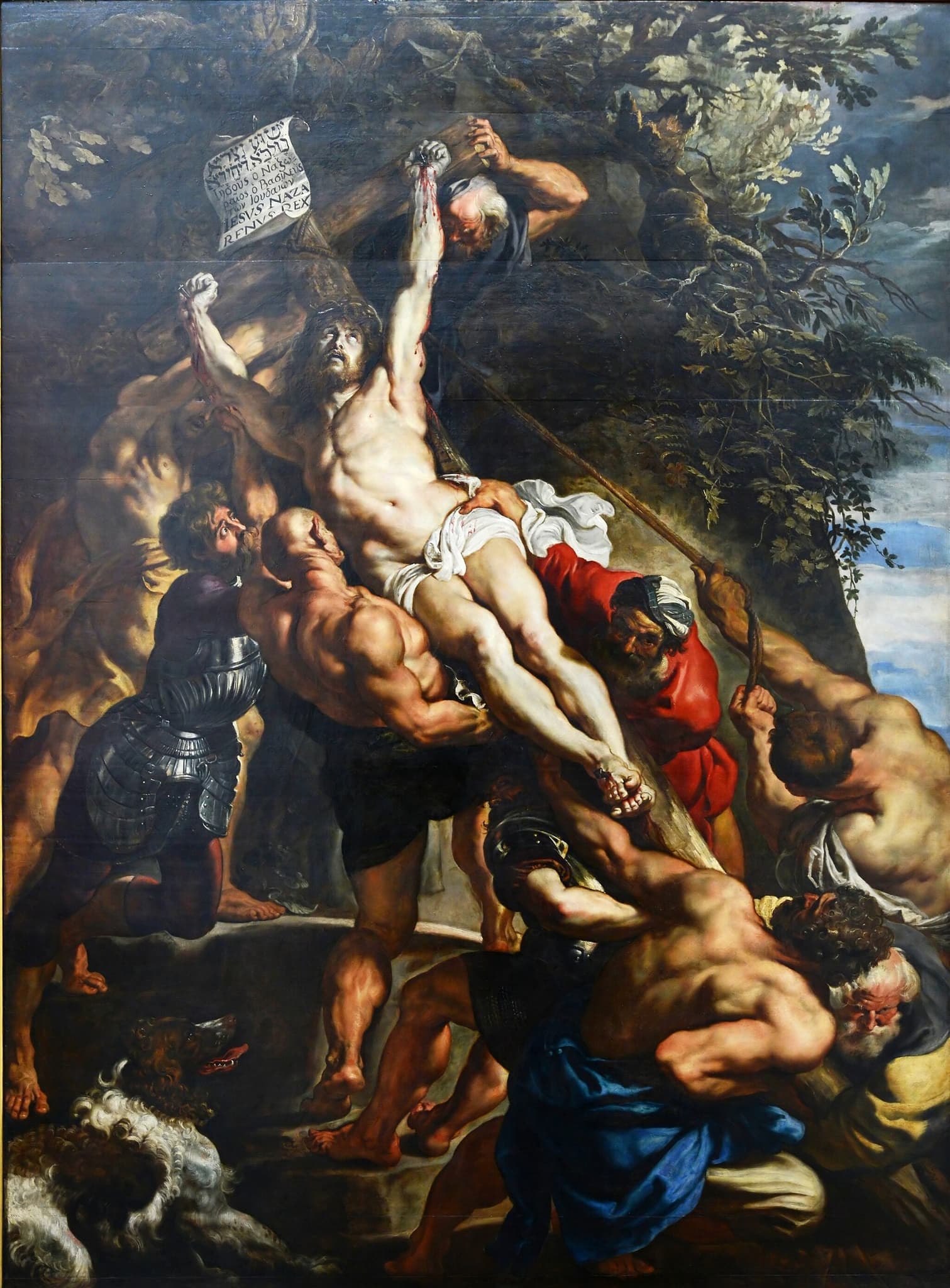
Rubens and Rembrandt both rebuild history painting as a present-tense encounter directed by light. Illumination is not backdrop but logic. In Rubens’s The Elevation of the Cross, radiance isolates Christ against a vortex of muscle and rope so doctrine reads at a distance; in Rembrandt’s The Storm on the Sea of Galilee, a scraped beam of light finds faces and a calm Christ within chaos, teaching the eye where to trust. Each favors threshold moments—the second before resolution—so that seeing becomes an existential test.
Both fuse bodily immediacy with belief or ethics. Rubens turns collective exertion, fabric, and clear diagonals into Counter‑Reformation devotion, culminating in altar works like The Descent from the Cross where a white shroud stages communal care. Rembrandt compresses meaning into hands and faces: The Anatomy Lesson of Dr. Nicolaes Tulp makes knowledge visible in a lit triangle of arm, hands, and book; The Return of the Prodigal Son and The Jewish Bride find mercy and covenant in the pressure of touch. And both are synthesizers after Italy. Rubens absorbs Venetian color, Roman anatomy, and antiquity into a fluent Flemish Baroque built for public space; Rembrandt retools Italian legacies through Dutch optics—chiaroscuro as structure, not effect—so darkness withholds while light discloses. Their shared ground is a new Northern grammar of movement, mass, and light that makes sacred or human meaning immediate.
Decisive Difference
The decisive split is how each artist imagines what painting is for. Rubens designs vision as persuasive theater for a gathered public. Antwerp’s Catholic ecosystem sustained monumental altarpieces that had to read clearly across a nave: sweeping diagonals, interlocking figures, and warm Venetian color conduct viewers toward a unified response. Glazes and a continuous sheen guide the eye across action, turning motion itself into conviction. The Elevation and The Descent are not only narratives; they are liturgical devices calibrated to synchronize bodies and belief in communal space.
Rembrandt, working in a Protestant republic with few church commissions, increasingly makes painting a site of inward recognition. Meaning concentrates in small zones of light and in the material of paint. Darkness suppresses the nonessential; faces and hands become carriers of ethics. Late impasto and scored surfaces—exemplified by the gold sleeve in The Jewish Bride—slow the eye so that touch becomes legible. Even when he stages crisis at scale, as in The Storm on the Sea of Galilee, the vertical compression and intimate gazes conscript the beholder at close range. Works like The Return of the Prodigal Son, made without ecclesiastical commission, turn seeing into witness: not a cue to collective exaltation, but an invitation to attend to mercy. In short, Rubens organizes seeing by motion for a public; Rembrandt organizes it by concentration for a conscience.
Paired Works
The diagonal at the brink
Focus question: What does each diagonal ask the viewer to believe in the moment before resolution?
The Elevation of the Cross vs The Storm on the Sea of Galilee
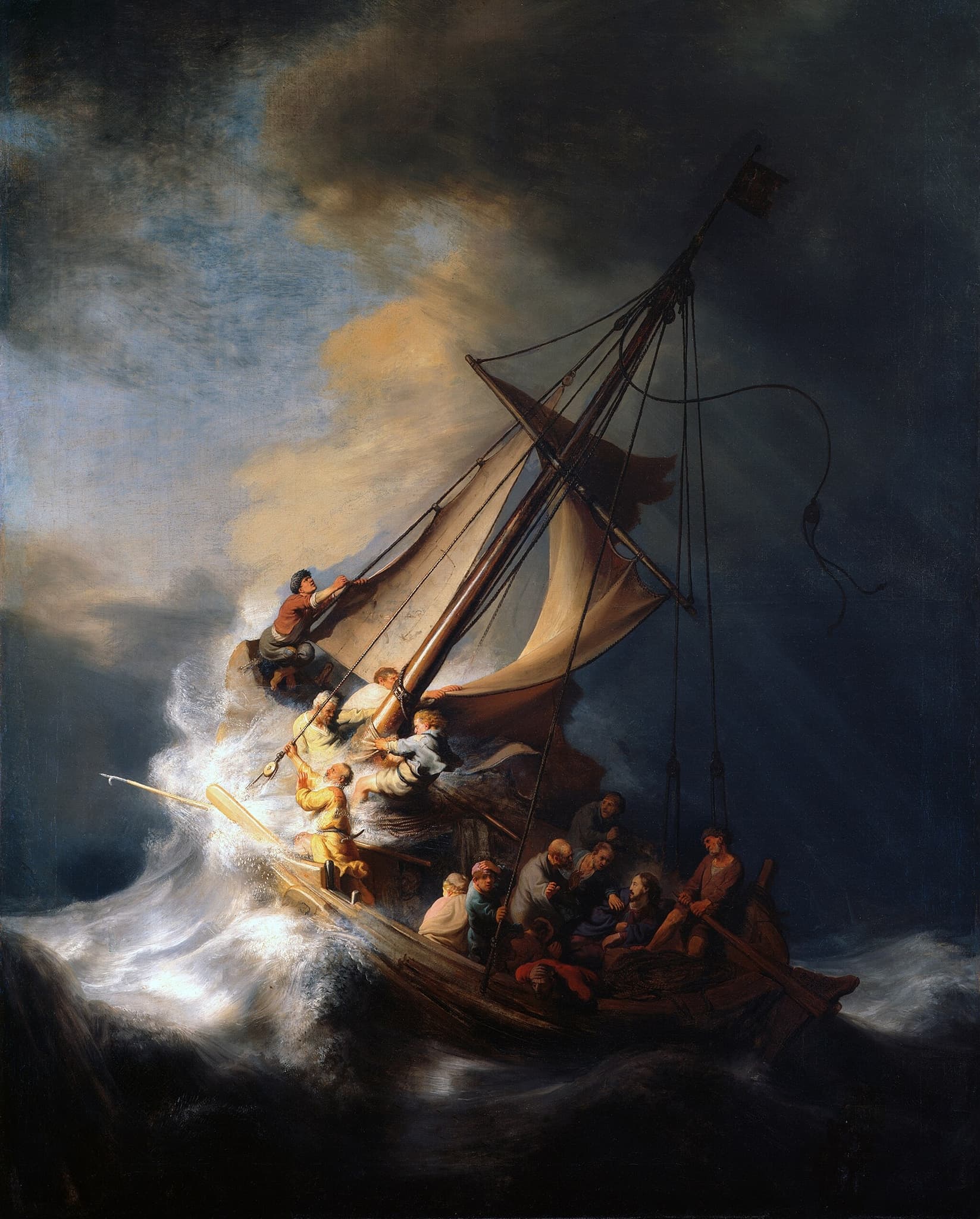
Both images hinge on a violent diagonal, but they allocate belief differently. Rubens’s altar-scale thrust hoists Christ through a chain of straining bodies; sheen and chiaroscuro weld figures into one instrument so that upward motion reads as exaltation. The diagonal is doctrinal: grace rises within human effort and commands the nave from afar. Rembrandt’s pitched mast flings the boat toward unseen rocks as torn canvas whips a vertical marine—his only one. Here the diagonal is testing, not triumph. A pocket of calm forms around the seated Christ while individualized faces register panic, calculation, and doubt. One sailor meets our gaze, enrolling us among the frightened. Light grazes the sail and then softens at Christ, staging a passage from frenzy to trust within inches. Rubens’s composition persuades a crowd by orchestrating motion; Rembrandt’s composition tutors a witness by concentrating light. Both turn crisis into present-tense experience, but one resolves outwardly in a public claim of victory, the other inwardly as a lesson in faith under pressure.
Transfer and touch
Focus question: How does each painter make salvation or mercy legible through the act of carrying or embracing?
The Descent from the Cross vs The Return of the Prodigal Son
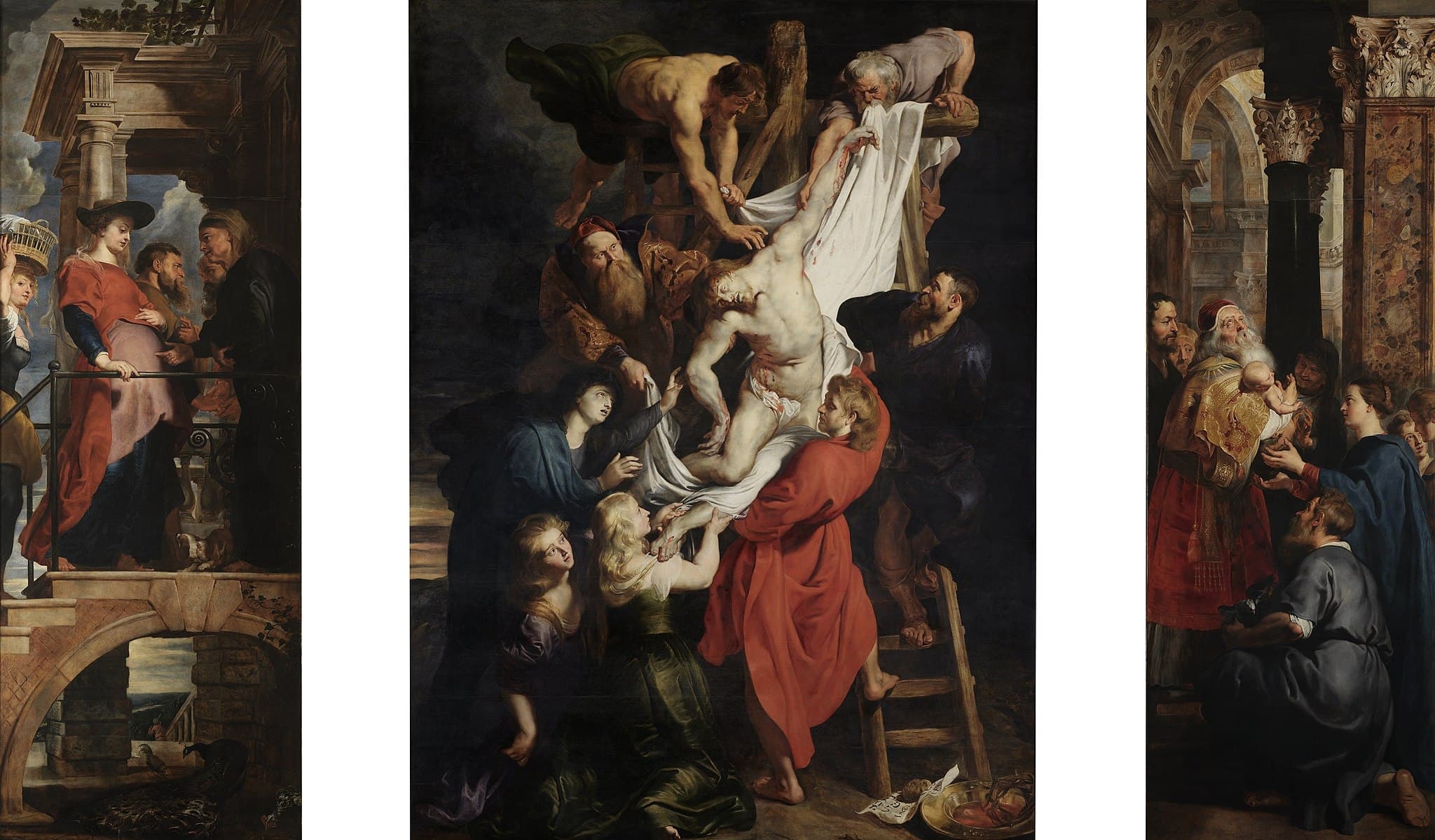
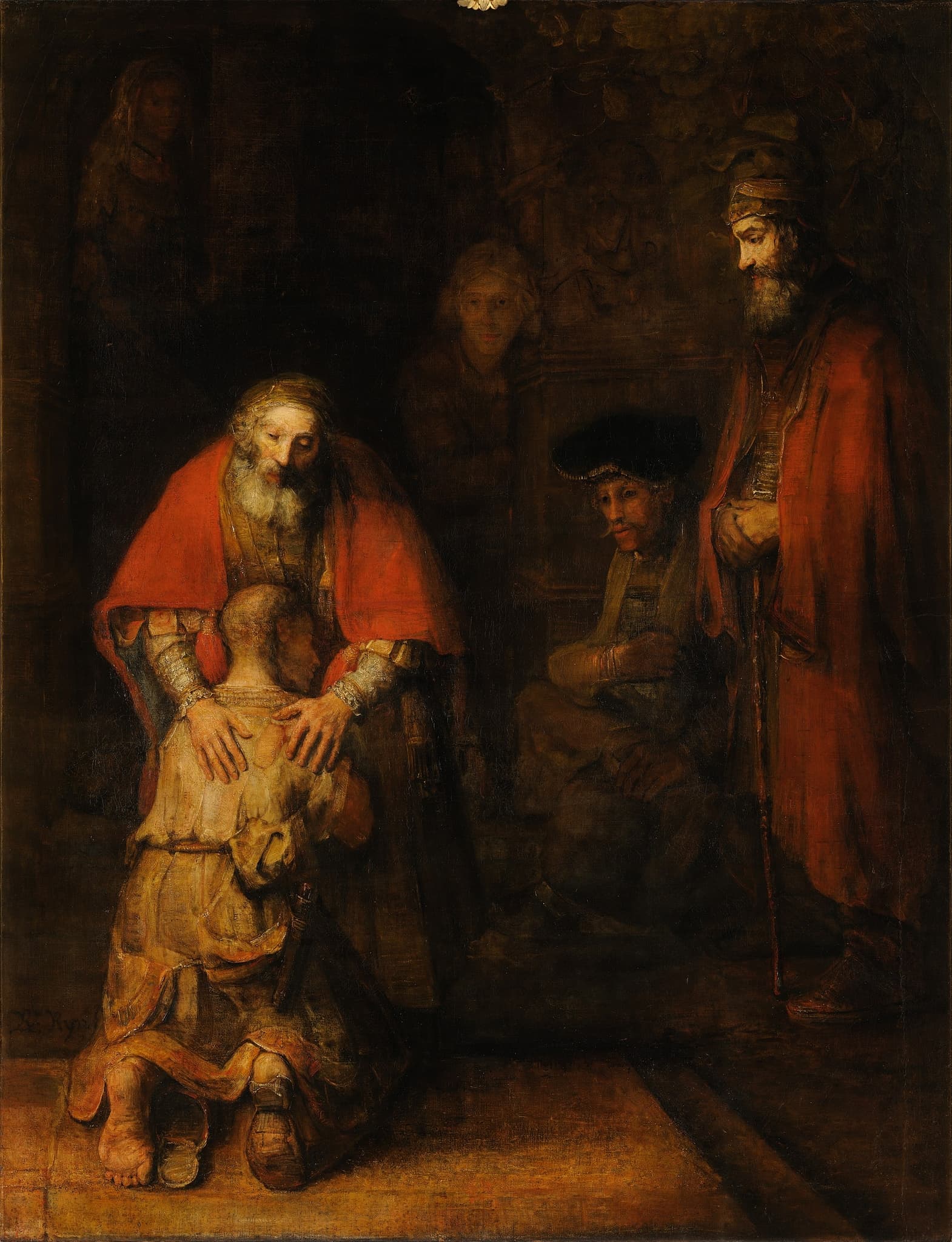
Rubens choreographs many hands along a luminous white shroud that diagonally guides Christ to the faithful below. Nighttime chiaroscuro isolates the transfer; the cloth reads like a liturgical device, turning grief into a communal act that dovetails with the Eucharist at the altar. The scene is public, rhetorical, and clear at distance—charity made visible by coordinated motion. Rembrandt answers with compression and hush. The father’s red mantle glows in dusk-like light as two hands rest on the son’s back; the torn shoe and shorn head keep the narrative honest. Witnesses hover in shadow, especially the upright elder brother, so mercy appears as an interior event that the viewer must join, not merely watch. Light anoints only faces, hands, and feet, converting touch into meaning. Rubens’s transfer is a staged covenant borne collectively; Rembrandt’s is a private restoration that unfolds over time. Both teach with touch, but one addresses a congregation, the other a conscience.
Covenants: spectacle and matter
Focus question: Where does meaning reside—in the spectacle of a world or in the material of paint?
The Garden of Eden with the Fall of Man vs The Jewish Bride
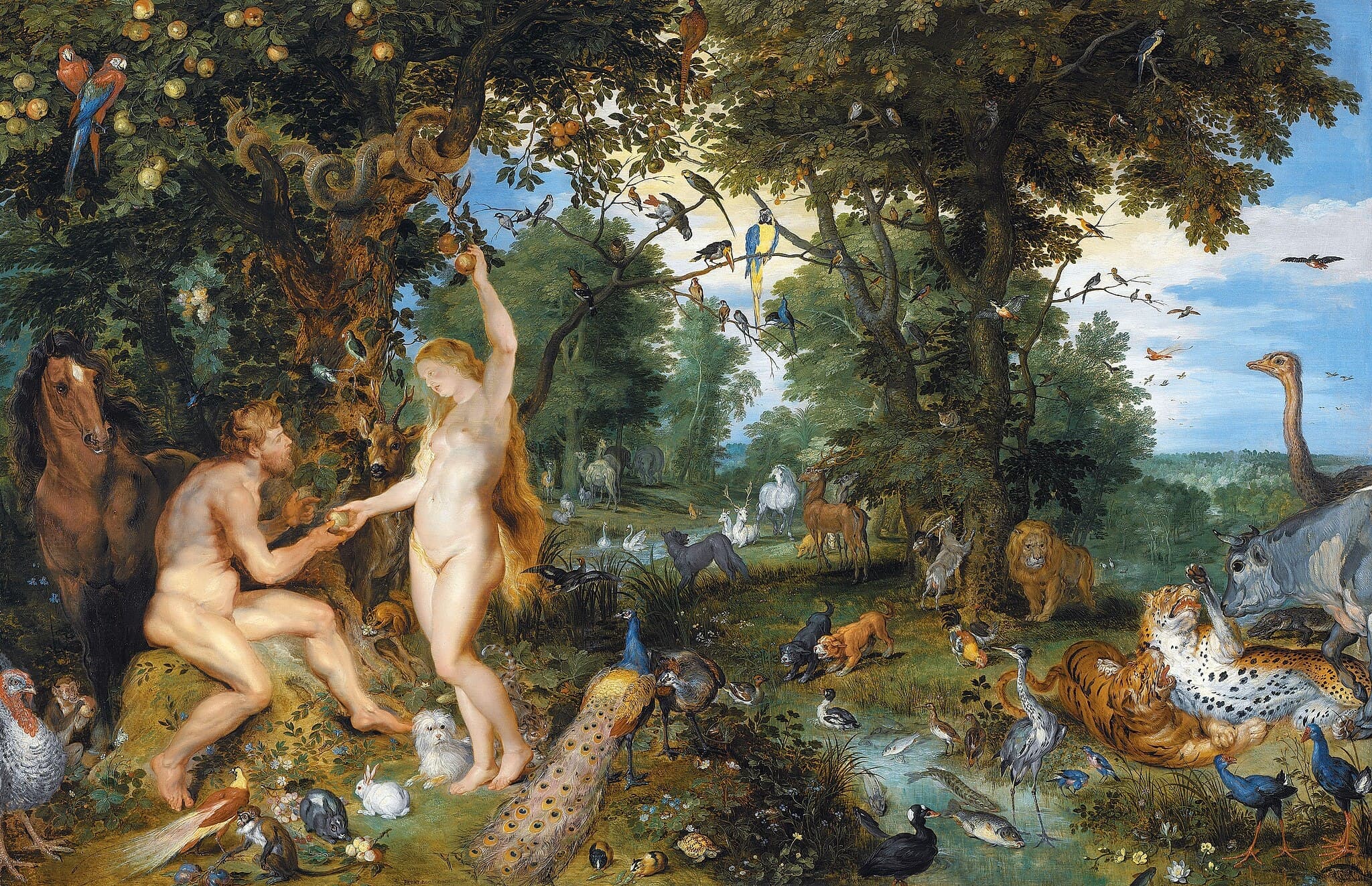
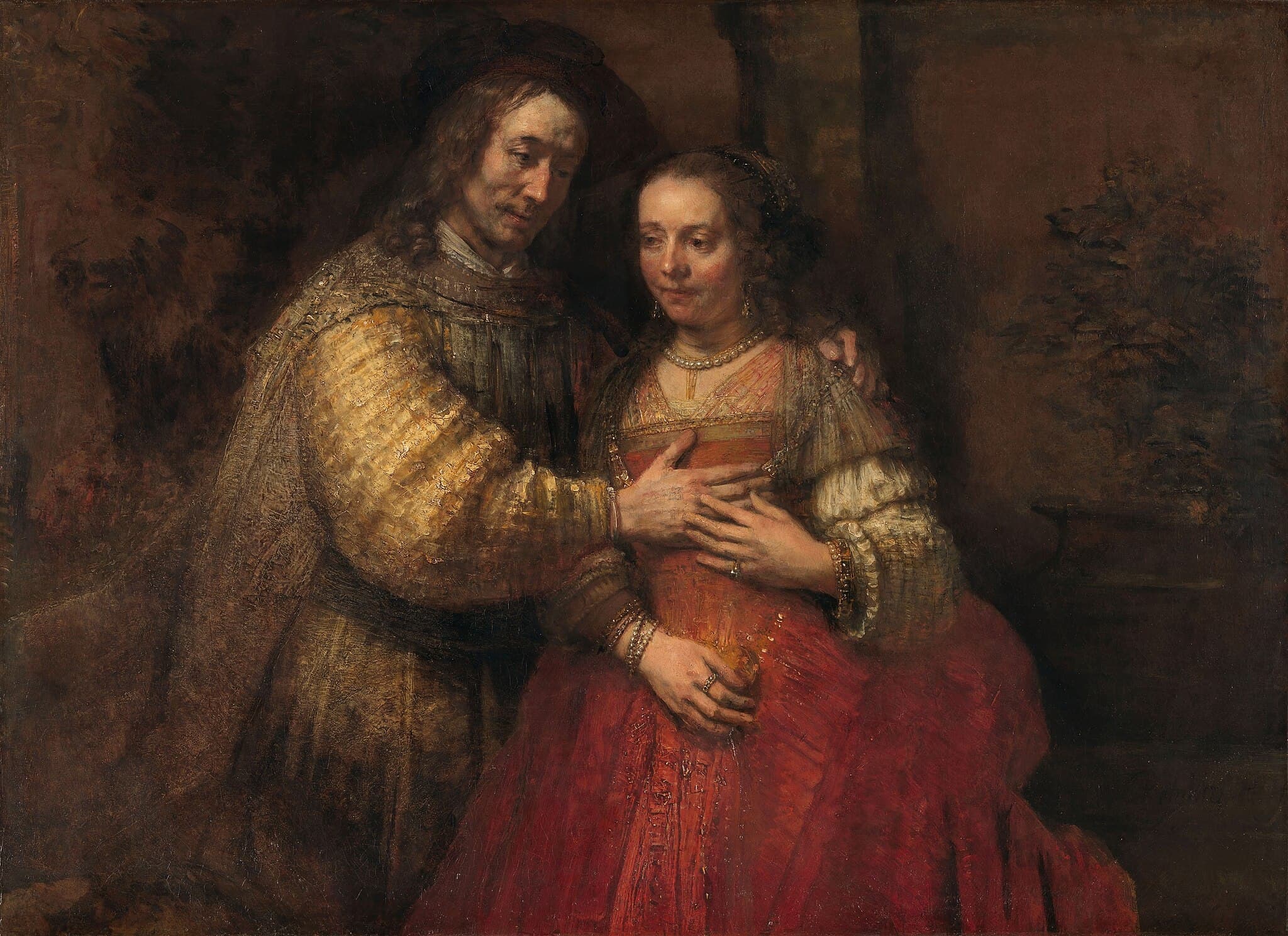
Rubens, collaborating with Jan Brueghel the Elder, centers Eden on an exchange of fruit amid an encyclopedic nature. The drama is compact—hands meet under a coiling serpent—while a world of animals and foliage flares around them. Spectacle teaches: abundance becomes the stage on which desire is tested. Surface is smooth and lucid so the whole reads swiftly, suitable for a princely setting that advertises knowledge and moral order. Rembrandt strips spectacle away. Two figures fill the frame against a dark, nearly abstract ground; three hands form a covenantal triangle over chest and bodice. The man’s gold sleeve is built from thick impasto and incisions so that paint catches light like metal—protection made tangible—while the woman’s red gown is worked in fine, trembling layers. Here matter itself speaks. Meaning resides in how paint holds light and how touch is registered. Rubens’s covenant is narrated by a dazzling world; Rembrandt’s is embodied in the physical speech of paint.
Why This Comparison Matters
This pairing clarifies two durable models for what pictures can do. Rubens shows how composition, color, and choreographed gesture can move a public—how painting becomes a civic and liturgical force that reads instantly and persuasively across space. Rembrandt shows how concentration, shadow, and the tactility of paint can turn looking into witness—how images work at the scale of conscience and time. Learning to shift between them trains viewers to adjust distance: step back for Rubens’s orchestration of many, step close for Rembrandt’s ethics of attention.
The distinction also maps institutions and markets onto vision: Counter‑Reformation Antwerp rewarded altar-theater; the Dutch Republic cultivated private devotion and civic inquiry. Yet their shared premise—that light makes meaning present at crisis—shapes much of later Northern art. Understanding this axis helps a general reader parse everything from Baroque altarpieces to intimate genre scenes: is the painting asking you to join a public act, or to dwell with a private truth?
Related Links
Sources
- Khan Academy — Rubens, The Elevation of the Cross
- Encyclopaedia Britannica — Descent from the Cross (Rubens)
- The Met Heilbrunn — The Reformation and Art
- Getty — Rubens and the Legacy of Antiquity
- The Met Heilbrunn — Rembrandt van Rijn: Paintings
- National Gallery of Art — Rembrandt, Lucretia (1664) technical note
- Mauritshuis — The Anatomy Lesson of Dr. Nicolaes Tulp
- Isabella Stewart Gardner Museum — The Storm on the Sea of Galilee
- State Hermitage Museum — The Return of the Prodigal Son
- Rijksmuseum — The Jewish Bride