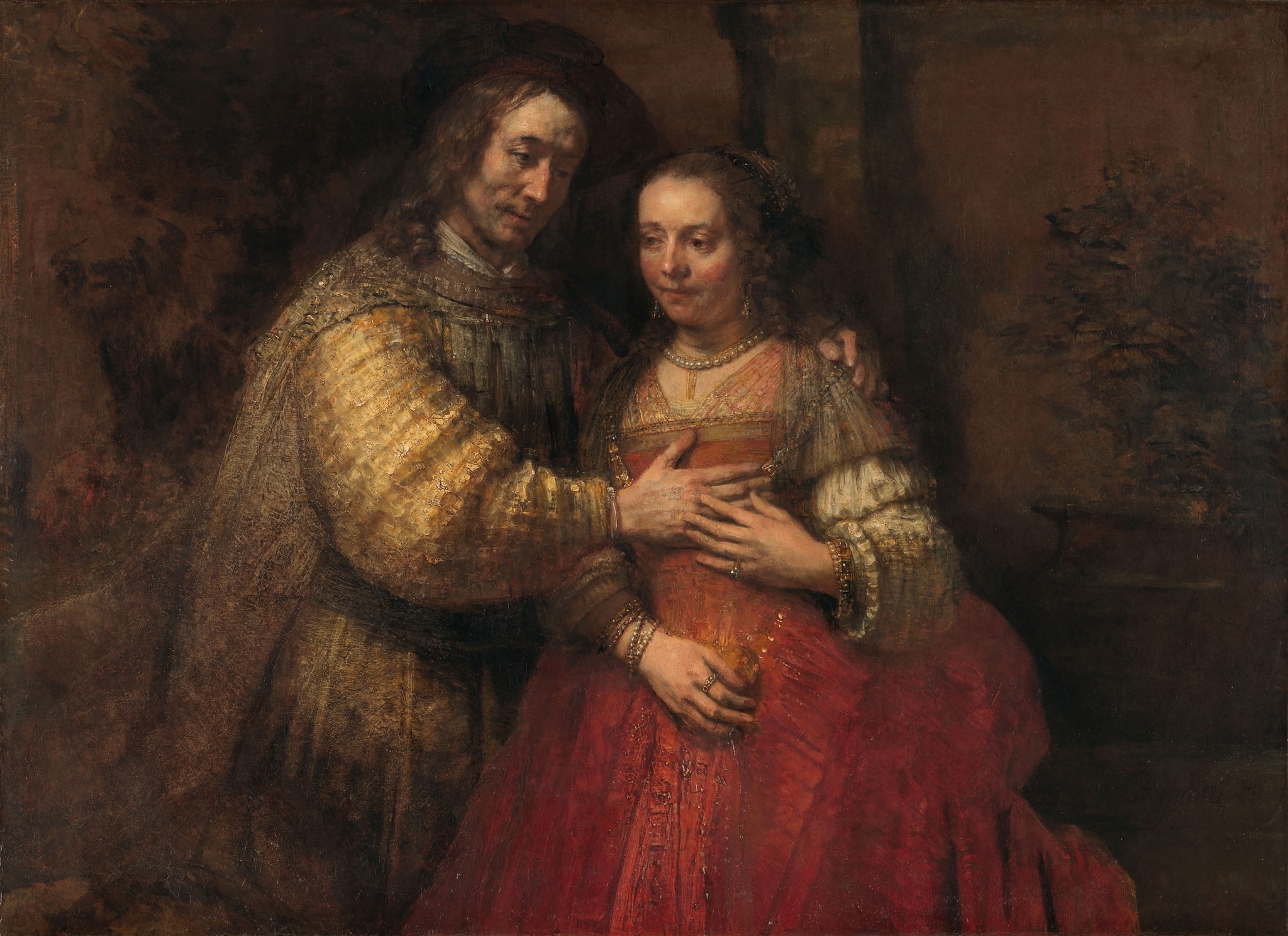
Isaac and Rebecca, Known as ‘The Jewish Bride’

by Rembrandt van Rijn

Rembrandt van Rijn’s Isaac and Rebecca, Known as ‘The Jewish Bride’ crystallizes marriage as a covenant of love, protection, and consent. In warm chiaroscuro, the man’s enclosing arm and open right hand meet the woman’s regulating left hand over her chest, while her other hand gathers the glowing red dress. The painting turns a biblical recognition scene into an intimate vow illuminated from within.

Study Print Studio

Create a personal study print

Build a companion study sheet around the part of this painting that speaks to you most. Choose a detail, shape an interpretation, and walk away with something personal and display-worthy.

Fast Facts

Year
c. 1665–1669
Medium
Oil on canvas
Dimensions
121.5 × 166.5 cm
Location
Rijksmuseum, Amsterdam
See all Rembrandt van Rijn paintings in Amsterdam
Isaac and Rebecca, Known as ‘The Jewish Bride’ by Rembrandt van Rijn (c. 1665–1669) featuring Man’s open hand on the woman’s chest, Woman’s hand covering his, Gathered red dress, Hammered-gold sleeve

Click on any numbered symbol to learn more about its meaning

Meaning & Symbolism

Rembrandt composes the scene as a solemn pact enacted by touch. The man inclines, his left arm encircling the woman’s shoulder; his right hand opens broadly over her chest, fingers spread and weight gently borne. She answers by laying her left hand across his to accept—and govern—the contact, while her right hand folds the glowing red skirt at her waist. This counterpoise of giving and consenting forms the painting’s axis: affection is affirmed, but also bounded, dignified, and self-possessed 2. The ringed fingers, the small string of pearls, and the fine chain that catches light at the neckline read as emblems of vow and constancy, not display; they whisper status while declaring union 2. The red garment pulses with life and passion, yet its energy is steadied by the man’s hammered-gold sleeve, whose thick, ridged impasto makes light behave like metal—substance turned into meaning. In this tense, tactile surface, love is not shown as theatrical ardor but as weight and shelter. Light engineers the picture’s ethics. A warm, concentrated glow isolates the couple against a shadowed architecture, with only a softened arch and a potted plant faintly legible; the world recedes so the relationship can speak. By excluding the spying king Abimelech, who traditionally certifies Isaac and Rebecca’s marriage in Genesis 26:8, Rembrandt displaces narrative proof with inward evidence—the evidence of touch, gaze, and conscience 2. The man’s face, modeled in chiaroscuro, bends toward reflection rather than triumph; the woman’s downcast composure signals steadiness after trial. This restraint reframes the biblical episode from a drama of recognition to a meditation on covenant. Scholars have noted that such inwardness aligns with the Dutch portrait historié, where contemporary sitters assume sacred roles to claim moral identity; whether specific sitters are present or not, the format here turns biblical time into present-tense virtue 2. Irving and Marilyn Lavin further read the gestures as encoding the “sister and spouse” theology—chaste, legitimized union—intensified by the woman’s modest control of touch and the man’s protective spread of the hand 3. The work consolidates the lessons of Rembrandt’s late career. After bankruptcy and personal loss, his painting thickens—earth tones, laden strokes, and free surfaces become agents of meaning, not mere description 12. In the gold sleeve, paint rises almost sculpturally; in the red dress, it shimmers like woven light. This materiality literalizes intimacy: love is something felt, weighted, and seen to gleam through darkness. The picture’s historical reception confirms its inward power: 19th‑century viewers bestowed the nickname “The Jewish Bride,” and Van Gogh, meeting the canvas in 1885, praised its profound tenderness 14. Today the Rijksmuseum rightly restores the scriptural identification—Isaac and Rebecca—while maintaining the resonant sobriquet that testifies to its fame 1. Standing in the Gallery of Honour, the painting asserts that marriage, in Rembrandt’s hands, is not a pageant but a quiet sacrament enacted by light, flesh, and paint.

Explore Deeper with AI

Ask questions about Isaac and Rebecca, Known as ‘The Jewish Bride’

Popular questions:

Powered by AI • Get instant insights about this artwork

💬 Ask questions about this artwork!

Interpretations

Formal Analysis

Rembrandt’s late style converts facture into meaning: the hammered-gold sleeve and shimmering reds are not mere description but ethical rhetoric. Thick impasto catches and scatters light so that texture choreographs attention toward the hands—the site of vow and restraint. The subdued ground and softly legible arch compress space into a chiaroscuro chamber, a stage for conscience rather than spectacle. Here, medium becomes metaphor: paint is worked until it behaves like fabric and metal, making union feel weighted, durable, and protective. Such material bravura aligns with the artist’s 1660s turn toward rugged surfaces and concentrated palettes after personal and financial calamity, where touch—of brush and of bodies—carries narrative and moral force 12.

Source: Rijksmuseum; Smarthistory

Iconographic Reading

Identified with Genesis 26:8, the painting suppresses the witness Abimelech to stage a covenant without tribunal. Irving and Marilyn Lavin’s “sister and spouse” reading clarifies the choreography: his open hand signifies protective possession legitimized by marriage, while her covering hand asserts modest control—chastity ratified through consent. The couple’s moral status is not proclaimed by emblematic props but inscribed in gesture; pearls and rings whisper legitimacy rather than advertise wealth. By fusing Old Testament subject with a portrait-like reserve, Rembrandt translates biblical time into present-tense virtue, letting the viewer perceive sanctified union as inwardly guaranteed rather than publicly policed 23.

Source: Irving & Marilyn Aronberg Lavin; Smarthistory

Historiated Portrait & Social Identity

The format aligns with a Dutch portrait historié, where contemporary sitters assume sacred roles to claim moral identity. Even if specific patrons are unknown, the scale, restricted setting, and timeless dress invite viewers to read the couple as models of pious domesticity. Adornment is calibrated: rings, a slim chain, and discreet pearls perform status-in-restraint, consistent with Calvinist-inflected decorum. This hybrid of portrait and history picture places virtue in the present, making the painting a tool of ethical self-fashioning as much as biblical recollection. The result is a public image of private goodness: recognizable social bodies enacting scriptural fidelity, ideal for Amsterdam’s mercantile, reputation-conscious elite 24.

Source: Smarthistory; Rijksmuseum (One Hundred Masterpieces story)

Reception History & Affect

Nineteenth-century viewers, unsure of subject, named it “The Jewish Bride,” signaling the canvas’s affective authority beyond iconographic certainty. Van Gogh’s 1885 response—placing it among Rembrandt’s most tender works—recognizes how warmth of palette, brevity of setting, and the silent treaty of hands make emotion legible without narrative spectacle. The Rijksmuseum’s modern titling restores Isaac and Rebecca while preserving the nickname as testimony to the work’s fame and interpretive pull. That the painting could be profoundly moving under two titles attests to Rembrandt’s strategy: anchor meaning in touch and light rather than in plot, so viewers from different eras can still read its ethical intimacy 15.

Source: Rijksmuseum; Van Gogh Letters

Gendered Agency & Ethics of Touch

The image scripts a negotiation of intimacy: his spread fingers over her chest declare care and claim; her hand governs the contact, transforming possession into consent. This measured exchange converts eros into agape—desire tempered by duty and chastened tenderness. The woman’s lowered gaze and composed bearing complicate passivity; she regulates proximity and pace, while the man inclines protectively, not triumphantly. Such staging aligns with early modern discourses of marital virtue that prized modesty, mutuality, and legitimacy. Rembrandt’s psychological tact—eschewing theatrical embrace—lets gender dynamics unfold as ethical poise rather than dominance, a reading strengthened by the Lavins’ theology of “sister and spouse” and by Smarthistory’s emphasis on restraint 23.

Source: Irving & Marilyn Aronberg Lavin; Smarthistory

Beholder’s Share: Omission as Moral Device

By removing Abimelech—the narrative certifier—Rembrandt drafts the viewer as witness and conscience. The scene becomes a private covenant made public only to us, demanding an interpretive act: do we read possession, consent, or both? The sparse architecture and vegetal note reduce distractions so that the ethics of touch fill the void. This strategy leverages seventeenth-century Dutch taste for inwardness, where faith and virtue are proven in conduct, not ceremony. The result is an interactive iconography: recognition occurs not in the plot but in the beholder’s judgment, an aesthetic that suits Rembrandt’s late practice of psychological immersion and light as moral instrument 26.

Source: Smarthistory; National Gallery of Art (artist biography)

Related Themes

About Rembrandt van Rijn

Rembrandt van Rijn (1606–1669) was a leading Dutch Golden Age painter and printmaker whose Amsterdam years (from 1631) produced virtuosic portraits and ambitious history paintings. In the early 1630s he favored polished finishes, saturated color, and theatrical staging—qualities on display in this 1633 canvas. Although prolific, this is his only known painted seascape [2][4].
View all works by Rembrandt van Rijn

More by Rembrandt van Rijn
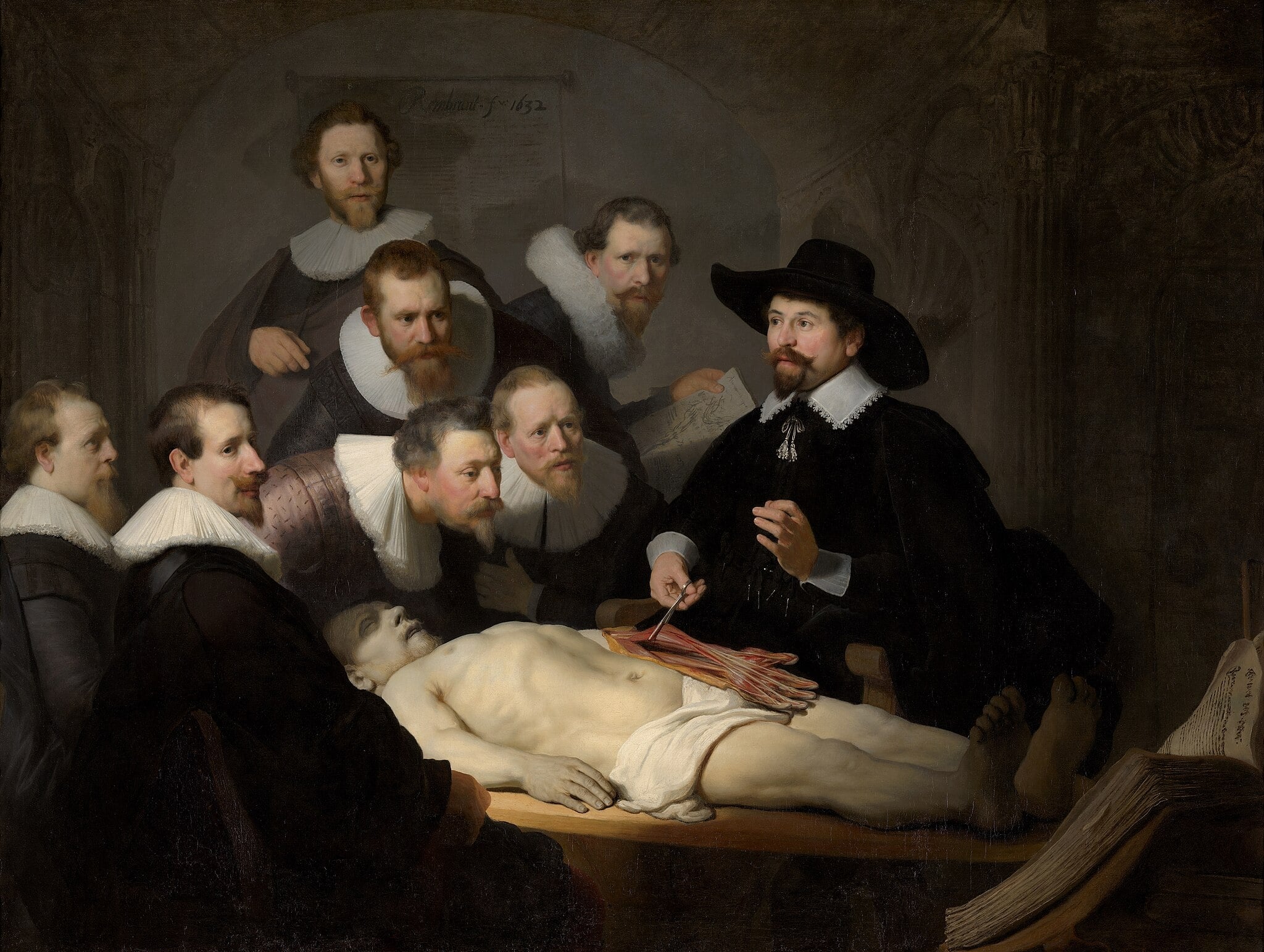
The Anatomy Lesson of Dr. Nicolaes Tulp by Rembrandt van Rijn

The Anatomy Lesson of Dr. Nicolaes Tulp

Rembrandt van Rijn (1632)

Rembrandt van Rijn turns a civic commission into a drama of <strong>knowledge made visible</strong>. A cone of light binds the ruff‑collared surgeons, the pale cadaver, and Dr. Tulp’s forceps as he raises the <strong>forearm tendons</strong> to explain the hand. Book and body face each other across the table, staging the tension—and alliance—between <strong>textual authority</strong> and <strong>empirical observation</strong> <sup>[1]</sup><sup>[2]</sup>.
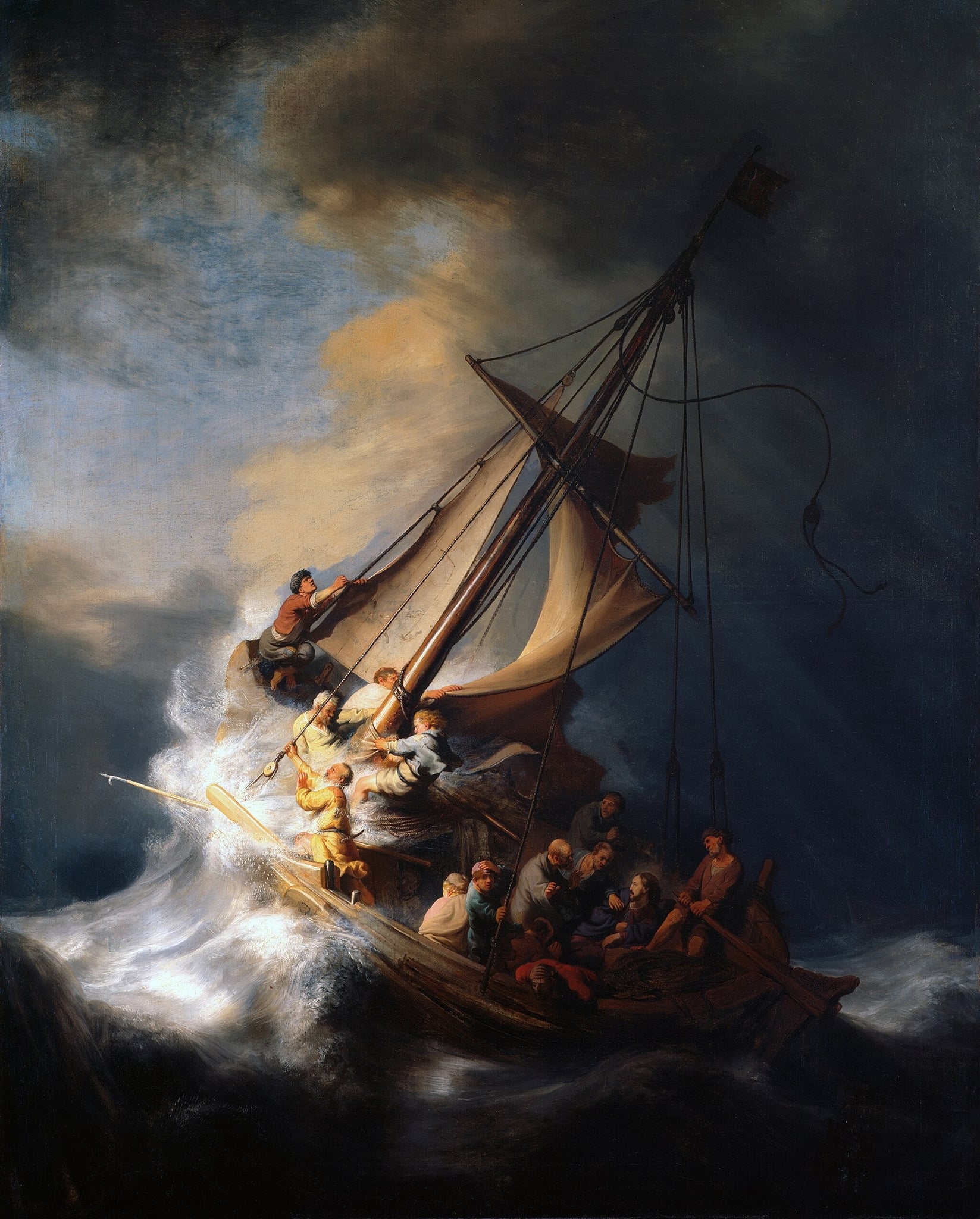
The Storm on the Sea of Galilee by Rembrandt van Rijn

The Storm on the Sea of Galilee

Rembrandt van Rijn (1633)

Rembrandt van Rijn’s The Storm on the Sea of Galilee stages a clash of <strong>human panic</strong> and <strong>divine composure</strong> at the instant before the miracle. A torn mainsail whips across a steeply tilted boat as terrified disciples scramble, while a <strong>serenely lit Christ</strong> anchors a pocket of calm—an image of faith holding within chaos <sup>[1]</sup><sup>[3]</sup>. It is Rembrandt’s only painted seascape, intensifying its dramatic singularity in his oeuvre <sup>[2]</sup>.
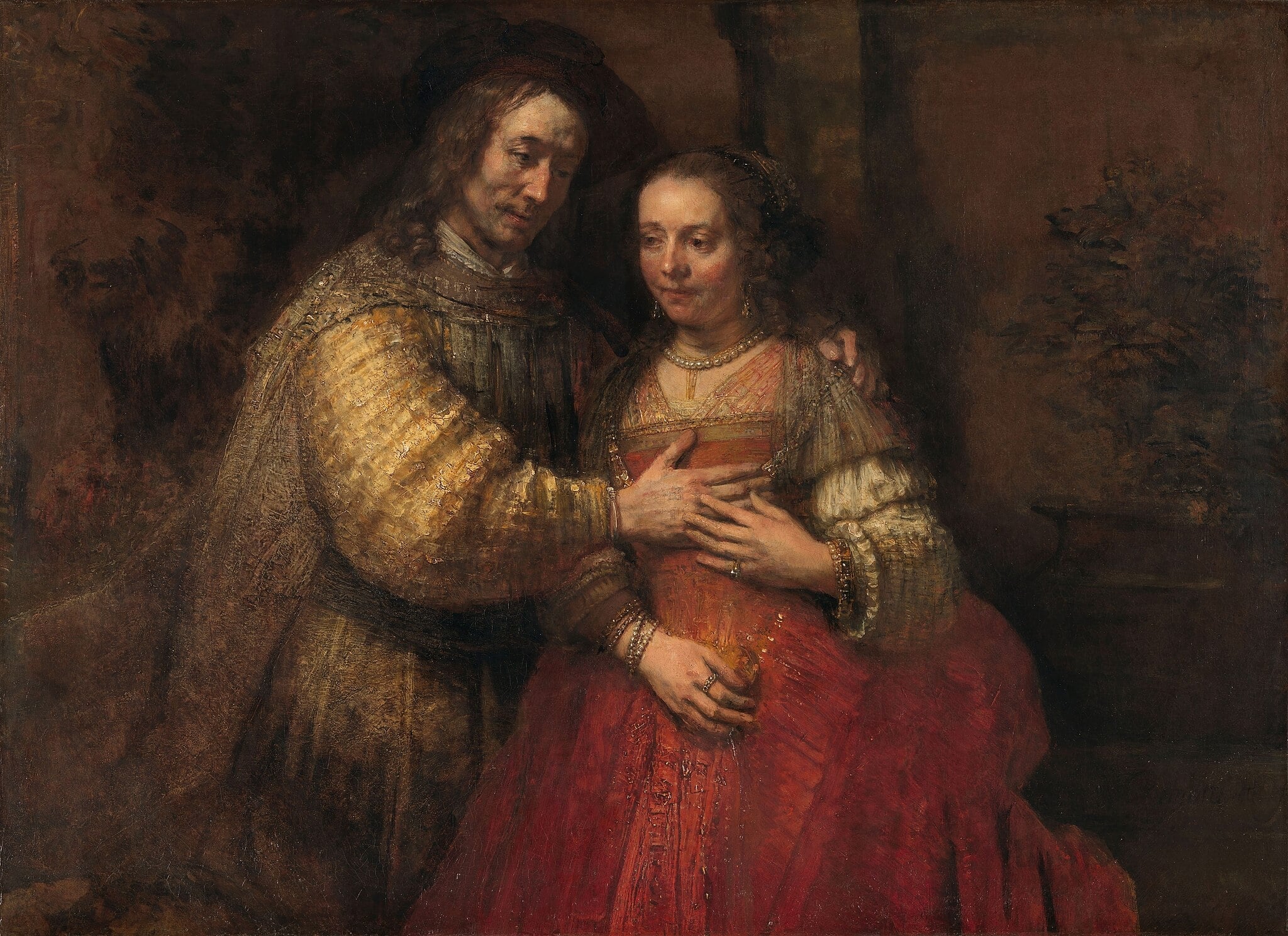
The Jewish Bride by Rembrandt van Rijn

The Jewish Bride

Rembrandt van Rijn (c. 1665–1669)

The Jewish Bride by Rembrandt van Rijn stages an intimate covenant: two figures, read today as <strong>Isaac and Rebecca</strong>, seal their union through touch rather than spectacle. Light concentrates on faces and hands, while the man’s glittering <strong>gold sleeve</strong> and the woman’s <strong>coral-red gown</strong> turn paint itself into a metaphor for fidelity and tenderness <sup>[1]</sup><sup>[3]</sup>. This late masterpiece embodies Rembrandt’s <strong>material eloquence</strong>—impasto as feeling—within a hushed, dark setting <sup>[1]</sup><sup>[2]</sup>.
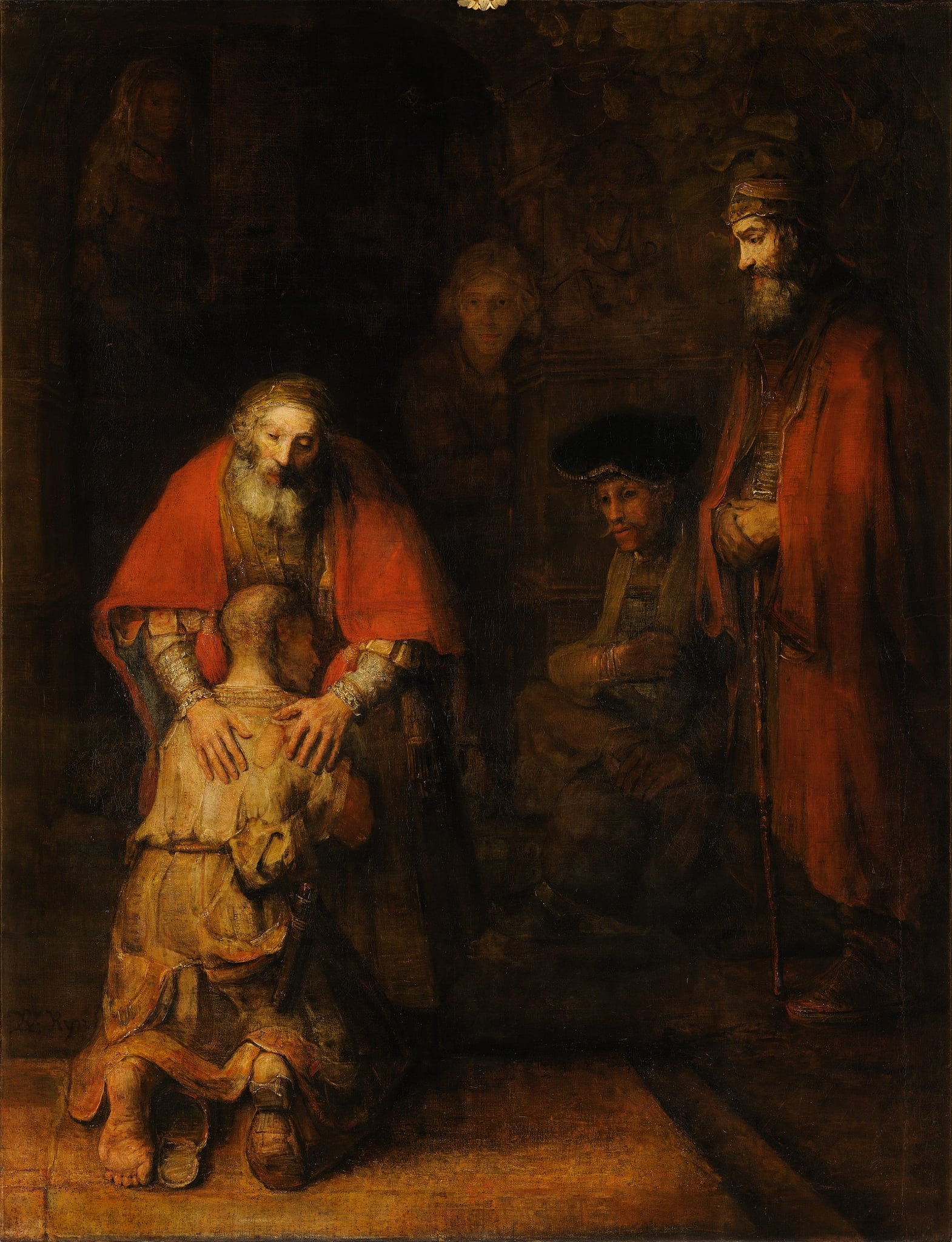
The Return of the Prodigal Son by Rembrandt van Rijn

The Return of the Prodigal Son

Rembrandt van Rijn (c. 1661–1669 (probably completed by 1669))

Rembrandt van Rijn’s The Return of the Prodigal Son is a late-life meditation on <strong>mercy</strong>, <strong>homecoming</strong>, and <strong>restored dignity</strong>. In a hush of dusk-like light, a ragged son kneels into his father’s <strong>embrace</strong>, while an upright elder brother holds back in shadow. The image concentrates meaning in illuminated <strong>faces, hands, and feet</strong>, turning a parable into a timeless human reckoning. <sup>[1]</sup><sup>[2]</sup>
The Sampling Officials of the Amsterdam Drapers’ Guild, Known as ‘The Syndics’ by Rembrandt van Rijn

The Sampling Officials of the Amsterdam Drapers’ Guild, Known as ‘The Syndics’

Rembrandt van Rijn (1662)

Rembrandt van Rijn’s The Sampling Officials of the Amsterdam Drapers’ Guild, Known as ‘The Syndics’ (1662) stages a <strong>meeting interrupted</strong>: six guild officials glance up from an open <strong>stalenboek</strong> (sample book) atop a sumptuous <strong>Oriental carpet</strong>, as if a merchant has just entered. The low vantage and unified yet varied poses convert routine inspection into a drama of <strong>civic authority</strong> and <strong>public accountability</strong> <sup>[1]</sup>.