Romantic love
Featured Artworks
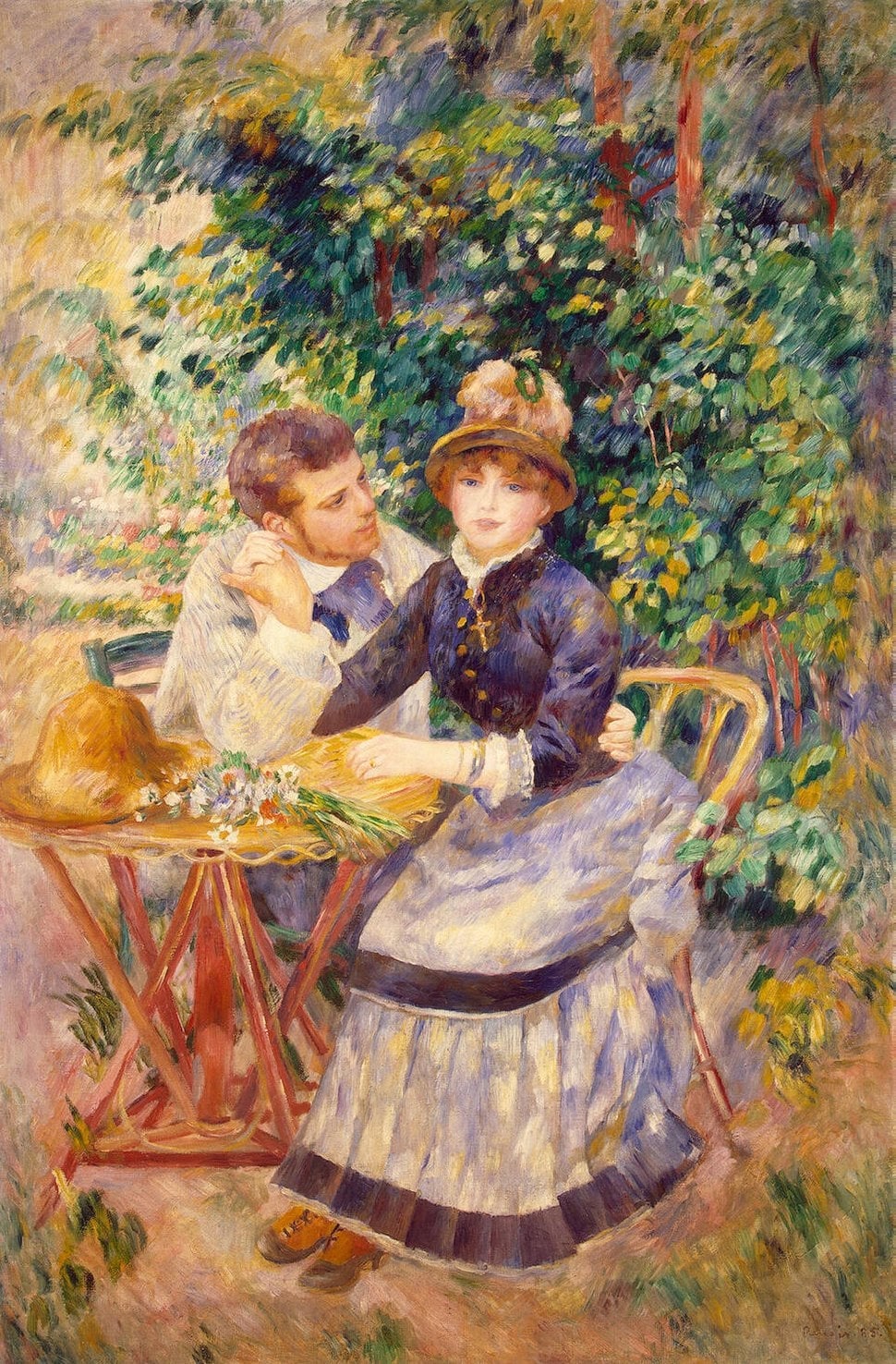
In the Garden
Pierre-Auguste Renoir (1885)
In the Garden presents a charged pause in modern leisure: a young couple at a café table under a living arbor of leaves. Their lightly clasped hands and the bouquet on the tabletop signal courtship, while her calm, front-facing gaze checks his lean. Renoir’s flickering brushwork fuses figures and foliage, rendering love as a <strong>transitory, luminous sensation</strong> <sup>[1]</sup><sup>[3]</sup>.
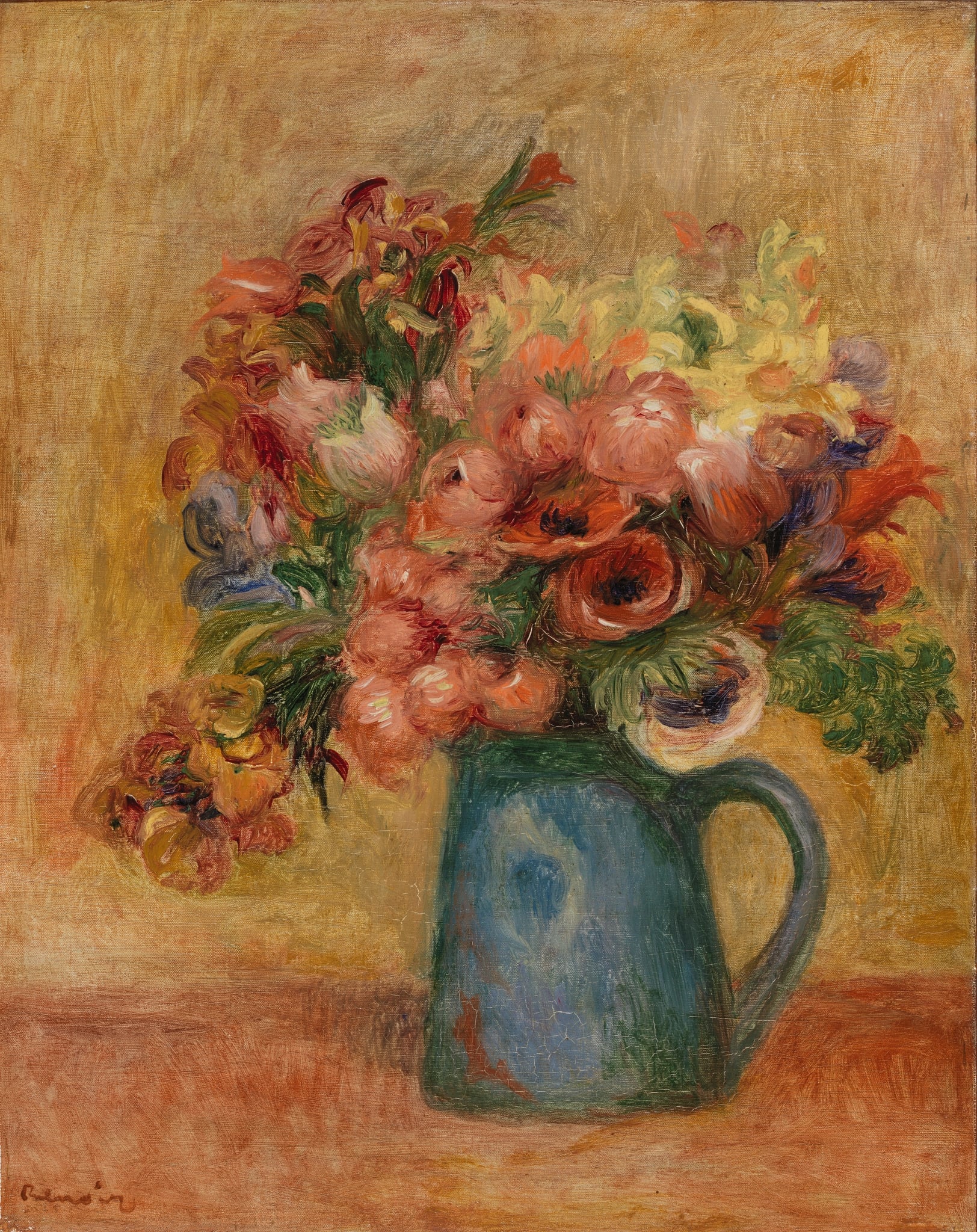
Vase of Flowers
Pierre-Auguste Renoir (c. 1889)
Vase of Flowers is a late‑1880s still life in which Pierre-Auguste Renoir turns a humble blue‑green jug and a tumbling bouquet into a <strong>laboratory of color and touch</strong>. Against a warm ocher wall and reddish tabletop, coral and vermilion blossoms flare while cool greens and violets anchor the mass, letting <strong>color function as drawing</strong> <sup>[1]</sup><sup>[4]</sup>. The work affirms Renoir’s belief that flower painting was a space for bold experimentation that fed his figure art.
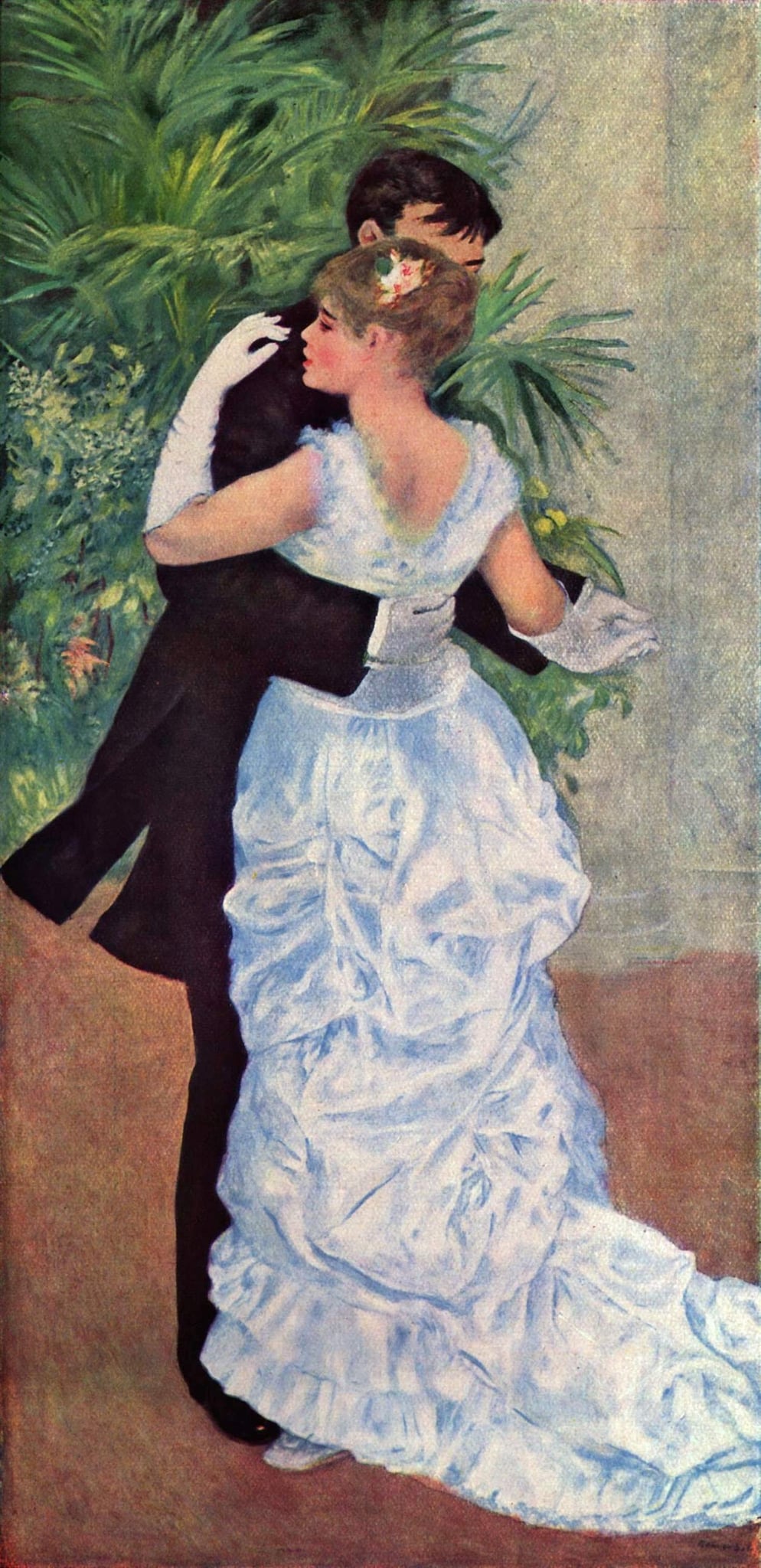
Dance in the City
Pierre-Auguste Renoir (1883)
Pierre-Auguste Renoir’s Dance in the City stages an urban waltz where decorum and desire briefly coincide. A couple’s close embrace—his black tailcoat enclosing her luminous white satin gown—creates a <strong>cool, elegant</strong> harmony against potted palms and marble. Renoir’s refined, post‑Impressionist touch turns social ritual into <strong>sensual modernity</strong> <sup>[1]</sup><sup>[2]</sup>.
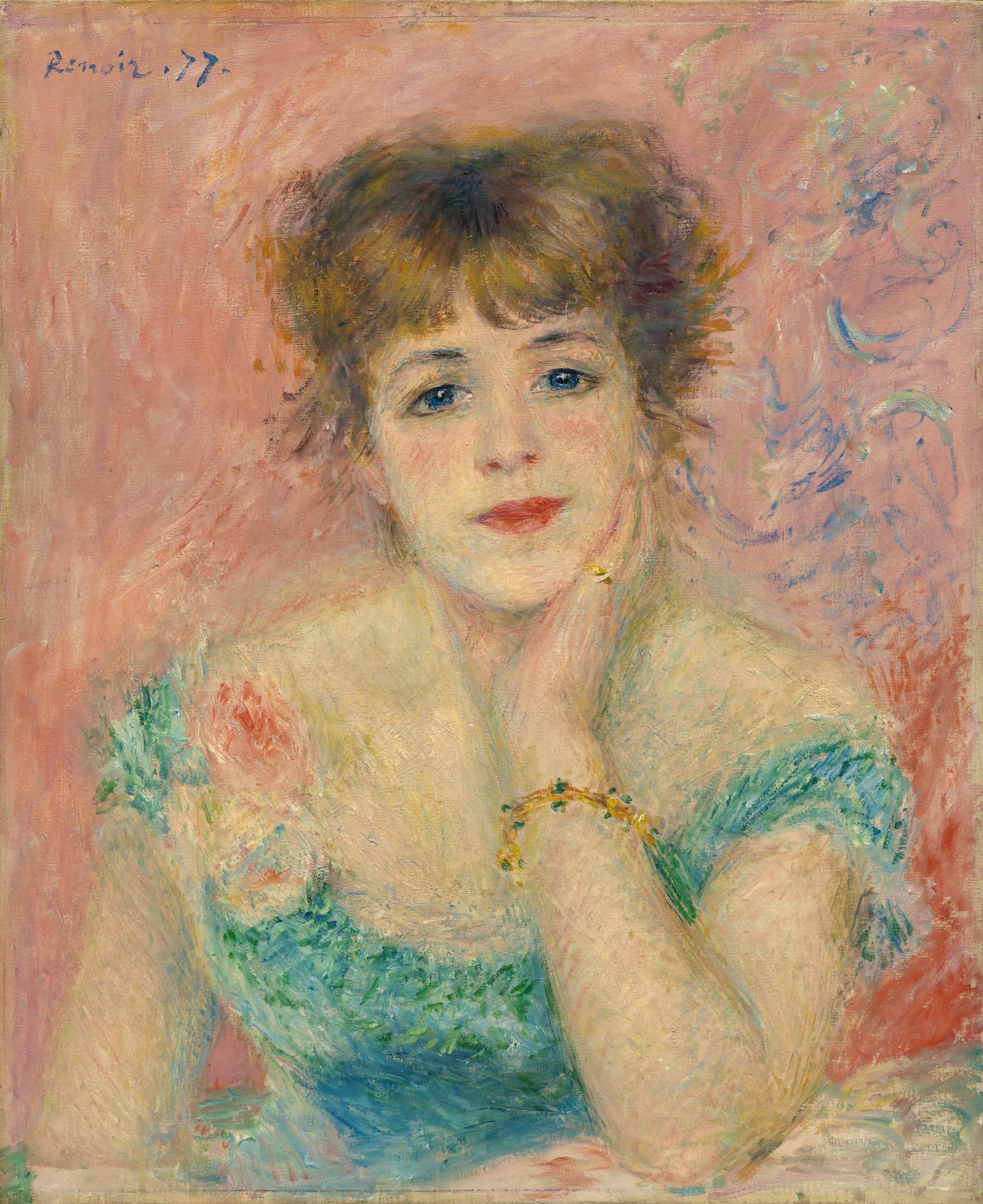
Portrait of Jeanne Samary
Pierre-Auguste Renoir (1877)
Renoir’s Portrait of Jeanne Samary (1877) turns a modern actress into a study of <strong>radiance and immediacy</strong>, fusing figure and air with shimmering strokes. Cool blue‑green dress notes spark against a warm <strong>coral-pink atmosphere</strong>, while the cheek‑in‑hand pose crystallizes a moment of intimate poise <sup>[1]</sup><sup>[4]</sup>.
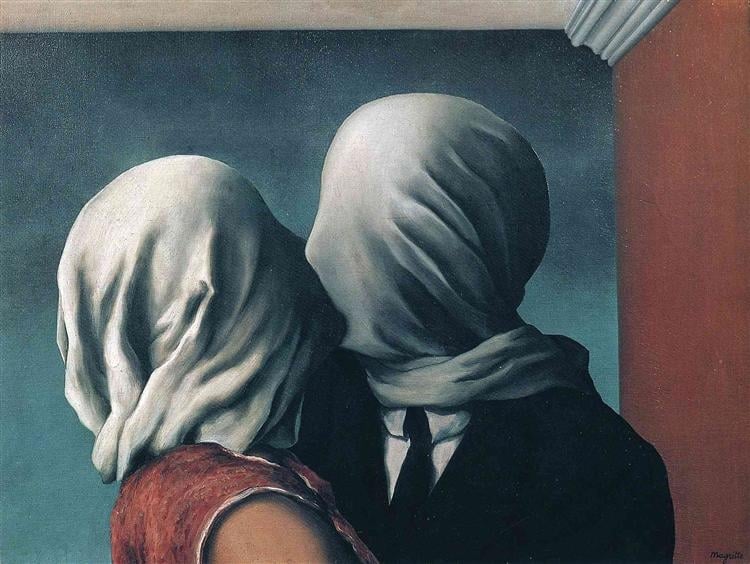
The Lovers
Rene Magritte (1928)
René Magritte’s The Lovers turns a kiss into an emblem of <strong>desire obstructed</strong>: two figures—she in red, he in a dark suit—press together while their heads are swathed in <strong>white cloth</strong>. Within a cool blue‑grey interior bounded by crown molding and a rust-red wall, intimacy becomes an image of <strong>opacity</strong> rather than revelation <sup>[1]</sup>.
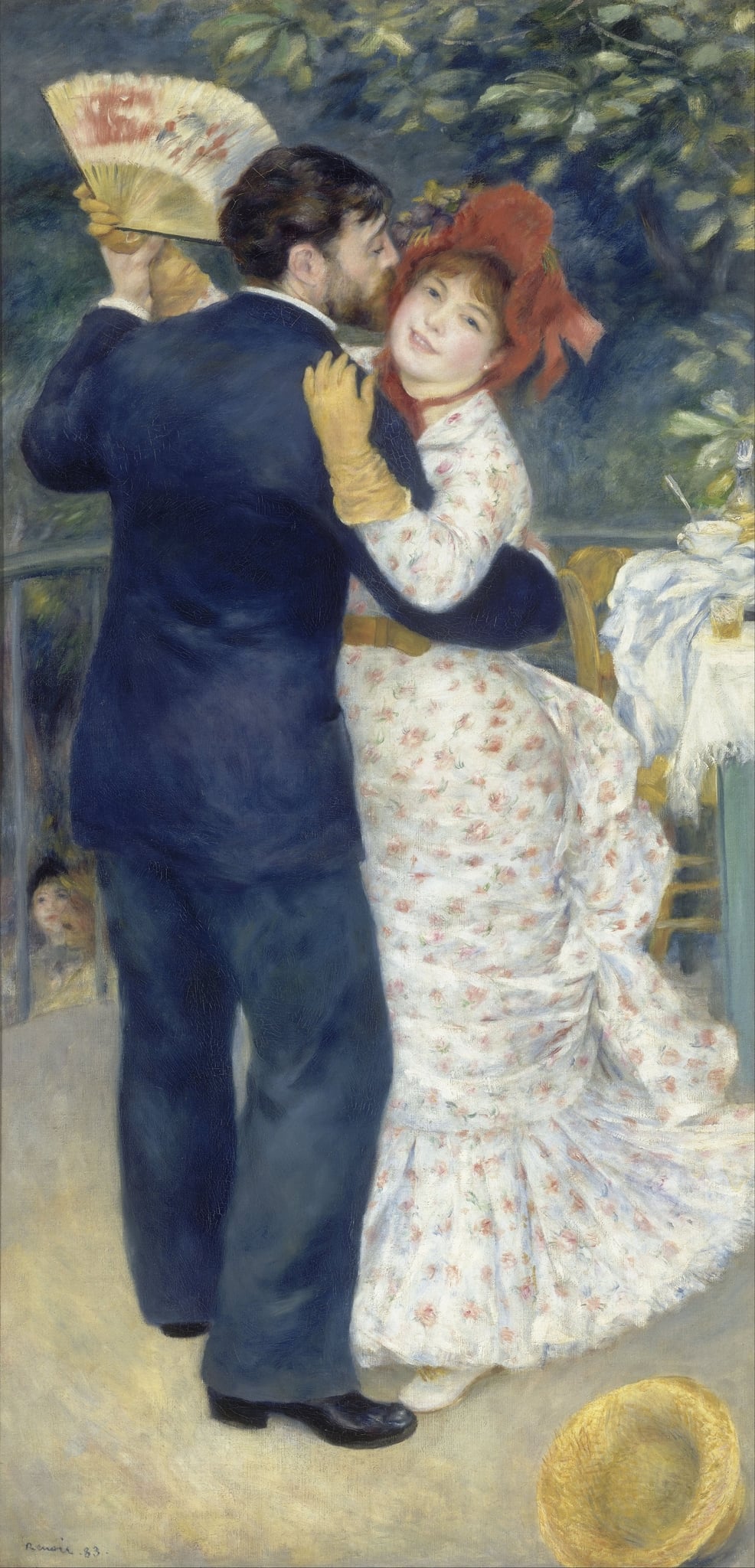
Dance in the Country
Pierre-Auguste Renoir (1883)
Dance in the Country shows a couple swept into a close embrace on a café terrace, their bodies turning in a soft spiral as foliage and sunlight dissolve into <strong>dappled color</strong>. Renoir orchestrates <strong>bourgeois leisure</strong>—the tossed straw boater, a small table with glass and napkin, the woman’s floral dress and red bonnet—to stage a moment where decorum and desire meet. The result is a modern emblem of shared pleasure, poised between Impressionist shimmer and a newly <strong>firm, linear touch</strong>.
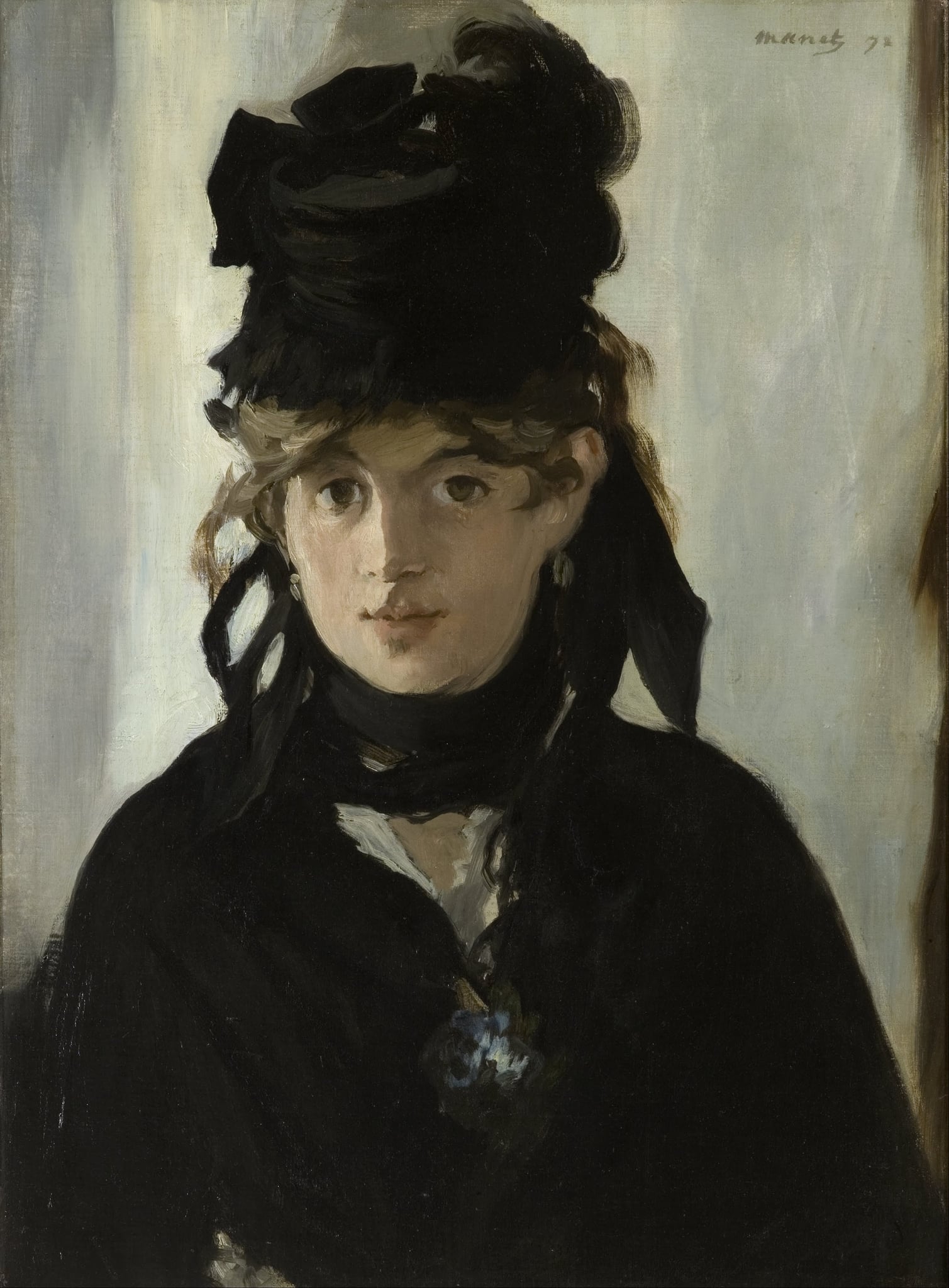
Berthe Morisot with a Bouquet of Violets
Édouard Manet (1872)
Édouard Manet’s Berthe Morisot with a Bouquet of Violets is a close, modern portrait built as a <strong>symphony in black</strong> punctuated by a tiny violet knot. Side‑light chisels the face from a cool, silvery ground while hat, scarf, and coat merge into one dark silhouette, and the eyes are painted strikingly <strong>black</strong> for effect <sup>[1]</sup>. The single touch of violets introduces a discreet, coded <strong>tenderness</strong> within the portrait’s refined restraint <sup>[1]</sup><sup>[3]</sup><sup>[4]</sup>.
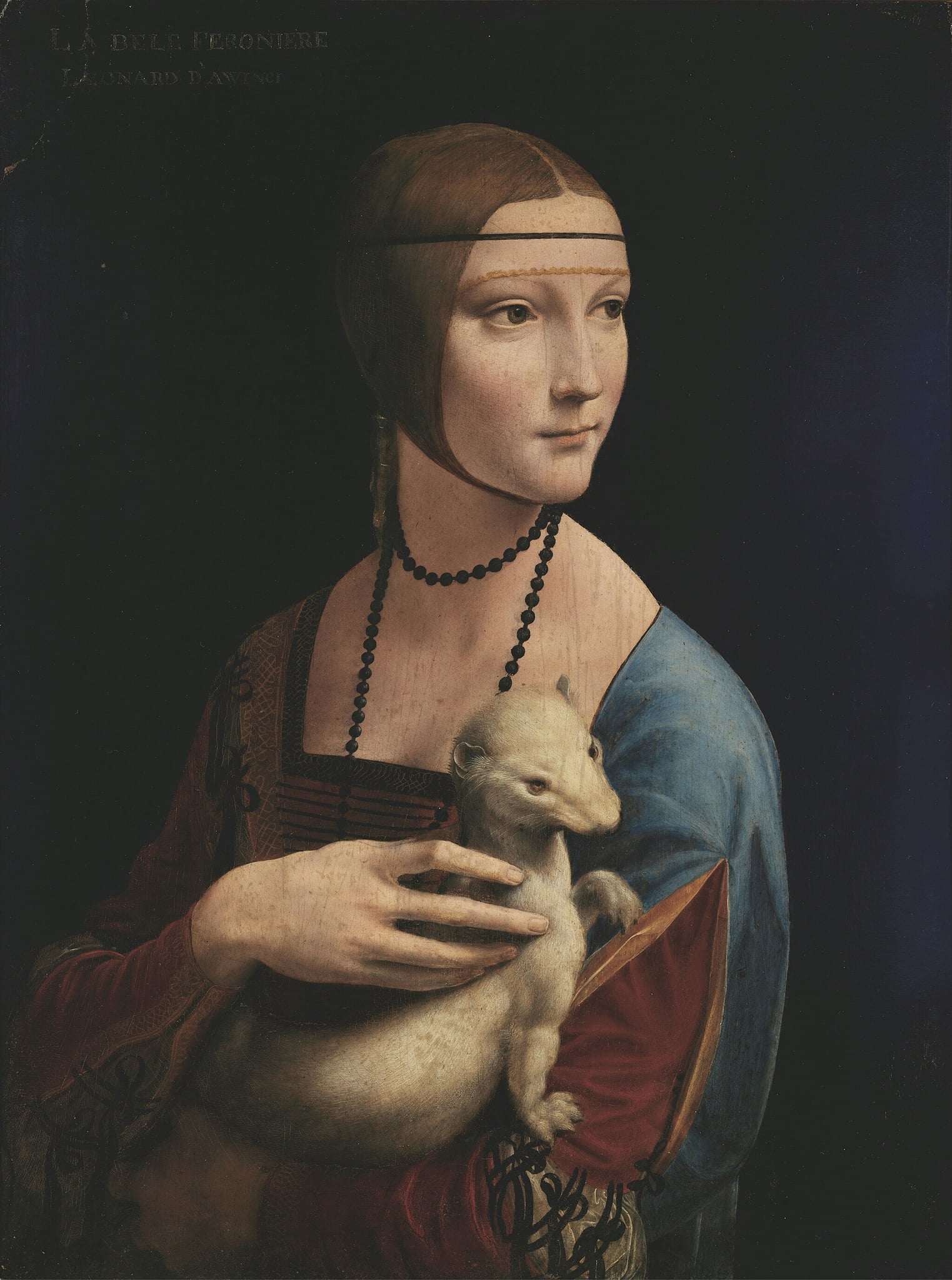
Lady with an Ermine
Leonardo da Vinci (c. 1489–1491)
Leonardo da Vinci’s Lady with an Ermine forges a new kind of court portrait, uniting poised intelligence with emblematic meaning through the sitter’s alert turn and the sleek, pale <strong>ermine</strong>. The painting transforms a likeness into a thesis on <strong>virtue, favor, and inward motion</strong>, using sfumato and a dynamic spiral pose to bind woman and animal in a single thought. Its afterlife—blackened background, misnaming inscription—adds a visible record of reception atop Leonardo’s original intent <sup>[1]</sup><sup>[3]</sup>.
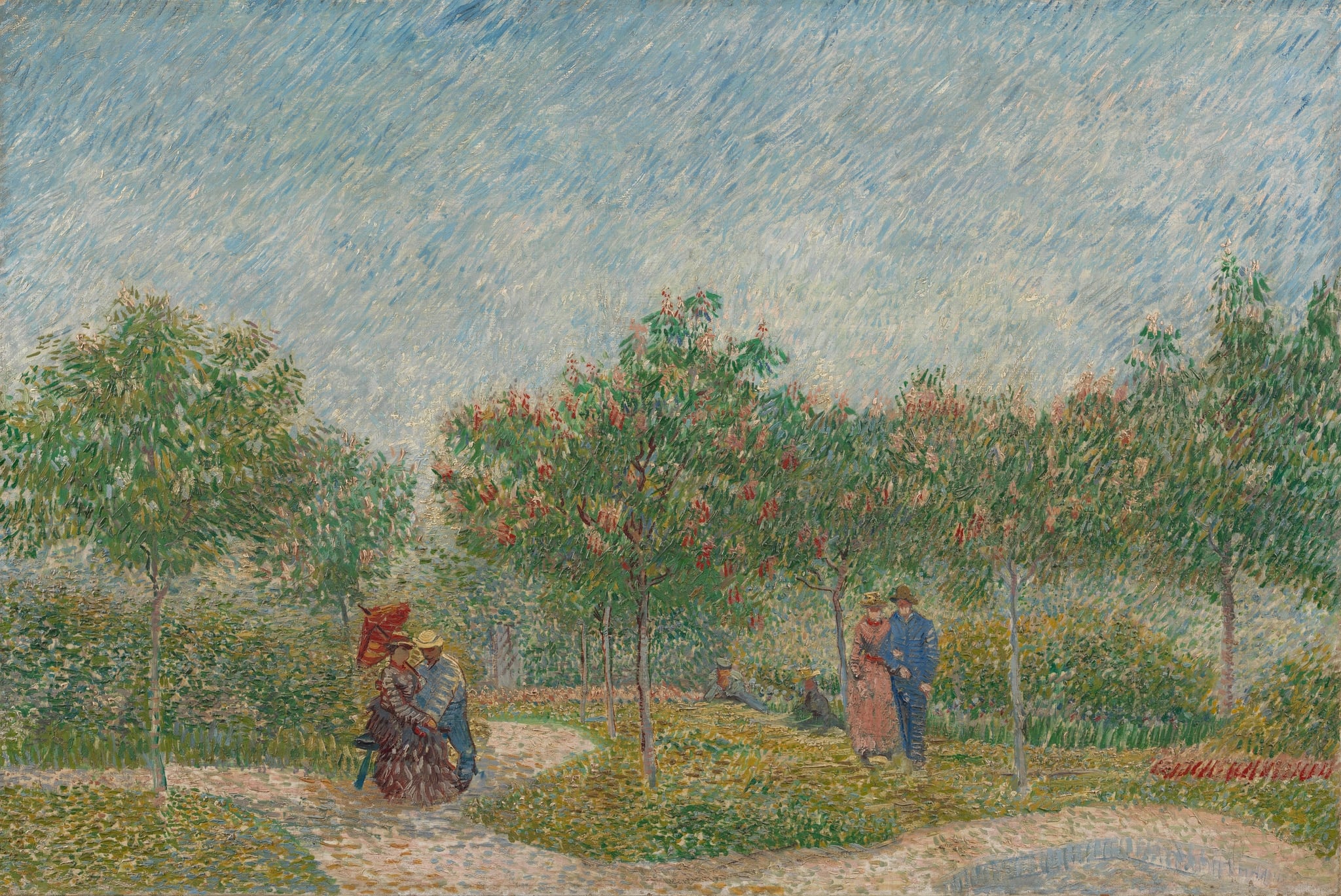
Garden with Courting Couples: Square Saint-Pierre
Vincent van Gogh (1887)
In Garden with Courting Couples: Square Saint-Pierre, Vincent van Gogh turns a small Montmartre park into a stage where <strong>spring</strong>, <strong>intimacy</strong>, and <strong>urban leisure</strong> converge. Short, shimmering strokes fuse pink chestnut blossoms, curving paths, and paired figures into one pulse of <strong>renewal</strong> and <strong>togetherness</strong> <sup>[1]</sup><sup>[2]</sup>.
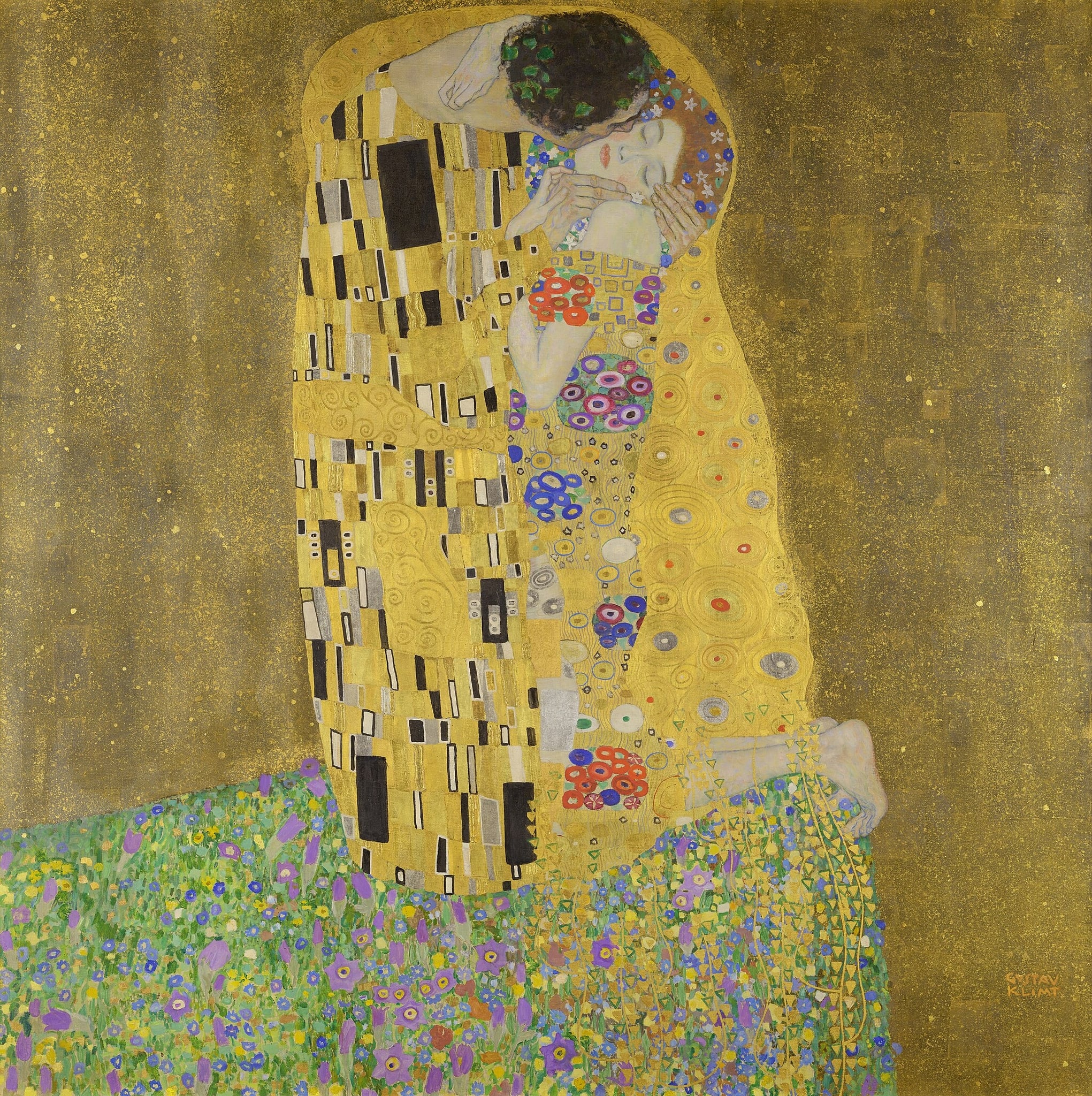
The Kiss (Lovers)
Gustav Klimt (1907–1908 (Belvedere lists 1908/09))
The Kiss (Lovers) crystallizes Klimt’s <strong>Golden Period</strong> ideal: erotic union staged as a sacred vision. Two bodies fuse beneath a single golden mantle, poised on a flowered ledge at the brink of the unknown, where <strong>pattern becomes symbol</strong> and intimacy becomes icon.
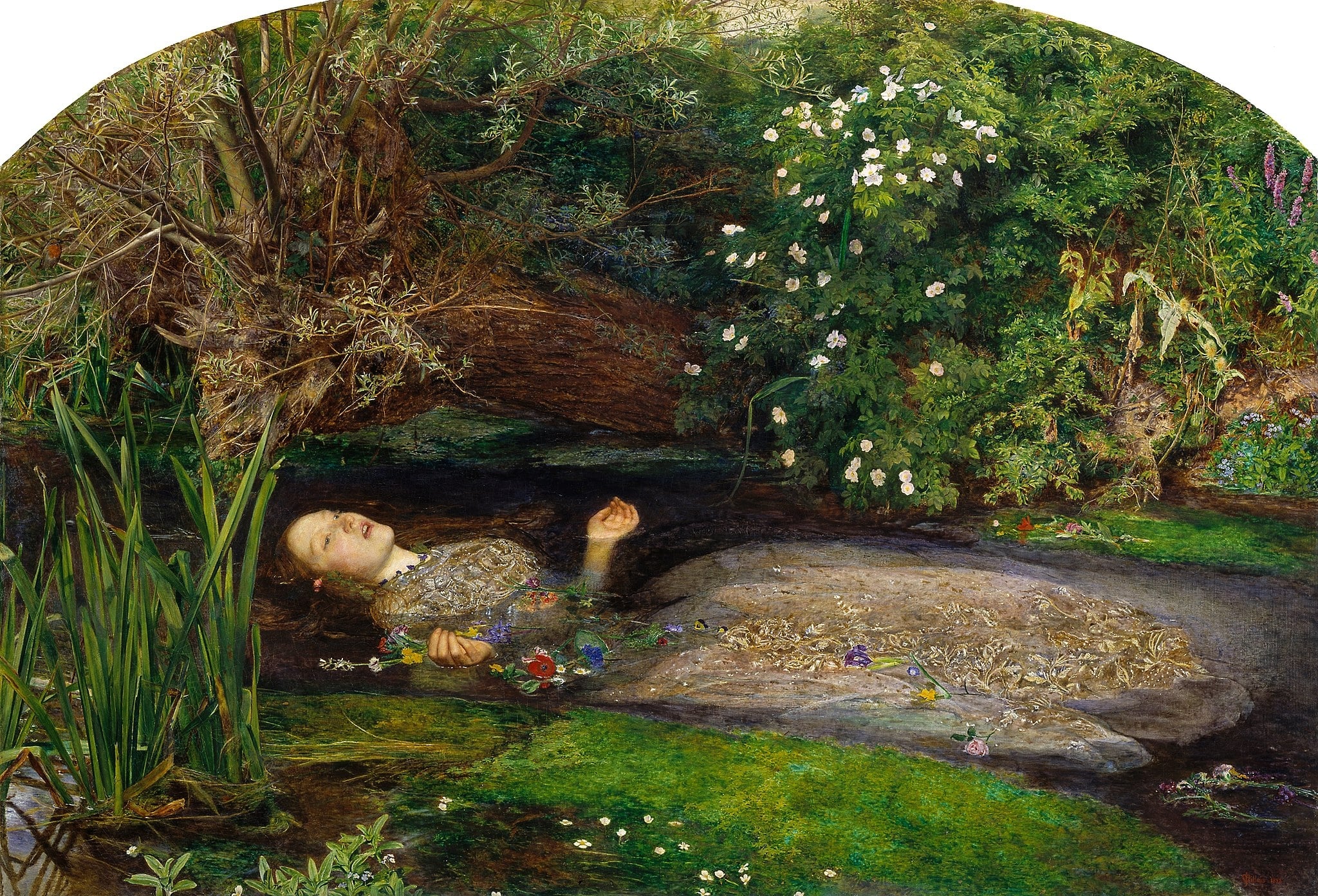
Ophelia
John Everett Millais (1851–1852)
John Everett Millais’s Ophelia shows Shakespeare’s heroine floating in a narrow stream, her jeweled dress both buoying and engulfing her. Millais renders the riverbank with <strong>forensic botanical precision</strong>, so that reeds, willow, briars, nettles, and a scatter of emblematic flowers surround a face slack in mid‑song and hands raised in <strong>open‑palmed surrender</strong> <sup>[1]</sup><sup>[3]</sup>.
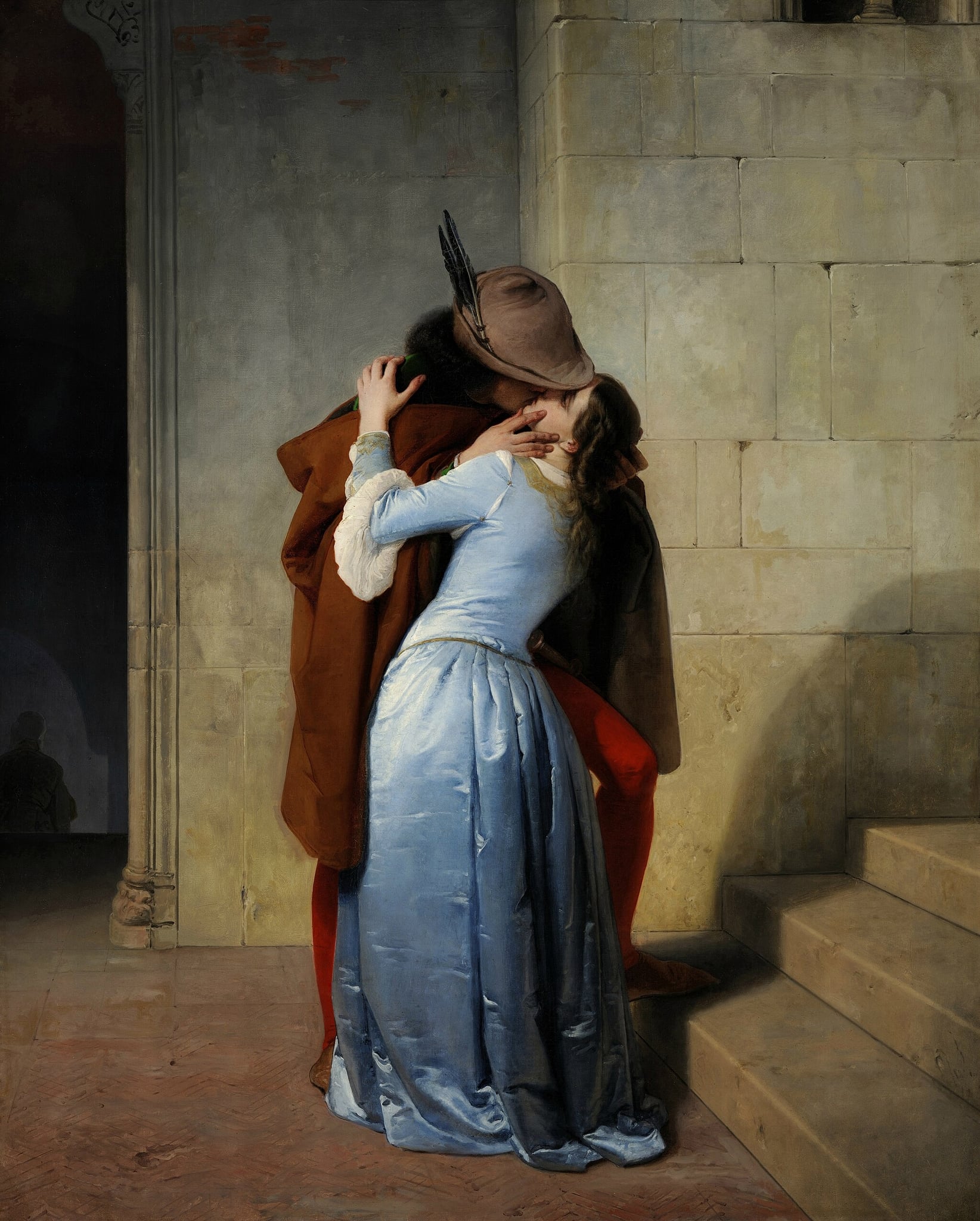
The Kiss (Hayez)
Francesco Hayez (1859)
Francesco Hayez’s The Kiss (Hayez) fuses intimate passion with <strong>political resolve</strong>: a clandestine embrace staged on a cold stone threshold as departure looms. The man’s <strong>outward-angled foot</strong> on the stair and the flash of a <strong>dagger</strong> compress time to a final instant before flight, while tricolour cues fold love into the Risorgimento alliance of 1859 <sup>[1]</sup>. The painting’s cool masonry and <strong>theatrical light</strong> make private tenderness read as public courage.
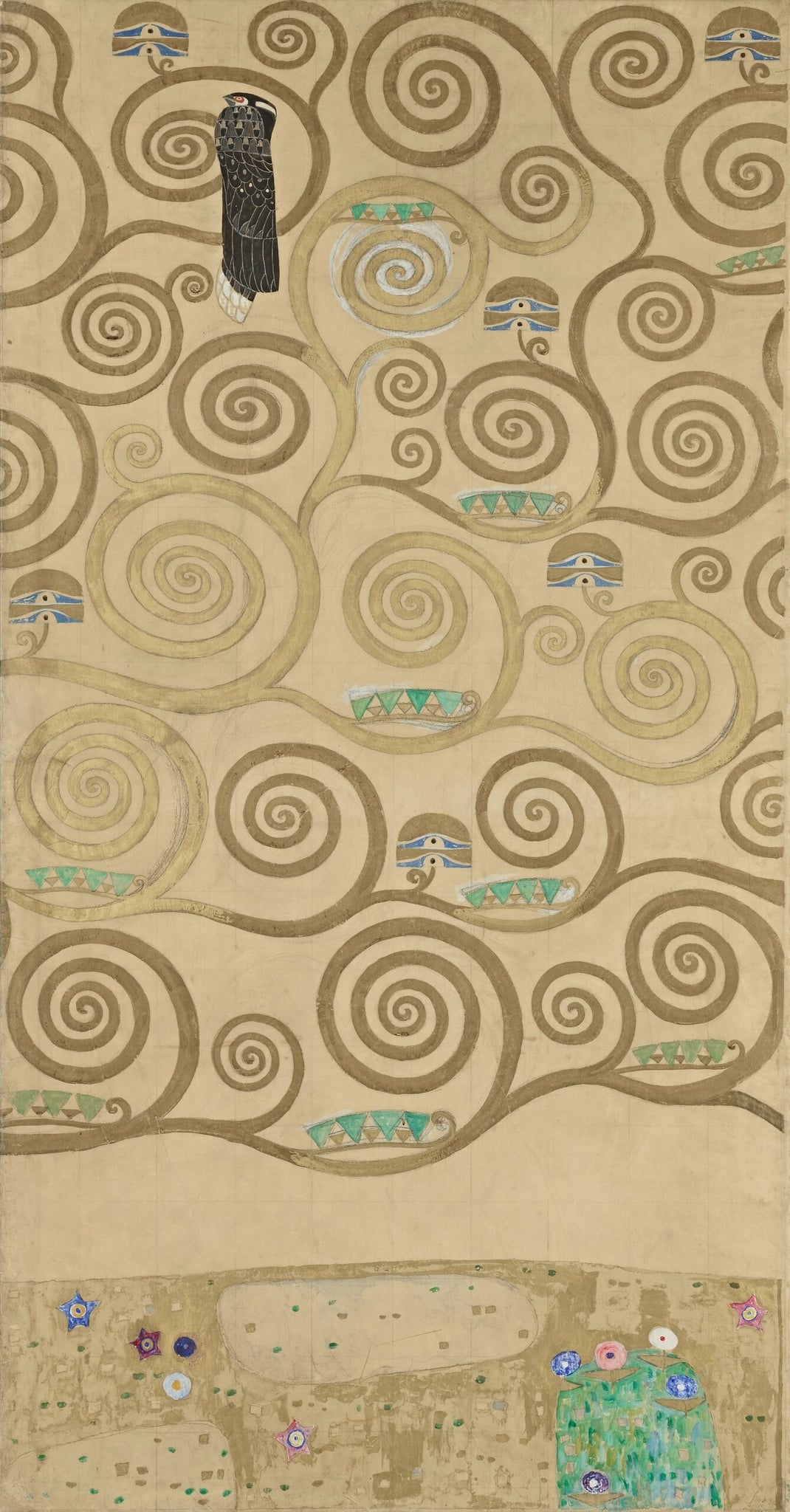
Part of the Tree of Life (Part 5)
Gustav Klimt (1910–1911)
In Part of the Tree of Life (Part 5), Gustav Klimt renders a cosmos of spiraling branches studded with <strong>Eyes of Horus</strong>, turquoise tesserae, and a solitary dark <strong>bird</strong>. The panel condenses themes of vigilance, renewal, and mortality into a decorative grammar that served as a full-scale working <strong>cartoon</strong> for the Stoclet dining-room mosaics—a key Secessionist <strong>Gesamtkunstwerk</strong> <sup>[1]</sup><sup>[2]</sup>.
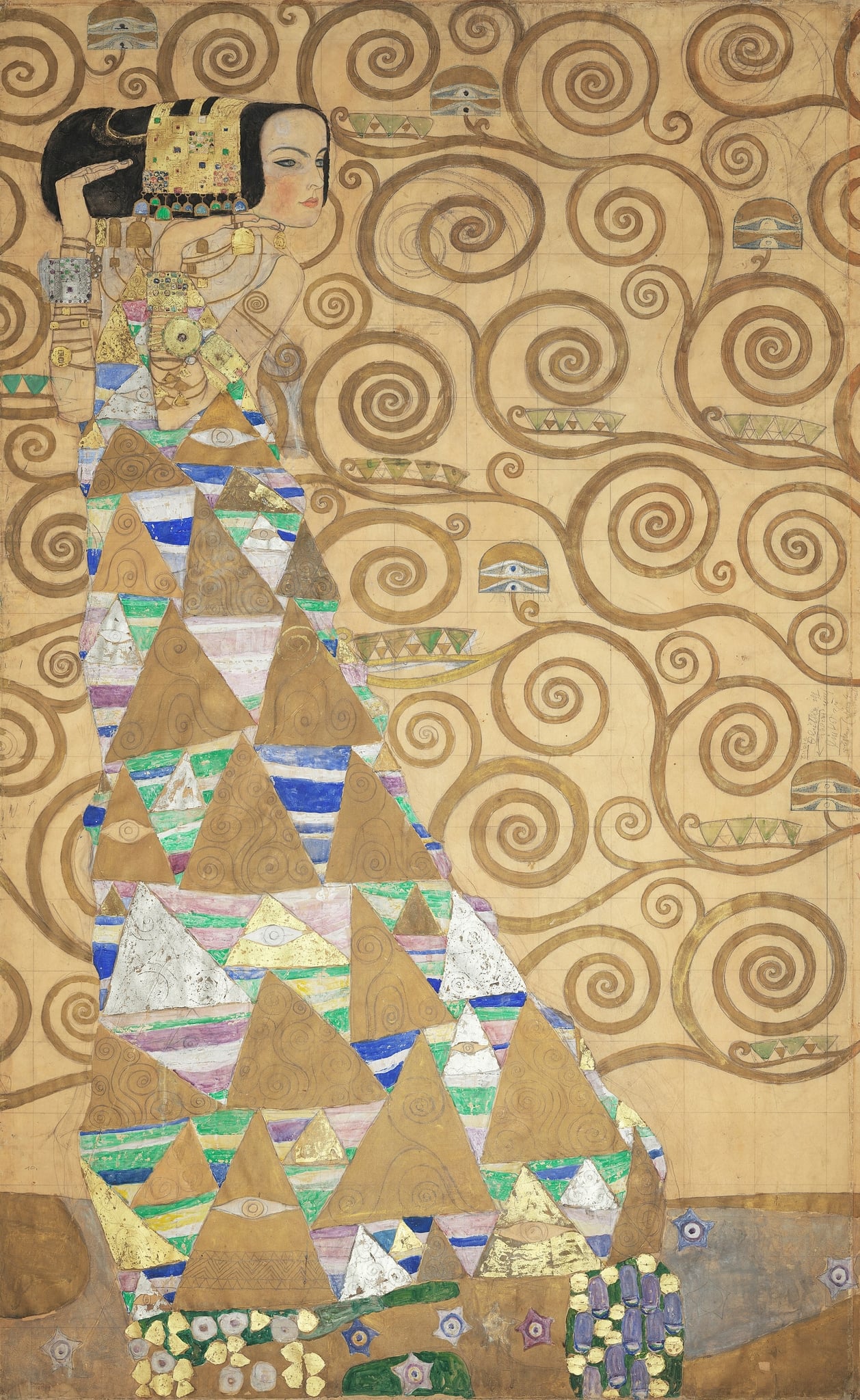
Expectation (Dancer)
Gustav Klimt (1911)
Expectation (Dancer) crystallizes a <strong>charged pause</strong>: a profile figure, rigid as an <strong>Egyptian relief</strong>, advances through a field of spiraling <strong>Tree of Life</strong> coils while a mosaic robe of triangles and watchful <strong>eyes</strong> armors her body. Klimt fuses <strong>ornament and symbol</strong> so that anticipation itself becomes pattern and gold-lit ritual <sup>[1]</sup><sup>[4]</sup>.
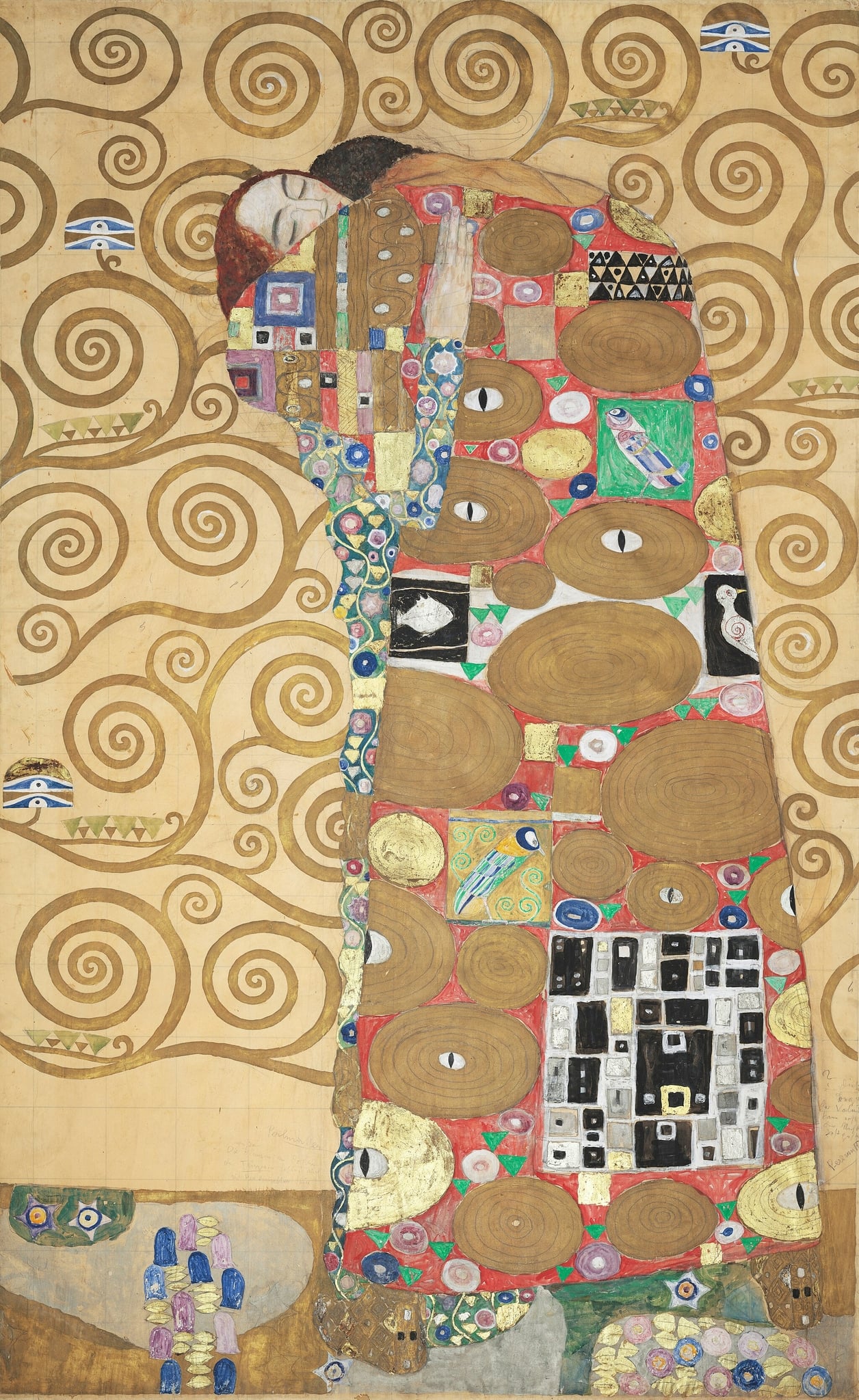
Fulfillment
Gustav Klimt (1910–1911 (cartoon); mosaic installed by 1911)
Klimt’s Fulfillment fuses two lovers into a single, radiant figure set before the spiraling <strong>Tree of Life</strong>, turning private embrace into a <strong>sacral consummation</strong>. Patterned robes—ovals, eyes, and flowers against black‑and‑white rectangles—stage a union of <strong>feminine/masculine energies</strong> within a golden, eternal field <sup>[1]</sup><sup>[3]</sup>.
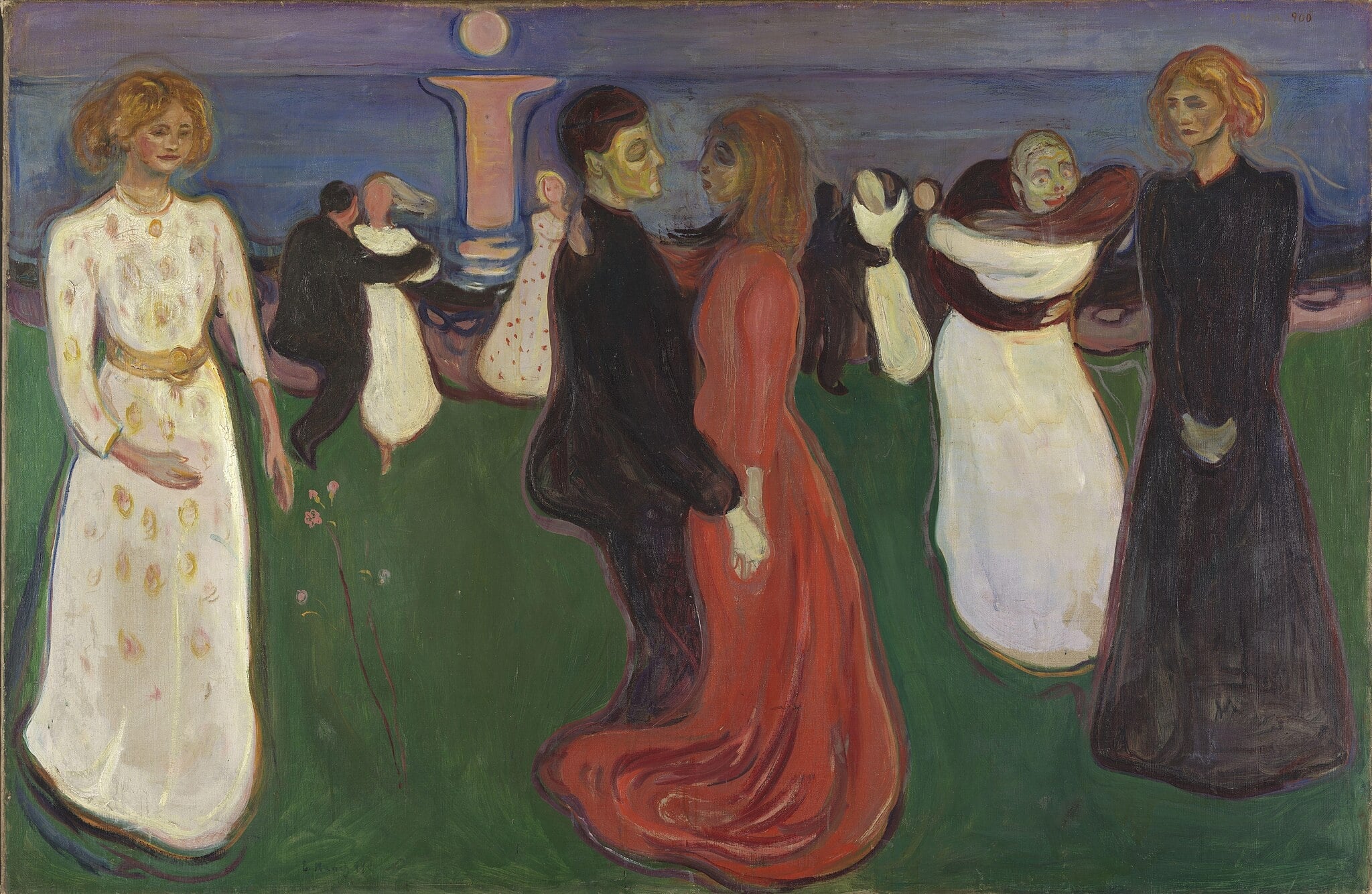
The Dance of Life
Edvard Munch (1899–1900)
The Dance of Life compresses <strong>youth, passion, and renunciation</strong> into a single moonlit scene on the Åsgårdstrand shore. A pale girl in white, a red‑clad woman entwined with a dark-suited man, and a withdrawn figure in black form a symbolic arc that binds love to <strong>time and mortality</strong> <sup>[1]</sup><sup>[2]</sup>.
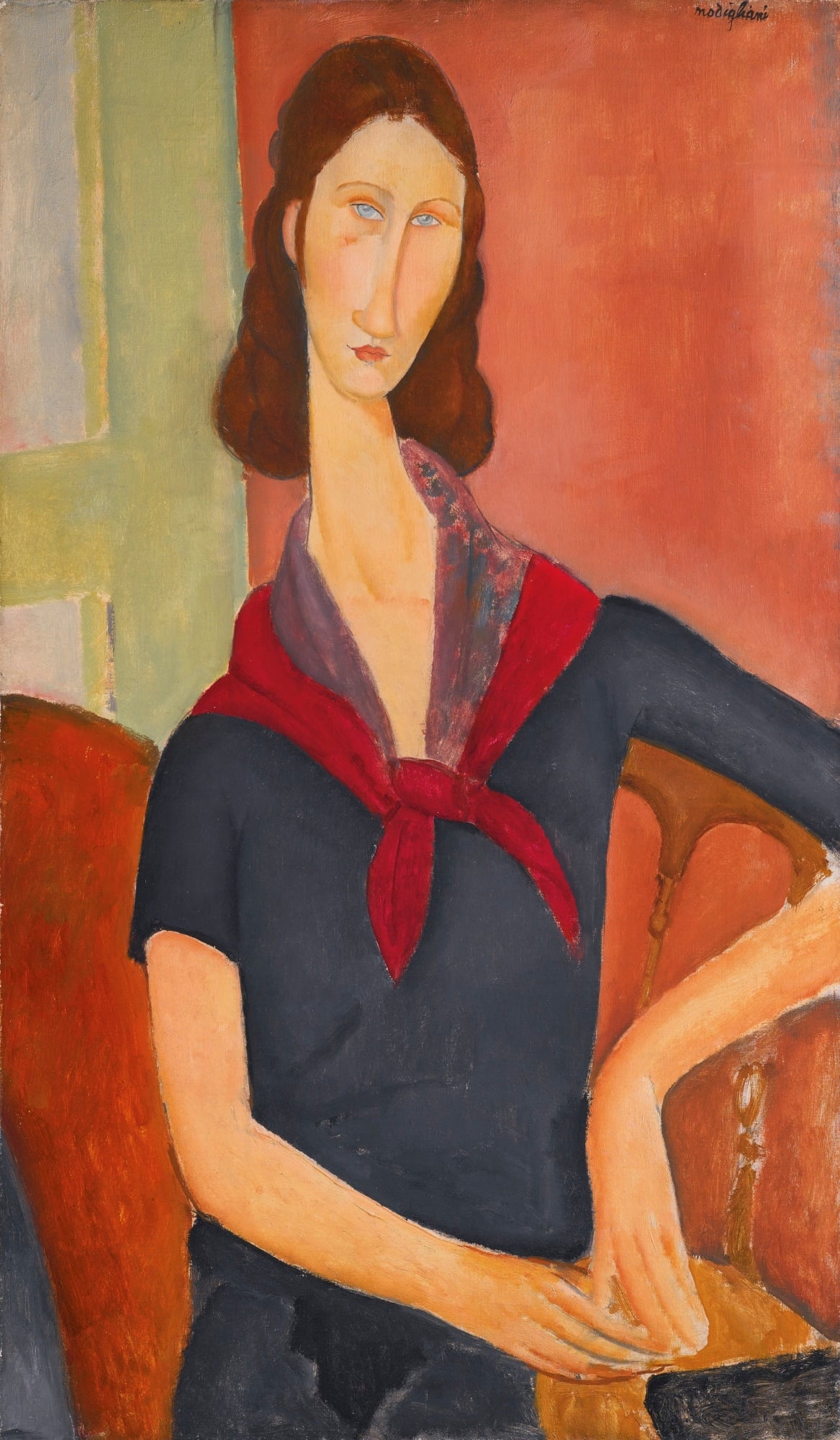
Jeanne Hébuterne (au foulard)
Amedeo Modigliani (1919)
Jeanne Hébuterne (au foulard) crystallizes Modigliani’s late style into a poised emblem of <strong>tenderness held in restraint</strong>. The elongated neck, <strong>masklike visage</strong>, and cool navy dress are pierced by the <strong>red scarf</strong> at the throat, a chromatic node that concentrates feeling and presence <sup>[1]</sup><sup>[2]</sup>. The subtly indicated pupils—rare in many Modigliani portraits—sharpen her psychological immediacy amid the flattened, terracotta field <sup>[1]</sup>.
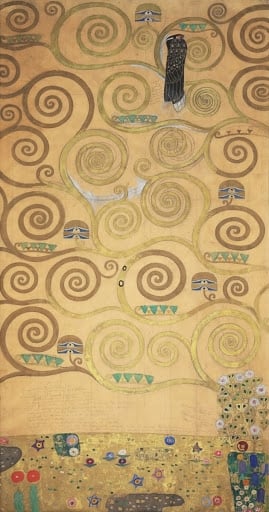
Part of the Tree of Life (Part 3)
Gustav Klimt (1910–1911)
Gustav Klimt’s Part of the Tree of Life (Part 3) is a full‑scale cartoon for the Stoclet Frieze, where a gold ground hosts spiraling branches studded with <strong>Eyes of Horus</strong> and jewel‑like emblems. A perched <strong>Horus falcon</strong> and a carpet of stylized flowers fuse myth, ornament, and cyclical vitality into a single, curling design <sup>[1]</sup><sup>[2]</sup>.
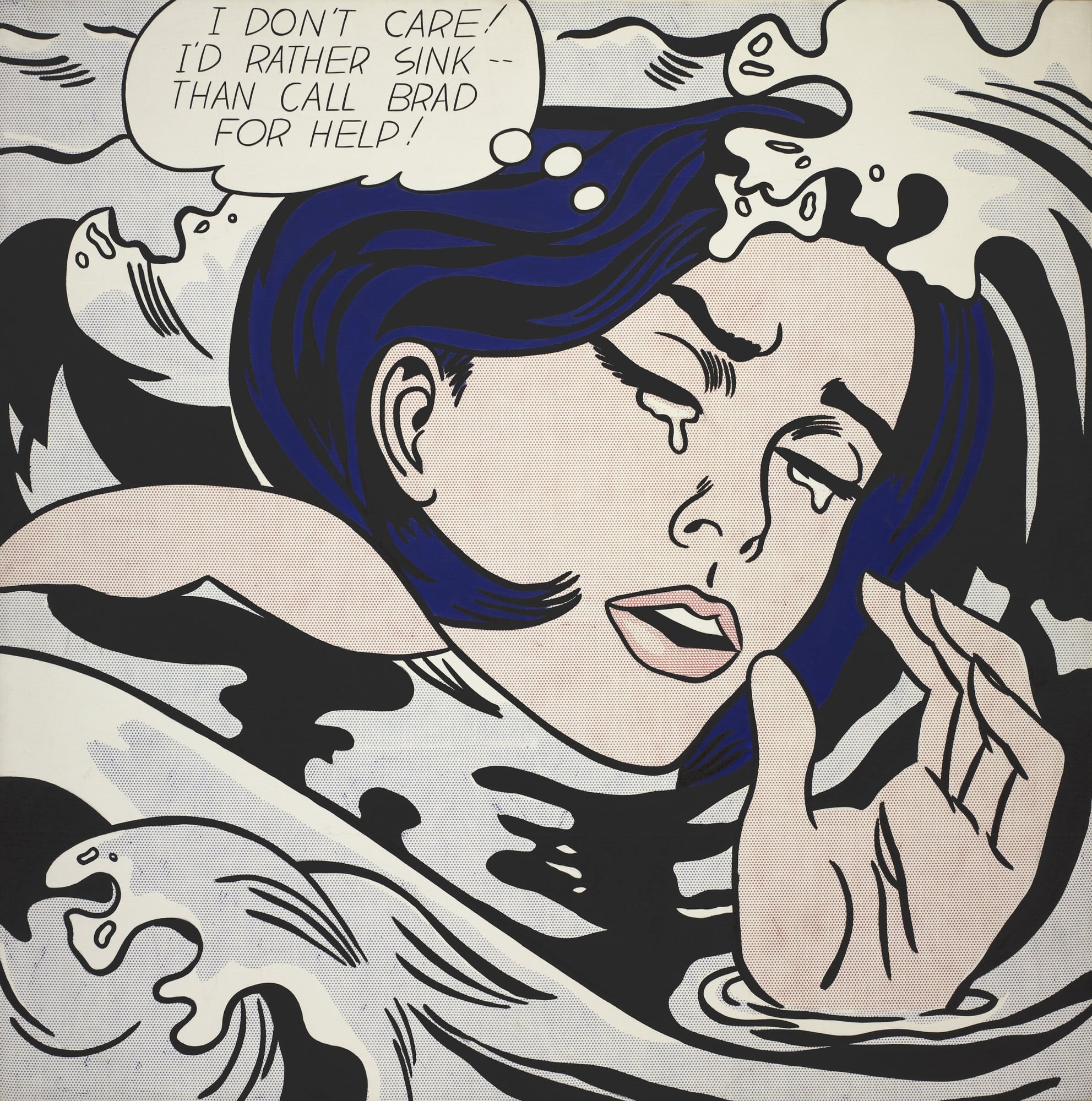
Drowning Girl
Roy Lichtenstein (1963)
<strong>Drowning Girl</strong> converts a romance-comic crisis into a monumental icon of cool, stylized emotion. With tight cropping, <strong>Ben-Day dots</strong>, and heavy black contours, <strong>Roy Lichtenstein</strong> isolates a heroine who declares, "I DON’T CARE! I’D RATHER SINK—THAN CALL BRAD FOR HELP!" The painting turns mass-media melodrama into a distilled language of signs that oscillates between parody and pathos <sup>[1]</sup><sup>[4]</sup>.
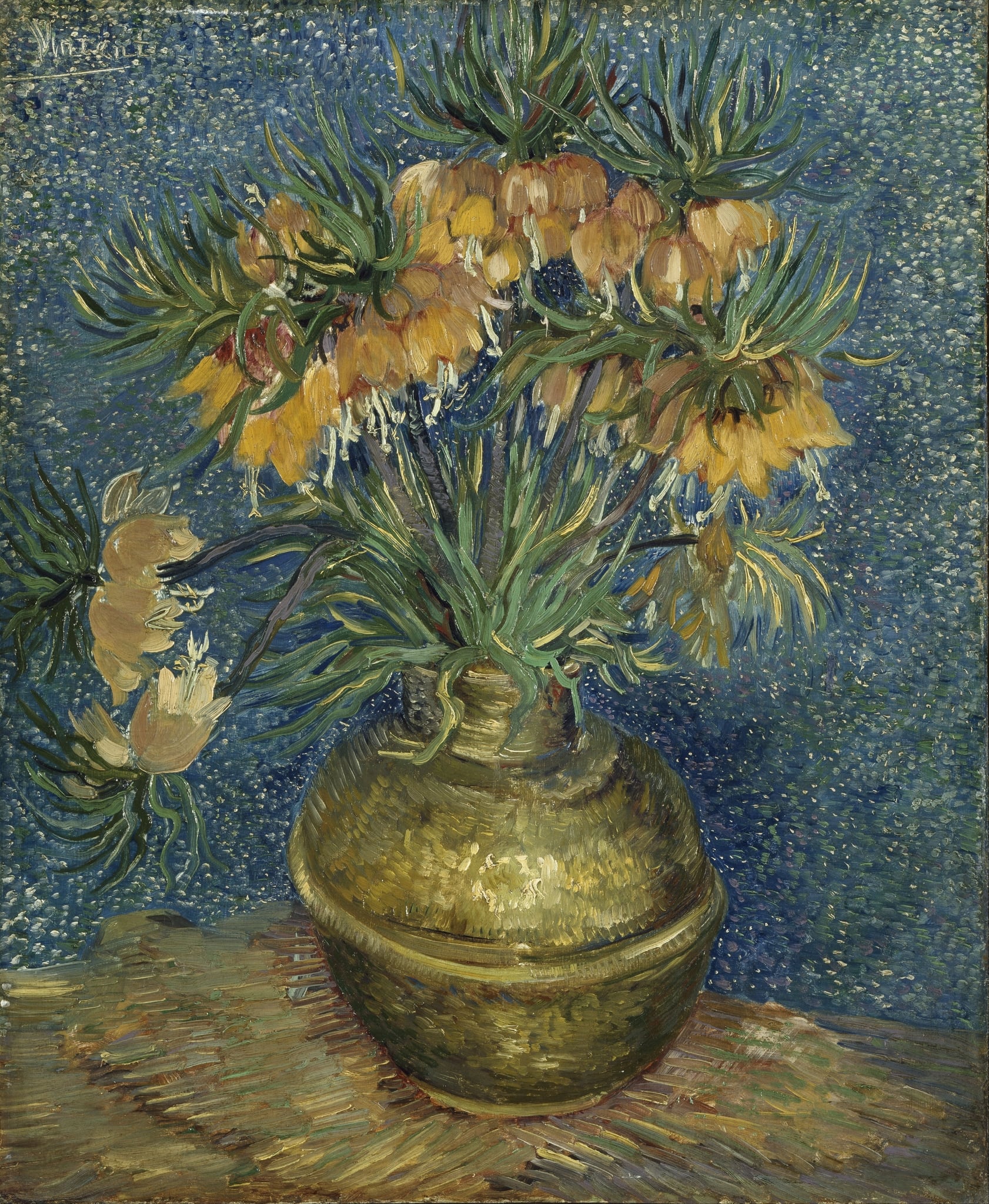
Imperial Fritillaries in a Copper Vase
Vincent van Gogh (1887)
A blaze of orange <strong>crown‑imperials</strong> arcs from a rounded <strong>copper vase</strong> against a stippled, breathing <strong>blue field</strong>. Van Gogh orchestrates a charged blue–orange counterpoint to turn still life into living force, where metal seems warm and air seems cool, and the flowers bow yet radiate power.
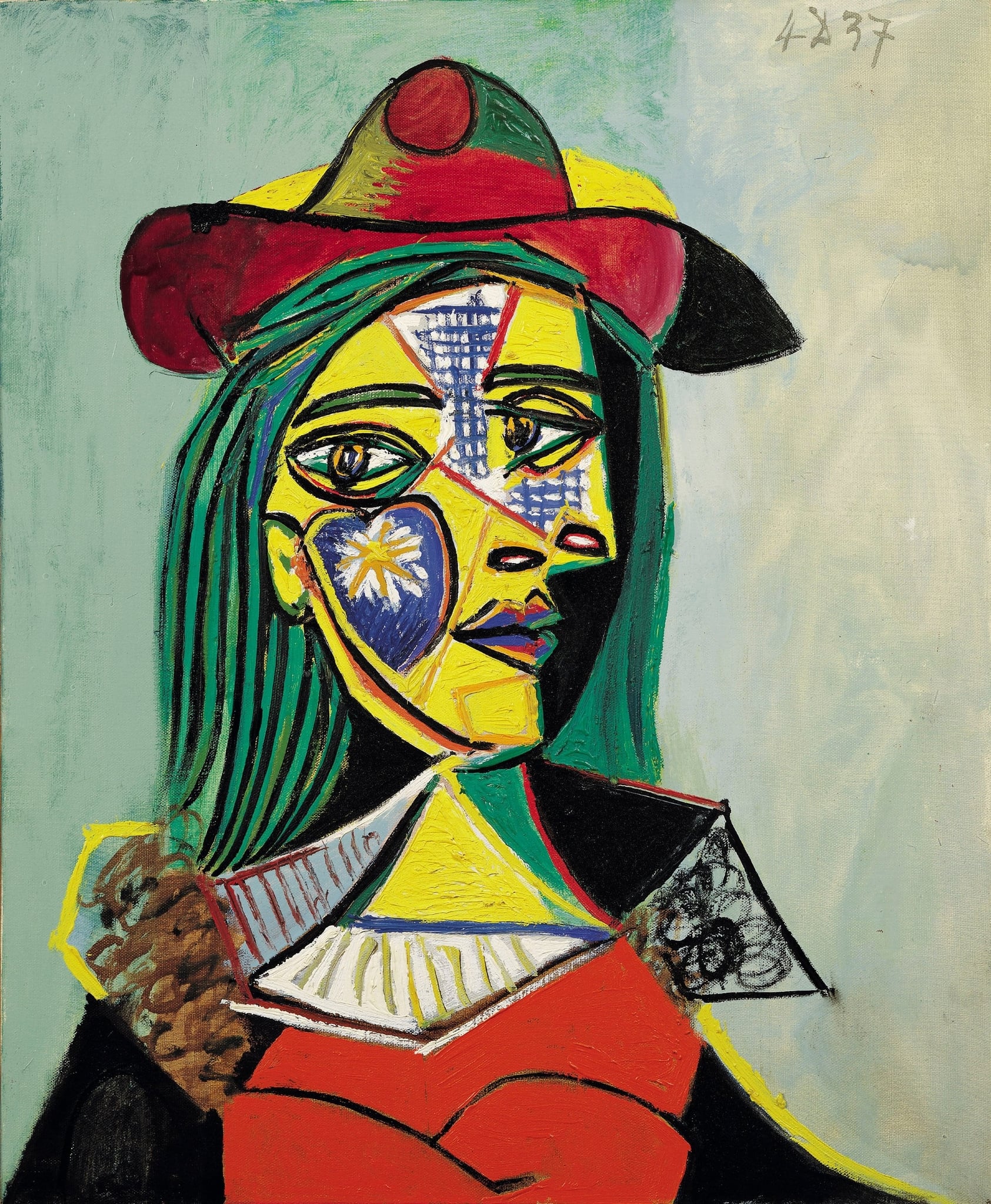
Woman in Hat and Fur Collar (Marie-Thérèse Walter)
Pablo Picasso (1937)
Picasso’s Woman in Hat and Fur Collar (Marie-Thérèse Walter) crystallizes a lover’s image into a <strong>split, mask-like icon</strong>: profile and frontal views fuse under a red hat while emerald hair cascades over a russet fur collar. Electric yellows, greens, and reds, bound by <strong>black contours</strong>, turn intimacy into a modern emblem of desire and poise <sup>[1]</sup>.
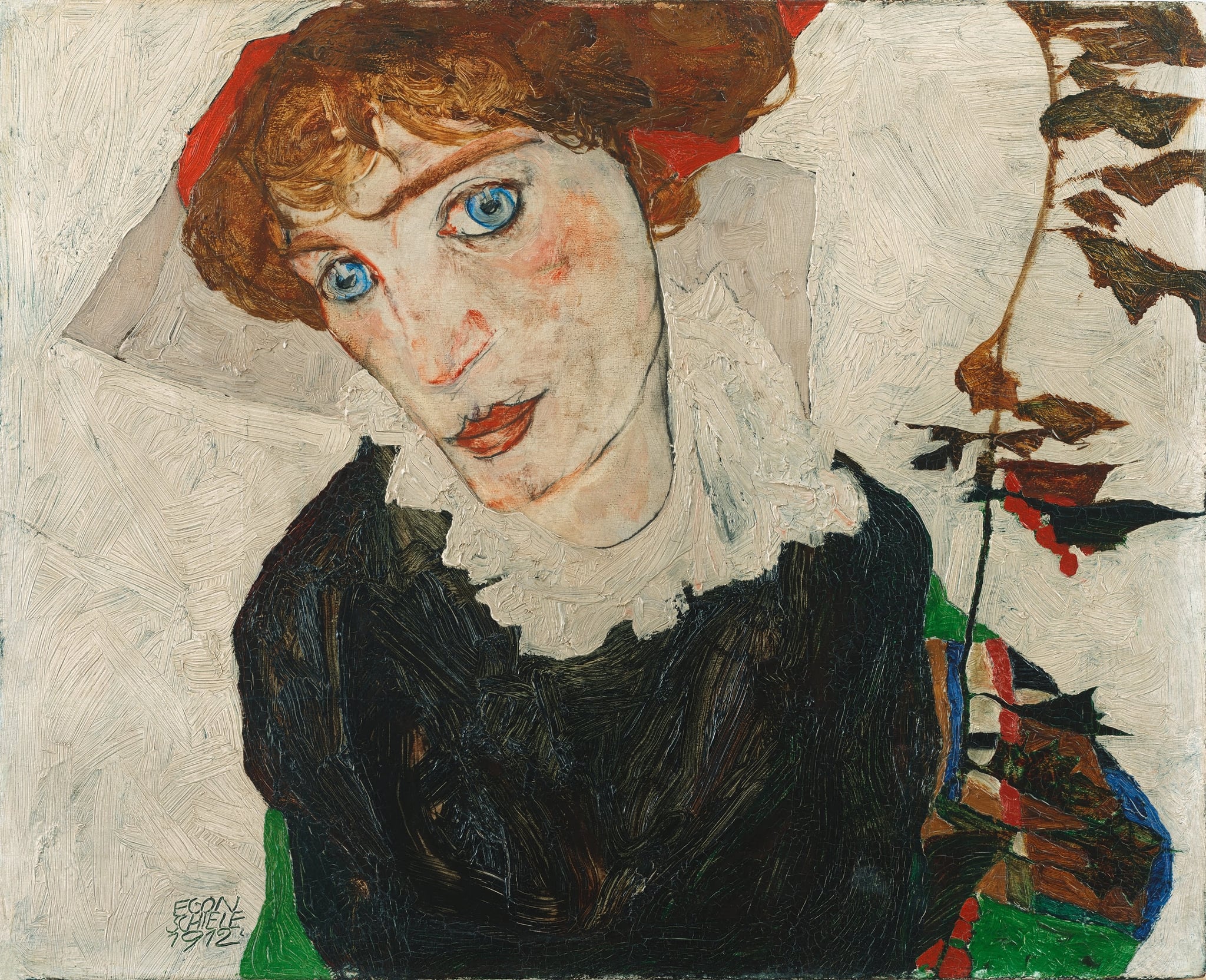
Portrait of Wally
Egon Schiele (1912)
Egon Schiele’s Portrait of Wally (1912) turns likeness into <strong>emotional topography</strong>: an oblique head, ice‑blue eyes, and a ruffled white collar flare against an <strong>impasto, airless ground</strong>. The right‑edge twig with red berries acts as a terse sign of <strong>vitality under threat</strong>, while jagged contours and a dense black dress pull the figure toward us with unsettling intimacy <sup>[1]</sup><sup>[3]</sup>.
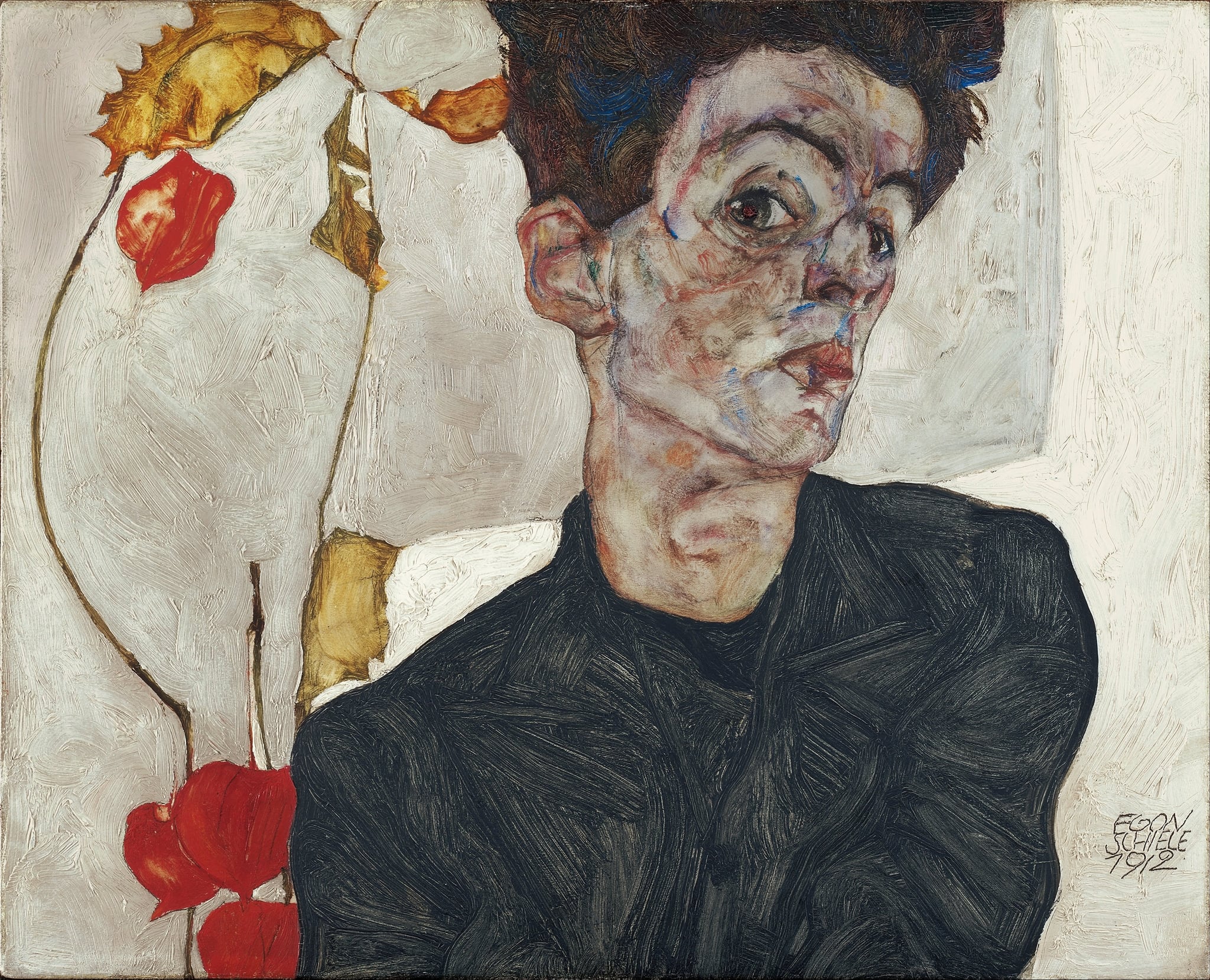
Self-Portrait with Physalis
Egon Schiele (1912)
In Self-Portrait with Physalis, Egon Schiele twists his gaunt body toward us, the face flayed by violet and blue accents and set against a scraped, chalky ground. The <strong>red-orange lantern pods</strong> flare beside his black, sharply linear jacket, a <strong>counterweight</strong> that charges the image with tension between vitality and decay <sup>[1]</sup><sup>[2]</sup>. Signed and dated <strong>1912</strong> at lower right, it crystallizes Schiele’s Expressionist self-scrutiny.
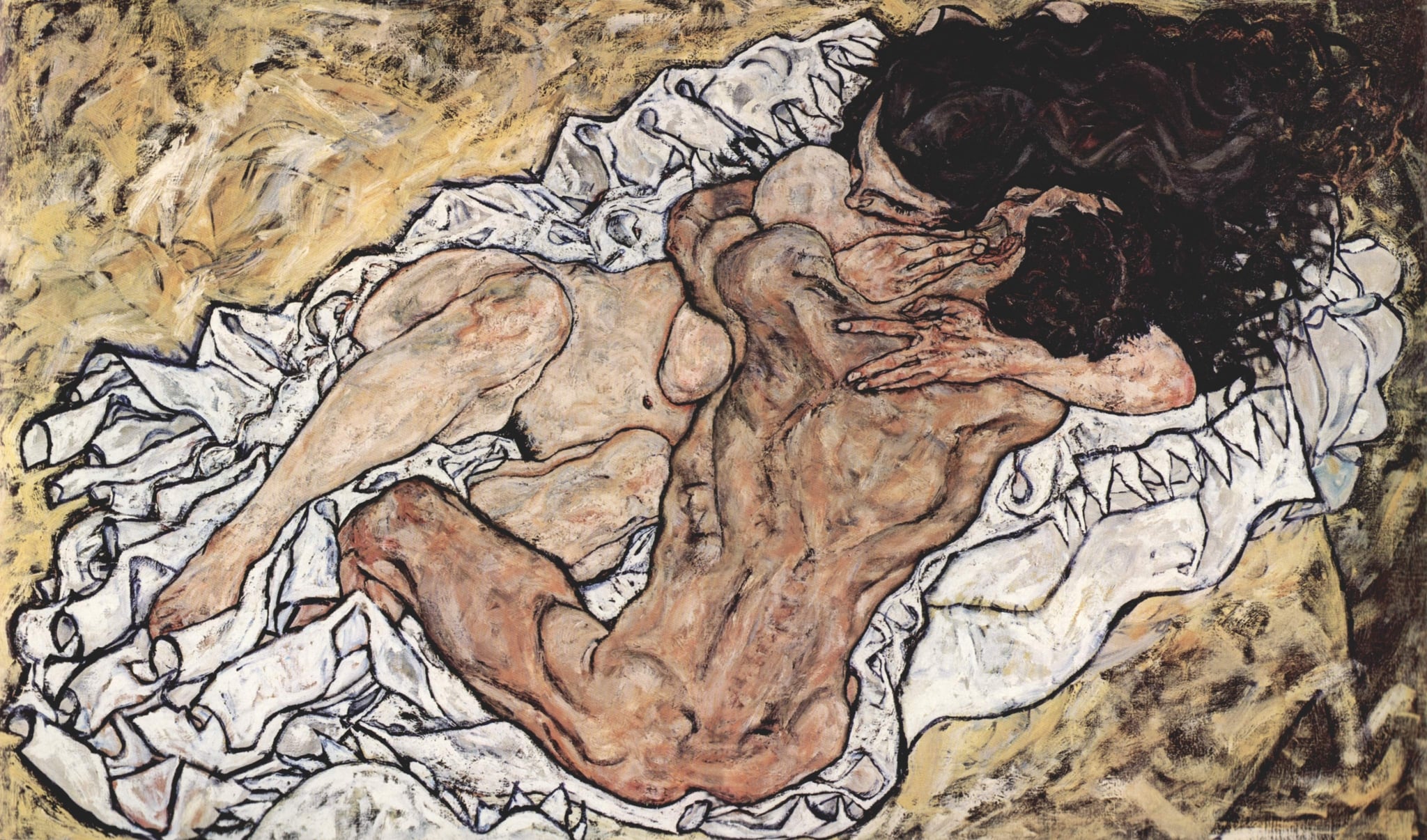
The Embrace
Egon Schiele (1917)
The Embrace fuses two nude bodies into a single, trembling organism, where <strong>tenderness</strong> and <strong>separation anxiety</strong> coexist. Schiele’s taut contours, proliferating <strong>hands</strong>, and storm‑like <strong>sheet</strong> make desire feel both sheltering and perilous <sup>[1]</sup>. From the overhead view, intimacy reads as a pact against isolation and a recognition of the body’s <strong>fragility</strong>.
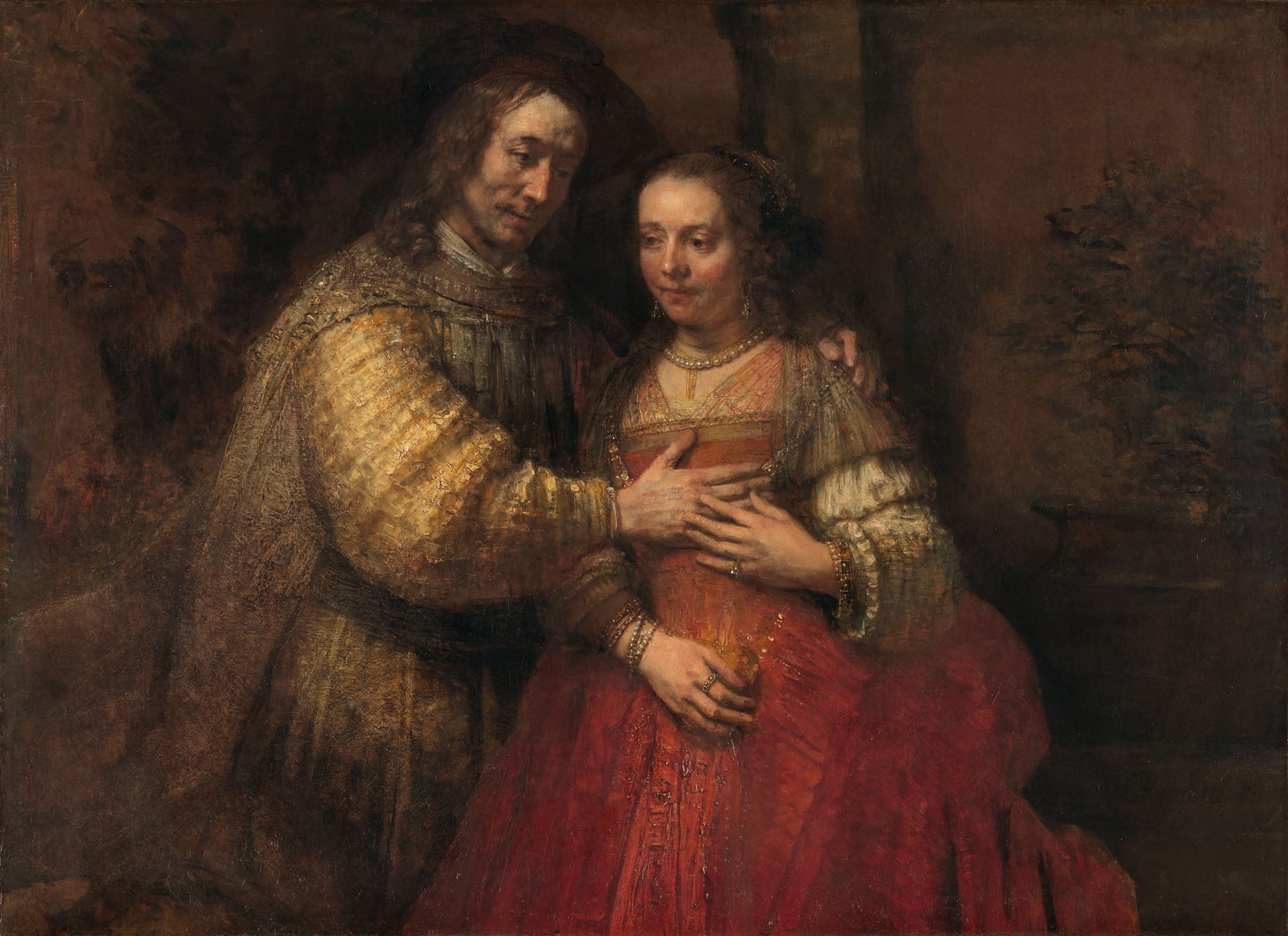
Isaac and Rebecca, Known as ‘The Jewish Bride’
Rembrandt van Rijn (c. 1665–1669)
Rembrandt van Rijn’s Isaac and Rebecca, Known as <strong>‘The Jewish Bride’</strong> crystallizes marriage as a covenant of <strong>love, protection, and consent</strong>. In warm chiaroscuro, the man’s enclosing arm and open right hand meet the woman’s regulating left hand over her chest, while her other hand gathers the glowing red dress. The painting turns a biblical recognition scene into an intimate vow illuminated from within.
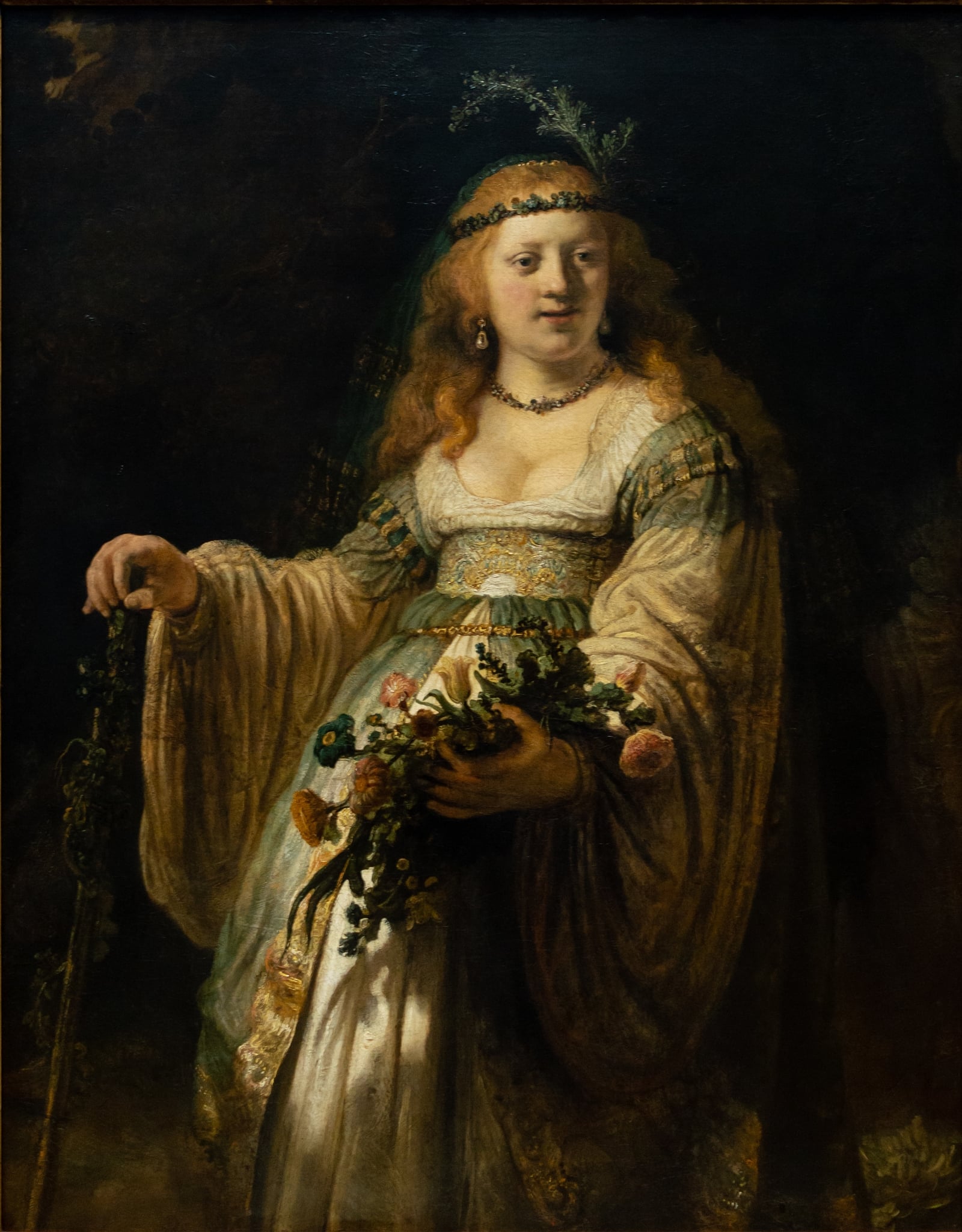
Saskia van Uylenburgh in Arcadian Costume
Rembrandt van Rijn (1635)
Rembrandt van Rijn’s 1635 portrait of his wife, Saskia, appears as a luminous shepherdess in <strong>Arcadian costume</strong>, her face and hands caught in a warm cone of light while the world around her recedes into shadow. The wreath, foliage‑twined staff, and armful of blossoms transform a private likeness into an emblem of <strong>fertility, prosperity, and renewal</strong> <sup>[1]</sup>.