The Lovers

by Rene Magritte

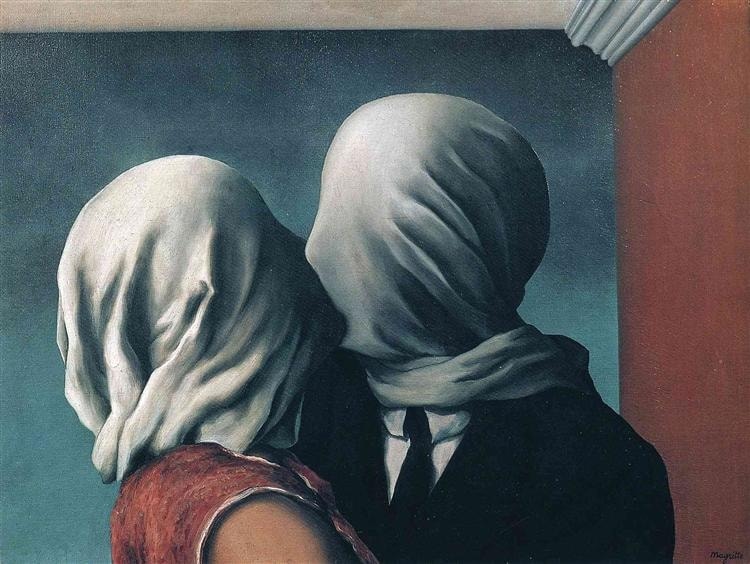
René Magritte’s The Lovers turns a kiss into an emblem of desire obstructed: two figures—she in red, he in a dark suit—press together while their heads are swathed in white cloth. Within a cool blue‑grey interior bounded by crown molding and a rust-red wall, intimacy becomes an image of opacity rather than revelation [1].

Fast Facts

Year
1928
Medium
Oil on canvas
Dimensions
54 x 73.4 cm
Location
The Museum of Modern Art, New York
The Lovers by Rene Magritte (1928) featuring White cloth veils/shrouds, The obstructed kiss (pressed heads), Red dress and bare arm, Black suit and tight tie

Click on any numbered symbol to learn more about its meaning

Meaning & Symbolism

Magritte composes a scene of thwarted contact that reads less as romance than as a rule. The woman’s bare arm and red dress meet the man’s black suit and tight knot of tie; all signals point to a kiss, yet the draped white cloth denies breath, touch, and sight. This contradiction is staged with deliberate plainness: a blue‑grey wall, a slice of red wall, and a crisp crown molding isolate the couple in a shallow box of space, like actors performing on a set. The fabric’s weighty folds—pinched at the man’s neck, sagging at the woman’s cheek—register with almost documentary precision, so that material fact (cloth) cancels emotional fulfillment (kiss). The result is an image in which opacity is not accident but law: closeness is permitted, contact is not 12. That law carries multiple charges. At one level, the shrouds enforce anonymity, stripping faces of identity and collapsing lovers into a type—“the man,” “the woman”—a move consistent with Surrealism’s fascination with masks and impersonality 2. At another, the cloths behave as censors, turning eros into a scene of forbidden action: the kiss occurs, but it cannot occur “as a kiss.” The Lovers therefore dramatizes the everyday experience of relational unknowability—how partners remain partially veiled to each other—while also brushing against mortality, as the veils echo funeral shrouds. Museums and scholars have long noted these resonances, while cautioning against reductive biographical decoding; Magritte himself resisted psychoanalytic explanations, preferring enigmas that confront the world rather than confess the self 135. The painting’s power comes from keeping these readings in productive tension rather than resolving them. Formally, Magritte borrows the rhetoric of mass visual culture only to subvert it. The tight crop, deadpan lighting, and head‑and‑shoulders framing mimic the melodramatic cinematic close‑up that promises revelation at the moment of a kiss. Instead, the veils deliver frustration, converting spectacle into withheld information 2. This strategy aligns The Lovers with a small series from 1928 that iterates the veiled‑head motif (including The Lovers II), underscoring Magritte’s serial testing of how concealment reorganizes desire and meaning 14. The precise, matter‑of‑fact brushwork—so characteristic of the artist—refuses painterly sentiment; it is the clarity of depiction that makes the obstruction absolute. In this sense, the painting offers a thesis about images themselves: that representation can be most truthful when it withholds, that mystery is not the opposite of clarity but its consequence. That is why The Lovers remains a touchstone in discussions of modern intimacy, spectatorship, and Surrealist thought: it shows that what binds lovers may also be the membrane that keeps them apart—and that the image, like love, is structured by what it cannot finally reveal 123.

Explore Deeper with AI

Ask questions about The Lovers

Popular questions:

Powered by AI • Get instant insights about this artwork

💬 Ask questions about this artwork!

Interpretations

Historical Context: Belgian Surrealism Meets Pulp Melodrama

Magritte’s veiled kiss fuses Belgian Surrealism’s interest in masking with the graphic punch of pulp-thriller imagery. Paul Nougé urged Magritte in 1927 to adopt the melodramatic look of commercial illustration; The Lovers answers with a cinematic close‑up that promises revelation and delivers blockage 12. Scholars also connect the shroud motif to Fantômas‑style crime iconography, where identity is a menace precisely because it is hidden 6. Rather than depicting the unconscious through automatism, Magritte stages a lucid, set-like tableau that behaves like mass culture—and then subverts it. The painting thus performs Surrealism’s double maneuver: borrowing the spectacle of modern media while exposing the contingency of what images let us see—or refuse us to see 126.

Source: MoMA; National Gallery of Australia (catalogue text via ArtBlart)

Serial Method: Testing Concealment Across Variants

The Lovers belongs to a 1928 cluster that systematically varies the veiled‑head motif. MoMA’s version stages the abortive kiss indoors; The Lovers II (NGA Canberra) presents two frontal, veiled figures outdoors/neutrally, not kissing 147. Read together, the pair shows Magritte’s serial logic: alter pose, setting, and action to recalibrate desire and meaning while keeping facture deadpan. This is not narrative progression but a controlled experiment in concealment—how much a picture can withdraw while remaining legible. The seriality aligns with Surrealism’s practice of permutation and with Magritte’s broader 1926–38 “ordinary made strange” program, where a limited repertoire of motifs is recombined to test visual thought itself 1247.

Source: MoMA; National Gallery of Australia; University of Sydney (on NGA accession)

Against Psycho-biography: Love, Death, and the Refusal to Confess

Funereal resonances in the veils invite a biographical key—the oft‑repeated tale of Magritte’s mother’s suicide and a face covered in cloth. Yet elements of that story are disputed, and Magritte rejected psychoanalytic decoding, insisting there is “only one mystery: the world” 35. Museums caution that the painting’s charge arises from holding readings—eros/thanatos, anonymity, censorship—in tension rather than solving them 12. Taking the artist at his word shifts the question from private trauma to public image‑making: how a painting can be both lucid and withholding, intimate and incommunicable. The Lovers thereby models an anti-confessional Surrealism: an art of conceptual displacement that engages mortality without reducing form to autobiography 1235.

Source: MoMA; Encyclopaedia Britannica; Taipei Times (on Magritte’s stance)

Spectatorship and Withheld Information

By mimicking a filmic close‑up at the instant of a kiss, Magritte recruits the viewer’s habituated desire for revelation—then interposes cloth as a censor of touch and sight. The work exemplifies Surrealism’s critique of spectatorship: the more exact the mimesis, the more absolute the withholding 12. The veil is not a symbol to decipher but a device that reorganizes looking, converting a melodramatic climax into an epistemic dead end. In this sense, The Lovers is a lesson in how images produce—not merely depict—desire and frustration, turning the viewer into a participant in the scene’s interdiction. What we “know” here is the limit of knowing; the picture’s clarity sharpens, rather than solves, its mystery 12.

Source: MoMA (object text; exhibition framing)

Domestic Stagecraft: Gender, Class, and the Theater of Intimacy

The blue‑grey wall, a slice of red wall, and crisp molding frame the figures like actors on a set; bourgeois attire (black suit, tie; red dress, bare arm) codes a conventional couple inside a conventional room 1. Against this normalcy, the improvised shroud reads as a rupturing prop—domesticity meets interdiction. The painting thus plays on classed fashion and interior decor as signals of order that make the obstruction feel like law, not accident. Gendered cues summon a hetero script only to be suspended by fabric’s “material fact,” turning a private rite into a public tableau of separation. The Lovers becomes a study in how interiors and costumes choreograph desire—and how a single object can arrest the choreography entirely 13.

Source: MoMA; Encyclopaedia Britannica (context on Magritte’s method)

Related Themes

About Rene Magritte

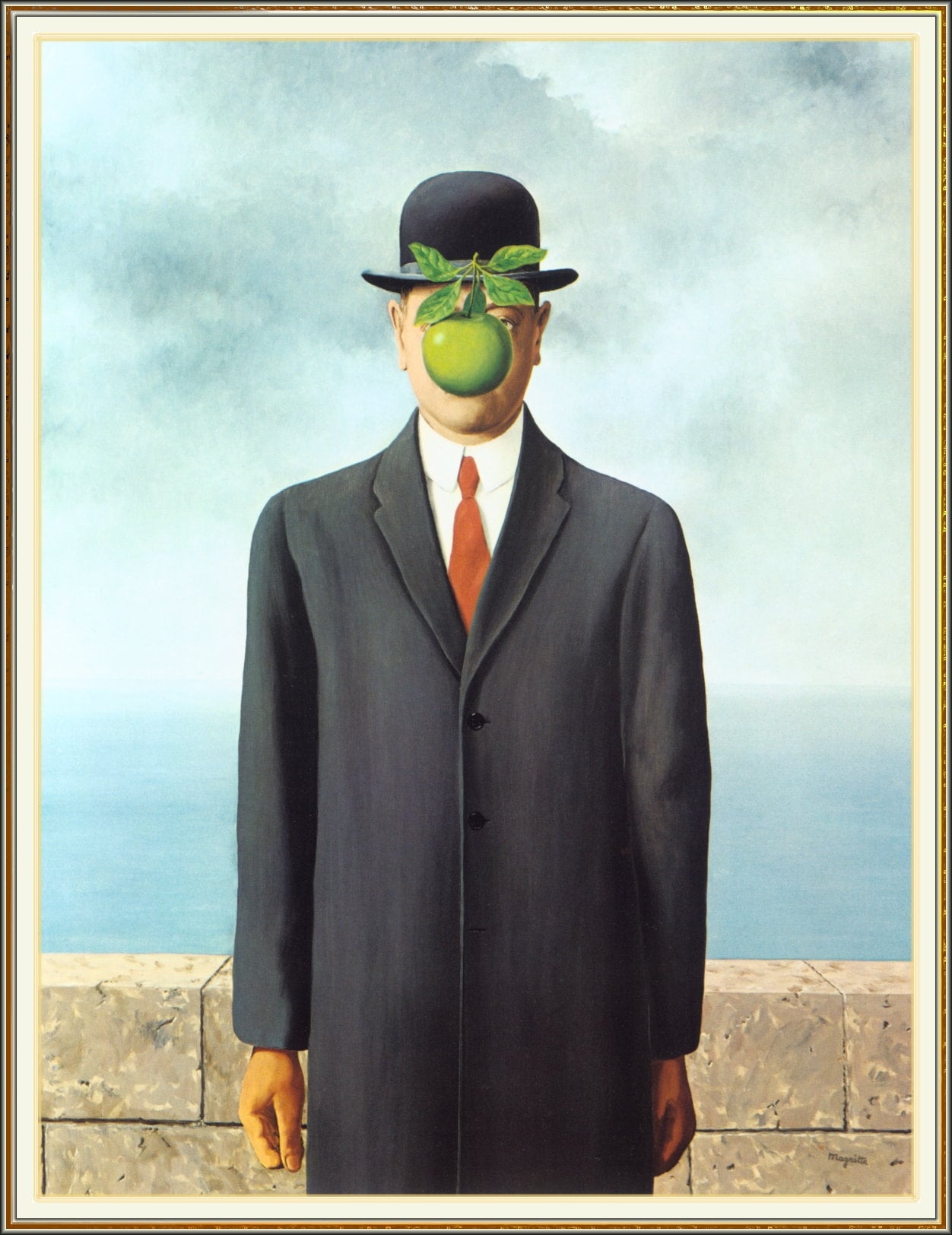
Rene Magritte (1898–1967) was a Belgian Surrealist who transformed ordinary motifs—apples, bowler hats, clouds—into philosophical puzzles about language, vision, and reality [5][4]. Influenced by de Chirico yet fiercely independent, he favored deadpan clarity to expose the mysteries latent in everyday things [4][5].
View all works by Rene Magritte

More by Rene Magritte