The Son of Man
Study Print Studio
Create a personal study print
Build a companion study sheet around the part of this painting that speaks to you most. Choose a detail, shape an interpretation, and walk away with something personal and display-worthy.
Fast Facts
- Year
- 1964
- Medium
- Oil on canvas
- Dimensions
- 116 × 89 cm
- Location
- Private collection
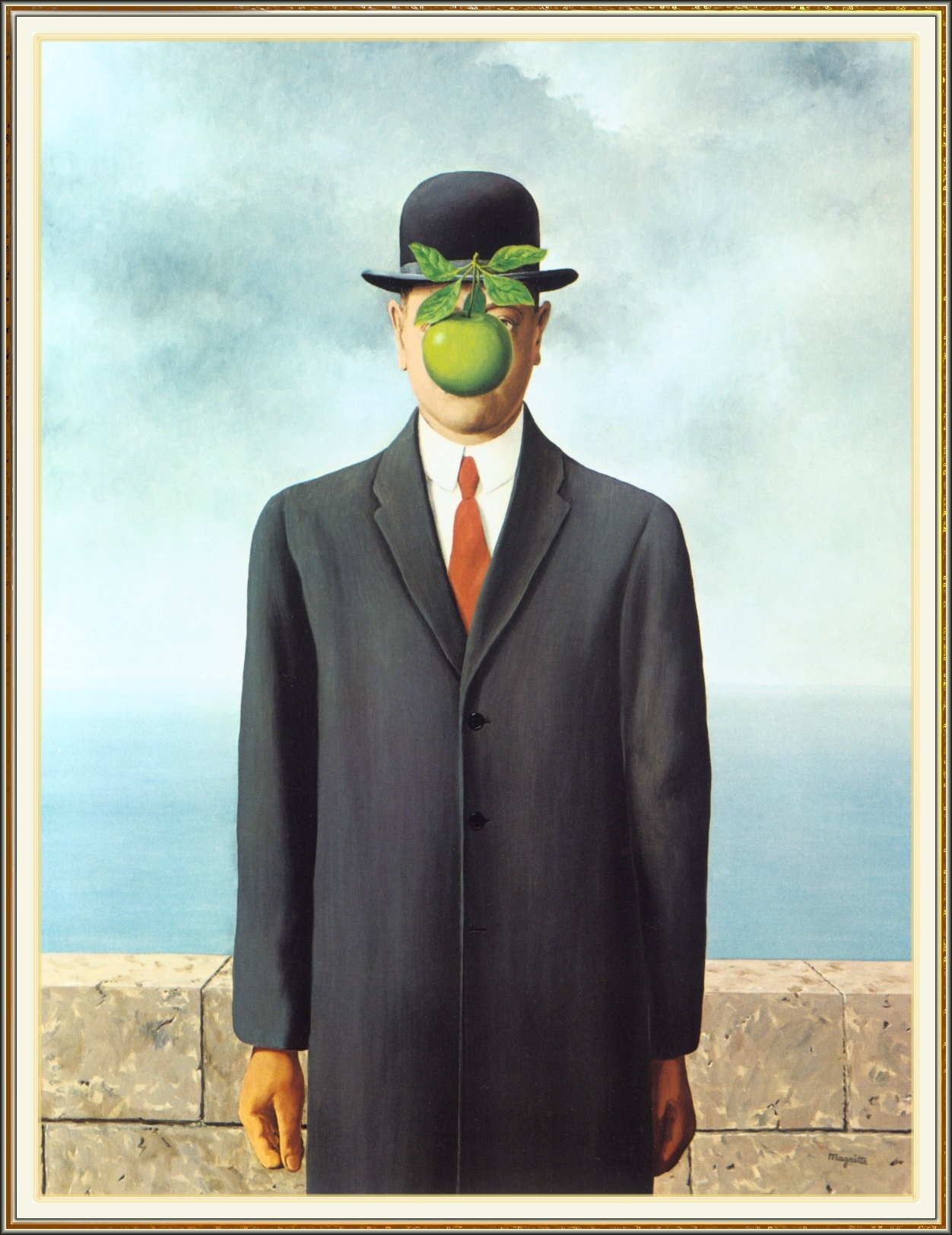
Click on any numbered symbol to learn more about its meaning
Meaning & Symbolism
Explore Deeper with AI
Ask questions about The Son of Man
Popular questions:
Powered by AI • Get instant insights about this artwork
Interpretations
Semiotics and Title as Trap
Source: MoMA; Christie’s (quoting Torczyner/Magritte)
Bourgeois Anonymity and Class
Source: Artsy; SFMOMA
Theological Undertone, Doctrinal Refusal
Source: Christie’s (Sylvester/Torczyner quotations)
Phenomenology of the Gaze
Source: SFMOMA; Christie’s (Torczyner/Magritte)
Stagecraft, Anomaly, and the de Chirico Legacy
Source: MoMA; Encyclopaedia Britannica
Explore Specific Elements
Dive deeper into individual scenes and details within The Son of Man.
The Green Apple
Magritte’s hovering green apple turns a straightforward portrait into a puzzle about seeing and knowing. By masking the face at the very point where identity should appear, the fruit converts an everyday object into a precise instrument of concealment and desire.
The Bowler Hat
Magritte’s bowler hat is the most ordinary thing in the strangest of pictures. By crowning an immaculate everyman with a commonplace hat, Magritte forged an instantly legible modern type that lets the painting withhold identity even as it feels familiar. The hat turns a private portrait into a public riddle.
The Visible Eye
A thin crescent of the sitter’s left eye peeks around the apple in Magritte’s The Son of Man, refusing full concealment. That tiny glint of sight turns the painting into a duel between showing and hiding, keeping identity present even as it is blocked.
Seen in Comparisons
Related Themes
About Rene Magritte
More by Rene Magritte
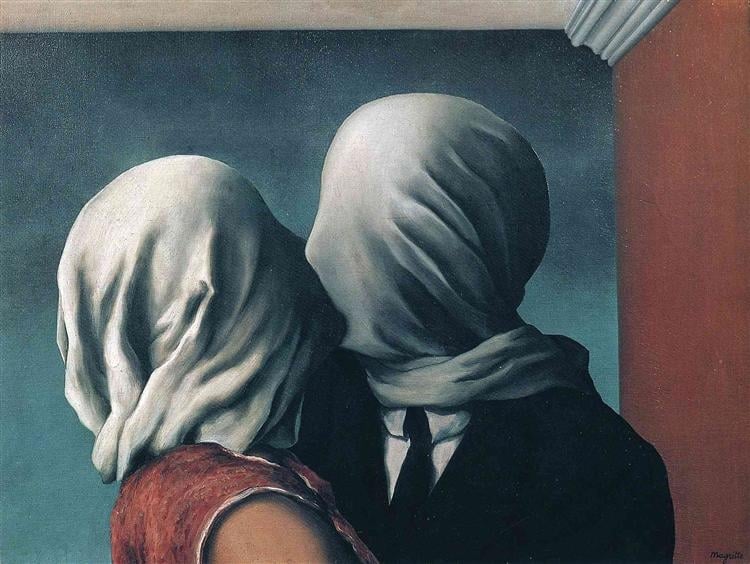
The Lovers
Rene Magritte (1928)
René Magritte’s The Lovers turns a kiss into an emblem of <strong>desire obstructed</strong>: two figures—she in red, he in a dark suit—press together while their heads are swathed in <strong>white cloth</strong>. Within a cool blue‑grey interior bounded by crown molding and a rust-red wall, intimacy becomes an image of <strong>opacity</strong> rather than revelation <sup>[1]</sup>.
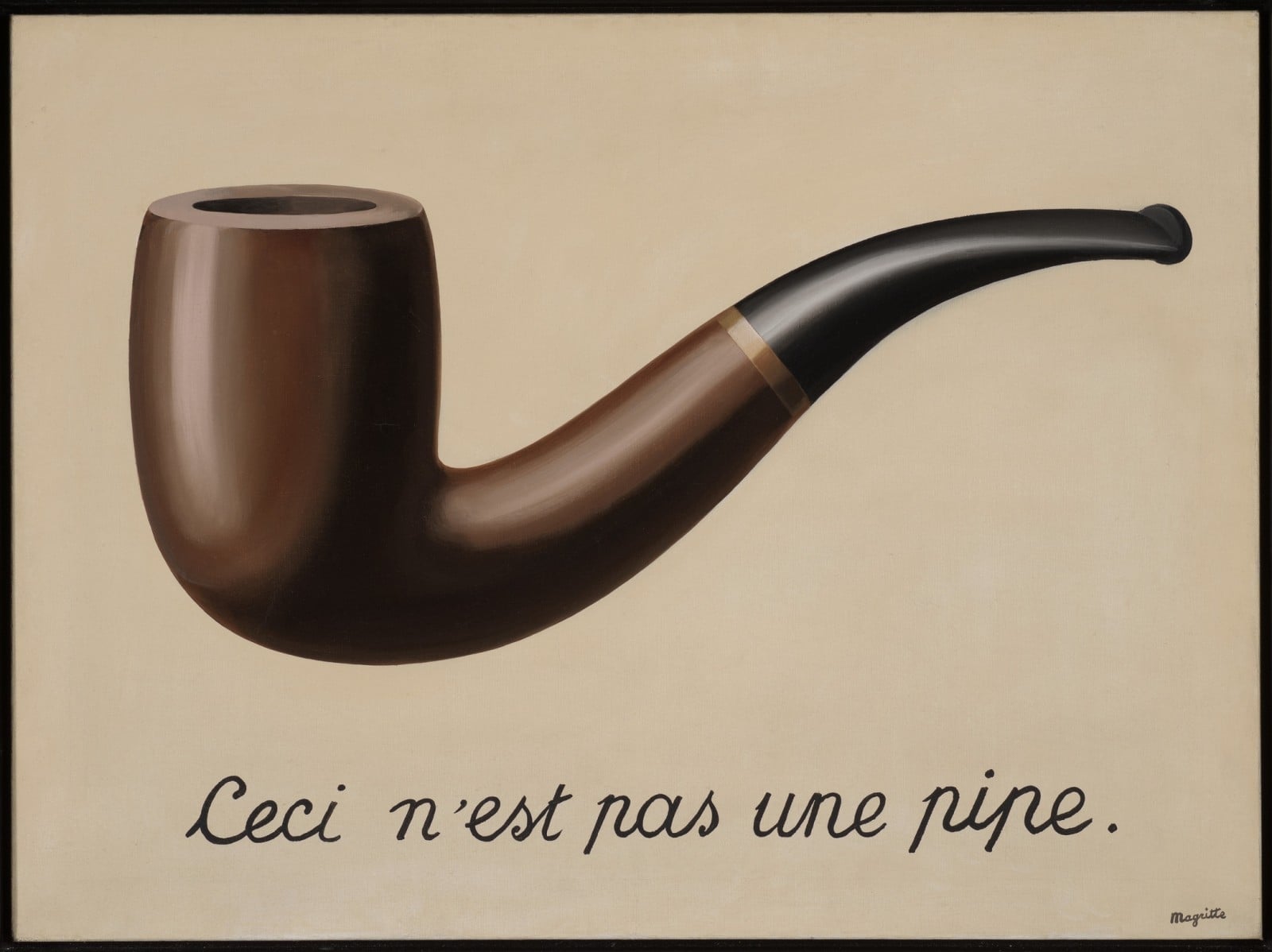
This is Not a Pipe
Rene Magritte (1929)
A crisply modeled tobacco pipe hovers over a blank beige field, while the cursive line "Ceci n’est pas une pipe" coolly denies what the eye assumes. The clash between image and sentence turns a familiar object into a <strong>thought experiment</strong> about signs and things. Magritte’s deadpan exactitude and ad‑like layout stage a <strong>philosophical trap</strong>: you can see a pipe, but you cannot smoke this picture. <sup>[1]</sup><sup>[2]</sup>