The Bowler Hat in The Son of Man
A closer look at this element in Rene Magritte's 1964 masterpiece
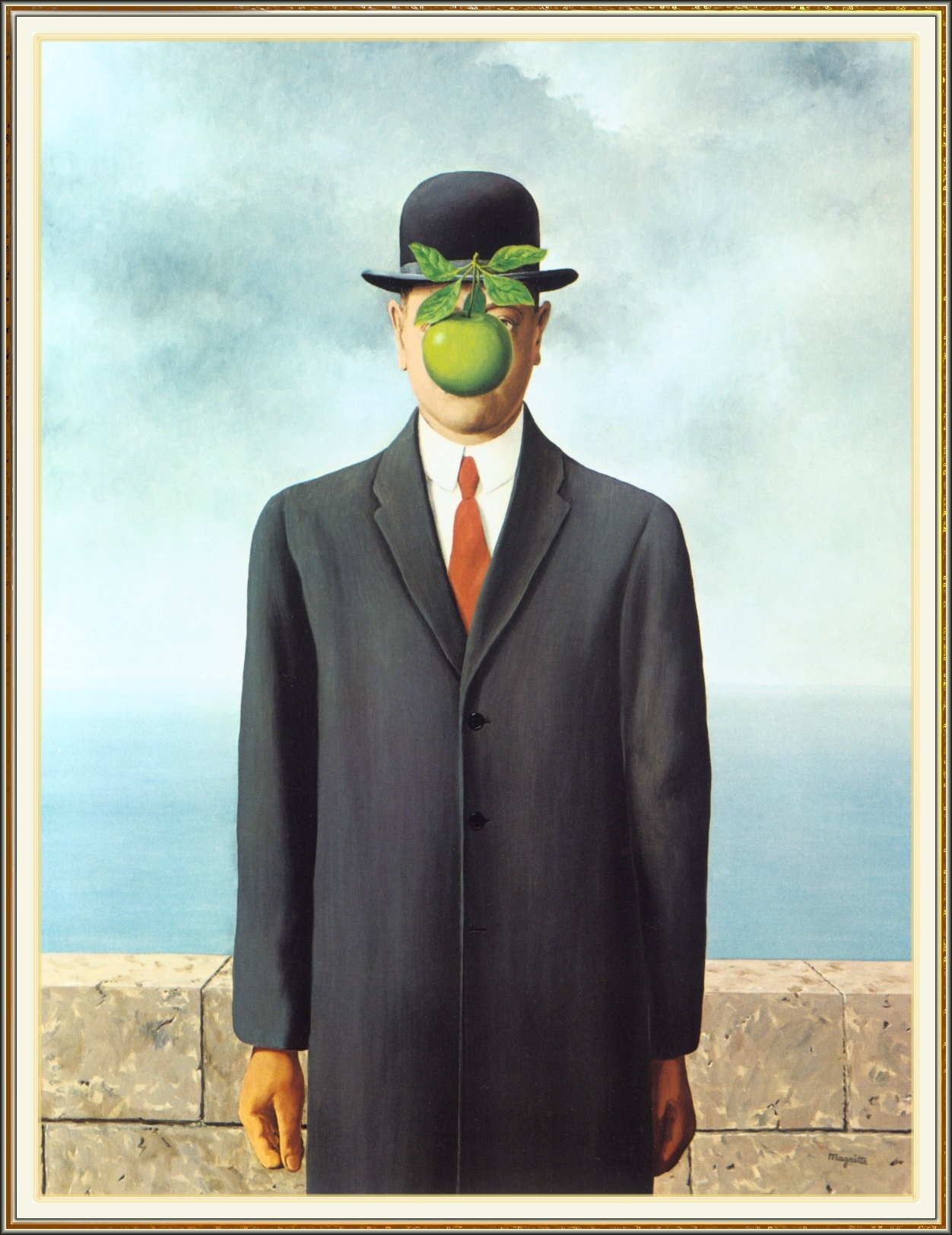
Magritte’s bowler hat is the most ordinary thing in the strangest of pictures. By crowning an immaculate everyman with a commonplace hat, Magritte forged an instantly legible modern type that lets the painting withhold identity even as it feels familiar. The hat turns a private portrait into a public riddle.
Historical Context
Painted in 1964, The Son of Man belongs to Magritte’s late period, when he repeatedly staged a front‑facing man in an overcoat and black bowler against neutral skies and urban parapets. Curators have shown that Magritte developed this figure across his career, returning to it in oils and gouaches more than fifty times between 1926 and 1966. The motif functioned as a dependable protagonist and, increasingly, as the artist’s anonymized stand‑in—an alter ego designed to look deliberately commonplace rather than individual 12.
The bowler hat’s presence reflects the real clothing of middle‑class city men in Magritte’s milieu and the painter’s own cultivated, conventional appearance. Far from being incidental, the hat signaled a recognizable twentieth‑century type that Magritte could deploy as a stable armature for visual experiments in concealment and recognition. By the mid‑1960s—when The Son of Man was painted—the bowler‑hatted man had become a signature device that museums describe as central to Magritte’s thinking about identity and perception 12.
Symbolic Meaning
The bowler hat operates as an emblem of anonymity and the bourgeois everyman. Museum essays argue that Magritte’s figure is intentionally generic—recognizable yet nonspecific—so that questions of identity can be raised without the anchoring facts of portraiture. The hat signals a standardized urban male, a type viewers already know, which allows Magritte to test how much a person can be reduced to surface while remaining legible 1.
Scholars also track the motif’s evolution: early associations with detectives and urban professionals gradually give way to a generalized emblem of modern man, stripped of biography and psychology 10. Educational resources expand on this shift, noting how the bowler‑hatted protagonist becomes a recurring character through which Magritte rehearses variations on selfhood and spectatorship 6. At the same time, Magritte resisted one‑to‑one “symbolic” readings; part of the image’s charge comes from that tension—viewers inevitably read conformity and facelessness into the hat, even as the artist insists his images thwart fixed allegory 8. Thus the bowler hat is neither mere costume nor tidy code: it is a deliberately banal sign that turns social type into philosophical puzzle 16810.
Artistic Technique
Magritte renders the hat with deadpan precision: a crisply contoured brim, a cool black crown modeled by restrained tonal shifts, and a matte finish that reads as solid, ordinary, and incontrovertibly real. This prosaic, illusionistic realism—forms cleanly outlined, lighting even and unemphatic—makes the impossible feel plausible, a hallmark of his late style 5. Museums describe the period’s canvases as executed with “virtuosic precision and uncanny clarity,” qualities that give the bowler its weight and quiet authority 4. Compositional staging is equally calculated: the hat “caps” the vertical silhouette, aligns with the cloud band and horizon, and stabilizes the figure so the surreal obstruction of the face can strike with maximum force 1.
Connection to the Whole
Magritte said the picture dramatizes the friction between what is seen and what is hidden. In The Son of Man the floating apple hides the most individualizing feature—the face—while the bowler and overcoat assert an impersonal social type. The hat, then, guarantees legibility at the very moment the apple defeats recognition, sharpening the painting’s meditation on visibility and desire: we can identify the kind of man, but not the man himself 31.
Placed against the calm sea and clouded sky, the hat anchors the figure in everyday reality as the rest of the scene drifts toward enigma. Related canvases from 1964 reprise the bowler‑hatted protagonist, confirming that Magritte was using this element as a rigorous tool to test how sameness, disguise, and spectacle structure modern identity 71.
Explore More from This Painting
This detail is one part of The Son of Man. Use the links below to return to the full interpretation, browse the full set of details, or view the painting's valuation if available.
Sources
- SFMOMA – Self‑Portrait as Anonymous Artist (curatorial essay on the bowler‑hatted man)
- SFMOMA – René Magritte: The Fifth Season (press/overview; alter‑ego and >50 appearances)
- Wikipedia – The Son of Man (basic description; Magritte 1965 quote)
- Menil Collection – Golconda (context for the bowler‑hat figure; late‑period clarity)
- MoMA – Magritte exhibition press (prosaic, sharply contoured illusionism)
- Art Gallery of New South Wales – Video: Magritte and the bowler‑hatted man
- Christie’s – Le lieu commun (1964) scholarly essay on the 1964 cluster and culmination
- Oxford Academic – Commentary on Golconda; Magritte’s resistance to fixed symbolism
- Artsy – On Magritte’s fascination with bowler hats and their shifting associations