This is Not a Pipe
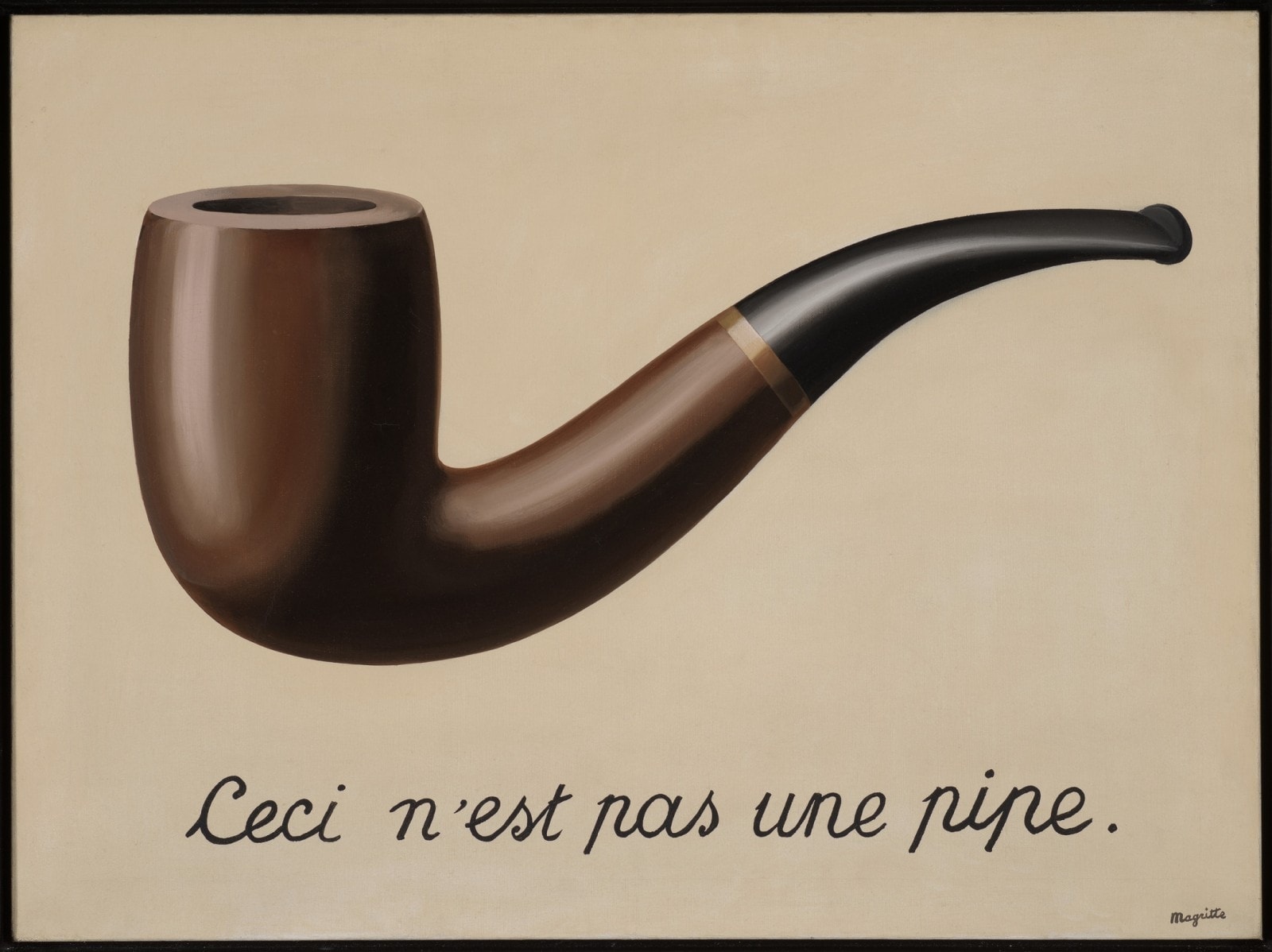
A crisply modeled tobacco pipe hovers over a blank beige field, while the cursive line "Ceci n’est pas une pipe" coolly denies what the eye assumes. The clash between image and sentence turns a familiar object into a thought experiment about signs and things. Magritte’s deadpan exactitude and ad‑like layout stage a philosophical trap: you can see a pipe, but you cannot smoke this picture. [1][2]
Fast Facts
- Year
- 1929
- Medium
- Oil on canvas
- Dimensions
- 60.33 × 81.12 cm
- Location
- Los Angeles County Museum of Art (LACMA), Los Angeles
Click on any numbered symbol to learn more about its meaning
Meaning & Symbolism
Magritte constructs a lucid demonstration device. Against a uniform beige ground, he renders a curved briar pipe with commercial polish: the highlight gliding along the bowl, the darkened inner lip, the band at the joint, and the tapering black stem that arcs toward the edge. Everything about the image promises legibility, as if it belonged on a classroom chart or in a magazine advertisement. Then, in neat, forward‑slanting cursive centered beneath the pipe, the sentence arrives like a caption—only it refuses to caption. "Ceci n’est pas une pipe" punctures the expectation that pictures and words confirm each other; it insists they are different orders of signification. As Magritte himself liked to point out, no one can pack this bowl or inhale from this stem, because it is not a pipe but a picture of a pipe. The work thus becomes a classroom for skepticism, training the viewer to separate the thing from its representation. 12
Read through modern semiotics, the painting stages the arbitrariness of the link between signifier and signified. The painted image (an icon, in Peircean terms) resembles its referent; the word "pipe" (a symbol) has no natural tie to what it names; neither equals the object resting in a pocket or clenched in a jaw. By writing the denial under an image that so persuasively mimics product illustration, Magritte leverages the rhetorical authority of advertising to show how easily it can mislead. In his 1929 sequence Les mots et les images, produced the same year, he systematically teased such mismatches between names and depictions; This is Not a Pipe is the distilled problem in oil. Foucault later called Magritte’s move a dismantling of the calligram, the traditional fusion of word and image; here the fusion is refused, and the promise of identity between text and picture is exposed as a trick of layout. Word, image, and object slide past one another, and the painting keeps that slippage in view. 34
The composition’s restraint is crucial to its force. There is no tabletop, no smoker, no smoke: nothing to absorb attention but the contradiction itself. The script’s modest elegance and the picture’s flawless modeling act as foils; their clarity intensifies the paradox. Out of this pared theater comes a modernist proposition with long afterlives: art can be a proposition rather than an illusion, a statement about meaning rather than a window onto things. That is why This is Not a Pipe is important—not only to Surrealism’s campaign to make the familiar strange, but to Conceptual Art’s later insistence that the idea is the artwork’s primary medium. Magritte returned to the motif in variations, doubling pipes, reframing canvases within canvases, and retitling the ensemble to keep the question open; each version reiterates the original lesson while showing how quickly habit reasserts itself. We see the pipe. The sentence says otherwise. Between those two certainties, Magritte installs a durable doubt—and teaches viewers how to think with images rather than merely trust them. 156
Explore Deeper with AI
Ask questions about This is Not a Pipe
Popular questions:
Powered by AI • Get instant insights about this artwork
💬 Ask questions about this artwork!
Interpretations
Philosophical Reading: Foucault’s Dismantled Calligram
Michel Foucault reads Magritte’s pipe/text pairing as the undoing of the calligram—a form where word and image are meant to coincide. In This Is Not a Pipe, the caption and the depiction refuse to fuse, so the painting never says “this is…” in any stable way. Instead, it stages sliding relations among inscription, depiction, and referent, disallowing an anchor that would fix meaning. Foucault calls this a mode of non-affirmative painting, in which representation points to its own operations rather than to an external object. The result is not a contradiction to be solved but a system to be experienced: a machine that generates differences between seeing, saying, and knowing. Magritte’s letters to Foucault underscore this analytic, anti-illustrative intent 2.
Source: Michel Foucault (University of California Press)
Rhetorical Lens: Advertising’s Authority as a Decoy
Magritte co-opts the didactic clarity of advertising—polished object, empty ground, neat script—to bait our expectation that image and caption will confirm one another. LACMA’s label frames the canvas as a “treatise” staged in ad-like form; that borrowed authority becomes the work’s decoy. The artist’s early employment in commercial design helps explain his fluency with this rhetoric of legibility. By denying the pipe at the very point of maximal plausibility, the painting exposes how slogans and product images construct belief, turning the viewer into a consumer of signs rather than of things. The piece thus operates as both a Surrealist defamiliarization and a critique of credulity trained by modern visual culture 14.
Source: LACMA; Encyclopaedia Britannica
Semiotic Analysis: Icon, Symbol, and the Arbitrary Link
Read through modern semiotics, the pipe image functions as an icon (it resembles a pipe), while the word “pipe” is a symbol (a conventional sign). Neither equals a smokeable object. Magritte had just published Les mots et les images (1929), a suite of aphorisms and diagrams probing how names and pictures diverge; the painting condenses that inquiry into an elegant paradox. By isolating the object and its caption, Magritte foregrounds the arbitrariness between signifier and signified and exposes the category differences among icon, index, and symbol. The result is a pedagogical device that teaches viewers to parse sign-functions rather than conflate them, anticipating later conceptual practices that treat the artwork as an argument about meaning 13.
Source: Textyles (on Les mots et les images); LACMA
Serial Thinking: Variations as Meaning Machines
Magritte’s later returns to the motif—such as The Tune and Also the Words (1964) and Les Deux Mystères (1966)—are not mere reprises but experiments in recursion. A pipe hovers above a painted canvas of a pipe; titles mutate; formats shift from oil to gouache and drawing. Each variation tweaks framing, scale, or textual context to re-test how naming and depiction interact. The serial method shows that the work’s “answer” is never final; repetition multiplies interpretive drift. In this laboratory of versions, Magritte demonstrates that meaning is procedural—a function of framing devices, titling, and adjacency—rather than a property sealed inside a single, original image 57.
Source: Art Institute of Chicago; Christie’s (documentation of 1966 drawing)
Reception & Legacy: From Surrealism to Conceptual Art
This Is Not a Pipe’s deadpan paradox became a foundational precedent for Conceptual Art’s privileging of ideas over illusion. Its influence runs through artists who interrogate text-image relations and the status of representation (e.g., Baldessari, Johns, Broodthaers). Curatorial frames from MoMA’s Magritte retrospective underline how the 1926–38 period forged a model of idea-driven art that later movements would adopt and radicalize. By treating the canvas as an argumentative structure—rather than a window onto the world—Magritte helped recast the modern artwork as a site for linguistic, institutional, and philosophical critique that remains active in contemporary practice 46.
Source: Encyclopaedia Britannica; MoMA (Magritte: The Mystery of the Ordinary, 1926–1938)
Related Themes
About Rene Magritte
Rene Magritte (1898–1967) was a Belgian Surrealist who transformed ordinary motifs—apples, bowler hats, clouds—into philosophical puzzles about language, vision, and reality [5][4]. Influenced by de Chirico yet fiercely independent, he favored deadpan clarity to expose the mysteries latent in everyday things [4][5].
View all works by Rene Magritte →