The Visible Eye in The Son of Man
A closer look at this element in Rene Magritte's 1964 masterpiece
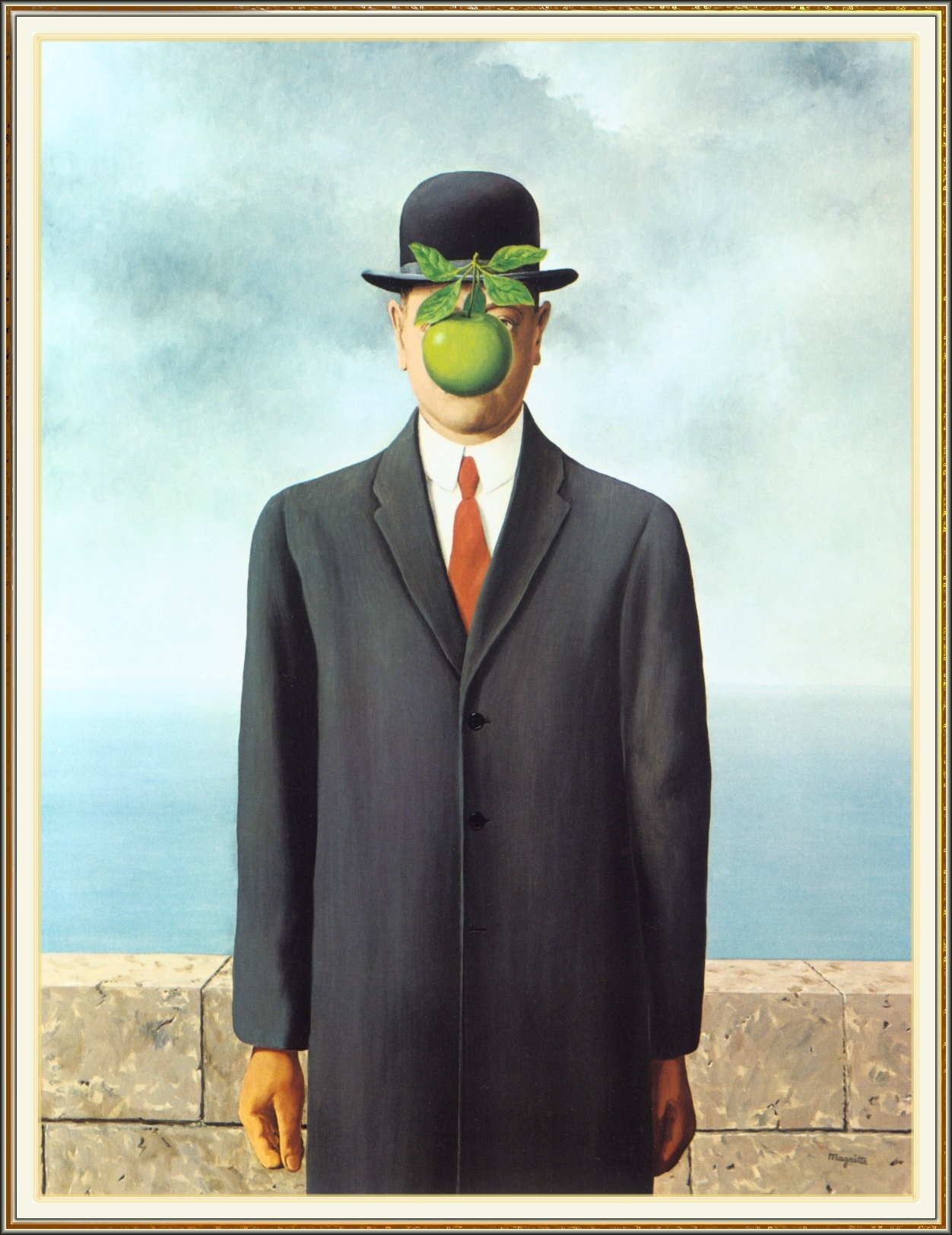
A thin crescent of the sitter’s left eye peeks around the apple in Magritte’s The Son of Man, refusing full concealment. That tiny glint of sight turns the painting into a duel between showing and hiding, keeping identity present even as it is blocked.
Historical Context
Magritte painted The Son of Man in 1964 as a commissioned self‑portrait for his friend and patron Harry Torczyner. After experiments in early 1964, including the related gouache Le goût de l’invisible, he fixed on a solution that would present the self while withholding it. The title—suggested by Irène Scutenaire—carried, in Magritte’s words, no theological message; the crux was a composition in which an ordinary object would partially hide the face. The sliver of the left eye visible around the apple enacts that “partial” condition on the canvas 1.
This calculated allow‑through aligns with Magritte’s long‑standing method of concealment—veiling, masking, doubling—that defined his Surrealist practice. Institutional surveys present concealment as one of the core strategies across his oeuvre, a throughline continued here in late style. By staging the conflict between the “hidden visible” (the face) and the “apparent visible” (the apple) within a single pinpoint of vision, the painting modernizes the self‑portrait as a puzzle about seeing rather than a revelation of identity 21.
Symbolic Meaning
Magritte formulated this picture type as a contest between the “hidden visible” and the “apparent visible.” The eye that peeks from behind the apple is the hinge of that contest: it proves the person is there and looking back, yet denies completion. The effect keeps the viewer’s desire perpetually charged—wanting to see what the apple withholds—precisely the response Magritte sought when he insisted the screen should only partially mask the face 1. Curators have echoed this, describing how the work activates the desire to see what is hidden; the eye is the trigger that sustains that appetite 5.
Across Magritte’s oeuvre, vision itself is a subject. In works like The False Mirror, the eye becomes a metaphor for perception and the way images mediate reality. The visible eye in The Son of Man reprises that inquiry: it is both a literal organ and a sign for seeing-as-thinking, reminding us that what we “know” of faces, selves, and pictures is constructed through obstacles and screens 4.
While the bowler-hatted figure invites symbolic readings, Magritte rejected doctrinal interpretations of the biblical title; the image’s meaning resides in its philosophical play with visibility. The peeking eye functions less as a religious symbol than as bait, keeping the face—and our curiosity—alive behind the apple’s calm facade 12.
Artistic Technique
Magritte renders the eye with the same cool, highly finished naturalism that governs the whole canvas. His deadpan, illustrative style minimizes brushwork so that the improbable reads as matter‑of‑fact; the tiny eye crescent is edged crisply, modeled with consistent light, and therefore registers as indisputably real 3. Color and placement sharpen the effect: the saturated green of the apple stands off against the cool sky and gray overcoat, while the eye’s warm flesh tones nibble at the apple’s contour, ensuring immediate legibility 6.
Compositionally, the frontal pose and perfectly centered fruit concentrate attention on the obstruction. The eye’s slight angle—glancing around the apple’s left edge—creates a micro‑drama of pursuit and evasion, a visual rhyme with the picture’s broader theme of concealment made palpable at the scale of a few millimeters 63.
Connection to the Whole
The Son of Man is a self‑portrait that withholds identity while confirming presence. The visible eye is the painting’s fulcrum: it restores personhood and the reciprocity of the gaze at the very point of blockage, embodying the “contest” between hidden and apparent visibles that Magritte described 1.
Because the eye looks back, viewers feel both resisted and addressed, a tension that fuels the enduring urge to see beyond the apple—an urge curators have singled out as central to the work’s impact 5. Within Magritte’s larger system of concealment strategies, the eye sliver is the most concise statement of his project: to make seeing uncertain yet irresistible, turning a masked face into a meditation on how images disclose and deny in the same breath 2.
Explore More from This Painting
This detail is one part of The Son of Man. Use the links below to return to the full interpretation, browse the full set of details, or view the painting's valuation if available.
Sources
- Christie’s lot essay on The Son of Man (Magritte’s statements via Torczyner; title origin; denial of theological intent)
- MoMA press release: Magritte—The Mystery of the Ordinary, 1926–1938 (core methods including concealment)
- The Art Story, “René Magritte” (deadpan, illustrative technique)
- Annenberg Learner, “The False Mirror” (Magritte’s eye motif and vision)
- Forbes (SFMOMA, curatorial framing on the desire to see what is hidden)
- Art in Context, “The Son of Man – Formal Analysis” (visible left eye; color and compositional contrasts)