The Green Apple in The Son of Man
A closer look at this element in Rene Magritte's 1964 masterpiece
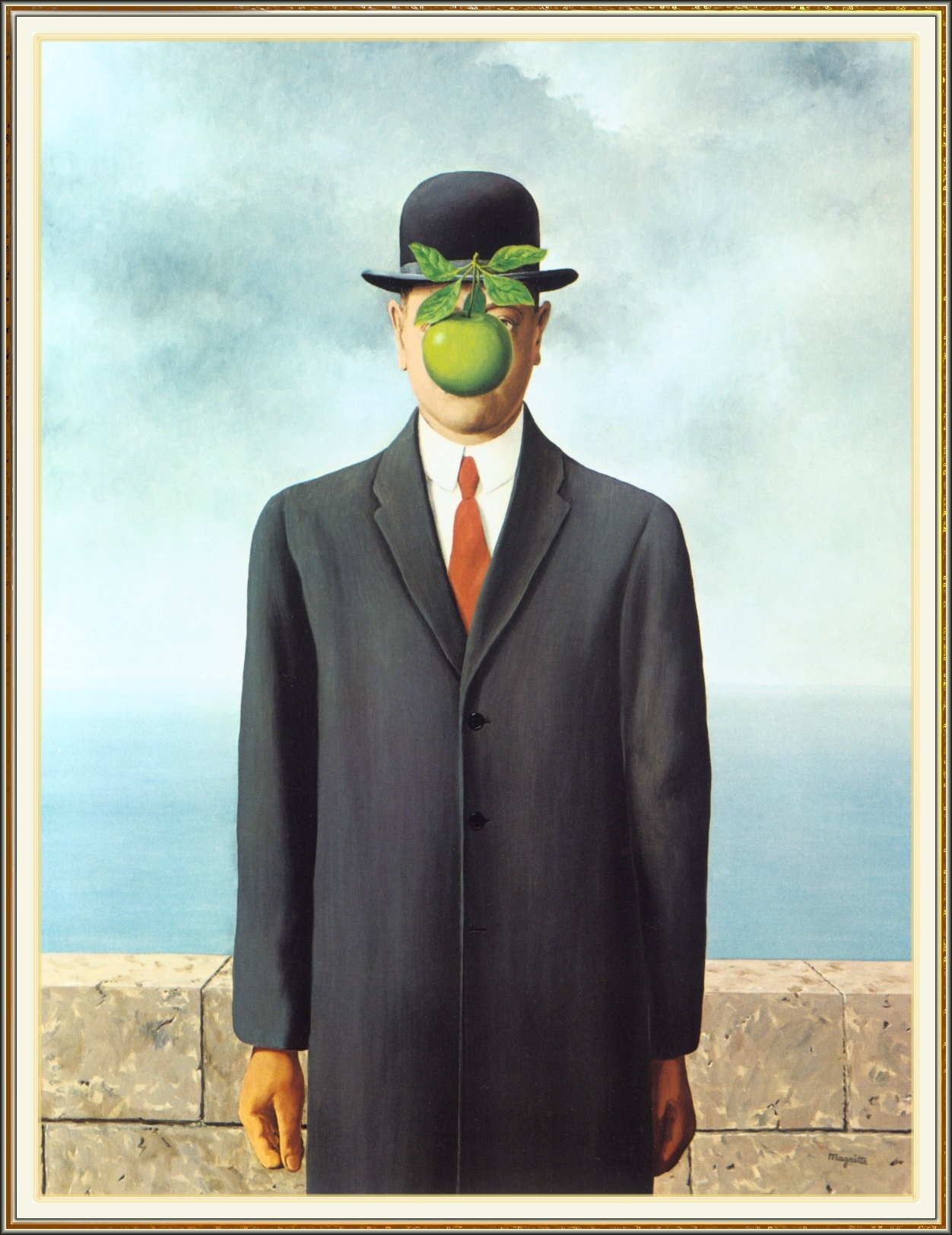
Magritte’s hovering green apple turns a straightforward portrait into a puzzle about seeing and knowing. By masking the face at the very point where identity should appear, the fruit converts an everyday object into a precise instrument of concealment and desire.
Historical Context
Painted in 1964, The Son of Man belongs to Magritte’s late period, when he repeatedly staged the bowler‑hatted figure as an anonymous self-portrait. SFMOMA’s curatorial writing frames the series as Magritte’s way of proposing a self-image that withholds biographical likeness, privileging idea over identity 2. In this setting, the green apple is not an incidental prop: it is the device that frustrates the central promise of portraiture—access to the face—thereby declaring the artist’s priorities in the work’s closing decade.
The apple is also one node in a decades‑long motif cycle. Across paintings like The Listening Room (1952), Magritte repositions the fruit—enlarged to fill a room, or, here, floated before a face—to test how an ordinary thing can dislocate perception through scale, site, and function 3. This practice aligns with his broader commitment to the seen/hidden dialectic that structures much of his oeuvre, where ordinary objects are made to interrupt recognition and the stability of meaning 9.
Symbolic Meaning
The green apple operates as a concrete emblem of concealment. It sits where viewers expect a face, turning the act of looking into an encounter with obstruction and delay. Magritte’s oft‑cited formulation—“everything we see hides another thing”—is realized with surgical clarity: the visible fruit prevents the very recognition portraits conventionally provide 71. In art‑historical terms, the painting dramatizes the gap between what images show and what they withhold, a theme Magritte pursued across related works that probe the limits of representation 9.
The apple also triggers culturally loaded associations without resolving them. Because the title invokes “Son of Man” and the object is an apple, interpreters regularly register biblical echoes of temptation and the “forbidden fruit.” Magritte’s image invites that resonance while refusing doctrinal closure, keeping meaning in suspension 6. Read alongside the bowler hat—long linked to bourgeois everydayness and anonymity—the apple intensifies the sense that the subject is generic, a stand‑in for the modern everyman rather than a named individual 5. Finally, placed within the artist’s apple genealogy (from The Listening Room to Ceci n’est pas une pomme), the fruit is best understood as a repeatable tool for destabilizing naming, scale, and recognition—an engine of ambiguity rather than a single, locked symbol 310.
Artistic Technique
Magritte renders the apple with his characteristic deadpan naturalism: smooth modeling, crisp contour, and even light that make the fruit look ordinary yet strangely authoritative in space 4. Its saturated green and clean edge give it a firm, volumetric presence, floating so near the face that only a sliver of one eye appears above it—sharpening the painting’s conceal/reveal game 1.
Compositionally, the apple is centered along the figure’s vertical axis and bracketed by a parapet, a sea horizon, and a clouded sky—a stage‑like stacking of planar zones that keeps forms parallel to the picture plane. This measured arrangement heightens the apple’s interruption of the portrait’s focal point and stabilizes the image’s quiet shock 111.
Connection to the Whole
The apple is the painting’s hinge: it makes The Son of Man “about” the act of looking. By obstructing the face, the fruit recasts our encounter with the work as a search that can never be satisfied, enacting Magritte’s insistence that every image withholds something from view 7.
In concert with the bowler‑hatted figure’s cultivated anonymity, the apple universalizes the sitter—less a person than a structure for thought—aligning with curatorial accounts of Magritte’s late self‑imaging as deliberately impersonal 52. The device also plugs the canvas into the artist’s larger program of concealment and estrangement that renews our attention to the ordinary, a program echoed across his oeuvre and in museum interpretations of his legacy 98.
Explore More from This Painting
This detail is one part of The Son of Man. Use the links below to return to the full interpretation, browse the full set of details, or view the painting's valuation if available.
Sources
- Wikipedia — The Son of Man (composition and motif details)
- SFMOMA — Self‑Portrait, Anonymous Artist (curatorial essay)
- Menil Collection — The Listening Room (apple motif across works)
- The Guardian — Magritte’s ‘conventional’ manner and technique
- Artsy — On Magritte’s bowler hats and anonymity
- WReview (academic PDF) — Title/apple links and biblical resonance
- Juxtapoz — SFMOMA’s Fifth Season and the ‘everything we see hides another thing’ frame
- The Met — Perspectives on Magritte’s play with vision and concealment
- Wikipedia — The Human Condition (Magritte) and the visible/hidden theme
- Christie’s — Ceci n’est pas une pomme (apple within words-and-images investigations)
- The Independent — On Magritte’s stage-like, planar compositions