Berthe Morisot with a Bouquet of Violets

by Édouard Manet

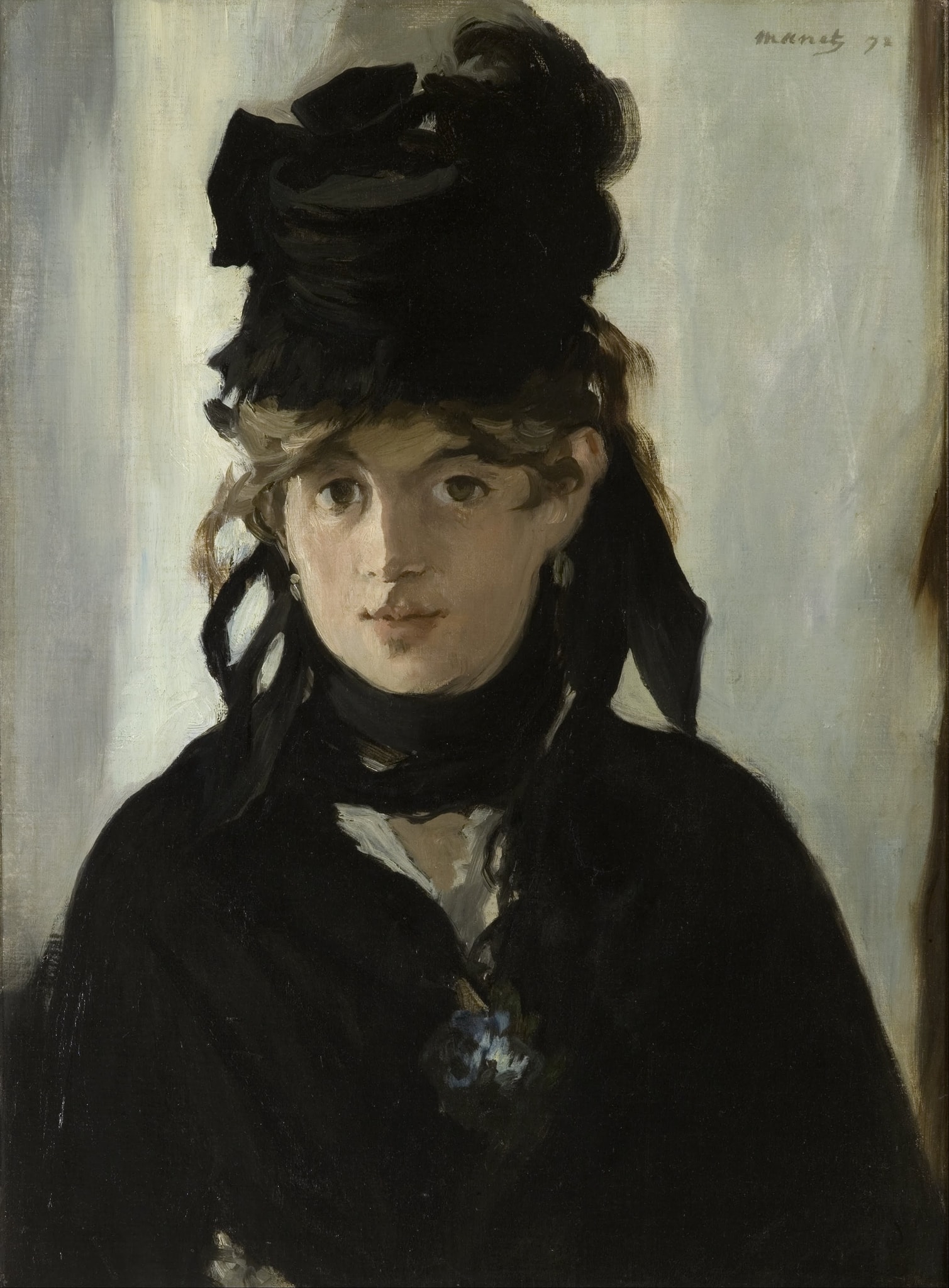
Édouard Manet’s Berthe Morisot with a Bouquet of Violets is a close, modern portrait built as a symphony in black punctuated by a tiny violet knot. Side‑light chisels the face from a cool, silvery ground while hat, scarf, and coat merge into one dark silhouette, and the eyes are painted strikingly black for effect [1]. The single touch of violets introduces a discreet, coded tenderness within the portrait’s refined restraint [1][3][4].

Fast Facts

Year
1872
Medium
Oil on canvas
Dimensions
55.5 × 40.5 cm
Location
Musée d’Orsay, Paris
Berthe Morisot with a Bouquet of Violets by Édouard Manet (1872) featuring Bouquet of violets, Symphony of black clothing, Side-light, Deeply black eyes

Click on any numbered symbol to learn more about its meaning

Meaning & Symbolism

Manet composes the likeness as a compact theatre of light. A cool, brushed backdrop—thinly painted in silvers and pearl grays—pushes the figure forward while a vivid beam from the left ignites forehead, cheek, and lip. Within that beam, the face is not “described” so much as struck into being: quick strokes for the brow and nose, a soft half‑tone pooling beneath the lower lip, and eyes rendered deeply black despite their true green—an explicit choice the Musée d’Orsay notes to heighten contrast and intensity 1. Around this luminous mask, the costume collapses into a single field of blacks: the hat’s piled ribbons, the scarf’s loose tails, the coat’s broad planes. Edges dissolve and re‑congeal; Manet lets a ribbon flicker with two loaded strokes and leaves the lower coat in near‑abstract sweeps. The result is a portrait that presses close to the picture plane yet withholds anecdote, concentrating all psychological charge in the intervals between light and shadow. Against this rigor, the violets at the neckline are the painting’s heartbeat. Tiny, cool, and half‑submerged in the dark, they are placed exactly where a brooch might sit—neither flaunted nor hidden. In nineteenth‑century floriography, violets signified modesty, discretion, and steadfast or secret love; Manet knew this code and repeatedly used violet sprigs to temper or complicate his modern portraits 34. Here, that delicate chromatic accent anchors feeling within restraint: a whisper of color that reads as intimacy without spectacle. The black costume should not be reduced to literal mourning in 1872; the Orsay frames it as a virtuoso lesson in black that also heightens the sitter’s often‑remarked “Spanish” allure, aligning Manet with Velázquez and Goya while proposing the elegance—and expressive range—of noir within modern life 1. This is Manet’s rejoinder to his friends’ brightening palettes: a demonstration that black can be a prism, not an absence. At the same time, the close cropping, the absence of props, and the quick, tactile facture announce a modern portrait ethic—one that distills identity into light, touch, and a single emblem. Why Berthe Morisot with a Bouquet of Violets is important, then, is twofold. First, it captures the postwar reset of Manet’s practice in late 1871–72, when he returned to portraiture with sharpened economy, reengaging collaborators from before the siege of Paris 1. Second, it stages his ongoing exchange with Impressionism from an oblique angle: not by adopting high‑key color, but by proving how side‑light, abbreviated brushwork, and strategic black can modernize the portrait without sacrificing gravity 126. Critics and curators have long felt the intimacy of this picture; its authority lies not in biographical conjecture but in the way the painting itself performs closeness—through proximity, through the muffling darks, through the violet’s quiet insistence. As later prints after the composition attest, Manet recognized he had achieved a potent image worth reiterating, one in which a minimal set of means yields maximal presence 7. The portrait’s lasting spell resides in that economy: a face found in a flash of light, a figure nearly absorbed by the city’s black, and a single violet that makes feeling visible while keeping its secret 15.

Explore Deeper with AI

Ask questions about Berthe Morisot with a Bouquet of Violets

Popular questions:

Powered by AI • Get instant insights about this artwork

💬 Ask questions about this artwork!

Interpretations

Historical Context: Aftermath Style

Painted in 1872, the work registers Paris’s postwar discipline not through overt subject matter but through method: concise touch, lateral illumination, and suppressed anecdote. Manet had served in the Garde nationale and resumed studio practice late in 1871; this return coincides with a sharpened economy that curators at the Orsay link to his renewed focus on portraiture and “symphony in black.” The side light reads like a moral and formal reset, chiseling the face from restraint rather than flourish. This is modernity as reconstruction by clarity—a pared grammar of light/dark that exchanges Salon rhetoric for a lucid, almost architectural staging of presence 1.

Source: Musée d’Orsay

Hispanism and the Power of Black

The portrait leverages Manet’s long Hispagnolisme—a dialogue with Velázquez and Goya—to upgrade black from absence to expressive matter. By clothing Morisot in stacked blacks and striking her with sidelight, Manet imports a Spanish courtly gravitas into a Parisian, modern key. The result is both homage and counter‑proposal to Impressionist brights: black becomes a prism that organizes value, temperature, and tactility. The Orsay underscores this as a “lesson” in black, while broader Manet scholarship situates such chromatic austerity within his project of inventing modernity without abandoning composure and weight 12.

Source: Musée d’Orsay; The Met (Heilbrunn Timeline of Art History)

Coded Intimacy: Violets as Soft Speech

Placed where a brooch might sit, the violets operate as coded sentiment within a field of decorum. In the 19th‑century language of flowers, violets signified modesty, discretion, and faithful or secret love—a cultural code documented in period manuals and surveys 34. Manet’s contemporaneous still life with violets, fan, and a letter addressed “À Mlle Berthe Morisot” intensifies this lexicon, suggesting how small floral motifs could carry personal address without narrative display 5. While biographical claims should be cautious, the chromatic whisper here reads as a tender counterpoint to the sober blacks, allowing feeling to circulate in the picture as emblem rather than confession 1345.

Source: Cornell University Library; RHS; Musée d’Orsay; Washington Post (Sebastian Smee)

Optics and Abstraction: The Engine of Side Light

Manet forges a mask of light that is less anatomical description than optical impact. Orsay notes that Morisot’s green eyes are painted black to heighten contrast, and that a vivid lateral beam carves the visage into alternating bands of value 1. Around this, forms are abbreviated—ribbons, scarf tails, coat planes—so that recognition and paintfight alternate at the edge. This oscillation between struck highlight and suggestive dark nudges portraiture toward abstract organization (patch, plane, edge) while preserving likeness. The strategy reframes verisimilitude as an event of illumination rather than an inventory of parts—Manet’s mimesis as optical compression 12.

Source: Musée d’Orsay; The Met (Heilbrunn Timeline of Art History)

Repetition, Print, and the Making of an Icon

Manet’s decision to produce an etching and two lithographs after this composition signals his awareness of its exemplary force. As Nancy Locke has shown, such reproductive afterworks consolidate familial and intimate typologies in Manet while testing how an image’s aura translates across media 6. The transfer from oil to print compresses tones and simplifies edges, clarifying the portrait’s armature: the flare of face, the engulfing blacks, the small violet accent. Circulation through prints thus codifies the picture’s modern schema—a template of close framing, value orchestration, and emblematic sign—amplifying its reach beyond the studio and confirming its status as a model image in Manet’s repertoire 6.

Source: Nancy Locke, Manet and the Family Romance (Princeton University Press)

Colleague as Muse: Gendered Modernity

Portraying a fellow painter, Manet stages a peer-to-peer modern portrait that withholds domestic props and professional tools alike, concentrating identity into light and touch. Recent scholarship reassesses Manet–Morisot as a reciprocal exchange rather than a one‑way muse dynamic; the compressed composition and sober tonality read as ethical modernity—respect through restraint, intimacy without possession 17. Within a culture that often feminized Impressionist “lightness,” Manet’s gravely elegant image acknowledges Morisot’s charisma while preserving her interiority, modeling a new portrait protocol for artistic colleagues: proximity, minimalism, and emblem over anecdote 7.

Source: Musée d’Orsay; Manet & Morisot (Yale University Press, 2025)

Related Themes

About Édouard Manet

Édouard Manet (1832–1883) bridged Realism and Impressionism, turning modern urban life into a chief subject of painting. In his final years, declining health led him to intimate formats and studio-staged scenes that still pulse with immediacy, culminating in late masterpieces like A Bar at the Folies-Bergère [4].
View all works by Édouard Manet

More by Édouard Manet

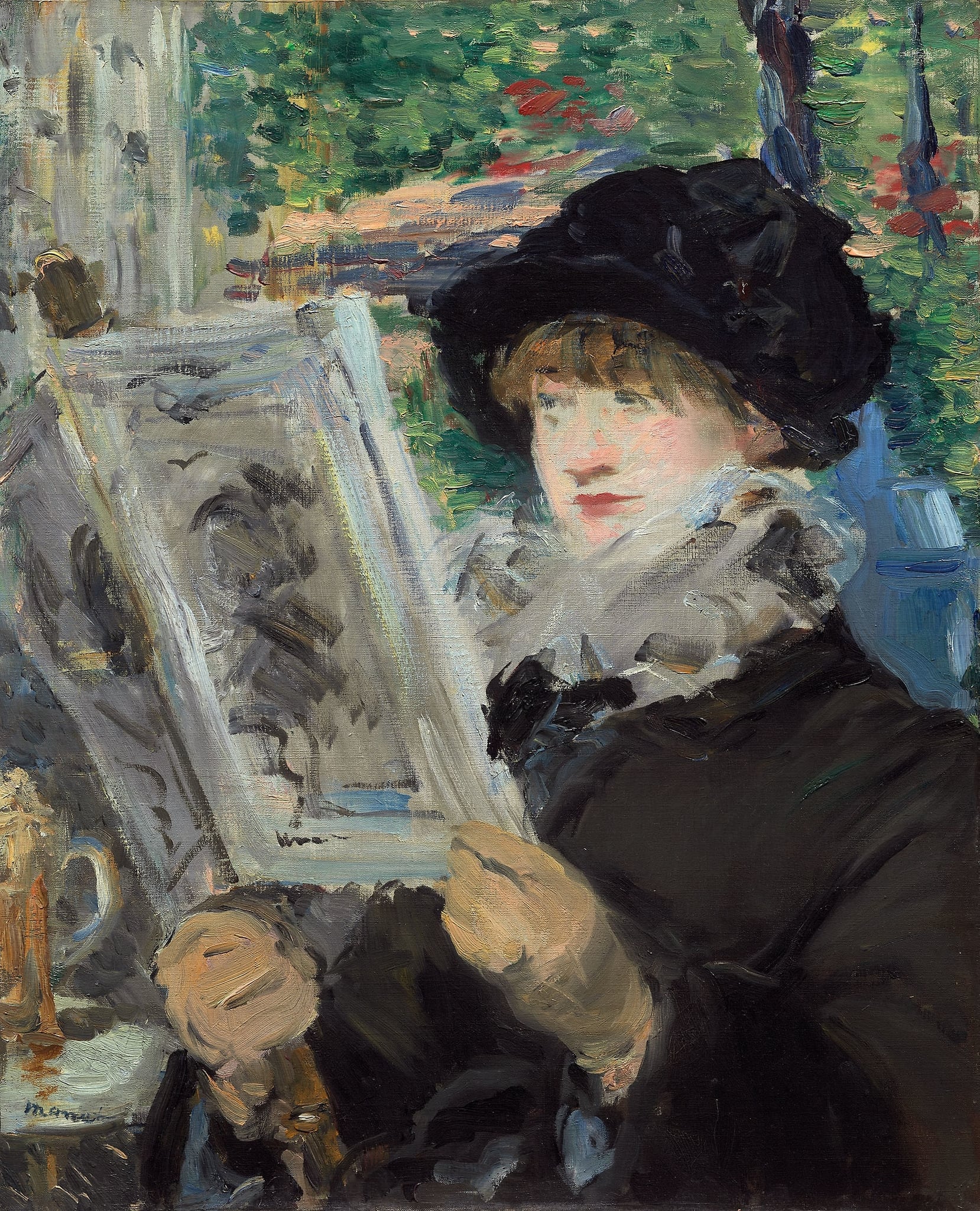
Woman Reading by Édouard Manet

Woman Reading

Édouard Manet (1880–82)

Manet’s Woman Reading distills a fleeting act into an emblem of <strong>modern self-possession</strong>: a bundled figure raises a journal-on-a-stick, her luminous profile set against a brisk mosaic of greens and reds. With quick, loaded strokes and a deliberately cropped <strong>beer glass</strong> and paper, Manet turns perception itself into subject—asserting the drama of a private mind within a public café world <sup>[1]</sup><sup>[2]</sup>.
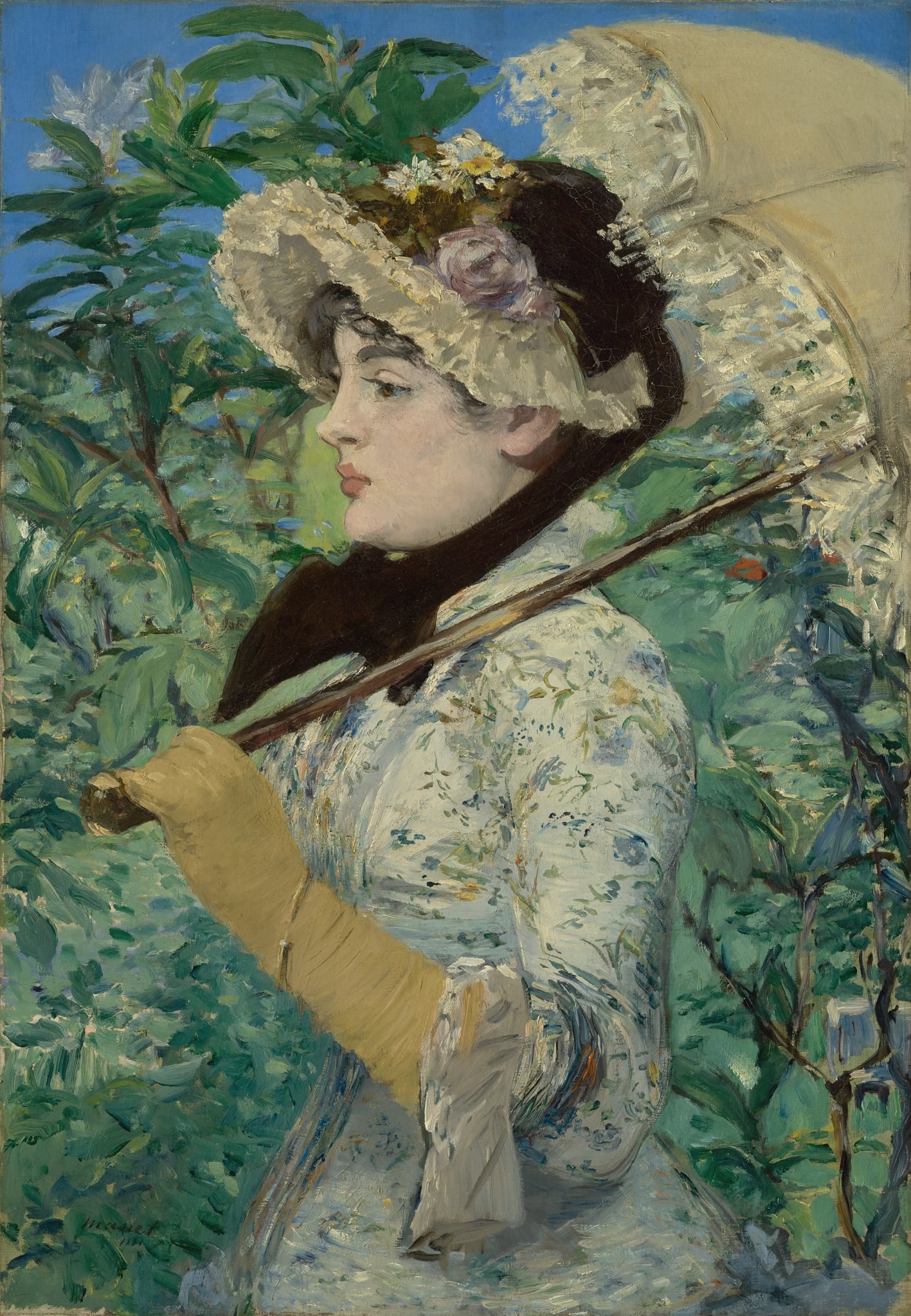
Jeanne (Spring) by Édouard Manet

Jeanne (Spring)

Édouard Manet (1881)

Édouard Manet’s Jeanne (Spring) fuses a time-honored allegory with <strong>modern Parisian fashion</strong>: a crisp profile beneath a cream parasol, set against <strong>luminous, leafy greens</strong>. Manet turns couture—hat, glove, parasol—into the language of <strong>renewal and youth</strong>, making spring feel both perennial and up-to-the-minute <sup>[1]</sup><sup>[2]</sup>.

On the Beach by Édouard Manet

On the Beach

Édouard Manet (1873)

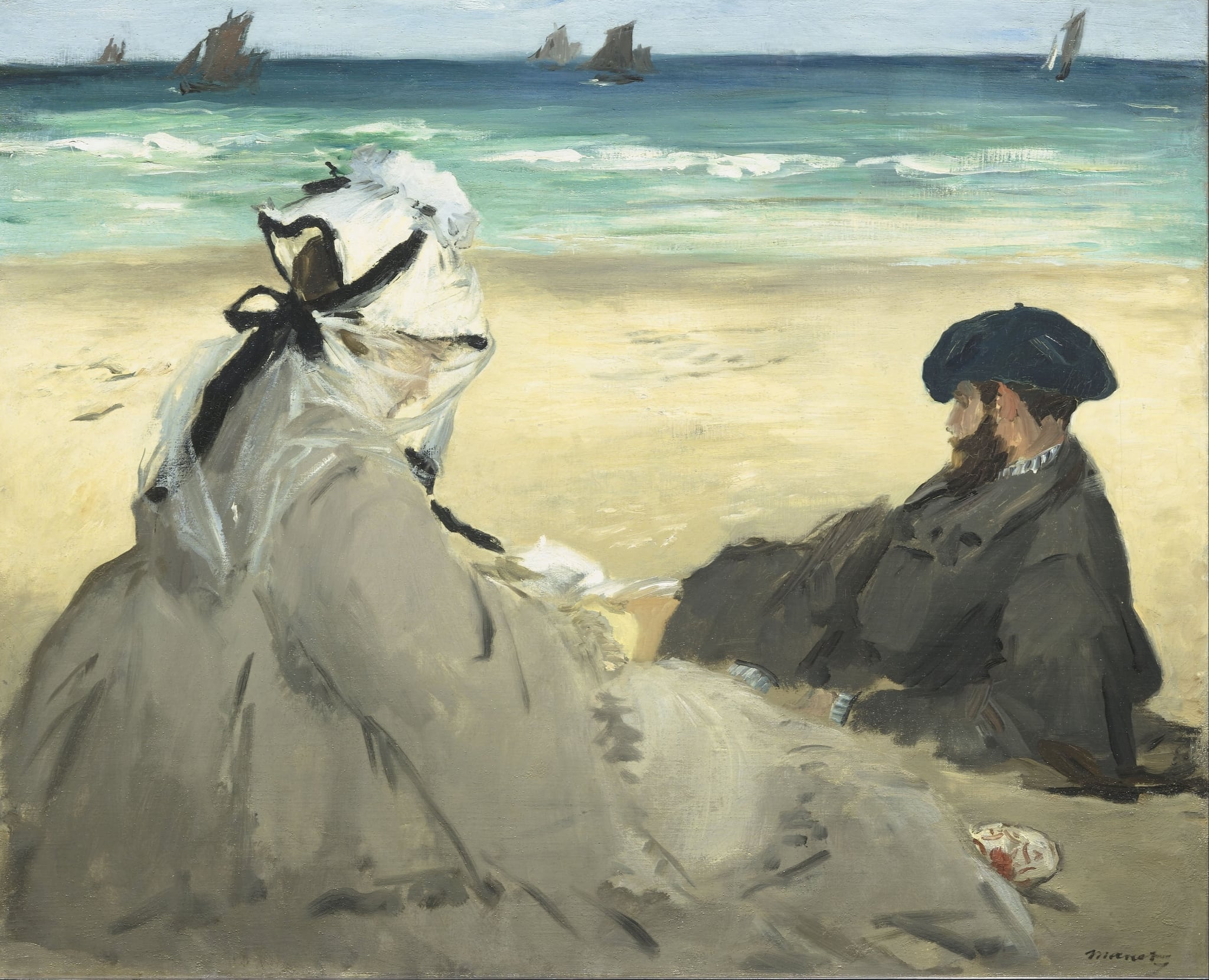
On the Beach captures a paused interval of modern leisure: two fashionably dressed figures sit on pale sand before a <strong>banded, high-horizon sea</strong>. Manet’s <strong>economical brushwork</strong>, restricted greys and blacks, and radical cropping stage a scene of absorption and wind‑tossed motion that feels both intimate and detached <sup>[1]</sup>.
Plum Brandy by Édouard Manet

Plum Brandy

Édouard Manet (ca. 1877)

Manet’s Plum Brandy crystallizes a modern pause—an urban <strong>interval of suspended action</strong>—through the idle tilt of a woman’s head, an <strong>unlit cigarette</strong>, and a glass cradling a <strong>plum in amber liquor</strong>. The boxed-in space—marble table, red banquette, and decorative grille—turns a café moment into a stage for <strong>solitude within public life</strong> <sup>[1]</sup><sup>[2]</sup>.

The Fifer by Édouard Manet

The Fifer

Édouard Manet (1866)

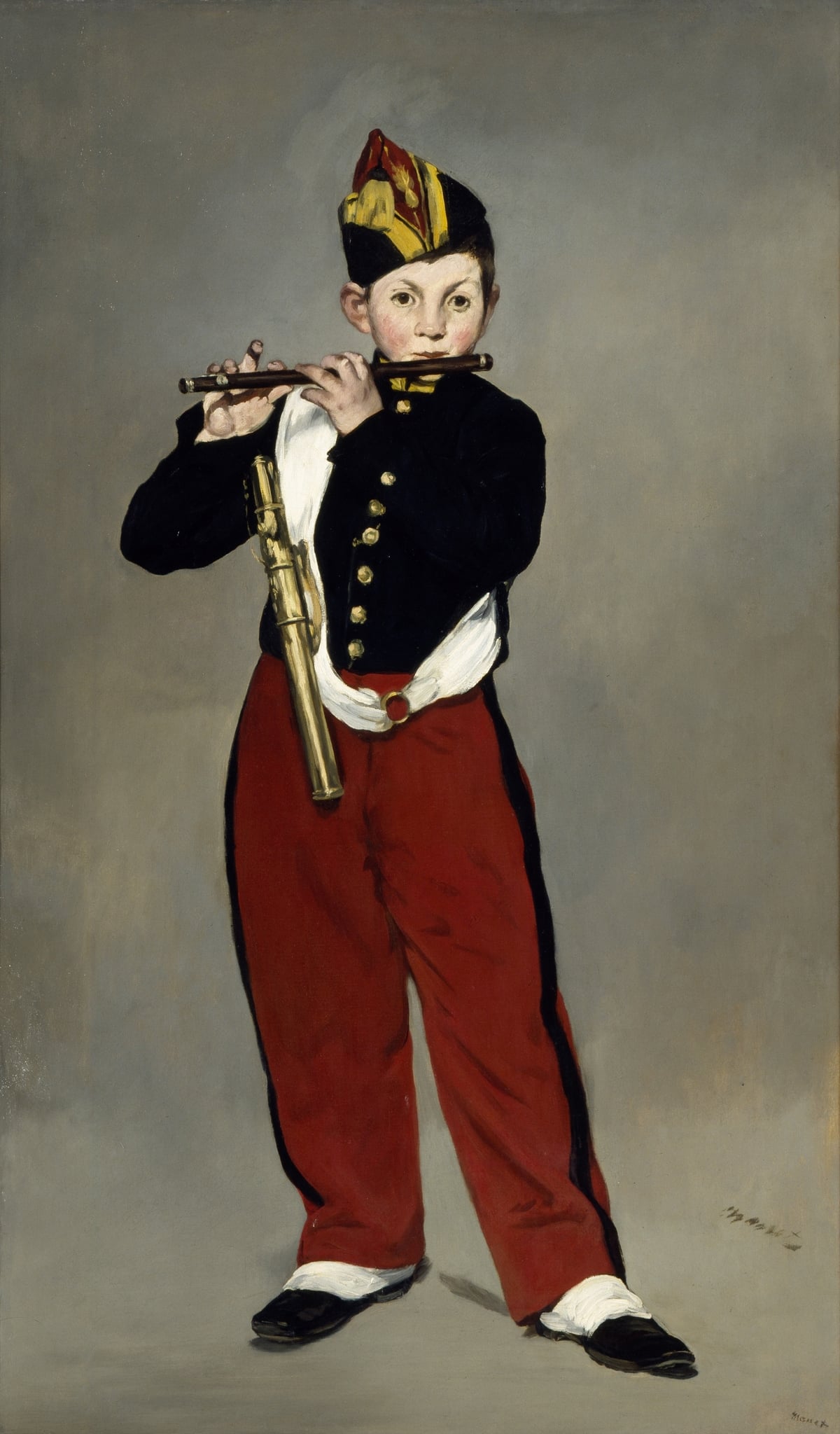
In The Fifer, <strong>Édouard Manet</strong> monumentalizes an anonymous military child by isolating him against a flat, gray field, converting everyday modern life into a subject of high pictorial dignity. The crisp <strong>silhouette</strong>, blocks of <strong>unmodulated color</strong> (black tunic, red trousers, white gaiters), and glints on the brass case make sound and discipline palpable without narrative scaffolding <sup>[1]</sup>. Drawing on <strong>Velázquez’s single-figure-in-air</strong> formula yet inflected by japonisme’s flatness, Manet forges a new modern image that the Salon rejected in 1866 <sup>[1]</sup><sup>[2]</sup><sup>[3]</sup>.
Music in the Tuileries by Édouard Manet

Music in the Tuileries

Édouard Manet (1862)

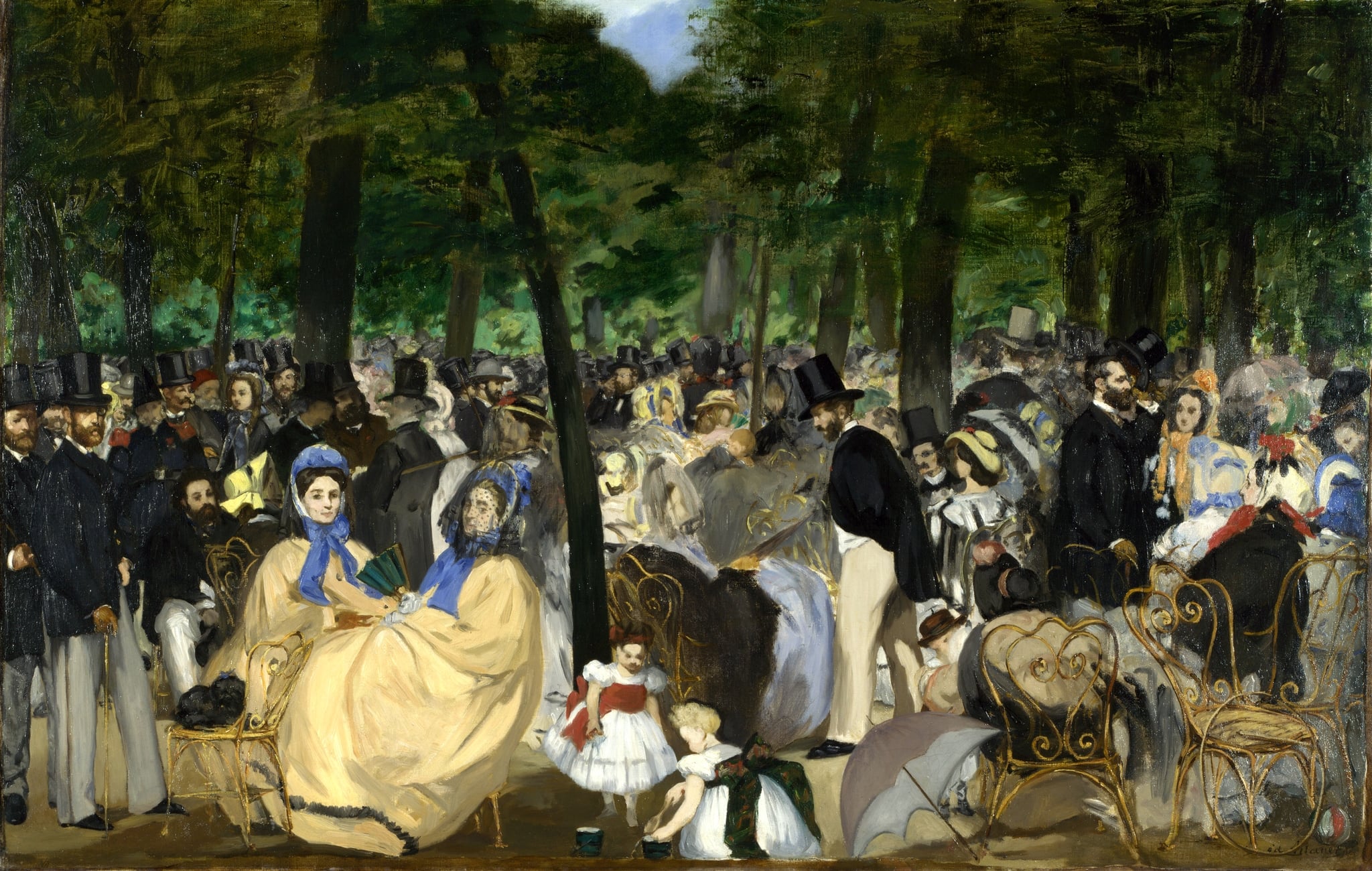
Édouard Manet’s Music in the Tuileries turns a Sunday concert into a manifesto of <strong>modern life</strong>: a frieze of top hats, crinolines, and iron chairs flickering beneath <strong>toxic green</strong> foliage. Instead of a hero or center, the painting disperses attention across a restless crowd, making <strong>looking itself</strong> the drama of the scene <sup>[1]</sup><sup>[2]</sup>.