Portrait of Haesje Jacobsdr van Cleyburg

by Rembrandt van Rijn

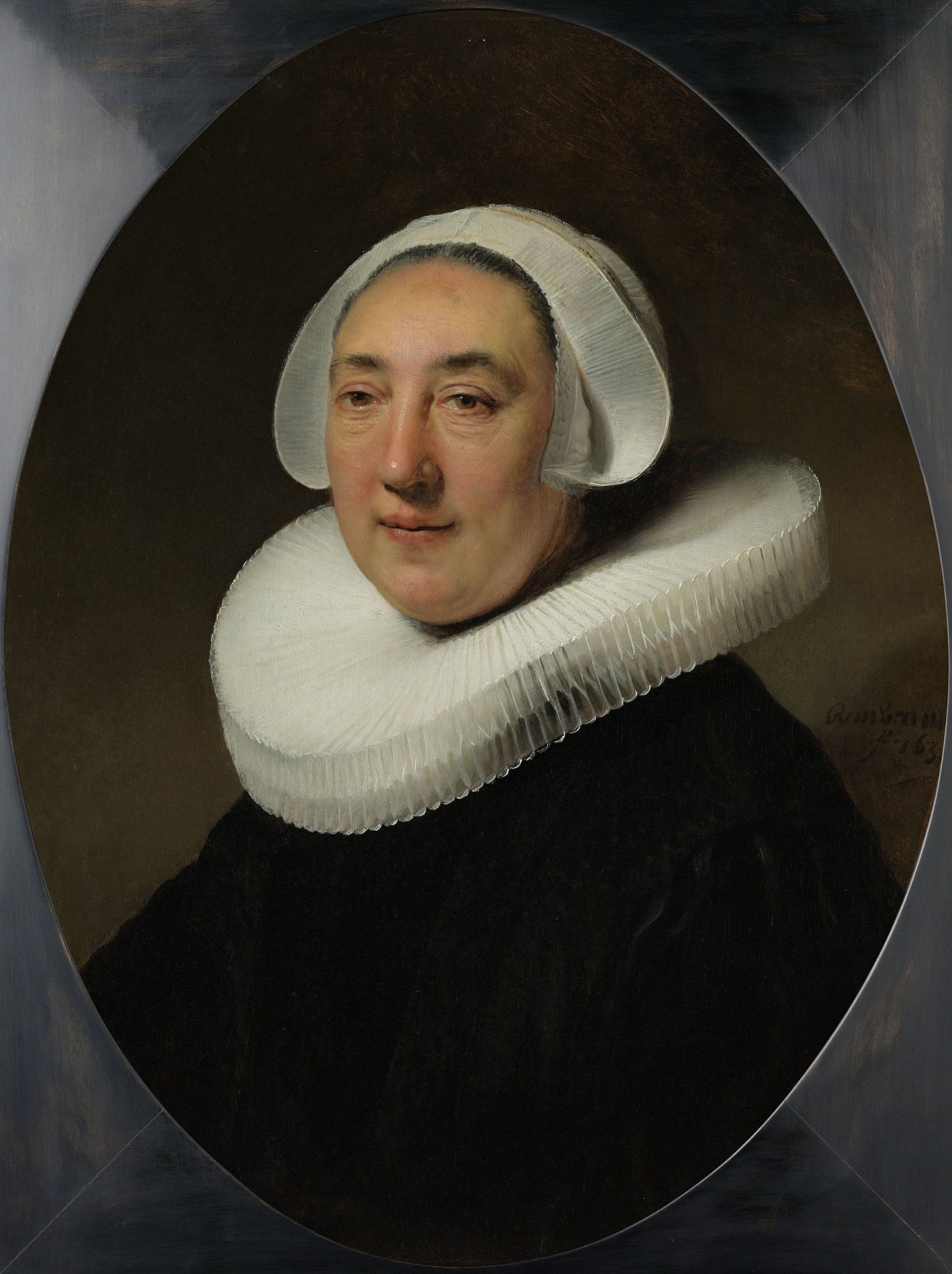
Rembrandt’s 1634 Portrait of Haesje Jacobsdr van Cleyburg stages a Dutch burgher within a feigned oval opening, illuminated by selective chiaroscuro that models warm skin against brilliant millstone ruff and sober black dress. The painting balances modesty and status, making virtue visible while quietly declaring prosperity through immaculate linen and craft [1][4].

Study Print Studio

Create a personal study print

Build a companion study sheet around the part of this painting that speaks to you most. Choose a detail, shape an interpretation, and walk away with something personal and display-worthy.

Fast Facts

Year
1634
Medium
Oil on panel
Dimensions
68.6 × 53.4 cm
Location
Rijksmuseum, Amsterdam
See all Rembrandt van Rijn paintings in Amsterdam
Portrait of Haesje Jacobsdr van Cleyburg by Rembrandt van Rijn (1634) featuring Millstone ruff, White coif (bonnet), Black gown, Feigned oval opening

Click on any numbered symbol to learn more about its meaning

Meaning & Symbolism

Rembrandt engineers a studied economy of means to project inner steadiness. Warm light skims the sitter’s left cheek and nose, catching moisture at the eye and the soft translucency at the nostril, while the opposite side sinks into tempered half‑shadow. That calibration—neither theatrical spotlight nor diffuse haze—lets the face read as lived and morally legible, not staged. The millstone ruff, articulated in crisp pleats with a cool, pearly edge, forms a luminous ring that both frames and measures the head. Its extravagant material and labor, known to require extraordinary lengths of linen, announce prosperity; yet its whiteness, precision, and cleanliness signal order and self-command rather than display 15. The plain white coif tightens this rhetoric of restraint: it encloses the temples and ears, catching a mid‑tone sheen where it rounds the skull, so that the bonnet’s discipline seems to contain the body’s warmth. Against a dress painted as a near‑absorbent black, the black‑and‑white dialectic becomes the portrait’s thesis: virtue in contrast, wealth in understatement 5. The feigned oval surround radicalizes presence by subtracting place. Within the dark opening, the sitter advances as if from a void; outside it, the painted spandrels cool to steel‑gray, clarifying the optical trick and making the likeness read like a cameo or a medal in relief 14. This oval device, fashionable in Amsterdam and Rotterdam around 1634, allowed Rembrandt to compress narrative into a single act of appearing—no table, glove, or curtain; only a measured turn of the head and the trace of a faint, closed‑lip smile. Such formal spareness matches the Remonstrant milieu linked with this commission, where sobriety and civic responsibility organized self‑presentation 24. Even the sitter’s sidelong gaze—steady, unflustered, not confrontational—constructs domestic authority as calm vigilance rather than public performance. In this way, the picture becomes a compact social contract: the ruff guarantees means; the black gown guarantees restraint; the light guarantees character. At the level of paint, Rembrandt’s mid‑1630s practice fuses fashion and phenomenology. He builds the ruff with short, bright strokes that pinch and release along each pleat, letting tiny blue‑gray cools creep into the shadows to keep the white alive. By contrast, the cheek and chin are knitted from warmer flesh tones with soft gradations that refuse the brittleness of the linen. This juxtaposition—soft flesh versus hard fabric—turns aging itself into subject matter: mortality acknowledged, dignity maintained. Seen alongside the pendant of Dirck Jansz. Pesser, the portrait functions as a family manifesto, proclaiming station and piety at the very moment Rembrandt was refining a new language of psychological immediacy in Dutch portraiture 124. That is why Portrait of Haesje Jacobsdr van Cleyburg is important: it crystallizes a culture’s values in the smallest visible decisions—pleat by pleat, highlight by highlight—until social ethics become inseparable from the look of light on skin 46.

Explore Deeper with AI

Ask questions about Portrait of Haesje Jacobsdr van Cleyburg

Popular questions:

Powered by AI • Get instant insights about this artwork

💬 Ask questions about this artwork!

Interpretations

Medium/Format Analysis

The feigned oval is more than a fashion; it is a medium-aware device that imports the logic of medals and printed cartouches into paint. By staging Haesje as if emerging through an aperture, Rembrandt collapses portrait and frame, making presence feel sculptural—like a cameo lifted from darkness. The cooling of the painted spandrels clarifies the trick, teaching the eye how to see the likeness as both object and apparition. In Rotterdam of the early 1630s this convention compressed narrative into the act of appearing, aligning with a culture that prized probity over anecdote: no curtain, no table—just physiognomy and light as truth claims for character 2.

Source: National Gallery, London

Historical Context

Read against Rotterdam’s Remonstrant networks, the portrait’s sobriety is not only moral rhetoric but also a prudent public language after the 1619 ban. Within this dissenting Protestant milieu, material lavishness migrated into the least flamboyant register—white linen—allowing families to project prosperity while avoiding accusations of pride. Haesje’s immaculate ruff and pared setting thus operate as a form of civic self-regulation: wealth acknowledged, controversy averted. Rembrandt’s 1634 trip to paint Haesje, her husband Dirck, and Aechje Claesdr. shows the artist as a mediator of this etiquette, importing Amsterdam fashions (feigned ovals, emphatic chiaroscuro) to fit a community that prized ethical restraint and communal respectability over theatrical self-assertion 12.

Source: National Gallery, London; Rijksmuseum

Gender Analysis

The ruff’s authority rests on women’s domains of textile knowledge—bleaching, cutting, pleating, starching—where expense and labor accrue to a surface coded as modest. By concentrating luxury in white linen, the portrait showcases a feminine economy of maintenance that sustains household reputation without jewels or props. The coif tightens this domestic rhetoric, enclosing hair and ears to literalize discretion, while the ruff’s exactitude testifies to discipline performed daily in the care of fabrics. Rembrandt’s paint tracks that labor: crisp, pearly edges, blue‑gray cools in the folds, a sheen that reads as freshly laundered. Fashion here is a gendered technology of virtue—conspicuous cleanliness rather than conspicuous consumption 14.

Source: Rijksmuseum; Art Gallery of New South Wales

Social History of Art

As pendant to Dirck Jansz. Pesser, Haesje’s portrait constitutes a coordinated public instrument: matched ovals, congruent dress codes, and parallel lighting establish a dyad of domestic governance. Together they articulate a household treaty—his civic standing balanced by her disciplined stewardship, their shared sobriety converting private piety into public credit. The cross‑museum dispersion of the pair today underscores how integral the coupling was to the work’s original social function: seen side by side, the panels synchronize gaze, posture, and textile rhetoric into a single statement of conjugal and mercantile identity in 1634 Rotterdam 135.

Source: Rijksmuseum; LACMA; Rembrandt in Southern California

Vanitas Reading

Without skulls or hourglasses, the portrait stages vanitas through material contrasts: mutable flesh versus intransigent linen. The cheek’s moist warmth and soft gradations concede time’s pressure; the ruff’s crystalline pleats suggest an ideal of order that resists it. This tension—aging visage held within a ring of perfected fabric—renders mortality as a tempered fact, ethically managed rather than theatrically lamented. In Rembrandt’s 1634 practice, such phenomenology is moral: light parses what endures (character, discipline) from what yields (skin), letting Protestant self‑scrutiny replace overt allegory. It is vanitas by touch and temperature, not by emblem 12.

Source: Rijksmuseum; National Gallery, London

Related Themes

About Rembrandt van Rijn

Rembrandt van Rijn (1606–1669) was a leading Dutch Golden Age painter and printmaker whose Amsterdam years (from 1631) produced virtuosic portraits and ambitious history paintings. In the early 1630s he favored polished finishes, saturated color, and theatrical staging—qualities on display in this 1633 canvas. Although prolific, this is his only known painted seascape [2][4].
View all works by Rembrandt van Rijn

More by Rembrandt van Rijn
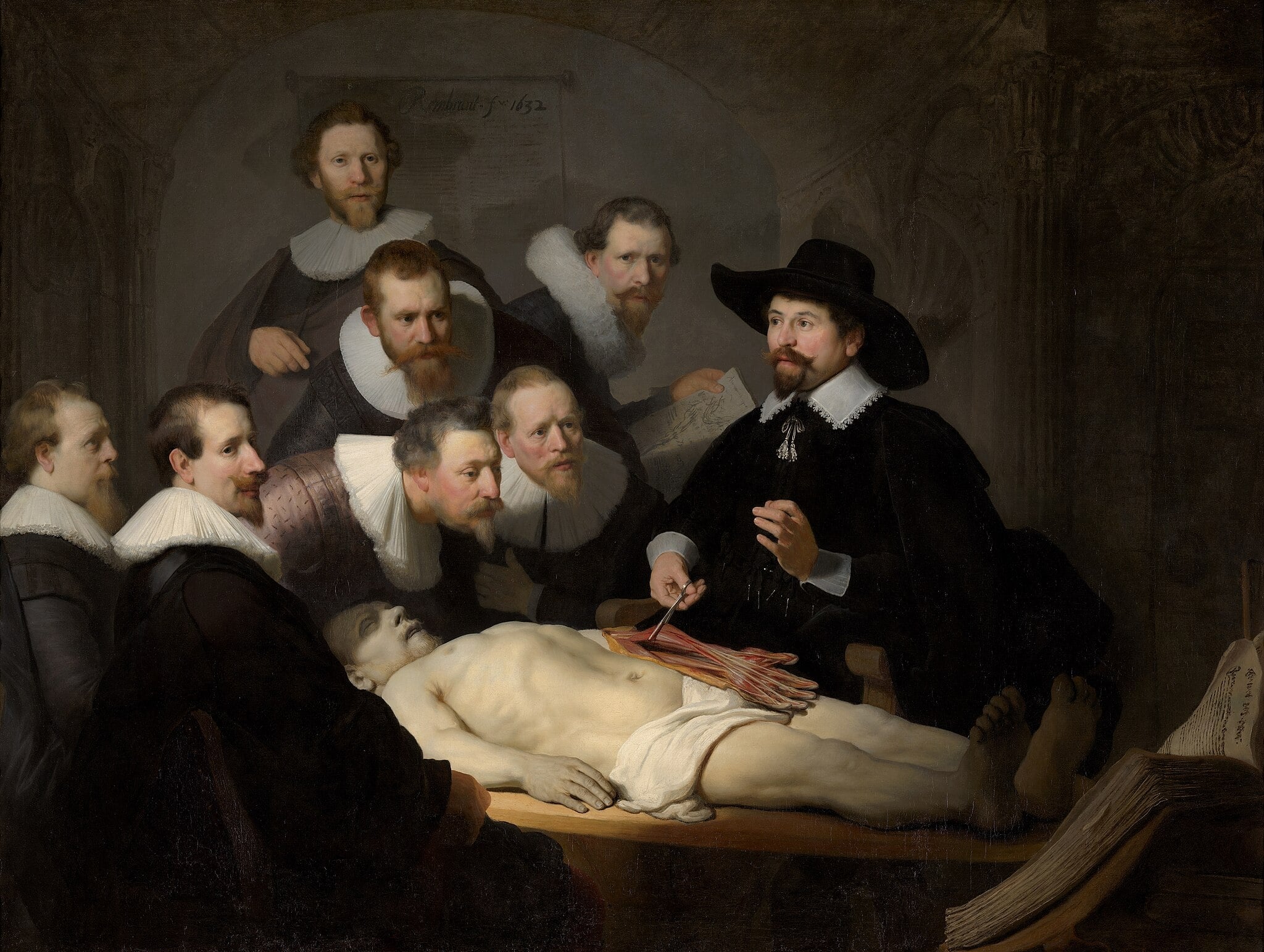
The Anatomy Lesson of Dr. Nicolaes Tulp by Rembrandt van Rijn

The Anatomy Lesson of Dr. Nicolaes Tulp

Rembrandt van Rijn (1632)

Rembrandt van Rijn turns a civic commission into a drama of <strong>knowledge made visible</strong>. A cone of light binds the ruff‑collared surgeons, the pale cadaver, and Dr. Tulp’s forceps as he raises the <strong>forearm tendons</strong> to explain the hand. Book and body face each other across the table, staging the tension—and alliance—between <strong>textual authority</strong> and <strong>empirical observation</strong> <sup>[1]</sup><sup>[2]</sup>.
Isaac and Rebecca, Known as ‘The Jewish Bride’ by Rembrandt van Rijn

Isaac and Rebecca, Known as ‘The Jewish Bride’

Rembrandt van Rijn (c. 1665–1669)

Rembrandt van Rijn’s Isaac and Rebecca, Known as <strong>‘The Jewish Bride’</strong> crystallizes marriage as a covenant of <strong>love, protection, and consent</strong>. In warm chiaroscuro, the man’s enclosing arm and open right hand meet the woman’s regulating left hand over her chest, while her other hand gathers the glowing red dress. The painting turns a biblical recognition scene into an intimate vow illuminated from within.

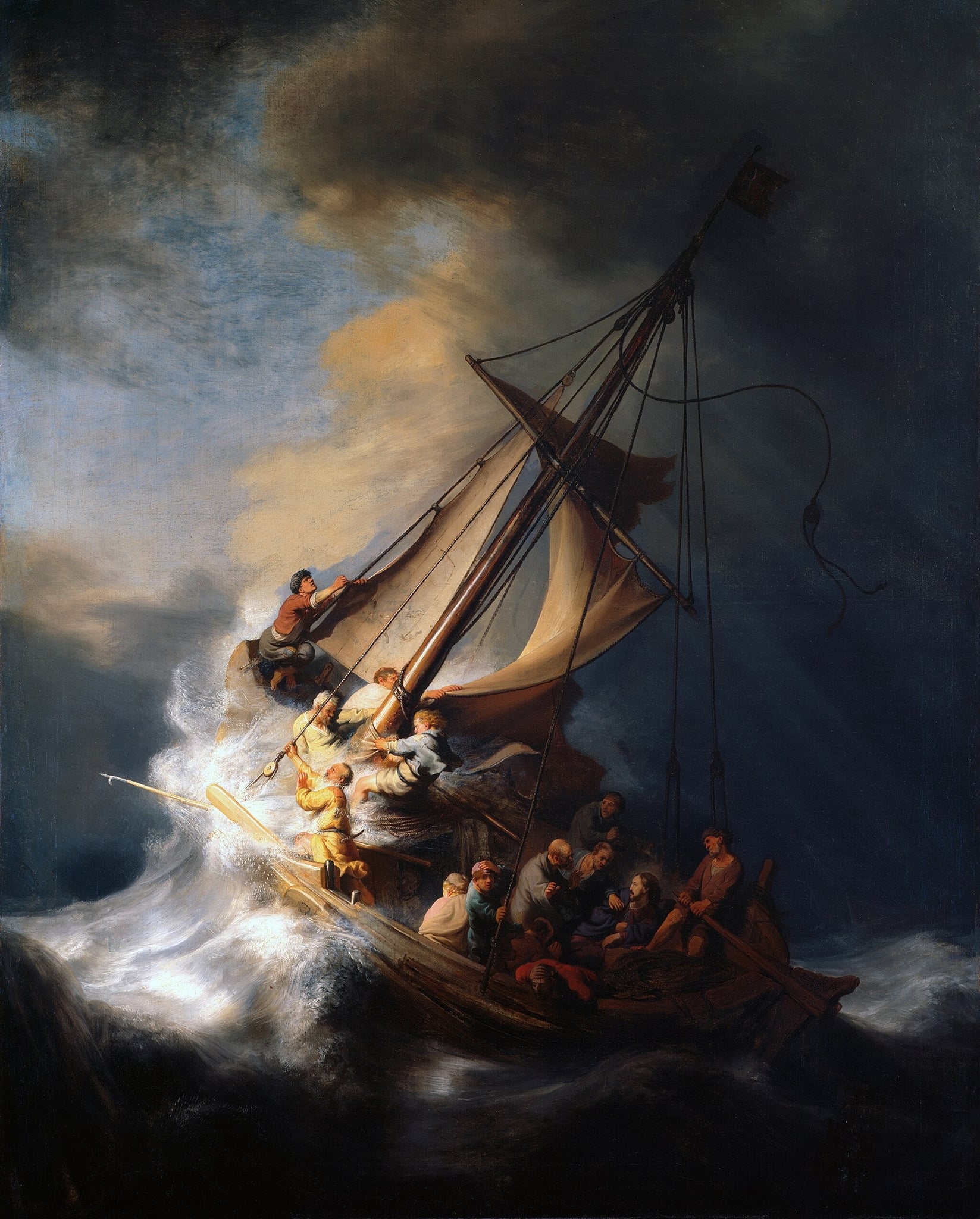
The Storm on the Sea of Galilee by Rembrandt van Rijn

The Storm on the Sea of Galilee

Rembrandt van Rijn (1633)

Rembrandt van Rijn’s The Storm on the Sea of Galilee stages a clash of <strong>human panic</strong> and <strong>divine composure</strong> at the instant before the miracle. A torn mainsail whips across a steeply tilted boat as terrified disciples scramble, while a <strong>serenely lit Christ</strong> anchors a pocket of calm—an image of faith holding within chaos <sup>[1]</sup><sup>[3]</sup>. It is Rembrandt’s only painted seascape, intensifying its dramatic singularity in his oeuvre <sup>[2]</sup>.
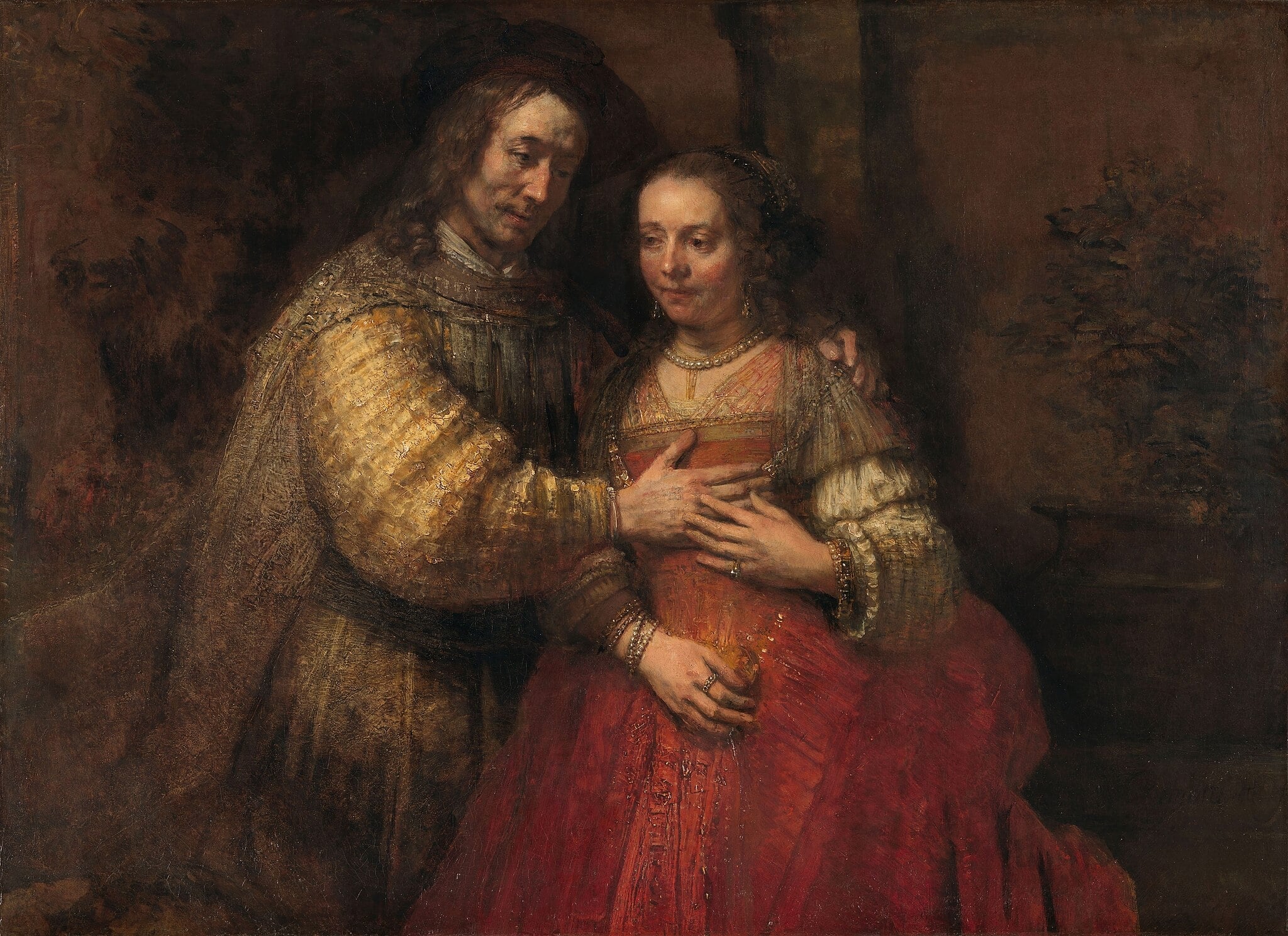
The Jewish Bride by Rembrandt van Rijn

The Jewish Bride

Rembrandt van Rijn (c. 1665–1669)

The Jewish Bride by Rembrandt van Rijn stages an intimate covenant: two figures, read today as <strong>Isaac and Rebecca</strong>, seal their union through touch rather than spectacle. Light concentrates on faces and hands, while the man’s glittering <strong>gold sleeve</strong> and the woman’s <strong>coral-red gown</strong> turn paint itself into a metaphor for fidelity and tenderness <sup>[1]</sup><sup>[3]</sup>. This late masterpiece embodies Rembrandt’s <strong>material eloquence</strong>—impasto as feeling—within a hushed, dark setting <sup>[1]</sup><sup>[2]</sup>.
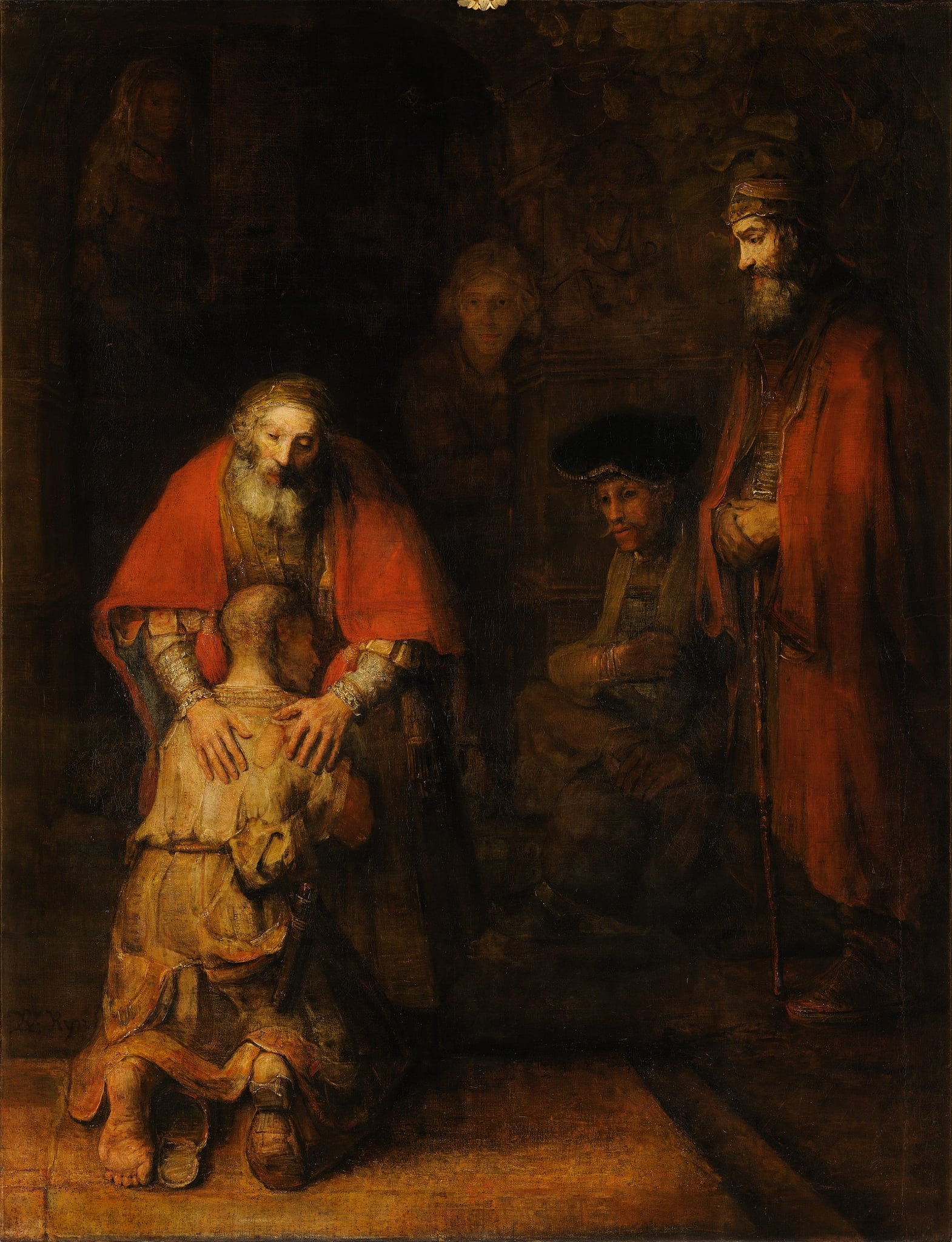
The Return of the Prodigal Son by Rembrandt van Rijn

The Return of the Prodigal Son

Rembrandt van Rijn (c. 1661–1669 (probably completed by 1669))

Rembrandt van Rijn’s The Return of the Prodigal Son is a late-life meditation on <strong>mercy</strong>, <strong>homecoming</strong>, and <strong>restored dignity</strong>. In a hush of dusk-like light, a ragged son kneels into his father’s <strong>embrace</strong>, while an upright elder brother holds back in shadow. The image concentrates meaning in illuminated <strong>faces, hands, and feet</strong>, turning a parable into a timeless human reckoning. <sup>[1]</sup><sup>[2]</sup>
The Sampling Officials of the Amsterdam Drapers’ Guild, Known as ‘The Syndics’ by Rembrandt van Rijn

The Sampling Officials of the Amsterdam Drapers’ Guild, Known as ‘The Syndics’

Rembrandt van Rijn (1662)

Rembrandt van Rijn’s The Sampling Officials of the Amsterdam Drapers’ Guild, Known as ‘The Syndics’ (1662) stages a <strong>meeting interrupted</strong>: six guild officials glance up from an open <strong>stalenboek</strong> (sample book) atop a sumptuous <strong>Oriental carpet</strong>, as if a merchant has just entered. The low vantage and unified yet varied poses convert routine inspection into a drama of <strong>civic authority</strong> and <strong>public accountability</strong> <sup>[1]</sup>.