The Standard Bearer

by Rembrandt van Rijn

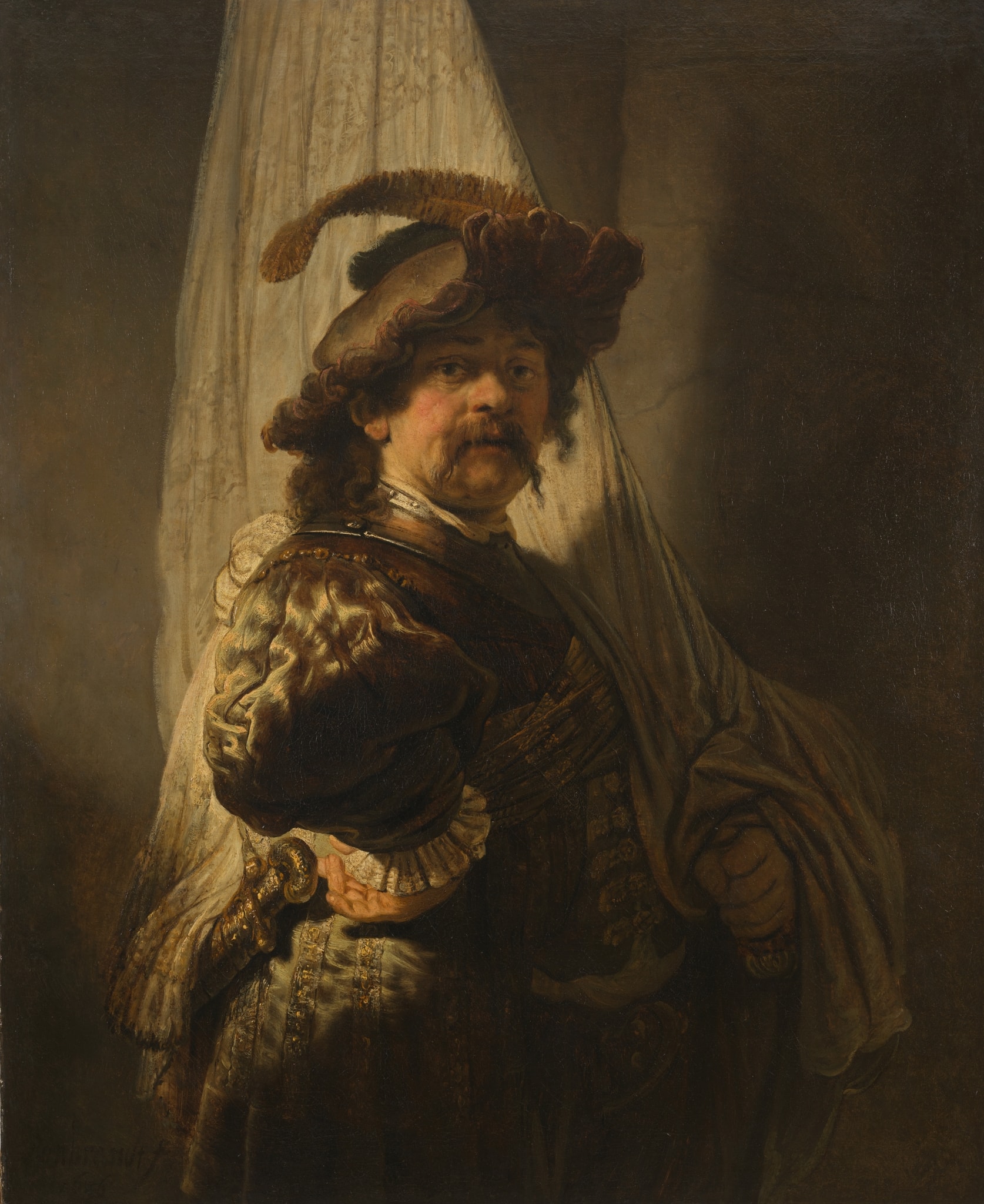
Rembrandt van Rijn’s The Standard Bearer (1636) thrusts a single figure into a wedge of light, his satin sleeve and metal gorget flashing as the pale standard billows behind him. The diagonal flag and forward-leaning stance assert resolve and readiness, while the enveloping shadow and wary gaze convert civic office into a meditation on honor and the solitary weight of leadership [1][4].

Study Print Studio

Create a personal study print

Build a companion study sheet around the part of this painting that speaks to you most. Choose a detail, shape an interpretation, and walk away with something personal and display-worthy.

Fast Facts

Year
1636
Medium
Oil on canvas
Dimensions
118.8 × 96.8 cm
Location
Rijksmuseum, Amsterdam
See all Rembrandt van Rijn paintings in Amsterdam
The Standard Bearer by Rembrandt van Rijn (1636) featuring Standard (flag), Gorget, Column/Pier, Dagger

Click on any numbered symbol to learn more about its meaning

Meaning & Symbolism

Rembrandt shapes meaning through a choreography of diagonals and textures. The translucent standard rises like a sail, setting off the sitter’s face and the crushed gleam of his satin sleeve; the left hand clamps the staff just above the gorget, making duty a physical weight that must be borne. The figure’s twist toward us and compact, forward-leaning pose generate an immediate sense of readiness; yet the gaze remains alert rather than triumphant, an index of vigilance instead of swagger. The standard’s bright plane is not mere backdrop—it is the picture’s moral stage, a screen against which the persona is tested. A shadowed architectural pier—read as a column—stabilizes the scene and invokes the emblem of Fortitude, translating a civic office into a classical virtue 14. Costume and lighting declare the work’s theatricality, which is central to the meaning of The Standard Bearer. The broad-brimmed hat tufted with a feather, the slashed sleeves, and ornate baldrick evoke sixteenth‑century Landsknecht bravura rather than a contemporary Amsterdam uniform. This is a deliberate masquerade—what scholars call a portrait historié—through which Rembrandt plays the role of ensign to magnify his own artistic identity. The Rijksmuseum now presents the painting as a large self-portrait; Sluijter has argued that the comic-actorly costume aligns it with rhetoricians’ processions and performative self-display, not literal documentation of militia dress 123. These positions converge on a single point: the work is a public statement. It is less a likeness of an officer than a manifesto of capability—of handling light that rakes, fabrics that glisten, metal that catches sparks, and a psychology tuned to responsibility. Why The Standard Bearer is important is bound to this ambition. Painted in early Amsterdam years, it functions as a virtuoso advertisement aimed at the lucrative militia market that would culminate in The Night Watch six years later 1. The ensign’s apparatus—a gorget signaling rank, the dagger at hip, the swelling flag—condenses the civic guard’s mythology of courage and youthful prestige while acknowledging its ceremonial, representational nature 4. Rembrandt’s staging keeps that duality visible: the figure pushes forward as if to step out of the gloom, but the darkness remains close, reminding us that leadership is exercised at the edge of uncertainty. The picture argues that honor is not noise but poise; not blare but bearing. By merging allegory (column as fortitude), persona (self in costume), and technical bravura (loose, daring brushwork, radiant highlights), Rembrandt turns a single, near-life-size figure into a thesis on authority. In this fusion of role and self, The Standard Bearer claims space for the artist as a civic actor, making painterly mastery itself the ultimate standard to be carried 124.

Explore Deeper with AI

Ask questions about The Standard Bearer

Popular questions:

Powered by AI • Get instant insights about this artwork

💬 Ask questions about this artwork!

Interpretations

Formal Analysis

Rembrandt engineers a vector-field of diagonals—the staff, sash, banner fold—to drive the body’s torque and make the ensign project into the viewer’s space. The painter’s impastoed highlights on satin, the specular glints on the gorget, and the subtractive scumbles in the banner modulate how light reads as weight and rank. Crucially, the flag’s translucence stages a chiaroscuro test: the face emerges against a luminous plane rather than a dark void, converting backdrop into ethical proscenium. This formal orchestration signals virtuosity aimed at high-stakes commissions; its confident handling anticipates the multi-figure complexity of The Night Watch, advertising control over fabric, metal, flesh, and psychological presence all at once 12.

Source: Rijksmuseum (object entry and press materials)

Costume History & Theatricality

The Landsknecht-inflected getup—broad-brimmed hat with plume, slashed sleeves, ornate baldrick—belongs to a historicizing costume repertory, not to any contemporary Amsterdam militia uniform. Sluijter reads this as a portrait historié with comic-actorly overtones, aligning Rembrandt’s self-presentation with rhetoricians’ processions and civic pageantry rather than battlefield realism. Such masquerade dislodges the image from literal reportage and reframes it as performative authorship: the painter “plays” ensign to scale up his social and artistic rank. The result is a tension between swaggering bravura and self-aware play, where dress is an instrument of identity construction and a signal that the work’s truth lies in artifice expertly handled 37.

Source: E. J. Sluijter (Journal of Historians of Netherlandish Art); Rijksmuseum Bulletin

Civic-Military Sociology

Within Dutch schutterij culture, the standard-bearer connoted youthful prestige, visibility, and risk. By the 1630s the role was as ceremonial as it was martial; insignia like the gorget had shifted from armor to emblem of office. Rembrandt compresses this sociology into attributes: the dagger at hip, swelling flag, and gleaming gorget synthesize danger, display, and rank. The work’s stance—alert but not exultant—mirrors the ensign’s contradictory status as both symbol and servant of communal identity. Read this way, the painting navigates a civic ecology in which office-holding, bachelorly honor, and urban spectacle structure the portrait’s claims to public significance 45.

Source: National Gallery of Art (Dutch Paintings Online); Cleveland Museum of Art (gorget context)

Allegory & Virtue Ethics

The shadowed architectural pier reads as a column of Fortitude, translating a paid civic office into a classical virtue. Rather than a simple prop, the column anchors a moral axis: the body’s forward tilt and the flag’s diagonal are counterweighted by this vertical of steadfastness. The ensign’s gaze—"alert rather than triumphant"—supports a virtue-ethical framing in which courage is composure, not bravado. By embedding a personation of office within learned allegory, Rembrandt fuses portraiture, emblem tradition, and history painting, elevating a market-facing image into a moral picture that tests character against the luminous field of the standard 1.

Source: Rijksmuseum (object entry and iconography)

Function & Market Strategy

Beyond likeness, the canvas likely functioned as a studio showpiece—a persuasive “demo” to attract lucrative militia commissions. Dudok van Heel has tied early copies and studio circulation to Rembrandt’s strategic self-positioning in Amsterdam’s market, where mastery over difficult effects—metallic sheen, satin crush, and complex lighting—signaled readiness for large civic projects. The work’s scale, bravura handling, and hybrid genre (portrait-history) align with a portfolio logic: it visualizes the artist’s capacity to coordinate symbolism, physiognomy, and spectacle—the very toolkit a militia company would prize in a group portrait. In this reading, the flag is also a banner for professional ambition 26.

Source: British Museum (after-works; Dudok van Heel); Rijksmuseum press

Related Themes

About Rembrandt van Rijn

Rembrandt van Rijn (1606–1669) was a leading Dutch Golden Age painter and printmaker whose Amsterdam years (from 1631) produced virtuosic portraits and ambitious history paintings. In the early 1630s he favored polished finishes, saturated color, and theatrical staging—qualities on display in this 1633 canvas. Although prolific, this is his only known painted seascape [2][4].
View all works by Rembrandt van Rijn

More by Rembrandt van Rijn
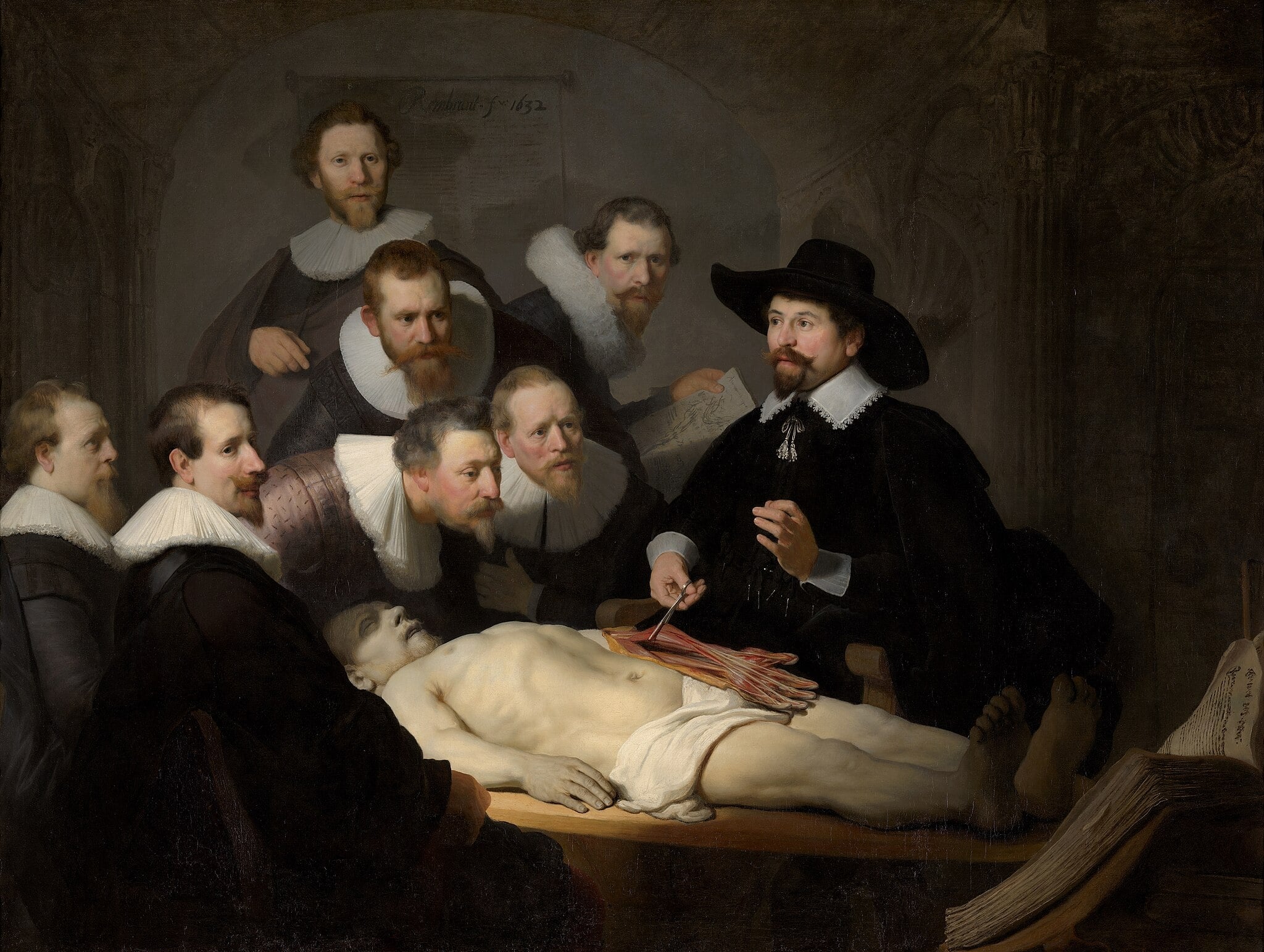
The Anatomy Lesson of Dr. Nicolaes Tulp by Rembrandt van Rijn

The Anatomy Lesson of Dr. Nicolaes Tulp

Rembrandt van Rijn (1632)

Rembrandt van Rijn turns a civic commission into a drama of <strong>knowledge made visible</strong>. A cone of light binds the ruff‑collared surgeons, the pale cadaver, and Dr. Tulp’s forceps as he raises the <strong>forearm tendons</strong> to explain the hand. Book and body face each other across the table, staging the tension—and alliance—between <strong>textual authority</strong> and <strong>empirical observation</strong> <sup>[1]</sup><sup>[2]</sup>.
Isaac and Rebecca, Known as ‘The Jewish Bride’ by Rembrandt van Rijn

Isaac and Rebecca, Known as ‘The Jewish Bride’

Rembrandt van Rijn (c. 1665–1669)

Rembrandt van Rijn’s Isaac and Rebecca, Known as <strong>‘The Jewish Bride’</strong> crystallizes marriage as a covenant of <strong>love, protection, and consent</strong>. In warm chiaroscuro, the man’s enclosing arm and open right hand meet the woman’s regulating left hand over her chest, while her other hand gathers the glowing red dress. The painting turns a biblical recognition scene into an intimate vow illuminated from within.

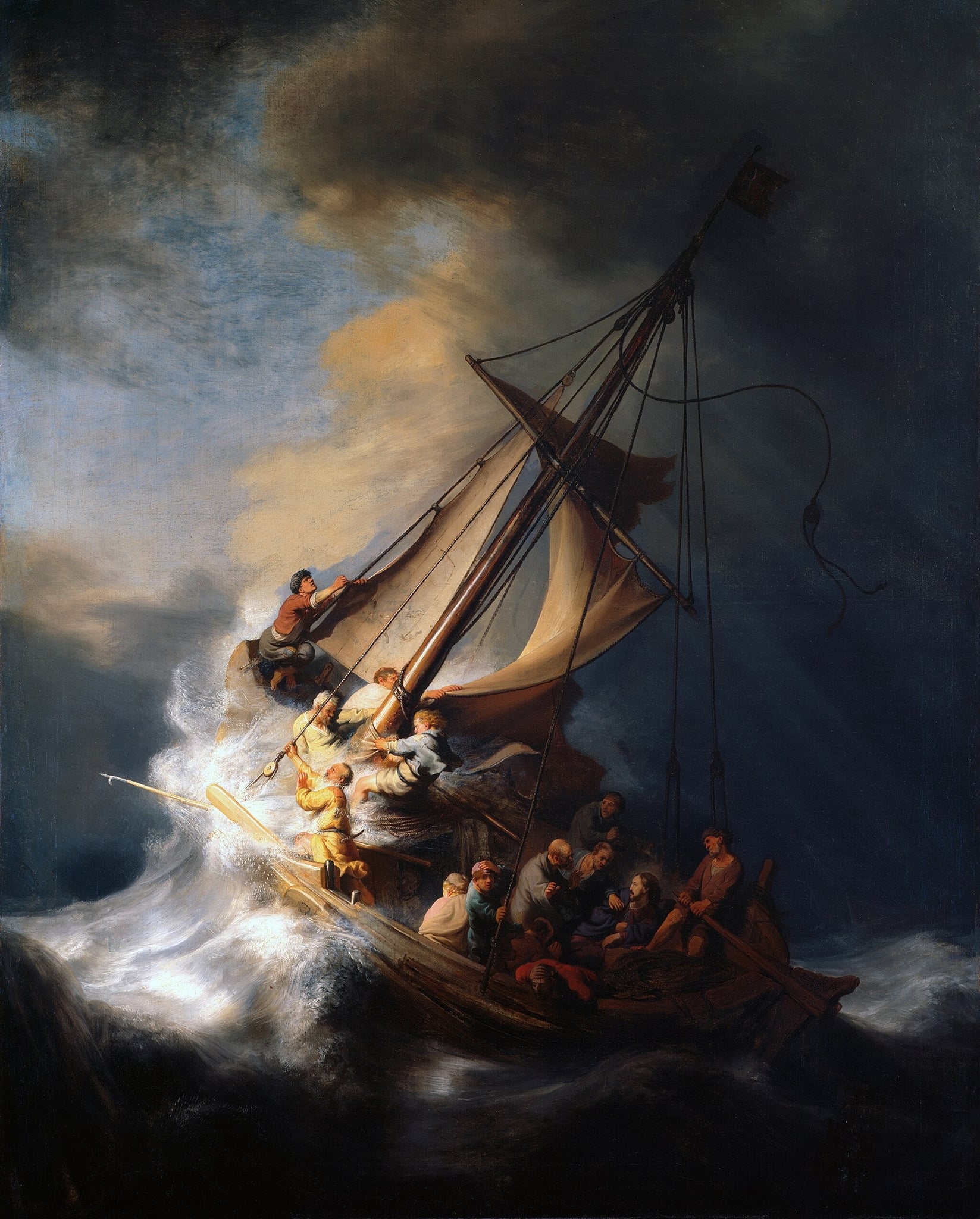
The Storm on the Sea of Galilee by Rembrandt van Rijn

The Storm on the Sea of Galilee

Rembrandt van Rijn (1633)

Rembrandt van Rijn’s The Storm on the Sea of Galilee stages a clash of <strong>human panic</strong> and <strong>divine composure</strong> at the instant before the miracle. A torn mainsail whips across a steeply tilted boat as terrified disciples scramble, while a <strong>serenely lit Christ</strong> anchors a pocket of calm—an image of faith holding within chaos <sup>[1]</sup><sup>[3]</sup>. It is Rembrandt’s only painted seascape, intensifying its dramatic singularity in his oeuvre <sup>[2]</sup>.
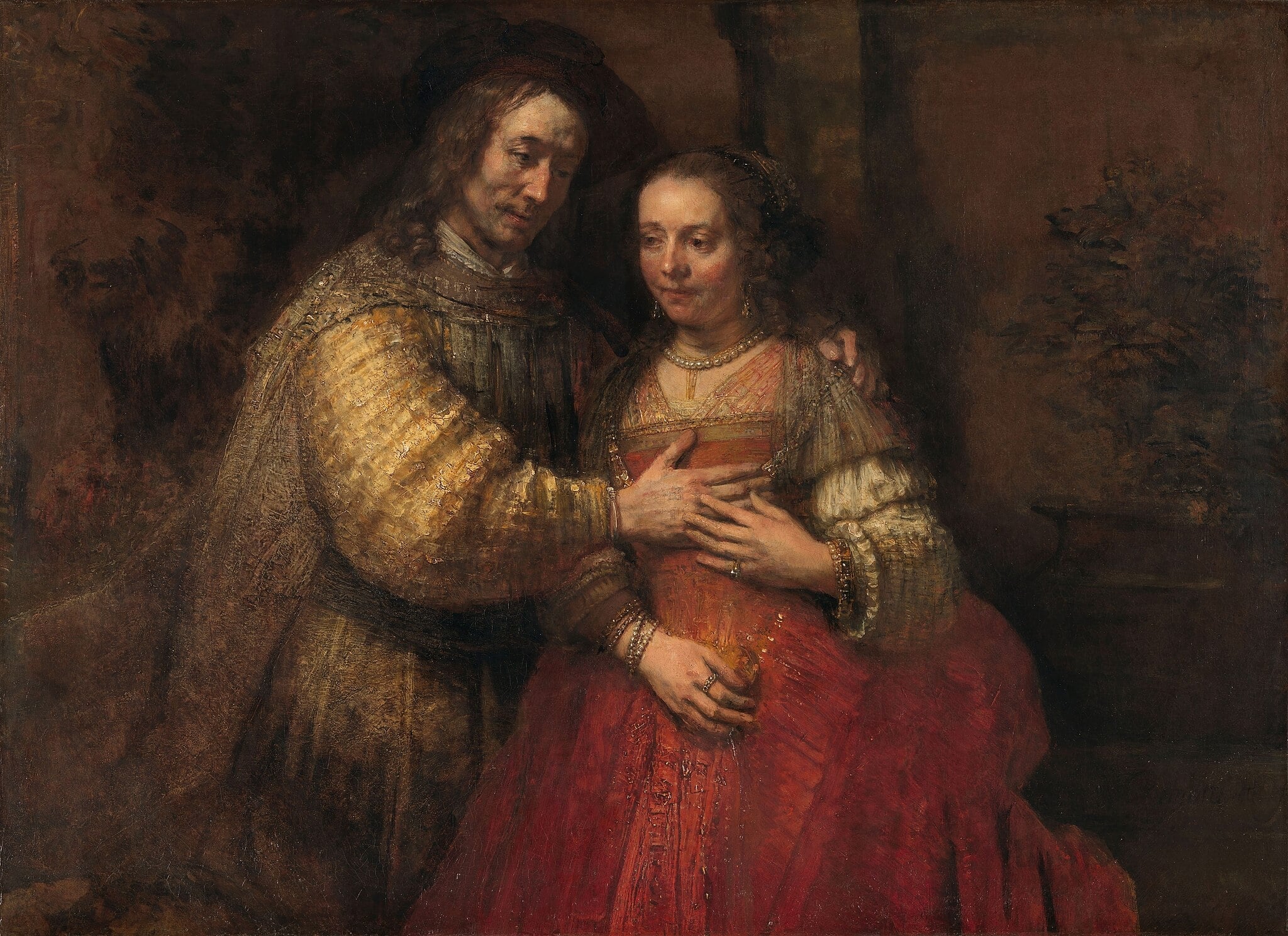
The Jewish Bride by Rembrandt van Rijn

The Jewish Bride

Rembrandt van Rijn (c. 1665–1669)

The Jewish Bride by Rembrandt van Rijn stages an intimate covenant: two figures, read today as <strong>Isaac and Rebecca</strong>, seal their union through touch rather than spectacle. Light concentrates on faces and hands, while the man’s glittering <strong>gold sleeve</strong> and the woman’s <strong>coral-red gown</strong> turn paint itself into a metaphor for fidelity and tenderness <sup>[1]</sup><sup>[3]</sup>. This late masterpiece embodies Rembrandt’s <strong>material eloquence</strong>—impasto as feeling—within a hushed, dark setting <sup>[1]</sup><sup>[2]</sup>.
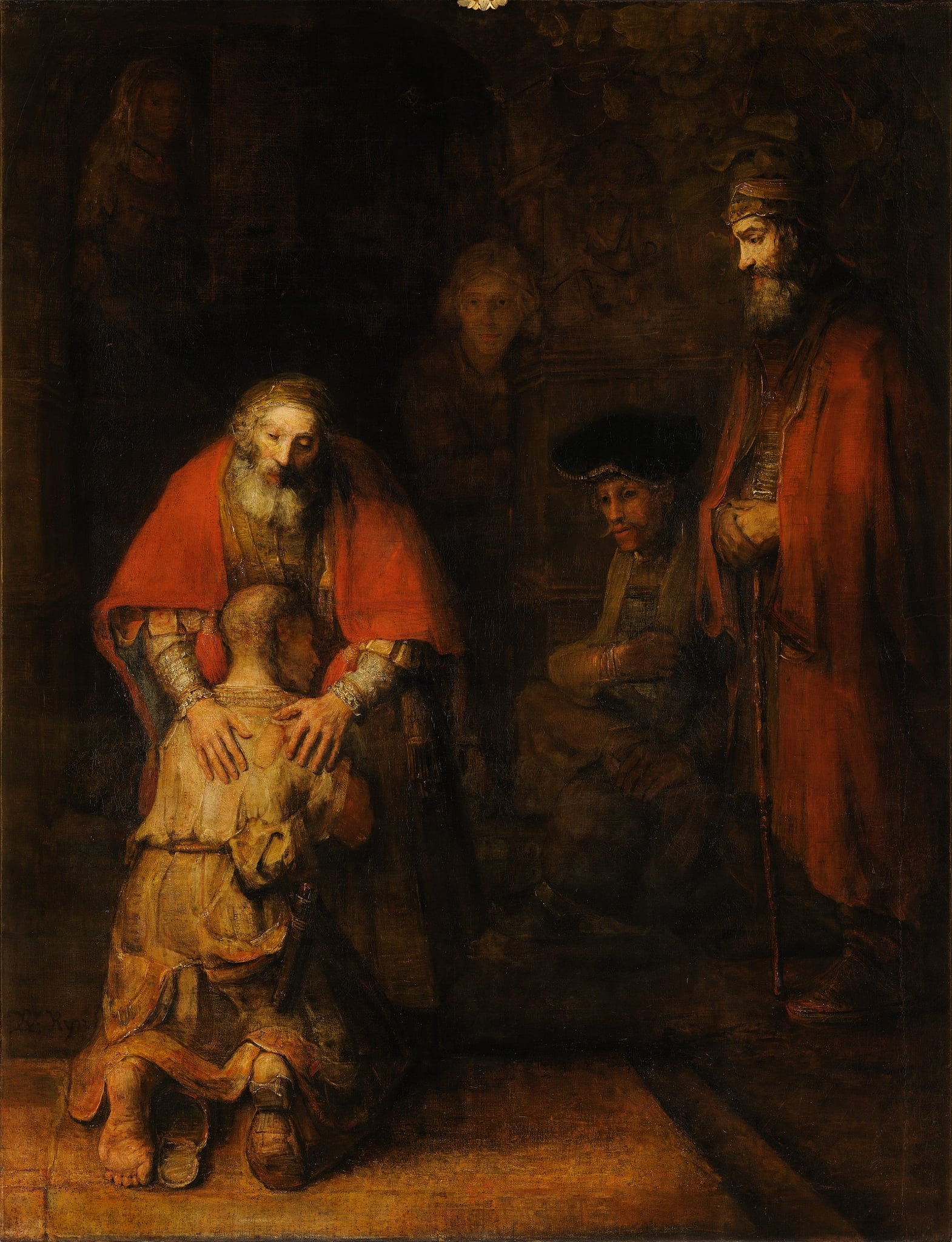
The Return of the Prodigal Son by Rembrandt van Rijn

The Return of the Prodigal Son

Rembrandt van Rijn (c. 1661–1669 (probably completed by 1669))

Rembrandt van Rijn’s The Return of the Prodigal Son is a late-life meditation on <strong>mercy</strong>, <strong>homecoming</strong>, and <strong>restored dignity</strong>. In a hush of dusk-like light, a ragged son kneels into his father’s <strong>embrace</strong>, while an upright elder brother holds back in shadow. The image concentrates meaning in illuminated <strong>faces, hands, and feet</strong>, turning a parable into a timeless human reckoning. <sup>[1]</sup><sup>[2]</sup>
The Sampling Officials of the Amsterdam Drapers’ Guild, Known as ‘The Syndics’ by Rembrandt van Rijn

The Sampling Officials of the Amsterdam Drapers’ Guild, Known as ‘The Syndics’

Rembrandt van Rijn (1662)

Rembrandt van Rijn’s The Sampling Officials of the Amsterdam Drapers’ Guild, Known as ‘The Syndics’ (1662) stages a <strong>meeting interrupted</strong>: six guild officials glance up from an open <strong>stalenboek</strong> (sample book) atop a sumptuous <strong>Oriental carpet</strong>, as if a merchant has just entered. The low vantage and unified yet varied poses convert routine inspection into a drama of <strong>civic authority</strong> and <strong>public accountability</strong> <sup>[1]</sup>.