Politics of Looking vs Ethics of Looking
Both painters rebuild the viewer’s role inside the picture. Velázquez turns a studio into court theater that notices us; Rembrandt moves meaning into faces and hands seen at close range. Side by side, they show how light, placement, and paint decide whether vision is a public protocol or an inward recognition.
Comparison frame: How does each artist reengineer the act of looking—Velázquez as a public protocol of power, Rembrandt as an intimate ethics of attention?
Quick Comparison
| Topic | Diego Velazquez | Rembrandt van Rijn |
|---|---|---|
| Core similarity | Turns seeing into the subject of the picture. | Turns seeing into the subject of the picture. |
| Viewer’s seat | You stand where the monarchs stand (Las Meninas). | You sit at the slab or within arm’s reach (Anatomy Lesson; late narratives). |
| Function of light | Grades rank and decorum; crowns the Infanta, governs protocol. | Selects persons and touch; verifies feeling and moral stakes. |
| Material rhetoric | Tonal unity, soft contours; coherence at distance—shared courtly air. | Impasto, scumble, incisions; paint as touch that slows the eye. |
| Stage and reference | Court studio with a mirror and cited canvases—vision aligned with rule. | Civic rooms and dark thresholds—vision aligned with conscience. |
| What looking secures | Authorization and representation. | Recognition, mercy, and lived knowledge. |
| Artist’s presence | Painter inside the scene, claiming noble rank (Las Meninas). | Self-portraits and inserted witnesses recruit us into the event. |
Shared Ground
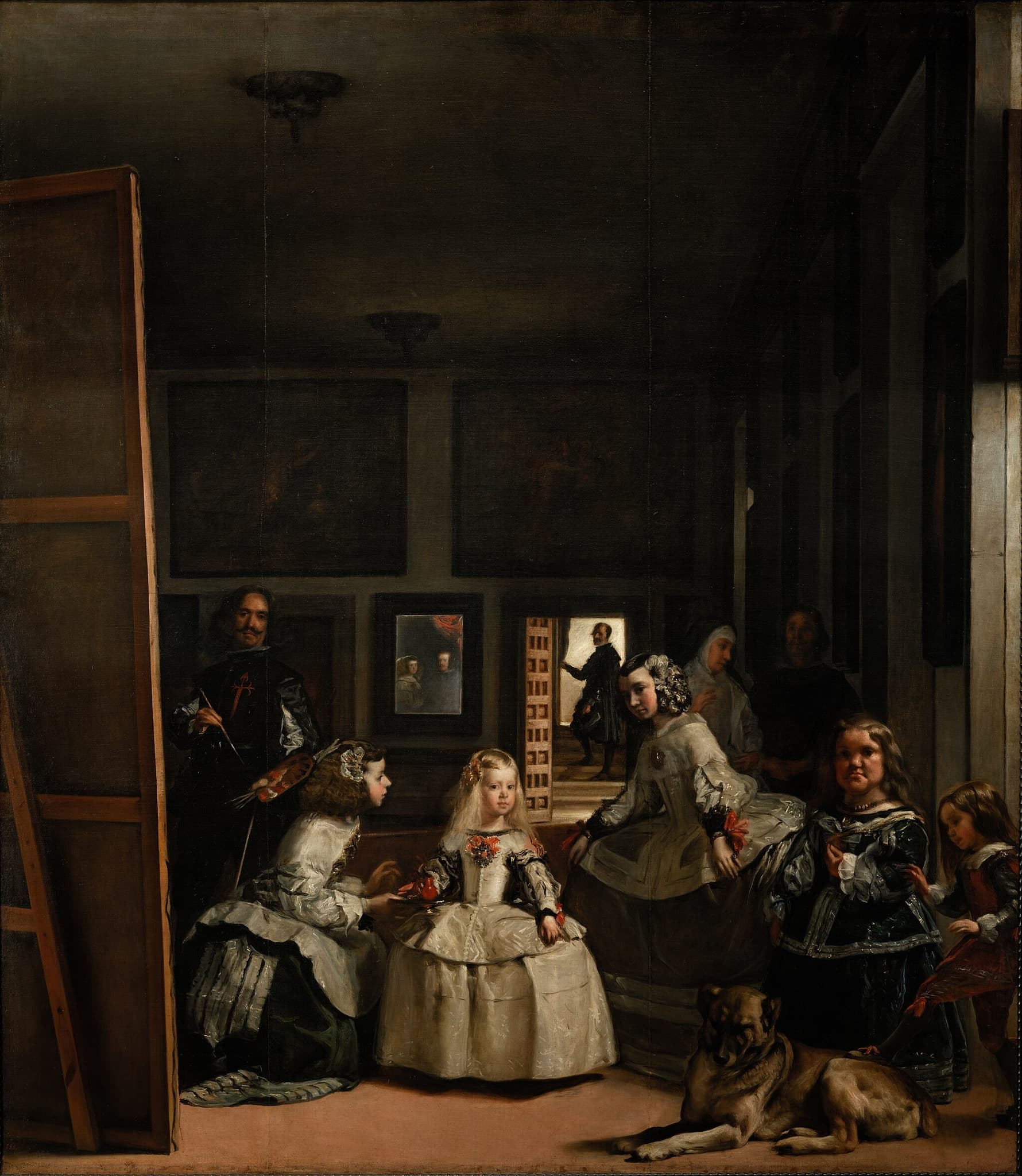
Velázquez and Rembrandt meet on essential ground: each remakes the viewer’s place inside the painting and treats light as an argument rather than a glow. In Velázquez’s Las Meninas, a mirror confirms that we occupy the monarchs’ station; the room orbits our position, as if the court and the painter recognize us. Rembrandt is just as conscripting, but his means are intimate: in The Anatomy Lesson of Dr. Nicolaes Tulp the table’s edge pushes into our space, and in late narratives we stand within the radius of faces and hands where decisions are felt.
Both artists let light carry meaning. Velázquez crowns the Infanta and grades the studio into hierarchical half-tones; Rembrandt concentrates beams on the sites of agency—hands, profiles, gestures—so that illumination names what matters. Each also turns painting into a form of thinking about seeing. Las Meninas maps a network of looks and a reflexive mirror; Rembrandt’s public lesson stages knowledge as it moves from book to body to mind, while late works distill recognition into close-lit silence.
What keeps them humane is their naturalism without theater. Velázquez dignifies courtiers and dwarfs with the same tonal tact; Rembrandt individualizes every face in civic or sacred scenes. Across long careers, both elevate painting’s status: Velázquez builds a courtly, intellectual image of the art; Rembrandt’s self-portraits and histories insist that painting is an instrument of inquiry and moral insight.
Decisive Difference
Where Velázquez makes seeing a public protocol, Rembrandt makes it an inward recognition. In Las Meninas, spectatorship is engineered as court theater: ranked attendants, a vanishing doorway, and above all the back-wall mirror fuse artist, sitters, and our vantage into a single apparatus. Who is allowed to see—and be seen—is the subject. Even the room cites other pictures on the back wall, aligning Habsburg taste with classical authority. Vision here is authorized, staged, and reciprocal with rule.
Rembrandt locates truth in ethically charged nearness. In the Anatomy Lesson, a didactic triangle—the cadaver’s arm, Tulp’s demonstrating hands, the open book—makes knowledge visible. In The Jewish Bride, light and touch crystallize a vow; in The Return of the Prodigal Son, mercy becomes legible where hands rest and faces glow. No mirror of sovereignty or courtly décor is needed: the meaning is verified by human presence at close range.
Their materials argue the point. Velázquez’s tonal economy sustains the fiction of shared courtly air; edges soften so authority appears natural. Rembrandt’s late paint is tactile—ridges, scumbles, even incisions—so the eye must linger where feeling resides. The result is two optics: an optics of authority that organizes space around rank and representation, and an optics of empathy that compresses space to the reach of touch and judgment.
Paired Works
Protocol vs demonstration
Focus question: How do these public pictures model the power—and limits—of looking?
Las Meninas vs The Anatomy Lesson of Dr. Nicolaes Tulp
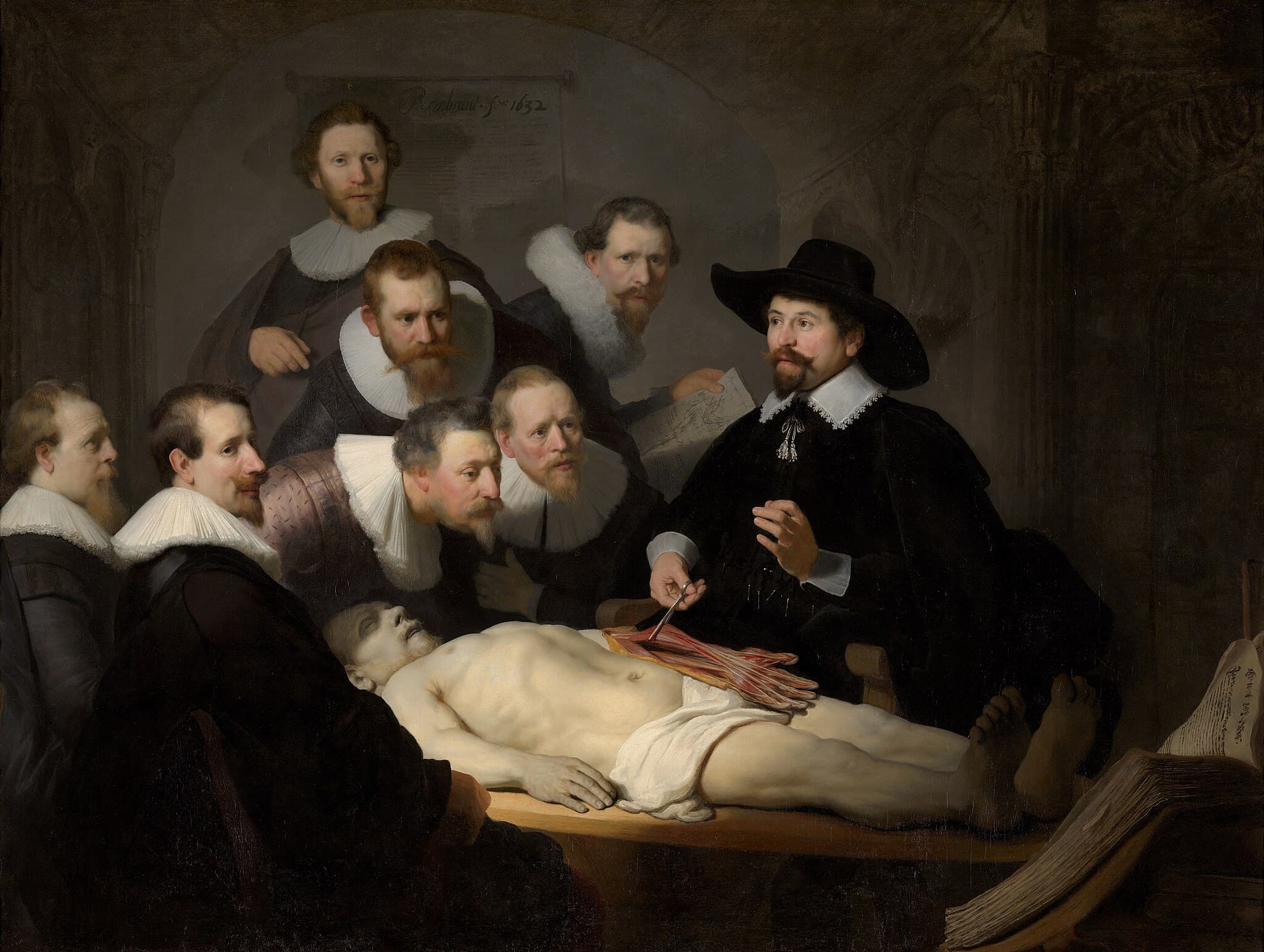
Las Meninas organizes attention around a sovereign mirror: our position, equated with the monarchs, activates the entire room. Light crowns the Infanta, a doorway fixes the vanishing axis, and the painter’s self-inclusion argues that representation itself is a court function. Seeing is a privilege that moves outward from rank. Rembrandt’s lesson answers with a different public: citizens and surgeons gathered around a cadaver while Dr. Tulp translates tendons into function. A tight beam binds the arm, Tulp’s demonstrating hands, and an open book—likely echoing Vesalius—so that knowledge passes from body to mind in front of us. The viewer’s seat shifts from the monarch’s apex to the witness at the slab; power is replaced by demonstration. Even sequence serves the point: the arm is dissected before the abdomen, elevating the hand as a sign of human agency. Both paintings recruit us, but Velázquez legitimizes a regime of looking, while Rembrandt builds a community of understanding.
Social seeing vs conjugal seeing
Focus question: What changes when the networked gaze of court becomes the pressure of two hands?
Las Meninas vs The Jewish Bride
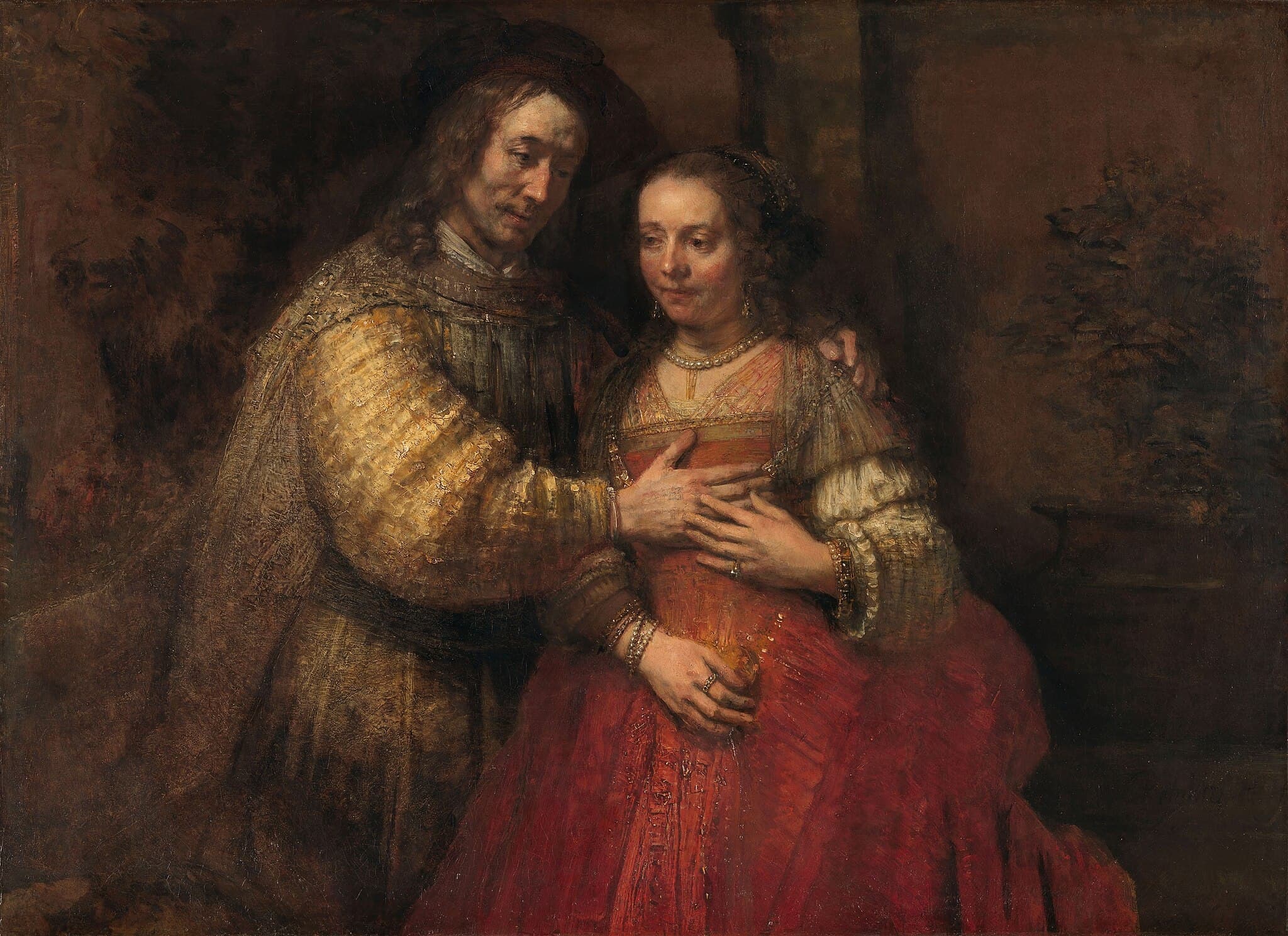
Velázquez calibrates a public choreography: attendants glance, a dwarf meets our eye, the painter pauses mid-stroke, and a mirror folds our presence into courtly protocol. The light that isolates the child-princess is also a code of rank. Rembrandt compresses the field until nothing remains but two bodies and the ethics of their touch. The man’s broad hand on the woman’s chest, answered by her measured hand over his, forms the painting’s center; faces and hands alone receive the blessing of light. Materially, the contrast is decisive: Velázquez’s tonal unity makes air and hierarchy feel seamless; Rembrandt’s impastoed gold sleeve and granular reds slow the eye into tactile attention, turning matter into tenderness. The viewer moves from a system of sanctioned visibility to a consent enacted at arm’s length. Where Las Meninas teaches how a court sees, The Jewish Bride teaches how a vow is felt.
Representation vs reconciliation
Focus question: How does each artist stage time and judgment within an interior?
Las Meninas vs The Return of the Prodigal Son
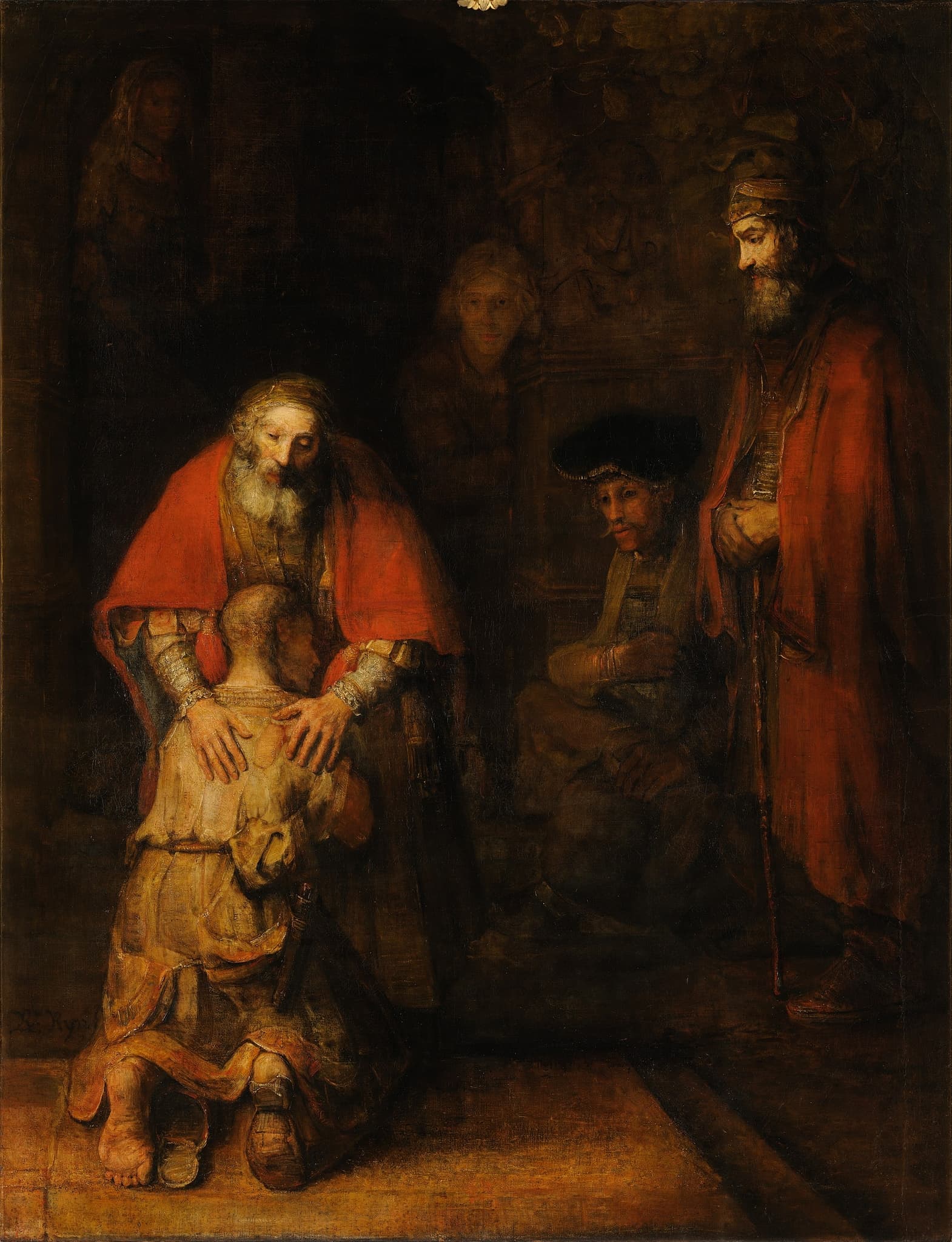
Las Meninas is time-filled: a doorway figure freezes mid-step, glances circulate, the painter halts his brush. The present tense belongs to representation itself—the picture knows we are here. Rembrandt answers with suspended time: a kneeling son leans into a father’s hands and the room goes quiet. Nothing competes with the embrace; even spectators hang back in shadow, their moral positions undecided. Light does different work. Velázquez grades it to naturalize etiquette and the nearness of power; Rembrandt restricts it to faces, hands, and worn shoes so that dignity is given back in a few lit facts. Material handling follows suit: Velázquez’s economy sustains shared air; Rembrandt’s softened edges and dense paint make compassion palpable. In Madrid, the interior validates the conditions of representation; in the late Amsterdam canvas, the interior becomes a threshold where judgment yields to mercy.
Why This Comparison Matters
Set together, Velázquez and Rembrandt show that painting is not only what is pictured but how attention is organized. Where you stand, what is lit, and how paint behaves decide what counts as truth. One system yokes sight to authority and makes representation itself a public act; the other compresses distance until light and touch test persons at close range. This axis—protocol versus empathy—clarifies why Las Meninas remains a touchstone for thinking about images and why Rembrandt’s late works still shape how we picture recognition, promise, and return. The comparison equips viewers to read other images, too: ask what seat the picture builds for you, what its light authorizes, and whether its matter invites participation or confirms display. Those questions travel well—from Baroque courts and Dutch civic rooms to contemporary screens—because they name the real subject: attention as a form of value.
Related Links
Sources
- Museo del Prado – Las Meninas collection entry
- Mauritshuis – The Anatomy Lesson of Dr. Nicolaes Tulp
- Rijksmuseum – The Jewish Bride (SK-C-216)
- State Hermitage Museum – The Return of the Prodigal Son
- National Gallery, London – Rembrandt in detail (late technique, impasto)
- Smarthistory – Rembrandt, The Anatomy Lesson of Dr. Tulp
- London Review of Books – Peter Campbell, At the National Gallery (Velázquez’s tonal unity)
- Museo del Prado – Apollo as Victor over Pan (back-wall identification in Las Meninas)
- Khan Academy – Velázquez, Las Meninas (Order of Santiago cross noted as later addition)
- Foucault, The Order of Things – opening chapter on Las Meninas