Self-Portrait

by Mary Cassatt

In Self-Portrait, Mary Cassatt presents a poised, modern woman angled diagonally across a striped chair, her gaze turned away in thoughtful reserve. A sage-olive ground and tight crop strip away setting, while the white dress flickers with lilacs and blues against a decisive red ribbon and floral bonnet. The image asserts professional selfhood through restraint, asymmetry, and broken color.[1]
💰

Market Value

$6-10 million

How much is Self-Portrait worth?

Fast Facts

Year
1878
Medium
Watercolor and gouache on wove paper laid down to buff wood-pulp paper
Dimensions
60 × 41.1 cm (23 5/8 × 16 3/16 in.)
Location
The Metropolitan Museum of Art, New York
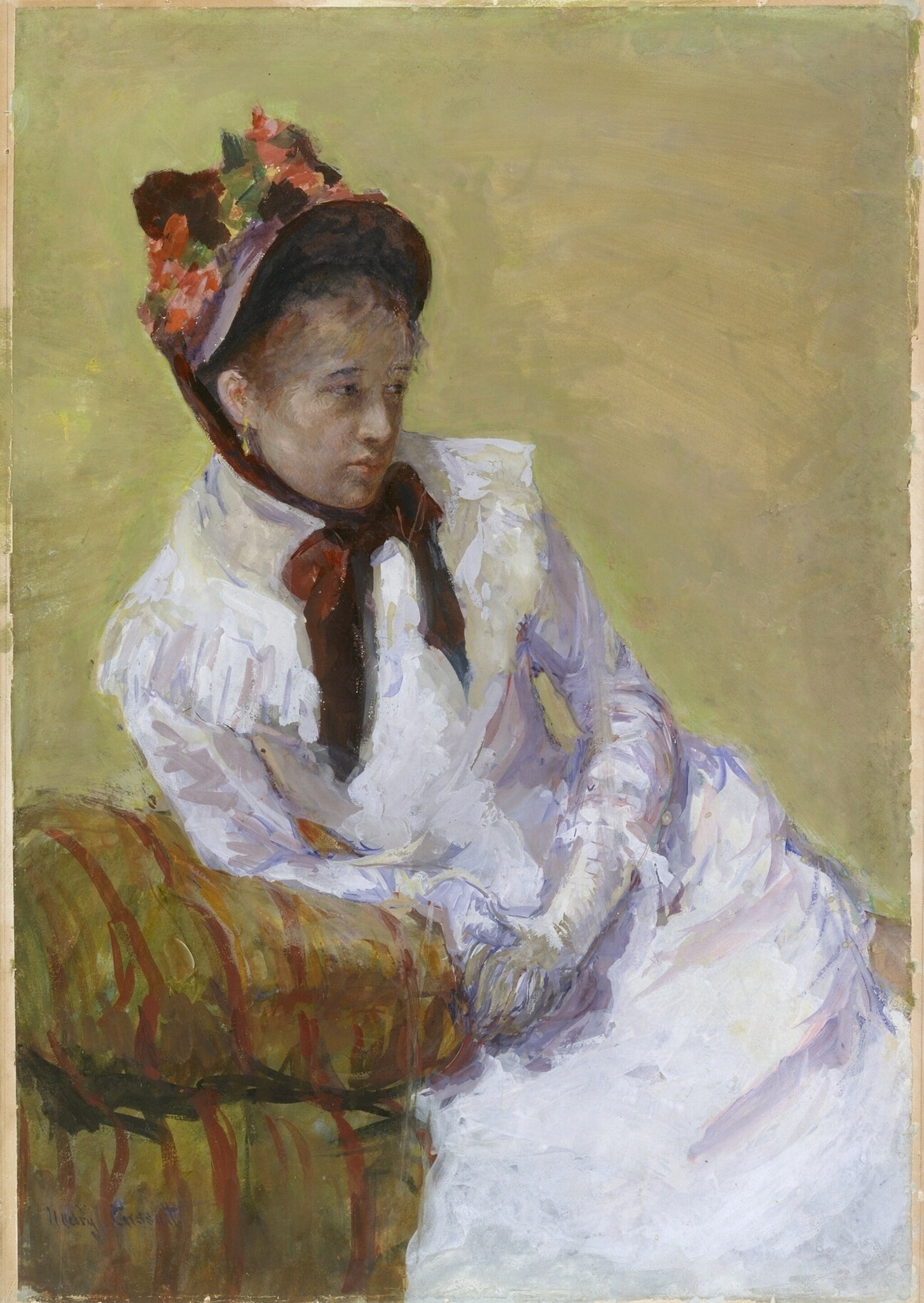
Self-Portrait by Mary Cassatt (1878)

Click on any numbered symbol to learn more about its meaning

Meaning & Symbolism

Cassatt composes Self-Portrait as a measured act of self-fashioning. The sitter’s body drives diagonally across the striped upholstery, a dynamic thrust that both animates and restrains the figure; the hands interlock tightly at the lap, countering the forward lean with guarded poise. This quiet tension between tilt and clasp stages presence and privacy at once. The sage-olive ground, stripped of depth or incident, refuses anecdote and centers cognition—her slightly averted gaze reads as appraisal rather than retreat. In the high-chroma red neck ribbon and the bonnet’s floral notes, Cassatt sets warm accents against the cooling whites of the dress and the green field, a complementary play the Met links to her exchange with Degas.1 But she deploys color not for prettiness; she uses it to sharpen attention at the head and throat, the sites of voice and thought. The white dress, worked in rapid, luminous strokes of lilac and blue, announces virtuosity in water-based media while dissolving conventional finish—labor made visible as touch rather than gloss.14 Attire becomes language. The bonnet and gloves declare propriety, the expected costume for a woman in public, yet here they read as protective framing: they ring-fence the face and seal the hands, signaling boundaries around the artist’s interiority.3 That boundary-making is strategic. Cassatt’s asymmetrical, cropped composition declines the centered, declarative claim of many male self-portraits; instead, she chooses a modern angle that insists on subjectivity without spectacle. The viewer is invited to recognize a professional at work, not through props of the studio, but through compositional intelligence—cropping, diagonal rhythm, and the energetic facture of the dress and chair. The striped upholstery echoes the brushwork’s tempo, binding body and ground in a single modern cadence; it also anchors the diagonal so the off-to-right gaze does not drift into vagueness but into intention. In this way, the picture inverts the usual dynamic of feminine display: fashion is present, yet subordinated to inference, thought, and artistic method. Historically, the timing is pointed. Painted the year after Degas’s invitation and just before her first Impressionist exhibition, Self-Portrait operates as a public declaration of membership in an avant-garde while remaining legible to polite society.12 That doubleness anticipates Cassatt’s wider project: images of modern women whose social decorum shelters intellectual and creative agency. In recent reassessments, curators emphasize Cassatt’s rigor and labor; this sheet materializes that case—gouache and watercolor built in brisk, decisive layers, a modern palette keyed to perception, and a pose that converts social restraint into self-command.4 The result is not a confession but a proposition: a woman artist can claim authority without abandoning respectability. Self-Portrait thus matters as a model of how form, color, and comportment can encode autonomy, making the refined silhouette carry the weight of ambition.134

Explore Deeper with AI

Ask questions about Self-Portrait

Popular questions:

Powered by AI • Get instant insights about this artwork

💬 Ask questions about this artwork!

Interpretations

Symbolic Reading: Fashion as Armor

In Cassatt, hats and gloves often do more than glitter; they carve out psychological privacy within public‑facing decorum. Here the bonnet frames the intellect while gloves seal the hands—the very instruments of agency—turning adornment into protective framing rather than flirtation. Princeton curators have read similar bonnets and gloves in her work as signaling ambiguous publicness that safeguards inner life. In this self‑portrait, that grammar becomes autobiographical: attire rings‑fences face and labor, asserting boundaries around a woman artist’s thought and work even as she steps before the viewer. Fashion functions as a tactical screen—visibility without surrender 13.

Source: Princeton University Art Museum; The Metropolitan Museum of Art

Historical Context: Membership and Markets

Painted just after Degas’s 1877 invitation and before Cassatt’s 1879 Impressionist debut, the portrait acts as a public credential for entry into a radical cohort while staying readable to polite society. That double address mattered in a Paris art world stratified by gender and class: Cassatt was an American in France, courting exhibition visibility and cultivating patrons such as Louisine Elder (Havemeyer), who acquired the sheet by 1879 and later helped deposit Impressionism in U.S. museums. The self‑portrait thus mediates between avant‑garde identity and bourgeois collecting networks, demonstrating how women artists navigated institutions and tastemaking to secure professional standing 156.

Source: The Metropolitan Museum of Art; Encyclopaedia Britannica; Philadelphia Museum of Art

Formal Analysis: Diagonal Authority

Cassatt builds authority through the pose’s asymmetry and the green, flattened ground that clips away anecdote; the diagonal drive of torso and chair sets up a controlled instability resolved by the interlocked hands. The result is neither coy nor theatrical but a modern calibration of stance, akin to Degas’s lessons in complementary contrasts (sage vs. red) and daring crop. Color concentrates at head and ribbon to stage cognition and voice, while the striping of the upholstery echoes the brushwork’s tempo, welding figure to setting as a single, contemporary rhythm. This formal system asserts selfhood without recourse to studio props—the composition itself is the credential of professionalism 1.

Source: The Metropolitan Museum of Art

Medium/Process: Water‑Based Virtuosity

Gouache interlocks with watercolor to toggle opacity and translucency, making process legible—wet‑into‑wet veils in the white dress counter shot accents at the ribbon and bonnet. The sheet’s quick, “unfinished” look is a choice, not a lack: a challenge to Salon finish aligned with Impressionist speed and perception. Recent scholarship reframes Cassatt’s oeuvre around work and technique, emphasizing how facture communicates intention; critics note how this exhibitionary emphasis on labor clarifies, rather than romanticizes, her method. In this portrait, medium becomes message: authorship is argued in touch, not gloss 167.

Source: The Metropolitan Museum of Art; Philadelphia Museum of Art; The Guardian

Gender Politics: Reserved Gaze, Assertive Role

Cassatt’s averted or sideways gaze reads as appraisal, not retreat—a tactic echoed in her c. 1880 self‑portrait, where she withholds the working surface, reversing the looker/ looked‑at dynamic. Across both images, she declines frontal bravura yet directs attention to the head and throat—the sites of thought and voice—arguing that a woman can exercise artistic authority within respectable codes. This is not capitulation but strategy: an agentive reserve that inverts feminine display by subordinating fashion to inference and composition. The result is a portrait of authorship calibrated to the era’s gendered constraints yet unmistakably self‑possessed 124.

Source: The Metropolitan Museum of Art; Smithsonian National Portrait Gallery; Google Arts & Culture (NPG)

Related Themes

About Mary Cassatt

Mary Cassatt (1844–1926) was an American painter who settled in Paris, exhibited with the Impressionists, and became a key conduit for introducing their art to U.S. collectors. After 1890 she adopted japoniste flatness, bold patterning, and strong design, focusing on modern women’s lives—especially mother‑and‑child subjects—until failing eyesight curtailed her work by 1914 [4].
View all works by Mary Cassatt

More by Mary Cassatt

Woman in Black at the Opera by Mary Cassatt

Woman in Black at the Opera

Mary Cassatt (1878)

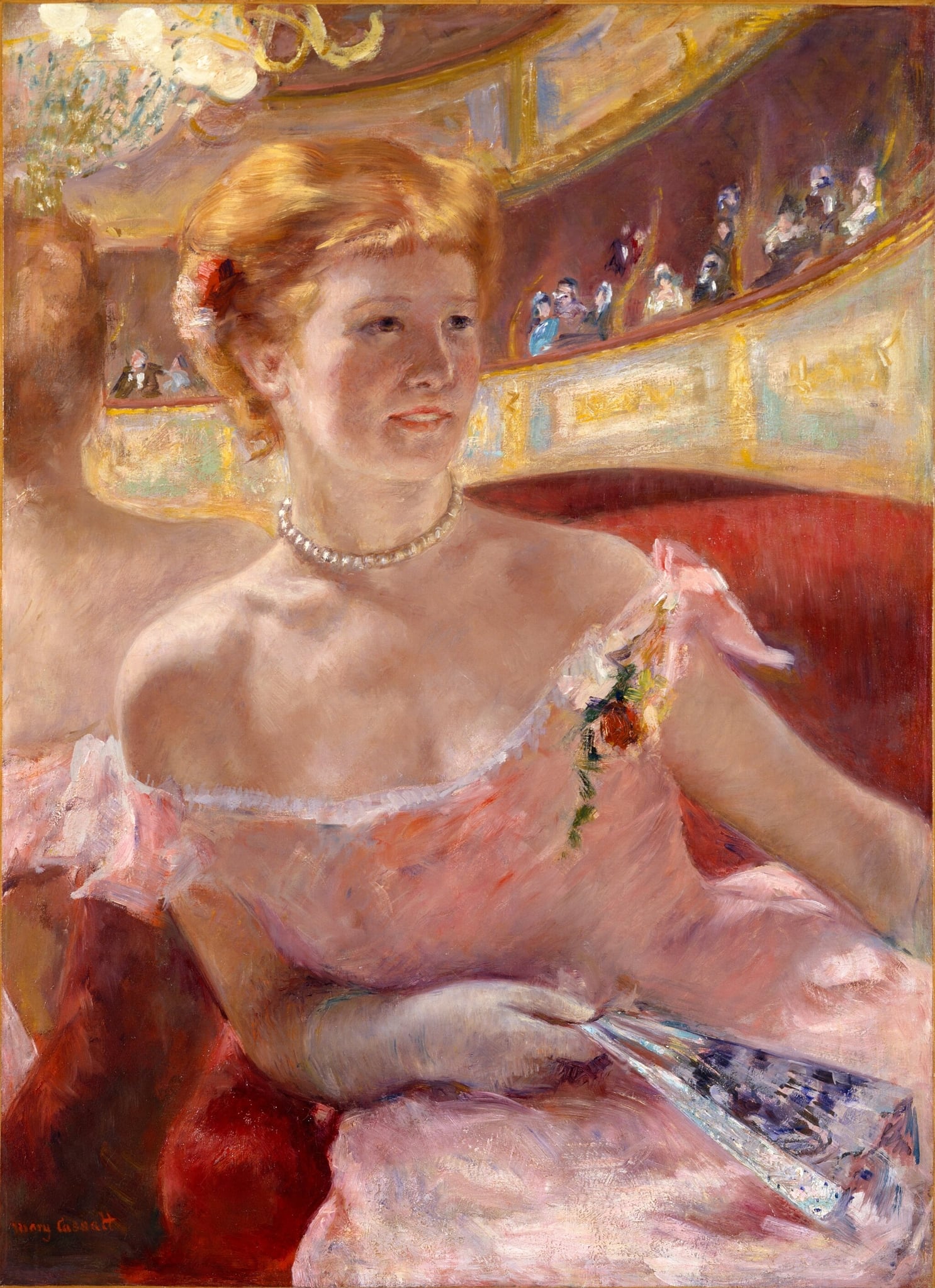
Mary Cassatt’s Woman in Black at the Opera stages a taut drama of vision and visibility. A woman in <strong>black attire</strong> raises <strong>opera glasses</strong> while a distant man aims his own at her, setting off a chain of looks that makes public leisure a site of <strong>power, agency, and surveillance</strong> <sup>[1]</sup><sup>[2]</sup>.

The Tea by Mary Cassatt

The Tea

Mary Cassatt (about 1880)

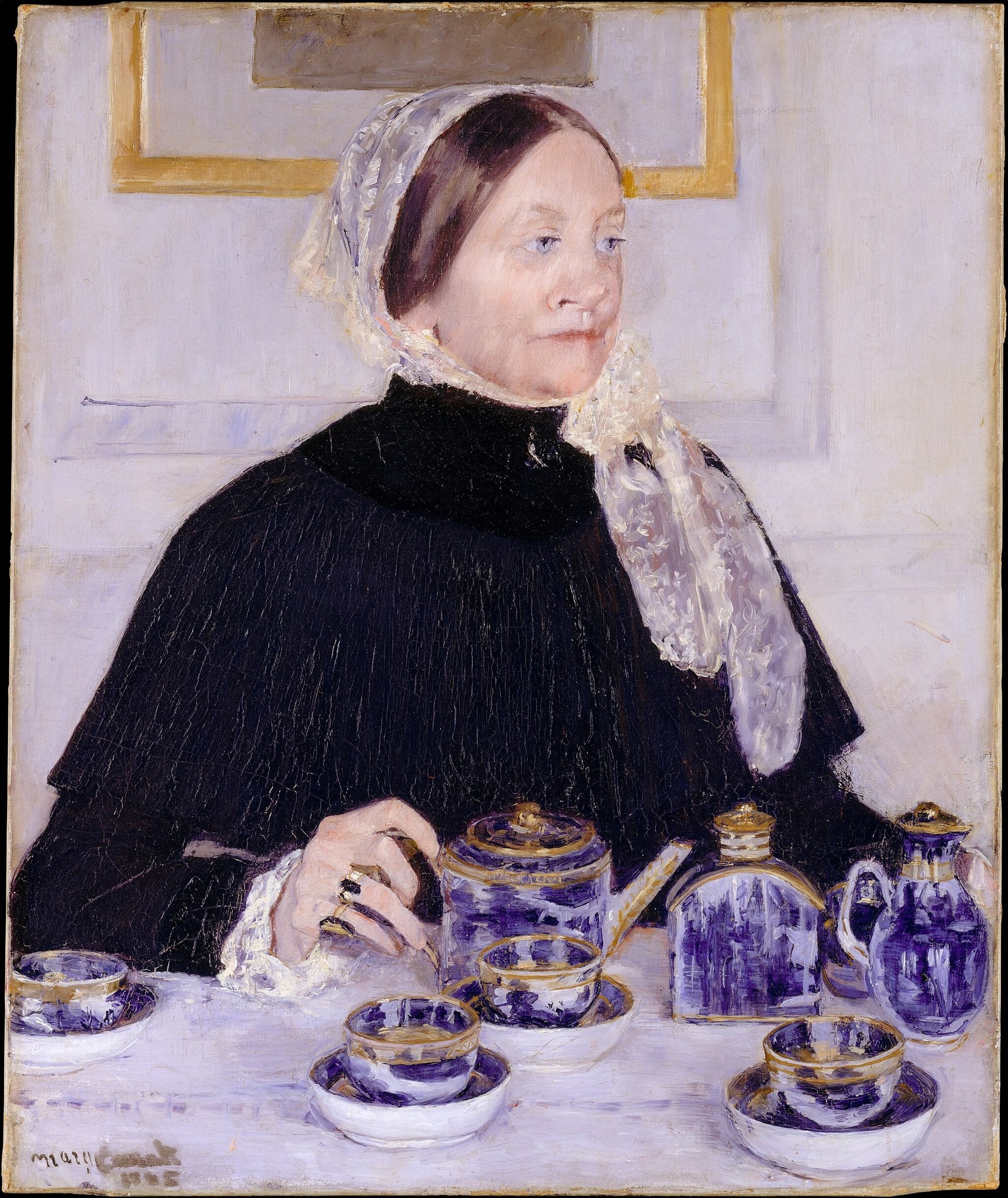
Mary Cassatt’s The Tea stages a poised, interior <strong>drama of manners</strong>: two women sit close yet feel apart, one thoughtful, the other raising a cup that <strong>veils her face</strong>. A gleaming, oversized <strong>silver tea service</strong> commands the foreground, its reflections turning ritual objects into actors in the scene <sup>[1]</sup>. The shallow, cropped room—striped wall, gilt mirror, marble mantel—compresses the atmosphere into <strong>intimacy edged by restraint</strong>.

Little Girl in a Big Straw Hat and a Pinafore by Mary Cassatt

Little Girl in a Big Straw Hat and a Pinafore

Mary Cassatt (c. 1886)

Mary Cassatt’s Little Girl in a Big Straw Hat and a Pinafore distills childhood into a quiet drama of <strong>interiority</strong> and <strong>constraint</strong>. The oversized straw hat and plain pinafore bracket a flushed face, downcast eyes, and <strong>clasped hands</strong>, turning a simple pose into a study of modern self‑consciousness <sup>[1]</sup>. Cassatt’s cool grays and swift, luminous strokes make mood—not costume—the subject.

Breakfast in Bed by Mary Cassatt

Breakfast in Bed

Mary Cassatt (1897)

Breakfast in Bed distills a <strong>tender modern intimacy</strong> into a tightly cropped sanctuary of rumpled white linens, protective embrace, and interrupted routine. Mary Cassatt uses <strong>cool light</strong> against <strong>warm flesh</strong> to anchor attention on the mother’s encircling arm and the child’s outward gaze, fusing care, curiosity, and the rhythms of <strong>everyday modern life</strong> <sup>[1]</sup><sup>[2]</sup>.

Young Mother Sewing by Mary Cassatt

Young Mother Sewing

Mary Cassatt (1900)

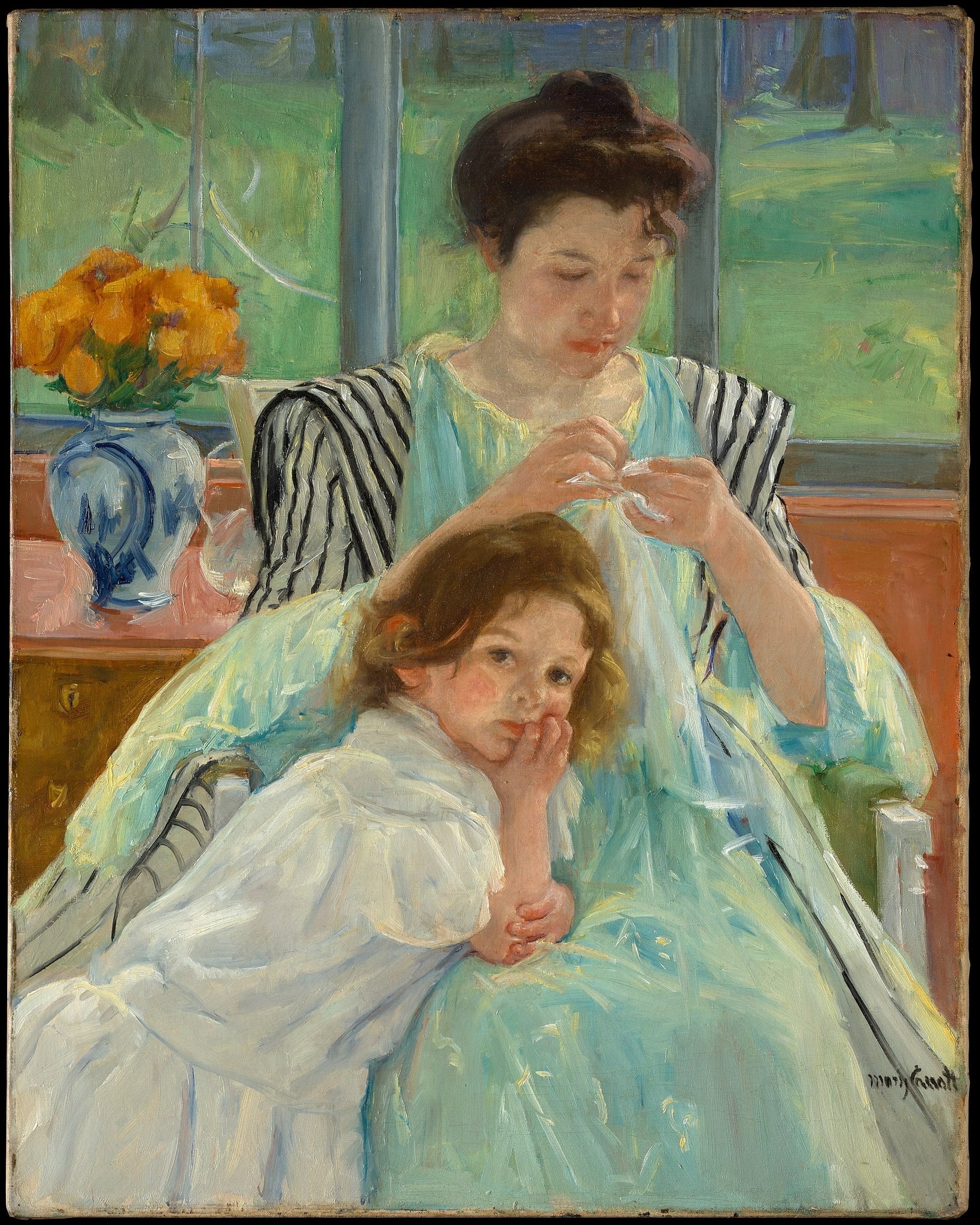
Mary Cassatt’s Young Mother Sewing centers the quiet <strong>labor of care</strong>: a mother steadies pale fabric while a child in white leans into her, eyes meeting ours. Cool <strong>greens and blues</strong> bathe the figures as striped sleeves and chair arms rhythmically return attention to the mother’s working hands, while a burst of <strong>orange blossoms</strong> by the window anchors interior life against the world outside <sup>[1]</sup>.
Children Playing on the Beach by Mary Cassatt

Children Playing on the Beach

Mary Cassatt (1884)

In Children Playing on the Beach, Mary Cassatt brings the viewer down to a child’s eye level, granting everyday play the weight of <strong>serious, self-contained work</strong>. The cool horizon and tiny boats open onto <strong>modern space and possibility</strong>, while the cropped, tilted foreground seals us inside the children’s focused world <sup>[1]</sup>.