The Red Studio
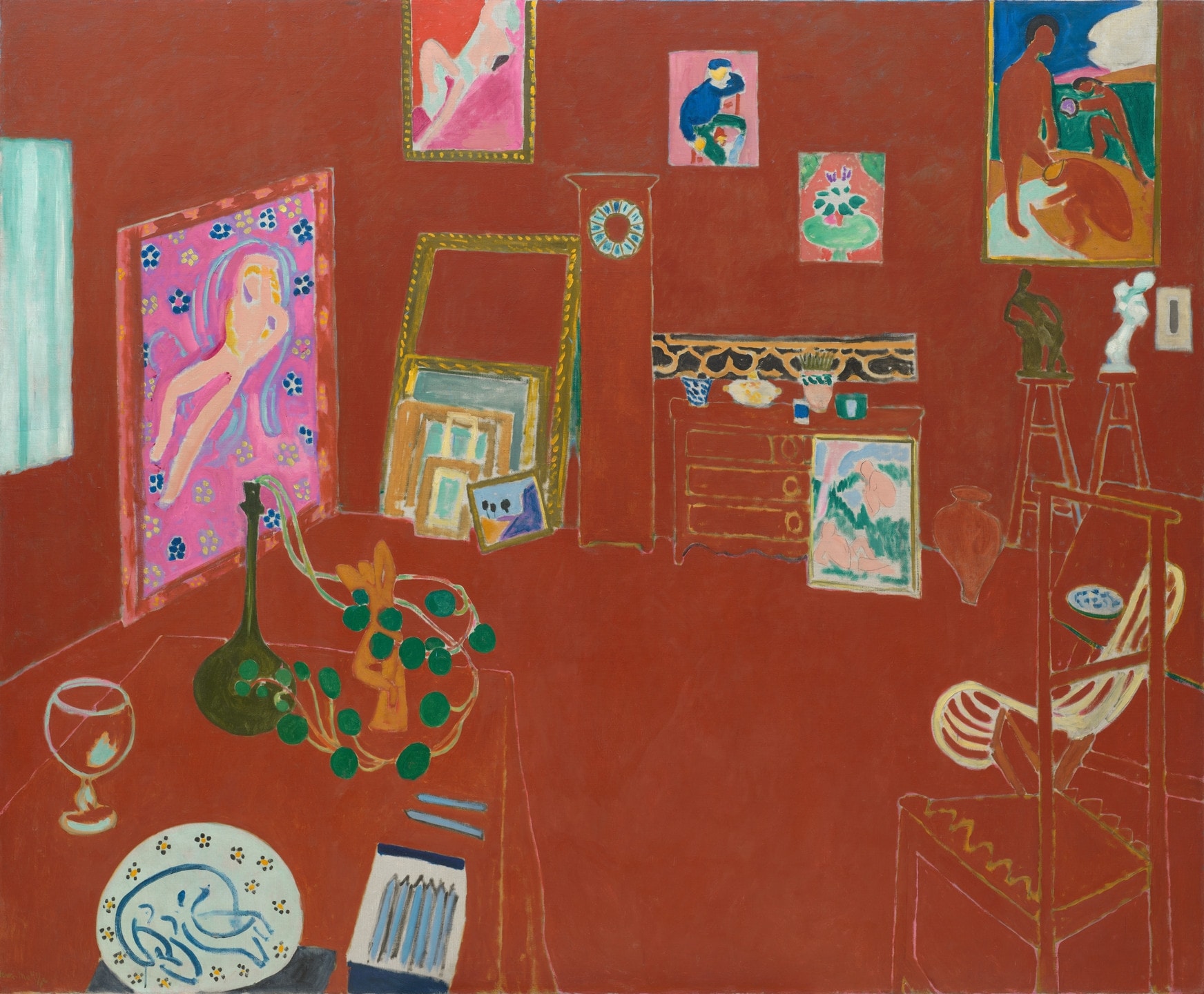
Henri Matisse’s The Red Studio (1911) saturates the artist’s workspace in a continuous field of Venetian red, collapsing walls, floor, and furniture into a single chromatic plane. Objects and architecture appear as mustard-yellow reserve lines that read like drawing, while Matisse’s own paintings and sculptures retain full color, asserting art’s primacy within the room [1][2][3]. The result is a studio that feels like a mental map rather than a literal interior.
Study Print Studio
Create a personal study print
Build a companion study sheet around the part of this painting that speaks to you most. Choose a detail, shape an interpretation, and walk away with something personal and display-worthy.
Fast Facts
- Year
- 1911
- Medium
- Oil on canvas
- Dimensions
- 181 x 219.1 cm
Click on any numbered symbol to learn more about its meaning
Meaning & Symbolism
Matisse builds The Red Studio by first resolving a conventional interior and then decisively flooding it with Venetian red, leaving slim, unpainted edges to stand as the room’s drawn skeleton—table rim, chair rungs, easel legs, doorjambs, the molding across the back wall. Technical analysis shows these “lines” are reserves, not added outlines, which is why the furniture seems to hover rather than sit in space 3. That spectral quality peers out everywhere in the image you’re viewing: the cane chair at right exists mainly as a ribbed silhouette; the chest of drawers becomes a red block laced by yellow seams; the easel is a ghostly frame leaning against an equally dematerialized wall. By contrast, the artworks inside the artwork refuse dissolution. The pink reclining nude at left, the bright green cyclamen near center‑right, the blue‑green seascape in the upper right corner—each retains saturated, individuated color. Even small studio accents puncture the red field: the green bottle and draped vine on the foreground table, the white plate painted with a blue figure, the three grey‑blue crayons beside the open box. These color islands establish a rhythm that replaces perspectival recession with decorative cadence, turning the studio into a flat yet pulsing score of beats and pauses 12.
Matisse encodes temporality and authorship directly into this chromatic world. The grandfather clock on the back wall shows a face without hands, nullifying ordinary time and asserting that creativity follows its own measure; the pale, luminous window at far left promises daylight yet does not cast conventional shadows, reinforcing the sense of an interior released from natural law 25. Most tellingly, the artist’s body is absent, but the act of making is present in surrogates: the open box of crayons and the angled, empty frame on the floor function as self‑portrait in absentia. Meanwhile, the nested paintings and sculptures document Matisse’s recent production with surprising fidelity to their original palettes, even as everything else yields to red. Conservation confirms this paradox was engineered late: the red was laid over a dried, polychrome composition, effectively declaring color as the agent that remakes space and hierarchy 3. In this declaration lies the work’s influence. The plane of undifferentiated red anticipates later explorations of the all‑over field and the emotive power of near‑monochrome—a lineage often traced forward to color‑field painters who studied this canvas closely after it entered MoMA 4. Yet The Red Studio is not an abstract color experiment stripped of narrative. It is a manifesto of artistic life, where furniture becomes line, time stops, and finished works shine back at their maker like sentient companions. That is why The Red Studio is important: it transforms a studio from a container of things into a visible state of mind, articulating a modern belief that color can both construct reality and reveal the artist’s inner order 1245.
Explore Deeper with AI
Ask questions about The Red Studio
Popular questions:
Powered by AI • Get instant insights about this artwork
💬 Ask questions about this artwork!
Interpretations
Patronage and Autonomy (Historical Context)
Commissioned by Sergei Shchukin but ultimately rejected, The Red Studio dramatizes a moment when avant‑garde aesthetics exceeded a major patron’s expectations. Shchukin’s preference for figuration confronted Matisse’s radical, near‑monochrome interior, exposing the friction between market taste and artistic experiment. The painting’s early bafflement at the 1912 Grafton Galleries and the 1913 Armory Show further registers its dissonance with prevailing norms. Paradoxically, MoMA’s 1949 acquisition turned that rejection into canonization, making the work a pilgrimage object for later painters. This arc—commission, refusal, ridicule, and institutional embrace—charts a classic path of modernist autonomy, where innovation first alienates then reshapes reception and value 52.
Source: Washington Post (Sebastian Smee); MoMA exhibition page
Conservation as Interpretation (Technical Study)
Multispectral imaging shows that Matisse built a multicolored interior and then imposed a late veil of Venetian red, leaving thin “reserve” gaps as lines. Rather than drawing contours, he withheld paint to let underlayers articulate tables, chair rungs, and architectural seams—explaining why forms seem to hover. XRF mapping also confirms that the embedded artworks maintain notable fidelity to their original pigments, even as everything else sinks into red. This double move—precision color‑translation for quoted works, radical flattening for the room—creates a hierarchy of attention engineered at the level of materials and sequence, not merely style. Conservation thus reveals the painting as a choreographed process artwork, where making is the message 32.
Source: npj Heritage Science (MoMA/SMK team); MoMA exhibition materials
Genealogy and Influence (Modernism to Color‑Field)
After MoMA acquired the canvas in 1949, artists like Mark Rothko studied its chromatic audacity closely. The Red Studio’s all‑over field, suppression of modeling, and emotive saturation presage mid‑century color‑field painting, yet without abandoning figuration entirely. Its lesson is not monochrome for its own sake, but color as a structuring principle capable of reorganizing space, time, and hierarchy. This inheritance travels from Matisse’s decorative flatness to later painters’ immersive veils of color, suggesting a lineage of affective fields rather than strict formal descent. In this view, The Red Studio functions as a hinge between post‑Fauvist decor and the spiritualized color planes of postwar abstraction 412.
Source: Britannica (The Red Studio); MoMA object/exhibition pages
The Studio as Self‑Archive (Medium Reflexivity)
By nesting his own paintings, sculptures, and a ceramic within the scene—often matching their original palettes—Matisse turns the studio into a reflexive archive of practice. This is not merely decoration: it’s a curatorial essay in paint about how artworks relate to one another and to the labor that produced them. The carefully transcribed color of the quoted works contrasts with the red‑saturated environment, asserting the autonomy of art within the artist’s domain. Reuniting these objects in the 2022 exhibition made clear that The Red Studio performs as a compact, visual catalogue raisonné in embryo, where selection, placement, and chromatic fidelity become claims about authorship and legacy 23.
Source: MoMA exhibition (Temkin/Aagesen); npj Heritage Science
Paradoxical Space and the Viewer (Formal Analysis)
Building on early formal readings, critics note Matisse’s elevated viewpoint and the room’s contradictory cues: flatness from the red field versus spatial hints from reserve lines and object overlaps. Furniture dematerializes into linear scaffolds while the nested works insist on chromatic presence, flipping the hierarchy of studio life: art over furnishing. The handless clock intensifies spatial indeterminacy by suspending temporal anchors, and the pale window withholds cast shadows that would map depth. The result is an elastic perceptual field that invites the viewer to oscillate between planarity and projection, sensation and structure—a dialectic that keeps the studio vivid yet fundamentally unstable 762.
Source: Artnet News (summarizing Reiff); Hyperallergic; MoMA exhibition page
Seen in Comparisons
Related Themes
About Henri Matisse
Henri Matisse pivoted around 1904–06 from Divisionist touch to high‑key, liberated color, consolidating this language during the 1905 summer in Collioure and unveiling it to scandal at the Salon d’Automne. His pursuit of color as an autonomous vehicle for structure and feeling became a cornerstone of modern art [2][3].
View all works by Henri Matisse →