At the Moulin Rouge
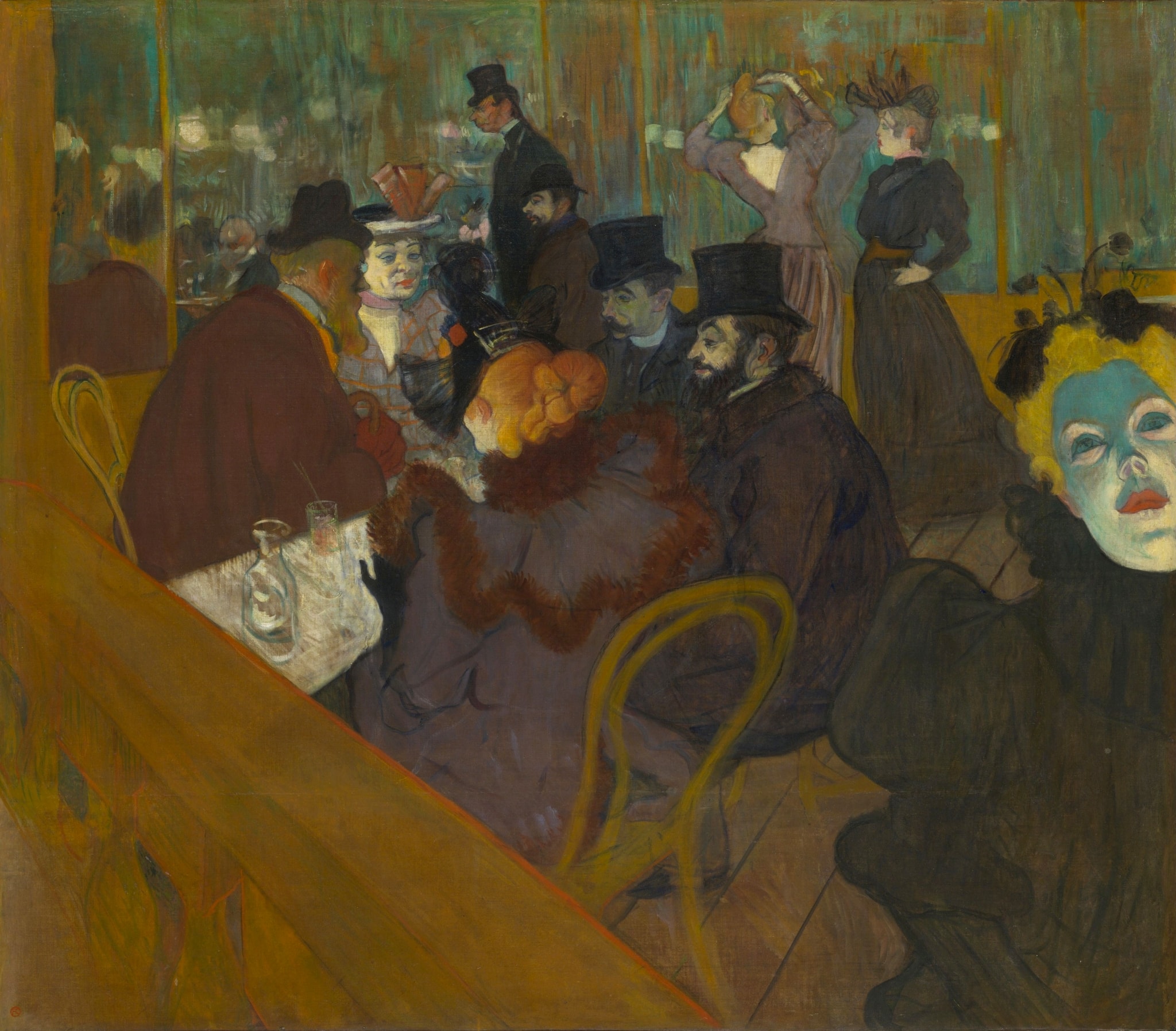
At the Moulin Rouge plunges us into the churn of Paris nightlife, staging a crowded room where spectacle and fatigue coexist. A diagonal banister and abrupt croppings create off‑kilter immediacy, while harsh artificial light turns faces masklike and cool. Mirrors multiply the crowd, amplifying a mood of allure tinged with urban alienation [1][3][4].
Study Print Studio
Create a personal study print
Build a companion study sheet around the part of this painting that speaks to you most. Choose a detail, shape an interpretation, and walk away with something personal and display-worthy.
Fast Facts
- Year
- 1892–1895
- Medium
- Oil on canvas
- Dimensions
- 123 × 141 cm
- Location
- Art Institute of Chicago, Chicago
Click on any numbered symbol to learn more about its meaning
Meaning & Symbolism
Lautrec orchestrates the scene so that our entry is uneasy from the first glance. The diagonal banister in the foreground both invites and blocks us, a barrier that declares we are observers, not participants. Inside the room, a cluster of figures hunches around a table strewn with glasses and a carafe; their bodies touch, but their attention drifts, and glances skid past one another rather than connect. At the right edge, a green-blue, spotlighted face—cool, powdered, almost masklike—tilts toward us, so near it seems cropped by a camera’s viewfinder. That chromatic shock is not an eccentric flourish; it records the brutal cast of artificial night light on stage makeup, a fact that converts color into social critique: beauty as surface, glare as exposure, performance as a kind of self-erasure. Along the back wall, mirrors double and triple the crowd, transforming the cabaret into an echo chamber of bodies without easy contact. The composition’s abrasions—oblique angles, sudden cut-offs, and a teetering vantage—translate the jostle of the room into form, echoing strategies associated with Degas, photography, and Japanese prints 134.
Color does the ethical work here. Acidic greens and oranges flare against muddy browns, staging a push-pull between attraction and decay. The brilliant hats and fur collars dissolve into a haze of smoke and reflections, while faces blanch toward pallor under gas and electric lamps. The result is neither simple condemnation nor romance; it is a ledger of costs. Pleasure requires performance, and performance extracts a toll—the weariness visible in rounded shoulders at the table, the self-absorption of figures fixing hair before the mirror, the cool separation even within a crush of bodies. By anchoring us in a vantage that feels half-hidden and half-stumbled-into, the painting enlists our looking in the very voyeurism it scrutinizes. We are complicit, and that complicity is the point: modern entertainment industries thrive on eyes that consume. Even the picture’s material history intensifies this theme; the right-hand section was once cut away and later reattached, a literal fragmentation and suturing that rhymes with the work’s fractured optics and the commerce of nightlife imagery 1.
This is modernity rendered as theater of surfaces, yet it avoids caricature by acknowledging the fragile humanity of its players. The table’s loose semicircle suggests camaraderie that cannot quite coalesce; the mirrored room promises infinite company but delivers repetition without deep contact. In compressing these contradictions—closeness and isolation, glamour and fatigue—At the Moulin Rouge achieves a diagnostic clarity about fin‑de‑siècle urban life. Its pictorial devices are not mere style; they are arguments about how late‑19th‑century Paris felt when seen through electric light: unstable, spectacular, and psychologically estranging. That is why the painting endures as a touchstone of modern urban vision and as a model for using composition, color, and light to think socially as well as aesthetically 134.
Explore Deeper with AI
Ask questions about At the Moulin Rouge
Popular questions:
Powered by AI • Get instant insights about this artwork
💬 Ask questions about this artwork!
Interpretations
Technologies of Night: Electric Light as Subject
Rather than mere ambience, artificial light becomes a protagonist. The acid green cast on May Milton’s face records the chromatic distortions of gas and early electric illumination striking stage makeup, pushing descriptive color toward a social critique of spectacle’s physiological violence. Faces blanch, oranges flare, and shadows compress, creating a visual ecology in which perception itself feels unreliable. Lautrec translates these technologies into form—cropped edges, oblique diagonals, and a foreground barrier that mimic the sensory jolt of nighttime interiors. In effect, the painting is an experiment in modern optics: how surfaces behave under glare, how eyes wander in smoke, how color carries ethical charge. It demonstrates that modernity is not just what is depicted but how it is sensed—uneven, saturated, and estranging 12.
Source: Art Institute of Chicago; Smarthistory
Performance as Labor: The Cost of Entertainment
The canvas reads the cabaret not as escapist fun but as a theater of work. Performers preen in mirrors; regulars slouch in a posture of fatigued consumption; even the artist inserts himself as a participant-observer in the nightlife economy. By aligning fashion, cosmetics, and bodily display with commodified leisure, Lautrec tallies the toll extracted by nightly spectacle—what the picture’s own rhetoric calls a “ledger of costs.” The weariness of rounded shoulders and sliding glances marks affective depletion, while the table’s near‑camaraderie registers a solidarity that never fully coheres. This is a sociology of nightlife rendered in paint, attentive to the gendered and classed labor underpinning pleasure and its circulation as image in fin‑de‑siècle Paris 13.
Source: Art Institute of Chicago; The Metropolitan Museum of Art
Mirror Logic: Multiplication and the Fractured Self
The back‑wall mirror does more than enlarge space; it multiplies personae. Figures repeat, truncate, and drift, producing a cabinet of echoes where identities are built for viewing and split by reflection. This mise‑en‑abyme of bodies suggests that modern urban subjectivity is serial and performative: the self as an aggregate of appearances under lights, glimpsed at angles, never fully possessed. The mirror also converts intimacy into spectacle—private gestures become public display—while the diagonal banister keeps us complicit yet apart, a position of voyeuristic distance. In this reading, Lautrec’s cabaret is a laboratory of modern identity construction, where replication becomes a condition of being seen 23.
Source: Smarthistory; The Metropolitan Museum of Art
Cross-Media Modernism: From Degas to Posters and Photography
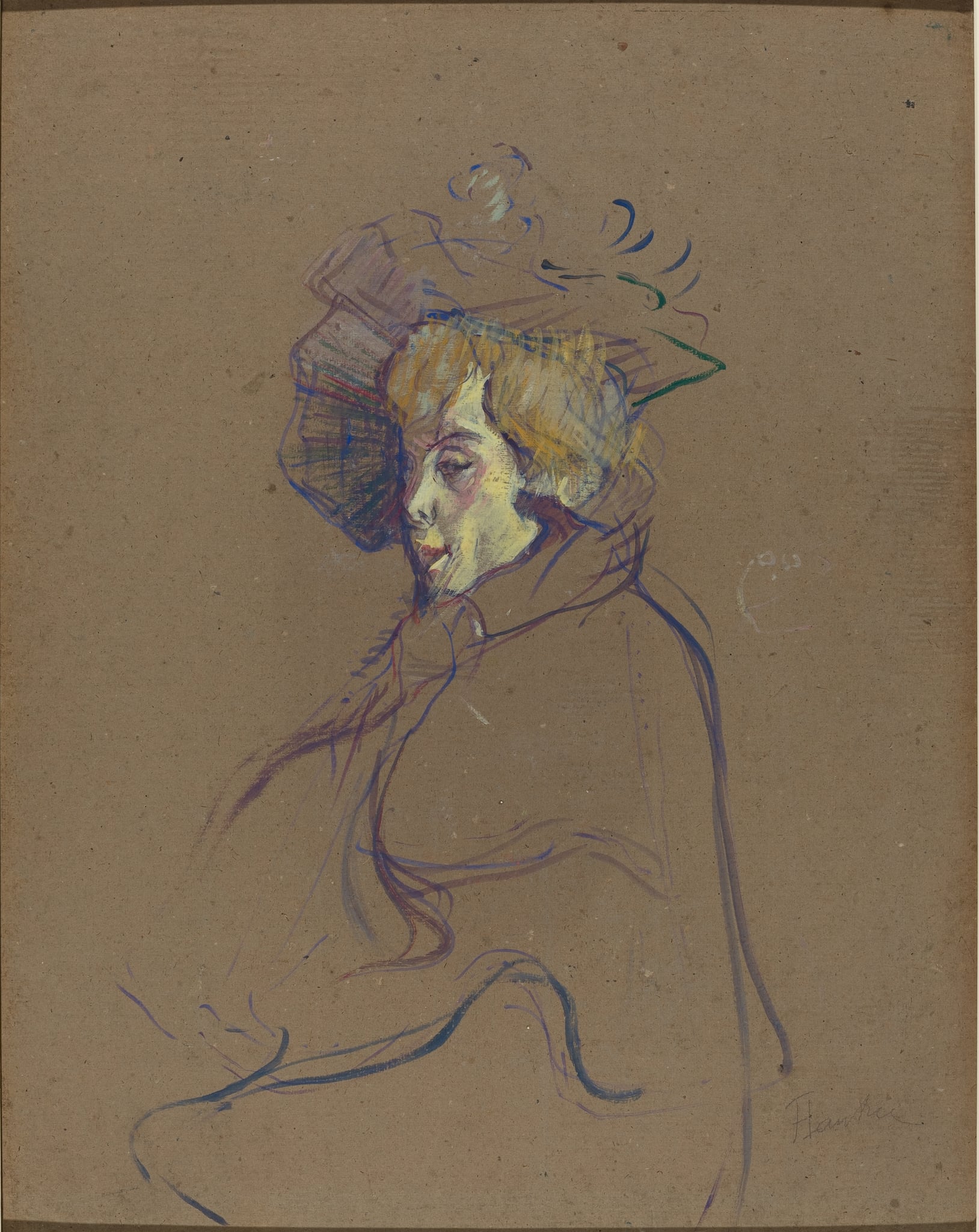
Lautrec fuses the radical cropping of Degas, the snapshot asymmetry of photography, and the flat, silhouette logic of Japonisme with his own poster-maker’s eye. The result is a painterly space that feels printed—contours punchy, colors high‑key, edges abruptly cut—anticipating the graphic immediacy of his lithographic posters and importing their commercial visuality back into oil. This cross‑pollination is not stylistic garnish; it frames nightlife as an image industry, where people are designed to be seen. The green-lit profile at right resonates with Lautrec’s separate poster of May Milton, a reminder that performers circulate across media as branded figures, and that painting, too, can be a site of publicity and critique 24.
Source: Smarthistory; Cleveland Museum of Art (May Milton poster)
Cut Canvas, Cut Social World: Material History as Meaning
The painting’s right-hand section—containing the shocking, green profile—was once cut away and later reattached, a physical rupture that mirrors the composition’s own abrupt framings and social disconnections. This surgical history literalizes the work’s themes: fragmentation, commodification, and the reassembly of nightlife into saleable parts. By suturing the piece back together, the object carries its own biography of market pressures and curatorial repair, echoing how the cabaret recombines bodies, looks, and roles each night. The result heightens the painting’s meta-commentary on viewing: we enter as complicit observers, our gaze both consuming and stitching meaning across an image with a history of being severed and restored 15.
Source: Art Institute of Chicago; The Guardian (Jonathan Jones)
Related Themes
About Henri de Toulouse-Lautrec
Henri de Toulouse-Lautrec (1864–1901) was a French Post‑Impressionist who immersed himself in Montmartre’s cabarets, fusing avant‑garde composition with commercial lithography. His work distilled the spectacle and strain of modern nightlife, shaping how the Belle Époque was seen then and remembered now [2][3].
View all works by Henri de Toulouse-Lautrec →