Nighthawks
Study Print Studio
Create a personal study print
Build a companion study sheet around the part of this painting that speaks to you most. Choose a detail, shape an interpretation, and walk away with something personal and display-worthy.
Fast Facts
- Year
- 1942
- Medium
- Oil on canvas
- Dimensions
- 84.1 × 152.4 cm
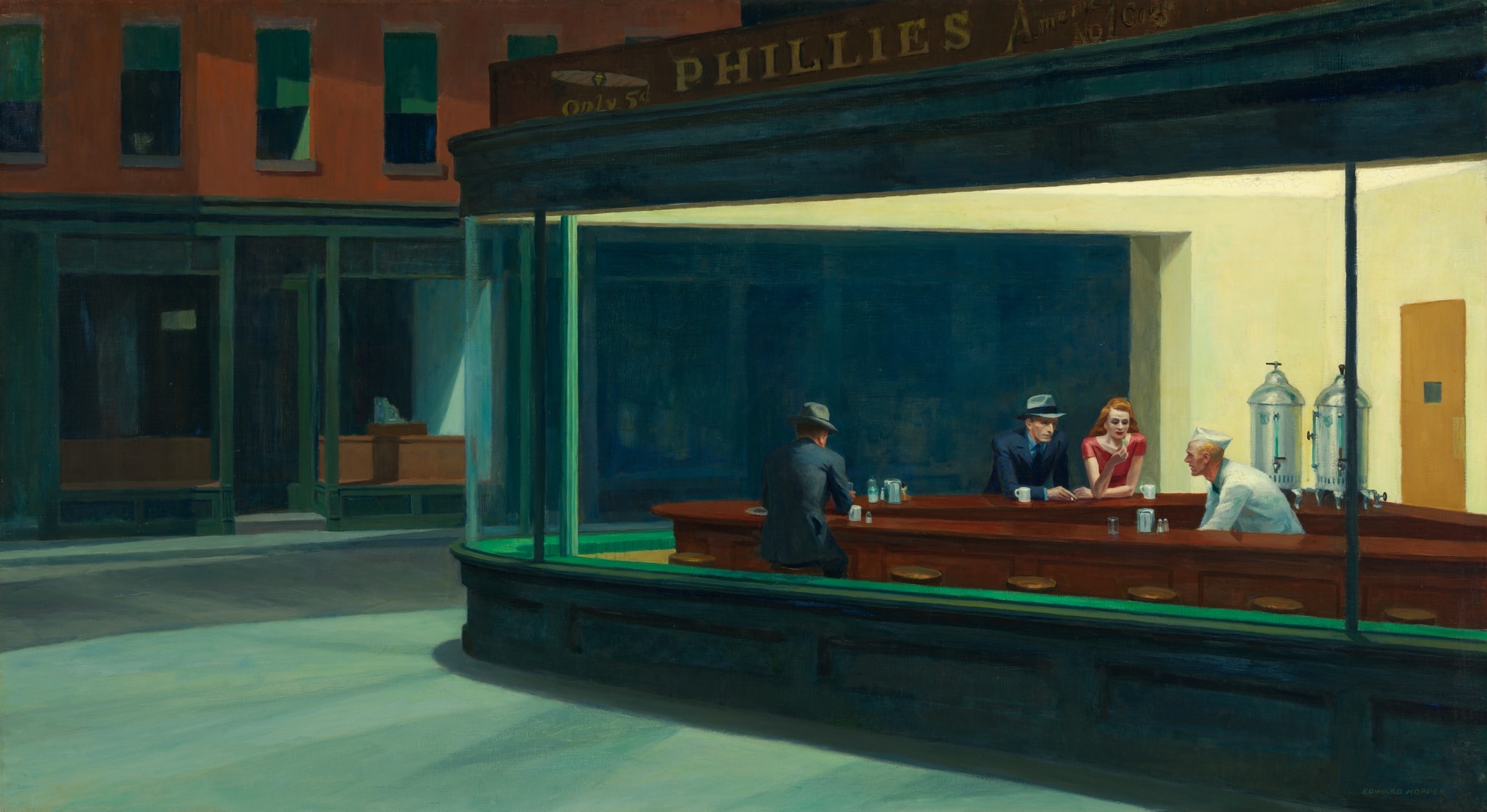
Click on any numbered symbol to learn more about its meaning
Meaning & Symbolism
Explore Deeper with AI
Ask questions about Nighthawks
Popular questions:
Powered by AI • Get instant insights about this artwork
Interpretations
Historical Context
Source: Art Institute of Chicago (Oehler)
Cinematic/Noir Lens
Source: Art Institute of Chicago
Literary Intertext
Source: Art Institute of Chicago
Process & Constructed Realism
Source: Whitney Museum of American Art; Art Institute of Chicago; Gail Levin (via Christie’s)
Urban Semiotics of Advertising
Source: PBS American Masters; Art Institute of Chicago
Spectatorship & the Ethics of Looking
Source: Art Institute of Chicago
Explore Specific Elements
Dive deeper into individual scenes and details within Nighthawks.
The Couple at the Counter
Hopper’s couple at the counter—her red blouse blazing under fluorescent light, his steel-gray hat tilted over a cool blue shirt—sits close yet remains apart. Modeled by Jo Hopper and, via mirror studies, Edward himself, they crystallize Nighthawks’ tension between urban proximity and private isolation, while hinting at fragile community within the wartime night.
The Lone Man
Hopper’s ‘lone man’—the hat-brimmed patron with his back to us—turns anonymity into a dramatic device. He anchors the left edge of Nighthawks while converting the viewer into a watcher outside the glass, a modern urban Rückenfigur whose silence carries the painting’s charge of projection and distance.
The Empty Street
Hopper’s “Empty Street” in Nighthawks is a deliberately voided city corner—no door, no pedestrians, no cars—where darkness itself becomes the subject. This evacuated exterior turns the diner’s fluorescent glow into a beacon and fixes the viewer outside, transforming urban night into a stage for suspense and modern solitude.
The Diner's Green Glow
The diner’s greenish fluorescence is the drama of Nighthawks: a hard, modern light that floods the counter, seals the glass, and leaves the street in shadow. At once clinical and inviting, this glow stages the figures as if on a set—signaling 1942 modernity while holding viewers at a cool remove.