The Lone Man in Nighthawks
A closer look at this element in Edward Hopper's 1942 masterpiece
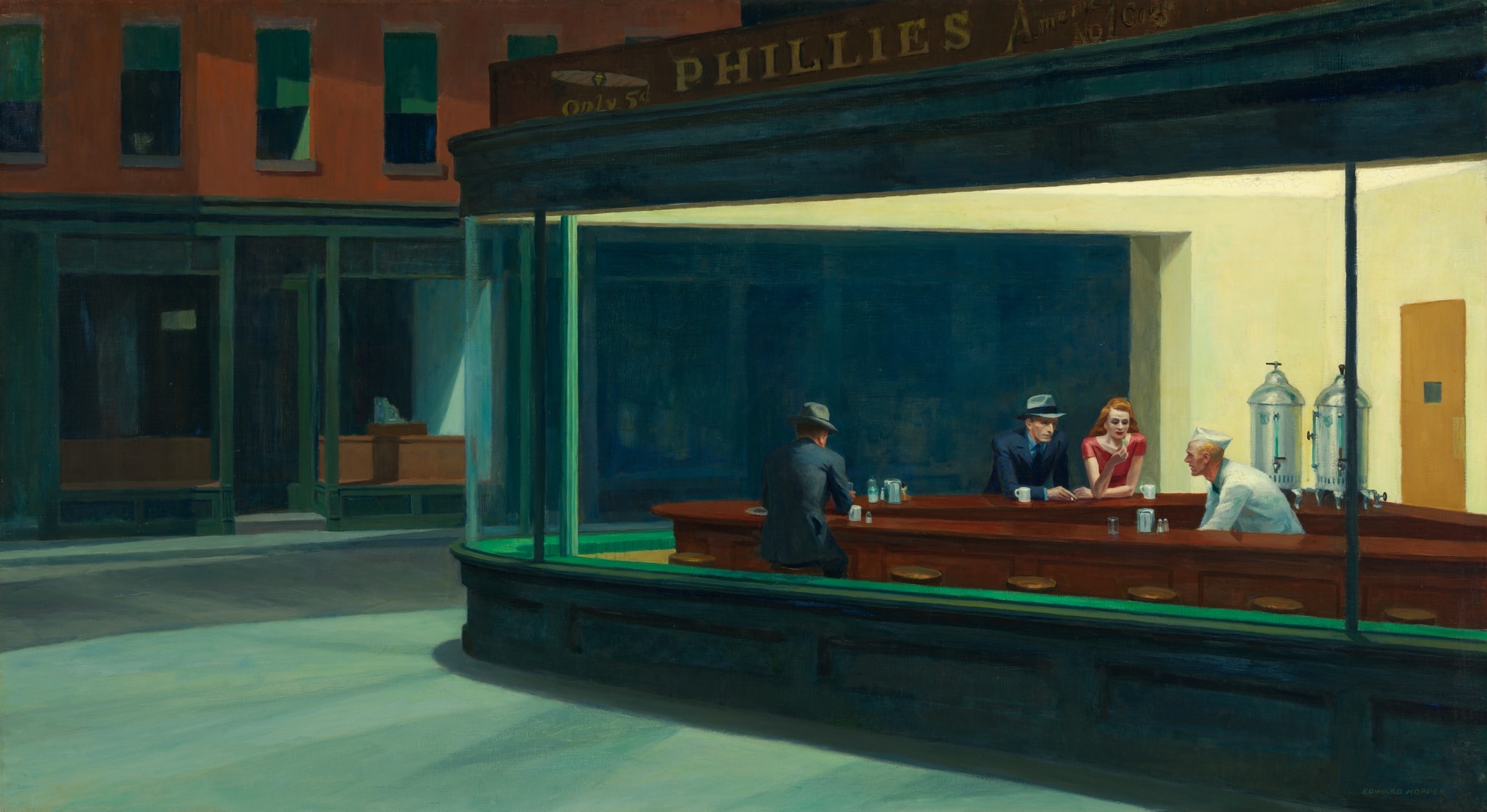
Hopper’s ‘lone man’—the hat-brimmed patron with his back to us—turns anonymity into a dramatic device. He anchors the left edge of Nighthawks while converting the viewer into a watcher outside the glass, a modern urban Rückenfigur whose silence carries the painting’s charge of projection and distance.
Historical Context
Edward Hopper finished Nighthawks on January 21, 1942, in the anxious early weeks after Pearl Harbor. Scholars consistently read the painting’s emptied streets and taut quiet as a home-front mood of separation, intensified by our placement outside a sealed, glowing diner 41.
The leftmost figure emerged through sustained trial. Early studies cast him as a belted policeman; Hopper stripped away the uniform and recast him as a nondescript city man, shifting the character from social role to urban everyman 53. Jo Hopper noted that Edward posed for the two men, making the back-turned body likely self-modeled while remaining resolutely generic 8.
Hopper also staged new technology and city form. He worked through the diner’s harsh fluorescent light and the acute glass corner in drawings; museum commentary links those choices to how we view the scene across unbroken plate glass 21. The corner-lot geometry, so typical of Manhattan, lets Hopper park a back-viewed anchor at the left to meet our gaze before it hits the diner’s blinding wedge of light 4.
Symbolic Meaning
Seen from behind, the man withholds his face and, with it, psychology. Hopper activates a long art-historical device—the Rückenfigur—that invites us to look with the figure while denying entry. In Nighthawks the tradition migrates from romantic landscape to a fluorescent, nocturnal interior, heightening the modernity of the effect 91. The plate glass and the absent visible door make that barrier literal 4.
The back view turns the patron into our proxy: he sits in light yet remains unreadable. Carter E. Foster emphasizes that Hopper’s pictures solicit projection and resist simple loneliness tags; the faceless man functions as the canvas’s most elastic screen for that projection 7.
Smarthistory describes a network of urban ‘near misses,’ where gazes and gestures never quite connect; the lone man consummates that structure by facing neither us nor the couple, embodying detachment rather than merely illustrating it 4.
Robert M. Coates’s classic review clinches the point: the couple’s nearness does not defeat solitude—‘the man-and-woman are just as separate… as the lone man is’—so the back-turned figure becomes the clearest emblem of modern estrangement under unforgiving light 61.
Artistic Technique
Hopper builds the figure with economical masses: a deep blue suit, fedora, and the compact wedge of back and shoulders that locks the left edge. The Whitney points to the subtle ‘rumples in the back of one man’s coat,’ proof of close looking and of how light models texture 1.
Preparatory sheets isolate a ‘man in a suit sitting from behind,’ confirming the silhouette as a deliberate tool, not a byproduct 3. In studies Hopper used white chalk to test the diner’s glare against street darkness; that contrast carves a crisp silhouette while keeping the face concealed 2. The figure’s weight steadies the counter’s oblique run and channels the eye inward along the mahogany band 4.
Connection to the Whole
Compositionally, the back-turned man is a hinge: his dark mass counterbalances the counter’s luminous diagonal, steering us into the space while keeping us psychologically outside, mirrored by the unbroken glass and the nocturnal street beyond 41.
Within the painting’s system of near misses, he is the keystone. He engages neither the couple nor the server, literalizing the gap between seeing and touching that the architecture enforces 4. Coates’s observation that both the couple and the solitary patron remain ‘utterly apart’ secures his anonymity as central to Nighthawks’ thesis about modern spectatorship and wartime urban quiet 6.
Explore More from This Painting
This detail is one part of Nighthawks. Use the links below to return to the full interpretation, browse the full set of details, or view the painting's valuation if available.
Sources
- Whitney Museum of American Art – Audio guide: Edward Hopper, Nighthawks, 1942 (transcript)
- Whitney Museum of American Art – Audio guide: Study for Nighthawks, 1941 or 1942
- Whitney Museum – Hopper Drawing: Art & Artists (checklist including 'Man in a suit sitting from behind')
- Smarthistory – Edward Hopper, Nighthawks
- Los Angeles Times – Barbara Isenberg, 'The creative process behind Edward Hopper’s paintings' (Judith Barter on the policeman-to-suit evolution)
- The New Yorker – Robert M. Coates, 'Color and Form' (1964)
- The New Yorker – 'Edward Hopper’s Details' (Carter E. Foster interview)
- Wikipedia – Nighthawks (Hopper) (Jo Hopper letter on modeling)
- Wikipedia – Rückenfigur
- Smithsonian SIRIS – Object record: Nighthawks (painting)