The Couple at the Counter in Nighthawks
A closer look at this element in Edward Hopper's 1942 masterpiece
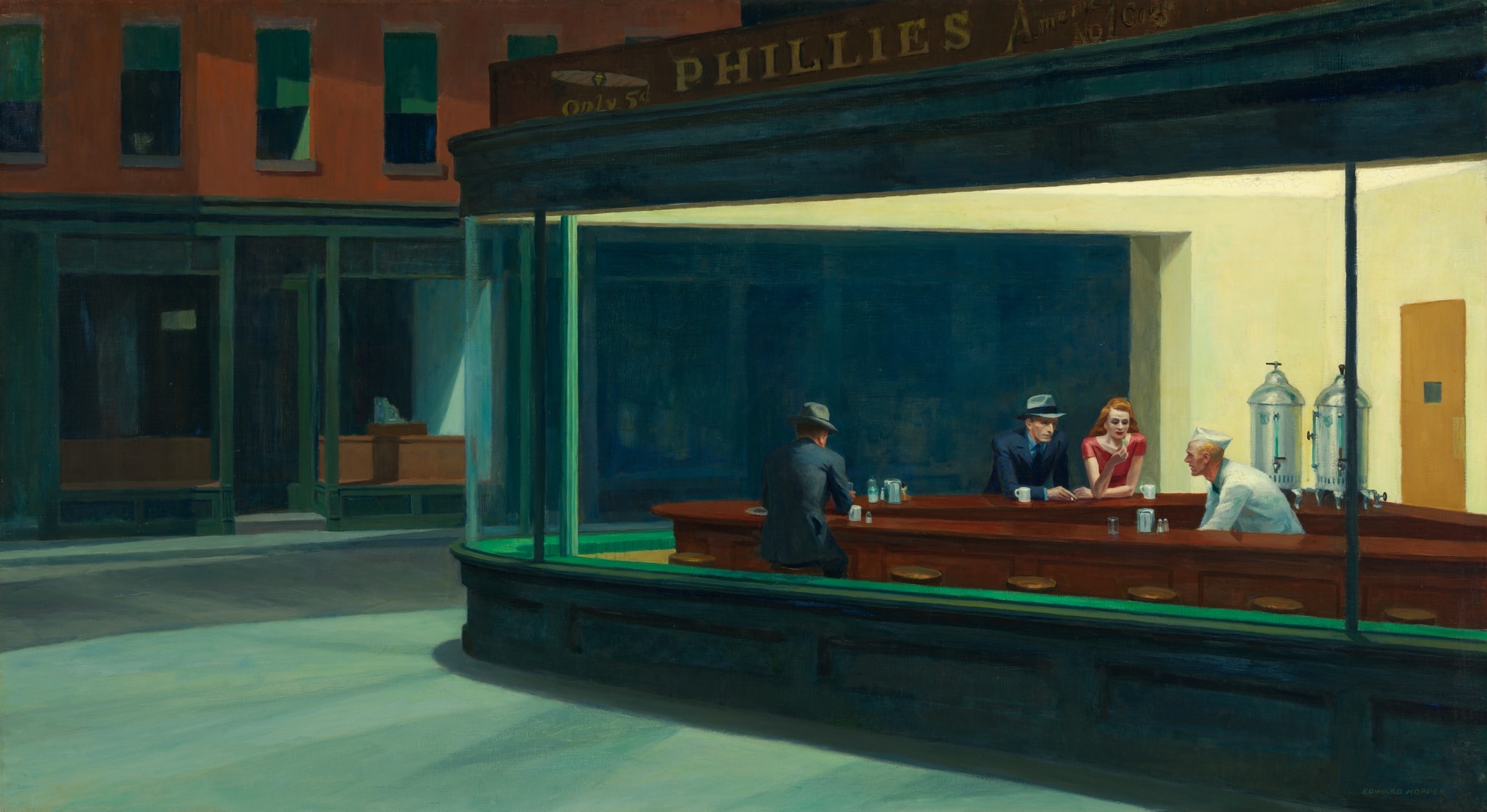
Hopper’s couple at the counter—her red blouse blazing under fluorescent light, his steel-gray hat tilted over a cool blue shirt—sits close yet remains apart. Modeled by Jo Hopper and, via mirror studies, Edward himself, they crystallize Nighthawks’ tension between urban proximity and private isolation, while hinting at fragile community within the wartime night.
Historical Context
Hopper conceived Nighthawks in the winter of 1941–42, in the immediate aftermath of Pearl Harbor and amid New York blackout drills. Curator Sarah Kelly Oehler characterizes the brilliantly lit diner—and the decision to populate it with four figures rather than a single loner—as a potential wartime beacon, staging social presence against surrounding darkness 1. Within that staging, the man in a dark suit beside the red‑haired woman becomes crucial: they suggest companionship yet hold their silence, mirroring a city poised between anxiety and solidarity.
Hopper later explained that the picture was “suggested by a restaurant on Greenwich Avenue where two streets meet,” and that he “simplified the scene … and made the restaurant bigger.” He drew on cinematic lighting and literary cues, distilling multiple observations into a composite set built for mood rather than reportage 2. The couple emerges from this deliberate construction as an expressive device: not documentary portraiture but engineered types whose ambiguous bond lets viewers project stories into the late‑night hush 2.
Symbolic Meaning
The pair condenses Hopper’s modern urban theme: proximity without intimacy. Smarthistory describes the painting’s “near misses”—hands that almost touch but do not—turning the couple into an emblem of solitude within shared space 3. The Whitney underscores the same psychological staging: seated close, they appear emotionally disconnected, a studied non‑encounter we witness from the sidewalk, separated by glass that we cannot cross 4.
Yet wartime context lends a countercurrent. As Oehler argues, the very presence of multiple patrons inside the fluorescent refuge can read as fragile community and hope; the couple’s quiet adjacency therefore carries a dual charge—alienation tempered by the possibility of solace 1. Hopper’s film‑noir lighting and allusions to terse, diner‑set fiction court narrative speculation without closure, keeping their relationship unresolved and magnetic 2. Their identities also blur the line between observation and autobiography: Jo modeled the woman, and Edward posed for the male patrons in a mirror, so the man beside her partially derives from Hopper’s own body—a doubling that complicates our reading of intimacy, performance, and self‑projection in the scene 78.
Artistic Technique
Hopper refined the couple through numerous studies, ultimately positioning them near the counter’s sharp bend, with the man in three‑quarter view and the woman in profile—angles that avert eye contact and preserve separate interiorities 6. Harsh, then‑modern fluorescent light saturates their skin tones and the woman’s red blouse, which punctuates a field of greens, ochres, and browns; the man’s steel‑gray hat and pale‑blue shirt cool the palette, heightening contrast and mood 5.
Small, telling details intensify the psychological charge: Jo’s notes record the woman “eating sandwich” and the man “holding cigarette,” while countless viewers remark on the not‑quite‑touching hands—micro‑compositional choices that sustain suspense between contact and withdrawal 739.
Connection to the Whole
Placed at the counter’s apex, the couple anchors the painting’s right side and furnishes its central narrative question—Are they together, strangers, beginning, ending?—that Hopper refuses to answer 2. Their warm reds and illuminated skin balance the diner's acidic greens and the city’s cool darks, helping orchestrate the rigorous geometry of light and color that powers the work’s atmosphere 105.
Alongside the lone man with his back to us and the alert counterman, they complete Hopper’s quartet of urban types who share a space yet remain sealed within themselves. That tension—communal setting versus solitary minds—is the painting’s thesis, and the couple is its most pointed case study, inviting us, outside the glass, to supply the story we cannot finally know 34.
Explore More from This Painting
This detail is one part of Nighthawks. Use the links below to return to the full interpretation, browse the full set of details, or view the painting's valuation if available.
Sources
- Art Institute of Chicago — Nighthawks as Hope: A Curator Muses on Edward Hopper and Crisis (Sarah Kelly Oehler)
- Art Institute of Chicago — Nighthawks microsite (origins, Greenwich Avenue, cinematic/literary context)
- Smarthistory — Edward Hopper, Nighthawks
- Whitney Museum of American Art — Audio: Edward Hopper, Nighthawks, 1942
- Art Institute of Chicago — Acquiring Nighthawks
- Whitney Museum of American Art — Study for Nighthawks (drawing)
- Wikipedia — Nighthawks (Jo’s ledger and 1942 letter, cross‑referenced in museum writing)
- The New Yorker — Edward Hopper’s Details
- Artnet News — 3 Hidden Truths in Edward Hopper’s Nighthawks
- Art Institute of Chicago — Object page: Nighthawks, 1942