The Empty Street in Nighthawks
A closer look at this element in Edward Hopper's 1942 masterpiece
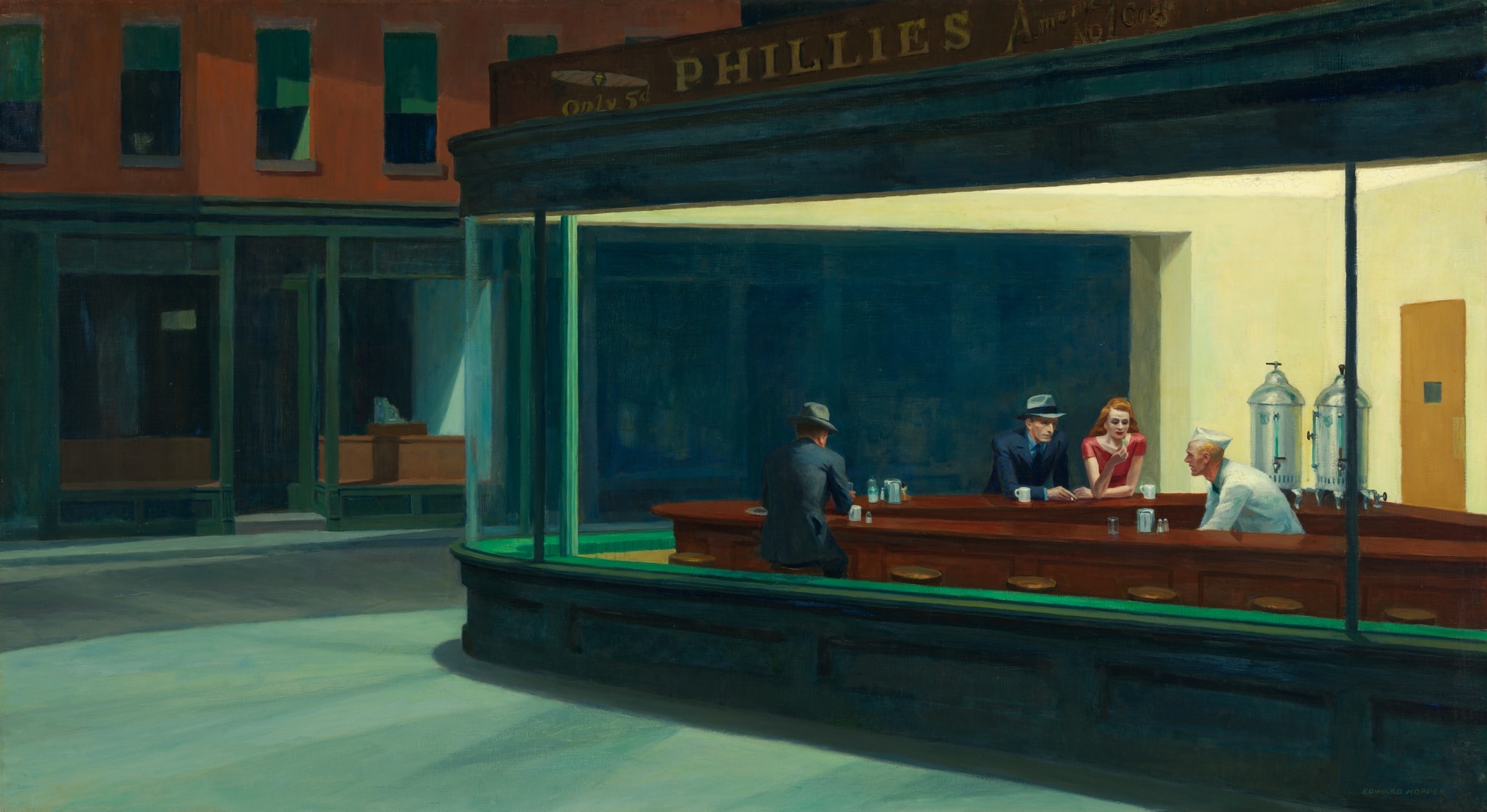
Hopper’s “Empty Street” in Nighthawks is a deliberately voided city corner—no door, no pedestrians, no cars—where darkness itself becomes the subject. This evacuated exterior turns the diner’s fluorescent glow into a beacon and fixes the viewer outside, transforming urban night into a stage for suspense and modern solitude.
Historical Context
Painted and sold in 1942, Nighthawks emerged as the United States entered World War II. Curators note that Hopper imagined a brilliantly lit diner in a largely darkened city, a scenario legible to contemporary viewers amid wartime blackout culture and New York’s mandated dimouts that reduced outdoor illumination 25. The street outside the diner is accordingly stripped of lamplight and activity, while the interior’s new, cold fluorescent glare—a technology only then becoming common—reads as aggressively modern against the surrounding dark 12.
Hopper’s own working method supports this effect. He simplified the setting, enlarged the restaurant, and eliminated incidental street details, including any visible entrance, to forge an austere, near-universal corner 18. The result is not a documentary record of a particular block but a historically resonant wartime image: a city partially blacked out, its sidewalks emptied, with a lone commercial beacon cutting through the gloom.
Symbolic Meaning
The deserted exterior operates as a visual correlative for urban isolation in the modern era. Art-historical accounts link the work’s emptied streetscape to wartime unease and the psychic disconnection of metropolitan life, with the blank pavement outside echoing the inward separations among the figures inside 6. Hopper’s voided corner also carries a cinematic, film‑noir charge: the oblique angle, hard electric light, and framing through glass stage suspense and estrangement, turning the street into a set where nothing happens and everything is felt 84.
Hopper resisted literal readings of loneliness, yet admitted he was “probably” painting the loneliness of a large city; the street functions as a structural device that encodes that solitude without narrative incident 9. Its absences are catalogued everywhere—no traffic, signage, litter, or streetlamps; the only legible text is the PHILLIES cigar ad, and across the way a lone cash register sits in a dark shop, a token of commerce with no customers 73. Scholars have further aligned this evacuated urban night with a wartime Surrealist poetics—a dreamlike stillness and a charged emptiness that feels both timely (1942) and timeless in its emblem of modern anxiety 11.
Artistic Technique
Hopper renders the street as a broad negative space by wrapping the acute corner of a wedge‑shaped building and curving the glass along the sidewalk; the viewer stands on the vacant pavement, looking in 4. A single, icy fluorescent source floods the interior while deep greens, blue‑blacks, and large shadow planes suppress exterior detail; no streetlamp interrupts the darkness, so tone and color alone empty the street 3. Crucially, Hopper omits a visible door, sealing the interior and defining the sidewalk as an inaccessible zone 1. Preparatory drawings show him refining this light‑dark opposition and paring the exterior toward near‑abstraction, confirming the emptiness as a worked‑out choice rather than a literal transcription 10.
Connection to the Whole
The “Empty Street” is the painting’s structural foil. It sharpens the inside/outside, light/dark, company/solitude binary that gives Nighthawks its charge; without the evacuated sidewalks, the diner’s glow would lose its dramatic pressure 3. By removing a visible entrance, Hopper turns the pavement into a zone of exclusion where the viewer is positioned—able to see but unable to enter—mirroring the patrons’ own guarded inaccessibility 14. Even small external cues, such as the solitary cash register across the street, reinforce the suspension of normal urban life and keep attention fixed on the contained interior drama 3. The result condenses a 1942 mood—public spaces dimmed, futures uncertain—into a clear, universal image of modern urban suspense 9.
Explore More from This Painting
This detail is one part of Nighthawks. Use the links below to return to the full interpretation, browse the full set of details, or view the painting's valuation if available.
Sources
- Art Institute of Chicago, Nighthawks (object page with curatorial text)
- Art Institute of Chicago, “Acquiring Nighthawks”
- Smarthistory, “Edward Hopper, Nighthawks”
- Whitney Museum of American Art, Nighthawks (audio guide transcript)
- Museum of the City of New York, NYC wartime dimouts
- The Metropolitan Museum of Art, Heilbrunn essay: Edward Hopper (1882–1967)
- PBS American Masters, “What’s missing from Edward Hopper’s ‘Nighthawks’?”
- Art Institute of Chicago, Nighthawks microsite (film‑noir influences, simplification)
- Washington Post, interview with AIC’s Sarah Kelly Oehler on blackout idea
- Whitney Museum, Study for Nighthawks (drawing)
- Gail Levin, “Edward Hopper’s ‘Nighthawks’, Surrealism, and the War,” AIC Museum Studies 22, no. 2 (1996)