View of Delft
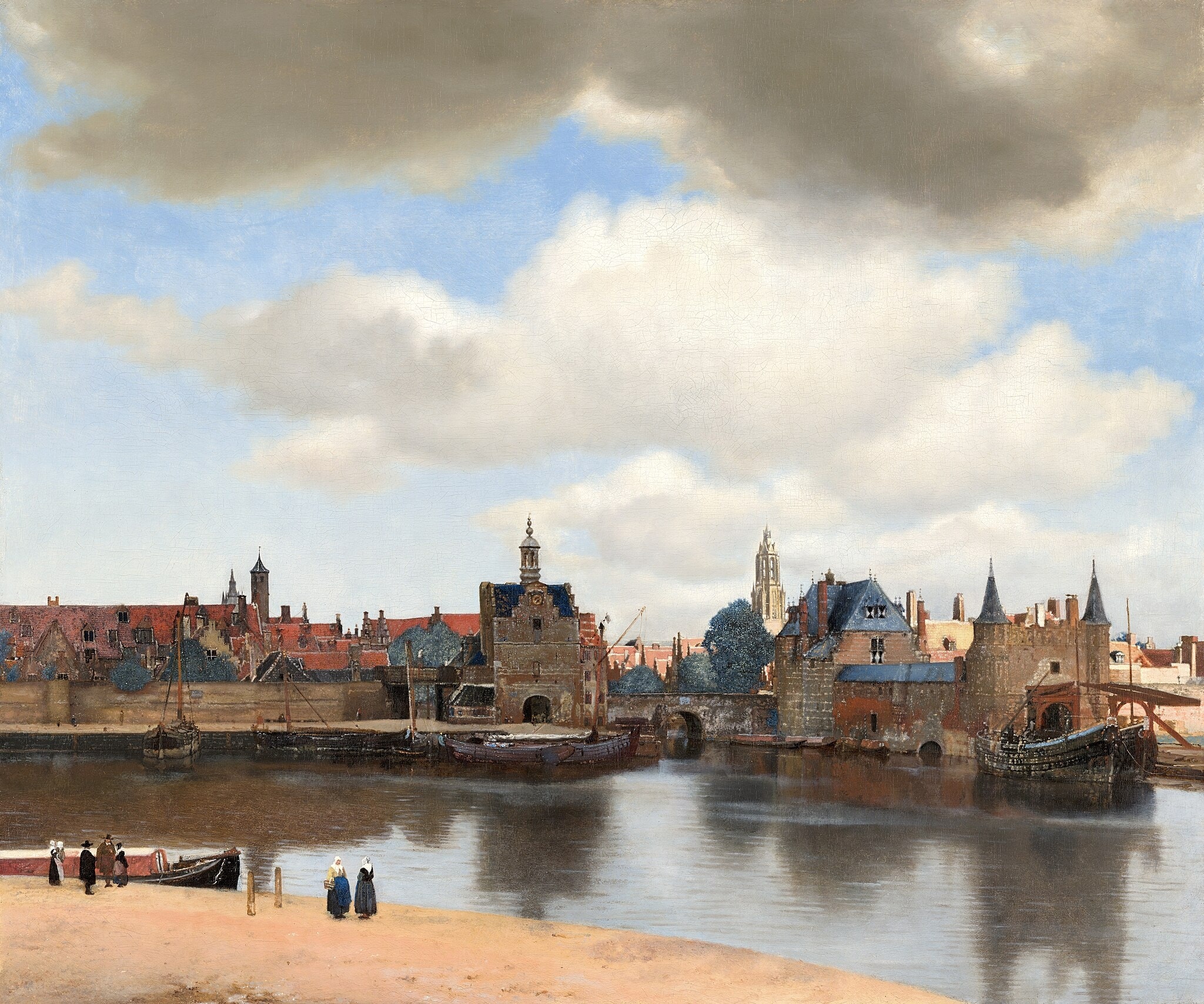
View of Delft turns a faithful city prospect into a meditation on civic order, resilience, and time. Beneath a low horizon, drifting clouds cast mobile shadows while shafts of sun ignite blue roofs and the bright spire of the Nieuwe Kerk, holding the scene’s moral center [1]. Small figures and moored boats ground prosperity in everyday community without breaking the hush.
Fast Facts
- Year
- c. 1660–1661
- Medium
- Oil on canvas
- Dimensions
- 96.5 × 115.7 cm
- Location
- Mauritshuis, The Hague

Click on any numbered symbol to learn more about its meaning
Meaning & Symbolism
Vermeer organizes the picture into three calm bands—water, city, sky—so the Kolk’s reflective surface functions like a clock of light, advancing time in ripples while steady walls and gates resist it 12. The Schiedam Gate near center, with its little clock turret, anchors mercantile movement: barges lie low in the water; a passenger trekschuit nudges the quay; cranes and a drawbridge signal regulated labor, not bustle 1. These instruments of traffic and trade read as emblems of civic order because they are stilled at a moment of readiness, their hard angles softened by the evenly diffused, silvery light Vermeer favored. Across the masonry, he sprinkles point-like highlights—on boat edges, window leads, and wet timbers—so industry glints without clamoring, a visual rhetoric that elevates work into communal dignity 26. On the sandy bank, two women in white caps and a few townsfolk stand apart, scaled to the fore but socially modest; their quiet choreography frames the city as a stage for ordinary virtue, not heroic display.
Vermeer assigns symbolic primacy to the Nieuwe Kerk by bathing its tower in a break of sun and nudging it nearer the composition’s axis than strict optics would dictate 12. The church’s bright stone rises like a metronome through the drift of clouds, an image of continuity and civic memory tied to the House of Orange and William of Orange’s tomb; its illuminated presence makes the surrounding trade appear not merely profitable but purposeful, ordered under a shared moral horizon 13. The paired gates—Schiedam to the center-left and the Rotterdam Gate to the right—frame this ascent with watchful thresholds, emblems of a city that regulates entry and exchange. Vermeer’s low horizon gives dominance to a vast, mutable sky whose shadow pools over the foreground ramparts while leaving blue slate roofs and red tiles to catch quick fire; this calibrated play of shadow and selective illumination declares a principle: stability absorbs change. The visual fact that clouds move while brick endures becomes an argument about Delft’s recovery after the 1654 Thunderclap explosion: commerce resumes, façades are whole, the harbor works; the city is tranquil because it is resilient 3.
The painting’s equilibrium grows from choice, not mere record. Curators and scholars have shown that Vermeer subtly adjusted architecture and spacing to heighten harmony—centering effects, clarifying silhouettes, and smoothing perspective transitions—so a truthful view becomes an ideal civic image 12. Technical observers note his cool lead whites and ultramarine tints weaving a pearly atmosphere; fine pointillés sparkle across water and rooftops, effects often linked to careful optical study, though the camera obscura debate remains open 26. Even the internal “timestamp”—the belfry openings of the Nieuwe Kerk shown without bells—binds the image to a moment around 1660–1661 when the Hemony carillon was not yet installed, while some astronomical sleuthing has proposed an earlier September morning; such debates only underscore how precisely Vermeer tied light and civic form to a live instant 14. In sum, View of Delft proposes a compact between nature’s change and human order: a city that prospers without noise, remembers without pomp, and stands—under a sky that passes—as a community held in measured light 123.
Explore Deeper with AI
Ask questions about View of Delft
Popular questions:
Powered by AI • Get instant insights about this artwork
💬 Ask questions about this artwork!
Interpretations
Formal/Technical Analysis: Optics as Poetics
The painting’s famously even, pearly atmosphere and scintillating pointillés read as more than virtuoso finish; they function like a low-key optical rhetoric. Slight “defocus” in brick planes, speckled highlights on water and roofs, and the soft dispersion of skylight suggest observation through an optical device, yet Vermeer’s hand edits those perceptions into structural harmony—smoothing intervals, clarifying silhouettes, and re-centering the spire to stabilize the whole. This is a hybrid of optical mimesis and compositional artifice: a lens-informed look tempered by painterly design. The result is an image that feels empirically seen but intellectually composed, turning light phenomena into a syntax of civic calm 26.
Source: Arthur K. Wheelock Jr. & C. J. Kaldenbach; ColourLex technical roundup
Power & Ideology: The City as Self-Portrait after Disaster
View of Delft operates like a soft-spoken civic manifesto. In the wake of the 1654 Thunderclap, Vermeer presents intact walls, working quays, and watchful gates as emblems of institutional resilience. By bathing the Nieuwe Kerk—tomb of William of Orange—with clarifying sun, he aligns local recovery to the House of Orange’s national narrative. The harbor’s tools of exchange promise prosperity, but their stillness connotes regulated, ethical commerce under shared memory. Rather than triumphal spectacle, the painting advances a persuasive ideology of order: prosperity without noise, continuity without pomp, a republic secured by measured work and watchful thresholds 134.
Source: Mauritshuis; Annenberg Learner; Metropolitan Museum (Vermeer and the Delft School)
Temporal Forensics: Dating, Bells, and the Morning Problem
Vermeer embeds time as both motif and puzzle. The Schiedam Gate’s clock and the empty belfry of the Nieuwe Kerk create an internal timestamp: the Hemony carillon was installed between May 1660 and autumn 1661, supporting the museum’s c. 1660–1661 dating. Yet astronomical sleuthing has proposed a specific morning—around 8 a.m., early September 1659—based on sun angles and period clocks. That hypothesis remains debated, but it clarifies the work’s conceptual nerve: the city’s identity is forged at a precise, observable hour when light articulates structures. The canvas thus doubles as a chronometric landscape, where civic form and atmospheric time interlock 157.
Source: Mauritshuis; The Guardian (reporting Olson et al.); Ars Technica (analysis of Olson study)
Social History: Work, Infrastructure, and Quiet Class
Harbor machinery, barges, and the trekschuit render the infrastructure of labor as the city’s tacit protagonist. Vermeer keeps staffage figures small and composed, emphasizing collective function over individual heroism. The scene privileges processes—loading, passage, regulation—over spectacle, mirroring the Dutch Republic’s civic ethic of disciplined commerce. Even the highlights on wet timbers and boat edges perform an ethical aesthetics: labor shines, but does not clamor. The result is a visual sociology of mid-17th-century Delft in which class is legible through tasks and tools, and dignity arises from coordinated, well-lit routines within a supervised urban fabric 12.
Source: Mauritshuis; Wheelock & Kaldenbach
Reception Aesthetics: Proust’s ‘Little Patch’ and Modern Seeing
Marcel Proust’s fixation on a “little patch of yellow wall” in this painting reframed View of Delft for modern viewers: not only a city portrait, but a field of micro-intensities where small chromatic events—sunlit tiles, a roofline’s glint—become revelations. This reception history shows how Vermeer’s calibrated, local color sensations anticipate a modernist gaze that extracts meaning from minute optical facts. Proust’s scene of rapt attention converts Vermeer’s civic poise into a lesson in aesthetic attention: to look closely is to discover worlds inside “ordinary” passages, aligning the painting with later conceptions of everyday perception as an artistic end in itself 1.
Source: Mauritshuis (Proust reception)
Related Themes
About Johannes Vermeer
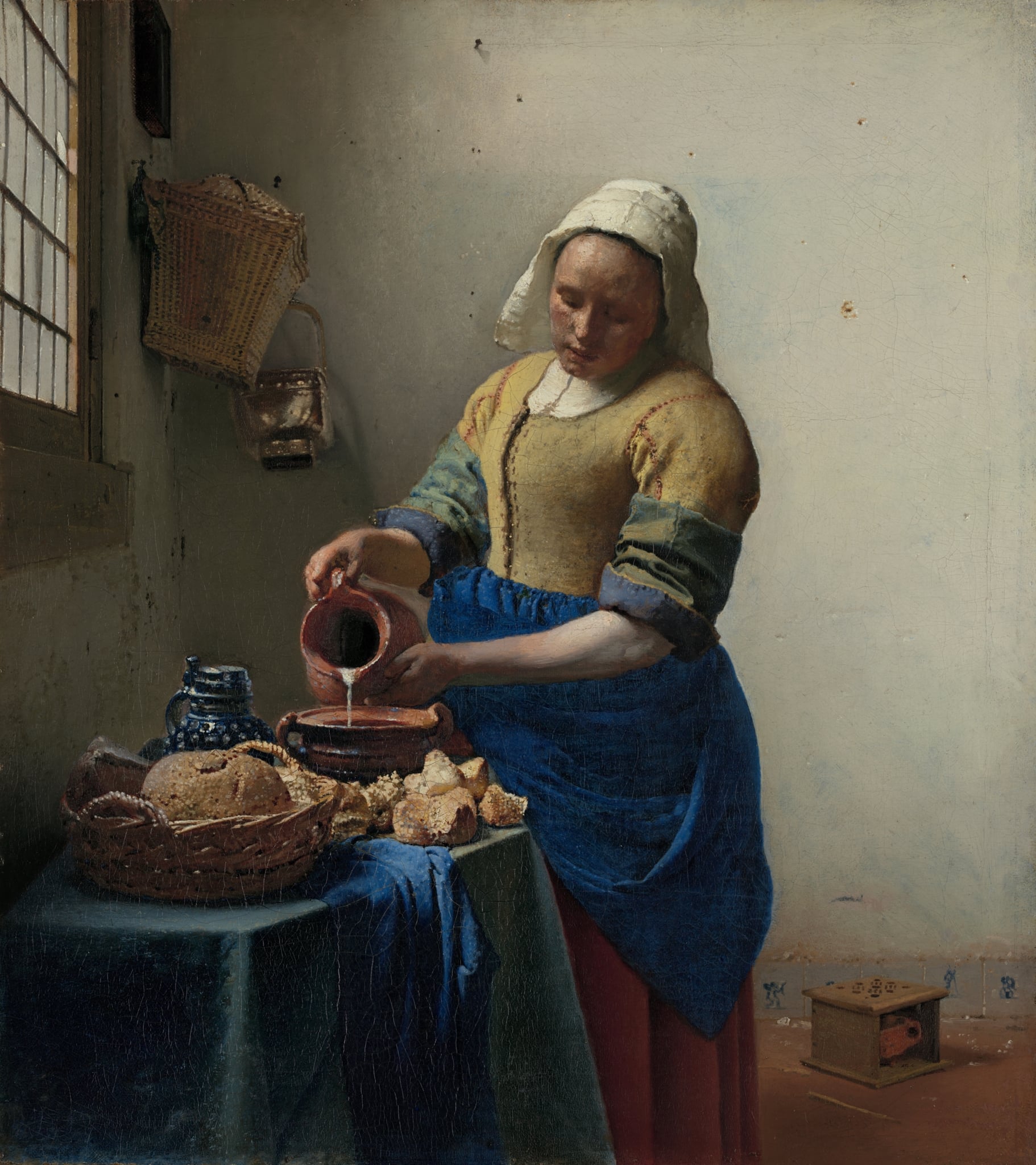
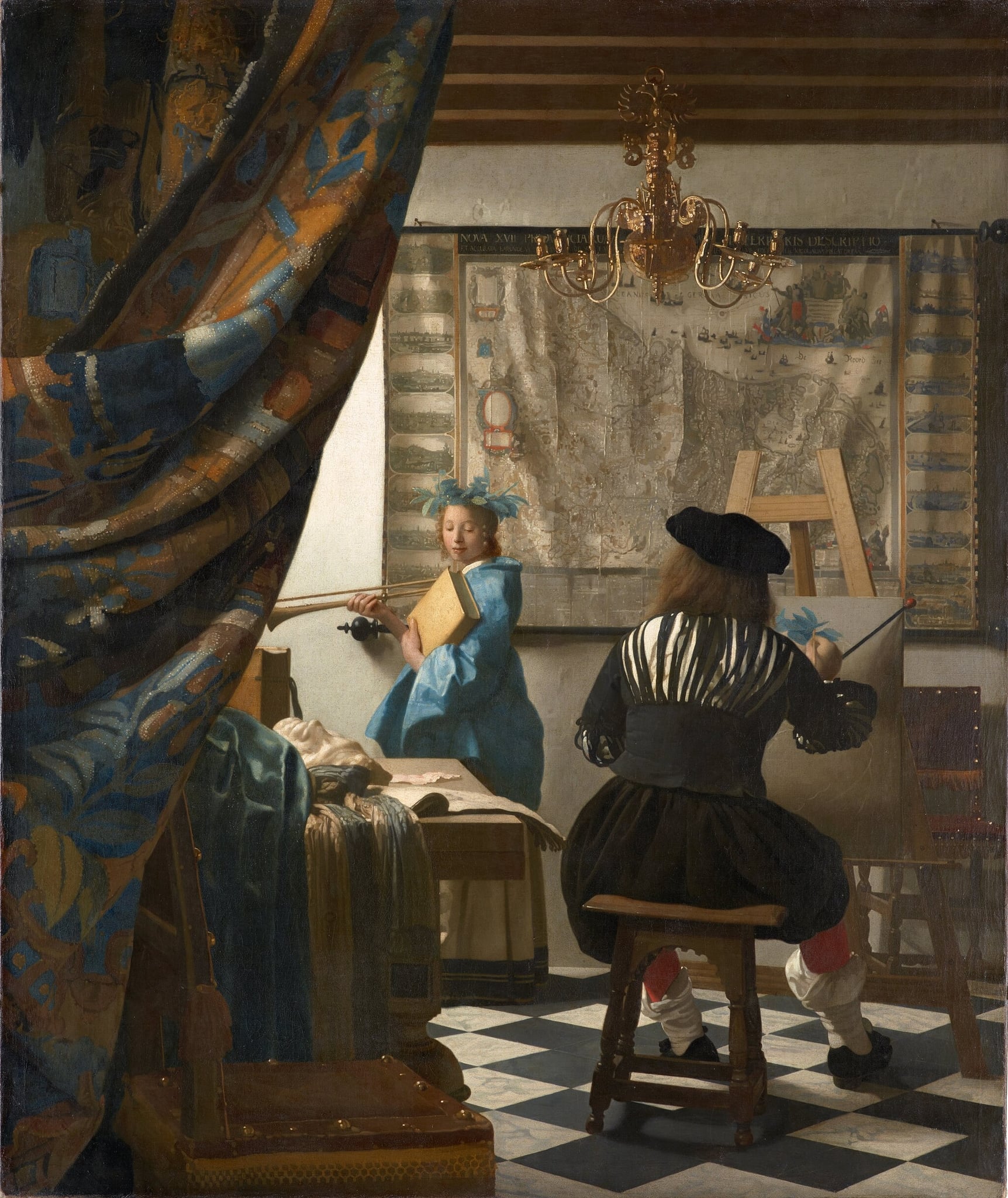
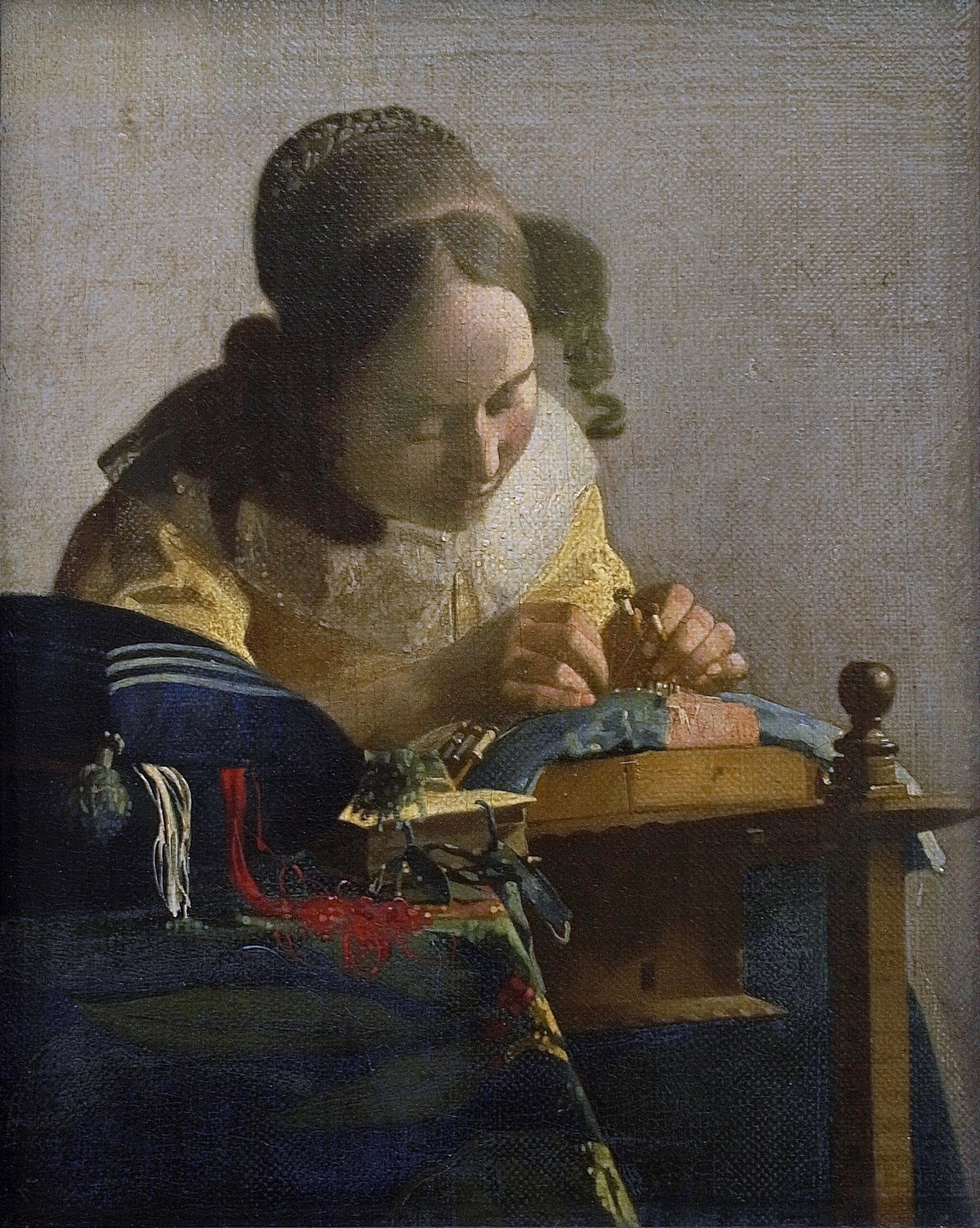
Johannes Vermeer (1632–1675) lived and worked in Delft, producing a small oeuvre of luminous interior scenes defined by meditative light and measured craft. Technical research shows he began with swift underpainting and then refined forms and light with exceptional deliberation, a method newly underscored by The Milkmaid’s imaging discoveries [1][3]. His art elevates everyday life into enduring models of clarity, quiet, and human presence.
View all works by Johannes Vermeer →