How Much Is The Red Vineyard Worth?
Last updated: March 22, 2026
Quick Facts
- Methodology
- comparable analysis
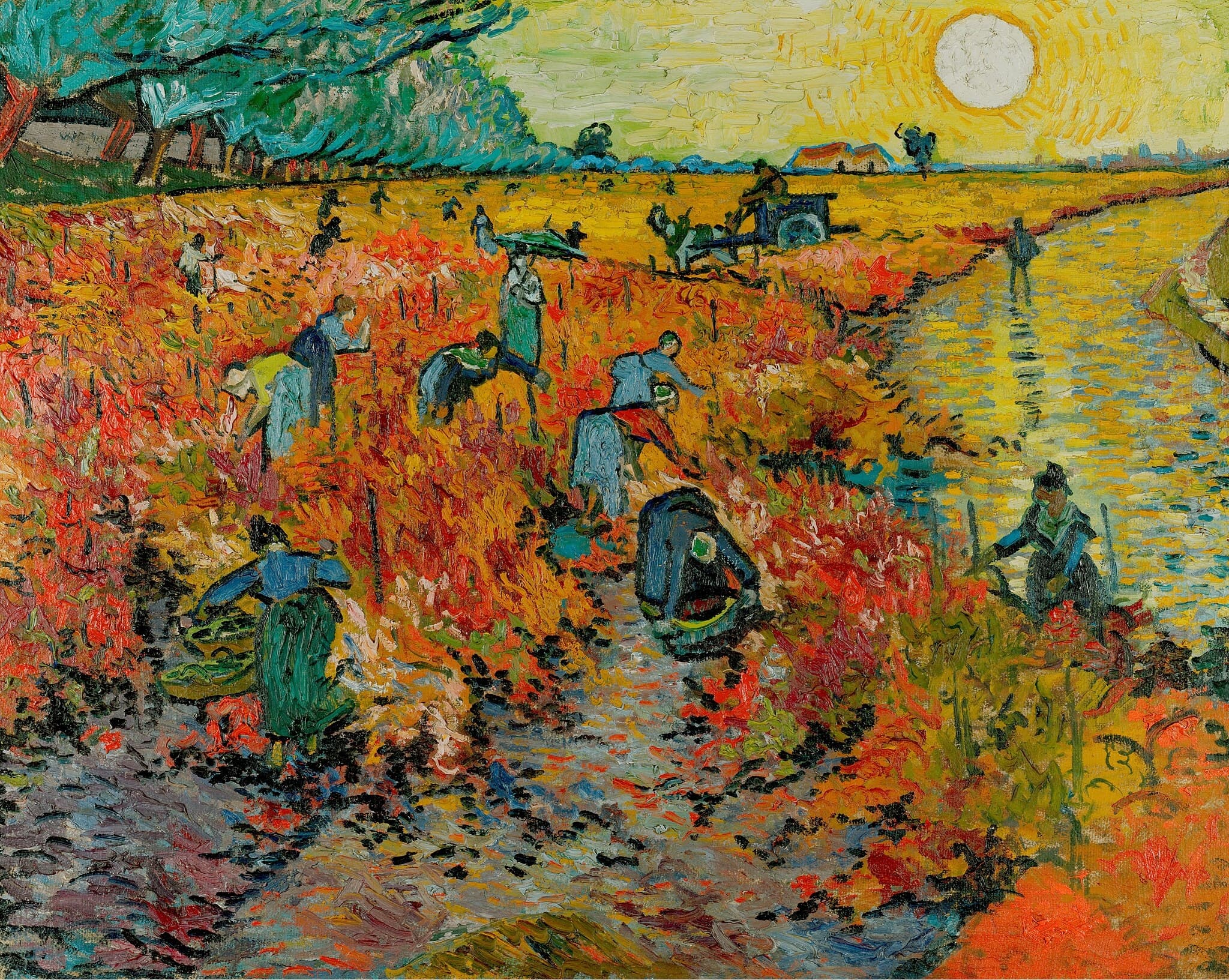
Hypothetical fair‑market value for Van Gogh’s The Red Vineyard is estimated at $130–170 million. This places the work above most recent Van Gogh auction benchmarks and near the artist’s current record for a prime 1888 Arles landscape, recognizing its exceptional provenance as the only painting documented as sold during his lifetime and its museum-grade quality.
Valuation Analysis
Conclusion and range. Anchored to recent, best-in-class Van Gogh auction results and adjusted for this canvas’s singular historical cachet, The Red Vineyard (1888) would reasonably command $130–170 million in an unconstrained sale. This positions it above the majority of recent Van Gogh prices and near the artist’s market apex for prime Arles-period works, reflecting both quality and narrative significance.
Comparables and pricing anchors. The most relevant benchmark is Orchard with Cypresses (1888), which set Van Gogh’s current auction record at $117.18 million (with fees) in November 2022, confirming sustained trophy-level demand for luminous, 1888 Provence landscapes [2]. Additional high-tier signals include the $71.35 million result for the late‑1880s Cabanes de bois parmi les oliviers et cyprès (2021) and the continued resetting of period sub‑records (e.g., a Paris-period still life at $62.7 million in 2025), demonstrating broad depth across the artist’s late-1880s production [3][4]. Against this backdrop, The Red Vineyard’s prime date, scale, chroma, and subject place it squarely at the top of the Van Gogh curve.
Art-historical significance and fame. Painted in November 1888 at Arles, The Red Vineyard is not only a mature, high‑impact composition (harvesters in incandescent evening light) but also the painting widely cited as the only work Van Gogh sold during his lifetime—purchased by Anna Boch at Les XX in Brussels in early 1890. This singular provenance is repeatedly emphasized in scholarship and by the Pushkin State Museum of Fine Arts, which has held the painting since 1948 [1][5]. That lifetime-sale narrative confers an exceptional, story-driven premium above and beyond even strong period comparables.
Rarity of opportunity and demand dynamics. The picture has been effectively off the market for over a century and long embedded in a Russian state collection [1]. Were it ever legally deaccessioned and exportable, competitive intensity among global trophy buyers—now including a growing cohort in Asia—would likely be acute, a dynamic observed around recent Van Gogh results and broader top‑end Modern sales [3]. This scarcity-of-supply factor merits an additional premium on top of the record-adjacent comp base.
Key sensitivities. Two variables could shift the realized price materially. First, condition: a fully published, recent conservation/technical report (support, paint layer stability, cleaning/varnish history, retouching) is necessary to confirm the upper band of this range. The Pushkin’s ongoing technical work underscores the need for current data [1]. Second, legal/exportability: the estimate reflects a blue‑sky scenario of clear title and free circulation; actual transactability in Russia is near zero, and any legal friction would compress the realizable price versus theoretical market appetite. Balancing these, the painting’s period, quality, and unmatched narrative justify a confident $130–170 million valuation today.
Key Valuation Factors
Art Historical Significance
High ImpactPainted in November 1888 at Arles, The Red Vineyard belongs to Van Gogh’s peak period, with a vivid, narrative composition of harvesters under raking light. This is precisely the vintage and expressive mode that anchors the artist’s top valuations. Its palette and subject connect closely to the most coveted Provence works, ensuring placement at the top of the artist’s market curve. Beyond formal quality, it encapsulates keystone themes—rural labor, autumnal color, and spiritual intensity—that define Van Gogh’s late style and underpin sustained institutional and collector demand.
Market Comparables
High ImpactThe closest anchor, Orchard with Cypresses (1888), holds the current Van Gogh auction record at $117.18m, establishing the going rate for prime Provence landscapes. Additional late‑1880s works continue to trade at $70m+ and, more recently, high‑quality Paris-period pieces have reset to the $30–60m+ band. Against this comp set, The Red Vineyard’s date, chromatic power, and composition argue for pricing above most peers and proximate to the 2022 record—supporting a $130–170m band in today’s market.
Provenance and Fame
High ImpactThe work’s outsized renown as the only painting Van Gogh is documented to have sold during his lifetime (to Anna Boch at Les XX) confers a unique historical cachet. Its long residence in a major state museum further amplifies rarity of opportunity—a critical premium driver for global trophy collectors. This combination of narrative fame and institutional pedigree positions the painting among the most desirable Van Goghs hypothetically available.
Condition and Technical State
Medium ImpactWhile no public, recent conservation dossier is available, any top‑end transaction would hinge on confirmation of structural soundness (canvas/support), paint layer stability, and surface coherence (varnish/retouching). For an 1888 canvas, differences in condition can move value by double‑digit percentages. The Pushkin’s ongoing technical engagement underscores the importance of a current report; pristine or excellent condition would support the upper band of this estimate, while meaningful issues could compress it.
Legal/Exportability Constraints
Medium ImpactThe painting is held by the Pushkin State Museum of Fine Arts in Moscow. In practice, Russian state cultural-property and export regulations make transactability negligible. This valuation therefore reflects a hypothetical, unconstrained context with clear title and free circulation. If a sale required complex title clearing or faced export barriers, frictional discounts and execution risk could reduce realizable price versus the theoretical range presented here.
Sale History
Les XX exhibition, Brussels (public exhibition; private purchase)
Sold to Anna Boch for 400 Belgian francs; USD equivalent ≈ $77 at 1890 FX; date and conversion approximate.
Paris private sale (associated with Galerie Druet exhibitions)
Acquired by Ivan Morozov around 1909; asking price 30,000 francs (≈ $5,800 at 1909 FX); date and conversion approximate.
Vincent van Gogh's Market
Vincent van Gogh sits among the most valuable artists at auction, with sustained global demand for late‑1880s masterpieces. The artist’s current auction record is $117.18 million for Orchard with Cypresses (1888), achieved in November 2022 and underscoring the apex pricing for prime Arles landscapes [2]. Recent sales confirm depth across periods: a Paris‑period still life realized $62.7 million in 2025, while a Saint‑Rémy landscape achieved $71.35 million in 2021 [3][4]. Fresh, blue‑chip works with strong provenance routinely attract third‑party guarantees and intense competition from an international buyer base, including an expanding cohort in Asia. Period, subject, color, and condition are the key determinants of price tiering.
Comparable Sales
Orchard with Cypresses (1888)
Vincent van Gogh
Same artist and prime Arles year (1888); high‑chroma Provençal landscape, mid–large format, market apex for the period; closest like‑for‑like benchmark to The Red Vineyard.
$117.2M
2022, Christie's New York (Paul G. Allen Collection)
~$130.1M adjusted
L’Allée des Alyscamps (1888)
Vincent van Gogh
Same artist and same Arles season (autumn 1888); fiery palette and comparable dimensions; figure‑bearing Arles motif. A widely cited comp for major Arles canvases.
$66.3M
2015, Sotheby's New York
~$91.0M adjusted
Laboureur dans un champ (Ploughman in the Field) (1889)
Vincent van Gogh
Same artist, immediate next period (Saint‑Rémy, 1889) with agrarian labor subject; top‑tier landscape price showing market depth for rural motifs closely related to The Red Vineyard.
$81.3M
2017, Christie's New York
~$107.8M adjusted
Cabanes de bois parmi les oliviers et cyprès (1889)
Vincent van Gogh
Same artist, Provence landscape with olive trees and cypresses; luminous palette and strong composition; recent marquee result anchoring late‑1880s Provence pricing.
$71.3M
2021, Christie's New York (The Cox Collection)
~$85.5M adjusted
Piles de romans parisiens et roses dans un verre (Romans parisiens) (1887)
Vincent van Gogh
Same artist; high‑end Paris‑period still life setting a recent benchmark (2025). While a different subject from The Red Vineyard, it shows current trophy‑level demand across Van Gogh sub‑periods.
$62.7M
2025, Sotheby's New York
Portrait of Dr. Gachet (1890)
Vincent van Gogh
Same artist; one of the most iconic Van Gogh portraits. Not a landscape, but a trophy‑level price that provides an upper‑bound anchor for blue‑chip Van Gogh valuations in 2025 dollars.
$82.5M
1990, Christie's New York
~$205.1M adjusted
Current Market Trends
The upper end of the Impressionist/Post‑Impressionist market remains robust, with a pronounced flight to quality following a selective 2024 and a stronger 2025 for marquee consignments. Trophy lots by canonical names continue to see deep bidding, often supported by guarantees, while mid‑tier works face tighter competition. Van Gogh specifically benefits from renewed museum visibility and broadened geographic demand, including Asia-based collectors, as evidenced by recent seven‑ and eight‑figure results. In this environment, period‑defining, museum‑grade works with compelling stories command premium pricing and can test or surpass established auction benchmarks.
Study print
Study this painting as a print
Pair the full artwork with a museum-style study sheet focused on one meaningful detail.
Sources
- Pushkin State Museum of Fine Arts – Conservation project: Vincent van Gogh, The Red Vineyard
- The Art Newspaper – A Van Gogh record: Orchard with Cypresses soars to $117m at Paul Allen auction (Nov 2022)
- Sotheby’s – The 10 Most Valuable Lots Sold by Sotheby’s in 2025
- The Value – Christie’s New York (Cox Collection) result: Van Gogh’s 1889 Provence landscape at $71.35m
- The Art Newspaper – How did the only painting sold by Van Gogh in his lifetime end up in Russia? (Feb 2022)