The Harvest

by Vincent van Gogh

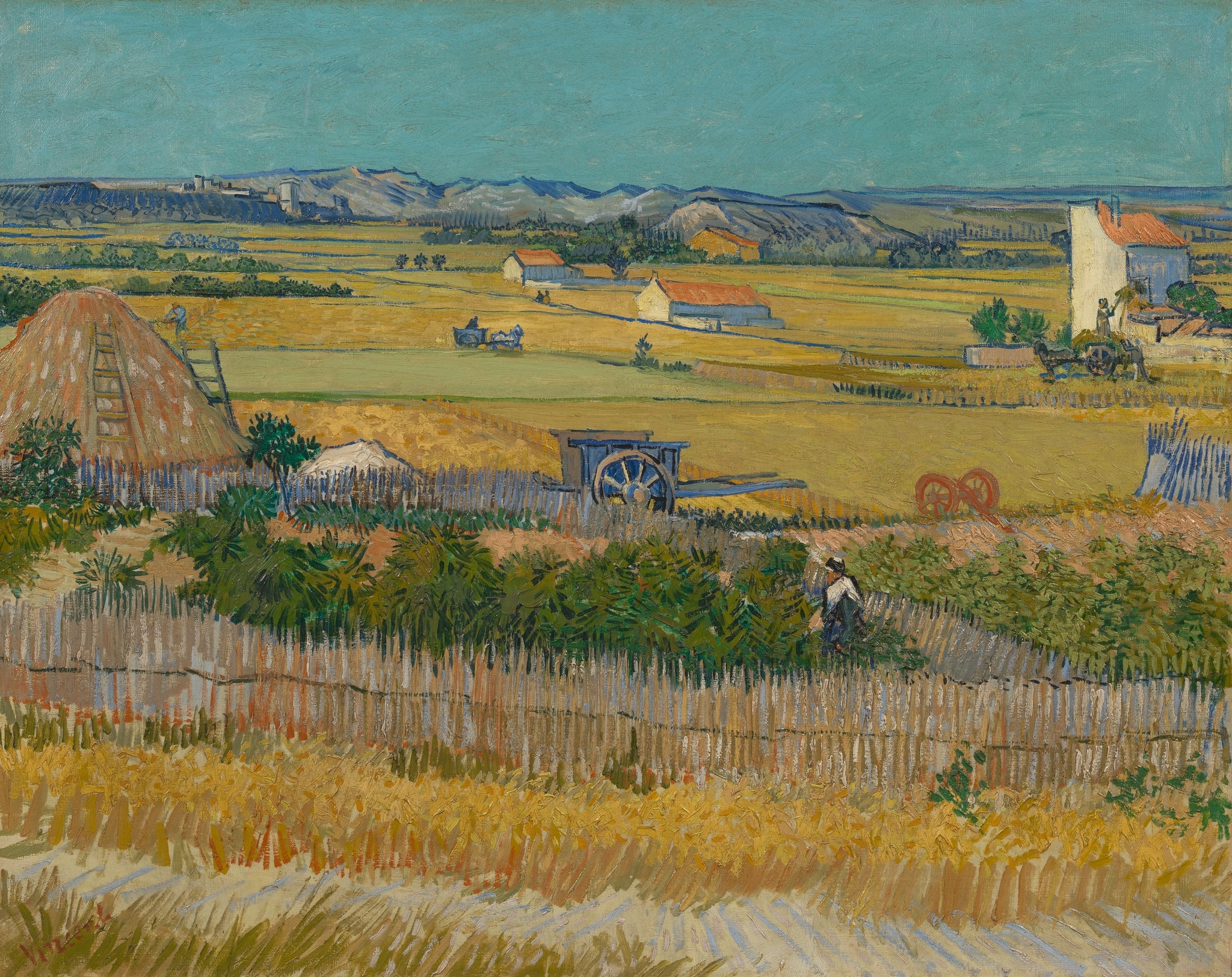
The Harvest surveys the La Crau plain as a luminous patchwork of ripe wheat, garden strips, and farm tracks under an azure sky. Van Gogh orchestrates tools and tasks—haystack with ladder, carts with red wheels, fenced plots—into a single, sunstruck order that turns labor into vision [1][2]. A lone reaper almost dissolves in the foliage, anchoring the panorama in human toil and seasonal time.

Study Print Studio

Create a personal study print

Build a companion study sheet around the part of this painting that speaks to you most. Choose a detail, shape an interpretation, and walk away with something personal and display-worthy.

Fast Facts

Year
1888
Medium
Oil on canvas
Dimensions
73.4 × 91.8 cm
Location
Van Gogh Museum, Amsterdam
See all Vincent van Gogh paintings in Amsterdam
The Harvest by Vincent van Gogh (1888) featuring Carts and wheels (including red wheels), Ripe wheat, Reaper, Haystack with ladder

Click on any numbered symbol to learn more about its meaning

Meaning & Symbolism

Van Gogh composes the landscape as interlocking planes—wheat in old‑gold strokes at the front, a hedged garden with a bent laborer, a hayrick laced by a ladder, then carts, sheds, and white farmhouses stepping back toward the blue serration of Montmajour. Each strip carries its own tempo: the foreground wheat flickers in short, leaning dashes; the garden bristles in tufted greens; the road bands glide laterally; the distant hills settle into calmer, horizontal strokes. This segmentation is not mere topography. It is a choreography of work—cutting, bundling, hauling, stacking—compressed into a single, panoramic now. The tools of harvest punctuate the field grammar: red cart wheels like beats in a score; fences and paths drawing measure lines; the ladder as a vertical accent thrusting toward the sun. The sky’s cool azure locks against the fields’ old gold, a deliberate chromatic counterpoint Van Gogh used to make viewers feel the scorched, vibrating air of June in Arles 12. The result is not reportage but essence: a landscape distilled to its operative forces—light, heat, and labor—held in visible equilibrium. Within this order, the figure is deliberately small. The reaper, nearly swallowed by the green plot, states Van Gogh’s conviction that people belong to the field’s rhythm more than the field belongs to them. In later letters he would call the reaper an image of death that is not sad, a ripening cut in full daylight with sunlight pouring gold over everything 3. That formulation clarifies the ethical temperature of The Harvest: here the emphasis is affirmative—on fecundity, stewardship, and the dignity of repetitive tasks—yet the image also hints at mortality through its cycles. The painting’s measured geometry suggests human management, but its overwhelming scale and light declare a nature that ultimately frames and finishes human effort. This duality—care and contingency—makes the canvas a hinge in Van Gogh’s wheat‑field cycle, balancing life’s productivity with the horizon of reaping that would occupy him in Saint‑Rémy 34. Why The Harvest is important, finally, is that it consolidates Van Gogh’s Arles method. He transforms a commonplace subject into a symphony of structure and color, proving his aim to express what the landscape means rather than what it looks like. The tight orchestration of marks organizes perception: we read the entire economy of a season at once, from stubble to stack, from garden row to granary path, all under a sky whose unbroken breadth confers unity and grace. Museum records affirm that he judged this canvas among his most successful of June 1888, produced during an intense campaign “under the burning sun,” and the painting has been recognized as a keystone of his Post‑Impressionist synthesis in Arles 14. The Harvest thus stands as a hymn of gratitude to work and summer—a declarative image in which color becomes climate, brushwork becomes labor, and a small human figure keeps time with the earth’s larger, renewing clock 125.

Explore Deeper with AI

Ask questions about The Harvest

Popular questions:

Powered by AI • Get instant insights about this artwork

💬 Ask questions about this artwork!

Interpretations

Formal Analysis: Polyphonic Space and Task-Rhythm

The canvas organizes depth as a polyphony of planes—wheat, garden, rick, road, outbuildings, horizon—each marked by distinct stroke-types that cue different “tempi” of labor. Short, canted dashes in the wheat read as rapid cutting; tufted greens stiffen into the garden’s slower cultivation; long lateral bands in roads and fields convey hauling and transit. These differentiated marks are not decorative; they function like a notational system that converts spatial recession into a legible sequence of actions. The result is a landscape you can “read” task by task, as if the land were scored for labor. Such orchestration reflects Van Gogh’s Arles breakthrough: directional brushwork and serial observation used to bind perception, movement, and making into one field of form 125.

Source: National Gallery of Art (teaching materials); Van Gogh Museum

Chromatic Counterpoint: Color as Climate

Van Gogh yokes the fields’ old gold to a cool azure sky, a deliberate complementary setup that makes color register as heat and air rather than mere hue. The high-key yellow range throws off the sensation of glare; the blue vault stabilizes the patchwork below while sharpening the perception of scorched atmosphere in June Arles. This chromatic counterpoint is integral to the painting’s argument that meaning can be carried by color: it conveys seasonal temperature, time of day, and the physical effort implied by harvest. In letters from the Arles period, Van Gogh stresses using color to “express [himself] forcefully,” and the museum underscores how this pairing compresses the experience of summer into a single, resonant scheme 21.

Source: Van Gogh Museum (gallery text and object entry)

Iconography & Ethics: Daylight Memento Mori

The near-miniature reaper is easy to overlook, yet he anchors a quiet allegory. In 1889 Van Gogh calls the reaper “an image of death,” but insists there is “nothing sad” about it—harvesting happens in the open, under a sun that turns everything to pure gold. Reading back from this statement clarifies the 1888 harvest series: here, mortality is ethical sunlight, folded into productivity and care rather than tragedy. The figure’s smallness within a vast order hints at human life as seasonal—ripe, then reaped—and frames dignity not as heroics but as steady participation in cycles. Arles supplies the affirmative pole of this symbolism; Saint‑Rémy will distill its existential counterpoint in the explicit reaper canvases 341.

Source: Van Gogh Letters (5–6 Sept 1889); The Met (Pickvance); Van Gogh Museum

Historical Context: Campaign Method and Compressed Time

June 1888 was a campaign: working “under the burning sun,” Van Gogh produced a rapid sequence of harvest images over roughly a week, until storms ended the work. The Harvest synthesizes that tempo by compressing stages—cutting, bundling, stacking, hauling—into one panoramic now. This simultaneity is historically grounded (it mirrors how fields around Arles were active on multiple fronts) yet formally innovative, turning reportage into a synoptic diagram of a season’s economy. The painting’s confident execution and the artist’s superlative judgment that it “kills all the rest” signal a moment when method (serial work on motif, decisive touch, calibrated color) and subject (rural labor in La Crau with Montmajour) clicked into a definitive Arles synthesis 14.

Source: Van Gogh Museum; The Met (Van Gogh in Arles)

Art & Representation: From Reportage to Essence

Van Gogh recasts the pastoral motif as modern pictorial thought: measured geometry and emphatic brushwork abstract the scene into a system of relations—planes, vectors, chromatic anchors—while remaining rooted in observation. This tilt from mimesis toward essence enacts his Arles credo that art should express what a place means, not just how it looks. The ladder, carts, and fenced paths read doubly—as rural facts and as compositional devices establishing axes and beats. Such medium reflexivity—painting about the structures that make seeing coherent—places The Harvest within Post‑Impressionist synthesis, where color architecture and mark-direction serve as agents of meaning, not accessories to it 24.

Source: The Met (Van Gogh in Arles); Van Gogh Museum (gallery text)

Related Themes

About Vincent van Gogh

Vincent van Gogh (1853–1890) developed a radical, emotion‑driven use of color after moving from Paris to Arles in 1888, seeking southern light and an artists’ community. In Arles he created the Sunflowers series to decorate the Yellow House ahead of Gauguin’s visit. His late work fused impasto, high chroma, and symbolic motifs that shaped modern painting [2][5].
View all works by Vincent van Gogh

More by Vincent van Gogh
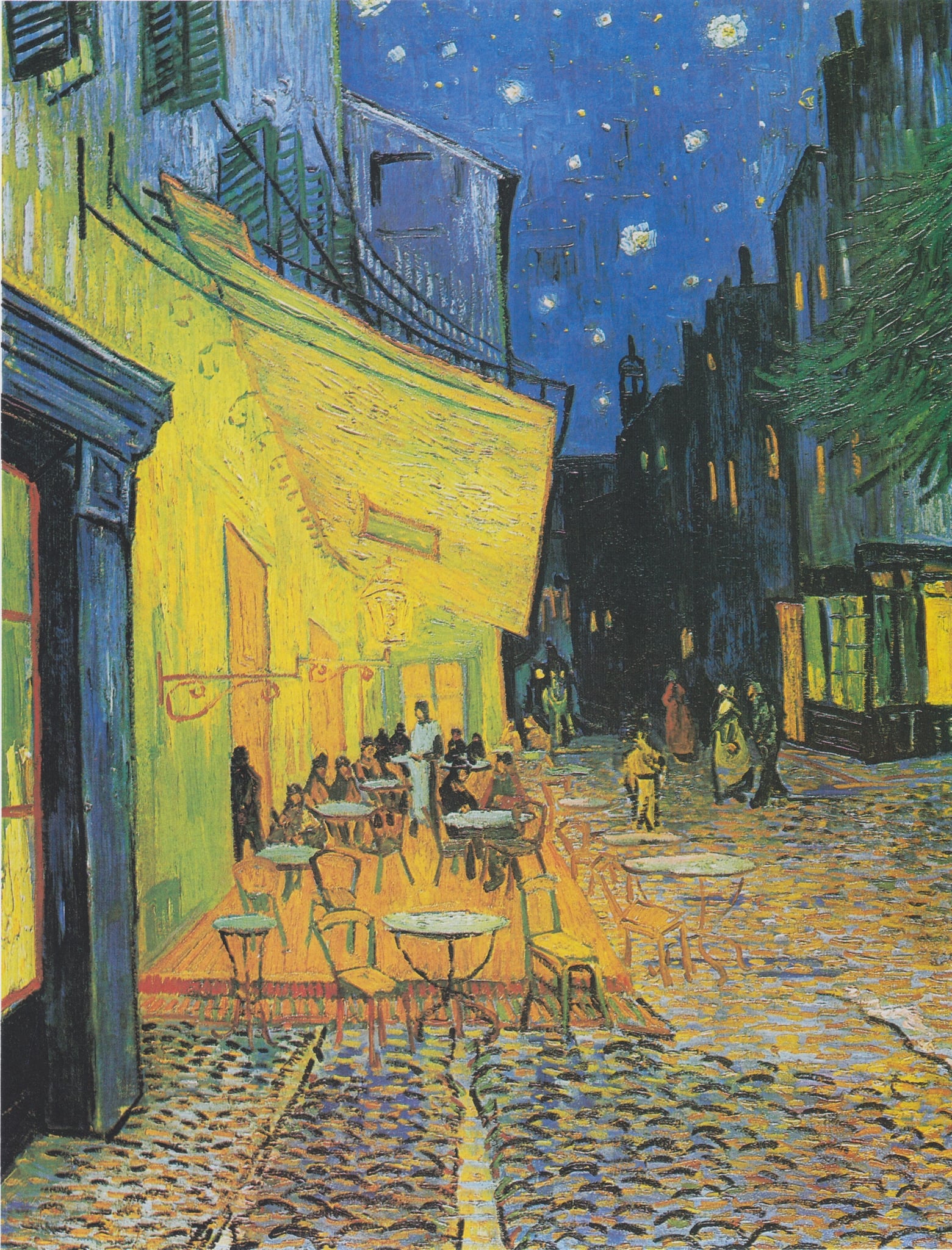
Café Terrace at Night by Vincent van Gogh

Café Terrace at Night

Vincent van Gogh (1888)

In Café Terrace at Night, Vincent van Gogh turns nocturne into <strong>luminous color</strong>: a gas‑lit terrace glows in yellows and oranges against a deep <strong>ultramarine sky</strong> pricked with stars. By building night “<strong>without black</strong>,” he stages a vivid encounter between human sociability and the vastness overhead <sup>[1]</sup><sup>[2]</sup>.
Red Cabbages and Onions by Vincent van Gogh

Red Cabbages and Onions

Vincent van Gogh (1887)

In Red Cabbages and Onions, Vincent van Gogh turns everyday produce into a drama of <strong>complementary color</strong> and <strong>restless brushwork</strong>. Hot red contours cinch violet cabbages and pale yellow bulbs against a cool, striated blue table, while a mustard‑yellow patch in the upper right tilts the space and sharpens the chromatic clash. The result asserts ordinary food as a locus of <strong>resilience</strong> and <strong>experimentation</strong> <sup>[1]</sup><sup>[2]</sup>.

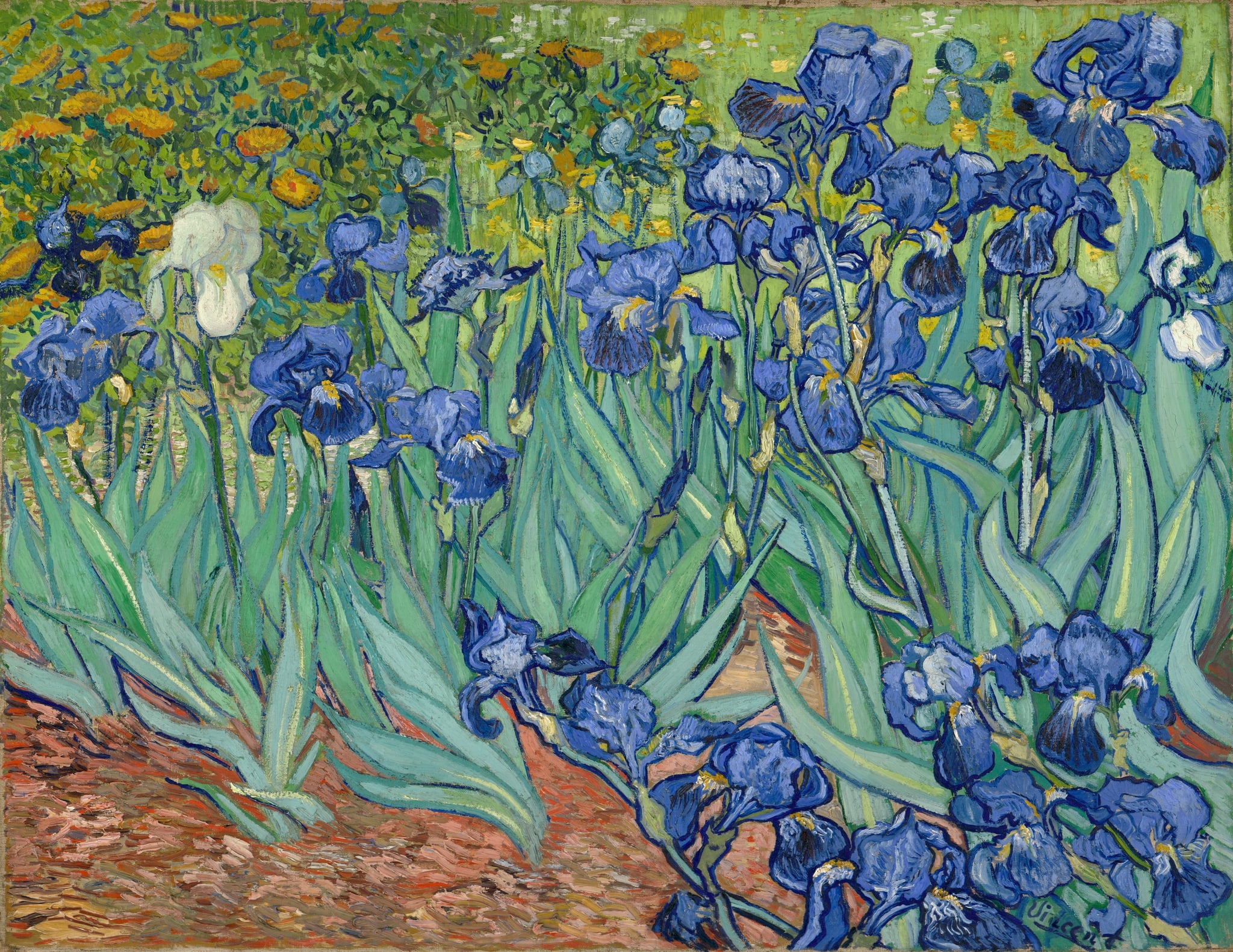
Irises by Vincent van Gogh

Irises

Vincent van Gogh (1889)

Painted in May 1889 at the Saint-Rémy asylum garden, Vincent van Gogh’s <strong>Irises</strong> turns close observation into an act of repair. Dark contours, a cropped, print-like vantage, and vibrating complements—violet/blue blossoms against <strong>yellow-green</strong> ground—stage a living frieze whose lone <strong>white iris</strong> punctuates the field with arresting clarity <sup>[1]</sup><sup>[2]</sup>.
Sunflowers by Vincent van Gogh

Sunflowers

Vincent van Gogh (1888)

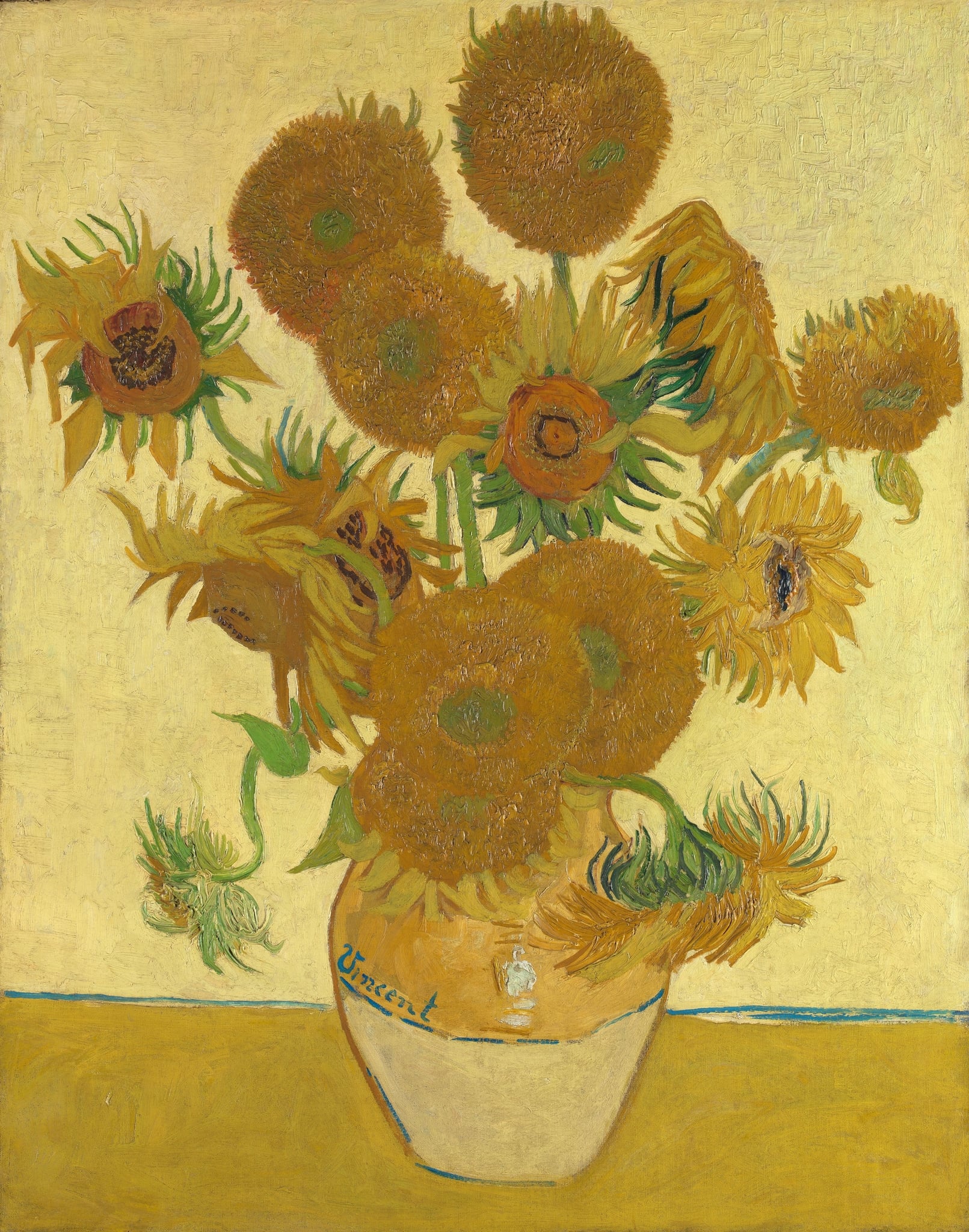
Vincent van Gogh’s Sunflowers (1888) is a <strong>yellow-on-yellow</strong> still life that stages a full <strong>cycle of life</strong> in fifteen blooms, from fresh buds to brittle seed heads. The thick impasto, green shocks of stem and bract, and the vase signed <strong>“Vincent”</strong> turn a humble bouquet into an emblem of endurance and fellowship <sup>[1]</sup><sup>[2]</sup>.

Garden with Courting Couples: Square Saint-Pierre by Vincent van Gogh

Garden with Courting Couples: Square Saint-Pierre

Vincent van Gogh (1887)

In Garden with Courting Couples: Square Saint-Pierre, Vincent van Gogh turns a small Montmartre park into a stage where <strong>spring</strong>, <strong>intimacy</strong>, and <strong>urban leisure</strong> converge. Short, shimmering strokes fuse pink chestnut blossoms, curving paths, and paired figures into one pulse of <strong>renewal</strong> and <strong>togetherness</strong> <sup>[1]</sup><sup>[2]</sup>.

In the Café: Agostina Segatori in Le Tambourin by Vincent van Gogh

In the Café: Agostina Segatori in Le Tambourin

Vincent van Gogh (1887 (Jan–Mar))

Van Gogh casts Agostina Segatori at a tiny, tambourine‑like café table, turning Le Tambourin into a <strong>stage of modern life</strong>. Cool greens and greys make the red <strong>flame‑plume hat</strong> and the foaming <strong>beer</strong> flare, while folded arms and a set‑aside <strong>parasol</strong> register private fatigue amid public display <sup>[1]</sup><sup>[2]</sup><sup>[3]</sup>.