How Much Is The Harvest Worth?
Last updated: May 27, 2026
Quick Facts
- Methodology
- comparable analysis
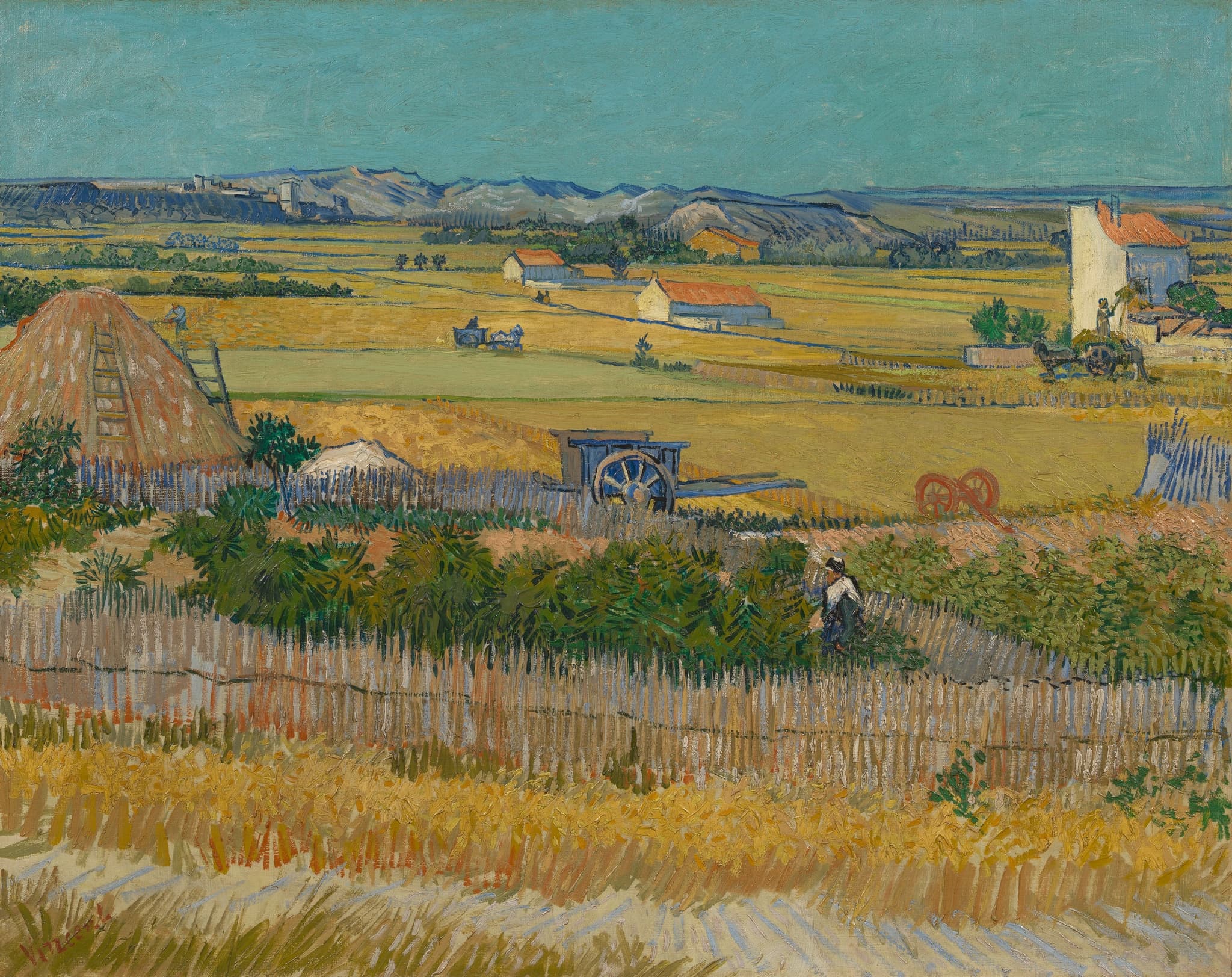
The Harvest (1888) is a signature Arles-period panorama by Vincent van Gogh, held by the Van Gogh Museum and never publicly sold. Anchored by the 2022 van Gogh landscape record at $117.2m and reinforced by a 2026 $29.4m sale of the large watercolor study for this exact motif, the work’s hypothetical fair‑market value today is $150–250 million. Trophy scarcity, period/subject primacy, and museum‑grade stature support this range.
Valuation Analysis
Work and status. Vincent van Gogh’s The Harvest (La moisson), oil on canvas, 73.4 x 91.8 cm, painted in Arles in June 1888 (F 412; JH 1440), is among the artist’s most celebrated Provençal panoramas. It entered the Van Gogh family collection via Theo and is now credited to the Vincent van Gogh Foundation and housed at the Van Gogh Museum, Amsterdam; it has never been publicly sold [1].
Headline estimate. The painting’s hypothetical fair‑market value is $150–250 million. This range is anchored to the current auction record for a van Gogh painting—Orchard with Cypresses (Arles, April 1888), sold for $117.18 million at Christie’s New York in 2022—and reflects The Harvest’s at-least-equal art-historical significance, panoramic ambition, prime 1888 date, and extraordinary visibility in scholarship and exhibitions [2].
Key comparables and market evidence. Beyond the 2022 record, late 1880s van Gogh landscapes consistently command major prices: Laboureur dans un champ (1889) realized $81.31 million (2017) and Cabanes de bois parmi les oliviers et cyprès (1889) made $71.35 million (2021), confirming deep demand for top-tier southern French subjects [6][5]. Importantly, the large watercolor study directly related to The Harvest (La moisson en Provence) achieved $29.4 million with fees at Sotheby’s in May 2026, underscoring outsized collector appetite for this precise motif even in works on paper [4]. The artist’s broader momentum—exemplified by a $62.7 million Paris-period still life in 2025—reinforces depth at the top end across periods and subjects [3].
Scarcity and trophy dynamics. A+ Arles-period masterworks of this visibility are effectively unavailable; most reside in institutions or core collections. If The Harvest were ever to be deaccessioned, scarcity, international competition, and the work’s media profile would likely draw intense bidding, with third‑party guarantees and cross-border demand shaping the outcome. At this level, pricing is driven less by incremental comps than by trophy desirability within a global, highly selective buyer pool.
Positioning within the range. The low end ($150m) reflects a conservative premium over the 2022 Arles-landscape record, while the high end ($250m) captures The Harvest’s elevated subject/period status, direct-study validation, and museum-grade caliber. Condition, surface preservation, and structural stability are the primary swing factors; pristine state would support the upper band. The work’s impeccable provenance (artist→Theo→Foundation→museum) and extensive literature/exhibition record further de-risk acquisition, supporting nine-figure valuation confidence [1].
Key Valuation Factors
Art Historical Significance
High ImpactPainted in June 1888 during van Gogh’s Arles apex, The Harvest is a definitive statement of his wheatfield/harvest cycle, integrating panoramic composition, heightened color, and rhythmic mark‑making. It is widely published, frequently exhibited, and central to the narrative of van Gogh’s mature style. The vantage unifies agricultural labor, architecture, and landscape into a single, emblematic Provençal vision—an image type core to the artist’s legacy. Catalogued as F 412 / JH 1440, the canvas is deeply embedded in scholarship and connoisseurship, elevating its cultural and market primacy. Among Arles-period landscapes, few works combine subject importance, scale, and pictorial ambition as completely as this painting, placing it at the top tier of the oeuvre.
Period and Subject Desirability
High ImpactArles (1888–89) is the most coveted window in van Gogh’s market, and harvest/wheatfield motifs are among the most sought-after subjects within that period. Direct Arles comparables have delivered the artist’s top prices at auction, including Orchard with Cypresses (1888) at $117.2m. The Harvest’s luminous palette, sweeping horizon, and emblematic agrarian theme align with the exact features that drive nine-figure bidding: prime date, instantly recognizable subject, and compelling compositional architecture. The 2026 sale of the large watercolor study for The Harvest at $29.4m shows buyers’ willingness to pay exceptional prices even for related works on paper, signaling strong conviction in the subject’s desirability and supporting a premium for the finished oil.
Scarcity and Trophy Competition
High ImpactA+ Arles-period van Goghs of this scale and ambition almost never surface; many are in museums or long-term private holdings. When a masterpiece-caliber van Gogh does appear, it commands intense global competition from a concentrated pool of UHNWIs and institutions, often underpinned by third‑party guarantees. This scarcity dynamic decouples pricing from incremental comparables and instead ties it to trophy demand. The Harvest’s museum stature and newsworthiness would likely amplify bidder engagement and media coverage, encouraging aggressive estimates and bidding. In a strong season, scarcity and trophy psychology can add tens of millions above conservative comps, justifying a range that meaningfully exceeds the 2022 Arles record while remaining grounded in recent data.
Provenance and Museum Status
High ImpactThe Harvest comes directly from the artist to Theo van Gogh, then by descent to Jo van Gogh-Bonger and their son Vincent Willem, and into the Vincent van Gogh Foundation—now on view at the Van Gogh Museum. This uninterrupted chain within the van Gogh family and Foundation minimizes provenance risk, enhances cultural credibility, and contributes to an institutional-grade dossier (exhibitions, literature, technical files). While deaccession is unlikely, if a sale were contemplated, such pedigree would streamline due diligence, appeal to risk‑averse global buyers, and support aggressive pricing. The painting’s standing within a leading single-artist museum further validates its canonical status, reinforcing a valuation premium typically reserved for the artist’s most important works.
Condition, Scale, and Display Impact
Medium ImpactAt 73.4 x 91.8 cm, The Harvest has ideal wall power: large enough to carry a room yet intimate enough for residential display. Assuming sound structural condition, stable paint layers, and a well-preserved surface with judicious conservation, the work sits favorably against auction comparables that set the artist’s records. Condition is the principal swing factor at this level; pristine or near-pristine state would validate the top of the range or higher in a competitive sale. Conversely, material issues (excessive lining, overcleaning, significant retouch) would temper bidding and narrow the spread. On balance, scale, composition, and chromatic intensity deliver marquee-level display impact that aligns with nine-figure collecting ambitions.
Sale History
The Harvest has never been sold at public auction.
Vincent van Gogh's Market
Vincent van Gogh occupies the top echelon of the global art market, with exceptionally deep demand for prime Arles and late 1880s works. The current auction record is $117.18 million for Orchard with Cypresses (Christie’s, 2022), and other late-1880s benchmarks include $81.31 million for Laboureur dans un champ (2017) and $71.35 million for Cabanes de bois parmi les oliviers et cyprès (2021). Momentum broadened in 2025 when a Paris‑period still life achieved $62.7 million, while in 2026 the large watercolor study for The Harvest brought $29.4 million—exceptional for a work on paper. Supply of A+ canvases is extremely limited, and fresh, museum‑grade material reliably attracts global competition at nine-figure levels.
Comparable Sales
Orchard with Cypresses (Verger avec cyprès)
Vincent van Gogh
Same artist; Arles 1888 landscape of orchard/country motif from the prime year, similar scale and ambition; top-tier, museum-quality benchmark for Arles-period landscapes.
$117.2M
2022, Christie's New York
~$128.1M adjusted
Cabanes de bois parmi les oliviers et cyprès
Vincent van Gogh
Same artist; large Provençal landscape (Saint-Rémy, 1889) with cypresses/olives—closely related southern French landscape vocabulary and market tier.
$71.3M
2021, Christie's New York
~$84.3M adjusted
Laboureur dans un champ (Ploughman in the Field)
Vincent van Gogh
Same artist; 1889 farmland scene with figure working the field—very close thematically to harvest/agrarian motifs and an A‑tier landscape auction benchmark.
$81.3M
2017, Christie's New York
~$106.1M adjusted
L’Allée des Alyscamps
Vincent van Gogh
Same artist; Arles 1888 series painted during Gauguin’s visit—core Arles-period, large-scale landscape with iconic subject and strong market validation.
$66.3M
2015, Sotheby's New York
~$89.5M adjusted
La moisson en Provence (large watercolor study for The Harvest)
Vincent van Gogh
Same artist; direct 1888 study for The Harvest—identical subject and moment in Arles. Although on paper, it demonstrates current demand for this exact motif.
$29.4M
2026, Sotheby's New York
~$28.8M adjusted
Current Market Trends
The top end of the Impressionist & Post‑Impressionist segment remains resilient despite recent cyclical softness. After a cooler 2024, late‑2025 marquee auctions signaled renewed trophy appetite, with guarantees and third‑party backing facilitating aggressive bidding for masterpieces. Blue‑chip European Modern names with prime-period works, impeccable provenance, and strong exhibition histories continue to clear ambitious estimates, while mid‑tier material faces more selective demand. Asia’s collector base remains an important growth constituency for canonical European works. In this two‑speed environment, museum‑caliber van Goghs—especially Arles 1888 landscapes—sit firmly in the segment most likely to elicit intense competition and price discovery at or above recent headline comparables.
Study print
Study this painting as a print
Pair the full artwork with a museum-style study sheet focused on one meaningful detail.
Sources
- Van Gogh Museum – The Harvest (La moisson), object record s0030V1962
- The Art Newspaper – A van Gogh record: Orchard with Cypresses soars to $117m (Nov 2022)
- The Art Newspaper – Two van Gogh records smashed (Nov 2025)
- The Art Newspaper – Bidding battle for Matisse leads Sotheby’s Modern sale; van Gogh study hits $29.4m (May 2026)
- The Value – Christie’s Cox Collection: van Gogh’s Cabanes de bois… sells for $71.35m (Nov 2021)
- Artnet News – Christie’s Impressionist & Modern Evening Sale (Nov 2017): Laboureur dans un champ at $81.31m