How Much Is Two Crabs Worth?
Last updated: June 26, 2026
Quick Facts
- Last Sale
- $9.4M (2004, Sotheby's London)
- Methodology
- comparable analysis
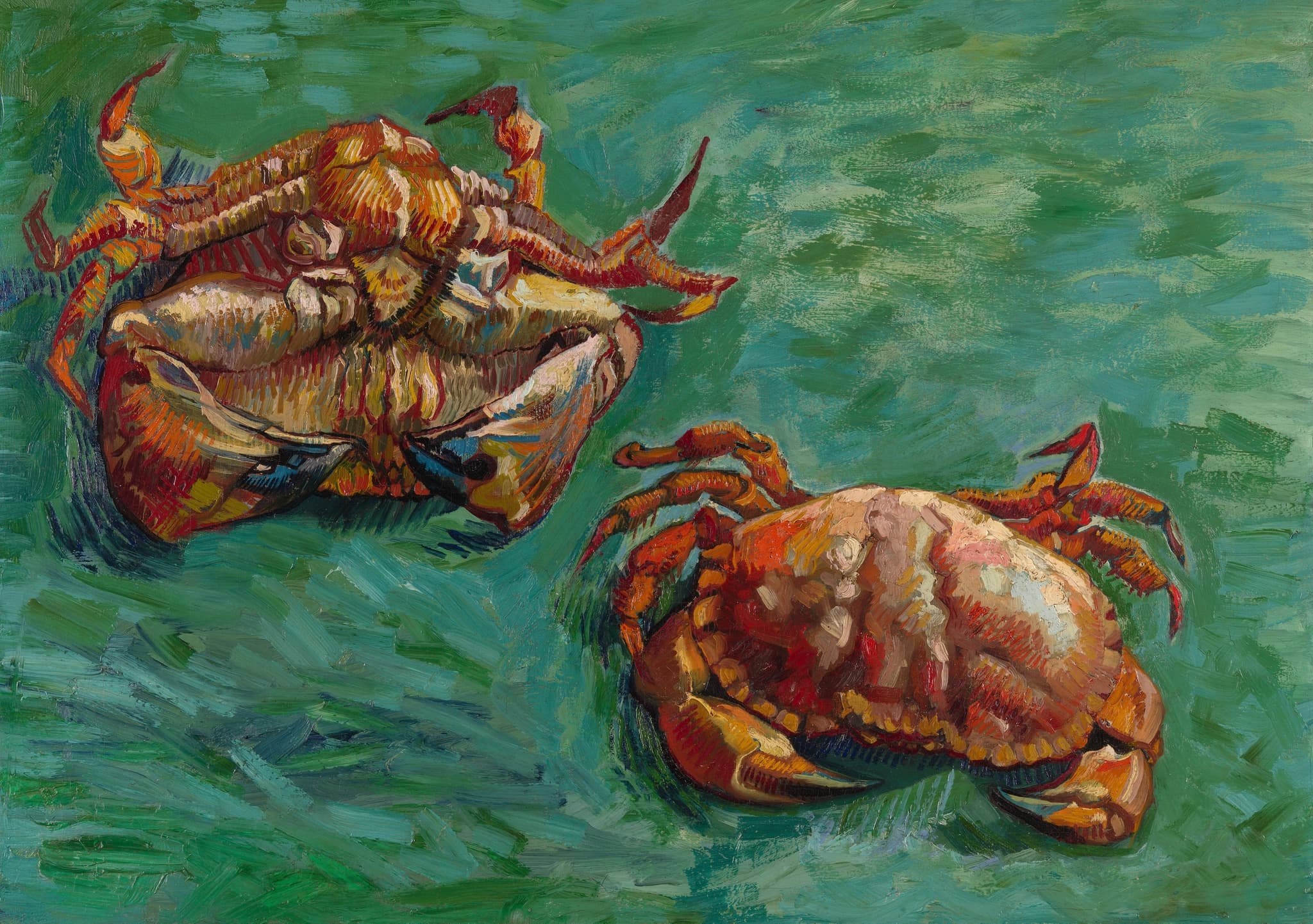
Two Crabs (F606) is a prime‑period Van Gogh still life, long on view at London’s National Gallery and last sold publicly at Sotheby’s London in 2004 for roughly $9.4 million. Anchored to recent late‑1880s Van Gogh benchmarks—still lifes at $61.8m (2014) and $62.7m (2025), late landscapes at $66–81m, and a $117.2m artist record (2022)—a fair, unconstrained estimate today is $70–105 million, assuming excellent condition and clean provenance.
Valuation Analysis
Overview and status. Vincent van Gogh’s Two Crabs (F606; 47 × 61 cm) is a distinctive, prime‑period still life associated with his late 1880s production. The painting is in a private collection and has been on long‑term loan to the National Gallery, London, enhancing its visibility and scholarly standing [1]. The most recent public sale occurred at Sotheby’s London on 22 June 2004, where it realized around £5.1m with fees (c.$9.4m), before entering its current private ownership and being lent to the National Gallery [2][3].
Method and comparables. This valuation is derived from direct, recent-market comparables for late‑1880s Van Gogh paintings, particularly still lifes and Saint‑Rémy/Arles works of similar caliber. Late Van Gogh still lifes have reached $61.8m (Vase with Daisies and Poppies, 2014) [5] and $62.7m (Parisian Novels, 2025), confirming robust depth for the category. Prime late landscapes have traded higher—L’Allée des Alyscamps (1888) at $66.3m (2015) and Laboureur dans un champ (1889) at $81.3m (2017) [6][7]—while smaller or less universal asylum‑period subjects have made about $40m (2019) [8]. The artist’s standing auction record is $117.2m for Orchard with Cypresses (2022), which sets the ceiling for truly iconic works [4].
Positioning Two Crabs. Two Crabs is a museum‑caliber, highly recognizable still life from a prime year, distinguished by its vivid complementary palette and ties to Van Gogh’s Japonisme interests. While it is not an icon on the order of Sunflowers, Irises, or the most coveted cypress/wheatfield landscapes, its date, quality, visibility at the National Gallery, and scholarly interest place it firmly above the $60m still‑life benchmark. Given thin supply of best‑in‑class Van Goghs and the flight to blue‑chip quality, a competitive auction or top‑tier private sale could rationally transact in the $70–105m range today, situating the work between the best still lifes and the marquee late landscapes [5][6][7][9].
Assumptions and sensitivities. This estimate assumes excellent structural and cosmetic condition, clean title, and fully documented provenance/exhibition history consistent with the 2004 Sotheby’s catalogue [2]. Within the band, stronger guarantees, marquee‑collection provenance, and optimal sale choreography could press toward the upper end, while material condition issues would compress the outcome. In the current quality‑led market, the combination of prime period, museum exposure, and subject distinctiveness supports the $70–105m opinion of value.
Key Valuation Factors
Art Historical Significance
High ImpactTwo Crabs is a prime‑period Van Gogh still life that embodies the artist’s late‑1880s colorism and structured brushwork, and it resonates with his Japonisme interests and studio experimentation. Its pairing in scholarship with the related Crab on its Back (Van Gogh Museum) and its frequent reproduction bolster its art‑historical profile. While not at the absolute icon level of Sunflowers or Irises, it is a recognized, museum‑caliber canvas from a year that anchors many of the artist’s most desirable works. That scholarly and curatorial framing enhances demand among connoisseur buyers seeking late‑1880s exemplars rather than early Dutch-period subjects or minor motifs.
Prime Period and Quality
High ImpactThe painting dates to the artist’s late 1880s prime, a window that commands the highest prices across his market. Two Crabs displays saturated complementary hues and assured, sculptural handling that collectors associate with Arles/Saint‑Rémy excellence. Its scale (circa 47 × 61 cm) is substantial for a still life, with strong wall power relative to smaller easel studies. Market history confirms a premium for late‑1880s oils that combine chromatic intensity with clarity of composition. In this context, Two Crabs aligns more closely with the top still lifes that have set Van Gogh’s category benchmarks than with secondary works or earlier, exploratory pictures.
Provenance and Exhibition Exposure
High ImpactThe documented early chain—from Theo and Jo van Gogh‑Bonger to notable early collectors and dealers—confers confidence and cultural resonance. The work’s 2004 Sotheby’s sale established a modern market footing; its subsequent, long‑term loan to the National Gallery, London, grants sustained public profile and curatorial validation. Museum exposure tends to elevate perceived quality, improve buyer familiarity, and reduce perceived risk—factors that correlate with stronger bidding. This combination of traceable provenance, public visibility, and scholarly engagement positions Two Crabs as a ready “trophy‑adjacent” lot for top‑tier evening sales or discreet private placements.
Scarcity and Market Liquidity
High ImpactFresh, prime‑period Van Gogh oils appear infrequently at auction, and competition intensifies when examples surface, particularly in late‑1880s subjects. Recent results show healthy liquidity and depth of bidding at $40m–$80m+, with top icons surpassing $100m. Within this supply‑constrained environment, a distinctive, museum‑displayed still life from 1887–89 offers crossover appeal to collectors who may already own landscapes or portraits. Scarcity premiums and global demand from the U.S., Europe, and Asia support a valuation that not only clears the still‑life benchmark but also approaches the lower band of major late landscapes, justifying the $70–105m range.
Sale History
Sotheby's London
Impressionist & Modern Art Evening Sale, Lot 5; widely reported with fees c. £5.1m (~$9.4m).
Frederik Müller & Cie, Amsterdam
Lot 33; 100 guilders to Bernheim‑Jeune. USD nominal approx. based on historical parity.
Private sale (Amsterdam)
Jo van Gogh‑Bonger to William Cherry Robinson; 200 guilders ≈ £17 ≈ $83 nominal (approx.).
Vincent van Gogh's Market
Vincent van Gogh is among the most liquid and sought‑after names in the global art market. His auction record stands at $117.2 million for Orchard with Cypresses (Christie’s, 2022), and multiple late‑1880s oils have achieved between $60 million and $100 million+, indicating broad, deep demand at the summit. Still lifes from the late 1880s have reached $61.8 million (2014) and $62.7 million (2025), while prime late landscapes have realized $66–81 million in recent marquee sales. Scarcity of fresh, blue‑chip material and the artist’s durable cultural cachet underpin resilient pricing, with institutional programming and international buyer interest continuing to catalyze competition for best‑in‑class works.
Comparable Sales
Nature morte, vase aux marguerites et coquelicots (Vase with Daisies and Poppies)
Vincent van Gogh
Same artist; late-1880s/1890 still life with vivid palette; museum-caliber and widely exhibited; strong subject proximity to Two Crabs (prime-period still life).
$61.8M
2014, Sotheby's New York
~$80.3M adjusted
Parisian Novels (Romans parisiens)
Vincent van Gogh
Same artist; still life from 1887 with strong color/graphic appeal; most recent marquee van Gogh still-life result and record for a still life—highly relevant subject/period comp.
$62.7M
2025, Sotheby's New York
L’Allée des Alyscamps
Vincent van Gogh
Same artist; prime Arles (1888) period oil, larger scale; illustrates upper tier for late-1880s canvases that are more 'trophy' than still lifes—helps set the ceiling context.
$66.3M
2015, Sotheby's New York
~$84.9M adjusted
Laboureur dans un champ (Ploughman in the Field)
Vincent van Gogh
Same artist; 1889 Saint-Rémy oil from the exact prime year debated for Two Crabs; major late landscape establishing the high tier for late works.
$81.3M
2017, Christie's New York
~$99.2M adjusted
Arbres dans le jardin de l’asile
Vincent van Gogh
Same artist; 1889 asylum-period oil with strong color; smaller/less iconic subject than top landscapes but very close in date and period to Two Crabs.
$40.0M
2019, Christie's New York
~$46.8M adjusted
Coin de jardin avec papillons
Vincent van Gogh
Same artist; 1887 Paris-period nature subject with saturated complementary colors; useful lower-bound anchor for late-1880s non-icon subjects relative to still lifes.
$33.2M
2024, Christie's New York
~$34.2M adjusted
Current Market Trends
The current market for Impressionist and Post‑Impressionist “Modern Masters” is quality‑led and polarized, with top, museum‑grade works attracting vigorous global bidding and mid‑tier material trading more selectively. Van Gogh sits at the center of this flight to quality: supply is thin, estimates are supported by recent blue‑chip comparables, and high‑visibility institutional exhibitions have broadened demand. Within this environment, late‑1880s oils—especially compelling still lifes and Provence/Saint‑Rémy subjects—enjoy sustained liquidity, while strategic guarantees and best‑in‑class sale orchestration can extend outcomes into the $70m–$100m+ bracket for works with strong provenance, condition, and brand recognition.
Study print
Study this painting as a print
Pair the full artwork with a museum-style study sheet focused on one meaningful detail.
Sources
- National Gallery, London — Two Crabs object record
- Sotheby’s London, 22 June 2004, Lot 5 (Deux Crabes) — e-catalogue
- The Guardian — Report on £5m Van Gogh sale (2004)
- Wikipedia — Orchard with Cypresses (2022 record)
- DutchNews — Vase with Daisies and Poppies sells for $61.8m (2014)
- Town & Country — Van Gogh’s L’Allée des Alyscamps sells for $66.3m (2015)
- Artsy — Most expensive artworks sold in 2017 (includes $81.3m Van Gogh)
- Christie’s Press — Impressionist & Modern Evening Sale results (2019)
- Sotheby’s — The 10 Most Valuable Lots Sold by Sotheby’s in 2025 (includes $62.7m still life)