Two Crabs

by Vincent van Gogh

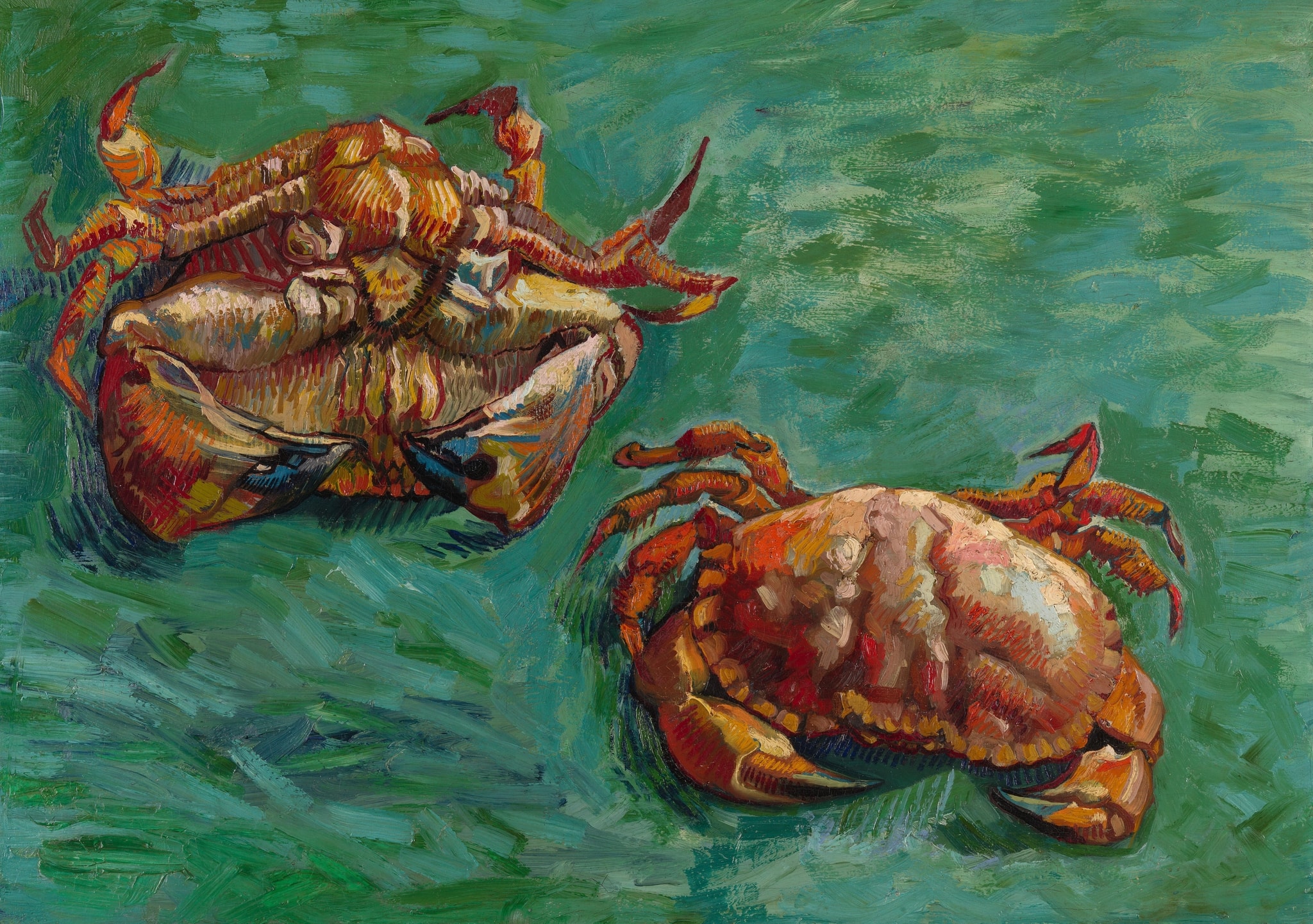
Two Crabs stages a compact drama of vulnerability and resilience: one crab lies overturned, the other holds firm on its claws. Van Gogh fuses complementary red–green contrasts with calligraphic outlines to make the scene pulse between peril and recovery [1].

Study Print Studio

Create a personal study print

Build a companion study sheet around the part of this painting that speaks to you most. Choose a detail, shape an interpretation, and walk away with something personal and display-worthy.

Fast Facts

Year
1889
Medium
Oil on canvas
Dimensions
47 × 61 cm
Location
National Gallery, London
See all Vincent van Gogh paintings in London
Two Crabs by Vincent van Gogh (1889) featuring Overturned crab, Upright crab, Female abdominal flap, Red–green complementaries

Click on any numbered symbol to learn more about its meaning

Meaning & Symbolism

Two Crabs asserts its stakes immediately in the left-right pairing: at left, the crab is flipped, legs splayed and belly exposed; at right, the shell sits upright, claws tucked into a defensive arc. Van Gogh renders both with short, faceted touches of vermilion, ocher, and cobalt blue, but he assigns different energies to each body. The overturned crab’s abdominal plate—marked with the enlarged flap that identifies it as female—reads as tender and permeable; the modeling breaks into striping and scalloped dashes that feel vulnerable to the field around it 1. The upright crab, by contrast, coheres as a convex mass; strokes wrap the carapace like armor plates. Across both, the thick, rhythmic green ground moves like a shallow, weeded tide, not a neutral tabletop. Those directional strokes do not merely surround the crabs; they pressure them, animating the threat of submersion and the will to keep footing. In this choreography of positions and pressures, the painting declares a narrative of setback and return rather than a neutral specimen study. Color drives that declaration. Van Gogh keys the scene to red–green complementaries, a Delacroix-inflected strategy that heightens emotional charge through opposition 1. The crabs’ orange-red bodies flash against cool sea-greens, while blue accents under the left crab’s claws drop the temperature to make its predicament feel colder and more precarious. The background’s broad, lateral strokes organize the space as a flattened, patterned field, compressing depth so the drama happens on the surface plane, where color and contour do the work. This planar emphasis, with crisp, enclosing outlines and calligraphic inflections on leg joints and belly ribbing, signals his study of Japanese woodblock prints—Hokusai and Kunisada’s crabs reproduced in the period literature he avidly read—absorbed and transformed into a Western oil technique that remains emphatically tactile and impasto-rich 1. The hybrid is intentional: Van Gogh binds Eastern linear economy to Dürer-like descriptive attention, so the female identifier, the knuckled joints, and the mottled shell patterning matter as both natural facts and expressive instruments 1. Biographically, the canvas amplifies its formal tensions into existential ones. In early January 1889, immediately after release from the Arles hospital, Van Gogh wrote that he would begin again with “one or two still lifes” to re-enter his craft; the National Gallery connects that plan to this very subject 41. Read through that lens, the overturned crab personifies a near-defeat; the upright companion models the act of righting oneself. Critics have noted that this pairing registers a post-crisis self-image—helplessness answered by stubborn survival—without resorting to anecdote or self-portraiture 3. Yet even if one brackets psychology, the painting insists on recovery as a pictorial fact: the right-hand crab’s gathered stance, the darker shadow pooling beneath it, and the denser contour around its claws all telegraph stability achieved against a moving ground. That is why Two Crabs is important: it demonstrates how Van Gogh could convert color theory and cross-cultural style into a legible ethics of endurance. The motif also converses with his earlier A Crab on its Back, showing that the overturned pose preoccupied him before Arles and that here he completes the thought by staging reversal alongside its correction, compressing failure and persistence into one, unforgettable dyad 21.

Explore Deeper with AI

Ask questions about Two Crabs

Popular questions:

Powered by AI • Get instant insights about this artwork

💬 Ask questions about this artwork!

Interpretations

Historiography & Dating: How Time Rewrites Meaning

Whether Two Crabs belongs to January 1889 in Arles or earlier in 1887 Paris is not a footnote—it changes the picture’s ethical register. If 1889, the overturned/righted dyad reads as a near-immediate post‑hospital allegory of survival, aligned with the letter promising to restart with still lifes 41. If 1887, the motif long predates the Arles crisis; the later pairing would then be an act of retrospection, folding an earlier Parisian crab study into a new two-part structure that viewers later psychologized 23. This debate models how curatorial dating can pivot interpretation from biographical testimony to studio revision and self‑curation, reminding us that meaning accrues not only on the canvas but across an artist’s evolving practice.

Source: The Art Newspaper (Martin Bailey); National Gallery, London; Van Gogh Museum

Eco-Phenomenology: Ground as Active Medium

The green field is not inert support; its directional, rhythmic strokes act like a shallow, weedy tide that presses back against the creatures. In this reading, Van Gogh stages an environmental encounter: the world as flow and pressure to which bodies must attune or succumb. The upright crab’s compacted stance and pooled shadow figure a micro‑ecology of footing and counter‑force; the overturned crab’s striped modeling implies permeability within that same current. Rather than a moral fable imported from outside, the scene’s ethics arise from painterly ecology—how color, vector, and surface motion articulate resistance within a field. The result anticipates modern accounts of landscape as an active system, not backdrop, making facture the vehicle of environmental agency 1.

Source: National Gallery, London

Gendered Natural History: Seeing Sex, Feeling Risk

The left specimen’s enlarged abdominal flap—a precise sign of a female brown crab—signals Van Gogh’s Dürer‑like fidelity to biological description even as he stylizes contour and hue 1. But this index of sex does double duty: placed on the overturned body, it blends natural-historical clarity with an affect of exposure, allowing gendered anatomy to structure the painting’s drama of risk. This fusion reflects a late‑19th‑century visual culture in which scientific illustration and fine art cross‑pollinated; here, sexual dimorphism is not a didactic label but a formal hinge—the site where calligraphic strokes, chromatic cooling, and pose converge to produce meaning. Van Gogh lets empirical detail and expression co‑author the scene’s stakes.

Source: National Gallery, London

Cross-Cultural Translation: Japonisme into Impasto

Two Crabs exemplifies translation rather than imitation. Van Gogh absorbs the flatness, contour economy, and motif from woodblock prints he studied in Gonse’s L’Art Japonais and in reproductions of Hokusai and Kunisada, then revoices them through saturated complements and tactile impasto 17. The result is a hybrid syntax: Japanese linear clarity organizes form, while Western oil’s material density dramatizes surface pressure and light. Read as a meditation on authorship, the canvas tests how borrowed forms change when rerouted through medium and mood—less cultural quotation than material re‑composition. In this lens, originality lies in the frictive seam where imported line meets embodied paint, generating an image that is historically legible and unmistakably Van Gogh.

Source: National Gallery, London; Van Gogh Museum (Japanese prints)

Color Science to Affect: Delacroix Rewired

Van Gogh activates Delacroix’s red–green complementaries to convert optical contrast into emotional voltage. Orange‑reds flare against bluish‑greens, while cooler blue accents under the left crab intensify the sense of exposure; yet the application resists Neo‑Impressionist dotting in favor of short, faceted strokes that keep energy on the surface 15. This is color as dramaturgy: complements not only heighten local hues but also map the painting’s ethical vector—from precariousness to poise. The compressed field denies deep space so that contrast works face‑forward, where viewers feel it. In doing so, Van Gogh demonstrates how 19th‑century color theory, filtered through personal touch and impasto, can exceed optics to stage a scene of endurance.

Source: National Gallery, London; Met Museum Heilbrunn Timeline

Related Themes

About Vincent van Gogh

Vincent van Gogh (1853–1890) developed a radical, emotion‑driven use of color after moving from Paris to Arles in 1888, seeking southern light and an artists’ community. In Arles he created the Sunflowers series to decorate the Yellow House ahead of Gauguin’s visit. His late work fused impasto, high chroma, and symbolic motifs that shaped modern painting [2][5].
View all works by Vincent van Gogh

More by Vincent van Gogh
Café Terrace at Night by Vincent van Gogh

Café Terrace at Night

Vincent van Gogh (1888)

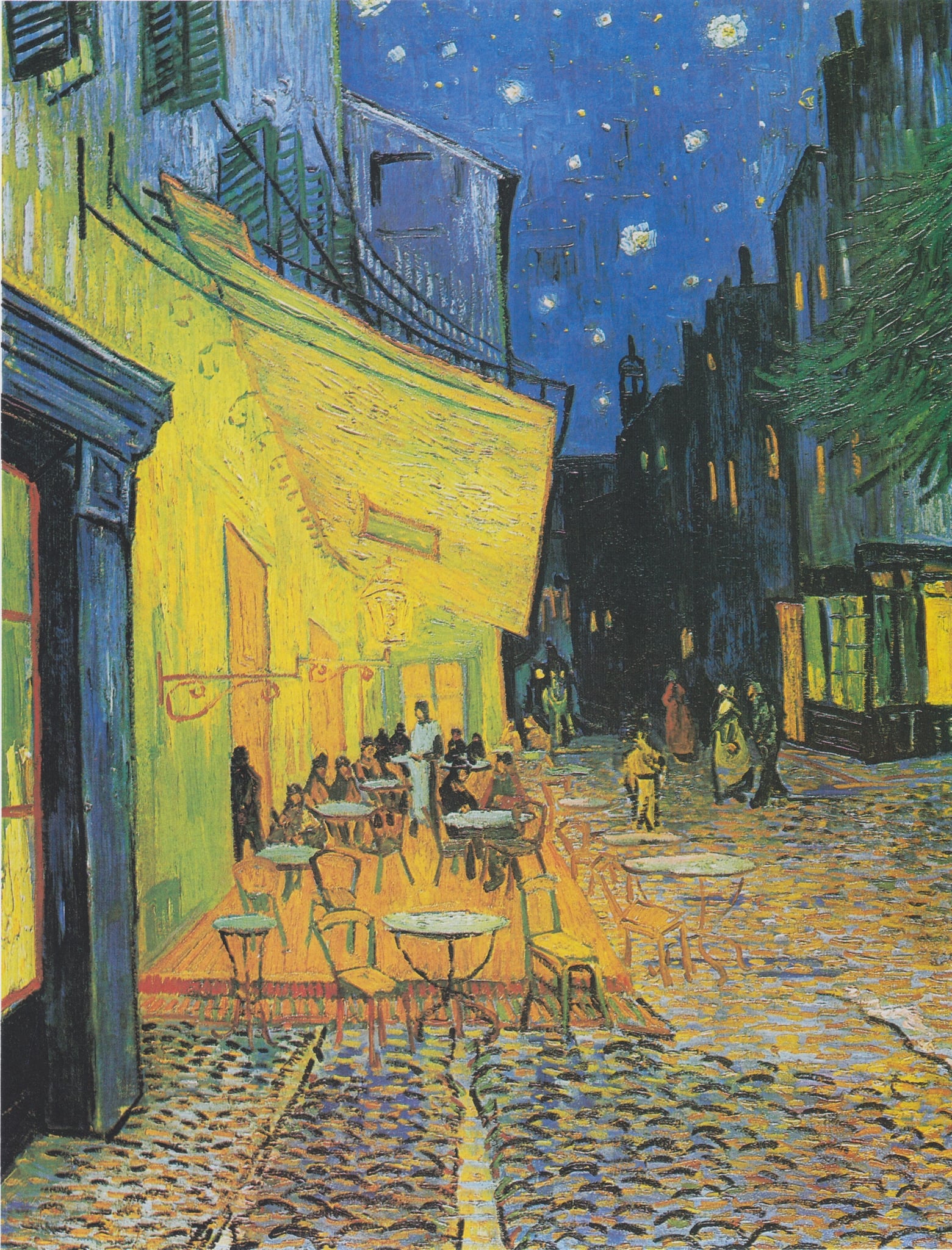
In Café Terrace at Night, Vincent van Gogh turns nocturne into <strong>luminous color</strong>: a gas‑lit terrace glows in yellows and oranges against a deep <strong>ultramarine sky</strong> pricked with stars. By building night “<strong>without black</strong>,” he stages a vivid encounter between human sociability and the vastness overhead <sup>[1]</sup><sup>[2]</sup>.
Red Cabbages and Onions by Vincent van Gogh

Red Cabbages and Onions

Vincent van Gogh (1887)

In Red Cabbages and Onions, Vincent van Gogh turns everyday produce into a drama of <strong>complementary color</strong> and <strong>restless brushwork</strong>. Hot red contours cinch violet cabbages and pale yellow bulbs against a cool, striated blue table, while a mustard‑yellow patch in the upper right tilts the space and sharpens the chromatic clash. The result asserts ordinary food as a locus of <strong>resilience</strong> and <strong>experimentation</strong> <sup>[1]</sup><sup>[2]</sup>.

Irises by Vincent van Gogh

Irises

Vincent van Gogh (1889)

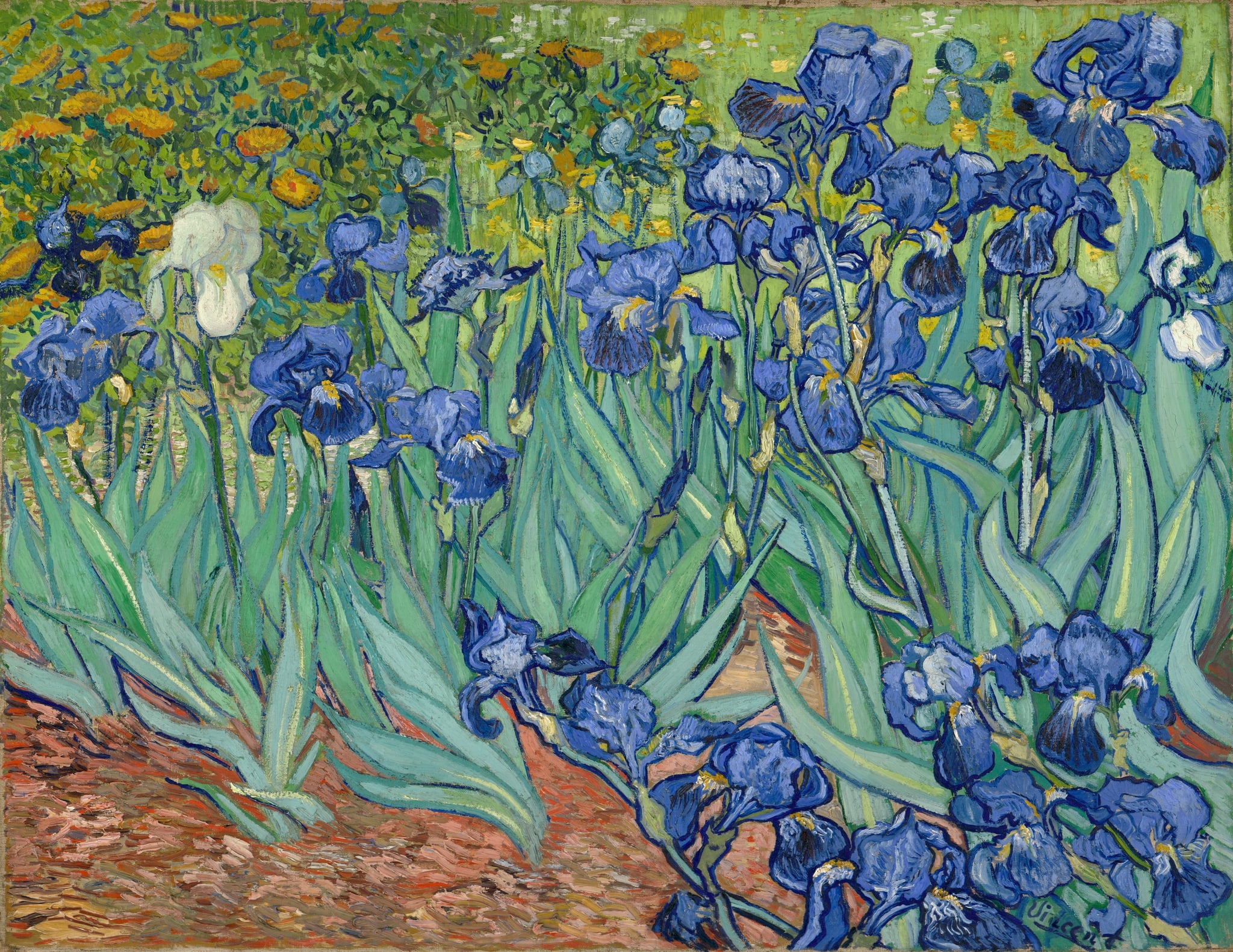
Painted in May 1889 at the Saint-Rémy asylum garden, Vincent van Gogh’s <strong>Irises</strong> turns close observation into an act of repair. Dark contours, a cropped, print-like vantage, and vibrating complements—violet/blue blossoms against <strong>yellow-green</strong> ground—stage a living frieze whose lone <strong>white iris</strong> punctuates the field with arresting clarity <sup>[1]</sup><sup>[2]</sup>.
Sunflowers by Vincent van Gogh

Sunflowers

Vincent van Gogh (1888)

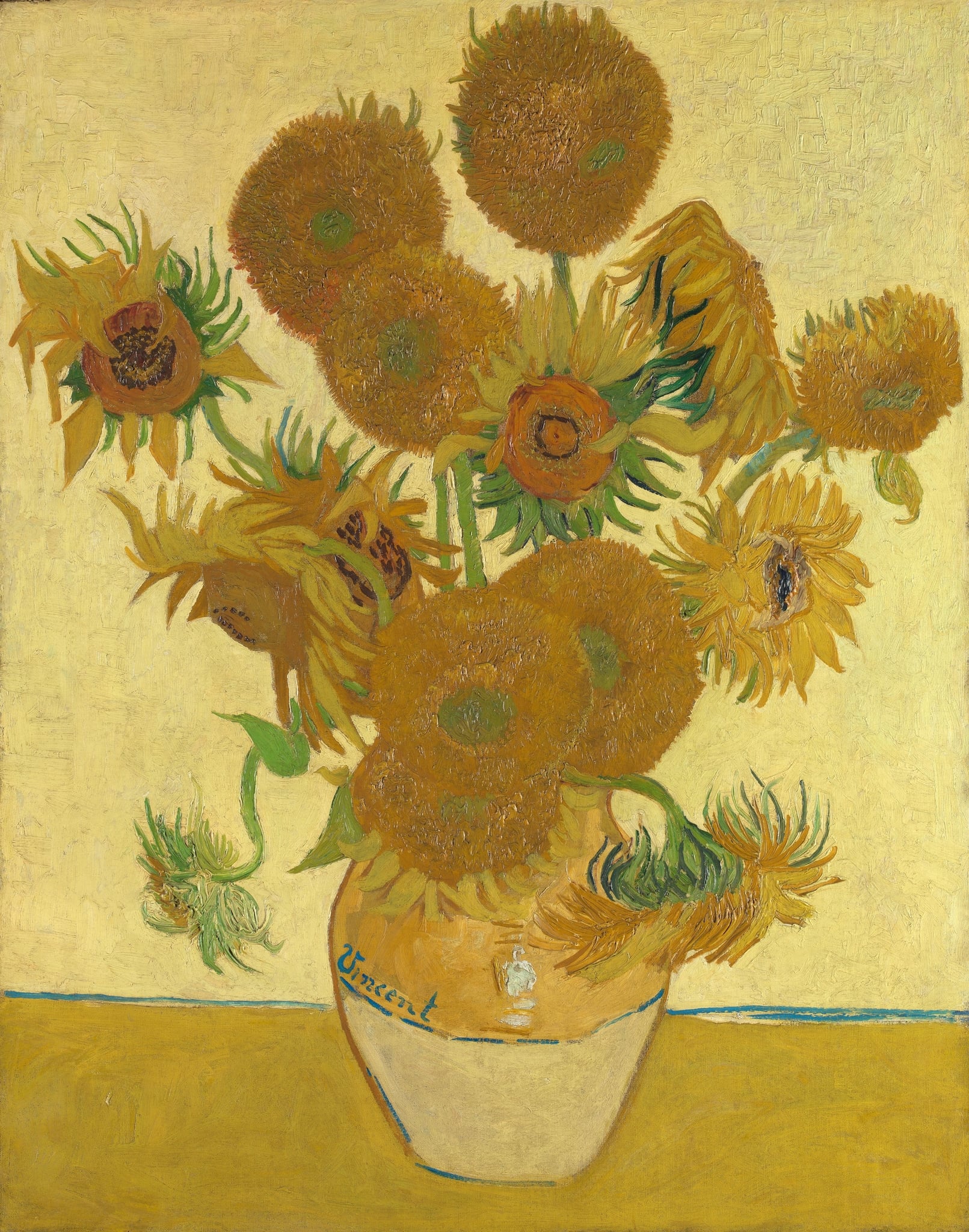
Vincent van Gogh’s Sunflowers (1888) is a <strong>yellow-on-yellow</strong> still life that stages a full <strong>cycle of life</strong> in fifteen blooms, from fresh buds to brittle seed heads. The thick impasto, green shocks of stem and bract, and the vase signed <strong>“Vincent”</strong> turn a humble bouquet into an emblem of endurance and fellowship <sup>[1]</sup><sup>[2]</sup>.

Garden with Courting Couples: Square Saint-Pierre by Vincent van Gogh

Garden with Courting Couples: Square Saint-Pierre

Vincent van Gogh (1887)

In Garden with Courting Couples: Square Saint-Pierre, Vincent van Gogh turns a small Montmartre park into a stage where <strong>spring</strong>, <strong>intimacy</strong>, and <strong>urban leisure</strong> converge. Short, shimmering strokes fuse pink chestnut blossoms, curving paths, and paired figures into one pulse of <strong>renewal</strong> and <strong>togetherness</strong> <sup>[1]</sup><sup>[2]</sup>.

In the Café: Agostina Segatori in Le Tambourin by Vincent van Gogh

In the Café: Agostina Segatori in Le Tambourin

Vincent van Gogh (1887 (Jan–Mar))

Van Gogh casts Agostina Segatori at a tiny, tambourine‑like café table, turning Le Tambourin into a <strong>stage of modern life</strong>. Cool greens and greys make the red <strong>flame‑plume hat</strong> and the foaming <strong>beer</strong> flare, while folded arms and a set‑aside <strong>parasol</strong> register private fatigue amid public display <sup>[1]</sup><sup>[2]</sup><sup>[3]</sup>.