Garden with Courting Couples: Square Saint-Pierre

by Vincent van Gogh

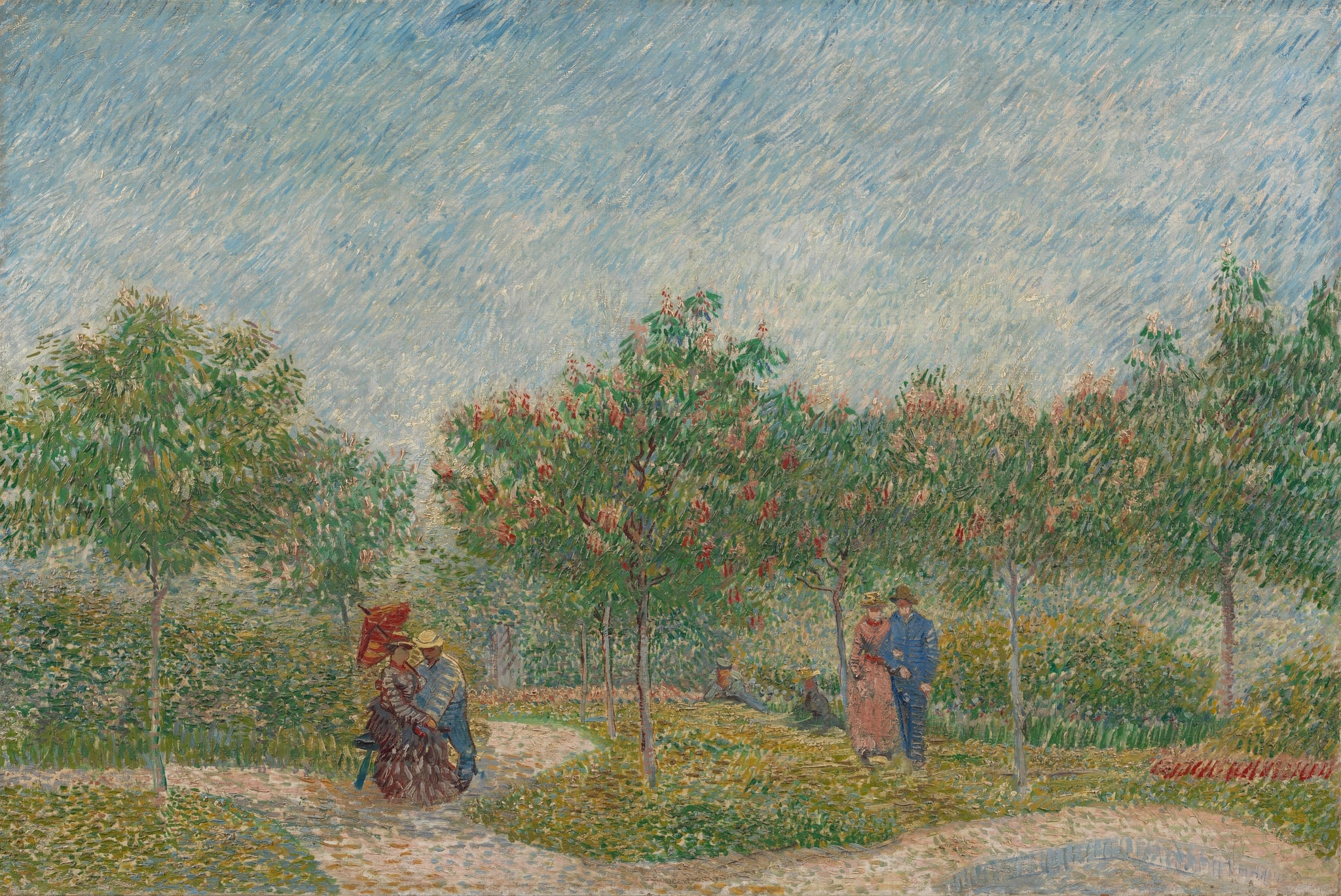
In Garden with Courting Couples: Square Saint-Pierre, Vincent van Gogh turns a small Montmartre park into a stage where spring, intimacy, and urban leisure converge. Short, shimmering strokes fuse pink chestnut blossoms, curving paths, and paired figures into one pulse of renewal and togetherness [1][2].

Study Print Studio

Create a personal study print

Build a companion study sheet around the part of this painting that speaks to you most. Choose a detail, shape an interpretation, and walk away with something personal and display-worthy.

Fast Facts

Year
1887
Medium
Oil on canvas
Dimensions
75 x 113 cm
Location
Van Gogh Museum, Amsterdam
See all Vincent van Gogh paintings in Amsterdam
Garden with Courting Couples: Square Saint-Pierre by Vincent van Gogh (1887) featuring Curving, intersecting paths, Flowering chestnut trees, Courting couples, Red parasol

Click on any numbered symbol to learn more about its meaning

Meaning & Symbolism

Van Gogh positions multiple courting pairs beneath a low canopy of flowering chestnut trees, their red‑pink spikes repeating through the foliage like a refrain. The two principal couples anchor the lower register: at left a seated pair huddles beside a red parasol; at right a walker in a blue coat leans toward a companion in a rose dress. Between them, pale, curving paths braid and separate, guiding the eye while suggesting the meandering courses of relationships. Across the surface, the sky and lawn thrum with slanted, variegated strokes of blue, cream, and green; these marks are not doctrinaire points but quick, rhythmic notations that make light feel mobile and the air slightly breezy. By letting figures remain generalized—faces barely specified, bodies defined by blocks of blue, rose, and umber—Van Gogh sidesteps anecdote. The lovers become types rather than portraits, so the park reads as a democratic arena where affection is universal. The chestnuts, a Parisian spring staple, assert seasonal renewal; their fresh greens and coral blooms echo the tenderness below. The result is an allegory delivered through optics: nature in bloom mirrors love in bloom 12. Technique delivers the theme. Van Gogh’s “free” divisionist touch—not dots but short, angled strokes—lets complementary contrasts do expressive work: blue coats against orange‑tinged pathways, rose dresses against green lawns, the small red flare of flowers against foliage. These oppositions heighten flirtation and expectancy while avoiding the mechanical regularity of strict Pointillism. The brushwork’s direction shifts with motif: vertical quivers for tree masses, diagonal sweeps for the sky, stippled runs for the lawns. That choreography fuses humans, paths, hedges, and sky into a single visual pulse, enacting togetherness at the level of paint handling 124. The setting—Square Saint‑Pierre on Montmartre’s slope—was already a public garden by the late 1870s, designed for strolling and respite, making it an apt modern stage for courtship 6. Van Gogh returned to this locale in related canvases, confirming its pull as a motif of urban leisure and light 5. Biographically, the scene doubles as wish and solace: during his Paris period he longed for domestic anchorage and struggled with “impossible love affairs,” and here he imagines companionship flourishing in a humane, orderly nature inside the city 1. That personal charge likely explains why he showed “the painting of the garden with the lovers” at the Théâtre Libre soon after, aligning it with avant‑garde explorations of modern life 3. Why Garden with Courting Couples: Square Saint-Pierre is important is that it crystallizes Van Gogh’s Paris breakthrough: color liberated into pure, broken strokes and composition tuned to a modern subject, yet always bent toward felt experience rather than optical dogma. The radiant sky is not a meteorological report; it is expectancy made visible. The crossed paths do not simply organize space; they model the social choreography of pairs that meet, part, and rejoin. In merging Neo‑Impressionist means with emotive ends, Van Gogh finds a language he will carry into Arles and beyond—one where paint itself becomes a conduit for connection, binding people to one another and to the living world 24.

Explore Deeper with AI

Ask questions about Garden with Courting Couples: Square Saint-Pierre

Popular questions:

Powered by AI • Get instant insights about this artwork

💬 Ask questions about this artwork!

Interpretations

Historical Context

Designed promenades in Paris squares were engines of sociability, and Van Gogh captures that civic choreography at the foot of Sacré‑Cœur. The Square Saint‑Pierre had opened as a public garden by 1877 and would be reshaped across subsequent decades, embedding the painting in a living timeline of urban planning under Alphand’s legacy of regulated greenery 5. The picture’s braided paths and benches echo how Paris engineered encounters among classes through shared leisure. Van Gogh’s couples aren’t sequestered; they mingle within a managed nature that modernizes the pastoral for city life. In this sense, the canvas registers not only affection but the municipal infrastructure of intimacy—how paths, shade, and seating orchestrate proximity and chance meetings in the metropolis 15.

Source: Van Gogh Museum; French Wikipedia (Square Louise-Michel history)

Formal Analysis

Van Gogh’s “free variation” on Pointillism replaces Seurat’s dots with short, angled strokes that keep color optical while preserving bodily urgency. Complementaries—blue/orange, red/green—spark tactile “vibration,” but the touch remains irregular, almost breathing, resisting the metric steadiness of Neo‑Impressionist procedure 16. Directional brushwork choreographs the scene: vertical quivers for foliage, slanting flicks for sky, stippled lawns—each vector a cue to sensation rather than a rule of optical science. This hybridization marks a technical pivot: Van Gogh absorbs divisionist color theory to intensify mood, not to codify it, aligning the park’s togetherness with a painterly syntax that visually “knits” figures, paths, and canopy into one pulsing field—the city’s communal spring rendered as living surface 146.

Source: Van Gogh Museum; Britannica (Paris transition); Van Gogh Museum, 'Vincent’s Colours'

Psychological Interpretation

Biographically, the scene reads as a wish‑image: during the Paris years Van Gogh longed for companionship and domestic stability even as he endured “impossible love affairs.” The painting answers that inner friction by staging a humane, orderly nature where intimacy appears effortless—faces generalized, gestures modest, harmony assumed 1. Instead of narrating a particular romance, he universalizes affection to imagine belonging as accessible and repeatable. The buoyant sky and quivering foliage externalize expectancy; light itself seems to anticipate connection. Such projection is consistent with Van Gogh’s broader habit of fusing outer motif with inner weather—the park as consolatory thought‑space where the self rehearses attachment. The result is less anecdote than emotional architecture: a setting built to hold hope 1.

Source: Van Gogh Museum

Landscape & Place (Topography of Montmartre)

Locating the scene at Square Saint‑Pierre ties its allegory to a hill then dominated by the rising Sacré‑Cœur, a contested monument of moral “renewal.” Van Gogh sidesteps polemic, yet the sloped site and chestnut canopy localize universals—love, spring—within a distinctly Montmartrois prospect 5. That he revisited the motif (see Yale’s related Square Saint‑Pierre, Paris) shows place operating serially: a laboratory where shifting light, foot traffic, and seasons modulate the same civic organism 3. The park is thus both index and symbol—an actual node in Paris’s circulatory system and a metaphoric commons for connection. Van Gogh’s insistence on this particular square underscores how landscape specificity can host shared, even archetypal, human rituals 35.

Source: Yale University Art Gallery; French Wikipedia (Square history)

Exhibition & Networks (Théâtre Libre)

Van Gogh noted that “the painting of the garden with the lovers” was at the Théâtre Libre, an avant‑garde venue known for naturalist drama and experimental culture 2. Showing the canvas there linked his modern subject—urban courtship in a managed park—to progressive audiences attuned to new social types and public behaviors. The choice suggests strategic self‑positioning: aligning a technically innovative, divisionist‑inflected surface with debates about modern life beyond the Salon. Read through this context, the painting functions like stagecraft: paths as blocking, tree canopies as scrims of light, couples as recurring roles. Exhibition history, in other words, confirms the work’s modernist aim—to fuse lived urban experience with newly liberated color and touch 12.

Source: Van Gogh Letters; Van Gogh Museum

Related Themes

About Vincent van Gogh

Vincent van Gogh (1853–1890) developed a radical, emotion‑driven use of color after moving from Paris to Arles in 1888, seeking southern light and an artists’ community. In Arles he created the Sunflowers series to decorate the Yellow House ahead of Gauguin’s visit. His late work fused impasto, high chroma, and symbolic motifs that shaped modern painting [2][5].
View all works by Vincent van Gogh

More by Vincent van Gogh
Café Terrace at Night by Vincent van Gogh

Café Terrace at Night

Vincent van Gogh (1888)

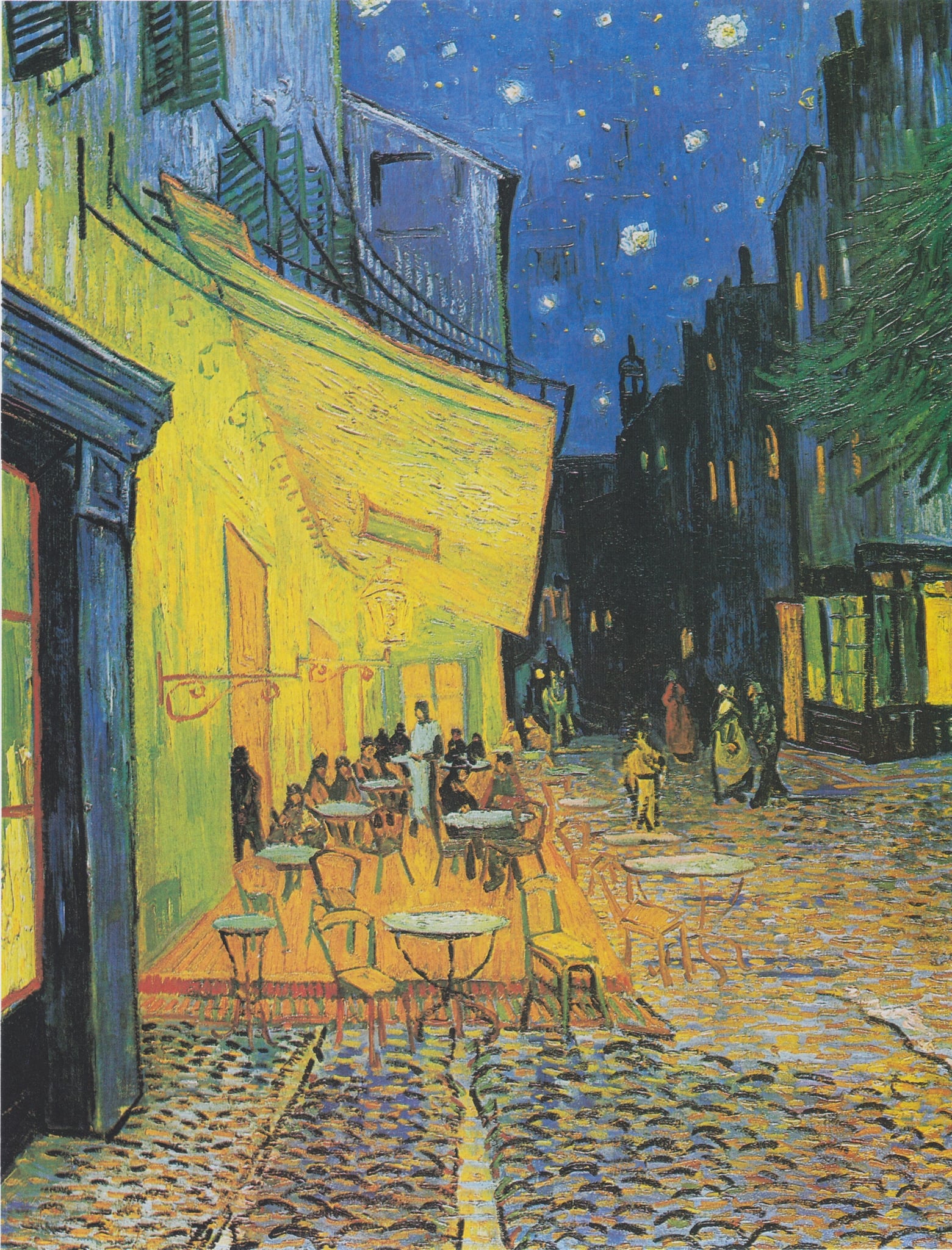
In Café Terrace at Night, Vincent van Gogh turns nocturne into <strong>luminous color</strong>: a gas‑lit terrace glows in yellows and oranges against a deep <strong>ultramarine sky</strong> pricked with stars. By building night “<strong>without black</strong>,” he stages a vivid encounter between human sociability and the vastness overhead <sup>[1]</sup><sup>[2]</sup>.

Red Cabbages and Onions by Vincent van Gogh

Red Cabbages and Onions

Vincent van Gogh (1887)

In Red Cabbages and Onions, Vincent van Gogh turns everyday produce into a drama of <strong>complementary color</strong> and <strong>restless brushwork</strong>. Hot red contours cinch violet cabbages and pale yellow bulbs against a cool, striated blue table, while a mustard‑yellow patch in the upper right tilts the space and sharpens the chromatic clash. The result asserts ordinary food as a locus of <strong>resilience</strong> and <strong>experimentation</strong> <sup>[1]</sup><sup>[2]</sup>.

Irises by Vincent van Gogh

Irises

Vincent van Gogh (1889)

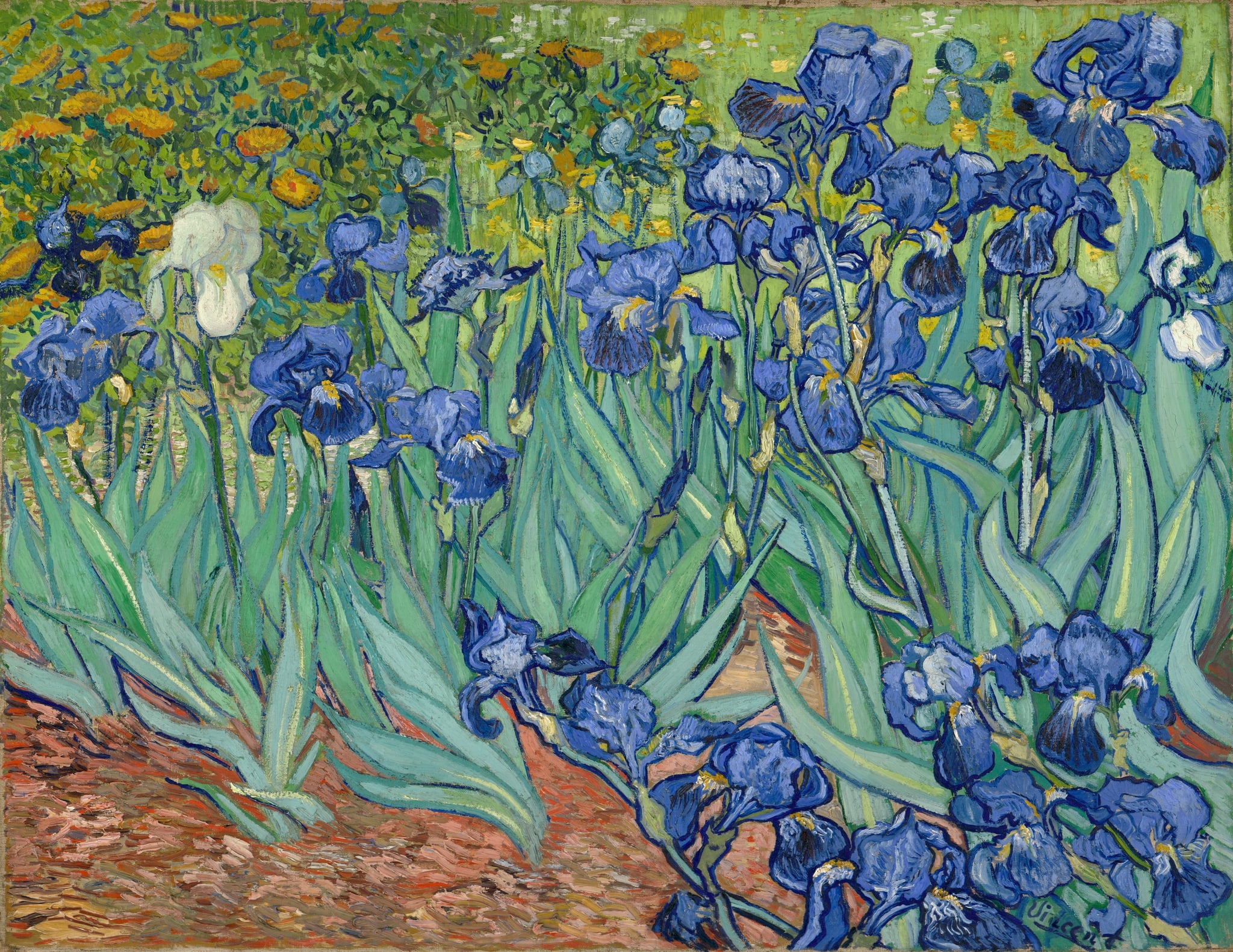
Painted in May 1889 at the Saint-Rémy asylum garden, Vincent van Gogh’s <strong>Irises</strong> turns close observation into an act of repair. Dark contours, a cropped, print-like vantage, and vibrating complements—violet/blue blossoms against <strong>yellow-green</strong> ground—stage a living frieze whose lone <strong>white iris</strong> punctuates the field with arresting clarity <sup>[1]</sup><sup>[2]</sup>.

Sunflowers by Vincent van Gogh

Sunflowers

Vincent van Gogh (1888)

Vincent van Gogh’s Sunflowers (1888) is a <strong>yellow-on-yellow</strong> still life that stages a full <strong>cycle of life</strong> in fifteen blooms, from fresh buds to brittle seed heads. The thick impasto, green shocks of stem and bract, and the vase signed <strong>“Vincent”</strong> turn a humble bouquet into an emblem of endurance and fellowship <sup>[1]</sup><sup>[2]</sup>.

In the Café: Agostina Segatori in Le Tambourin by Vincent van Gogh

In the Café: Agostina Segatori in Le Tambourin

Vincent van Gogh (1887 (Jan–Mar))

Van Gogh casts Agostina Segatori at a tiny, tambourine‑like café table, turning Le Tambourin into a <strong>stage of modern life</strong>. Cool greens and greys make the red <strong>flame‑plume hat</strong> and the foaming <strong>beer</strong> flare, while folded arms and a set‑aside <strong>parasol</strong> register private fatigue amid public display <sup>[1]</sup><sup>[2]</sup><sup>[3]</sup>.
Boulevard de Clichy by Vincent van Gogh

Boulevard de Clichy

Vincent van Gogh (1887)

Vincent van Gogh’s Boulevard de Clichy crystallizes a cool, wintry Paris into a <strong>vibrating field of light</strong> and motion. With leafless trees echoing lamp posts and façades stitched from lilac, blue, and sulfurous yellow strokes, the boulevard bends like a <strong>slow river of modernity</strong>. Tiny bundled figures drift across the cobbles, signaling the city’s <strong>anonymous flow</strong>.