Impasse des Deux Frères in Montmartre

by Vincent van Gogh

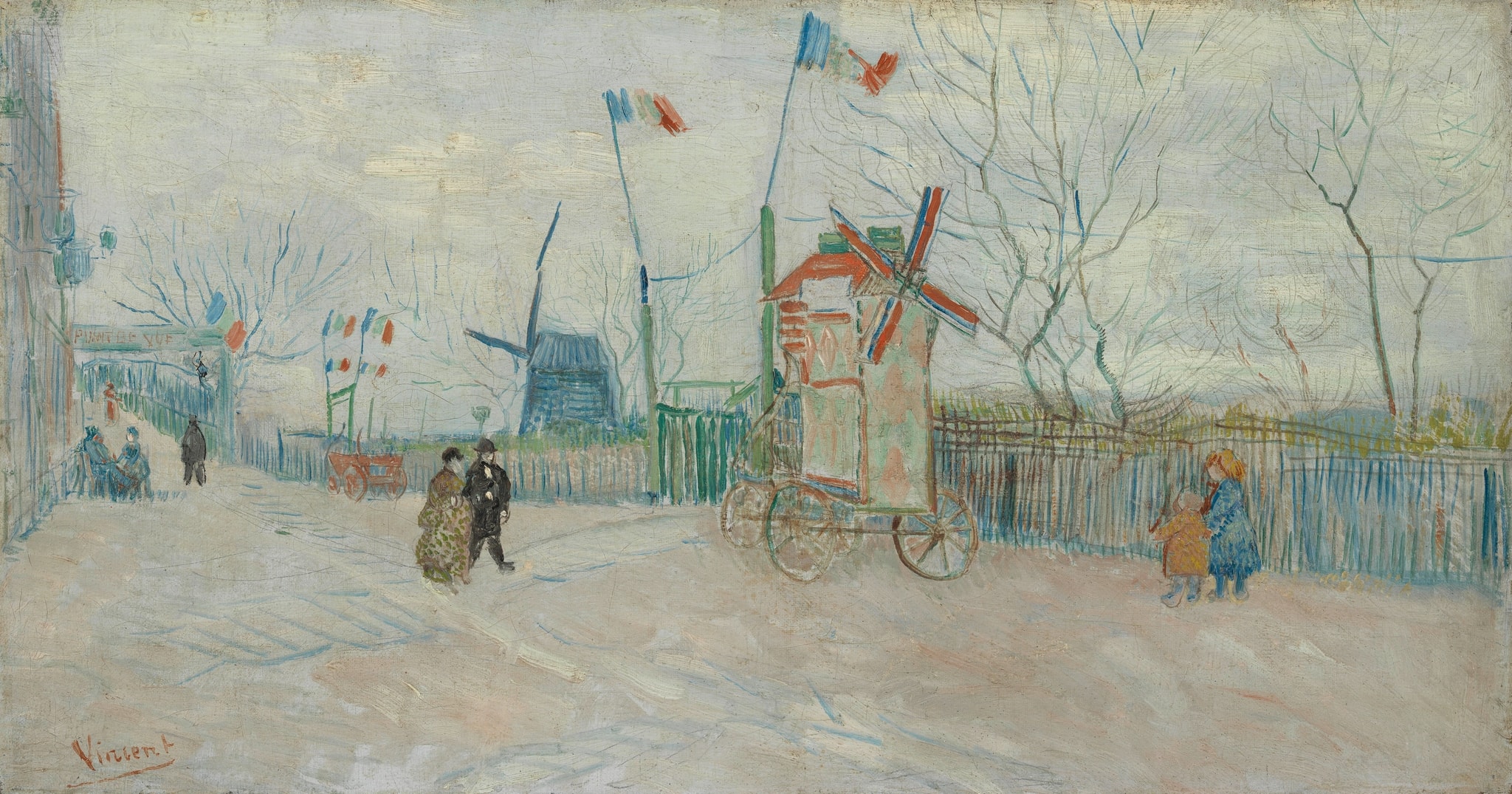
Van Gogh’s Impasse des Deux Frères in Montmartre crystallizes a threshold between rustic mills and a city turning to modern leisure. Tricolor flags, a wheeled “windmill” kiosk, and sketchlike figures animate a broad, chalky lane under pale winter light, declaring a neighborhood—and an artist—mid‑transition [1][3].

Study Print Studio

Create a personal study print

Build a companion study sheet around the part of this painting that speaks to you most. Choose a detail, shape an interpretation, and walk away with something personal and display-worthy.

Fast Facts

Year
1887
Medium
Oil on canvas
Dimensions
34.5 × 64.5 cm
Location
Van Gogh Museum, Amsterdam
See all Vincent van Gogh paintings in Amsterdam
Impasse des Deux Frères in Montmartre by Vincent van Gogh (1887) featuring Wheeled windmill kiosk, Traditional windmills, Tricolor flags, Leafless trees

Click on any numbered symbol to learn more about its meaning

Meaning & Symbolism

Van Gogh constructs the impasse as a site of suspended time—an apparent dead end that actually stages passage from past to future. On the left, darker mills and a modest entryway sit behind a ragged fence; on the right, bare, wiry trees trace the sky in fast, linear strokes. Across the center, a string of tricolor flags flashes red and blue against a cool, chalky ground, their flutter echoed by the little windmill-on-wheels—identified by the Van Gogh Museum as a likely advertising kiosk—whose painted blades mimic movement and commerce at once 1. The paired children and casual strollers drift like notes across the lane, reduced to rhythmic marks rather than portraits, amplifying a mood of lightness and transience. This orchestration of specific motifs—flags, kiosk, mills, leafless trees—declares that Montmartre’s workaday hillside has yielded to recreation and promotion, with the national colors injecting a civic pulse into a formerly rural verge 14. The broad, nearly empty foreground and the high, pale sky create a physical and psychological interval: space to pause before stepping into a newly spectacular city. Form delivers that meaning. In early 1887 Van Gogh lightened his palette and adopted broken strokes under the influence of Impressionism and Neo‑Impressionism; here, dry, sketchlike touches and short hatches make wind legible in the trees and flags while refusing heavy finish 6. Color is strategic: cool pastels wash the lane and sky, while incisive reds and blues puncture the surface at the flags and kiosk, turning national and commercial signs into color-events that organize the composition. Technique becomes argument; the painting’s provisional handling embodies the provisional status of the site itself, a place converting mills from labor to landmark. This aligns with Van Gogh’s sustained attraction to the periphery—the allotments, mills, and riverbanks where Paris’s expansion re-scripted everyday life—an orientation scholars read as a core of his artistic disposition 5. The Moulin à Poivre anchors the background as a relic, yet the wheeled kiosk and strolling public assert the future; between them, the impasse is not blockage but hinge. The work therefore documents more than a street; it captures a social transformation: the city’s absorption of rustic topography into leisure and display 124. Because this canvas belongs to a closely related pair from late winter–early spring 1887—one in Amsterdam and a companion long in private hands—its motif also registers Van Gogh’s rapid stylistic shift in Paris, from somber Dutch tonalities to a high‑key, aerated surface 23. The painting stands as evidence that subject and method converged: a changing Montmartre demanded a new visual language agile enough to catch breeze, banner, and passing crowd. In that sense, the impasse becomes Van Gogh’s working metaphor for artistic progress: pause, recalibrate, then turn. The picture shows how he locates modernity not downtown but at the margin, and how he translates that insight into a grammar of floating flags, provisional outlines, and animated color—an enduring key to the meaning of Impasse des Deux Frères in Montmartre and to why Impasse des Deux Frères in Montmartre is important within his Paris breakthrough 16.

Explore Deeper with AI

Ask questions about Impasse des Deux Frères in Montmartre

Popular questions:

Powered by AI • Get instant insights about this artwork

💬 Ask questions about this artwork!

Interpretations

Material Ephemerality

Recent technical studies of Van Gogh’s Paris works note fugitive pigments and altered surfaces, cautioning that today’s chroma may understate the painting’s original snap. Chalky grounds, thinned paints, and lightly bound layers can shift with time, subtly muting contrasts that once dramatized the flags and kiosk as color-beacons. Reading the work through material change sharpens its theme of transience: not only do flags flutter and crowds pass, but the very means of depiction evolves in the viewer’s eye across decades. The painting thus participates in modernity’s temporality twice—first in motif, then in material fate—complicating any fixed reconstruction of 1887 color sensation 7.

Source: npj Heritage Science

Civic Semiotics

The scattered tricolors do more than brighten the palette; they inscribe the space with the semiotics of the Third Republic—everyday, festive, and explicitly public. In Montmartre’s transitional topography, such flags function as civic markers that domesticate a once-peripheral site, aligning it with republican ritual (fêtes, processions) and the vernacular nationalism that saturates Parisian street life. Their chromatic punch—concentrated reds and blues against a cool ground—makes national identity operate as a pictorial signal system, organizing sightlines and circulation in the scene. Van Gogh thus lets the flag operate doubly: as a color-event within Impressionist syntax and as a public emblem whose modern authority turns a “dead end” into a shared, urbanized stage 110.

Source: Van Gogh Museum; Encyclopaedia Britannica

Urban Leisure Economy

The wheeled “windmill” that likely served as an advertising kiosk situates the impasse inside a new economy of leisure and publicity. In the 1880s, Montmartre’s mills, dance gardens, and promenades became nodes of spectacle culture, converting agrarian infrastructure into entertainment branding. Van Gogh captures this shift not through moralizing but through iconographic montage: flags, kiosk, and casual strollers replace carts, sacks, and millers. The butte becomes a market of attention, where circulation (of people, images, and ads) replaces production as the site’s raison d’être. The painting’s airy spacing and boulevard-like interval echo this consumable openness—an architecture of looking and lingering characteristic of modern Paris 13.

Source: Van Gogh Museum; The Metropolitan Museum of Art (context essay on Montmartre)

Technique as Atmosphere

Van Gogh’s 1887 touch—dry, broken hatches and flicks—operates as an index of wind and time, making motion legible without resorting to pointillist orthodoxy. The brushwork abbreviates figures into kinetic notations, while wiry trees and flag-strands translate breeze into linear rhythm. This is a selective uptake of Impressionism/Neo‑Impressionism: he adopts a high‑key palette and optical vibration yet resists schematic dotting, preserving immediacy and local inflection. Technique becomes argument: a provisional handling for a provisional site under conversion. The effect is phenomenological rather than formulaic—an urban aeration that keeps place, season, and weather coextensive with seeing in the moment 69.

Source: Van Gogh Museum (Along the Seine gallery texts); Sotheby’s Magazine

Sociology of the Edge

Viewed through a sociological lens, Montmartre’s impasse exemplifies Van Gogh’s durable preference for marginal zones—allotments, riverbanks, mills—where competing social scripts meet. This orientation, part disposition and part strategy, lets him test avant‑garde color and touch against transitional subject matter, staging negotiations between labor and leisure, private wandering and public festivity. The impasse is less a terminus than a threshold habitus, aligning with scholarship that places Van Gogh’s creativity at the urban periphery, where change is legible at human scale. The work’s compositional “pause” grants viewers the same stance: to witness modernization without being swallowed by it 56.

Source: Will Atkinson (Cultural Sociology); Van Gogh Museum (Along the Seine)

Twin Compositions, Rapid Evolution

Considering the closely related canvas auctioned in 2021 alongside the Amsterdam version highlights Van Gogh’s iterative method. Differences in format and emphasis (dimension shifts, figure placement, flag rhythm) suggest rapid recalibration of how best to orchestrate civic signs and open ground. Treated as a diptych of inquiry, the pair charts a move from descriptive street scene toward structural clarity, where color-accents (flags, kiosk) become compositional hinges. This doubling documents his Paris breakthrough not abstractly but in practice: same motif, newly aerated syntax—evidence of experiments in pacing, cropping, and publicness during late winter–spring 1887 28.

Source: Sotheby’s (2021 auction catalogue); Van Gogh Gallery (catalogue data)

Related Themes

About Vincent van Gogh

Vincent van Gogh (1853–1890) developed a radical, emotion‑driven use of color after moving from Paris to Arles in 1888, seeking southern light and an artists’ community. In Arles he created the Sunflowers series to decorate the Yellow House ahead of Gauguin’s visit. His late work fused impasto, high chroma, and symbolic motifs that shaped modern painting [2][5].
View all works by Vincent van Gogh

More by Vincent van Gogh
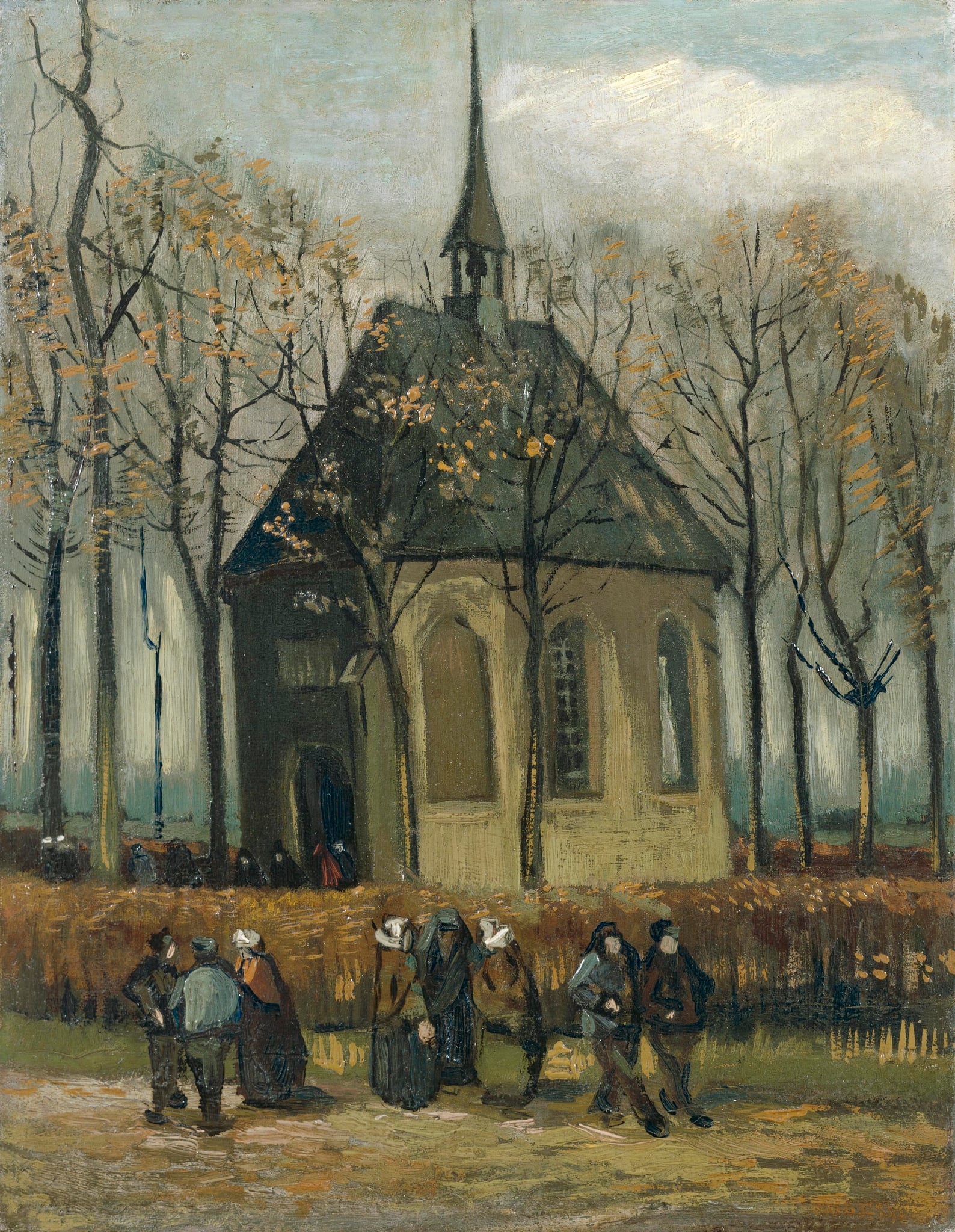
Café Terrace at Night by Vincent van Gogh

Café Terrace at Night

Vincent van Gogh (1888)

In Café Terrace at Night, Vincent van Gogh turns nocturne into <strong>luminous color</strong>: a gas‑lit terrace glows in yellows and oranges against a deep <strong>ultramarine sky</strong> pricked with stars. By building night “<strong>without black</strong>,” he stages a vivid encounter between human sociability and the vastness overhead <sup>[1]</sup><sup>[2]</sup>.
Irises by Vincent van Gogh

Irises

Vincent van Gogh (1889)

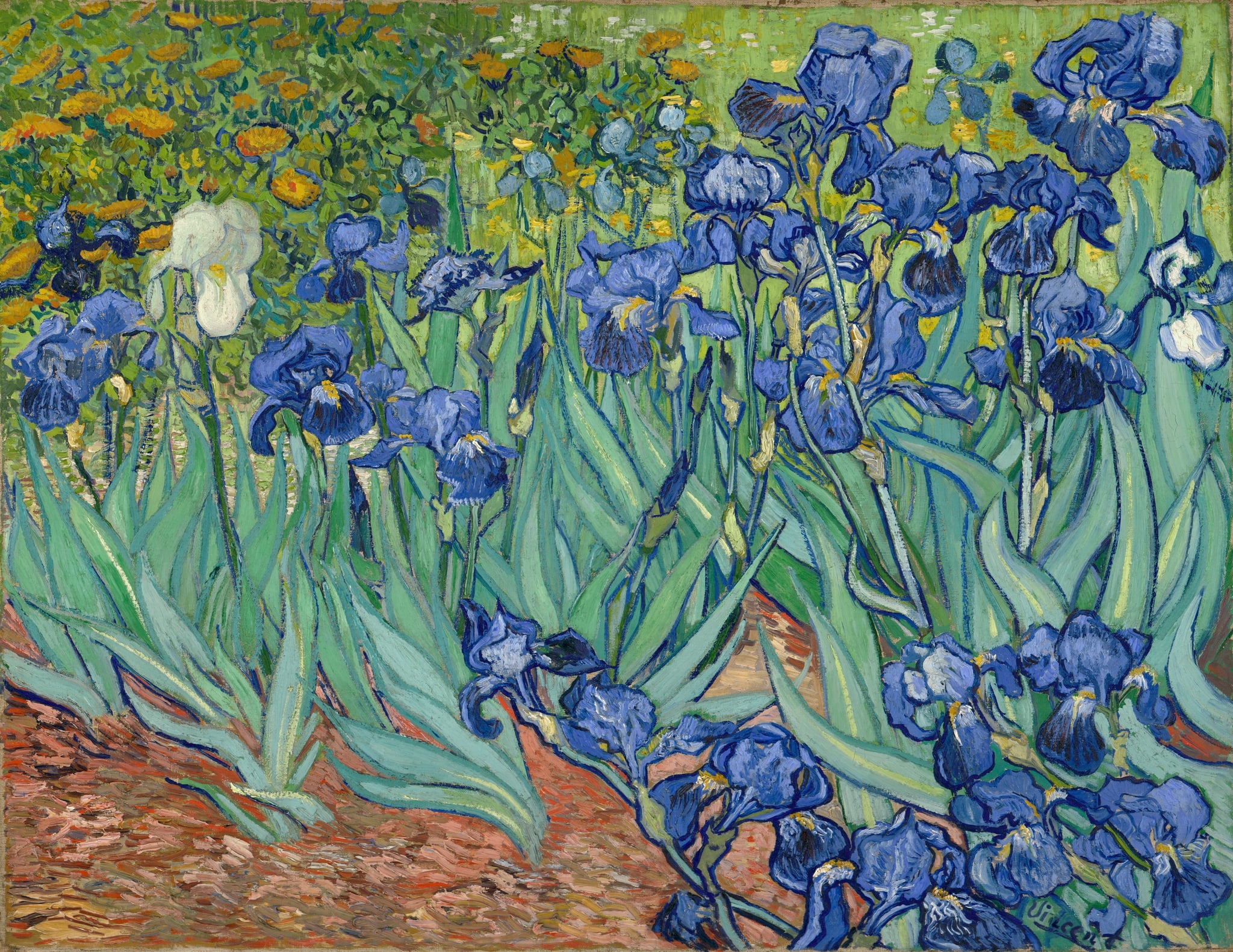
Painted in May 1889 at the Saint-Rémy asylum garden, Vincent van Gogh’s <strong>Irises</strong> turns close observation into an act of repair. Dark contours, a cropped, print-like vantage, and vibrating complements—violet/blue blossoms against <strong>yellow-green</strong> ground—stage a living frieze whose lone <strong>white iris</strong> punctuates the field with arresting clarity <sup>[1]</sup><sup>[2]</sup>.
Sunflowers by Vincent van Gogh

Sunflowers

Vincent van Gogh (1888)

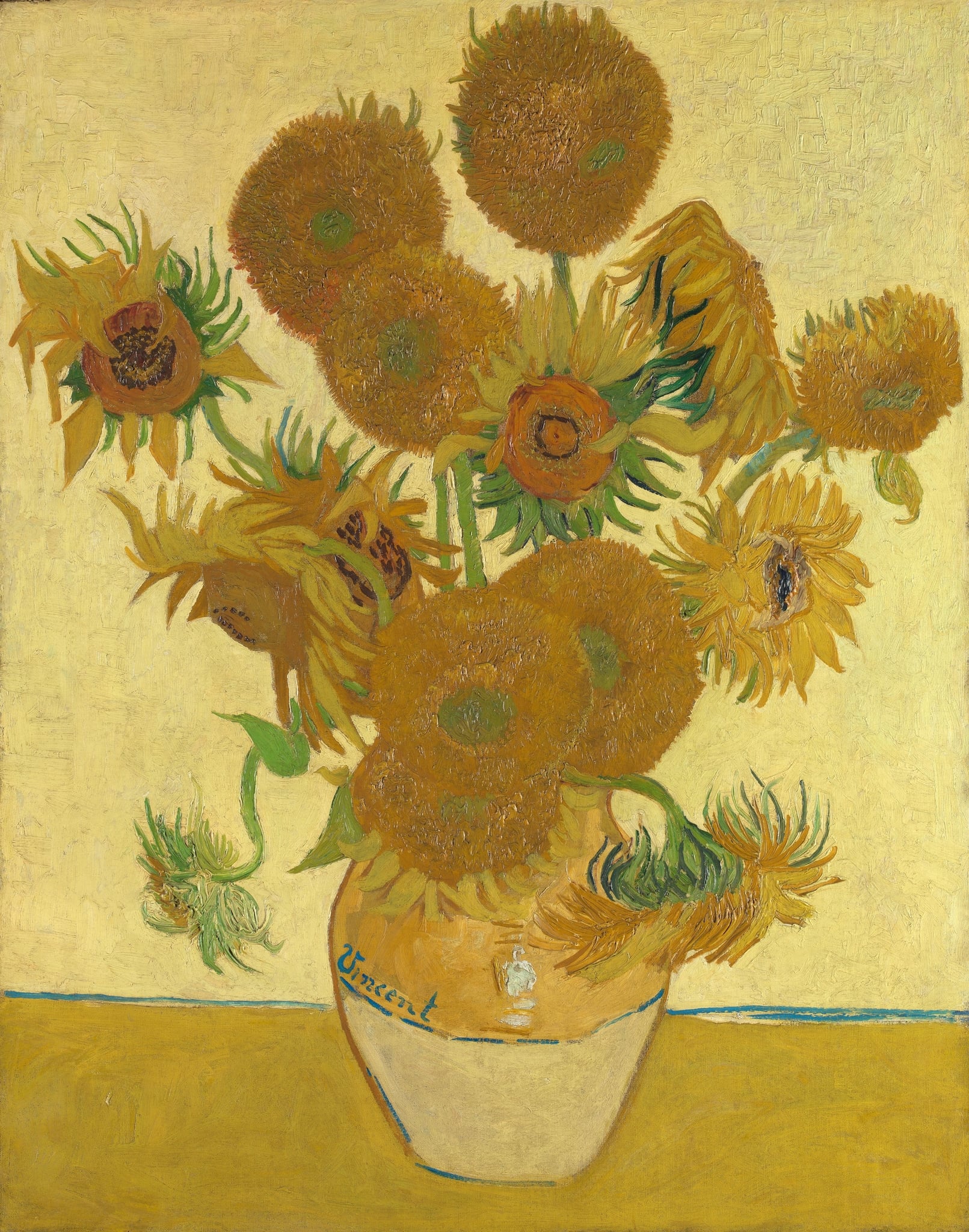
Vincent van Gogh’s Sunflowers (1888) is a <strong>yellow-on-yellow</strong> still life that stages a full <strong>cycle of life</strong> in fifteen blooms, from fresh buds to brittle seed heads. The thick impasto, green shocks of stem and bract, and the vase signed <strong>“Vincent”</strong> turn a humble bouquet into an emblem of endurance and fellowship <sup>[1]</sup><sup>[2]</sup>.
The Red Vineyard by Vincent van Gogh

The Red Vineyard

Vincent van Gogh (1888)

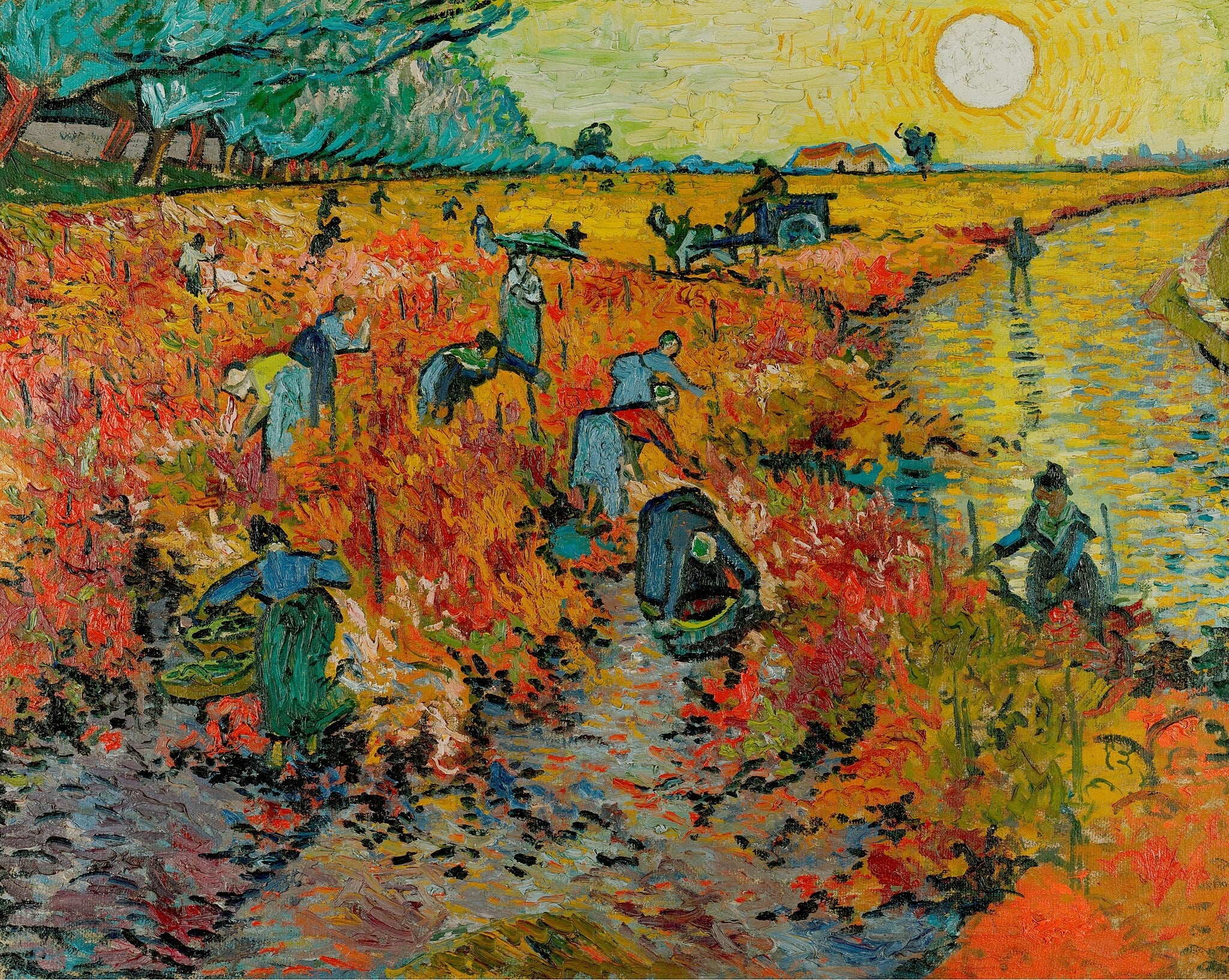
In The Red Vineyard, Vincent van Gogh forges a vision of <strong>autumn labor under a blazing sun</strong>, where harvesters flow diagonally through scarlet vines while a band of <strong>yellow light</strong> flares along a reflective roadway. The scene fuses <strong>exhaustion and ripeness</strong>, turning work into a rhythmic, almost liturgical procession <sup>[1]</sup><sup>[3]</sup>.

The Bedroom by Vincent van Gogh

The Bedroom

Vincent van Gogh (1889)

Vincent van Gogh’s The Bedroom turns a modest room into a psychological stage, using <strong>clashing color</strong> and <strong>tilted space</strong> to test whether color alone can evoke rest. The bright yellow bed, twin chairs, and green‑shuttered window press forward as the floor tilts and pictures cant, so that <strong>refuge and unease</strong> exist side by side <sup>[1]</sup><sup>[2]</sup>.

Self-Portrait with Bandaged Ear by Vincent van Gogh

Self-Portrait with Bandaged Ear

Vincent van Gogh (1889)

In Self-Portrait with Bandaged Ear (1889), Vincent van Gogh converts a recent crisis into an image of <strong>resolve</strong>. The frontal, slightly turned pose forces attention to the white bandage at the viewer’s right, while the fur cap, heavy coat, and the nearby <strong>Japanese print</strong> declare persistence and ideals that steady him in the wake of trauma <sup>[1]</sup><sup>[2]</sup>. The painting’s cool, wintry palette and insistent strokes make suffering legible yet disciplined, transforming pain into <strong>artistic purpose</strong> <sup>[2]</sup>.